Penman No. 189: Hearing the Mermaids Singing

TS-Eliot-by-flickr-user-Burns-Library-Boston-College-e1390926344763.jpg

Penman for Monday, February 29, 2016


I GAVE my undergraduate class in Contemporary American Literature (English 42) a special treat the other week. Luckily for them, while moving things around the house, I came across a book that I’d picked up at a sidewalk sale in San Francisco several years ago—very probably one of the best bargain books I’d ever bought, at $6.99. It was a big, fat book titled Poetry Speaks, and it included 3 CDs containing nearly 150 poems by authors ranging from Alfred Lord Tennyson, Walt Whitman, and T. S. Eliot to Langston Hughes, Allen Ginsberg, and Sylvia Plath.

Now, there are many such compilations of poetry you can find online, but what makes this collection unique is that most of the poems are read by the poets themselves—yes, including Tennyson, Whitman, and Eliot, from the earliest days of sound recording. I thought that by sharing the recordings with my students, I would give them a unique opportunity to hear not only some of the world’s greatest and best loved poems but also how their authors actually sounded.

And while—like the children we sire into this world—a poem is on its own once it’s published, subject to the reader’s interpretation, a poet reading his or her own work gives us a privileged insight into the poet’s mind and sensibility. We listen for the general tone, the pace, the emphasis the poet gives to certain words and turns of phrase, even the way he or she ends a line and segues to the next. These inflections personalize the poem, and turn it from lines on a page to a breath in the air.

Let’s not forget that poetry preceded writing, and that, in our ancient past, poetry was meant to be recited, not read. It performed both a ritual and an entertainment function. The old epics contained and transmitted the story of the race, and elevated everyday speech to something close to magical (all of Shakespeare’s plays, when you take a closer look, were written in iambic pentameter). Even in more modern times, some poets still wrote mainly to be heard. The book’s introduction quotes William Butler Yeats as saying that “I wanted all of my poetry to be spoken in a stage or sung…. I have spent my life in clearing out of poetry every phrase written for the eye, and bringing all back to syntax that is for the ear alone.”

Sadly, poetry’s public aspect has diminished over the past century. Not only are today’s poems mainly meant for the printed page; their messages are also much more private, to the point of inscrutability. The study and appreciation of poetry has become an essentially academic exercise.

This disjunction between performance and privacy probably explains why poetry readings can become boring, with readers failing to connect with the audience, who can’t figure out what the poets are saying. It’s difficult enough to understand the poems on the page, and harder still to understand them while being mumbled.

I’ve often noted, with some dismay, how many of today’s readers of poetry bleed the life out of poems by mouthing the words with a mewling preciousness or otherwise in a mechanical march, without an understanding of the sense of the piece itself. Most poems are infused with vigor, with an attitude that the poet has taken toward the work and perhaps even its presentation to the world. Critics will argue with this proposition, but it stands to reason that no one should understand a poem better than the poet himself or herself.

Understanding and public presentation, however, are two different things, and not every poet can give their poems the intensity or the nuancing they deserve. That applies even to some poets in the CDs: forgivably, Tennyson sounds phlegmatic in his rendition of what should have been a rousing “Charge of the Light Brigade,” but he was already 80 when Thomas Edison recorded him in 1889.

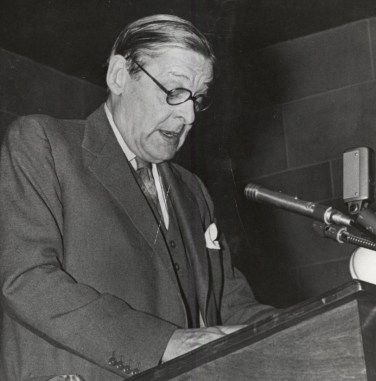
By contrast, Robert Frost (reading “The Road Not Taken” and “Stopping by Woods on a Snowy Evening”) and Sylvia Plath (reading “Daddy” and “Lady Lazarus”) sound resonantly clear and confident. T. S. Eliot reads all eight minutes of “The Love Song of J. Alfred Prufrock” in a thin, reedy voice—now totally British, a complete transformation of the former American born in Missouri who moved to England at 25—but somehow it’s what you expect of the man and the poem. I was in the bathroom as I listened to Eliot over the speakers at full volume, and found myself following along: “I have heard the mermaids singing, each to each…”
ACTIVITIES LIST.jpg

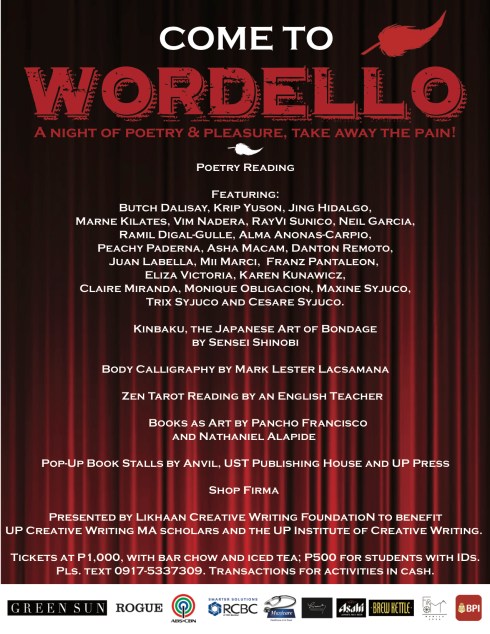
And if you’d like to hear more such mermaids, I’d like to invite you to “Wordello,” a very special and unique literary reading hosted by the Likhaan Creative Writing Foundation to benefit writing scholarships and other worthwhile literary projects. The Likhaan Foundation has been the UP Institute of Creative Writing’s steadfast partner in many an undertaking, and we can’t endorse Wordello strongly enough.

Inspired by the Poetry Brothel in New York, Wordello will happen on Saturday, March 5, 2016 in Green Sun, 2285 Chino Roces Ave. Ext., Makati. Doors open at 5 PM. Tickets will be sold for P1,000 (students with IDs come in at half-price), which will cover the show, drinks, bar chow, and special presentations. I was told to expect “a rope bondage presentation, calligraphy writing on the back of a woman, tarot card readings”, and so on, which all sound positively intriguing, but before your imagination runs riot, let me assure the prayerful that the good ladies of the Likhaan Foundation are as convent-bred as they come, but thankfully with a wicked sense of humor.

The invited readers include Krip Yuson, Jing Hidalgo, Marne Kilates, Vim Nadera, RayVi Sunico, Neil Garcia, Ramil Digal-Gulle, Alma Anonas-Carpio, Peachy Paderna, Asha Macam, Danton Remoto, Juan Labella, Mii Marci, Franz Pantaleon, Eliza Victoria, Karen Kunawicz,
Claire Miranda, Monique Obligacion, Maxine Syjuco, Trix Syjuco, Cesare Syjuco, and myself.

For more information, please check out https://www.facebook.com/wordelloph/info?tab=page_info or contact Chichi Lizot at chichilizot@gmail.com.

See you all on March 5 at Wordello—let’s make the spoken word rock!

[Image from jubilee-centre.org]



Penman No. 187: Journalists and Fictionists

journalist-bw-laptop-o-e1282144424870.jpg

Penman for Monday, February 15, 2016


MY GRADUATE fiction writing workshop—CW 211—opened last month, and I was glad to see that all my 12 or so students were taking fiction with me for the first time. I don’t mind when students study with me over two or three semesters—especially the best ones you want to see through to their first book—but a fresh crop of faces is always a relief of sorts, because you can be assured that everything you say in class will be new to them.

As a first-day practice, I ask the class members to give a brief self-introduction, as a writing workshop is almost like a support group, and requires a certain degree of intimacy, so people should know each other right from the beginning. The self-intros also give me a sense of my students’ backgrounds, from which I might be able to get an idea—albeit a very tentative and imperfect one—of the kind of fiction I can expect from them.

This semester, I have several students coming from Journalism, and I told them, with a semi-serious laugh which they returned, that it was usually the journalists I had the most trouble with in Fiction class. Now why did I say that?

Let me explain, first of all, that I was a journalist myself, and still see myself as a part-time member of the press. Indeed when, in high school, I began firming up my ambition to become a writer, it wasn’t to become a novelist or a short story writer—it was to become a journalist, in the belief that there was nothing nobler and more exciting than to get the news and be the first to tell the world about it. I achieved that ambition—or at least the start of it—when I was hired as a general-assignments reporter by the Philippines Herald and later as a suburban correspondent by Taliba in 1972, as an 18-year-old dropout, but martial law put an abrupt end to that. It wouldn’t be until 20 years later, in 1993, when I was back in a newsroom, though no longer as a reporter but as an editorial writer for TODAY, and in 2001 as a copyeditor for the investigative magazine Newsbreak, about the same time that I began writing this Lifestyle column for the STAR.

That’s not much of a career as lifelong journalists go, but it’s been enough to leave me with a healthy respect for the work that journalists do, especially in comparison to that of the fictionist, which I became as well. Both are difficult, and require their own kind of discipline; neither is particularly remunerative, although journalism, if undertaken as a regular job, will at least provide a steady income, while fiction must remain a strictly part-time avocation for 99% of its practitioners in this country.

When I teach a class in Creative Writing, I always tell my CW majors that they should never feel superior to journalists, because they don’t know what it’s like to have to find, write, and turn in a story every afternoon of every working day. Creative writing students like to bitch that they don’t have enough material, enough inspiration, and enough time to finish their magnum opus (which at the end of all that whining might turn out to be profoundly underwhelming). Journalists can’t even complain about these things, because they simply don’t factor into the making and delivery of a news story. Material? That’s for you to find or create. Time? A few hours. Inspiration? Your paycheck. I’ve commiserated beerside with journalist-friends over the travails they had to suffer to get a particular story—but only after the story was sent in, and not before.

So with all this admiration and respect for journalists and their job, why do I say they give me problems as fictionists? I’m generalizing here, of course, but the answer isn’t too far from from what, ironically, is a journalist’s chief virtue: they can’t let go of the facts. They find it very difficult to switch to a make-believe mode, and even when they do, their stories are thinly-disguised newsfeatures wanting in compelling, internally driven drama. When you point out a problem in the narrative—say an unlikely turn in the plot—the journalist’s defense will invariably be, “Well, that’s what really happened!”

Unfortunately, in fiction, “It really happened” just doesn’t cut it. What’s real in fiction is what’s on the page. Real life might provide the material and the inspiration for the fictional story, but that story has to acquire a life of its own, regardless of its origins in fact. This is why I tell my students that everything they submit to the workshop is fair game for criticism, and that they can’t and shouldn’t take it personally when someone comments that “I think the mother in this story is very narrow-minded and selfish,” even if that mother was based on one’s beloved mom—it’s “the mother on the page,” as I call that character, that we’re following, believing, and either rooting for or disliking.

And the first day of fiction class is also when I trot out one of my favorite quotes, paraphrased from Mark Twain: “Of course fact is stranger than fiction; fiction, after all, has to make sense.” Just think about it: we accept incredible reports in the news that we wouldn’t buy for a minute in a short story, even in a fantasy, because we expect fiction to adhere to an internal dramatic logic, whether it’s set in a garage or in a galaxy far, far away. The factual world has no such givens; things just happen, often for no apparent reason. That’s why fiction had to be invented: to make sense of life in the raw and all of its inconsistencies, paradoxes, and mysteries. (The opinion writer aims to do that as well, but on the plane of the abstract, using words like “justice” and “freedom”, which you normally won’t find in a well-crafted story; they’d be implied.)

If it’s any comfort to the fact-loving journalist, there’s another kind of writer whom I’ve discovered to have equal difficulty transitioning to fiction: the poet, for whom every word and turn of phrase is painfully precious, and a ten-page story might as well be an epic. But that’s fodder for another time.


[Image from thenextweb.com]

Penman No. 184: Degrees and Diplomas

MI1107TAGAAXX_lg.jpg

Penman for Monday, January 25, 2015


IT WAS with much interest that my eye strayed last week to a story on the BBC website with the headline ‘Penguin scraps degree requirement.” The article went on to report that publishing giant Penguin Random House—presumably one of the world’s most literate employers—was no longer requiring applicants for any job in the company to show college diplomas.

“The firm wants to have a more varied intake of staff and suggests there is no clear link between holding a degree and performance in a job. This announcement follows a series of financial companies dropping academic requirements for applicants. Neil Morrison, human resources director, says they want talented staff ‘regardless of background’,” the article noted. The report went on to say that leading accounting firms such as Deloitte and Ernst & Young had also relaxed their educational requirements, with Deloitte changing its selection process so recruiters would not know what schools its applicants had attended.

It’s a novel idea that sounds fair and makes sense, but I’m sure it will take some time before Philippine businesses catch on, as obsessed as we Pinoys are with college diplomas, especially those that come from certain schools. Just scan the Sunday classifieds in any local newspaper—for jobs of any real economic and social worth, your typical non-equal-opportunity employer will demand a piece of parchment from a “Class A” university, which will count more than any previous experience you may have acquired.

Arguably, that wasn’t always the case. We baby boomers belong to a generation—probably the last one—for whom gutsiness and scrappiness was still the best way forward, rather than degrees and diplomas. Just ask any taipan how many of them have Wharton MBAs. One of them whom I happen to know, because I’ve written his family’s history—Filinvest founder Andrew Gotianun Sr.—didn’t go beyond two years of college at San Beda, and had to drop out because of his father’s unexpected demise. His wife Mercedes, Filinvest’s other dynamo (Andrew was the visionary, Mercedes the executor), graduated from UP with a BS in Pharmacy, magna cum laude—but what led to her success as a banker wasn’t college but streetsmarts. “I made friends with the owners of banks abroad and convinced them to lend me their operations manuals,” Mercedes told me, “which we then adapted to local conditions. That’s how Family Savings Bank began.”

Indeed it used to be that you could get places without a college degree, as long as you had talent and guts (you needed both—just one wouldn’t have done it). Among writers, in particular, a degree was a bonus, maybe even a demerit, in those pre-MFA (Master of Fine Arts, the writing degree of choice) days. The old conviction was that, to know how to write, you had to know how to read, and the serious would-be writer read a lot outside of school without having to be told. The real test of the writer was, well, in the writing—in the quality and the consistency of one’s craft, rather than in the number of English units one could present.

There was no finer example of this than the late National Artist NVM Gonzalez, who never finished college (he did go to National University), but who went on to a distinguished writing and academic career here and in the US. The late journalist I. P. Soliongco was another such titan in his field. My friends Pete Lacaba and Krip Yuson, both dropouts by choice, deserve honorary PhDs for all their work as far as I’m concerned—not that they would care—but more valuable is the fact that they’ve been asked to teach and to share their expertise with younger Filipinos.

My own dad Jose Sr. also dropped out of college—he was the smartest kid of his time in our province of Romblon and could have gone on to become a de campanilla lawyer, but was too poor and also perhaps too confident in his abilidad to go the full distance, and soon fathered me and my four siblings. Seeing him write as well as he did—he was a keen reader of novels and magazines—I grew up believing that I didn’t need a college degree, either, to get where I wanted, so I dropped out of UP in my freshman year to get a job as a newspaper reporter. My younger brother Jess, also a talented writer, obviously had the same impression and did exactly the same thing, dropping out of UP before landing jobs with San Miguel’s PR department and later becoming editor-in-chief of the Mindanao Cross. I went on to work with the National Economic and Development Authority for ten years, even earning a graduate UP diploma in Development Economics as a special student and working on special detail with the United Nations Development Programme, doing project studies. I began writing plays, stories, and screenplays and winning Palancas, and felt that I could have gone on for life with little more than my 21 undergraduate units in English and 30 grad units in Economics.

But one day in 1981—after attending the Silliman Writers Workshop and falling under the spell of Robert Graves—I decided to go back to school as a returning sophomore, at the age of 27. I found school exhilarating, and later quit my job to study full-time, with my wife Beng taking up the slack. To be honest, it wasn’t the fiction that roped me in, but the poetry of Sidney, Wyatt, Shakespeare, Dylan Thomas, Philip Larkin, and James Dickey, among others. Having tasted such ambrosia, I craved more, and so I went on to Michigan for an MFA and to Wisconsin for a PhD, both on fellowships, making up for lost time (BA at age 30, MFA at 34, PhD at 37). I told myself that there was nothing more that I wanted to do for the rest of my life but write, teach, and spend time with family. There was, I must say, a great material and emotional cost to these degrees, which had I known it then I might not have been willing to pay. But with the deed done, I can’t regret the fact that these degrees have allowed me to move up the job ladder and gain the respect of people who haven’t the faintest idea what I do.

I finished college not so I could get a good job, which I already had, or so I could append little letters to my name, which I hardly use outside of work. (No self-respecting writer, as far as I know, has ever flaunted his or her PhD; you’d simply be laughed out of the place.) I did it for love—for the love of knowledge, especially the kind of knowledge for which there exists no practical utility and which is therefore the purest and sweetest, and for the love of my parents, who deserved some payback for all their hard work and sacrifice.

Make no mistake: I do agree with Penguin in broadening their search for good people to those without diplomas from Harvard or Oxbridge to show. You could miss out on a Steve Jobs, a Bill Gates, or a Mark Zuckerberg that way. But you could also always drop out of college, do your thing, and go back when you have the time to finish up—like Steven Spielberg, Oprah Winfrey, and Shaquille O’Neal did. Make that “Dr. O’Neal”—Shaq even went on to pick up a doctorate in Education in 2012.

And what about my brother Jess? He went back to school, too, earning a BA in Journalism at age 49, and a Bachelor of Laws at age 55. A published author, he now practices and teaches law, completing our father’s dream. Sometimes, those degrees and diplomas do count—for all the right reasons.


Penman No. 183: Why I Choose to Italicize

Abilidad.jpg

Penman for Monday, January 18, 2016


ONE OF the more interesting sidelights in our discussions at the NVM Gonzalez Centennial Workshop in Mindoro a couple of weeks ago had to do with the seemingly small issue of whether or not to italicize Filipino and other non-English words in an English text.

The conventional practice, of course, has been to italicize words like utang na loob, bagoong, kaibigan, and so on. That’s explicitly embodied in editorial stylebooks employed by such publications as The Economist, which hews to the policy that “FOREIGN WORDS AND PHRASES, such as cabinet (French type), dalits, de rigueur, jihad, glasnost, Hindutva, in camera, intifada, loya jirga, Mitbestimmung, pace, papabile, perestroika, sarariman, Schadenfreude, ujamaa, should be set in italics unless they are so familiar that they have become anglicised and so should be in roman. For example: ad hocapartheid
 a priori
 a propos
 avant-garde, etc.”

Not everyone, however, feels bound by this rule. Increasingly, over the past couple of decades, writers of color in both the US and the Commonwealth (and, yes, the Philippines) have chosen to resist and reject italicization, believing that doing so represents a form of acquiescence to the dominance of English, and of exoticizing one’s own language, making it appear quainter and therefore more artificially attractive than it should. It’s a political rather than a mere technical decision, a declaration of independence, as it were, from the strictures of style laid down by the old regime.

One of the most quoted sources for this position is the New York-based novelist Daniel Jose Older, who demonstrates in a YouTube video why italicizing Spanish words and phrases in an English text would sound silly in the real, spoken world.

This was brought up again at the recent NVM Gonzalez workshop, where half of the participants were Filipino-Americans who came over from the US. The workshop leader—the very capable fictionist Dr. Evelina Galang, who directs the creative writing program at the University of Miami—discussed the use of Filipino words in a mainly English text, and why glossaries (and, not incidentally, italics) are better dispensed with, leaving the writer with the responsibility of establishing or at least hinting at their meaning in context.

(Evelina has an essay devoted to this concern, and let me quote an eloquent passage from that piece: “As a girl who grew up hanging upside down on easy chairs with a book in her hand, I often read words—English and other words—that I did not understand. I rarely stopped to define them. Sometimes I wrote them down and looked them up later. (I was a geek, after all.) But more often than not, having stepped into a fiction John Gardner called ‘that vivid and continuous dream,’ and driven to know what happened next, I kept reading. Like Angel, I let the words wash right over me, I watched them working next to other words. I listened to them. I tasted them and felt the weight of them in my mouth. I imagined them surrounded by nothing at all. I followed them as they floated down the page, bumping into semicolons, swimming through parentheses, slapping up against em-dashes, evading italics, and falling right off the page. I read the words in context and, right or wrong, I gave the words their meaning.”

I agree perfectly with Evelina as far as contextualization goes. I’ve always taken it as a technical challenge to show what Filipino words like bucayo and manananggal mean without defining them in that direct but clumsy way that glossaries or footnotes provide. Importantly, Evelina went on to emphasize that these choices are, ultimately, for each author to make for his or her own good reasons, and that those choices deserve to be respected by other writers and readers.

As it happens, I’m one of the holdouts in the matter of italicization, and I premise my position on both technical and political grounds. First, in terms of readability, italics may seem intrusive—and if there’s too many of them in the text, that will certainly be true—but my pet theory is that it’s actually easier on the reader’s eye and mind to spot a non-English word coming up in the text and to prepare for it, rather than be surprised by something “foreign”, even if it’s one of our own. (Just imagine the confusion that words like “ate” (older sister), “pain” (bait), and “noon” (then) would make.) Personally, I don’t want my readers—especially in my fiction—stopping to wonder what specific words mean, which is why the older I get, the simpler my vocabulary becomes; I want the reader to grasp whole sentences, paragraphs, and scenes, and not to trip on individual words.

Politically, when I italicize Filipino words in an English text, I also mean to say that these words are special to me and to my culture, and I don’t want them to be diluted by a dominant foreign language, which is English. As far as I’m concerned, the whole book in English is already a translation of Filipino experience; most of the dialogue there was never spoken in English, in the first place.

I suppose it’s different when you’re writing in English as a minority in America, and you feel bound (as I would, in that situation) to claim and establish a parity between your mother tongue and English. And let’s face it—for many hyphenated minorities, especially second- and third-generation writers, English has become their mother tongue. When they write fiction about themselves, their characters will speak in English, and the odd Filipino word will be just that.

Indeed the issue goes beyond italicization; the question of when and how to use Filipino or other non-English words in an English text should be seriously pondered by every Filipino or Filipino-American (and Filipino-Canadian, etc.) writing in English, mindful that there are words and concepts in Filipino without exact translations in English, which might be better used as is. (And as Salman Rushdie once put it, “To unlock a language, look at its untranslatable words.”) However, one also needs to resist the urge to exoticize one’s writing by peppering it needlessly with native words and expressions just to add more “local color,” especially when ready translations are available.

I’ll go at greater length into matters of translation in another column-piece, but I’ll rest my case on this issue of italics for now, hoping that it adds a bit more asim to the global sinigang of language.

Penman No. 182: In NVM’s Footsteps

IMG_7884.jpg

Penman for Monday, January 11, 2016


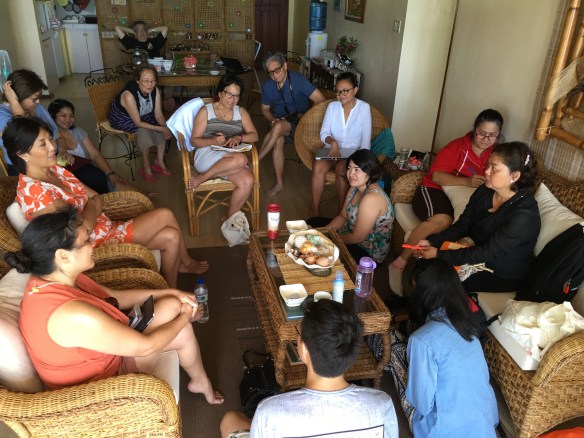
I’M WRITING this in Calapan, Oriental Mindoro, where I’ve come with a group of writers, most of them visiting Filipino-Americans, for the second and closing leg of the NVM Gonzalez Workshop, organized and led by NVM’s son Dr. Michael Gonzalez. Last year, 2015, marked the centenary of the late National Artist’s birth, and Myke thought that it would be fitting to hold the workshop, now on its sixth iteration, in the place most closely associated with his father, Mindoro.

NVM was actually born in my home province, Romblon (“about 60 kilometers and 40 years away,” I like to say), but he grew up in Mindoro, and wrote most of his works about its hardy people and their way of life, even when he moved to the United States. NVM died in 1999, but his memory remains fresh among his friends, colleagues, and former students on both sides of the Pacific. It was to honor that memory that Myke put this group together for both a workshop and a literary pilgrimage to the Philippines.

This year’s US-based contingent includes Mary Grace Bertulfo, who has written for television and children’s education and who runs a children’s creative writing workshop, Taleblazers, in Chicago; Anna Alves, a PhD student with the American Studies Program at Rutgers University in New Jersey; Chris “Kawika” Guillermo, a mixed-race Asian-American with Chinese, Filipino and Irish roots who has a PhD in English from the University of Washington, specializing in Asian and Asian-American fiction; Lisa Suguitan Melnick, a third-generation Filipina-American, an adjunct professor at the College of San Mateo and a contributing writer for PositivelyFilipino.com; Penelope Flores, a retired mathematician and educator from San Francisco State University; Myke Gonzalez, of course, who teaches Philippine Studies and Behavioral Science at the City College of San Francisco; and Evelina Galang, the workshop director, an accomplished fictionist who directs the Creative Writing program at the University of Miami.

Their local counterparts were Kat Cruz, a UP Business Administration graduate and company executive with a keen interest in writing; Meeko Camba, a young opera singer now studying Journalism in UP; Sarah Matias, a Creative Writing major who now runs Ant Savvy Creatives, a marketing and events company; Marily Orosa, a prizewinner publisher of coffee table books; Timmy Tuason, an expert in instructional design, materials development and project management; Jojo Hosaka, a surgeon and dog-show judge (and, like Timmy, a fellow fountain-pen enthusiast); Claire Agbayani, a graduate writing student at DLSU and PR practitioner; Judith Castillo, a teacher of English in Calapan; and Raul Manicad, an engineer, businessman, and guitarmaker. Myke and Evelyn were backstopped on the teaching staff by veteran fictionist Charlson Ong and myself.

We held the first part of the workshop from January 4 to 5 at the University of the Philippines in Diliman, where NVM had taught for many years in the 1950s, in the Gonzalo Gonzalez Reading Room of the College of Arts and Letters Library, which my office—the UP Institute of Creative Writing—administers as a repository of contemporary Philippine and Southeast Asian literature. From January 6 to 9, we moved to Calapan, where NVM used to go from their home in Mansalay to type out his manuscripts at the municipio, on paper that, Myke recalls, NVM apparently “borrowed” from the municipal government, whose stamp it bore.

The mixed composition of the group and the diversity of the participants’ backgrounds led to some very interesting discussions dealing with identity, race, language, and representation. While this was a writers’ workshop focused as much on technique as one’s philosophy of writing, inevitably the politics of writing took the foreground, given the Fil-Ams’ engagement with the issues that come with writing as a minority in America.

We talked about how the writer’s political positions define or feed into craft and technique, and how they shape the story itself. Understandably, given the environment they operate in, our US-based friends were keen on discussing the representation of race, of the Other, and the depiction of character in a racially or ethnically charged environment. We agreed that it was important to be accurate and to be fair in creating characters who will inevitably be seen to represent their race, whatever they may be; on the other hand, I interjected, it was just as important to remember that the character had first to succeed as an individual in the story, and that the character could even—and more interestingly—go against type; while we share many beliefs and practices as Filipinos, not all Filipinos think alike, and thankfully so.

The discussions also became a mutual revelation of what it was like to write as a Filipino and as a Filipino-American, and how we could be so similar yet also different in many ways. It wasn’t just the vocabulary, but the sensibility that came into play. In the end, we took the cue from NVM himself, who once famously explained his use of language thus: “I write in Filipino, using English.”

I learned a new word from Myke, who has a background in the social sciences—schismogenesis, promoted by the anthropologist Gregory Bateson in the 1930s, which roughly translates into how groups proliferate by breaking up. The context was the oft-made observation of how Fil-Ams and their organizations tend to fall apart because of personal and political differences (by one account I read, there are more than 3,500 Fil-Am organizations in Southern California alone)—a tendency we uniformly deplore. But Myke’s new word suggests a positive aspect, a way by which a race and its culture propagates itself.

We’d like to thank our hosts—the Madrigal-Gonzalez clan, for the use of the reading room in UP; Myke’s sister Selma, who spread out a very generous merienda for us; the Mother Butler Guild of Calapan, who conducted a charming putongan ceremony for the visitors; Florante Villarica, who has written a history of Oriental Mindoro and who had us over for dinner at his home; Anya Postma and the Mangyan Heritage Center, who made a wonderful presentation on Mangyan life and culture; and Chicago-based Almi Gilles, who lent us her their family’s beach house in Puerto Galera for our penultimate day in Mindoro.

And thanks, of course, to Myke and the Gonzalez family, for keeping their father’s flame alive.

Penman No. 178: So You Want to Do a Coffee Table Book

IMG_7603.jpg

Penman for Monday, December 14, 2015


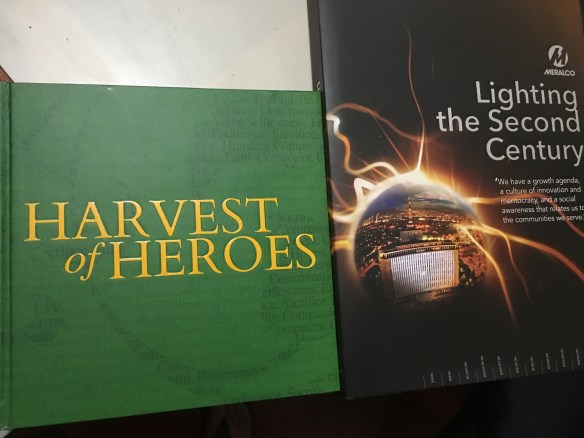
PEOPLE OFTEN ask me what it takes to produce a coffee table book. As a writer and editor, I’ve been involved with quite a few of them over the past twenty years. Just a couple of weeks ago, I was happy to attend the launch of one I co-wrote with Exie Abola and Felice Sta. Maria, Lighting the Second Century, produced for Meralco by the prizewinning Studio 5 group of publisher Marily Orosa.

While I suspect I know the answer, the first thing I tell anyone who asks me is, “What do you want a coffee table book for?”

Coffee table books are not cheap, running into the millions to produce—and, with few exceptions, they don’t make money for their publishers. So why even bother? Why does every year bring a plethora of new CTBs off the presses?

Many of those books don’t even come to market—they’re never meant to be sold or to make their investment back, and therein lies the reason for their existence: not to make money so much as to make an impression, not even to the general public but among a select group of readers, fellow connoisseurs, enthusiasts, and avatars of a certain thing or idea, to whom they can be given away as promotional material.

Because they’re generally not for-profit projects and because they require a sizable investment, CTBs are almost always conceived and funded by large institutions—corporations, foundations, universities, and the government—whose leaders have found some special reason to commission a CTB.

That reason is usually to commemorate and to celebrate an important milestone—the founding of an institution, the centenary of a founder, the completion of a major undertaking. CTBs can also be used to introduce or promote a new initiative—say, a province’s tourism program. Some CTBs may seem downright frivolous and extravagant, but many do serve a higher purpose beyond public relations, as visual records of our social and economic history,

But why a book, and why a coffee table book? Even and especially in this digital age—abounding with possibilities online and with new media—print still suggests permanence and prestige. The Web reaches far more people and is practically free, but many see it as an ephemeral medium, lacking the solidity and credibility of a book in the hand. For people and institutions seeking to perpetuate some shining moments and memories, the appeal and cachet of a CTB can be hard to resist.

CTBs are relatively new on the local publishing scene, and it wasn’t until the late 1970s when Gilda Cordero Fernando came out with such landmark tomes as Turn of the Century and A Question of Heroes that this new category of “desirable object” emerged. My own first exposure to CTBs was an epic challenge, when I edited the 10-volume Kasaysayan: The Story of the Filipino People for Readers’ Digest Asia in 1998, working with and learning from such legends as our editorial consultant, the late writer Doreen Fernandez, the late designer Nik Ricio, and our indefatigable project director, Tere Custodio.

Institutions usually go to PR or ad agencies for CTB projects, which are too complicated for in-house PR units to do all by themselves. They can also be put together and undertaken by people like me, Tere, or Marily who’ve had some experience in the work involved, but even I have to assemble a crew of first-rate professionals who can deliver good work on schedule.

CTBs are, first of all, conceptualized by the client in consultation with the writer or the PR specialists. While top management can and should give the marching orders early on—purpose, theme, scope, audience, treatment, budget—it’s best if a mid-level person with some understanding of media were designated to represent the client in dealings with the creatives, with full authority to streamline decisions and processes. (My worst nightmare would be to deal with a whole board of directors, each one of whom will be dipping into the editorial pie and making a general mess of things.)

Aside from the client, the CTB team will typically comprise the project director or manager; the head writer and his or her assistants; the executive editor; the book designer or art director; the photographer; and a production or editorial assistant in charge of logistics—handling money, setting up appointments, liaising with the client, following up the paperwork.

Many future problems can be solved right at the conceptualization stage. If the book’s purpose, scope, and audience are clear from the start, expensive adjustments can be avoided later on. Schedules, budgets, and deliverables have to be established and stipulated in a contract, leaving a little wiggle room for exigencies.

A CTB is picture-intensive, and will typically have a ratio of 60/40 or even 70/30 in terms of images to text. This means that there’s absolutely no excuse in a CTB for bad photography, bad design, and bad printing. If you can’t afford to come up with a good-looking product—never mind the text for the time being—then save your money and go for a regular, black-and-white book, not a CTB. Take note that a good designer could cost more than a good writer. (My pet peeves design-wise include designers who get too fancy with typography or insist on laying out text over an image, compromising readability.)

That said, showing off a well-designed book with awful text—poorly written and riddled with grammatical errors and misspellings—will be much like going to town with a date with the looks but also the brains of a lovebird (not that some people would mind). So invest in a good writer, one possessing a mastery not only of the language but also of the material, and with the patience and maturity to deal with both the client and his or her fellow creatives.

I’ve often found that the actual writing is the easiest and most pleasurable part of the job. Dealing with and interviewing clients can be quite stressful, and there’s a saturation point one reaches with almost any project, no matter how interesting it is.

Like any other book, CTBs also require sharp editors who can look over the writers’ shoulders. I never mind being edited myself, if the editor knows what he or she is doing. (If I don’t have the time to write the books myself, I’ll sometimes offer to do the editing.) CTBs, surprisingly enough, often reveal their lack of editorial oversight in their most visible and therefore vulnerable parts—in their titles, picture captions, and the front and back matter, which tend to be the last pieces of text to come in and are easily overlooked. I’ve seen expensive and glossy books with spelling errors on their title pages!

A good CTB should be a pleasure to read and to own. It should be a showcase of the art of good writing and good design. But above all, beyond being a plaything for creatives, it should do what it was meant to do—provide useful information in a visually engaging way. The best CTBs will retain their value over time and even become heirloom pieces on their own. That’s something worth keeping in mind next time somebody with more money than sense cries, “I want a coffee table book!”


Penman No. 174: What Women Remember

4510563825_5f753e970a

Penman for Monday, 16 November 2015


I WAS very pleased and much relieved—and, as one of the convenors—immensely proud for the Philippines to have successfully hosted this year’s conference of the Asia Pacific Writers and Translators (APWT) late last month in Manila.

Among the highlights of the conference was a keynote talk given on the last day by none other than one of our foremost fictionists and critics, Dr. Cristina “Jing” Pantoja-Hidalgo, now the Director of UST’s Center for Creative Writing and Literary Studies, who spoke on a subject even her fellow Filipino writers like me know very little about or pay only minor attention to—the journals, memoirs, and autobiographies of Filipino women. I found her lecture (titled “The Subversive Memory: Women Tell What Happened”) so informative that I asked her permission to excerpt parts of it to share with my readers, so here:

Several generations are represented in the seven women who are the subject of my new book, which I called To Remember to Remember…. t today is referred to as multi- er, is available at the UST Publshing Housee so informative that I asked her permission to exce

The oldest, Paz Policarpio-Mendez, was born in a small town in the province of Nueva Ecija in 1903, and was among the first children to enter the American public school system, and one of the first women to go all the way to college in UP. But, to get there and to stay there, she had to fight her father – who did not hesitate to beat her when he objected to her behavior or her opinions. Always painfully aware of her father’s preference for his sons, she strove to win honors in school, to merit his approval. But he never gave it. Later, she married a journalist who eventually became a diplomat, and finally the Secretary of Foreign Affairs. But Paz went right on studying and teaching, while raising a family, and attending to the duties of a diplomat’s lady.

The youngest, Rica Bolipata-Santos, was born in Manila, and educated entirely in Catholic schools, until she decided to get a PhD in Creative Writing in UP. She is sister to the three famous Bolipata brothers, musical child prodigies. This doomed her to play second fiddle to them, to grow up feeling unimportant, untalented, even ugly. Kept back from developing her own musical talent (she could sing!), not deliberately or maliciously, but through neglect, she found her voice in writing and in teaching. Now she is also an academic administrator. But the biggest trial in her life has been her special child, and her memoir is the story of her struggle to cope with anger, sorrow, sometimes despair.

In between there is Solita Camara-Besa, a woman who describes herself as a battered child – this abuse by her father did not let up even after she was married, until her husband, demanded that she choose between himself and her parents. For all this, she became one of the country’s first women doctors—though again, she experienced appalling gender discrimination in the UP College of Medicine, of all places—and was part of the heroic little band of UP faculty members who kept UP and its teaching hospital, the Philippine General Hospital – running throughout World War II.

The remaining four writers who are part of the book took for granted their right to an education and to careers of their own. But they had their own battles to fight. For Gilda Cordero-Fernando (b. 1930), maker of baby bags, keeper of antique shop, fashion designer, publisher, and one of the country’s finest writers of fiction and nonfiction, the battle was against her mother and the convent school education that she felt trapped in; against her husband who resented her writing, her writer friends, and the many worlds that her numerous gifts opened up to her, but kept a mistress for most of their life together; and against conventional ideas about what constitutes accomplishment and success.

For the prize-winning poet and academic, Merlie Alunan (b. 1943), it was the battle to hold it all together when she became a single parent, seeing herself and her children through school, teaching in college, holding workshops for struggling young writers, and picking up poetry awards along the way.

Jennifer Ortuoste (b. 1968) trained as an apprentice racehorse jockey, married a professional jockey and raised her babies in the Santa Ana Racetrack. Hers is the story of a battered wife; and the story of the collapse of her marriage is told against the backdrop of the demise of the racetrack that she loved. When her marriage fell apart, she picked herself up, became a journalist, got an M.A., and is now writing prizewinning fiction and nonfiction.

Criselda Yabes (b. 1964) chose a profession, which until the generation before hers was not considered quite respectable for women—journalism. The most independent, unconventional and alienated of the seven, her story is focused on 16 months of her life, the period after she had been abandoned by her lover of seven years. And, to keep a hold on sanity, she went to Europe, first on a scholarship, then as a war correspondent in different countries, until, in a borrowed apartment in Athens, she began to write about the year she had just lived through, and so found her way home.

In life, these women broke from the mold. They would not settle for what was expected of and from them as women. They wanted different things. In writing their memoirs, they, again, transgressed. For in the Philippines, family matters are kept private, particularly matters which will make the family lose face; one’s personal memoirs inevitably include other members of the family. They may not have been flaming radicals, marching down streets, waving banners and chanting slogans, or being hauled off to jail, being tortured and even killed, as some of their sisters were. But, in their own quiet way, they were rebels….

I read the memoirs of the three older writers as variations on a theme, the theme being the education of the modern Filipino woman, and her transformation, from sheltered schoolgirl into formidable, professional woman without relinquishing the role of wife and mother. I do not claim for this narrative that it applies to all modern Filipino women, nor even all modern Filipino women of the middle class (to which all three belong). But I do believe that it is a pattern that many Filipinas aspire to, and can therefore identify with. And I suggest that in telling their own life stories, these writers are creating a different myth, to replace the older narratives about the Filipina and her role in society….

These are the narratives that we, the next generation of Filipino women writers inherited. Most of our mothers had college degrees and careers. After they married, those who lived in extended families, or could afford reliable yayas went on working, and became quite expert at juggling their several roles, what today is referred to as multitasking, and they trained their daughters to do the same.

The memoirs of the younger writers are, in a sense, their response to these narratives. I take them as signposts. They mark the latest paths taken by Filipinas and what they reveal is the distance they have travelled, but not a change of direction. Those pioneers, some of them already so bold for their time, but working in relative obscurity, had pointed the way….

What these women have done is take the personal narrative—either the full-length autobiography or the memoir—and use it to open doors previously kept firmly locked, and to explore their own thoughts and feelings about the monsters lurking in its shadowy corners. This they have done in language both precise and elegant. Thus have they contributed to the story of their country, and the place in it of Filipino women.

(Jing Hidalgo’s new book, To Remember to Remember, is available at the UST Publishing House for P400.)


Penman No. 172: Going Against the Grain

IMG_8272

Penman for Monday, October 26, 2015

I WAS asked to give the first keynote last week at the annual meeting of the Asia Pacific Writers & Translators at the University of the Philippines, on the conference theme of “against the grain,” and here’s part of what I said:

The Filipino writer is among the freest in the world as far as self-expression is concerned; but the Philippines is also one of the deadliest countries for journalists in the world—according to the New York-based Committee to Protect Journalists, it ranked second only to Iraq in 2013.

Creative writing won’t pay you much, but you can say whatever you want and reasonably expect to stay alive and ambulant. Nobody in this country ever got killed or imprisoned in recent times because of a novel or a story. Neither has a Filipino despot been deposed because of a play or a poem. Journalism, on the other hand, can be a dangerous enterprise, especially if you live and work far away from the glare of the metropolis.

…. We have one of the region’s richest concentrations of writers, and very likely the region’s most strongly developed systems for the development of new writers; but these writers have precious few readers.

We have never lacked for writers, and likely never will. The Filipino writing community is very much alive, producing new work not only in English but in Filipino and in many regional languages.

Within the region, we can claim to have the oldest, the longest-running, and possibly the most comprehensive writing programs—not just writers’ workshops which go back 50 years, but also degree programs from the BA to the PhD in several major universities. The Palanca Awards, which are handed out every year to the best work in many categories and several languages, have been running now for 65 straight years.

New young writers will find it easier to break out and get noticed by their peers and seniors here than in many other places, because, while Filipinos respect their elders, and everyone above 40 is a “Sir” or a “Ma’am,” we do not have the kind of master-apprentice, or senior-junior relationship that exists elsewhere. You do not need a senior’s validation or sponsorship to advance; indeed you might move forward much faster by slaying a literary father or two.

But for all the literary talent we think we have, it can be argued that creative writers really don’t matter much in Philippine politics today—certainly not as much they used to—because, to be hyperbolic about it, no one reads, no one buys books, and no one understands nor cares what we’re doing.

It’s a sad fact that in a country of 100 million people, with a literacy rate of about 97%, a first printing for a new novel or book of stories will likely run to no more 1,000 copies—which will take about a year to sell, and earn the author a maximum of about P50,000 (about US$1,000) for a few years’ work—good enough for a new iPhone. There’s no such thing as a professional novelist or playwright in the Philippines, which makes it easier for writers of any worth to be sidetracked or co-opted by the government or by industry.

It’s ironic that Philippine literature’s political edge should be blunted not by timidity nor by censorship but by sheer market forces. The simplest reason many Filipinos don’t buy books has to be poverty, with the price of an average paperback being higher than the minimum daily wage.

But perhaps we writers ourselves are also to blame, for distancing ourselves from the mainstream of popular discourse. Politics is nothing if not the domain of the popular, and the very fact that many of us write in English is already the most distancing of these mechanisms. The question of language has always been a heavily political issue in multilingual Philippines, where some regionalists still resent the choice of Tagalog as the basis of the new national language Filipino in 1935, and where English is reacquiring its prominence not only as the lingua franca and the language of the elite but as our economic ticket to the burgeoning global call-center industry.

Political change in the Philippines has historically been led by the middle and upper classes, from the Revolution against Spain of 1896 to the anti-Marcos struggle of the 1970s and the 1980s to the Edsa uprisings of 1986 and 2001. Therefore, one might argue that English is, in fact, the language of reform and revolt in the Philippines in modern times.

But it is this same English-literate middle class—our potential readership—that is the strongest bastion of neocolonialism in the Philippines, blindly infatuated with Hollywood, hip-hop, and Harry Potter, keen on trading the local for the global, opportunistic in its outlook and largely unmindful of the social volcano on the slopes of which it has built its bungalows. As I often remind my fellow Filipino writers, our rivals on the bookshelves are not each other, but J. K. Rowling, Stephenie Meyer, E. L. James, Paulo Coelho, and Tom Clancy.

When I return to the two main points I raised—that we are free to speak and to write, but only in politically inconsequential forms; and that we have writers aplenty, but very few readers—I have little choice but to conclude that the main culprit is our self-marginalization through English, and the academicized, Western-oriented mindset the language encourages.

The interesting upside of this unfortunate situation is that—largely untethered from the considerations of commerce and politics—our writers have been free to write their hearts and minds out, producing poetry and fiction of a high quality that, in a double irony, might yet break through to the global market.

The triple irony would be that it sometimes takes the international spotlight for local readers to take notice of native genius. It sounds like wishful thinking, but by being here today, and connecting our literature to yours, we might do enough together to push our literatures to the forefront of our peoples’ consciousness.

But let’s face it: the margins are familiar if not comfortable territory to many of us, not only here but wherever we live and write, as they give us a clearer view of the center. Going against the grain is very much in the grain of how and why we work. And if you didn’t think so, you wouldn’t be here today.

Penman No. 171: All Systems Go for APWT 2015

APWTlogo

Penman for Monday, October 19, 2015

IT’S “ALL systems go” for this year’s edition of the annual Asia Pacific Writers and Translators (APWT) conference, which will be held in Manila later this week, from Thursday on to the weekend. As a member of the APWT Board and one of APWT 2015’s convenors, I’m particularly thrilled for the Philippines to be hosting this event, which is the literary equivalent of the APEC, the SEA Games, and let’s throw in The Amazing Race, which it could be a bit of for our foreign guests.

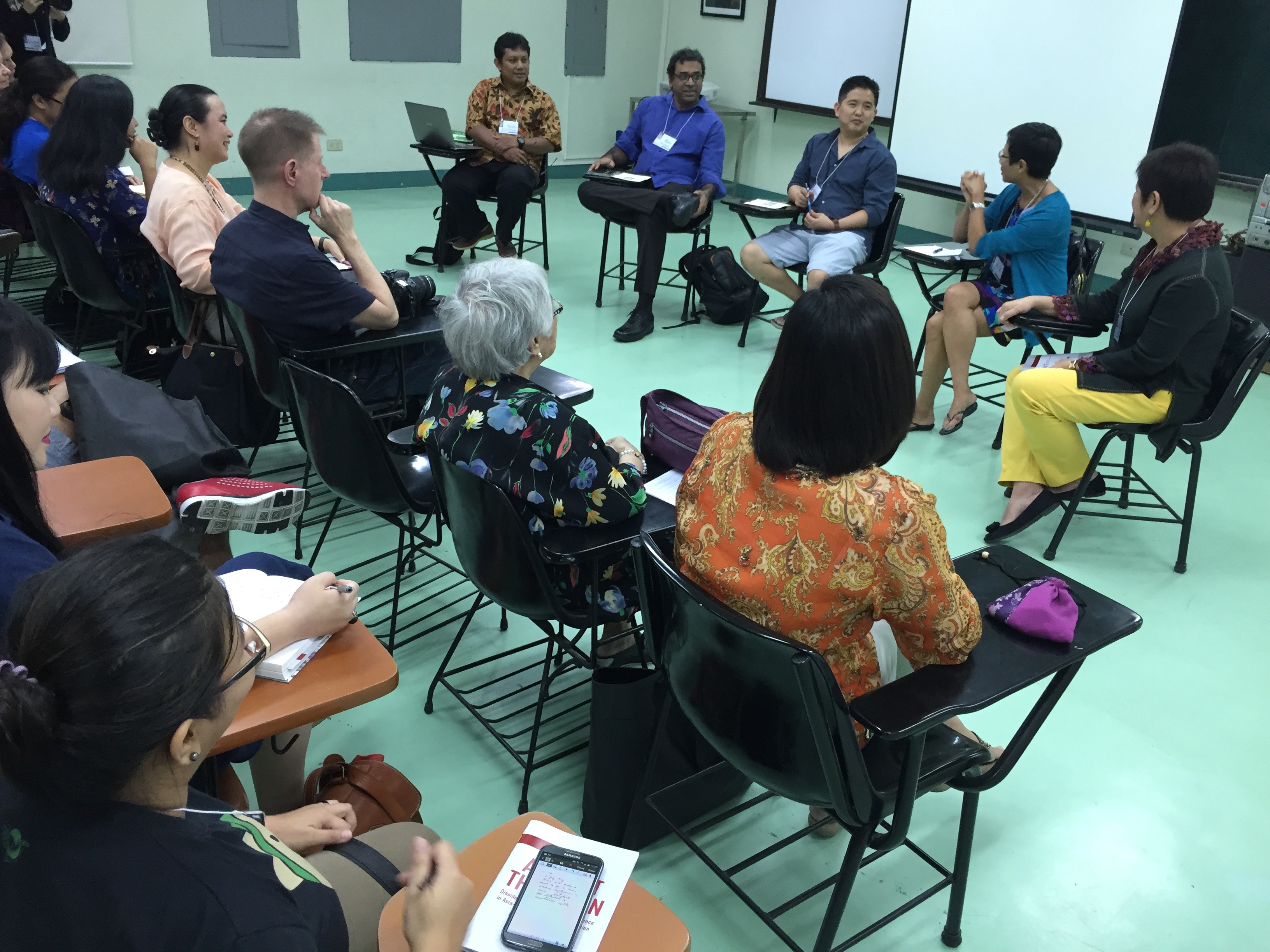
It’s not a competition, of course, and we won’t be signing any treaties or squabbling over territory. In fact, the way we’ve set things up, it’ll be a politician-free zone, which isn’t to say that politics will be off the menu. With topics ranging from “Sex and Sensitivities” and “Criminal Intent” to “Love in the Time of Dissonance” and “Why Publishers Prefer Outsiders,” there’ll be fireworks aplenty in the panel discussions we’ve put together for the three-day conference, which will be held at the Institute of Physics in UP Diliman on Thursday and Friday, before moving to De La Salle University and the University of Sto. Tomas on Saturday.

I’ll be one of four keynote speakers for the conference, and will speak on the conference theme, “Against the Grain,” at UP on Thursday morning, to introduce the Philippines and our culture and literature to the audience, especially our visitors. I’ll be followed the next day by Romesh Gunesekera, the UK-based, Sri Lanka-born Booker Prize finalist who partly grew up in Manila, where his father had worked for the Asian Development Bank. At La Salle on Saturday, the indigenous Australian author Philip McLaren will keynote the meeting, and Jing Hidalgo will close the conference at UST with a talk on the “subversive memory” of women writers.

These 30-minute keynotes will be the exception, however. It’s an APWT hallmark to keep presentations short (no more than 10 minutes max) and informal (no footnoted academic papers on obscure topics, please—and no PowerPoint!). The key phrase here is “writers in conversation,” so we expect easy, freewheeling discussions around the topics given to each panel, with lots of time for audience interaction.

We’re expecting at least 50 foreign participants to join around 100 local authors in APWT 2015. Filipinos have always been well represented at APWT. Its annual meetings had been previously held in Hong Kong, Bangkok, New Delhi, Perth, and Singapore, and this will be the first time it will be coming to Manila. Next year, we’re planning to hold it in Guangzhou, China.

If you want to meet with fellow writers, translators, publishers, and agents beyond our shores, you can’t do better than to sign up with APWT, a ten-year-old organization that has become the most active and visible network for writers and translators in the region. The great thing about APWT is that it was designed by and for practicing writers above all; while we have many academics, critics, and scholars among our members, theory isn’t our big thing, but practice—engagement with reading publics, dealing with shifting markets, connecting across the globe, adapting to new media, rolling with the political punches. If you’ve written what you think is a terrific novel and want to catch an agent’s or a publisher’s attention, APWT is the place to go.

Speaking of which, this year’s conference will offer six workshops that writers—both budding and accomplished ones—can sign up for, to sharpen their skills or explore new possibilities. You don’t have to attend the full conference to attend these workshops, which will be run by a sterling crew of international authors. Robin Hemley—who used to teach nonfiction at Iowa and now heads the Yale-NUS program in Singapore—will be handling one on “The Art of Memoir Writing”; Xu Xi, who directs the MFA program at the City University of Hong Kong, will teach fiction writing “with Asian characteristics”; the New Yorker Tim Tomlinson, another frequent Manila visitor, will share “Pitching Tips from the New York Writers Workshop” to help you sell your manuscript, at the same time that poet and editor Ravi Shankar will be teaching his students how to create “timeless verse”; at La Salle, Sally Breen will hold a master class in editing, to address “What Editors Want”; and simultaneously, Francesca Rendle-Short and David Carlin will employ improvisational techniques to engage participants in “Essaying Manila.”

I strongly urge those inclined among my readers to go out for one or two of these three-hour-long workshops, because you may never get the chance again to study directly with these masters, some of whom have become good friends of mine over the years and whose teaching and writing excellence I can swear to. There’s a fee to pay, but it will be well worth it, and you’ll remember the lessons you’ve learned long after you’ve forgotten how much they cost. Slots are limited, so sign up early. If you can’t pay in US dollars online, you can pay for the conference and/or the workshops at the door, in pesos (at a slightly higher rate of 50-to-1, to cover conversion and remittance charges).

Filipino citizens can attend the full three-day conference at a reduced fee of $40 or P2,000 (for students with IDs of UP, DLSU, and UST, the fee will be just P1,000); the workshops will each cost $40 or P2,000. These fees will include some meals and snacks provided by our generous sponsors and hosts, who include—aside from the three aforementioned universities—the National Commission for Culture and the Arts, the British Council, Anvil Publishing, and the Japan Foundation.

For more information and for links to the registration page (again, you can also register and pay at the door), see here: http://apwriters.org/apwt-2015-manila.

See you at the panels!

Penman No. 170: History Made Personal

Sofia+De Veyra and+Florence Harding

Penman for Monday, October 12, 2015

THE RECENT upsurge of interest in our history occasioned by runaway success of the film “Heneral Luna” is certainly welcome. While the film and its propositions may have sparked a flurry of debates among netizens about what really happened more than a hundred years ago, the important thing—as I noted in one of those “Heneral Luna” threads online—is that we’re having this discussion at all, when not too long ago, very few people cared.

(One of the most salient comments I came across was posted by a viewer who mused that—for all our newfound admiration for the hothead general’s bravery and principled stand—had we lived in Gen. Luna’s time, or were those circumstances transposed to the present—most of us middle-class Pinoys would probably side with the general’s more pragmatic enemies, arguing business to be more important than anything else. That’s a sobering thought, especially these days when many people seem to think of “nationalism” as being too old-fashioned if not downright irrelevant in this age of globalization, conveniently forgetting that globalization benefits some nations and economies more than others.)

There have been many times when I’ve wished that I’d become a historian instead of a literary person, so I could have looked into our past more deeply and more seriously to make better sense of our present. Indeed, when I returned to the University of the Philippines as a freshman after a ten-year hiatus in 1981, I chose between declaring myself as an English or a History major (I had entered UP in 1970 as a prospective industrial engineer).

Were it not for the need to take the easier path to make up for lost time, I would have chosen History in a flash, as interested as I was in stories of “what happened.” In grade school and high school, I read more books dealing with history, biography, geography, and science than fiction; to this day, when people ask me what single book has influenced me the most, I don’t think twice about answering The Forest by William Pomeroy, a lyrical account of an American’s travails as a Huk guerrilla, which I read in high school and encouraged me to become an activist.

Mine was a generation of students who grew up on the enlightened revisionism of Teodoro Agoncillo, Hernando Abaya, and Renato Constantino. I use the word “revisionism” because the standard historical texts at that time were written by such men as Gregorio F. Zaide, a mimeographed and paperbound copy of whose book—my mother’s college textbook, for sure—was as fascinating to me as a boy as any of Edgar Rice Burroughs’ Martian chronicles. In grade school in the early ‘60s, I had yet to become aware of the important qualifications and nuances to be made to telling the story of our past, such as the fact that histories unavoidably took sides, and that it was all too easy to be seduced into taking the wrong one.

These days, I content myself with writing commissioned biographies and institutional histories—which, while they pose their own literary and scholarly challenges, do not by any means qualify me as a historian. I remain ever aware that the true study of history involves an appreciation of the grand sweep of things as much as the little details, and I have to admit that it’s the details I’m more often fascinated by, leaving it to larger minds to scope out the overarching logic or the grand design of the human narrative.

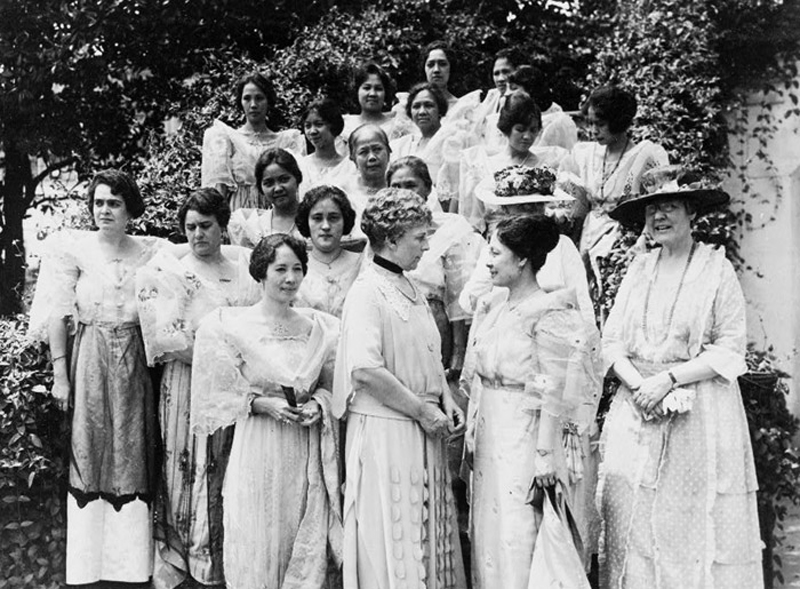
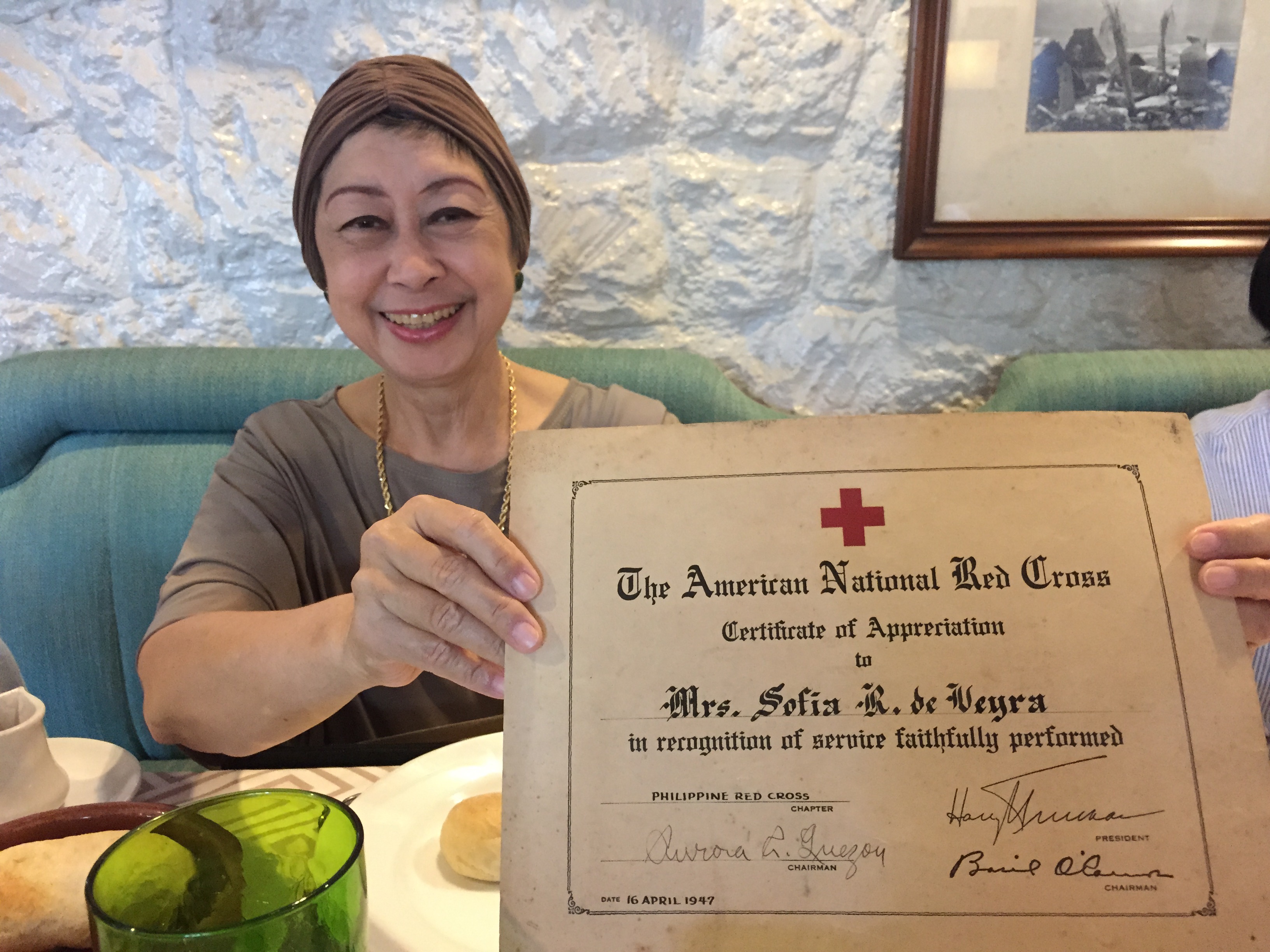
As a hopeless dabbler, hoarder, and kibitzer, I find myself irresistibly drawn to old objects and obscure information, and trade these gilded items with such fellow enthusiasts as my Washington-based friend Erwin Tiongson and his wife Titchie, who together run the Philippines on the Potomac website at popdc.wordpress.com. Erwin and Titchie were in Manila not too long ago for a vacation and a couple of lectures before the Philippine Studies Association and at the Ateneo, Erwin’s alma mater, on their most recent research into the colorful life in Washington of the remarkable Sofia de Veyra (you can read Titchie’s wonderful article on her here: http://www.positivelyfilipino.com/magazine/the-thoroughly-modern-sofia-de-veyra). My wife Beng and I had a chance to meet over lunch with the Tiongsons and with Sofia’s granddaughter Teresa “Binggay” Montilla and her aunt Rita Damian, and the look on Binggay’s face when the Tiongsons showed her pictures of her grandparents she had never seen before was priceless.

IMG_7997

Shortly afterwards, back in the US, Erwin wrote me to say that he had been able to track down an article in the May 20, 1921 issue of the Great Falls Tribune (published in Great Falls, Montana), about the protest launched by Fiipino Chinese businessmen, led by the banker Dr. Albino Z. Sycip, against a new bookkeeping law that apparently discriminated against Chinese merchants. Sycip had taken his case to the US courts, and was on his way to Washington to plead his case there. While he was in the States, on June 30, a son was born to his wife back home, a detail I recounted in a biography I wrote of the man who was that baby boy: “Albino decided to commemorate that visit by naming his new son ‘Washington.’ ‘Up to now Wash has semi-annual recurring bad dreams about what might have happened if the old man had been in Tallahassee or Vladivostok,’ the impish Alex [Wash’s brother] would write.” Erwin relayed the news item to Wash, who gratefully wrote Erwin back to say that he had never seen that article before (and another one reporting on his father’s victory in court).

More recently, Erwin and I have been exchanging clippings we’ve dig up on another outstanding Filipino, a Jesuit icon, the late Fr. Teddy Arvisu, and I’ll write up those findings one of these days (“His father wanted him to marry one of the Quezon girls,” Erwin tells me). I’d found an eloquent and impassioned speech against the rise of fascism by the young Teddy, published in a November 1940 issue of the Philippine Collegian; Teddy would become a soldier and join the Death March before achieving his dream of priesthood. At the moment, Erwin’s hot on the trail of Peyton March, the American officer who went after Gregorio del Pilar at Tirad Pass, and who lived in his last years in Washington. You better hurry, I told Erwin, as they’ll be making a “Goyong” movie soon.

Nothing of the kind of trivia that Erwin or I come across will change the big story of our past, but as avid amateurs, I’m sure we’re happy enough to help in making history more personal.

[Top image from the US Library of Congress]