
Qwertyman No. 110: The Truth Shall Make You Mad

Qwertyman for Monday, September 9, 2024
I’M WRITING this on a Friday morning with no particular topic in mind, threatening to be overwhelmed by a slurry of depressing and outrageous news flooding my inbox. As a news junkie, I get my foreign news in digests from the New York Times and the Washington Post, and of course I look up all the major local news websites. You’d think that would be enough, but of course I have to open CNN and the BBC online as well—and occasionally, when I feel obliged to do so, Fox News, if only to see what those people are saying. And then I turn the TV on to CNN, BBC, Al Jazeera, and Channel News Asia for onsite reportage and commentary, especially from a non-Western perspective. 

For all my efforts, this is what I got today, which I’m sure many of you did as well:

“Ugandan Olympian Rebecca Cheptegai dies after being set on fire by boyfriend” (CNN)

“Accused Georgia school shooter Colt Gray, 14, received gun used in massacre as Christmas gift from dad” (New York Post)

“Israeli attacks in Gaza kill 35 people as polio vaccinations continue” (Al Jazeera)

“Trump says he’d create a government efficiency commission led by Elon Musk” (AP News)

“Woman testifies husband drugged her for years, recruited dozens to rape her” (Washington Post)

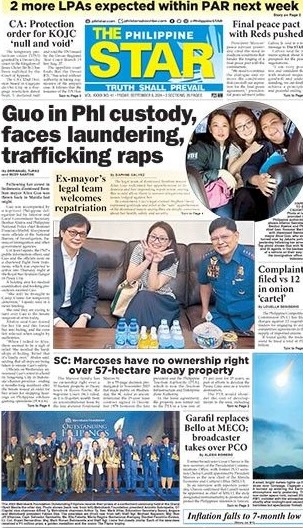
“What was behind the viral photo of Guo, Abalos, and Marbil?” (Rappler)

On a day like this, you have to ask yourself, “What has the world come to?” followed quickly by “Do I really want to know?” You emerge with a sense of a world gone mad, a moral universe you no longer recognize, playing by different rules for different people. Each one of those news items I mentioned above was enough to make me retch. 

While the loss of human life naturally rises to the fore of our concerns, how does one diminish the horror of being abused while unconscious over 70 times for years, or the cruel irony of vaccinating children only to bomb them afterwards? On which planet is it all right for a father to buy his young son—already known and reported to be prone to violence—an AR-14-style assault rifle for Christmas? (Answer: Not Mars but the United States, thanks to lax gun laws and even laxer parental supervision.) And speaking of that country, what do Americans think they can expect from a government run by two egomaniacs?

Let’s go to that viral snapshot, which I saw with my morning coffee, when I was still half-asleep and not too sure of what exactly I was looking at—the secretary, the escapee, and the police general seated on a sofa, all smiling into the camera, with a raft of refreshments on a table before them. 

No, I immediately thought, surely this was from the recent past, when all was still peachy between Ms. Guo and the administration. Or could it have been another of those clever AI pastiches, mounted to embarrass our honest and hard-working officials in hot pursuit of a wanted criminal? How else could you explain Alice’s sweet smile and finger gestures, and the equally benign countenances of the gentlemen beside her? Where was even the slightest trace of the loneliness and fear that were said to have driven our favorite chinita into self-exile, which would have left her haggard and despondent? 

Not having read anything else at that point, I almost made a comment on the first FB post of that image to the effect that “No, no, this can’t be true, this is all fake!” Providentially I held back, and looked for what I was sure would be a vehement denial from those concerned that the picture was ever taken. Instead, I found a story and a video of the good secretary explaining that he had no idea what Ms. Guo was doing as their “documentation” photo was being taken. Good Lord, I thought—if that wasn’t the chummiest picture I’d ever seen of captors and their captive, like something from a high-school reunion. So, okay, the smiles can be explained away—Alice was relieved that the Philippine police will now secure her from all threats; Abalos and Marfil were happy to have completed their mission. Does that call for refreshments, for a toast? Where did decorum go?

Sometimes I wonder if we read the news just to get all riled up—like poking yourself in the eye—as proof of life, or of our ability to still think and figure out right from wrong.

There’s a great article by Brett and Kay McKay on a website called artofmanliness.com titled “Is There Any Reason to Keep Up with the News?” It notes that “In The News: A User’s Guide, philosopher Alain de Botton draws on the ideas of Hegel to posit that in fact, the news in modern cultures has in some ways replaced ‘religion as our central source of guidance and our touchstone of authority.’

“Morning and evening prayers have been substituted with checking one’s news feed immediately upon rising and retiring to bed. While the faithful once sought inspiration in scripture, it’s now in the news ‘we hope to receive revelations, learn who is good and bad, fathom suffering and understand the unfolding logic of existence. And here, too, if we refuse to take part in the rituals, there could be imputations of heresy.’

“If the news represents a new kind of faith, it is surely one of our least examined. The media rarely does stories on itself—reports that might examine their actual worth and credibility.”

The article goes on to dissect our hallowed reasons for following the news—e.g., our desire for the truth and for the betterment of humanity—only to show how narrowed and pliable the truth can be, and how the news actually dehumanizes people (quoting Stalin: “The death of one person is a tragedy; the death of one million is a statistic”) rather than sharpens our humanity.

This I know: if the news is still the bringer of truth as I knew it to be, then this morning’s news has made me mad, in both senses of the word.

Qwertyman No. 29: Balloon over Boracay

Qwertyman for Monday, February 20, 2023

WHEN THE balloon was first spotted high over Boracay, some people thought it was a new ride, a welcome addition to the banana boats and paragliders that the tourists couldn’t seem to get enough of. 

“How much does it cost? Where does it land?” asked Akmal from landlocked Uzbekistan, whose belly was white as fish and whose hair reminded the locals of the red seaweed that sometimes strayed into the island’s waters. 

“Does it have a basket? I don’t see any people,” said Frida from icy Norway, who had actually flown on hot-air balloons where they were popular, as in Turkey’s Cappadocia and California’s Napa Valley. 

“It’s not from here,” said Gordo, the boy from Manoc-Manoc whose job it was to lash the ferry boats from Caticlan to their moorings and to take the hand of passengers stepping onto the pier. He had seen everything there was to see in Boracay in all of his seventeen years, from the shameless couplings on the surf to the occasional victim washed up on the shore, and all cuts of humankind from cigar-chomping Texans to barrel-chested Samoans, and he knew what belonged and what didn’t. This silver dot in the sky definitely did not. 

As if having a mind of its own, the balloon drifted north of the island to Yapak over Puka Shell Beach, then back down again over White Beach, where it attracted even more observers. Men who had been using their telescopes and cameras to focus on the usual bathing beauties turned their gear skyward to where people were pointing, and those with the longest lenses snapped pictures of the aerial intruder, for posting on Instagram and Facebook as the curiosity of the day.

Unknown to them, however, the balloon had been spotted much earlier by the government’s Aerial Surveillance Bureau, whose chief had hastily summoned his staff to an emergency meeting at the ASB’s secret command center, on the fringe of a golf course in southern Manila. The ASB’s Director O, a retired Air Force general, was still pulling off his gloves when his subordinates dropped into their seats and the lights went out. A blurry image of the drifting balloon appeared onscreen.

“This unidentified object entered our airspace above the Spratlys at 0423 hours, when it was too dark to be seen by our human spotters. It has since set course for Boracay Island, above which it has remained since 0933 hours, when it was finally spotted by one of our boys who was chasing a monkey up a coconut tree. Now the question is, what is it, who sent it, and why is it here? Is it friend or foe? The President expects me to report to him in the Palace in one hour and I need answers!”

“Sir, if I may,” said his Deputy Director M, “it looks exactly like the one they shot down over the USA and Canada. It’s a weather balloon from—from that country—equipped with advanced surveillance hardware and sophisticated communications capabilities.” It had been ordered since the previous administration not to mention “that country” by name in discussions of national security, so as not to give offense to a favored neighbor, and the habit had stuck, even in private conversations.

“Let’s not jump to conclusions!” said Director O. “There are many other countries perfectly capable of sending up these balloons. For all we know it could be a Lithuanian, a Ugandan, or a Wakandan balloon. I’m not going to upset the ambassador from that country with unproven allegations about his country’s behavior—however outrageous, obnoxious, and objectionable its actions are in the West Philippine Sea, just between you and me.”

“But why is it here, sir? And why Boracay?”

“Good question. Don’t quote me on this, but during the last National Security Council meeting, we were told that that country is preparing to reveal a new Thirteen-Dash Line map, supposedly drawn in the 16th century just before the Spanish came, that extends all the way to Boracay!”

“What?! But Stations 1, 2, and 3 are inalienable parts of our national patrimony! As Winston Churchill said, ‘We shall fight on the beaches, we shall fight on the landing ground, we shall fight on the hills, we shall never surrender!’”

“Yes, but in Boracay, people make love, not war. Imagine having to clean up all that white sand after an invasion. Another six-month lockdown! Can Philippine tourism afford it?”

“So what do we do, sir? Do we bring down this balloon?”

“With what? I already called the Air Force to see if they could fly by the object, but all of our fighters are undergoing maintenance—change oil, check battery, adjust brakes, etc.”

“What about kwitis?”

“Are you making a bad joke in a national emergency?”

“No, sir! The DOST and DND have a secret research program based in Bulacan called the Katipunan Weapons Initiative To Initiate Security, or KWITIS. It’s a multi-stage kwitis that can protect the archipelago against missiles, drones, asteroids, and UFOs like the Boracay balloon! It’s totally indigenous and sustainable, because it uses kawayan for the frame and kiping for decoration and employs out-of-work firecracker makers in the off-season—”

Just then another aide burst into the conference room, breathless with news.

“Sir! Turn on the TV! The balloon is down. The balloon came down!”

They switched to a live feed from CNN, which showed the balloon settled on the beach, its silver skin acting like a mirror for the dozens of kibitzers crowding around it, taking their selfies and groufies with gay abandon. A couple of local policemen who had tried to restrain the crowd were taking their selfies as well, flashing the “heart” hand-sign. “The balloon touched down about fifteen minutes ago on its own, and it is quickly becoming the center of what could become the biggest Boracay party ever! There are still no obvious indications of where it came from or why it is here, but this balloon seems to be totally harmless, so far, even ‘cute,’ according to Loujay, who’s visiting from London,” gushed the reporter. 

And then small puffs of red, blue, and yellow smoke came out of the metal box at the bottom of the balloon, and for a minute the people shrieked and began running away, but as the smoke dispersed and the people inhaled the fumes, their faces lit up in ecstasy and they began dancing. Music also poured out of the balloon—the frenetic techno club mix that brought even the masahistas and the barbecue vendors to their feet.

“I know that, sir! That’s Stefano DJ Stoneangels!” said Deputy Director M, whose shoulders began moving up and down. “This is even more mysterious than we thought. We are under attack!”

“Indeed we are,” said Director O. “We need to investigate further. Pack up, boys, and bring your trunks, we’re going to Boracay!”

(Image from madmonkeyhostels.com)

Qwertyman No. 19: The Real Maria Ressa

Qwertyman for Monday, December 12, 2022

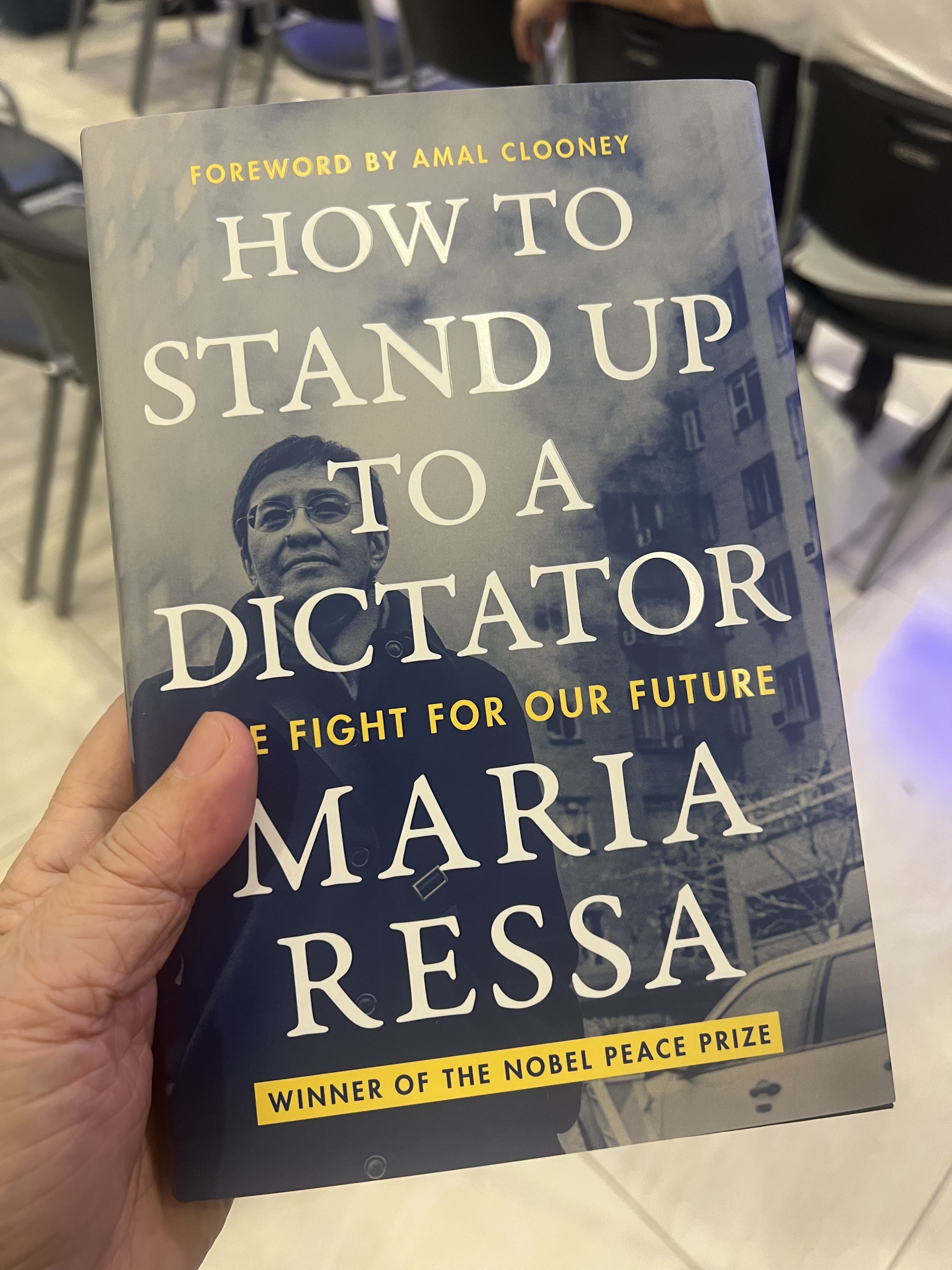
I WAS very honored to speak last Saturday at the launch of Maria Ressa’s new book, How to Stand up to a Dictator: The Fight for Our Future (Harper, 2022). I’d read an advance copy of it a couple of weeks ago, and to cut to the chase, if you’re thinking of buying a book to read for the holidays or to gift to friends, look no further. This book, for me, is among the year’s best in nonfiction.

I have to emphasize that word—nonfiction. As we all know we live in times when fiction has taken over as the most influential form of human discourse, particularly in the political arena. As a practicing fictionist, I should be happy about that, but I’m not and I can’t be, because so much of it is bad fiction, crudely written—and surprisingly, infuriatingly effective, at least with a certain kind of reader. 

Maria’s book cuts through all that. It’s undisguised, old-fashioned, in-your-face truth-telling, told in the same voice and tone we’ve become familiar with over the years of listening to her reportage over CNN. I’m sure that, like me, many of you wondered the first time you heard her: “Who was this little brown-complexioned woman speaking with an American accent?” She looked Filipino, but how come we’d never seen her before?

This was all before she rose to prominence—some would say notoriety—as the moving spirit behind Rappler, and subsequently to global fame as a Nobel Prize winner for Peace. We identified with her travails, shared her anger and sadness at the abuse she has received, and rejoiced in her victories, whether in the courts or in the larger sphere of public opinion. 

But how well do we really know Maria Ressa, and whatever drives her to be who and what she is? This book takes us to the person behind the phenomenon, and answers many questions we may have had about her and her stubborn advocacies.

The book’s title sounds like that of an instruction manual—which it is, and also is not, being part autobiography, part journalism, and part testimonial. As a manual for freedom fighters, it emphasizes the need for collaborative and collective action against seemingly insurmountable forces. Those forces now include the Internet, which, as Maria documents with both precision and profound dismay, has morphed from a medium that once held all kinds of liberative promises into a medium for mass deception and targeted assault. She draws her counsel not from some esoteric guru or academic paradigm, but from some very basic values that have informed her own life—the Honor Code she followed in school, and the Golden Rule.

“That’s what I lay out in this book,” she says, “an exploration into the values and principles not just of journalism and technology but of the collective action we need to take to win this battle for facts. This journey of discovery is intensely personal. That’s why every chapter has a micro and a macro: a personal lesson and the larger picture. You will see the simple ideas I hold on to in order to make what have—over time—become instinctive but thoughtful decisions.”

It’s this constant back-and-forth between the personal and the political—and at some point they become inextricably fused—that forms the fiber of Maria’s narrative and gives it strength. Her convictions are grounded in personal experience; they have not been paid for—as the hacks in the journalistic trade will allege, seeking to bring her down to their own level—except in the coin of personal suffering under the constant threat of imprisonment and violence.

But we learn from this book that trauma is nothing new to Maria. (We also learn that Maria Ressa wasn’t the name she was born into, but to find out her birth name, you’ll have to buy the book.) From her abrupt relocation from Manila to America at the age of ten, to her journalistic immersion in the horrors of conflict and disaster in Indonesia and Ormoc, the book chronicles Maria’s quest for truth, meaning, and purpose in her life, and that of others. She stresses the importance of remembering the past to make sense of the present, quoting TS Eliot’s phrase, “the present moment of the past.”

And so can we, she seems to suggest, even in these times of high anxiety, when we can see the vultures hovering over such once-sacrosanct treasures as our pension funds, while billions more go to feed the dogs of an increasingly untenable counter-insurgent war. The big words we have become used to tossing around—truth, freedom, reason, justice, democracy—they all come down to a personal choice to do the right thing, and the courage to do it. 

Nowhere is this matter of choice more evident than in the fact that Maria is here in the Philippines, having willfully subjected herself to our brand of justice, however imperfect it may be, instead of escaping to the safety of America or another haven, which her dual citizenship if not her celebrity can certainly afford her. She will see her own story through to the end, in the locale where it matters, among the people to whom it matters most.

I’ve often remarked, as a creative writer and professor of literature, that in this country, the writers most in danger of political persecution and retribution are really not fictionists or poets like me. Not since Rizal has a Filipino novelist been shot dead for what he wrote. For sure, we have lost many brilliant writers to the struggle for freedom and democracy—Emman Lacaba, and most recently Lorena Tariman and her husband Ericson Acosta. But they were killed by the State not for what they wrote—the State is illiterate when it comes to metaphor—but for what they allegedly did.

Rather, the most imperiled writers in the Philippines as in many other places are the journalists who speak the language of the people and of their plaints in terms too clear to ignore. They could be radio announcers like Percy Lapid, or the victims of wholesale murder in Maguindanao, or high-profile and exemplary targets such as Maria Ressa. It would have been easy for her to lash back at her critics and tormentors with the same viciousness. But, she says, “I will not become a criminal to fight a criminal. I will not become a monster to fight a monster.”

That, too, is a difficult choice, and one I am sure we are often tempted to cast aside. But Maria’s equanimity in the face of savagery shames us back into our better selves. It will be that kind of quiet resolve that we will need to survive and prevail. After all, we survived martial law. We can survive this regime—with agility, patience, and courage. But don’t take my word for it. Read Maria’s book to know that we can, and why we must.