Qwertyman No. 212: Better than AI

Qwertyman for Monday, August 24, 2026

MY RECENT column about my plans to harness AI in my Professional Writing class at the University of the Philippines provoked so many inquiries and reactions that I thought I’d share more of my ruminations, preparatory to a lecture on AI and writing that I’m scheduled to give at a conference in November. Feel free to disagree with and to interpellate me—some statements I’ll be making here might sound contradictory or even outrageous to some good people out there—so I can refine my arguments further. 

I’ll begin with the observation that the eminently practical Singaporeans have a strategic plan for promoting AI literacy toward what it calls “AI bilingualism,” i.e. domain expertise plus AI fluency. They don’t think AI should be taught as a separate course but embedded into what people are already doing. Citizens above 25 can avail themselves of free six-month subscriptions to AI apps. Singapore also hosts data centers under very strict conditions.

Can and should we go Singapore’s way? We’re still embroiled in the question over whether to allow a big data center like Pax Silica in—and rightly so. There are many key technical and ethical issues to sort out having to do with resource demands, legal frameworks, and people’s rights. 

That said, the realist in me expects that AI will be here to stay, whether we host it or not, like it or not, and there have audibly been many of those “nots” lately, in both public forums and social media. 

I can understand and respect this resistance. As an education professor studying AI reminds us, skepticism isn’t ignorance. It isn’t just technophobia; adopting AI isn’t as simple as getting used to a VCR, a cellphone, or even the Internet. Rejecting AI doesn’t mean you’re a Luddite, or you don’t understand algorithms, LLMs, and whatever it is they’re gushing about as though the heavens had parted and God’s open palms came out of the clouds showing “A” and “I.” I can see why even tech-savvy writers and artists will refuse to use it in their work on principle.

I myself use Claude in my nonfiction mainly to organize material, but beyond Google, I certainly won’t employ it in my fiction, precisely because I’m doing my best to avoid being predictable, which AI is in a sense all about.

(Am I not horrified by that image of Anthropic’s machine chopping up and digesting books for AI’s training? As an author and antiquarian book collector, of course I am. Will my outrage move the needle? Not by one degree; the harvest will continue, and its output will be so homogenized that we’ll be using it without knowing it. I think the original travesty, if you will, happened when those billions of trees were pulped and fed to the paper mills and printing presses so we could publish our precious books—but of course we don’t think of it that way.)

That doesn’t mean that in the future, writers and artists of unimpeachable integrity can’t or won’t find ways of integrating it organically into their work. It’s scary to contemplate, but AI will mutate to a point of familiarity and trustworthiness that it will be near impossible to deny or to ignore. Taking a page from physics, the controversial but eerily prescient futurist Raymond Kurzweil has anticipated a crucial juncture called “the Singularity,” when human and artificial will merge, likely through nanotechnology, and even boldly gives a date when that will happen: 2045. I’ll be long dead by then, so I’m not even going to worry about its implications.

But I will predict that in the lead-up to that point, at least in publishing, three streams will emerge. At the top tier will be 100% human-written books, which will come at a premium though not necessarily sell better (as it is, right now, many if not most such books don’t sell, anyway). In the middle will be hybrid human/AI work—the new and intriguing frontier we have yet to explore, which will be initially met with distrust if not disdain, but will come into its own. At the bottom rung will be 100% AI-generated work, especially popular fiction, produced by skilled prompters working for publishers who will be paying them no royalties. 

As I’ve often asserted, the notion that “human is always better” simply isn’t true. To begin with, the world is full of brutish, stupid, and even murderous people for whom the word “humanity” seems purely a biological description; granted, some such ogres become great artists, but the world is also full of kind, smart, and pleasant people who can’t write or draw for the life of them. 

In other words, the bar is so low that AI doesn’t have to do very much to surpass human capabilities. It can’t out-write Shakespeare or maybe even the class genius, but it surely can compose a better business letter than most ordinary people—who will be AI’s real base, not academics or creatives wringing their hands over whether and how to incorporate AI into their work. AI mainly empowers the inarticulate; the genuinely good will likely eschew it, or limit its use to the most rudimentary tasks like formatting.

AI cannot be the truth-seeker. It can’t even be the standard against which we rate our students’ or employees’ performance. AI doesn’t work 12-hour shifts or struggle to pay the rent or commute in heavy rain. AI doesn’t cost overhead, leaves, benefits, and profit sharing; it’s never absent, and doesn’t talk back, indulge in water-cooler gossip, or comment snarkily on your OOTD (at least not yet). In fact, it doesn’t cost a thing beyond a basic subscription, easily recovered from the savings on paychecks. Sure, it doesn’t have “soul” or that “uniquely human touch” that poets and painters love to wax romantic about—but honestly, did you get those the last time you called Customer Service and demanded to talk to a real live person? How many people truly manifest “soul” and a “uniquely human touch”? 

Studies have already shown that AI will consistently outperform people in certain specific tasks. What we need to find is what we can consistently do better than AI. The key question I’d like my students to ask themselves is, “Why should they hire me, and not AI?” 

Better than just resignation, my current position is one of critical acceptance: use it where it helps save time and effort with routine processes (but make sure students understand those processes first), and with organizing material following some supervening human design. 

As soon as I say that. I know I’m idly hoping that people will resist having AI do their “thinking” for them, and will treat AI as a mere assistant or executor. In many cases, the temptation to have AI do everything will simply be too great. But this is where the most important element of human agency comes in: not even in the design of the project itself, but in the decision if and how to use AI for best results. If you can write better than AI, that might be the best result yet.

(Image from itexperts.co.in)

Qwertyman No. 210: A Grand Experiment with AI

Qwertyman for Monday, August 10, 2026

TOMORROW, TUESDAY morning, will be the first day of the class I’m teaching this semester at the University of the Philippines in Diliman. I retired seven years ago, but as professor emeritus have availed myself of the option to keep teaching at least one course. I don’t have to, and sometime soon I might stop and take a proper rest, but I think it’s good for both my young students and myself to keep up what amounts to an intergenerational dialogue. 

Even in UP, too many courses are being taught by instructors just a few years older than the class. That’s good for communication and relatability of thought and treatment, and sure, the alternative of being lectured by your grandfather isn’t exactly thrilling. But I feel that now, more than ever, we need to bridge what the 1960s called the “generation gap” to make mutual sense of the world we’re living in, which is probably just as perplexing for me as for them. 

I usually teach at the graduate level, but for the first time in years (if not the last), I’ll be handling an undergraduate class, at my department’s request. It’s a course for seniors called Creative Writing 198: Special Topics (Professional Writing), which I myself designed and first taught over twenty years ago. It’s aimed at providing English, literature, and CW majors with the practical writing skills they hardly learn in school. They may know their Shakespeare and Salinger, their Defoe and Derrida, their Virginia Woolf and Virginia Moreno—but they can’t write an application letter, a news report, a feature story, a brochure, a speech, an AV script, or do a proper interview. 

In other words, they can’t write for a living, which is what the big, bad “real world” beyond graduation expects them to do. They get all starry-eyed about writing that great sci-fi or romance novel that will bring them international fame—and yes, who’s to say it won’t ever happen—but they’ll quickly realize that you need a day job to pay for all the instant noodles and pizza (not to mention the studio, the wi-fi, and the commutes) that dreams are made on. So—drawing on all my years as a self-styled “Swiss Army Knife” of writing—I designed CW 198, from which at least two generations of students have now emerged. I’m happy that many still write me back to say that it was one of the most useful courses they ever took. (To those who can’t study with me, you can take a look at my book, Windows on Writing, published by Vibal Press.)

I’m writing this not to advertise the course, which should be fully subscribed by now, but to share the anxieties and apprehensions that many teachers—from full professors down to the greenest instructor—are facing: how to teach writing in the age of AI. The last time I taught CW 198, AI was still something of a joke; I’d ask it to write something in the style of Nick Joaquin and it would throw up laughably pseudo-romantic garbage. 

I do recall, however, saying even then that AI was bound to catch up in time. That time has come, and we’re no longer laughing. The uncanny and frankly scary speed and precision with which AI has learned to mimic human writing—yes, your writing, if you feed it with enough examples—tell us that human thinking can’t be too difficult to approximate if not exceed. (Here, bring in your favorite senator, and you’ll see how low the bar is set. And it’s hard to accuse AI of being “soulless” when so many people and their productions are exactly that.) 

Not surprisingly, AI in education has been met with fear and suspicion, if not outright hostility. There have been reports of professors retiring early to escape the aggravation of having to chase after AI-assisted cheaters, and of having to sort out the natural from the artificial. All over the world, and all over academia, there have been movements against AI, or at least against its abuse and misuse—an aversion extended to all digital media. 

Sweden leads the world in moving back from digital screens to paper in its basic education; phone bans in school are now in effect in Denmark, Finland, France, and Italy, among others, as part of this “analog revival” to improve reading skills. Following such models as the University of Chicago Law School, the UP College of Law will now forbid law freshmen from bringing and using their digital devices in class, to encourage critical thinking.

I agree with these moves, especially at the foundational levels of education. At the same time, let me state what I think clearly: we reject or ignore AI at our own peril. It’s not going away, it will keep getting smarter, and our young people will be using it ten years from now with neither guilt nor shame, making precise prompts with natural fluency. I’m not saying that all the ethical questions will have been swept aside by then, but the major technical challenges (yes, with ethical dimensions) like AI’s enormous water and power requirements should have been resolved, likely with AI’s own help. 

That said, what am I going to do with my CW 198 class? I’ve decided that instead of banning it outright (which I suspect will be futile in any case) we’ll use AI—to see what it does and what we can do differently or better. I’ll have them do in-class writing to establish benchmarks, and then we’ll ask AI to come up with its own version. What AI says won’t be the standard by which papers will be scored, although it might be superior in some mechanical ways like grammar and spelling. We’ll see how AI shapes its arguments, against how we might approach the topic and present examples. We’ll put a premium on original thinking, on expressing individuality, focusing not so much on “getting it right” as on “making it mine.” 

I frankly don’t know how this will all work out, but at 72, I’ll be taking a privileged peek over the horizon, embarking on a grand experiment in the spirit of that poem recently recalled by “The Odyssey”: to strive, to seek, to find, and not to yield.

(image from noveltymediaworld.com)

Qwertyman No. 209: The Pinoy Odyssey

Qwertyman for Monday, August 3, 2026

LONG BEFORE “The Odyssey” became a must-see movie thanks to the tempest of reviews surrounding Christopher Nolan’s highly publicized iMax version (and to get this out of the way, yes, I’ve seen it), it was a must-read book for us as literature majors, alongside its companion epic, the Iliad. I don’t recall whose translation it was we used, very likely Lattimore’s, but like most students, we were reading it for the story, and as these narratives are meant to do, that story stuck in the mind. That’s the function of myth, what I call the eternal past, a kind of memory that feels we’ve all shared in one way or another, even if we were never there, separated by millennia and thousands of miles.

I appreciated the tragic grandeur of the Iliad, which I would bring up in class when I needed to talk about how great heroes fall and about how the epic seems to glorify war and warriors but actually shows how war dehumanizes us. There are many compelling scenes and situations in the Iliad, but I’ve always found the Odyssey more fascinating because, as the Beatles might have put it, it’s a magical mystery tour that takes its hero to every distant shore except, finally, his home, and even when he gets there, it’s no longer what it used to be; home may be a fixed place in the map of the heart but it’s never static, never just as it was.

I’ve often used the character of Odysseus to describe the modern Filipino, especially in my lectures to foreign audiences (just as I would tell Americans that “We were your first Vietnam” to make sure they would sit up and listen). If the Filipino diaspora, in which a tenth of our population has embarked for the farthest corners of the world, isn’t an odyssey of truly epic proportions, then I don’t know what is. 

It isn’t the departure that matters as much as the homing instinct—the desire to come home, however long or how far away one has been gone, for whatever reason. I’ve yet to meet a Filipino abroad who didn’t want to come home, at least for a visit. When they can’t, Filipinos do their best to recreate home or some semblance of it wherever they are. One of my most touching discoveries was a bar named “Kabayan” in a remote corner of New Zealand, which was open even in the mornings for Pinoy sailors who happened to drift along.

In that sense, Jose Rizal was an early Pinoy Odysseus, traveling the world a century before his countrymen did so in droves, neither for war nor economic opportunity but for knowledge, a journey brightened by dalliances with this Circe and that Calypso. As did the original, Rizal came home to find the place badly out of joint, in dire need of reform (although “reform” seems a kind description of what Odysseus did to his wife’s suitors). The big difference, of course, is that in Homer, Odysseus emerges scarred but triumphant, reunited with his family, the beneficiary of a peace enforced by the gods; Rizal’s happy interlude in Dapitan, on the other hand, ends with a son who dies soon after birth, his abortive entry into a foreign war, and his arrest and execution in a domestic conflict.

Rizal’s novels left us with the figures of Crisostomo Ibarra and Simoun—both returnees from overseas, the former initially brimming with idealism, the latter consumed by retribution. That they are the same man speaks to the extremes in which we find ourselves pulled today by our politics, misty-eyed with patriotic fervor over Alex Eala and the West Philippine Sea, and yet deeply divided and darkly cynical when brought down to our immediate realities. 

A visiting professor and former colleague at UP’s English department, Dr. Gerald Burns, found that from Rizal onward, we Filipinos have produced a tradition of what Burns calls the “repatriate theme” in Philippine fiction, involving a hero-figure who goes for an extended stay abroad, perhaps for study or work or both, and then comes home with a “boon,” some social good picked up from that sojourn, to be shared with one’s people. The balikbayan is full of progressive ideas—could be from that newly minted PhD, or that stint in Silicon Valley, or that research laboratory in Germany—and thinks that he or she can illumine a benighted motherland with knowledge, only to realize that new ideas and their bearers are unwelcome, and that the path to progress and liberation is dark, narrow, and treacherous. There are no gods who will make things easy, punish evil, or rectify wrongdoing. The Pinoy Odysseus comes home to find Penelope defiled or worse, having abandoned him; his house is teeming with reptilian politicians feasting on what remains of his wealth. 

The Nolan movie divided audiences and critics with its liberal interpretation of whatever it was that Homer wrote (to sum up my own reaction, I found it entertaining but not particularly enlightening, as I—perhaps from my burdensome position as a writer and reader—kept expecting the script to rise to the occasion). Its best service to us as Filipinos may not be to revive our interest in Western classical mythology—although there’s value in regrounding the present century’s infatuation with Star Wars, Tolkien, and Game of Thrones—but to make us think about our sense of home, and why we keep coming back to a place we sometimes feel should be forsaken. Is our Ithaca worth the long journey across monster-infested lands and hostile oceans? Who and what is it that awaits us at our door?

(Rizal image from RizalsofAbra on IG)

Penman No. 488: Artists in Residence

Penman for Sunday, August 2, 2026

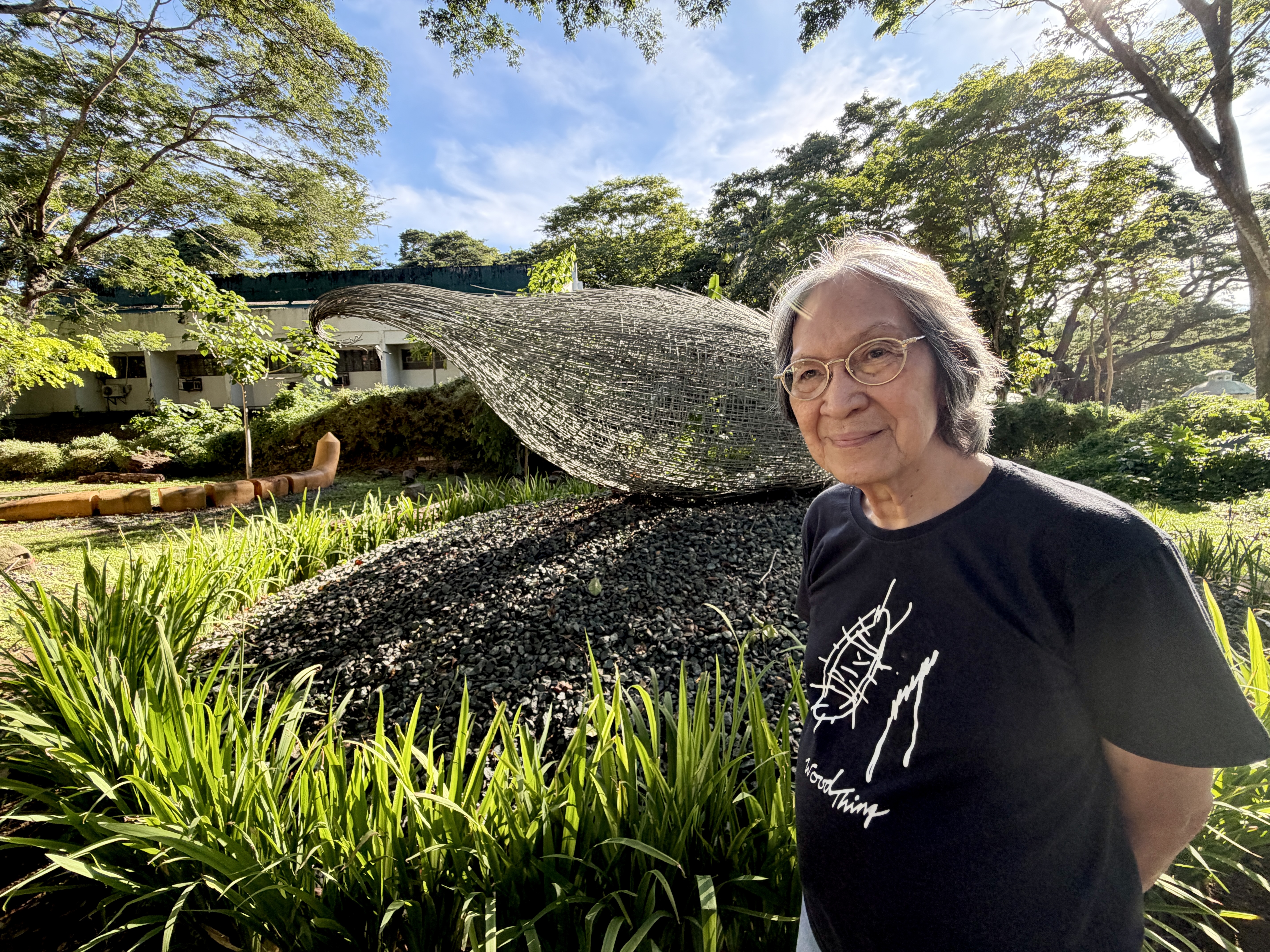
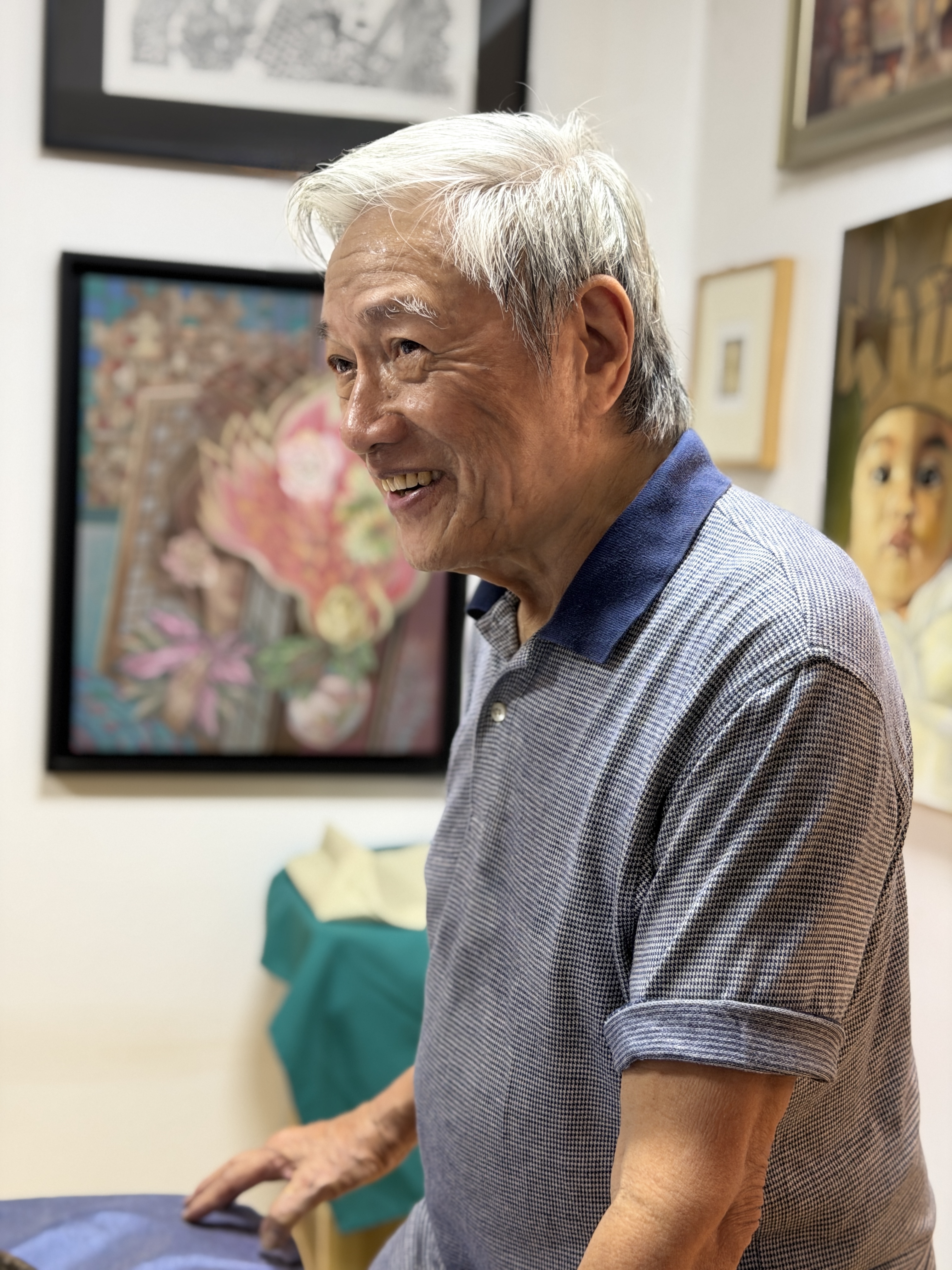
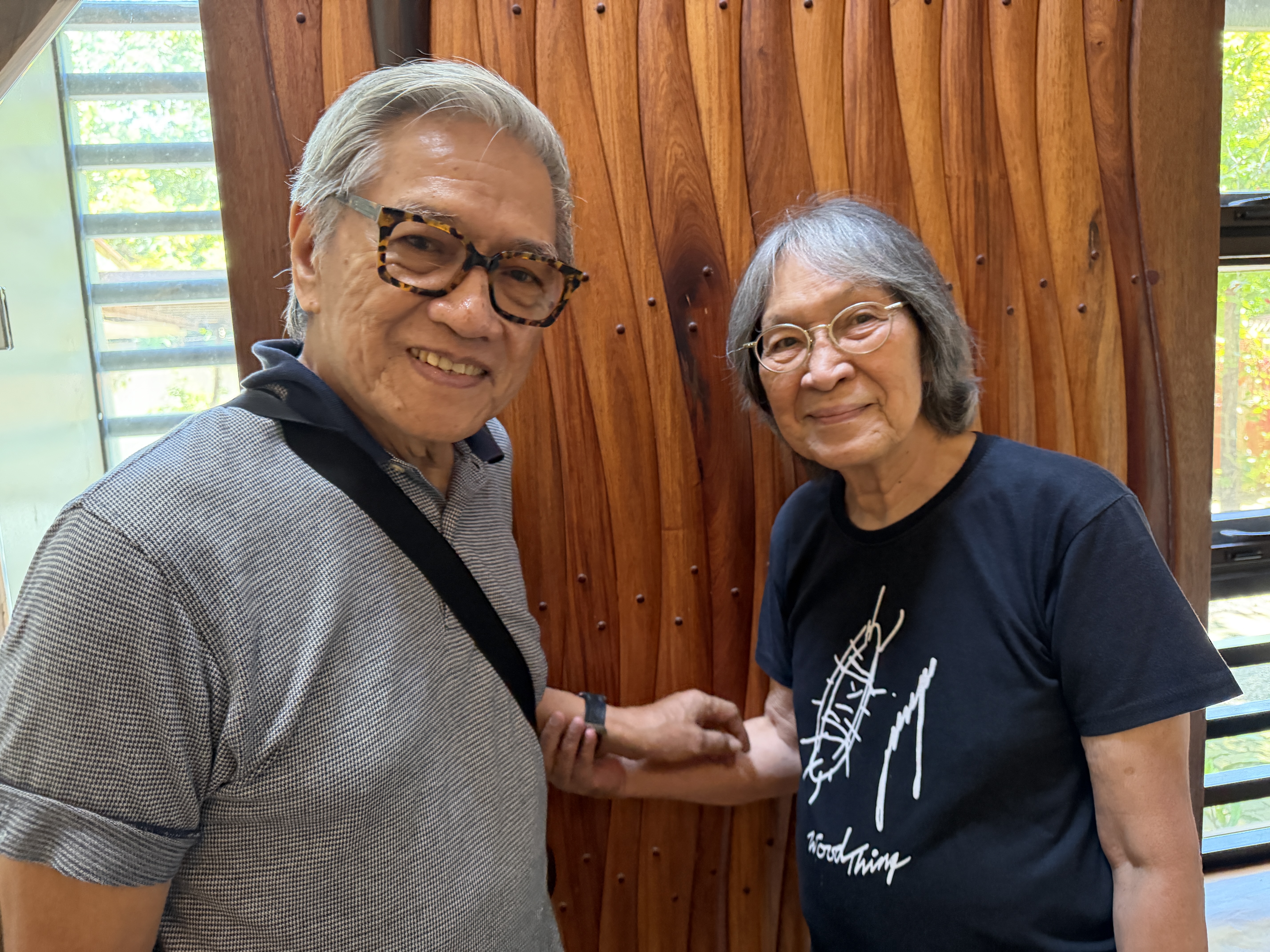
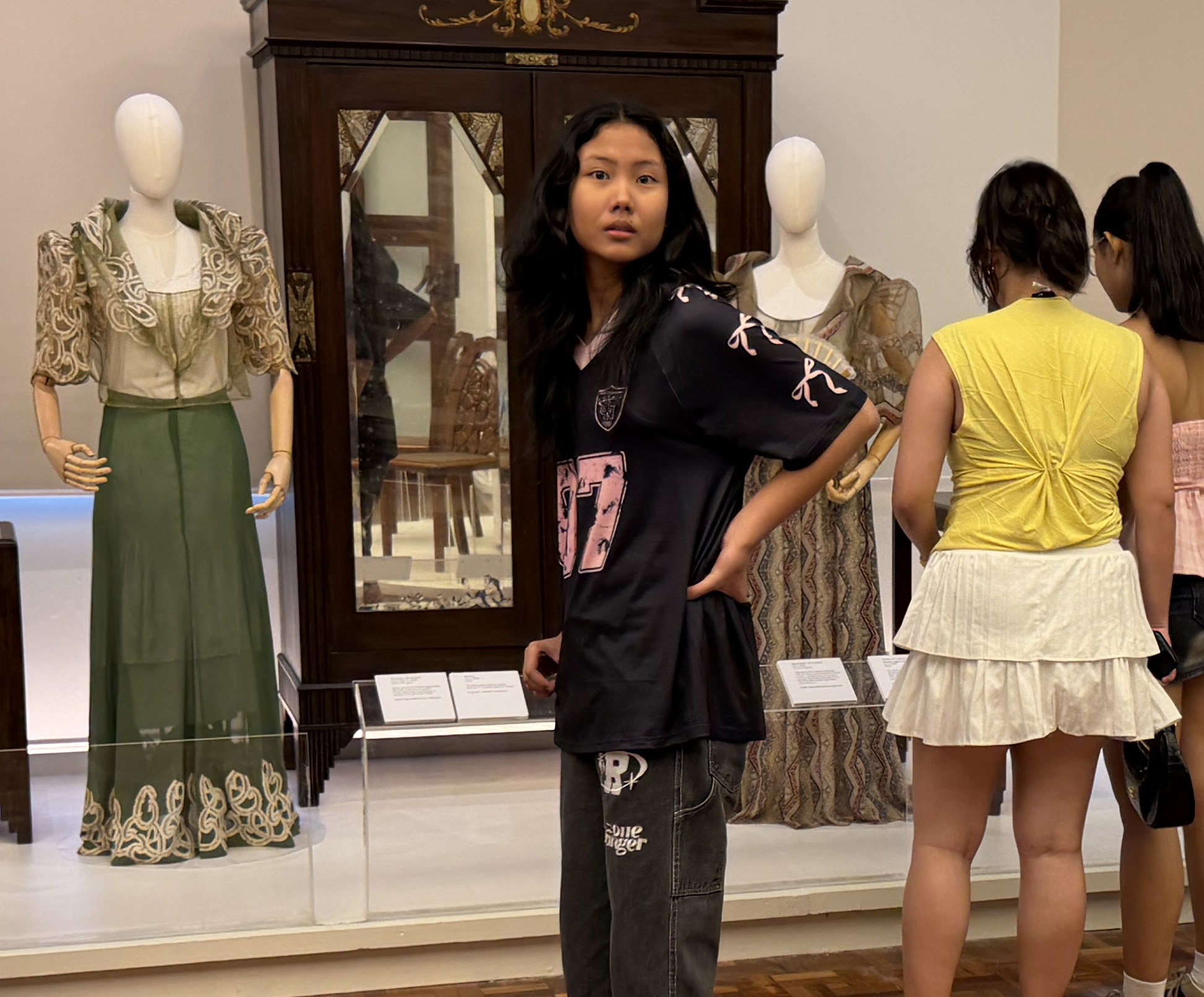
IT ISN’T every day that I get to spend time with two outstanding artists, and while I’ve become something of a recluse myself, exhausted by literary polemics and limiting my social life to very close friends, I couldn’t say no when my wife Beng asked me if I cared to join her on a day trip to Los Baños to visit the sculptor and painter Junyee. Junyee was a good friend of Beng’s from the UP College of Fine Arts, and while he lives in Los Baños with his wife Tess, Junyee has done many art installations around Diliman and often comes by our house on campus to drop off some buko pie. I’d enjoyed chatting with Junyee whenever our paths crossed, taking in his stories about his arduous struggle to become an artist, including a time when he had to work as a make-up artist for the dead in a funeral parlor in Cebu. But more on that later.

I was doubly pleased to learn that we would be accompanied to Los Baños by another artist-friend, Fil de la Cruz, whom I had known for over fifty years, and by his son Janos, also a talented and highly regarded young artist. Fil stands among our most brilliant, versatile, and accomplished printmakers; both he and Junyee have been nominated for the National Artist Award.

We had long been planning to visit Junyee in LB, where he and his wife Tess, who taught in UPLB, have lived for decades. When Tess retired a few years ago and they had to give up their home on campus, they found and bought a private lot just beyond the university property line, and built a new house there. Since anything that Junyee built was bound to be interesting, we wanted to see it, but the house was honestly just an excuse; we were going there for the artist himself. Now 84, Junyee recently hasn’t been in the best of health.

Though younger at 75, Fil has been facing serious challenges of his own. They had a lot to talk about, for sure—but we resolved to undertake this trip in high spirits, to celebrate art and life in joyful company. 

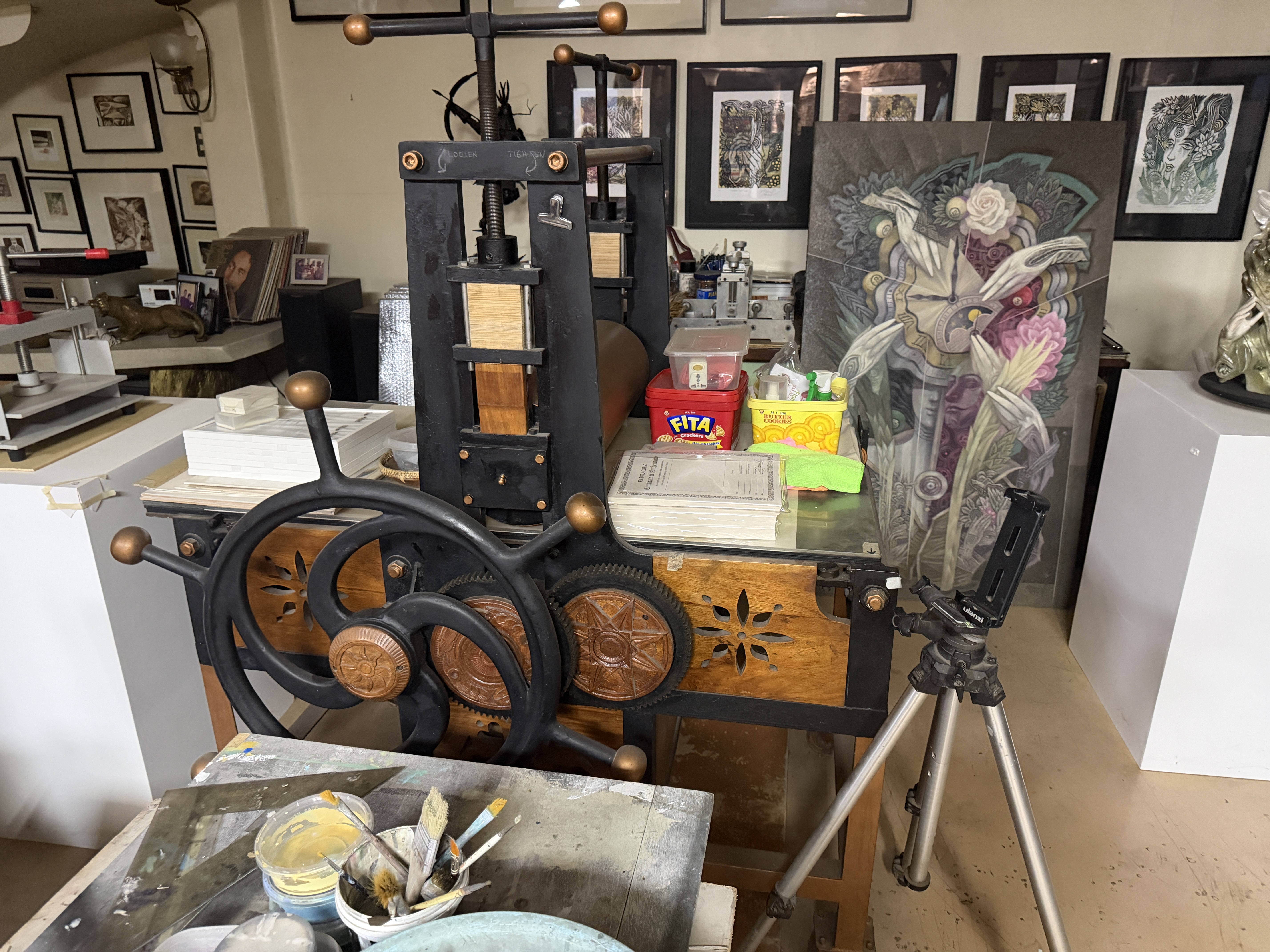
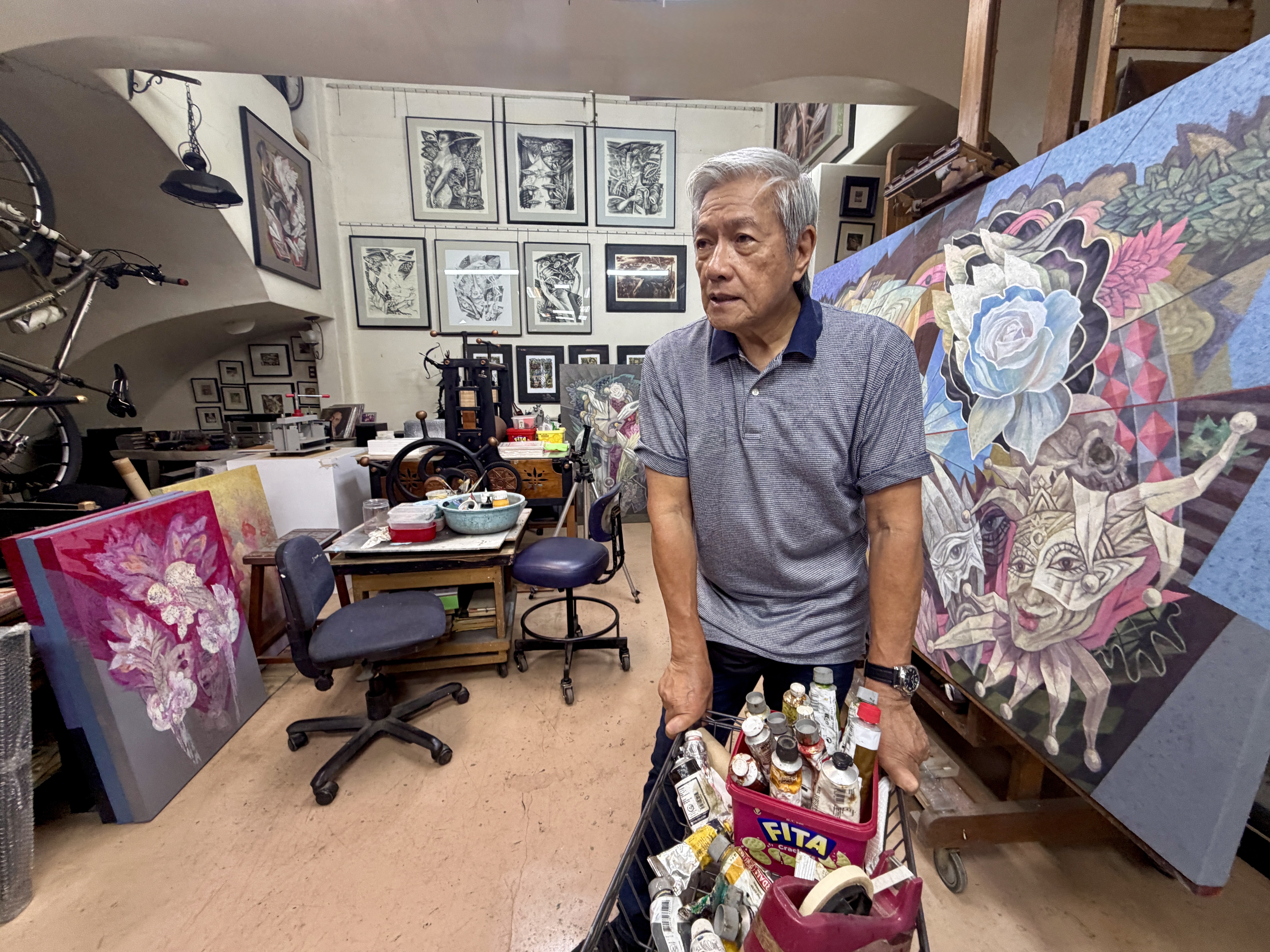
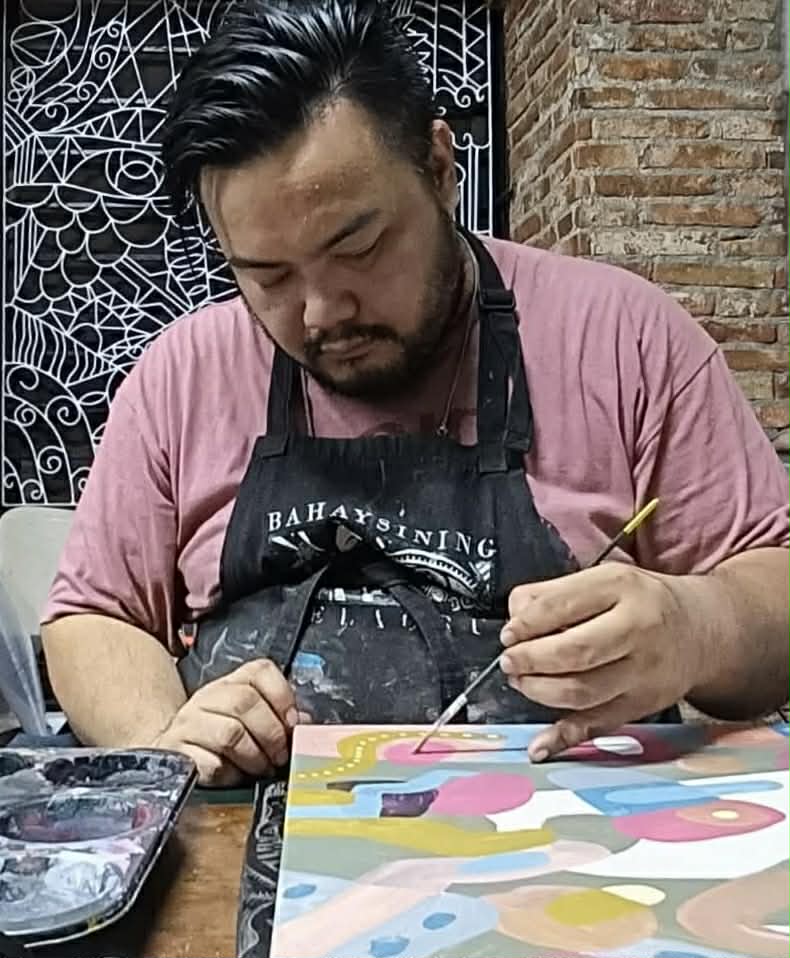
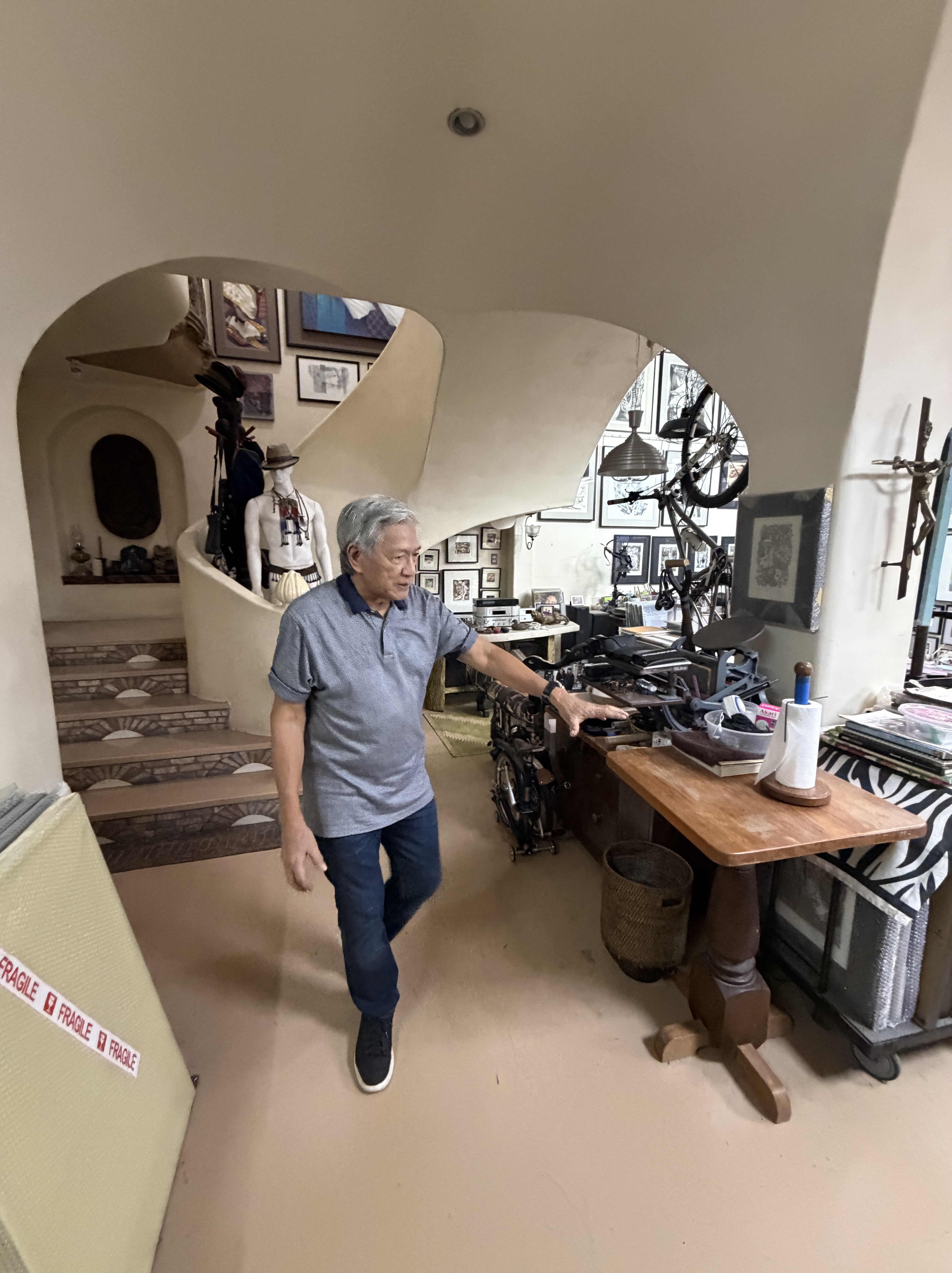
First we picked up Fil at his home in Muntinlupa. Aptly named Bahaysining, the three-story brick house is part (if not largely) studio, part gallery, and part living space, but immediately the visitor knows it’s a house made by artists for artists in both form and function. “This was much smaller early on,” Fil says of the place, ”and then I just kept adding to it as my practice and capabilities grew.” He shares the space with his son Janos, who keeps a studio of his own on the premises and helps his dad with both work and the daily business of living. 

The rooms teem with paintings, prints, drawings, sculptures, and most visibly, printmaking presses in various sizes that Fil himself designed and had made over the years. Much of his equipment rolls on wheels, the better to move them around when the studio has to meet a commission, and Fil and Janos have to labor long days and nights to get the job done. Fil is amazed that clients remember him and his work from way back and return to order new pieces. 

Fil also paints and sculpts as does Janos, but it’s in printmaking—the art of producing numbered copies of a design pressed on paper in limited editions—that you know his heart truly lies. I met Fil in the early 1970s in one of my past lives as a printmaker. He had graduated from his studies at UST, and I had just come out of martial law prison—where, to pass the time, I had taken up drawing with my fellow detainee Orly Castillo, who then took me under his wing at the Philippine Association of Printmakers in Ermita. The PAP was a hotbed of production for young artists then, and I was lucky to run into the likes of Bencab and Tiny Nuyda (not to mention a pretty girl named June “Beng” Poticar, who became my wife)—and yes, Fil de la Cruz, who even then was already establishing himself as a master of one of printmaking’s most difficult techniques, mezzotint, which produces an almost velvety texture. 

Perhaps because prints are relatively cheaper and come out in multiples, they’ve never quite gotten the respect they deserve, especially here in the Philippines, where the art market is enthralled by multimillion-peso paintings by the masters and by the exclusivity they exude. (Around 1974, when we were all working and hanging out at the PAP studio on Jorge Bocobo, it was a big day when a dealer came by to purchase our prints in bulk for as low as P15 per print, so she could stick them into frames she sold as décor to American servicemen in the bases.)

Fil’s come a long way from those days, and Bahaysining is a testament to his professional success, which has traveled a long arc from his youth in Bulacan and his student days at UST to further studies in New York and Paris, to over thirty solo exhibitions that have brought his prints to France, America, the former Czechoslovakia, Germany, China, Hong Kong, Korea, Spain, Belgium, and throughout the Philippines.

As it was a sunny weekday, the drive to Los Baños didn’t take long through the Jamboree route. Junyee had offered to take all of us out to lunch, but of course we first had to see and tour his and Tess’ three-year-old home. 

To know Junyee—“Luis Enano Yee Jr.” on his birth certificate—is to understand how inseparable art and life can be in the person who, from his youth onward, has seen art not only as descriptive or decorative but liberative, rooted yet transcendent, impermanent yet memorable. Widely acknowledged to be the father of installation art in the Philippines, Junyee has always been testing and pushing the boundaries of art, unbothered by commercial trends. Whether he works with discarded wood, woven metal, or wisps of sooty smoke, Junyee seems compelled to give physical shape to our thoughts and emotions, often using outdoor space as his canvas.

Born in the South and discouraged by his father from pursuing his artistic inclinations, Junyee fled to Manila and UP, where he apprenticed with Napoleon Abueva and found support from Jose Joya—masters whom he would soon surpass in competitions. Caught in the insurgent politics of the sixties, Junyee crafted work like his “Balag” trellis on which protesters could hang their slogans, but unlike many other artists of his time, he never let ideology dictate his insight and technique. He would later devote most of his art to environmental themes.

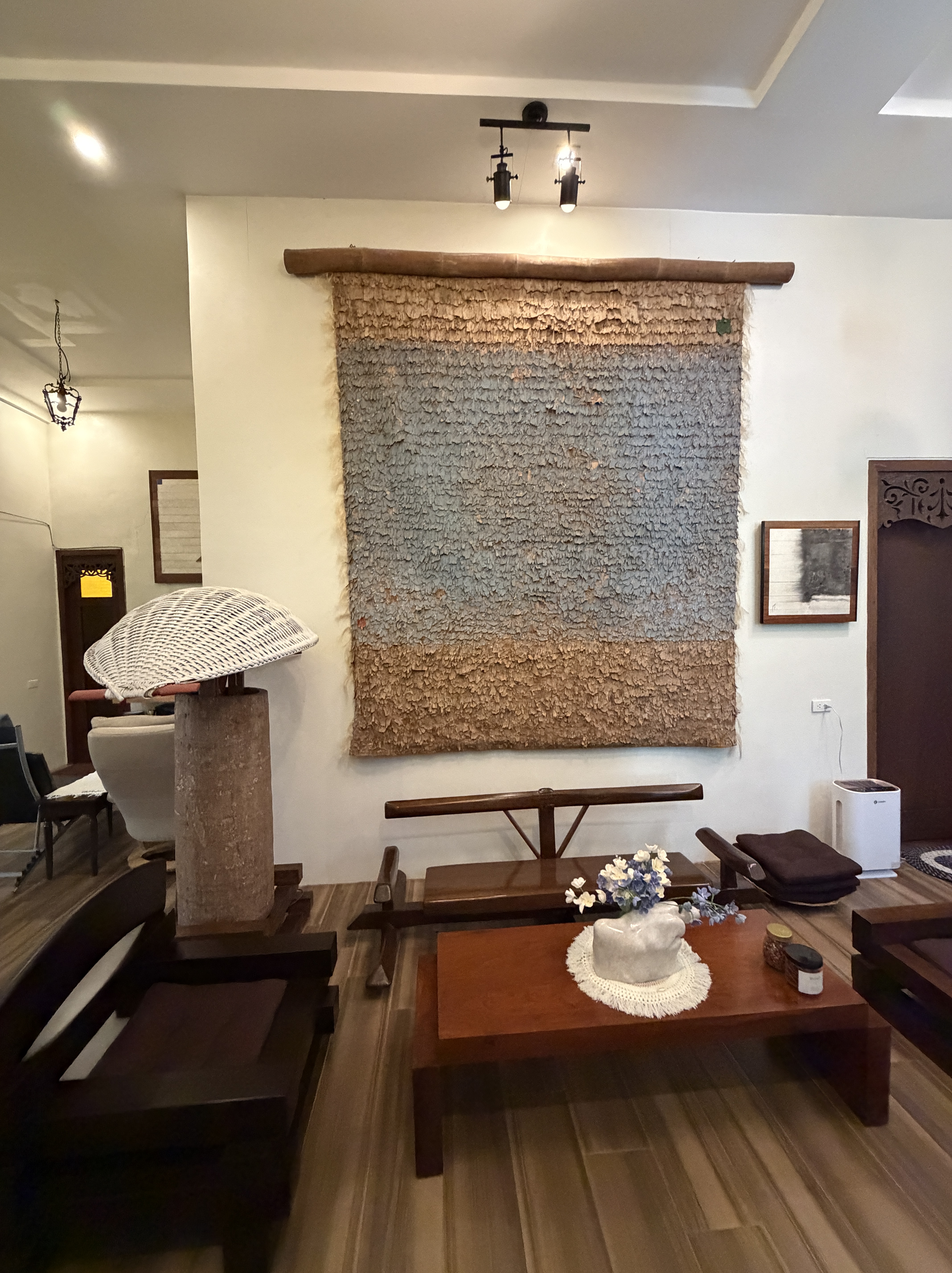
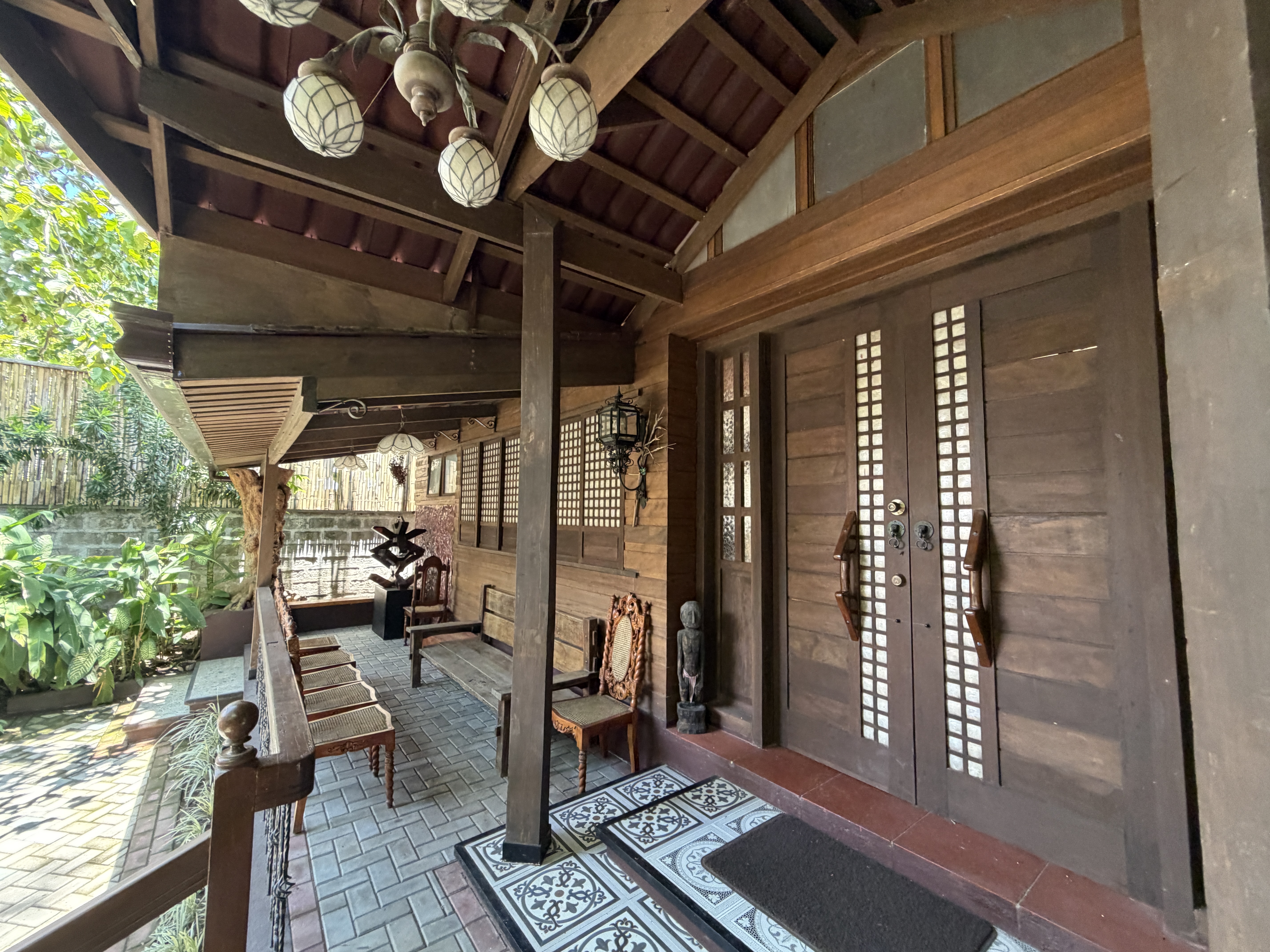
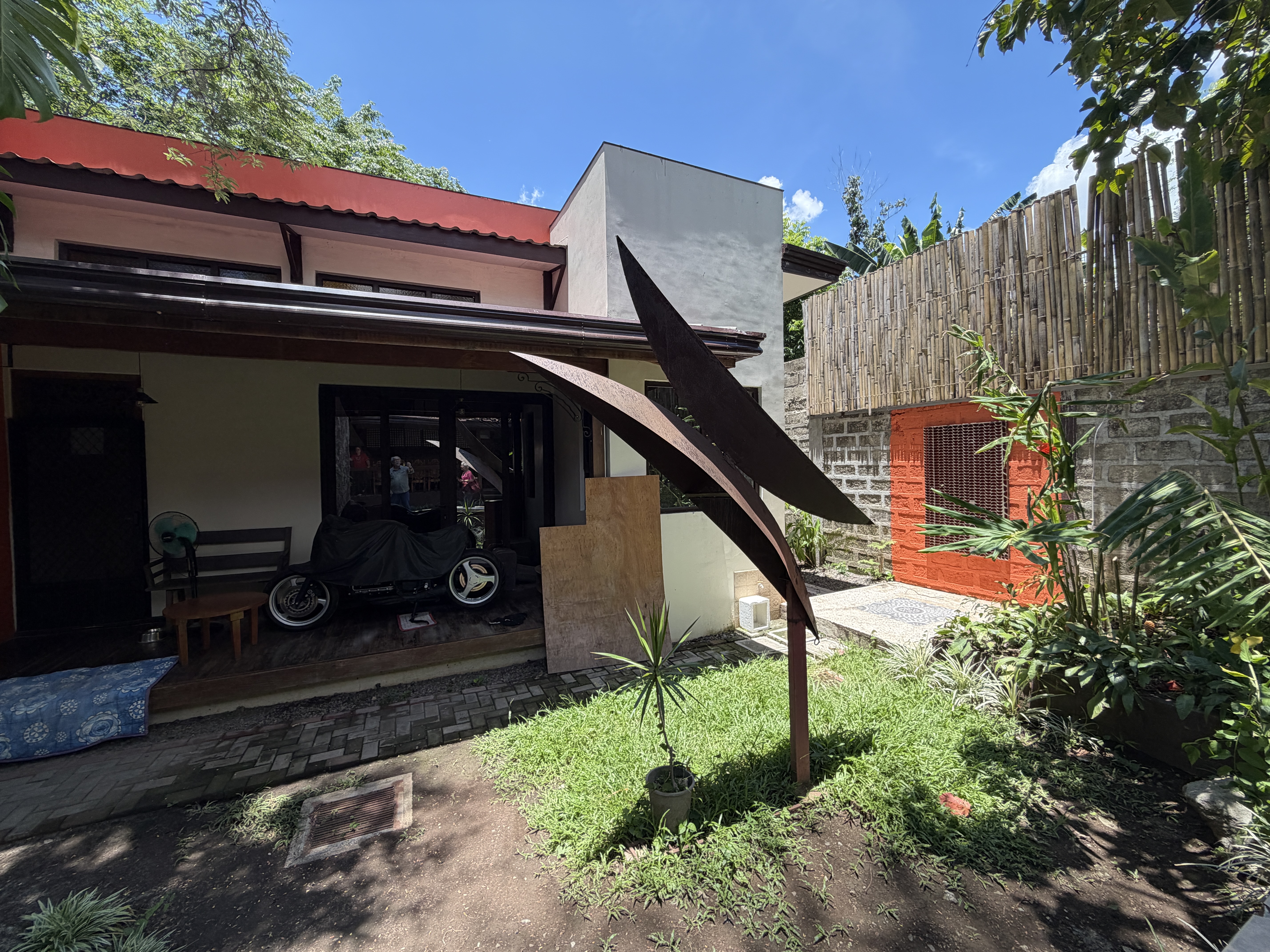
This was most evident in his new home, a modestly modern structure from the outside, nothing showy, but warm inside with wood, stone, and other natural elements, from the balayong door to the leaflike tapestry to the upturned hammock serving as a lampshade. 

Welcoming our party, Junyee points to a blank wall and remarks with a chuckle that something big used to hang there but had to be let go of, presumably for his crushing medications. It’s one of the few times he’ll advert to his maladies, of which he—and Fil for that matter—don’t make a big thing. When Junyee learns that Fil is similarly afflicted, the men knowingly embrace and call each other “classmate.” They smile, they laugh, they speak excitedly of the work that occupies their waking hours. There’s no time to be glum. Fil and Janos keep racks of sporty bicycles at home, hanging from the ceiling; Junyee shows off a gleaming high-performance BMW motorbike which he received from a patron, adding with a chuckle that “I don’t even know how to ride one!”

Over lunch at a favorite restaurant nearby, we have an animated discussion of AI and its likely effects on art and literature. I expect them to resist, but Junyee in particular is surprisingly open to the possibilities of hybridizing art and technology, as I am. “I’ve always been a fan of science,” he says, “and when I write my memoirs, which I’ll be doing soon, I’ll make sure to include a section on how science has influenced my life and work.” But even more useful and valuable than science for both men right now is faith, and Fil and Junyee speak unabashedly of how their faith strengthens them through their trials. As an installation artist, Junyee has never worried about transience and impermanence. “Everything in this world will pass anyway,” he says.

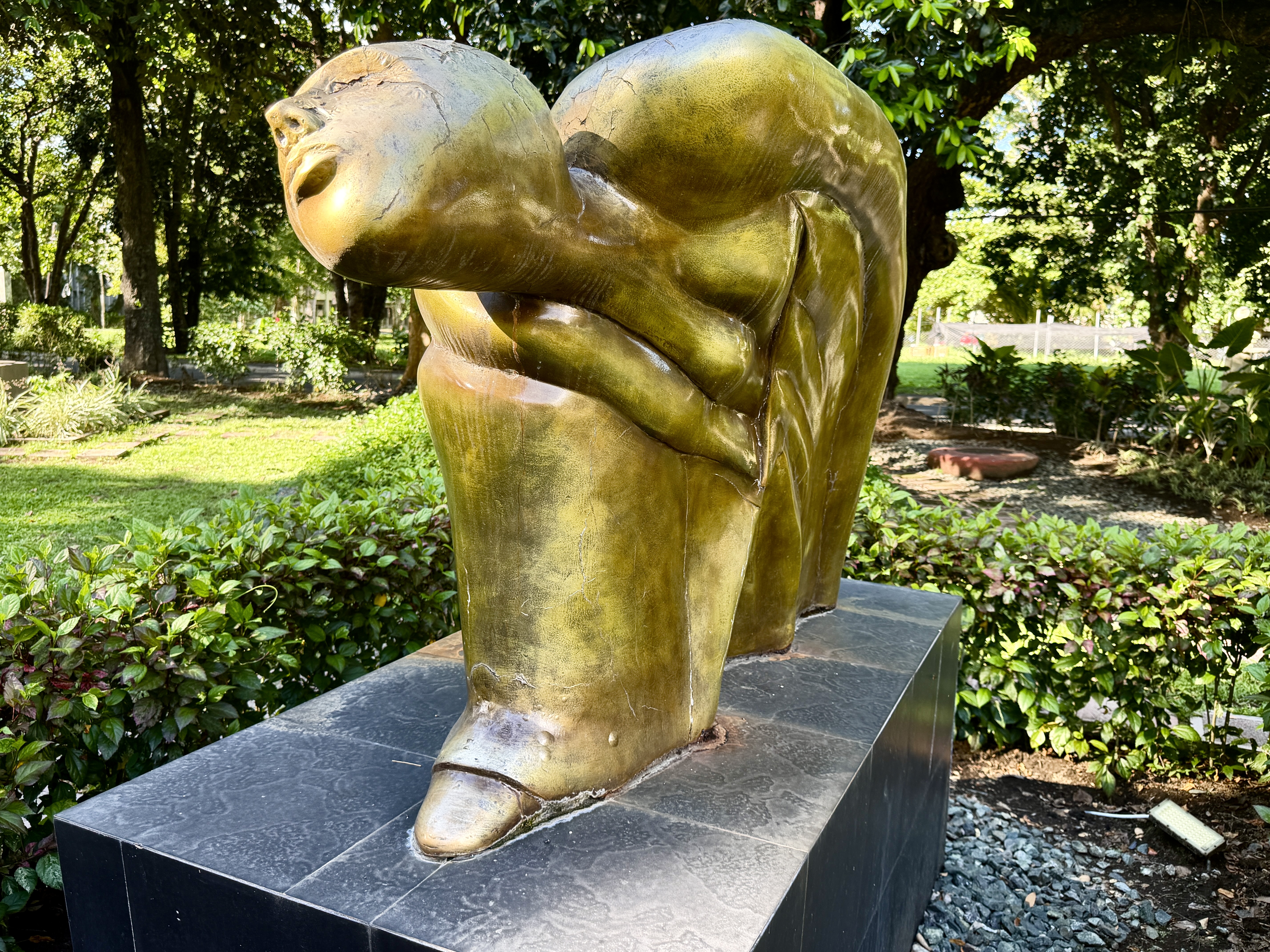
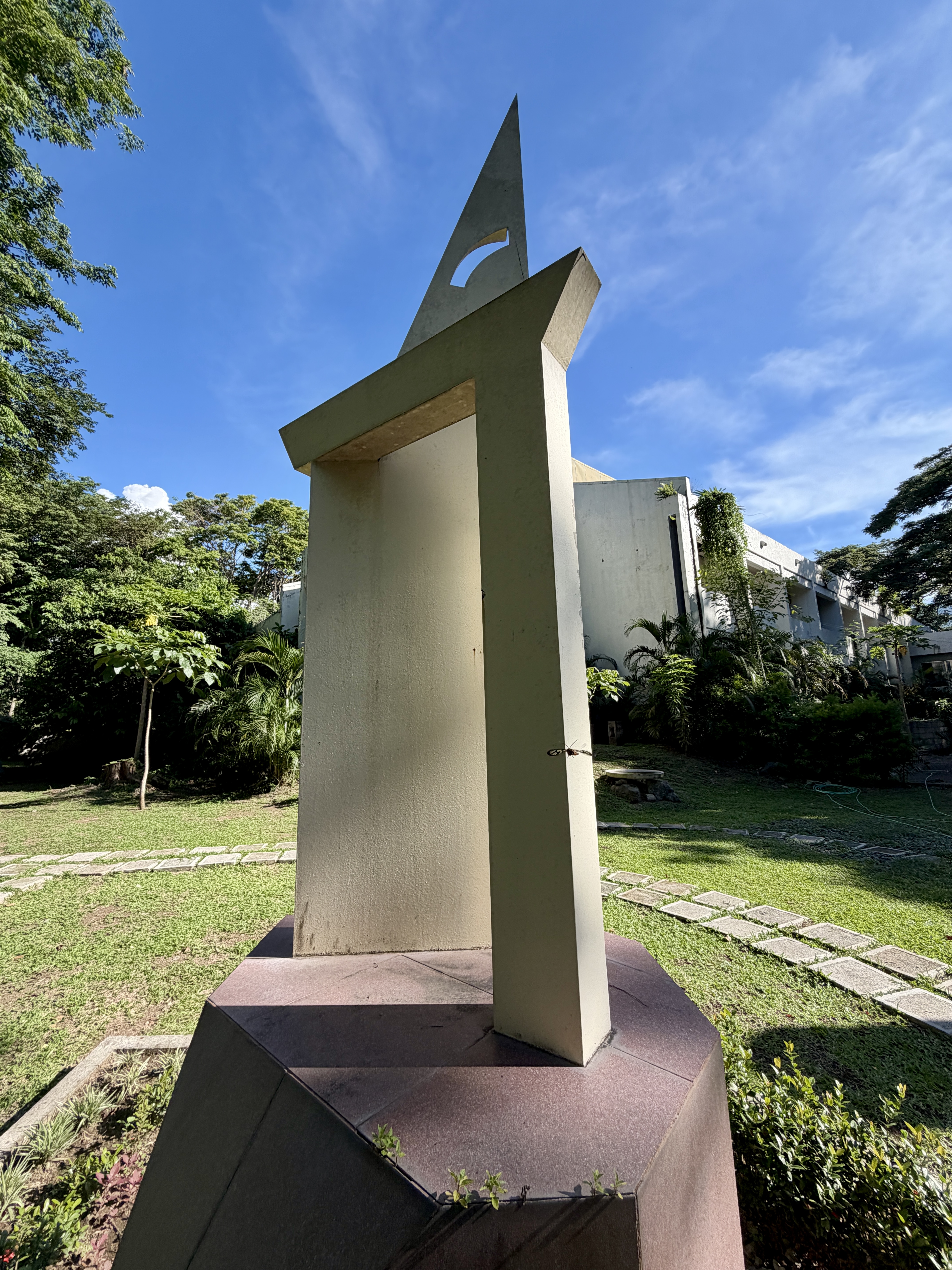
We pay a visit to the Sculpture Garden that UP Los Baños has put up on campus to showcase some of Junyee’s most important pieces. It is an outdoor gallery of some of his finest pieces, displaying the full range of his concerns, techniques, and capabilities. It’s hugely impressive, but Junyee makes it clear that he isn’t done yet. Across his home, he is constructing an art museum that he hopes will help spark a cultural renaissance in Los Baños, better known for agriculture and forestry, which Junyee’s art has also tapped into. His labors have not gone unnoticed; on top of his numerous local and international awards, Junyee will soon be receiving the highest recognition his alma mater can confer, among the worthiest of its recipients.

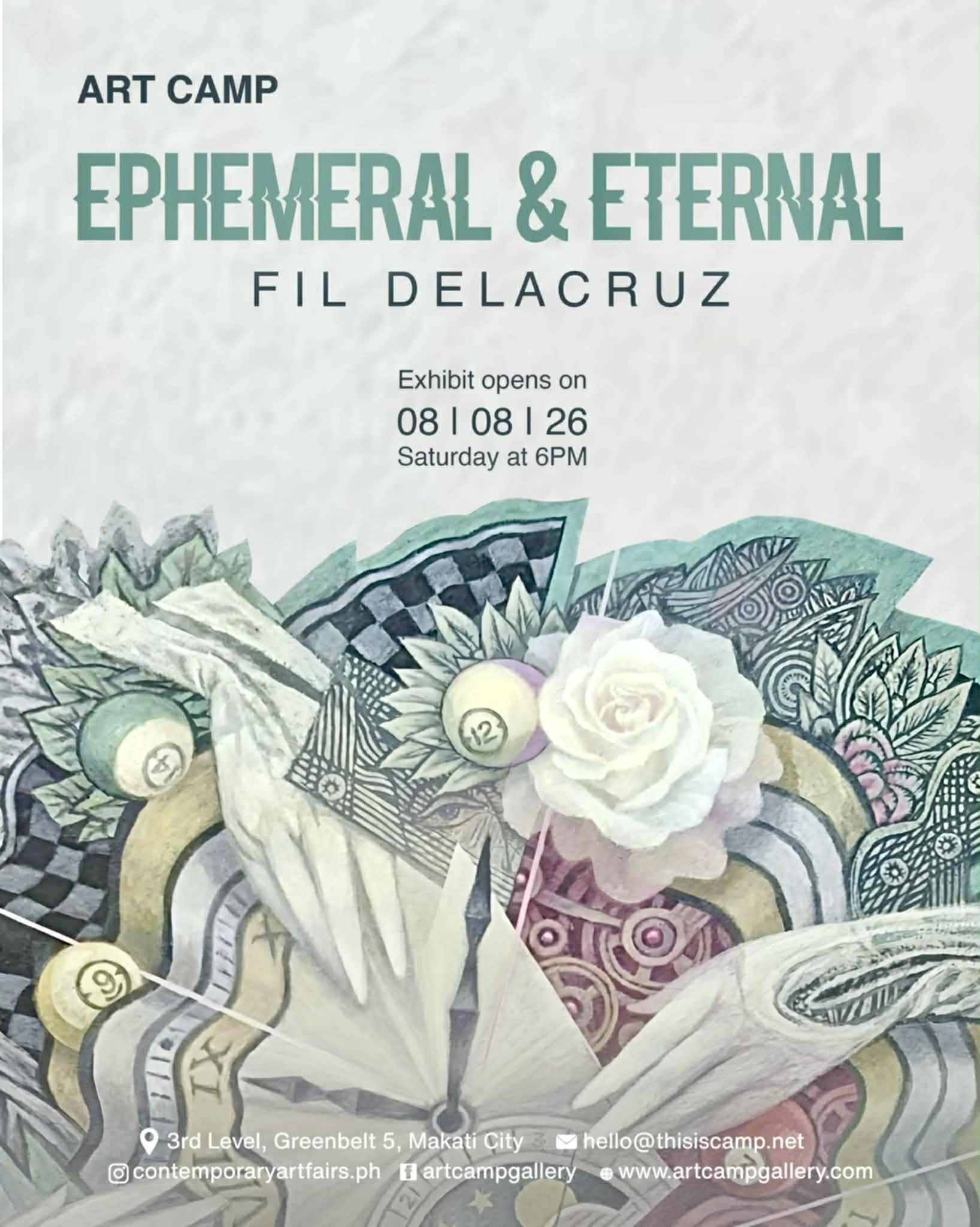
Neither is Fil de la Cruz resting on his laurels. He’ll be showing his newest paintings in an exhibit titled “Ephemeral & Eternal” opening next Saturday, August 8, running until the 22nd at Art Camp in Greenbelt 5, Makati. “The central thesis of the exhibition revolves around the duality of existence—the fleeting ‘ephemeral’ moments of lived experience versus the ‘eternal’ span of divinity,” according to the exhibit notes. “De la Cruz does not present time as a linear progression but as a divine force, encompassing all. In this series, he treats the passage of time not with anxiety, but with a refined serenity and deep reverence, seeking to capture the precise point where the transitory nature of life intersects with the infinite.” 

It’s as good a description as any of that trip to Los Baños and of our visit to these artist-friends’ homes, at this point between our shared past and the eternity that beckons to all of us.

Penman No. 487: A Prize for AI?

Penman for Sunday, July 12, 2026

LAST MAY, the literary world was rocked by the news that the winner of the Commonwealth Literary Prize—a short story titled “The Serpent in the Grove” by a little-known writer from Trinidad named Jamir Nazir—had been written using AI. Words like “fraud” and “hoax” flew out quickly into cyberspace. Probably suspecting something was off, someone had used an AI-detector app called Pangram to scan the piece, which returned an unequivocally damning judgment: “100% AI-generated.” 

Along with other Commonwealth winners, the story had been published in the respected literary magazine Granta. Given the uproar, the Commonwealth Prize judges reviewed Nazir’s drafts, and pronounced the work authentic; Granta severed its ties with the foundation giving the prize, but has retained the story on its website anyway for all to see and evaluate.

And that’s exactly what I did—go the website and read the work for myself before coming to any conclusion of my own.

Now, it’s not as if literary hoaxes are anything new; it’s happened before, and it’s even happened here. Long before AI, plagiarism and outright invention (a crime in the case of nonfiction) were practiced not only by the lazy and untalented but also by the cunning. Among the most notorious cases in the US were those of James Frey, who fabricated large sections of his bestselling memoirs, and Janet Cooke, whose Pulitzer-prizewinning story for the Washington Post turned out to be based on an entirely fictional character. Here in the Philippines, a postal clerk named Jose Marco duped generations of Filipinos into believing that the Code of Kalantiaw and a novel by Fr. Jose Burgos titled La Loba Negra were the real thing.

The fraud in these cases was uncovered not by programs like Pangram or GPTZero but by dogged scholarship—in the case of Kalantiaw, through the work of the historian William Henry Scott, who showed that Marco’s “code” had words that weren’t in use until centuries later.

Even with software, proving literary deception today is a lot more difficult, because creative writing almost by definition is, well, deception of the highest order, extremely liberal in its methods and means, and devious (without being necessarily evil) in its motivations. Fiction especially is intrinsically ambiguous, unlike journalism which rests on fact. So how can anyone be sure that this prizewinner was faked?

“The Serpent in the Grove” is not a very long short story at less than 3,400 words, and the controversy aside, is certainly an interesting if not significant one in many ways: freshness of language, simplicity of plot but complexity of character, power of imagination. It talks of a man named Vishnu who, enamored of a vamp he meets at the bar, contrives to drown his wife Sita in a well; she falls into it but then manages to crawl out with a neighbor’s help. Sita and even their young son seem to understand exactly what has happened, but no one brings it up and they somehow manage to survive into old age keeping that terrible truth unspoken. 

Some people have savaged the story after the scandal broke, in the way people change their minds instantly about someone after being told that person served time for rape or murder. Personally—and this could well be an unpopular opinion—I found it rich and engrossing, at least partly because of very same startling metaphors that got flagged as AI giveaways. It’s not an easy read, with its localized English, and I could see how Western readers attuned to the kind of language you hear at Walmart would find it painfully artificial (my friends in the Midwest found Nick Joaquin “too lush” when I had them read him). I don’t write that way myself, which is probably why it intrigues me even more. Here are some random excerpts:

“Sita moved quiet as if sound were taxed. Nineteen and brown like dust after rain, she turned roti dough with a rhythm that came not from joy but from endurance.”

“Marsha lived two bends down. If the village had a mouth, it was hers. Big in the way of women who never apologize to furniture, she had a laugh that shook dust from joists and a voice that could soften to coax a child from a ledge. She knew the ways of men hollowed by want until only one thing remained. She noticed the fresh-cut path and the way land bore witness. People talk about bush like it dumb. But bush keeps memory the way hair keeps scent.”

“Sita lifted two planks and slid them aside. Wood complained in a voice too near speech. She lowered the pail until rope slackened. Smell rose—old wet, crushed jasmine, frog skin. On the second haul, the board beneath her shifted the way a tired man shifts in his sleep. The plank gave one long groan and swallowed its word. Stone, shoulder, hip; shock of cold tearing breath. One foot banged and screamed. The wall was slick as lizard. She clawed moss and slid. Water took her and would not return her.”

So what did the software flag? Unlikely metaphors, it said, like the vamp “had the kind of walking that made benches become men.” Or that a character “smiled like sunrise over a sink.” It noted that there were nearly a hundred metaphors in such a short piece. It claimed that in the sentence “Coffee and cocoa leaned wild on a slope that wanted either rain in teeth or none at all,” the phrase “rain in teeth” made no sense, was a hallucination. 

But at this point, my own gut was telling me to trust Pangram less than the author. Call me dumb, but I find “rain in teeth” rather fetching. Any first-time workshopper would get that.

So would I have given the story a prize? That would depend on its competitors, which I haven’t seen, but it’s surely a story I would teach, both for its own merits and for its alleged employment of AI. I might even do that this incoming semester, when, for the first time in many years and possibly the last, I’ll be teaching an undergraduate class in Professional Writing. It’s a course I designed and had been teaching for two decades, but the big difference this time is that we’ll be dealing with AI—which is something that I don’t intend to ban outright (like Canute commanding the waves) but to grapple with head-on, negotiating the line between one’s imagination and what AI might do. I can foresee how controversial this will be, and I recognize the adamant opposition to AI from many writers and artists on both aesthetic and ethical grounds, but at 72, this could be my last look over the horizon. (I’ve already declared that I will no longer judge literary contests nor take part in literary workshops except in my own classes, so this will be my arena for engaging with AI.)

I wouldn’t be surprised if, in the future (and if it hasn’t happened already), some smartass with an ax to grind enters a wholly AI-generated story or poem into the Palancas, only so that when trusting judges make it win, he or she can declare them and the entire literary Establishment (yes, that cabal of superannuated gatekeepers who keep ignoring one’s literary genius) a bunch of fools.

Right now, what I’m thinking is, if you can come up with the kind of prompt that produces “The Serpent in the Grove,” then you deserve a prize—maybe not the Commonwealth one, which is still an open question, but at least one for inventiveness and audacity which seem to remain in short supply in what I’ve been reading, with or without AI.

Qwertyman No. 197: Cultural Lobotomy

Qwertyman for Monday, May 11, 2026

OUR FRIEND Toym Imao, among our most talented and productive sculptors, also serves as dean of the UP College of Fine Arts where my wife Beng teaches art conservation. Lately, like many academic administrators, Toym’s been feeling embattled because of the lack of resources given to his college, whose buildings may look new and good on the outside but whose roofs leak, among other ailments and deficiencies. (At least they have a building; my home College of Arts and Letters is still a vagrant in Diliman, more than ten years after the Faculty Center burned down.) Beng—who envisions the creation of a formal art conservation program and center in UP to serve the country’s longstanding needs in this area—sometimes has to teach in the garage of our campus home for lack of table space in their department. 

Let me quote a few salient lines from Toym’s self-described “rant,” which he published online:

“When students are treated as customers (rather than our future), when education becomes a service (than a mission), and when institutions are driven by metrics, compliance, and efficiency, we lose something essential.

“We lose the art school as a space of imagination. As a space of critique and discourse. As a space where we form not just skills, but ways of thinking. A space of engagement and confrontation. A space to take risks and make mistakes in a nurturing environment.

“An art school is not a diploma factory, it is a well of souls, it is a spirit house. If we lose these purposes, we do not just weaken education. We weaken our culture, we lose our spirit as a nation.”

But now Toym & Co. are up against an even bigger enemy, beyond leaking roofs and bureaucratic indifference: a government-sponsored initiative to gut the humanities and to bleed it out of the college curriculum so young Filipinos could enter the workforce sooner. 

The comeuppance of certain pseudo-journalists aside, no issue stood out in our FB feeds over this past week as much as the widespread outrage over the Commission on Higher Education’s proposed “Reframed General Education” program, cutting required GE units from 36 down to 18. They’ll do this by shoehorning the old (and already much-compressed) arts and humanities courses into such brainy-sounding but essentially hollow subjects as “Data, Evidence, and Ethics in a Knowledge Society” (which sounds to me like a puffed-up way of saying “Don’t use AI to plagiarize and write your homework,” which I’ll bet is how it’s going to be taught).

It isn’t hard to imagine how this act of cultural lobotomy came about: the CHED people were given marching orders from the start to find a way of cramming some GE subjects into a three-year curriculum. Never mind what kind of chop suey recipe they would come up with—like mixing a smattering of Philippine history into a sludge of Rizal; just fit everything in three years, and all will be well. 

I’m not even going to discuss in detail how and why the CHED proposal is such a sad, silly, an even stupid solution to a problem that, to begin with, is ill-defined. You can look up the analyses of people more attuned to the theory of education than I am—aside from Toym Imao, experts like Profs. Antonio P. Contreras, Mark Joseph Calano, and Jose Wendell Capili have already written extensively about this, and about the necessity of the humanities in our formation as humans and citizens. 

I will, however, raise a few points and questions for further thought:

Is the problem employability, of not teaching our young the skills our workplaces require? Are the arts and humanities–including language and history—therefore excess baggage that workers don’t need to do their jobs well?

General education isn’t about creating unemployable artists. It’s about helping ordinary people think like artists do—creatively, intuitively, critically, out of the box, to find better viewpoints and solutions than numbers alone can provide. And speaking of unemployed artists, why not build up and support creative industries like South Korea and other countries do, to channel our natural abilities in design, performance, and expression into globally competitive endeavors?

And who and where are the synoptic geniuses who are going to teach these massively integrated courses? Instructors who have a hard time teaching even basic English, and whose own grasp of history and philosophy is tenuous at best?

There’s a lot of the “digital” in the “reframed” GE program, a nod to the pervasiveness of the Internet and AI in education. But the real challenge is not how to detect and use AI, but to be naturally intelligent: to think and reason for yourself without reaching for your phone.

Bad education isn’t going to fix a bad economy and bad governance. But a good education that teaches young people the difference between right and wrong and between good and bad—and only the humanities can do that—will help them elect good leaders who can then make the best decisions for our economic well-being. 

“We have to do something!” cried Beng, as always the more ardent activist between the two of us. “Let’s rally in front of CHED. Let’s show them how strongly we feel about this issue!”

Of course I’ll go march with Beng wherever she goes, but I suspect that in this day and age, rallies don’t work as well as they used to. You’ll shout yourselves hoarse telling your co-marchers things they already know, while the people inside the office go about making coffee and sharing BTS chismis. You might get on the evening news, in between a mugging and a fashion piece.

You have to find the people who can actually change policy, and exert pressure there. They’re in Congress and the Senate, which controls the pursestrings and can make state university presidents and agency heads mumble like marionettes at budget hearings.

The trouble is, even people you’d expect to know better don’t seem to know any better. Sen. Sherwin Gatchalian, who chairs the Senate Basic Education  Committee while co-chairing the influential Edcom 2, is behind the push to cut college down to three years. His proposed Senate Bill 51 aiming for just that is the wind behind the CHED technical committee’s wings. That leaves us with Higher Education Committee Chair Loren Legarda, a staunch champion of the arts and culture, to bear the burden of our arguments in the arena where it matters.

She’ll have a lot of championing to do, against the likes of Sen. Robinhood Padilla, (mind you, the one in charge of constitutional amendments) who has opined that the job of opposition senators is, well, to oppose anything and everything. Indeed, the fact that we have people like him in the Senate is the best argument for a strong GE program—not just to educate them, but to make sure young Filipinos don’t vote donkeys (I’m using the kinder term here) into the Senate ever again.

Just thinking about it makes me want to put on my marching shoes, and I don’t care if Beng and I end up shouting into the wind. 

Penman No. 485: Forever Young—in Yearbooks

Penman for Sunday, May 3, 2026

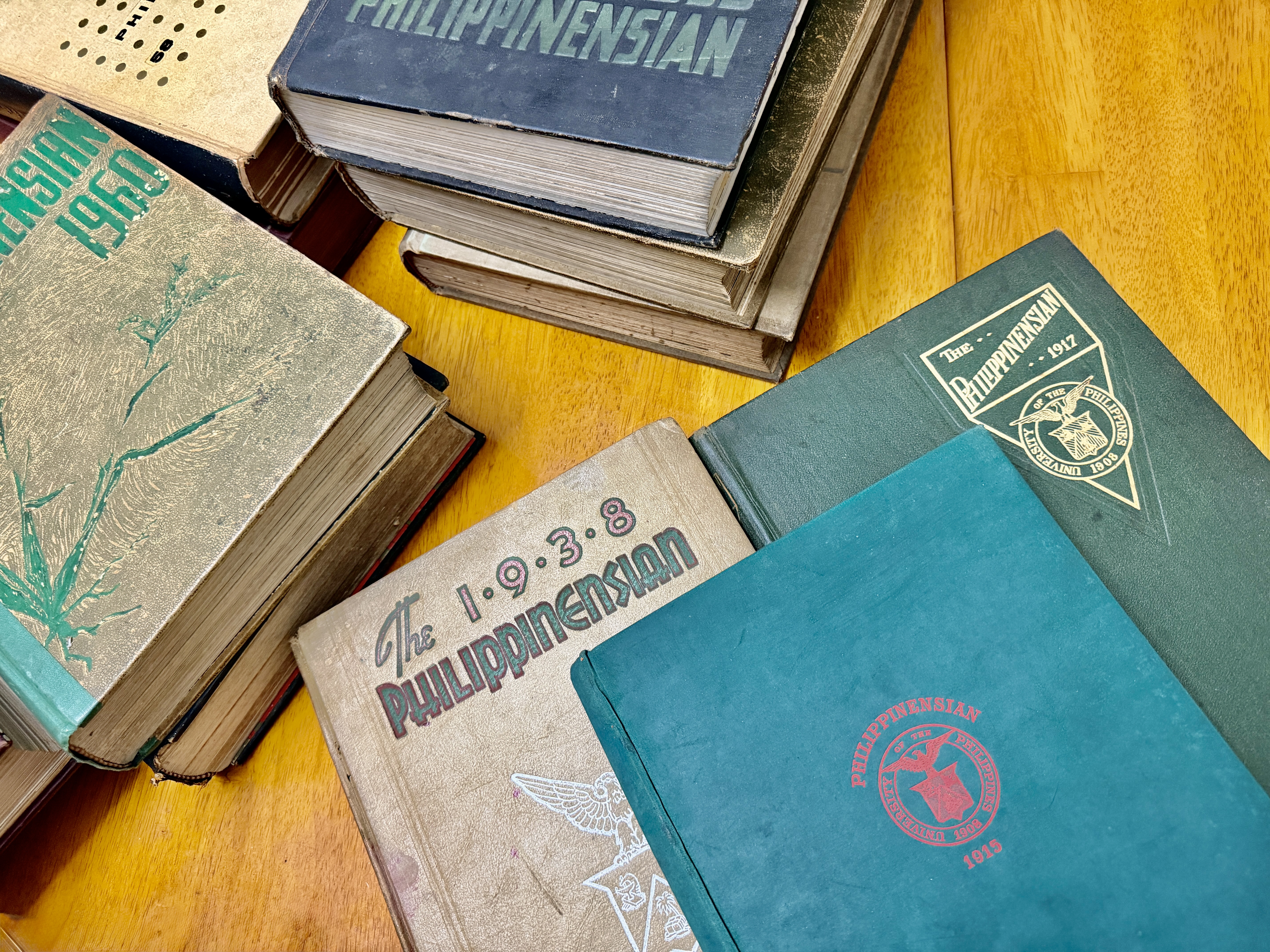
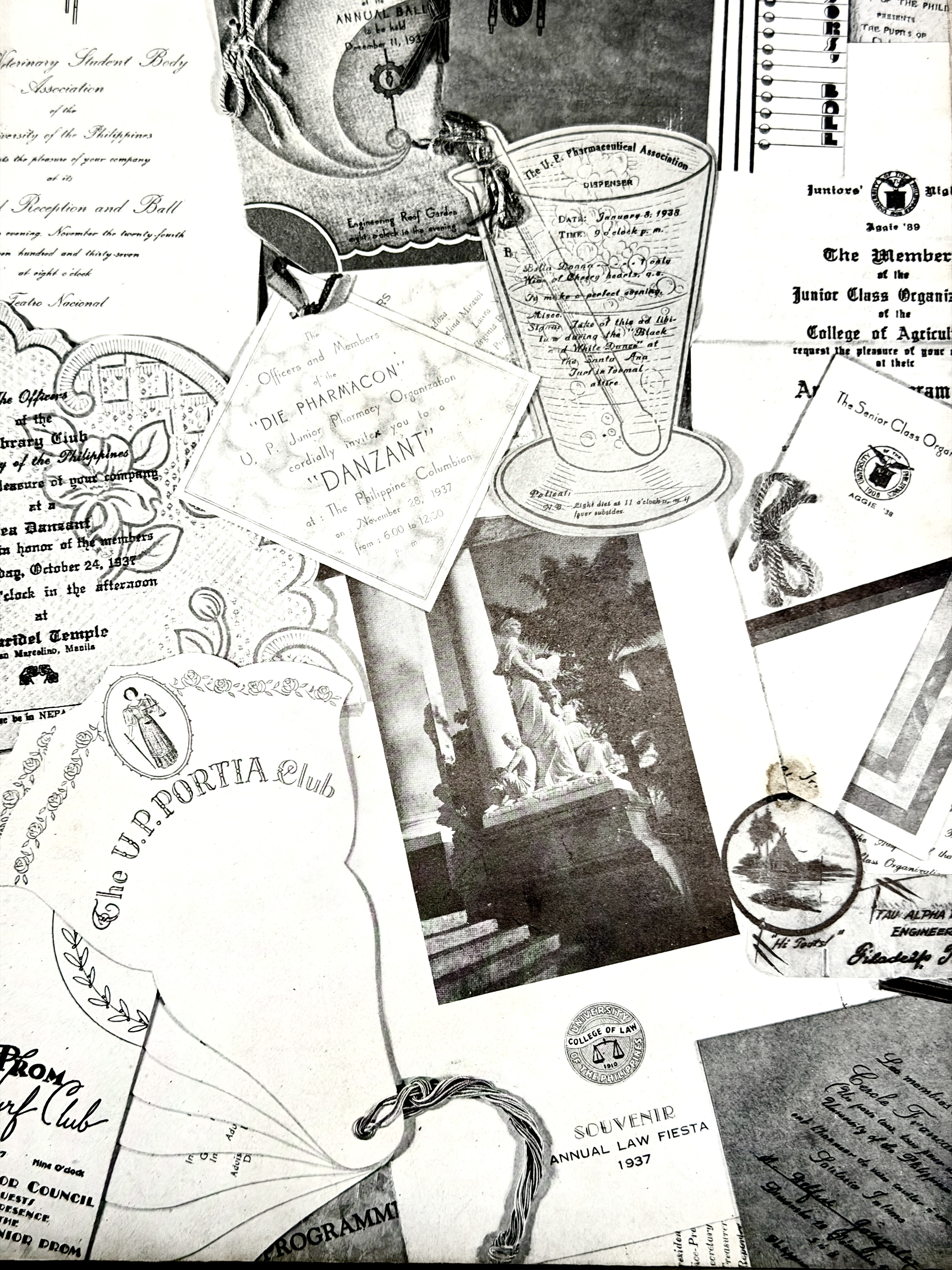
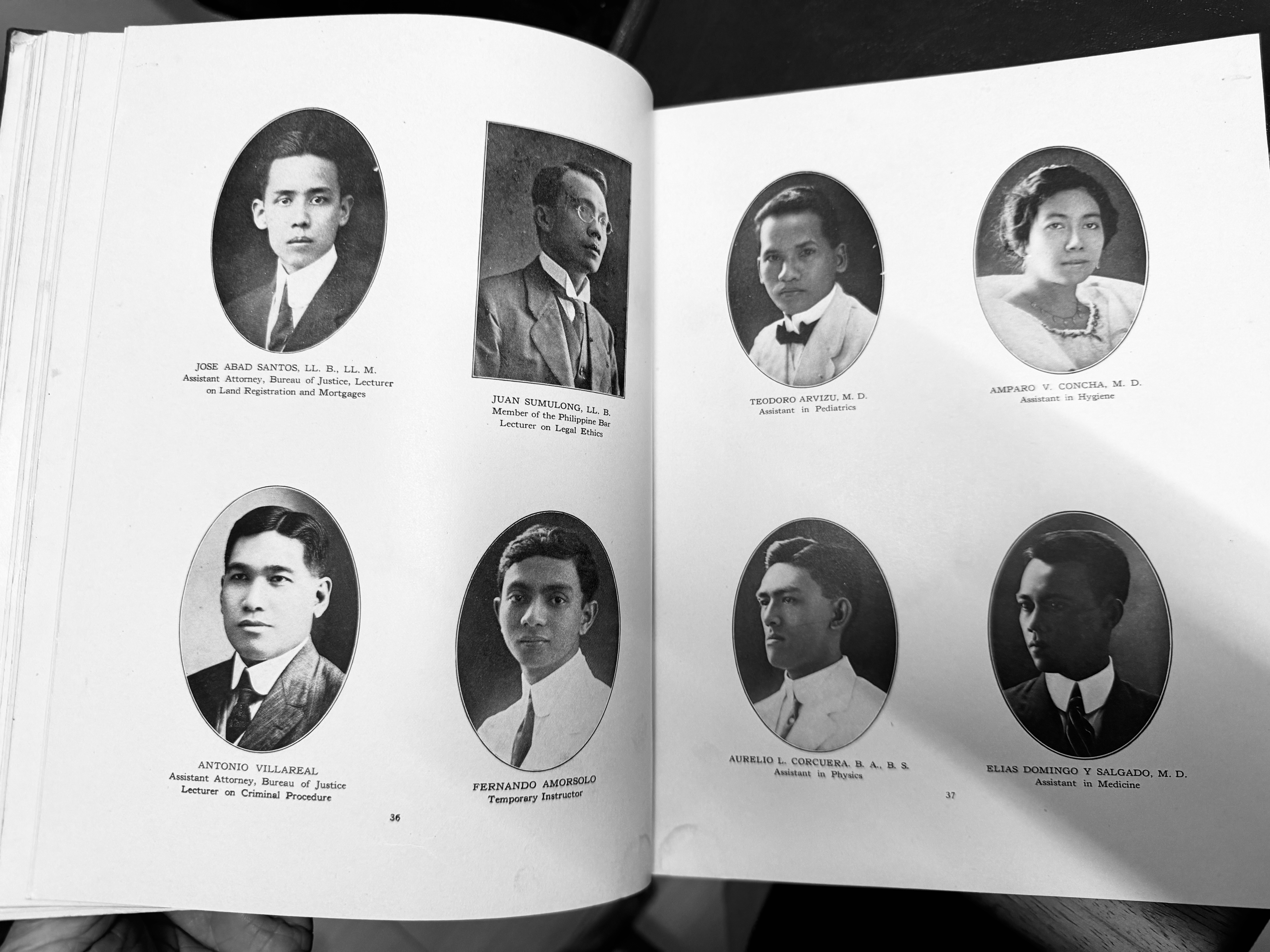
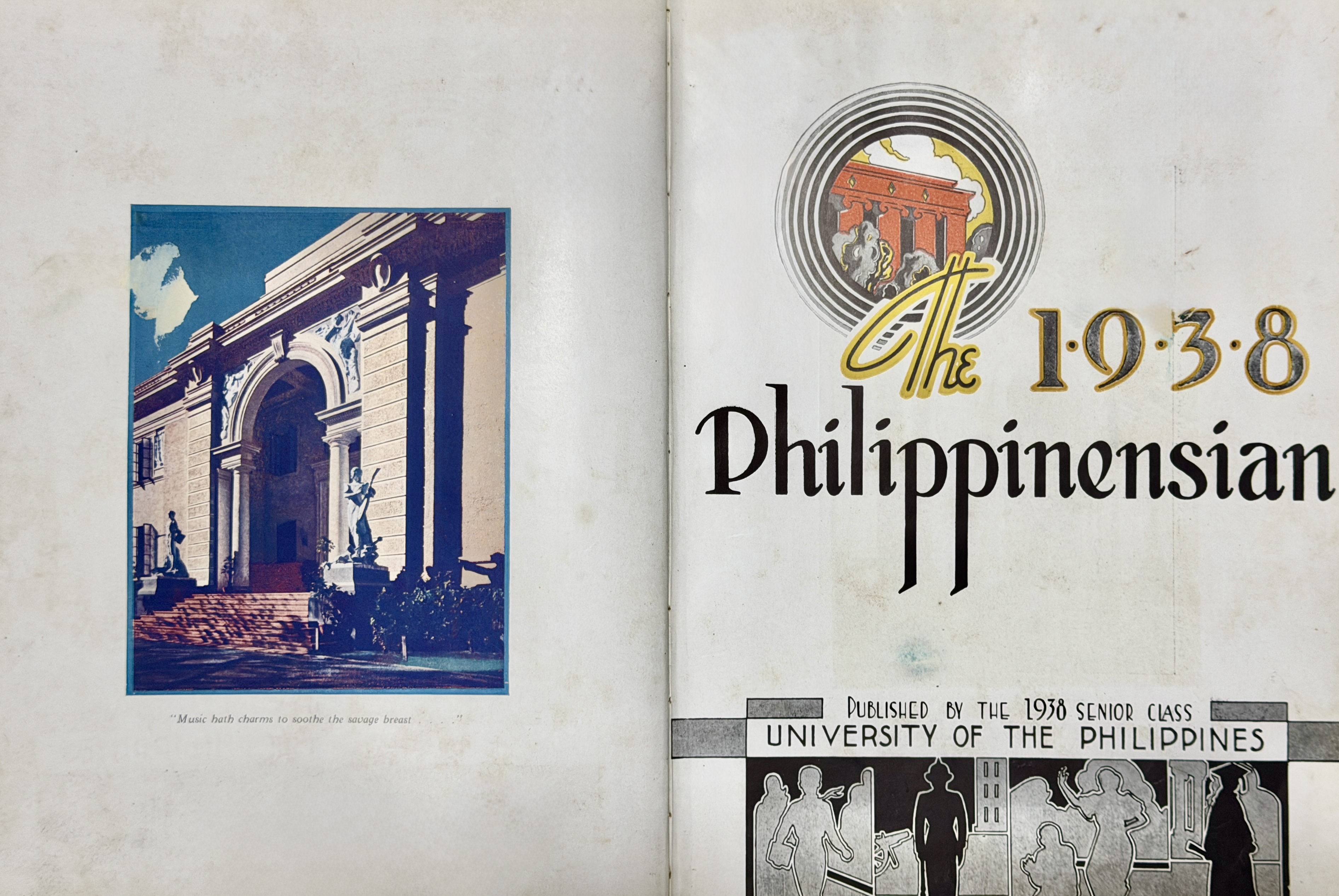
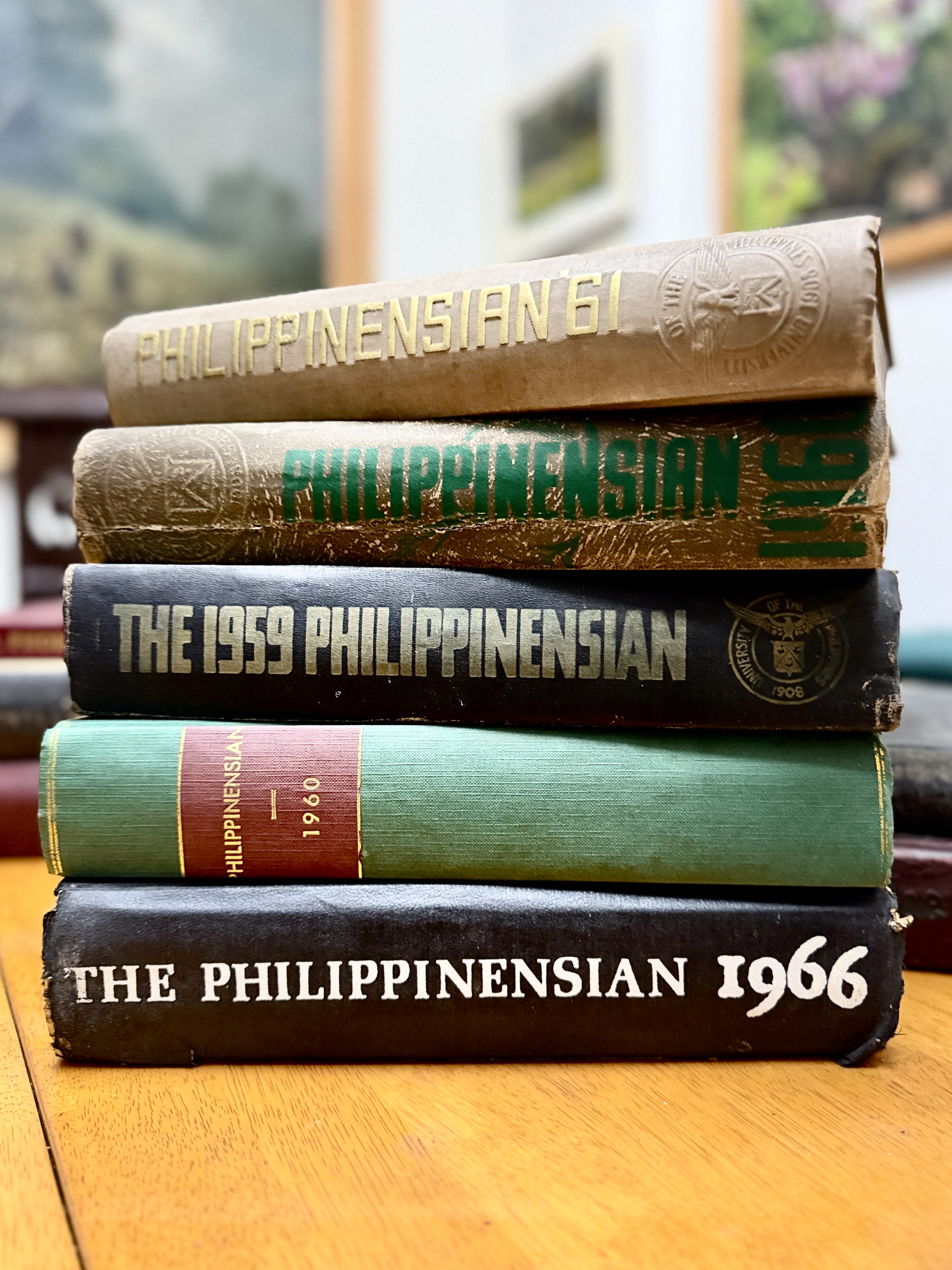
THERE’S SOMETHING terribly sad and yet also strangely soothing about thumbing through the pages of college and high school yearbooks from decades past. As a diehard UP alum and collector of UP memorabilia, I’ve accumulated a stack of yearbooks from the University of the Philippines called the Philippinensian (a name likely inspired by that from one of UP’s formative models, the University of Michigan’s Michiganensian). 

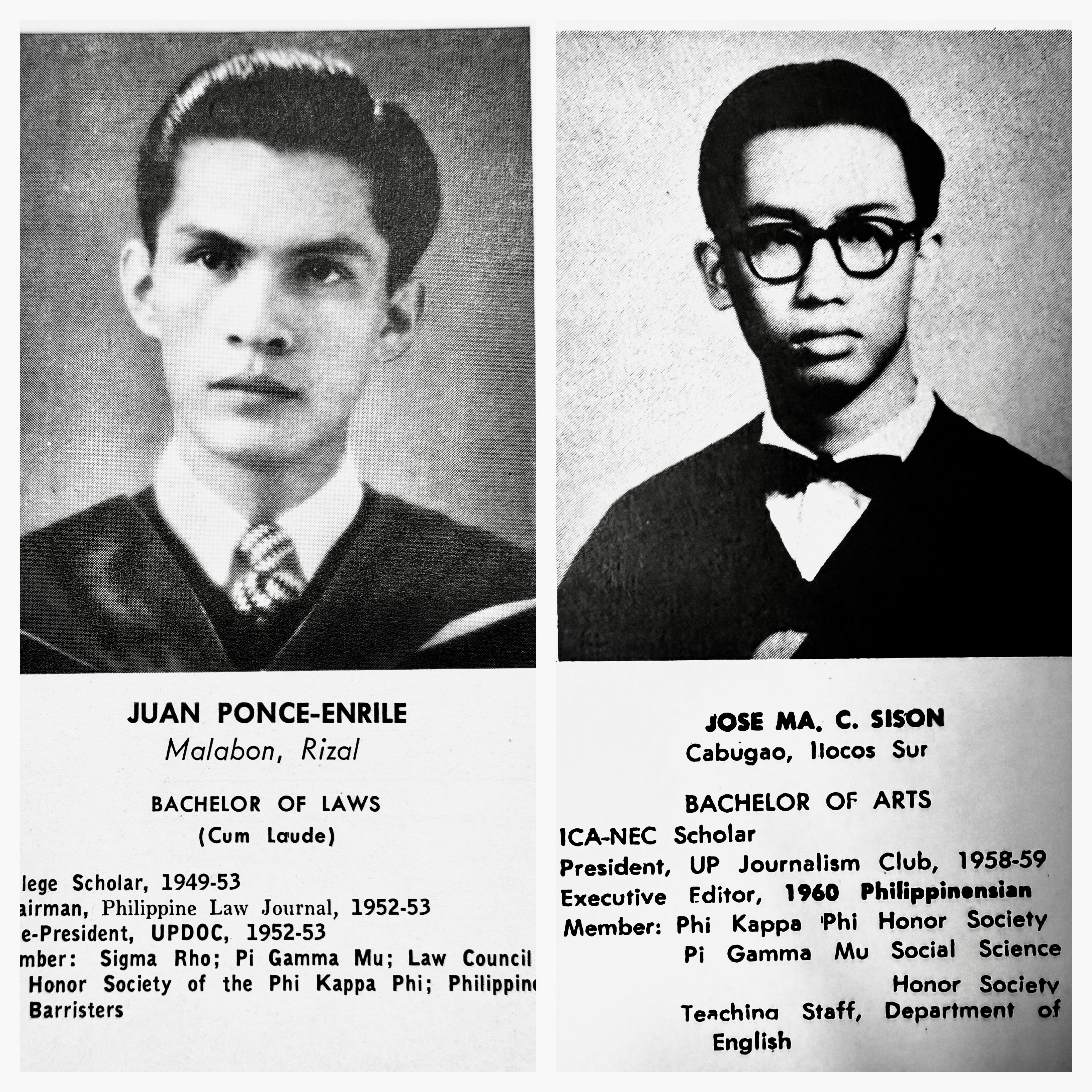
Going through them inevitably fills me with what I know to be a naïve longing for seemingly simpler times; the past gets rosier the farther we move away from it. But these images, imbued with innocence, still offer relief from today’s sordid realities. When I look at the youthful visages of such figures as Juan Ponce Enrile and Jose Ma. Sison, I am reminded that we had choices, and that, while indicative, college could be too soon to plot the full trajectory of our lives. Yearbooks are also, of course, an intellectual and social history of the university itself, balancing the frilly fun of a Cadena de Amor with the sonorous seriousness of editorial commentary.

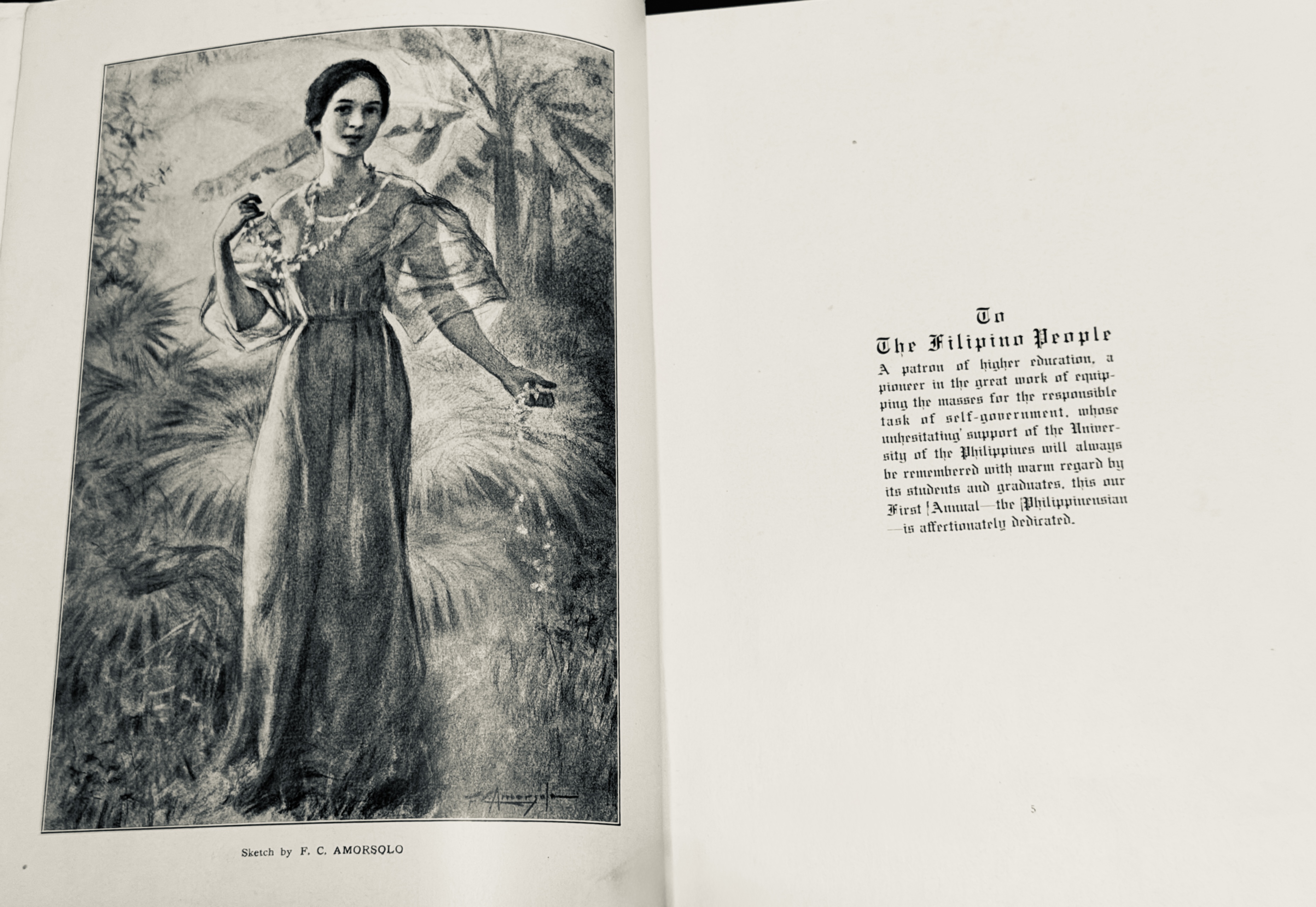
The first issue of the Philippinensian came out in 1915, seven years after UP opened in 1908—occasioned, argued its editors, by the realization that “There has heretofore been little consolidation of interests on the part of students of the University and the so-called University spirit, which should be stronger here because of the maturer quality of the students enrolled, was subordinated to the college spirit.” (I was fortunate to find a copy of this maiden volume, once owned and signed by Guillermo Tolentino.) 

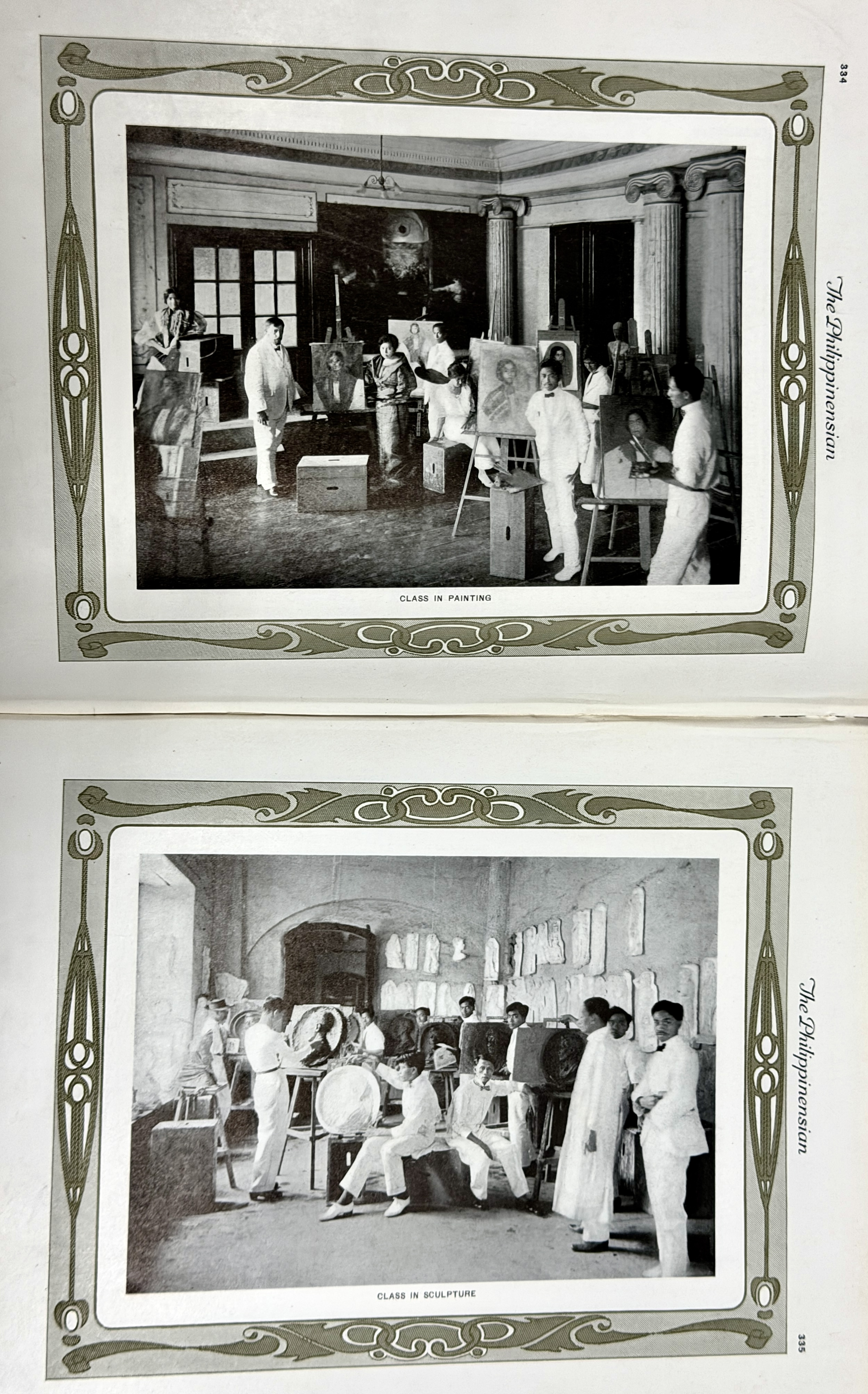
In 1928, the Philippinensian apparently assumed the name of UP Alpha. If you studied then at the College of Liberal Arts your professors would have been people like Maximo Kalaw, Conrado Benitez, H. Otley Beyer, Vidal Tan, Carlos P. Romulo, Maria Agoncillo, Paz Marquez Benitez, Manuel Bernabe, Jose P. Laurel, Marcial Lichauco, Mauro and Mendez, and Pura Santillan. The college’s editorialist expressed the tenuous hope that education would resolve the class struggle: “Far out in the villages away from cities reign ignorance, selfishness, suspicion, all things that a life of isolation and narrow-mindedness afford. We recognize the need for light in those nooks, that light which will add strength of vision to the eyes of the unlearned, which will make them see the invisible ties that unite hearts the world over. We are aware of the selfish exploitation of the poor by those who have greater cunning, and higher intelligence; but we believe that the broadening of the sympathies of the latter and the opening of their closed, hard hearts will banish away all suspicion and hatred that rend souls asunder.”

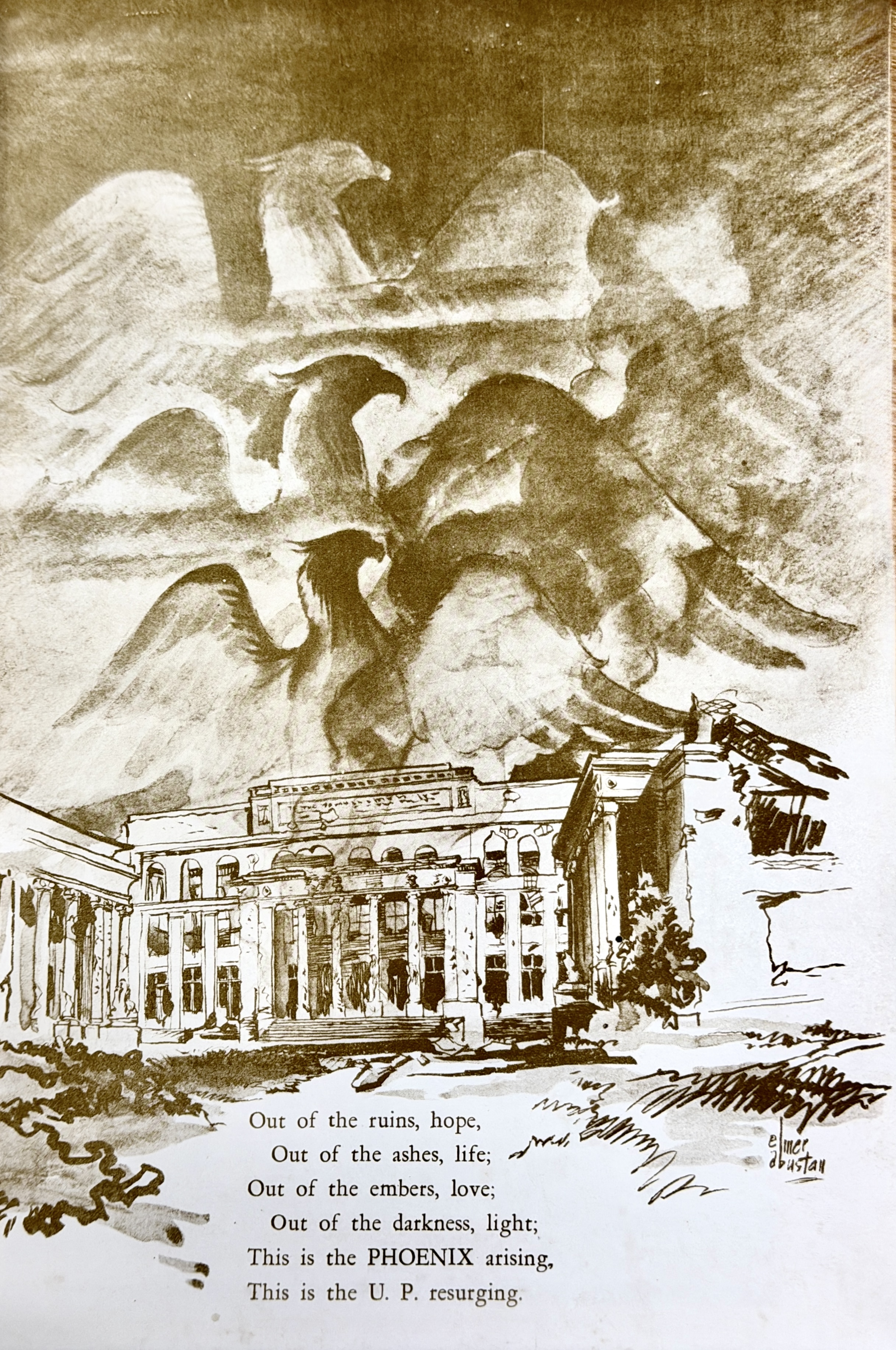
A decade later, the 1938 Philippinensian opened with a dedication to that year’s commencement speaker, Field Marshal Douglas A. MacArthur, followed by postcard-worthy shots of UP’s Manila campus, carefully curated to show off its best facets. The staging creates ironic if not tragic overtones, especially when taken with the photographs at book’s end of UP’s cadets in smart formation, many of whom would march into the maw of war in a few years. Padre Faura itself would be bombed to ruins, albeit with the Oblation statue still standing defiantly.

After the war, with school having been closed for a while and the whereabouts of hundreds of students and graduates unknown, the Philippinensian resumed in 1946 under the temporary banner of the UP Phoenix 1942-1946, to cover the lost years. The yearbook staff could only note that “Some letters [of invitation to the yearbook] were received postmarked ‘return to sender’ for various reasons: “addressee unknown,” “no such address,” “moved.” In many cases, the addresses were among those burned or shelled during the war. In a few cases, the graduates were already dead. But so long as there was a clue, no matter how unreliable, the staff did not fail to track it down, sending letters, again and again, to the same person, at different addresses.”

Among those who fortunately responded were Narita Manuel of San Andres, Manila, BSE 1942 (soon to marry a writer named NVM Gonzalez); Damiana Ligon Eugenio of Cabanatuan, Nueva Ecija, BSE 1942, cum laude(long before assuming the deanship of Philippine folkloric studies); and Renato Constantino of Manila, PhB 1946, cum laude, then already working for the Malacañang PR Office. (There were no privacy issues then, and one’s full address could be published at will.)

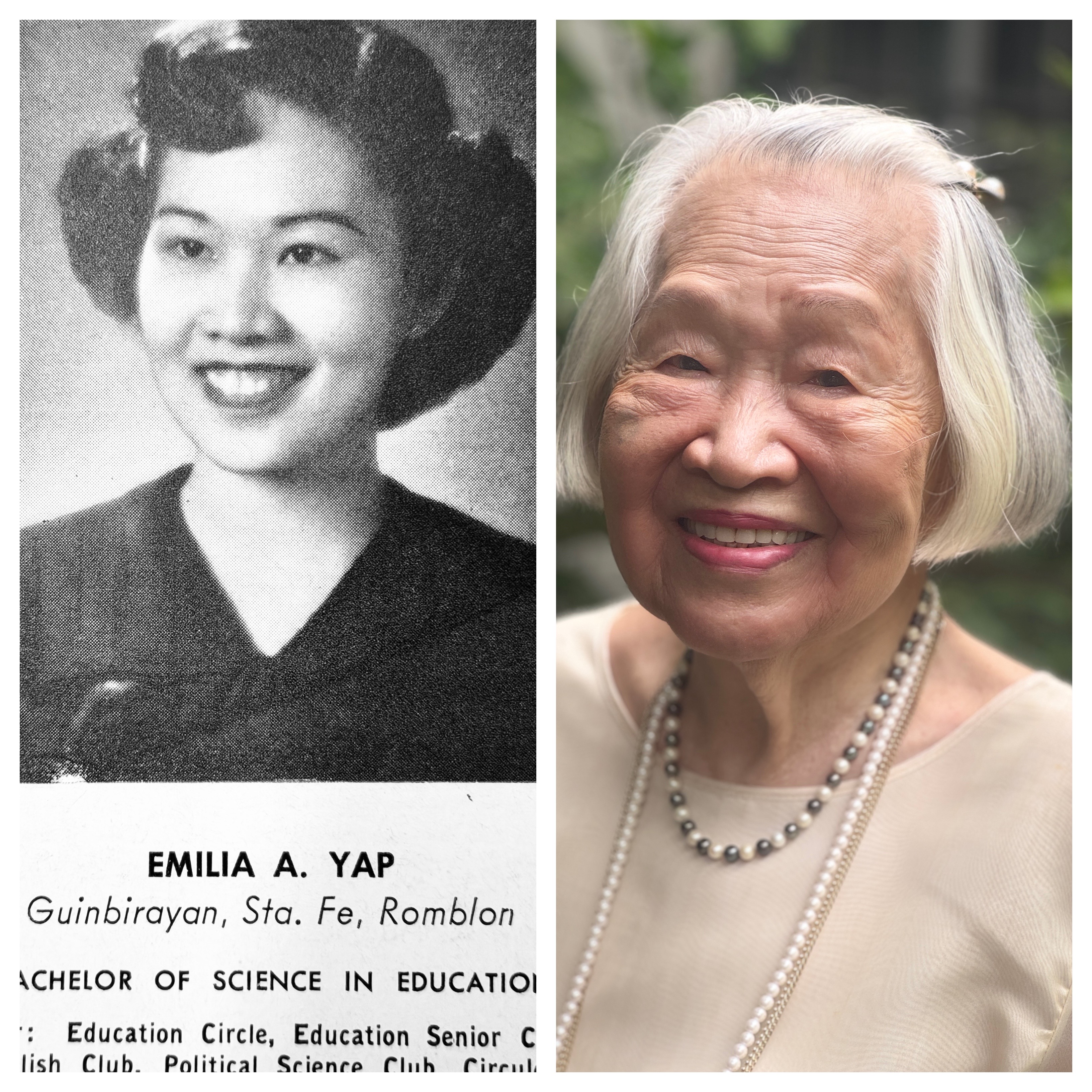
The closer we get to the present, the more familiar the names become, although their juvenile faces always come as a surprise. My mother Emy—who turns 98 next Sunday—was among those who first made the move from Padre Faura to Diliman. She appears as Emilia A. Yap, BSE, from Guinbirayan, Sta. Fe, Romblon, in the 1953 Philippinensian, a volume in which also appear such luminaries as Rafael M. Salas, Rony V. Diaz, Amelia Lapeña, Andrez Cristobal Cruz, Jose T. Joya, and Napoleon V. Abueva. For many alums, the ‘50s were UP’s golden age, and the yearbook reflects that; with the war over, it could claim that “The UP spirit is of beauty…. The tradition of looking for beauty everywhere, even where none is supposed to exist, is born… to temper an otherwise skeptical, cynical mind.”

But by the end of that decade, on the cusp of the ‘60s, and in the midst of the great debates between secular liberals and sectarian conservatives on campus, UP had to be ever reminded of its unique position as social critic. Introducing the 1958 Philippinensian marking UP’s golden jubilee, E. San Juan intoned that “Ours is an age of rebellion…. Man of the twentieth century… strives for a blessedness yet unbestowed, the blessedness incarnated in him as rebel-artist.” Petronilo Bn. Daroy would warn the following year that “It is at this point that we begin to see the estrangement of the university from the mainsprings of life, from the fact of the national reality. With politics controlling the focus and acting as guidepost from which the university must stand to gain its angle of vision, the reality that is revealed for inspection is necessarily fragmented and false.” 

UP’s vibrant social and cultural life continued, with the fraternities and sororities leading the way. The yearbooks lauded the smartest and the prettiest. But the dark clouds were gathering, and the mood was shifting. Writing in the 1966 Philippinensian, Temario C. Rivera began his essay with a stinging line: “Frivolity has always been the most vicious stigma of youth.” But, he concludes, invoking protests around the world, “The youth have finally come of age.”

In a few more years, the First Quarter Storm and the Diliman Commune would erupt, and the last Philippinensian would come out in 1971; the last Cadena de Amor had taken place in 1968. Many of those street warriors, myself included, would live on to their seventies and eighties, brandishing canes and hostage to metformin.

But in these yearbook pages, full of faces brimming with hope and idealism, we remain forever young and forever free.

Qwertyman No. 192: Apple@50 in a World@War

Qwertyman for Monday, April 6, 2026

A REEL circulated recently online explaining the origins of the ubiquitous Internet symbol @ for “at,” tracing it back to medieval monks seeking a shortcut and to merchants using it to mean “at the rate of,” and then finally to a coding convention adopting it to link a computer user’s name to his or her domain or location.

I found it fascinating because I’m something of a geek, a failed scientist who had to switch from Engineering to English because I couldn’t hack the math, who ended up channeling his digital side (as opposed to the analog, which collects vintage fountain pens and antiquarian books) into a decades-long devotion to Apple computers and to nearly everything Apple produced. I even chaired the Philippine Macintosh Users Group (PhilMUG) back in the mid-1990s when the handful of us felt like early Christians in a pagan universe. We had monthly get-togethers in small restaurants to unbox the latest SCSI peripherals and discuss the newest features of System 8.0. I prided myself in the fact that I could strip and reassemble a PowerBook Duo practically blindfolded. 

I mention this because Apple has just marked its 50th anniversary, having been founded in 1976 by Steve Jobs, Steve Wozniak, and Ronald Wayne with a machine cobbled together in a garage. After slogging through its first decades as a distant competitor to the more popular Windows PC, Apple finally achieved global domination after coming out with such game-changers as the colorful iMac, the iPod that made you smile the minute you put your earphones on, the ultraportable iPad, and of course the indispensable iPhone. 

As industry observers noted early on, the genius of Steve Jobs and Apple wasn’t just in its products, but in creating the need for them; you didn’t know how irresistible the iPhone was until you held one. Apple and its passion for personal computing—not just the hardware but an entire lifestyle ecology that integrated communication and writing with music and photography—arguably changed the world, or at least hastened its evolution.

But enough of the proselytization. I’m not writing this piece to sell you another Mac, which God knows Apple doesn’t need another endorser for. Instead, that half-century of Apple that just went by gave me pause to wonder where all that early joy of tech has gone, and indeed where technology has led us and will yet take us. 

Like many early adopters, as we were called then, I recall the inimitable thrill of trying out a new machine, an operating system, or a program—something to make life and work easier and faster than before, another bold step into the future, a declaration of faith in the power of technology to transform life and indeed the world itself. New technology arrived with the presumption of goodness and optimism—that it would bring relief to global poverty and hunger, find a cure for cancer and other human ailments, improve education, and generate jobs for billions; it would draw more people into the circle of development, empower the oppressed, and induce social equity. With the advent of the Internet, more doors and barriers came crashing down. We could express ourselves publicly, bypass the traditional gatekeepers of information, challenge authority, build communities of common interest, expose falsehood and spread the truth, and create a truly transparent, interconnected, and progressive global society.

The kind of tools that Apple and its competitors produced were supposed to assist that project. They did—and again they did not. Instead of tearing down walls between people, the Internet raised new ones, behind the anonymity of which we could tear each other down. Computers and smartphones now facilitate disinformation, human trafficking, money laundering, and all manner of scamming.

Worst of all, technology has made it easier to wage war and kill people (like it always has). From Desert Storm back in the early 1990s to the present Iran War, military assaults and even mass slaughter have assumed the sanitizing cloak of an e-sport, a posture Trump and his war gamers have actively adopted, reducing casualties to memes. Indeed the US-Israeli attack on Iran has now been called “the first AI war,” as an article by Michael Brown on Forbes.com substantiates:

“When I became the Director of the Defense Innovation Unit at the Pentagon in 2018, Project Maven was already underway. Long before LLMs, DIU was supporting Project Maven with several vendors to improve computer vision, an AI capability to distinguish among objects in satellite imagery to save analysts studying pixels…. That legacy led to Palantir’s Maven Smart System, today’s cornerstone of the U.S. military’s AI-powered operation. Maven fuses satellite imagery, drone video feeds, radar data, and signals intelligence into a single interface, allowing operators to classify targets, recommend weapons, and generate strike packages in near real time. The results have been staggering: more than 1,000 targets were struck in the first 24 hours of the campaign, a tempo that would have been unthinkable with purely human targeting processes. That tempo has been maintained with only 10% of the human analysts that would have previously been required to strike 1,000 targets daily.

“Yet the system’s limitations are equally revealing. Maven’s overall accuracy hovers around 60 percent, compared to 84 percent for human analysts. Palantir’s CTO nonetheless declared it ‘the first large-scale combat operation driven by AI,’ a characterization that raises questions about the ethics of AI-driven targeting and the adequacy of civilian protection safeguards.”

Of course it would be unfair to lay responsibility for this on the doorstep of Apple or other tech giants today—barring those who, unlike Anthropic, have actively lent their resources to Trump’s war machine. The companies known to have supported Israel’s military capabilities include Palantir, Microsoft, Google, IBM, and G42 (and yes, that’s according to AI). While the biblical prophets called for swords to be beaten into plowshares, somebody found a way to turn high tech’s plowshares into guns and missiles. 

And then again, as the gun rights advocates always say, “Guns don’t kill—people do.” With some people being so stupid and devoid of conscience, why should we even wonder if and when AI will work better than the human brain? That already happened, more than fifty years ago.

Email me at jdalisay@mac.com and visit my blog at http://www.penmanila.ph.
Penman No. 484: The Romance of Retro

Penman for Sunday, April 5, 2026

LATE LAST month, over two frenetic days at the Fairmont Hotel in Makati, more than 3,000 attendees crowded into a ballroom and the corridor outside for the sixth iteration of the Manila Pen Show since 2018. Not only did dozens of dealers and vendors coming from as far away as Russia and Turkey offer trays and tables full of pens, inks, and other writing paraphernalia. Seminar rooms were packed full of people learning how to adjust nibs, use fountain pens for painting, and master calligraphic strokes. What was most obvious and rather surprising was that the vast majority of attendees weren’t old fogeys like me who grew up with fountain pens, but young professionals and students eager to get their first Sailor, Pilot, or Pelikan—or even a five-figure Montblanc or Nakaya. 

The MPS is run by the Fountain Pen Network-Philippines, a group of enthusiasts that began with 20 people in our front yard in 2008. Now FPN-P counts 16,000 members online, from the Philippines and parts beyond—and if you think most of those people are idle lurkers, wrong: more than 9,000 of them participate actively on FPN-P’s Facebook page. And again, here’s the killer factoid: the group’s median age is somewhere between the late 20s and early 30s, clearly marking a demographic shift in the hobby from my fellow dinosaurs to the young bucks.

And it isn’t just pens. Everywhere around the world, young people are picking up and using typewriters, mechanical watches, film cameras, vinyl records, and pretty much anything older than they or even their parents are. They’re even wearing (after actively hunting down and paying big money for) torn jeans and ratty flannel shirts from the 1950s.

The romance of retro is definitely in the air. Whether it’s old tech or vintage clothing, the urge to try something old is palpably present, and “palpable” may be apt, because much of this fascination, according to the experts, has to do with the sense of touch. 

Beth McGroarty, the research director at the Global Wellness Institute, argues that “studies show that people are hardwired for things like touch from infancy,” and frames the analog revival as “a rebellion against that shapeless, disembodied, throwaway digital world of screens, and a hunger for physical objects and tools that are touchable.” 

That’s certainly true for fountain pens, which are as tactile as tools can get, and with which users establish intimate relationships. The act of writing with a pen represents the completion, commitment, and communication of an idea, a thought that starts from the writer’s brain, and gets processed by the writer’s emotions as it travels to his or her fingertips. The pen’s nib and ink commit the thought to paper and give it permanency, but also mediates it—you can often tell what the writer’s mood is by the shape and the sharpness and the fluidity of the written word. For young people growing up with keyboards, cursors, and block letters on an indifferent screen, nothing could be more different, because more personal, more “Me!”

That’s true even for typewriters, which—thanks largely to Manila-based repairman Gerald Cha and the Filipino Typewriter Collectors group on Facebook (yes, I’m also one of the organizers)—have attracted many young enthusiasts. They seem to be little more than clunky pre-computers at first glance—metal machines using greasy ink ribbons without “delete” buttons and no connection to the Internet—but it’s precisely this isolation that’s become its main draw for young users.

According to Walid and Joujou of Mr & Mrs Vintage Typewriters in the UK, who have restored thousands of machines over the past decade, the soaring interest has been driven by what they call “a craving for authenticity and quiet.” Now “quiet” isn’t a word you normally associate with the clackety-clack of an Underwood or a Remington. But take typing as a rejection of digital noise, which is what the many thousands of typewriter collectors around the world profess to like about their Olympias and Olivettis—complete disconnection from the outside world, replaced by total focus on what you’re typing, which you can’t simply erase without making a mess. Handwriting and typing demand deliberation.

So does, for that matter, film photography, to which young people are returning in droves, as if film were some holy membrane to be treated with respect if not awe (an attitude encouraged by the eye-watering price of film plus processing). I have a good friend who, like many millennials, turned away from megapixels and pocketable phone cameras to embrace expired Tri-X and clunky RB67s. I’d kid him about spending a fortune on his new passion and for thinking every shot through before pressing the shutter button—the mark of the classic photographer, a la Henri Cartier Bresson in wait of the “decisive moment”—only to send the roll through for digital conversion. But I can understand his commitment, because it’s about more than photography; it’s a decision to take fuller control over sensors and algorithms, to almost literally stamp one’s vision over the image, in defiance of AI, putting natural beauty over artificial prettiness.

And then there’s the element of what researchers call “meta-nostalgia,” a longing to capture and reinterpret the past on one’s own terms. In a world hurtling forward into the void, the imagined past offers clarity and security, if only because it already happened. Writing with a pen—especially a vintage one that your Lolo or Lola might have exchange love letters with—returns us to a fantasy of innocence (forgetting, of course, that someone like Josef Stalin signed death warrants with a tiny Pelikan 100–the pen beneath the Leica in the pic above). 

But returning to pens, it was clear from the MPS that this wasn’t a jump back to the ‘40s or ‘50s, except for the few of us who specialize in that period. The “kids,” as Beng and I like to call them, were buying pens to play with, employing a raft of designer inks that not only sheened but shimmered, most definitely no longer your Lolo’s reliable blue-black Quink. They also brought and bought journals, cases, stamps, washi tapes, and such accessories as make not just a hobby but indeed an industry. 

Retro is back with a vengeance, and as we oldies—the so-called “OGs”—sat back and marveled at what the young ones were willing to spend on what we used to think of as no more than writing tools, one of them came up to us with a flashy pen and said, “In fifty years, this will be vintage!” Indeed. Sooner or later, we’ll all belong to the past, and as today’s Gen Z’ers are beginning to realize, it can be far more fun and comforting than the uncertain future.

Email me at jose@dalisay.ph and visit my blog at http://www.penmanila.ph.

Qwertyman No. 190: Beyond Survival

Qwertyman for Monday, March 23, 2026


PARDON ME for this rambling piece this week, which I’m writing in a stupor, blindsided by the sudden, heartbreaking loss of a friend. I’m guessing I’m not alone in this state of disorientation, of looking for a center or an anchor to stabilize at least our view of the horizon. Every day we come across so many deaths on Facebook, amid hundreds of faceless thousands more around the world—much too many to mourn, even counting just your friends.

It’s been a tough time for many, with a war halfway across the planet casting a dark red shadow on us and our pedestrian lives, far out of sight and out of mind of Washington, Jerusalem, and Tehran, but ever vulnerable to the subterranean tremors of politics and economics snaking around the globe.

A viral post tried to make the best of that by reminding us that at least we’re not dodging missiles. That’s true, but it doesn’t remove the cloud of fear and uncertainty we’re living under—not to mention the pain of brutal price increases, which is what Donald Trump’s war comes down to for 98 percent of the world.

I’ve heard many friends and even strangers saying that despite all the aggravations we face today as Filipinos—the corruption, the inefficiency, the pollution, the noise both physical and political—they’re relieved to be where they are, instead of being somewhere out there under constant threat of death falling out of the sky. I’ll admit to feeling the same way, and that I even feel safer to be here today than in America, which I have no intention of revisiting until after the Trumpian nightmare is over.

No, this isn’t another piece about “resiliency,” although there’s certainly that, at least as a way of putting a good face on a bad experience. Rather I’m thinking about how we survive at all, beyond meeting economic needs, about prevailing meaningfully as humans with purpose and dignity and even hope in this horribly oppressive and degrading environment.

The fact is, people learn to adjust soon enough to adversity and privation, excepting such extremes as Stalingrad and Gaza, where sheer survival may have been heroic enough.

Nick Joaquin recalls in Manila, My Manila how quickly the city’s inhabitants fell back on their old routines after the first bombs exploded and the Japanese marched in. The shows reopened, the restaurants thrived, pedestrians bowed to the sentries, and life continued. Certainly there was terror and suffering aplenty, but until famine hit them, followed yet later by the horrors of the Japanese withdrawal, many Manileños apparently coped with the war.

Even closer to the present, we seniors well know what it was like in the early years of martial law, when, as if domestic turmoil weren’t enough, we were hit by a global oil crisis triggered by another Mideast war. The buzzwords then were “austerity,” “alcogas” and “Asiong Aksaya.” We mixed corn with our rice. We complained, we resisted, we struggled, we suffered—but we survived.

I have to remember these when I think of how confused and depressing the present can be, and how pointless it may seem to persevere, especially when we turn on the news or go online. We seem surrounded by hostility and indifference, by death and sorrow—and yet, just as insistently, goodness, creativity, and courage abide, our handmaidens and henchmen, the torchbearers of our humanity.

Last week, on one particularly busy day, my wife Beng and I attended two consecutive book launches.

The first, in Makati, was by our friend Erlinda Panlilio, who had been my student in a graduate writing class more than twenty years ago. Linda was among several women enrolled in Creative Nonfiction—all of them already accomplished in their respective fields—who thought that the time had come to gather and preserve the wealth of their memories in a book. I was less their teacher than their enabler, and many if not most of them subsequently published outstanding memoirs that looked back on lives well lived—not just in privilege as you might expect but in struggle, whether in business, love, conflict, or self-fulfillment.

Aside from many other compilations she’s edited, this was Linda’s third book (and she claims her last as she is now in her eighties, although no one believes her). The book, Saying Goodbye to the House, comes across as a valedictory, a summing-up of a long and fruitful life. At the launch, I said that it was important for senior voices like Linda’s to be heard in today’s frenetic, youth-oriented culture, which barely leaves time to pause, reflect, and rejoice as Linda does.

And then we moved back to Quezon City, where the young Cedric Tan was launching his second novel for young adults, a fantasy titled The Hotel Titania, in which a girl steps into a hotel that turns out to be full of magical beings. You could not imagine a sharper contrast with Linda Panlilio’s domestically grounded universe (which, being Filipino, has its touches of wonder as well). Cedric not only wrote a fantasy; by giving up his job to go full-time into writing, he’s living it, exploring territory at once exciting and fraught with danger.

Stepping into the car homebound after a day full of books and stories, Beng and I felt exhilarated, our confidence in the tenacity and the infinite variety of the human imagination restored. Against dismal reality, our memory and our curiosity would save us.

And then, as I was scrolling on my phone, came the stunning and crushing news that our friend, the veteran journalist and essayist Joel Pablo Salud, had succumbed to a heart attack. A recently professed Christian, Joel had fought hard for truth and justice, and he died a man of faith who knew where he was bound. Even among hard-bitten writers used to seeing the worst of things, the passing of someone so passionate about his craft, his convictions, and his family produced profound grief and consternation. Again we had to ask: why does God take the dearest of his creatures? Why does he bring so much suffering to the world?

And I think Joel knew the answer: so we could assert our humanity while we could, and among the best ways to do that is to employ our talents against surrender and despair. Every book we write does that. We seek survival not just to eat and breathe—but to love, to sing, to endure, to yet become.