Qwertyman No. 210: A Grand Experiment with AI

Qwertyman for Monday, August 10, 2026

TOMORROW, TUESDAY morning, will be the first day of the class I’m teaching this semester at the University of the Philippines in Diliman. I retired seven years ago, but as professor emeritus have availed myself of the option to keep teaching at least one course. I don’t have to, and sometime soon I might stop and take a proper rest, but I think it’s good for both my young students and myself to keep up what amounts to an intergenerational dialogue. 

Even in UP, too many courses are being taught by instructors just a few years older than the class. That’s good for communication and relatability of thought and treatment, and sure, the alternative of being lectured by your grandfather isn’t exactly thrilling. But I feel that now, more than ever, we need to bridge what the 1960s called the “generation gap” to make mutual sense of the world we’re living in, which is probably just as perplexing for me as for them. 

I usually teach at the graduate level, but for the first time in years (if not the last), I’ll be handling an undergraduate class, at my department’s request. It’s a course for seniors called Creative Writing 198: Special Topics (Professional Writing), which I myself designed and first taught over twenty years ago. It’s aimed at providing English, literature, and CW majors with the practical writing skills they hardly learn in school. They may know their Shakespeare and Salinger, their Defoe and Derrida, their Virginia Woolf and Virginia Moreno—but they can’t write an application letter, a news report, a feature story, a brochure, a speech, an AV script, or do a proper interview. 

In other words, they can’t write for a living, which is what the big, bad “real world” beyond graduation expects them to do. They get all starry-eyed about writing that great sci-fi or romance novel that will bring them international fame—and yes, who’s to say it won’t ever happen—but they’ll quickly realize that you need a day job to pay for all the instant noodles and pizza (not to mention the studio, the wi-fi, and the commutes) that dreams are made on. So—drawing on all my years as a self-styled “Swiss Army Knife” of writing—I designed CW 198, from which at least two generations of students have now emerged. I’m happy that many still write me back to say that it was one of the most useful courses they ever took. (To those who can’t study with me, you can take a look at my book, Windows on Writing, published by Vibal Press.)

I’m writing this not to advertise the course, which should be fully subscribed by now, but to share the anxieties and apprehensions that many teachers—from full professors down to the greenest instructor—are facing: how to teach writing in the age of AI. The last time I taught CW 198, AI was still something of a joke; I’d ask it to write something in the style of Nick Joaquin and it would throw up laughably pseudo-romantic garbage. 

I do recall, however, saying even then that AI was bound to catch up in time. That time has come, and we’re no longer laughing. The uncanny and frankly scary speed and precision with which AI has learned to mimic human writing—yes, your writing, if you feed it with enough examples—tell us that human thinking can’t be too difficult to approximate if not exceed. (Here, bring in your favorite senator, and you’ll see how low the bar is set. And it’s hard to accuse AI of being “soulless” when so many people and their productions are exactly that.) 

Not surprisingly, AI in education has been met with fear and suspicion, if not outright hostility. There have been reports of professors retiring early to escape the aggravation of having to chase after AI-assisted cheaters, and of having to sort out the natural from the artificial. All over the world, and all over academia, there have been movements against AI, or at least against its abuse and misuse—an aversion extended to all digital media. 

Sweden leads the world in moving back from digital screens to paper in its basic education; phone bans in school are now in effect in Denmark, Finland, France, and Italy, among others, as part of this “analog revival” to improve reading skills. Following such models as the University of Chicago Law School, the UP College of Law will now forbid law freshmen from bringing and using their digital devices in class, to encourage critical thinking.

I agree with these moves, especially at the foundational levels of education. At the same time, let me state what I think clearly: we reject or ignore AI at our own peril. It’s not going away, it will keep getting smarter, and our young people will be using it ten years from now with neither guilt nor shame, making precise prompts with natural fluency. I’m not saying that all the ethical questions will have been swept aside by then, but the major technical challenges (yes, with ethical dimensions) like AI’s enormous water and power requirements should have been resolved, likely with AI’s own help. 

That said, what am I going to do with my CW 198 class? I’ve decided that instead of banning it outright (which I suspect will be futile in any case) we’ll use AI—to see what it does and what we can do differently or better. I’ll have them do in-class writing to establish benchmarks, and then we’ll ask AI to come up with its own version. What AI says won’t be the standard by which papers will be scored, although it might be superior in some mechanical ways like grammar and spelling. We’ll see how AI shapes its arguments, against how we might approach the topic and present examples. We’ll put a premium on original thinking, on expressing individuality, focusing not so much on “getting it right” as on “making it mine.” 

I frankly don’t know how this will all work out, but at 72, I’ll be taking a privileged peek over the horizon, embarking on a grand experiment in the spirit of that poem recently recalled by “The Odyssey”: to strive, to seek, to find, and not to yield.

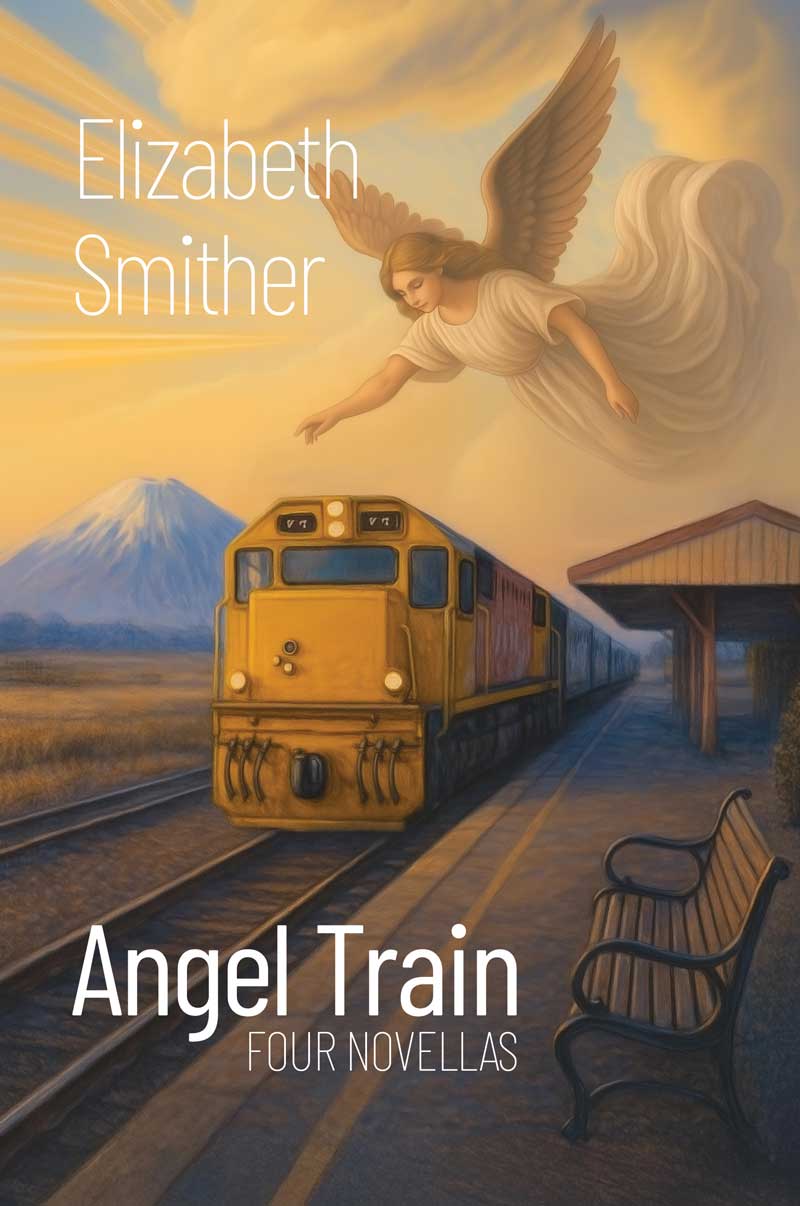
(image from noveltymediaworld.com)

Penman No. 488: Artists in Residence

Penman for Sunday, August 2, 2026

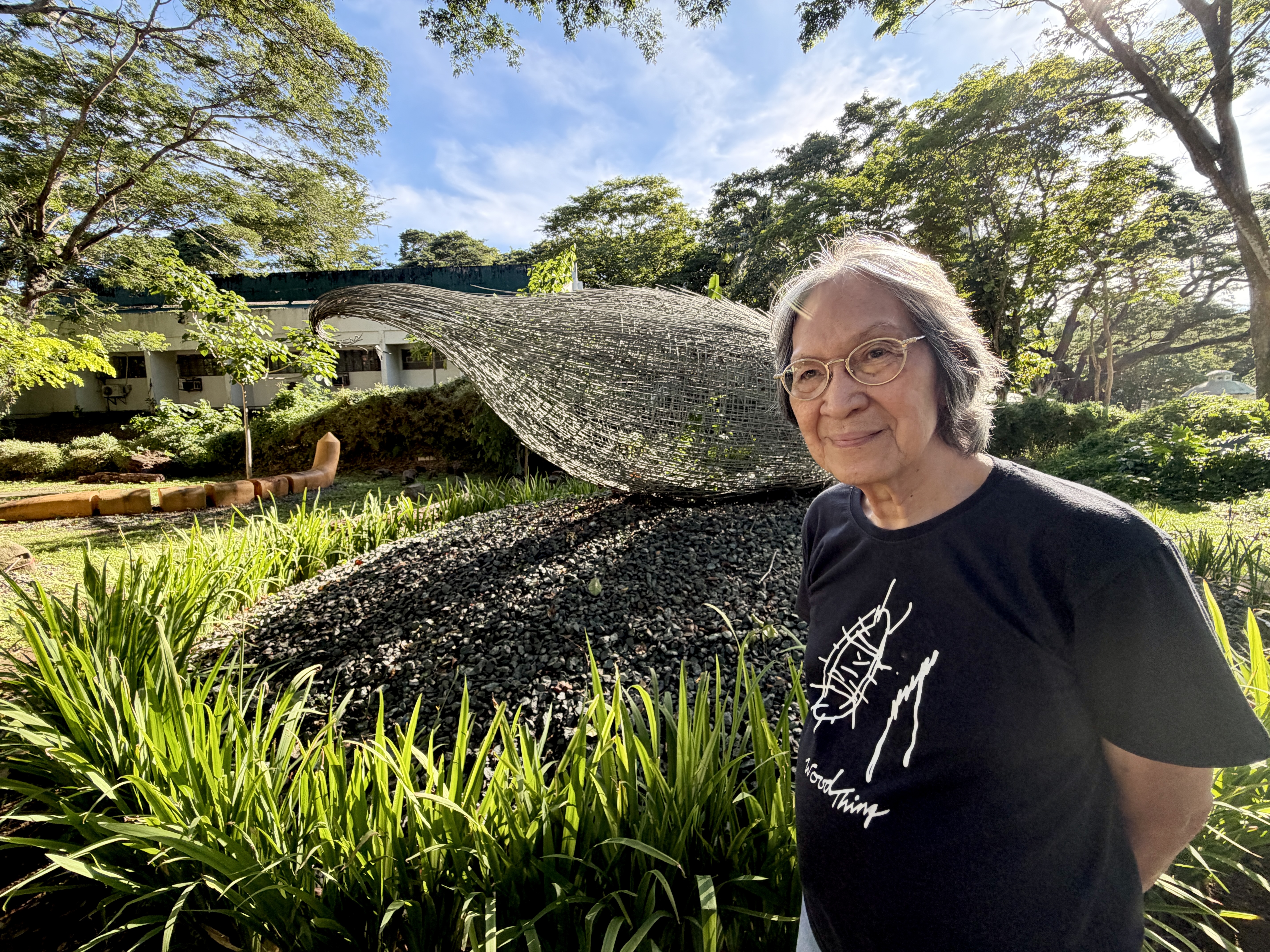
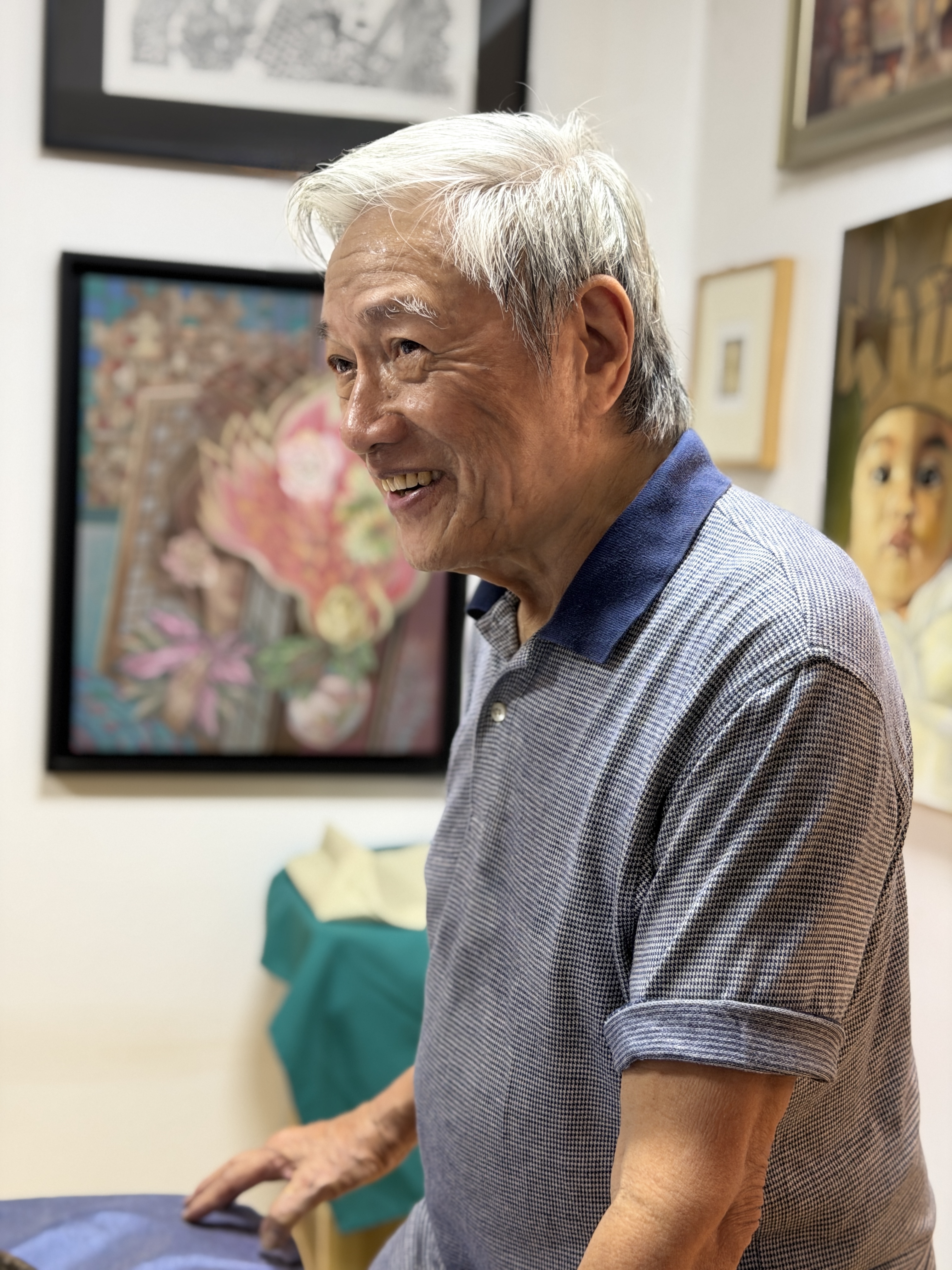
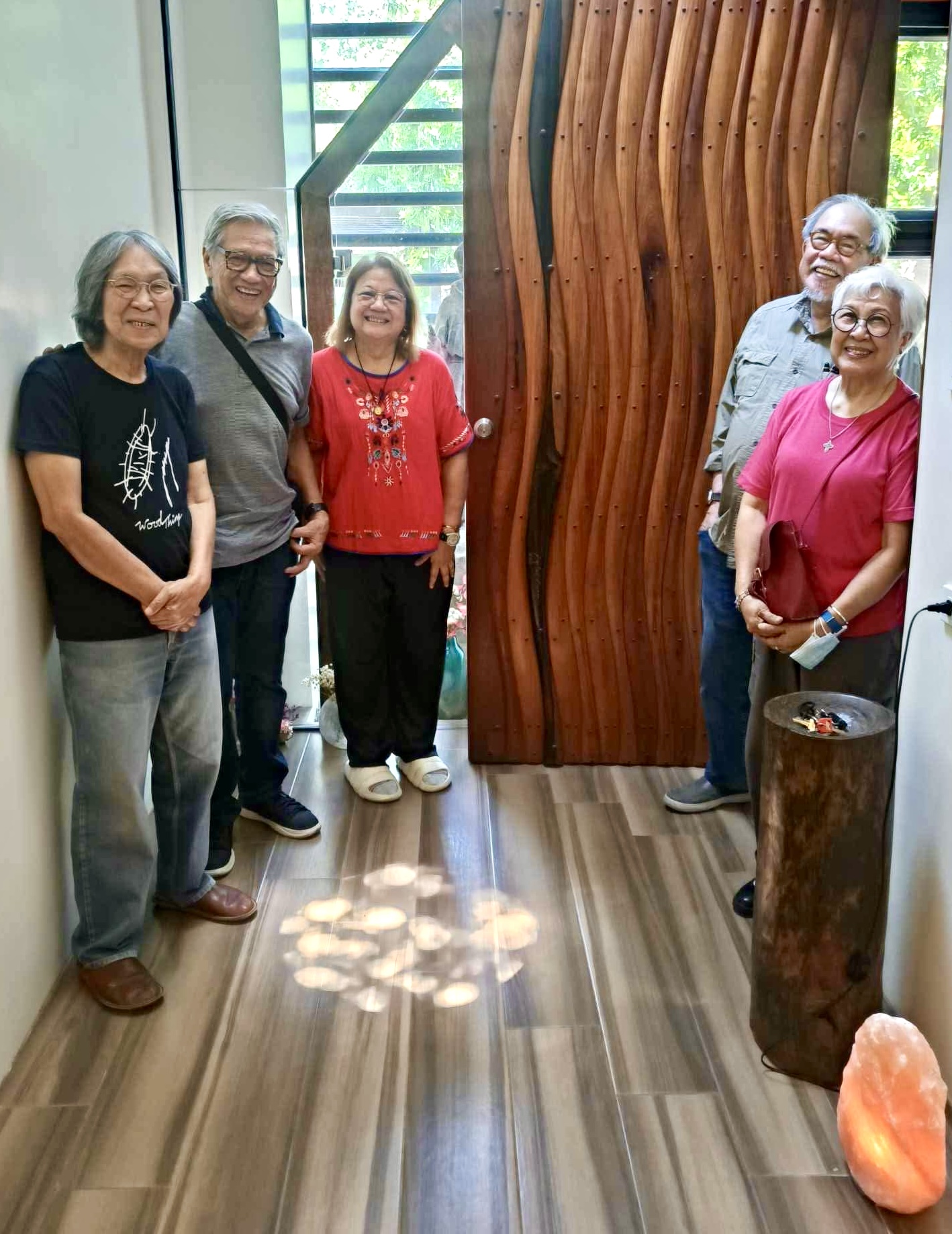
IT ISN’T every day that I get to spend time with two outstanding artists, and while I’ve become something of a recluse myself, exhausted by literary polemics and limiting my social life to very close friends, I couldn’t say no when my wife Beng asked me if I cared to join her on a day trip to Los Baños to visit the sculptor and painter Junyee. Junyee was a good friend of Beng’s from the UP College of Fine Arts, and while he lives in Los Baños with his wife Tess, Junyee has done many art installations around Diliman and often comes by our house on campus to drop off some buko pie. I’d enjoyed chatting with Junyee whenever our paths crossed, taking in his stories about his arduous struggle to become an artist, including a time when he had to work as a make-up artist for the dead in a funeral parlor in Cebu. But more on that later.

I was doubly pleased to learn that we would be accompanied to Los Baños by another artist-friend, Fil de la Cruz, whom I had known for over fifty years, and by his son Janos, also a talented and highly regarded young artist. Fil stands among our most brilliant, versatile, and accomplished printmakers; both he and Junyee have been nominated for the National Artist Award.

We had long been planning to visit Junyee in LB, where he and his wife Tess, who taught in UPLB, have lived for decades. When Tess retired a few years ago and they had to give up their home on campus, they found and bought a private lot just beyond the university property line, and built a new house there. Since anything that Junyee built was bound to be interesting, we wanted to see it, but the house was honestly just an excuse; we were going there for the artist himself. Now 84, Junyee recently hasn’t been in the best of health.

Though younger at 75, Fil has been facing serious challenges of his own. They had a lot to talk about, for sure—but we resolved to undertake this trip in high spirits, to celebrate art and life in joyful company. 

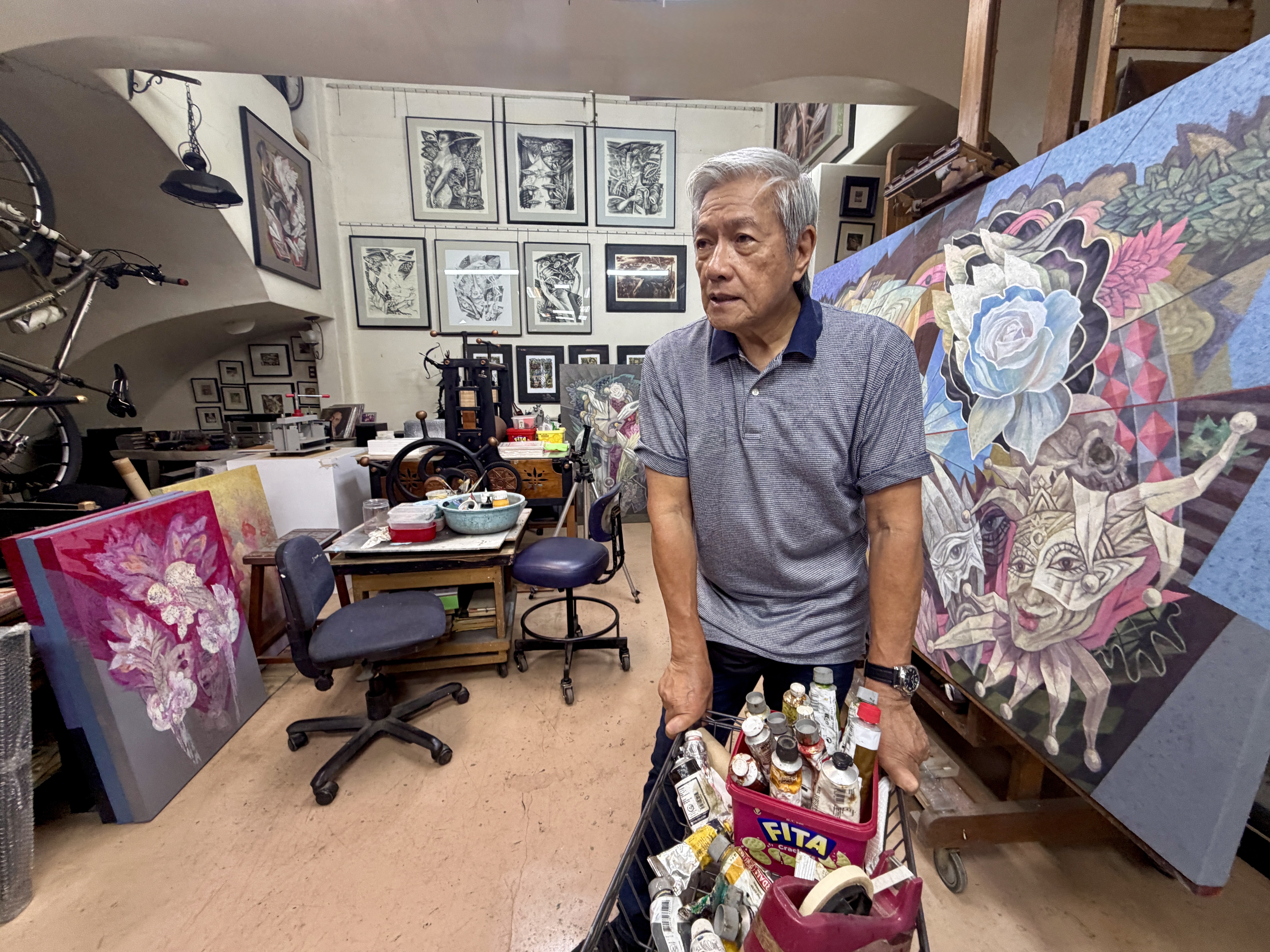
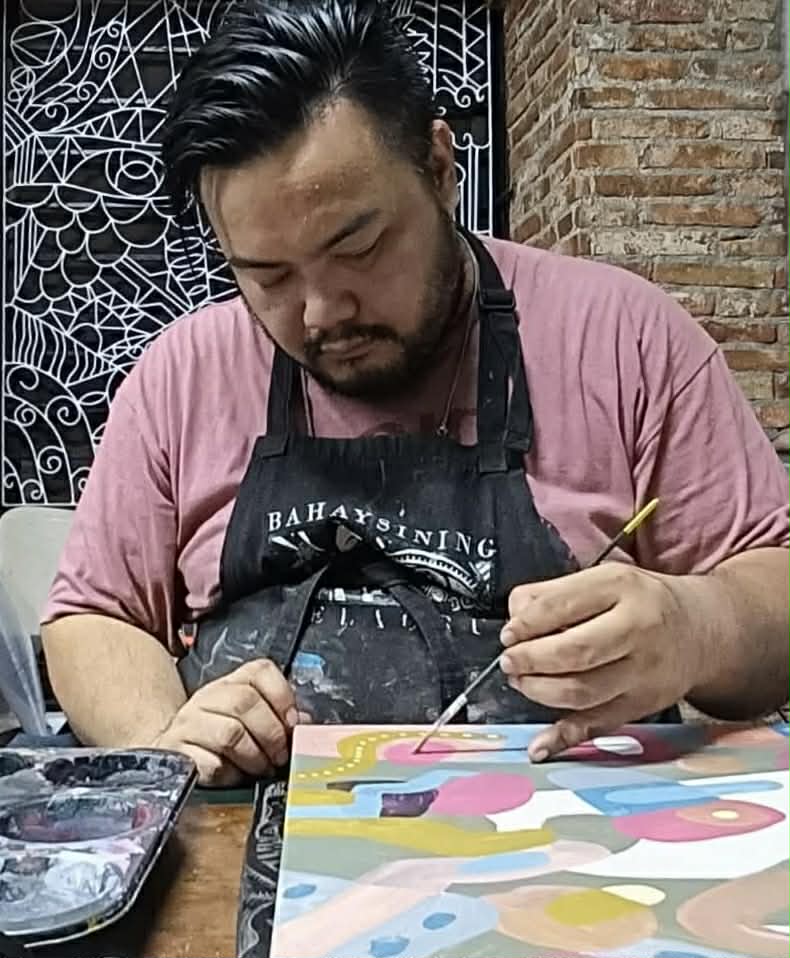
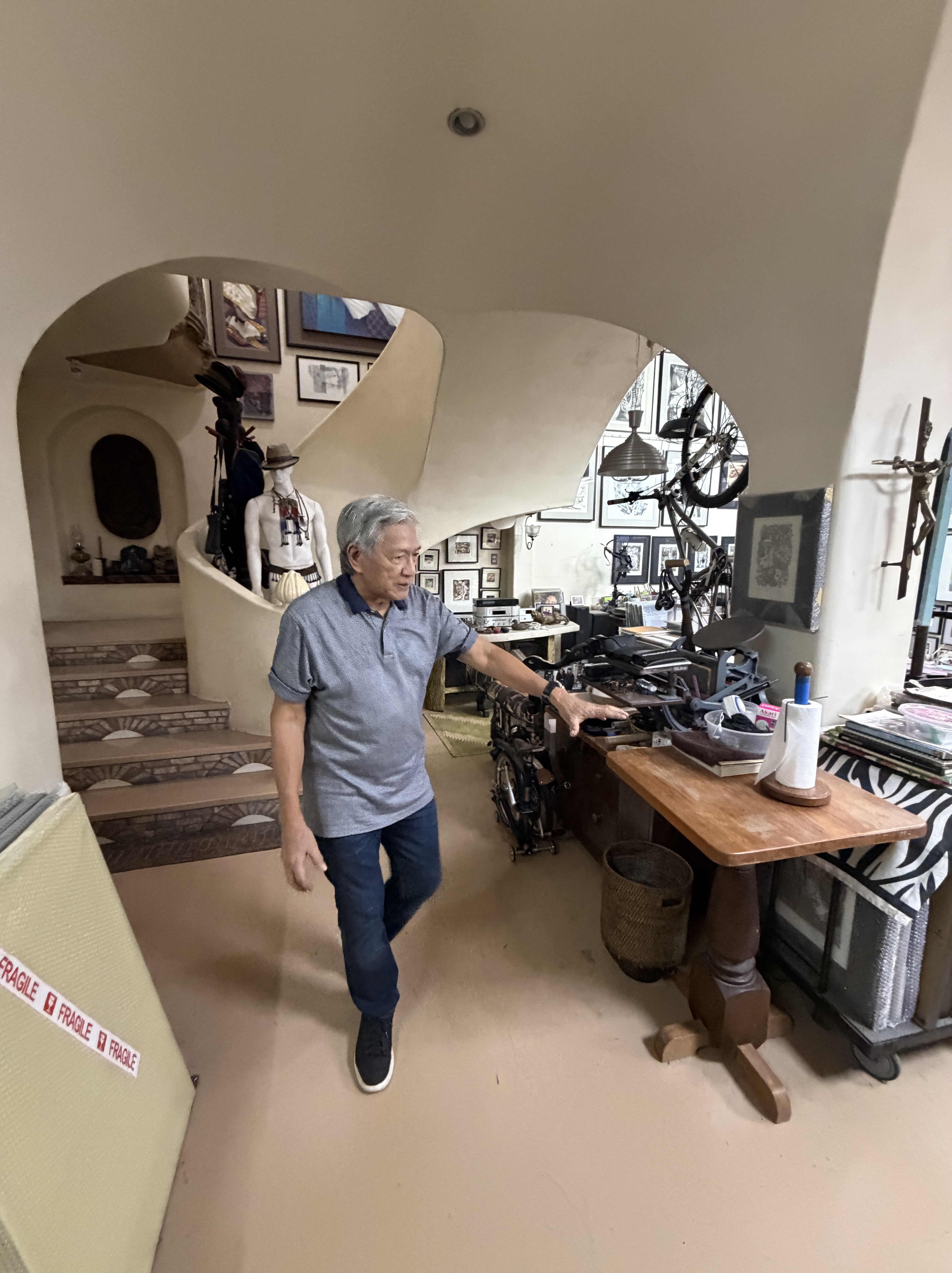
First we picked up Fil at his home in Muntinlupa. Aptly named Bahaysining, the three-story brick house is part (if not largely) studio, part gallery, and part living space, but immediately the visitor knows it’s a house made by artists for artists in both form and function. “This was much smaller early on,” Fil says of the place, ”and then I just kept adding to it as my practice and capabilities grew.” He shares the space with his son Janos, who keeps a studio of his own on the premises and helps his dad with both work and the daily business of living. 

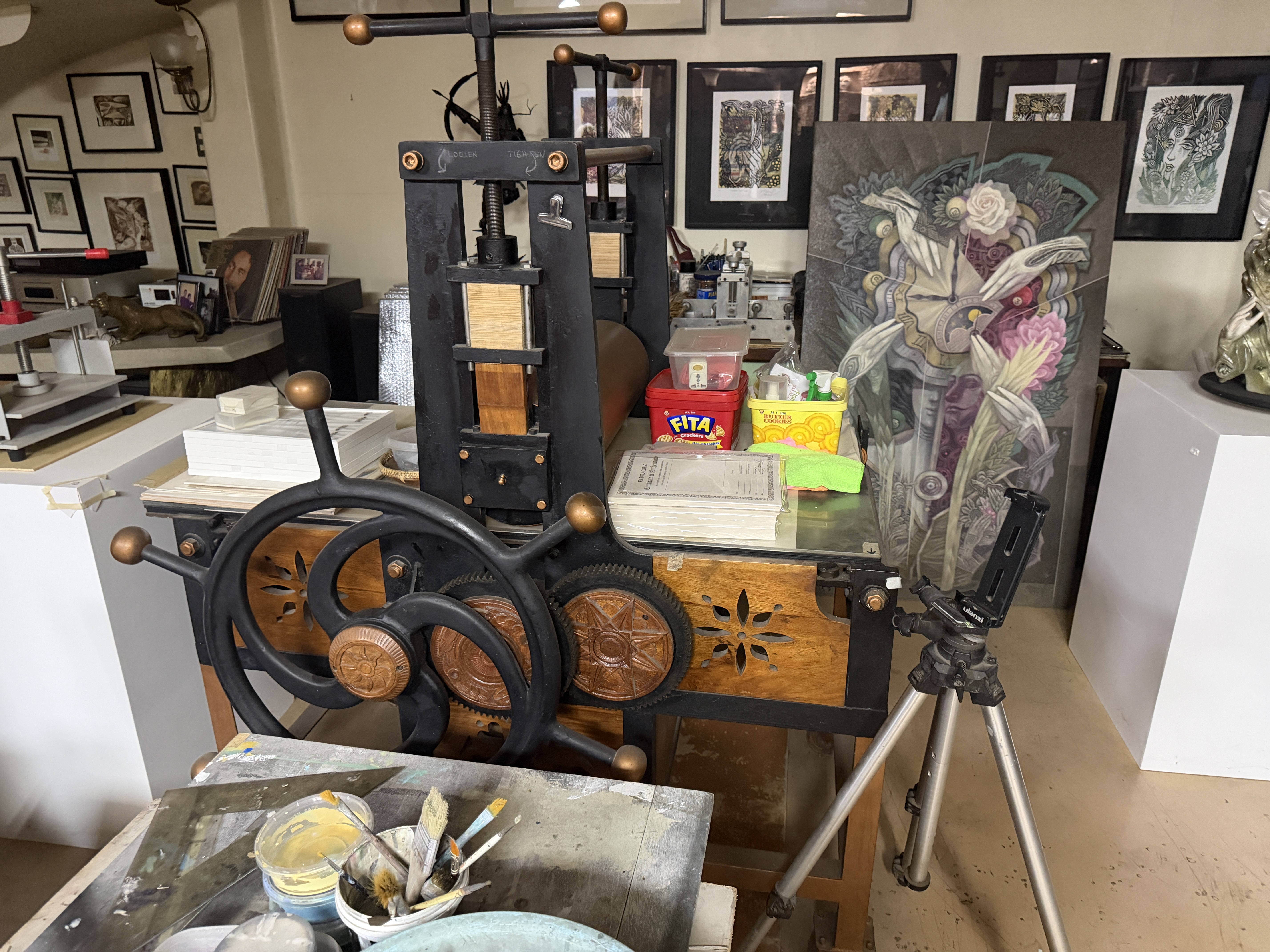
The rooms teem with paintings, prints, drawings, sculptures, and most visibly, printmaking presses in various sizes that Fil himself designed and had made over the years. Much of his equipment rolls on wheels, the better to move them around when the studio has to meet a commission, and Fil and Janos have to labor long days and nights to get the job done. Fil is amazed that clients remember him and his work from way back and return to order new pieces. 

Fil also paints and sculpts as does Janos, but it’s in printmaking—the art of producing numbered copies of a design pressed on paper in limited editions—that you know his heart truly lies. I met Fil in the early 1970s in one of my past lives as a printmaker. He had graduated from his studies at UST, and I had just come out of martial law prison—where, to pass the time, I had taken up drawing with my fellow detainee Orly Castillo, who then took me under his wing at the Philippine Association of Printmakers in Ermita. The PAP was a hotbed of production for young artists then, and I was lucky to run into the likes of Bencab and Tiny Nuyda (not to mention a pretty girl named June “Beng” Poticar, who became my wife)—and yes, Fil de la Cruz, who even then was already establishing himself as a master of one of printmaking’s most difficult techniques, mezzotint, which produces an almost velvety texture. 

Perhaps because prints are relatively cheaper and come out in multiples, they’ve never quite gotten the respect they deserve, especially here in the Philippines, where the art market is enthralled by multimillion-peso paintings by the masters and by the exclusivity they exude. (Around 1974, when we were all working and hanging out at the PAP studio on Jorge Bocobo, it was a big day when a dealer came by to purchase our prints in bulk for as low as P15 per print, so she could stick them into frames she sold as décor to American servicemen in the bases.)

Fil’s come a long way from those days, and Bahaysining is a testament to his professional success, which has traveled a long arc from his youth in Bulacan and his student days at UST to further studies in New York and Paris, to over thirty solo exhibitions that have brought his prints to France, America, the former Czechoslovakia, Germany, China, Hong Kong, Korea, Spain, Belgium, and throughout the Philippines.

As it was a sunny weekday, the drive to Los Baños didn’t take long through the Jamboree route. Junyee had offered to take all of us out to lunch, but of course we first had to see and tour his and Tess’ three-year-old home. 

To know Junyee—“Luis Enano Yee Jr.” on his birth certificate—is to understand how inseparable art and life can be in the person who, from his youth onward, has seen art not only as descriptive or decorative but liberative, rooted yet transcendent, impermanent yet memorable. Widely acknowledged to be the father of installation art in the Philippines, Junyee has always been testing and pushing the boundaries of art, unbothered by commercial trends. Whether he works with discarded wood, woven metal, or wisps of sooty smoke, Junyee seems compelled to give physical shape to our thoughts and emotions, often using outdoor space as his canvas.

Born in the South and discouraged by his father from pursuing his artistic inclinations, Junyee fled to Manila and UP, where he apprenticed with Napoleon Abueva and found support from Jose Joya—masters whom he would soon surpass in competitions. Caught in the insurgent politics of the sixties, Junyee crafted work like his “Balag” trellis on which protesters could hang their slogans, but unlike many other artists of his time, he never let ideology dictate his insight and technique. He would later devote most of his art to environmental themes.

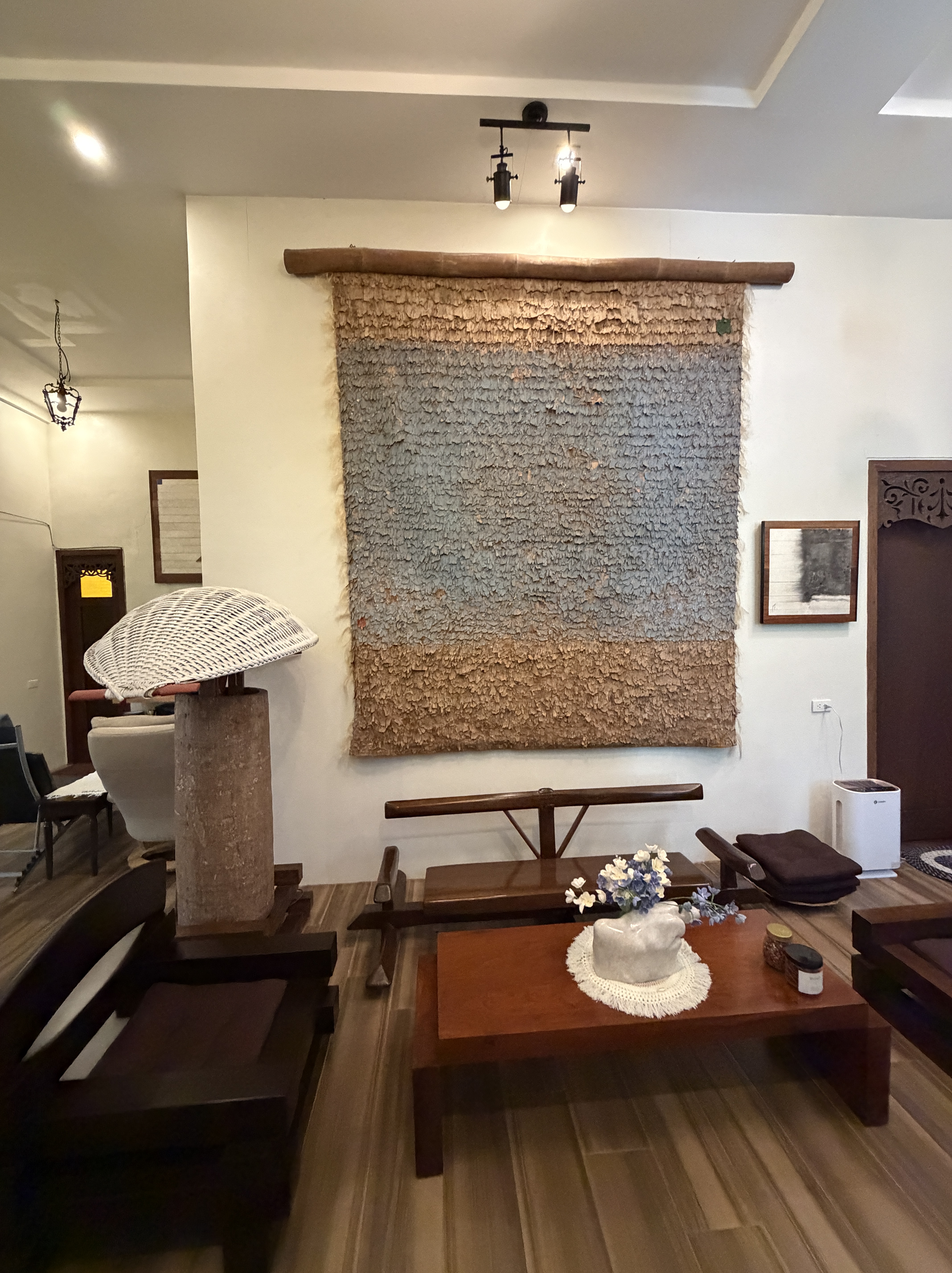
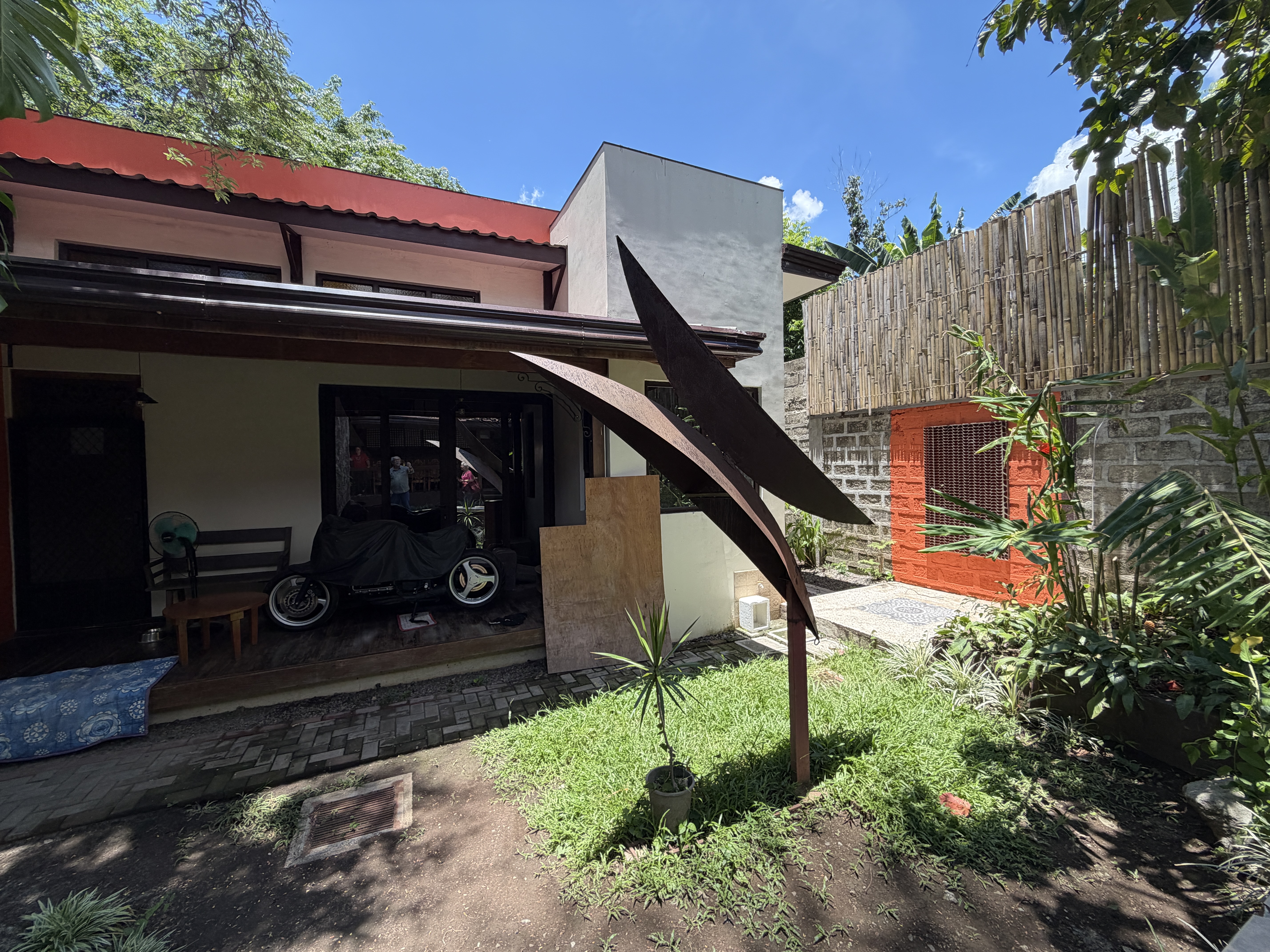
This was most evident in his new home, a modestly modern structure from the outside, nothing showy, but warm inside with wood, stone, and other natural elements, from the balayong door to the leaflike tapestry to the upturned hammock serving as a lampshade. 

Welcoming our party, Junyee points to a blank wall and remarks with a chuckle that something big used to hang there but had to be let go of, presumably for his crushing medications. It’s one of the few times he’ll advert to his maladies, of which he—and Fil for that matter—don’t make a big thing. When Junyee learns that Fil is similarly afflicted, the men knowingly embrace and call each other “classmate.” They smile, they laugh, they speak excitedly of the work that occupies their waking hours. There’s no time to be glum. Fil and Janos keep racks of sporty bicycles at home, hanging from the ceiling; Junyee shows off a gleaming high-performance BMW motorbike which he received from a patron, adding with a chuckle that “I don’t even know how to ride one!”

Over lunch at a favorite restaurant nearby, we have an animated discussion of AI and its likely effects on art and literature. I expect them to resist, but Junyee in particular is surprisingly open to the possibilities of hybridizing art and technology, as I am. “I’ve always been a fan of science,” he says, “and when I write my memoirs, which I’ll be doing soon, I’ll make sure to include a section on how science has influenced my life and work.” But even more useful and valuable than science for both men right now is faith, and Fil and Junyee speak unabashedly of how their faith strengthens them through their trials. As an installation artist, Junyee has never worried about transience and impermanence. “Everything in this world will pass anyway,” he says.

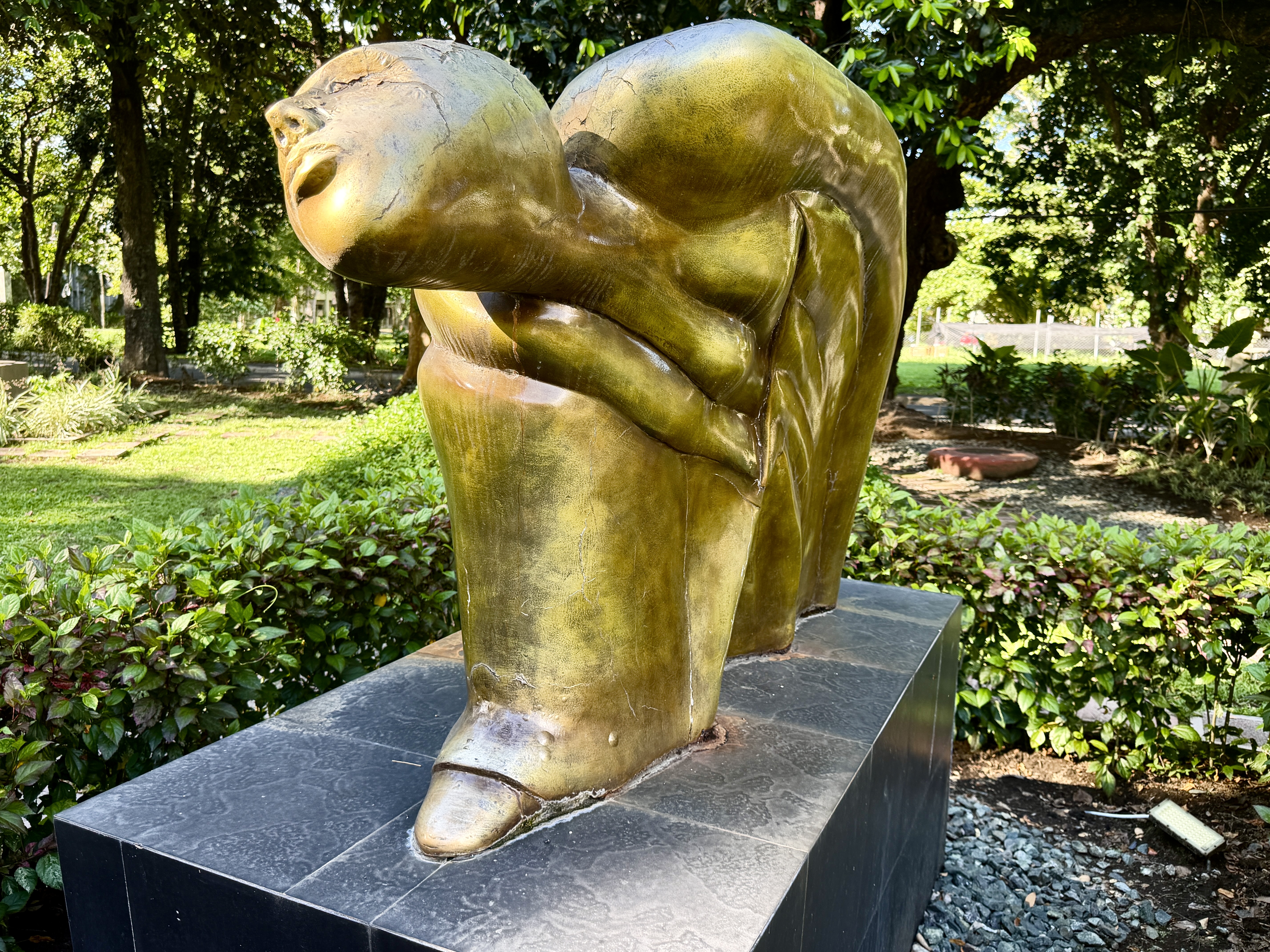
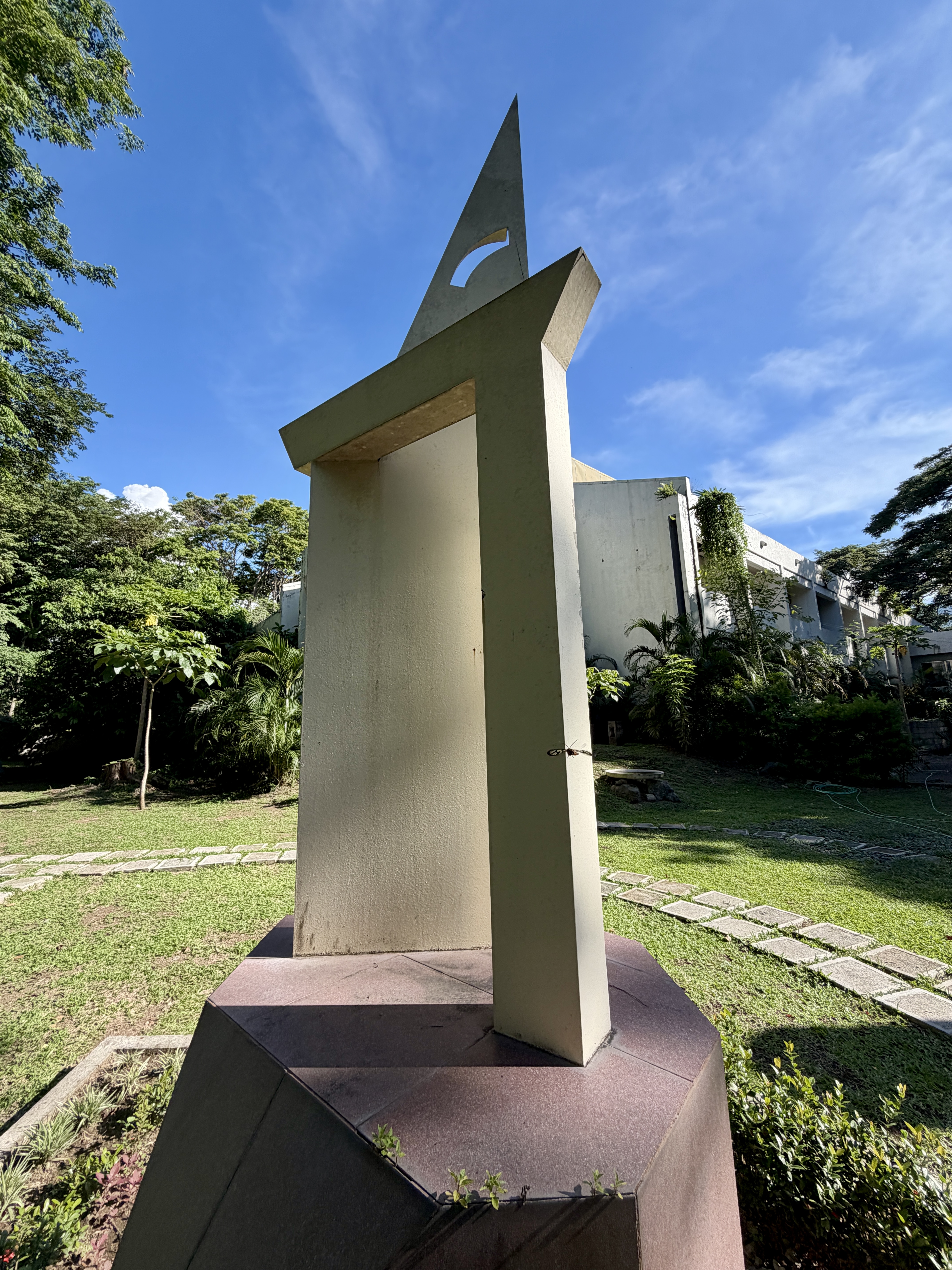
We pay a visit to the Sculpture Garden that UP Los Baños has put up on campus to showcase some of Junyee’s most important pieces. It is an outdoor gallery of some of his finest pieces, displaying the full range of his concerns, techniques, and capabilities. It’s hugely impressive, but Junyee makes it clear that he isn’t done yet. Across his home, he is constructing an art museum that he hopes will help spark a cultural renaissance in Los Baños, better known for agriculture and forestry, which Junyee’s art has also tapped into. His labors have not gone unnoticed; on top of his numerous local and international awards, Junyee will soon be receiving the highest recognition his alma mater can confer, among the worthiest of its recipients.

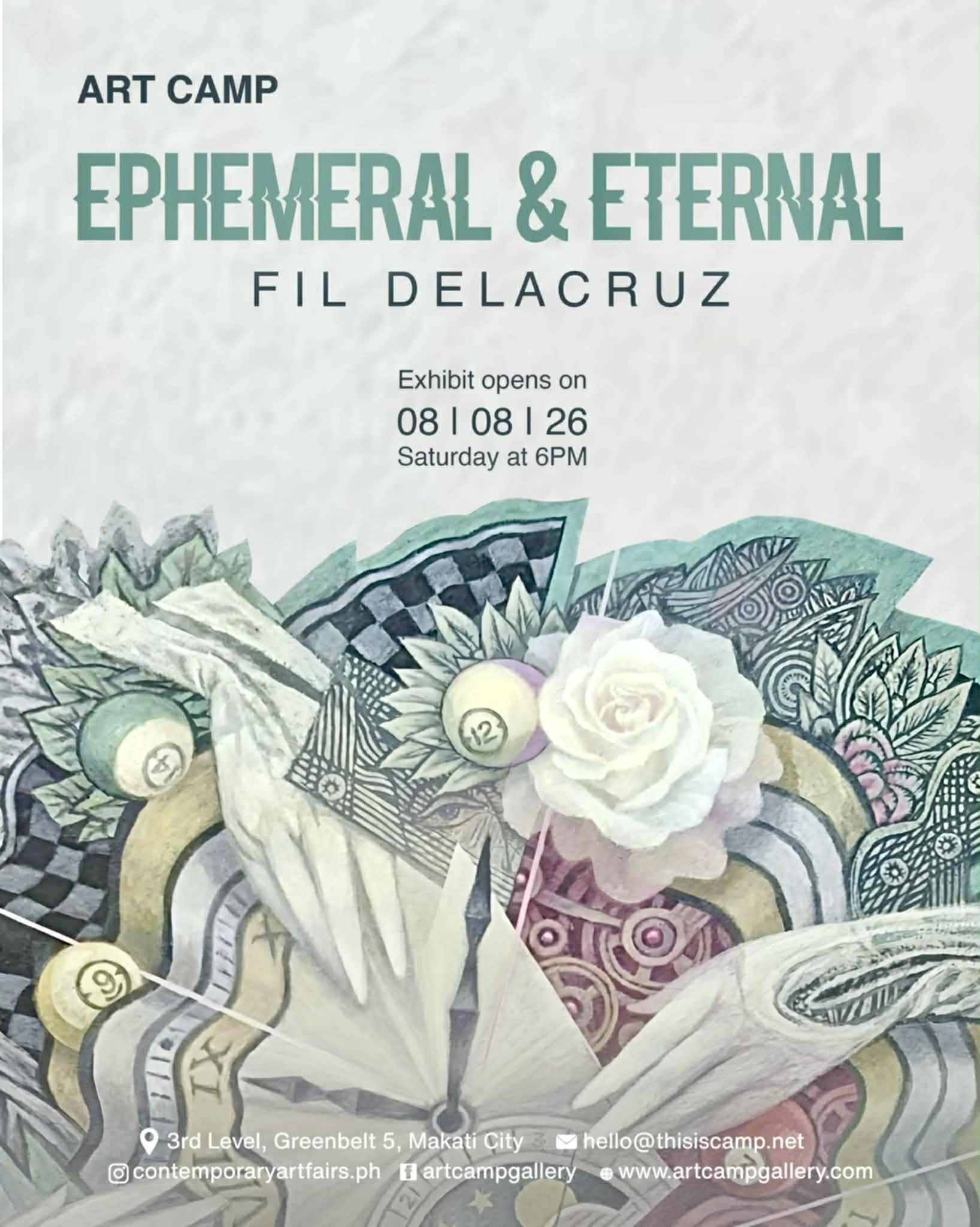
Neither is Fil de la Cruz resting on his laurels. He’ll be showing his newest paintings in an exhibit titled “Ephemeral & Eternal” opening next Saturday, August 8, running until the 22nd at Art Camp in Greenbelt 5, Makati. “The central thesis of the exhibition revolves around the duality of existence—the fleeting ‘ephemeral’ moments of lived experience versus the ‘eternal’ span of divinity,” according to the exhibit notes. “De la Cruz does not present time as a linear progression but as a divine force, encompassing all. In this series, he treats the passage of time not with anxiety, but with a refined serenity and deep reverence, seeking to capture the precise point where the transitory nature of life intersects with the infinite.” 

It’s as good a description as any of that trip to Los Baños and of our visit to these artist-friends’ homes, at this point between our shared past and the eternity that beckons to all of us.

Penman No. 487: A Prize for AI?

Penman for Sunday, July 12, 2026

LAST MAY, the literary world was rocked by the news that the winner of the Commonwealth Literary Prize—a short story titled “The Serpent in the Grove” by a little-known writer from Trinidad named Jamir Nazir—had been written using AI. Words like “fraud” and “hoax” flew out quickly into cyberspace. Probably suspecting something was off, someone had used an AI-detector app called Pangram to scan the piece, which returned an unequivocally damning judgment: “100% AI-generated.” 

Along with other Commonwealth winners, the story had been published in the respected literary magazine Granta. Given the uproar, the Commonwealth Prize judges reviewed Nazir’s drafts, and pronounced the work authentic; Granta severed its ties with the foundation giving the prize, but has retained the story on its website anyway for all to see and evaluate.

And that’s exactly what I did—go the website and read the work for myself before coming to any conclusion of my own.

Now, it’s not as if literary hoaxes are anything new; it’s happened before, and it’s even happened here. Long before AI, plagiarism and outright invention (a crime in the case of nonfiction) were practiced not only by the lazy and untalented but also by the cunning. Among the most notorious cases in the US were those of James Frey, who fabricated large sections of his bestselling memoirs, and Janet Cooke, whose Pulitzer-prizewinning story for the Washington Post turned out to be based on an entirely fictional character. Here in the Philippines, a postal clerk named Jose Marco duped generations of Filipinos into believing that the Code of Kalantiaw and a novel by Fr. Jose Burgos titled La Loba Negra were the real thing.

The fraud in these cases was uncovered not by programs like Pangram or GPTZero but by dogged scholarship—in the case of Kalantiaw, through the work of the historian William Henry Scott, who showed that Marco’s “code” had words that weren’t in use until centuries later.

Even with software, proving literary deception today is a lot more difficult, because creative writing almost by definition is, well, deception of the highest order, extremely liberal in its methods and means, and devious (without being necessarily evil) in its motivations. Fiction especially is intrinsically ambiguous, unlike journalism which rests on fact. So how can anyone be sure that this prizewinner was faked?

“The Serpent in the Grove” is not a very long short story at less than 3,400 words, and the controversy aside, is certainly an interesting if not significant one in many ways: freshness of language, simplicity of plot but complexity of character, power of imagination. It talks of a man named Vishnu who, enamored of a vamp he meets at the bar, contrives to drown his wife Sita in a well; she falls into it but then manages to crawl out with a neighbor’s help. Sita and even their young son seem to understand exactly what has happened, but no one brings it up and they somehow manage to survive into old age keeping that terrible truth unspoken. 

Some people have savaged the story after the scandal broke, in the way people change their minds instantly about someone after being told that person served time for rape or murder. Personally—and this could well be an unpopular opinion—I found it rich and engrossing, at least partly because of very same startling metaphors that got flagged as AI giveaways. It’s not an easy read, with its localized English, and I could see how Western readers attuned to the kind of language you hear at Walmart would find it painfully artificial (my friends in the Midwest found Nick Joaquin “too lush” when I had them read him). I don’t write that way myself, which is probably why it intrigues me even more. Here are some random excerpts:

“Sita moved quiet as if sound were taxed. Nineteen and brown like dust after rain, she turned roti dough with a rhythm that came not from joy but from endurance.”

“Marsha lived two bends down. If the village had a mouth, it was hers. Big in the way of women who never apologize to furniture, she had a laugh that shook dust from joists and a voice that could soften to coax a child from a ledge. She knew the ways of men hollowed by want until only one thing remained. She noticed the fresh-cut path and the way land bore witness. People talk about bush like it dumb. But bush keeps memory the way hair keeps scent.”

“Sita lifted two planks and slid them aside. Wood complained in a voice too near speech. She lowered the pail until rope slackened. Smell rose—old wet, crushed jasmine, frog skin. On the second haul, the board beneath her shifted the way a tired man shifts in his sleep. The plank gave one long groan and swallowed its word. Stone, shoulder, hip; shock of cold tearing breath. One foot banged and screamed. The wall was slick as lizard. She clawed moss and slid. Water took her and would not return her.”

So what did the software flag? Unlikely metaphors, it said, like the vamp “had the kind of walking that made benches become men.” Or that a character “smiled like sunrise over a sink.” It noted that there were nearly a hundred metaphors in such a short piece. It claimed that in the sentence “Coffee and cocoa leaned wild on a slope that wanted either rain in teeth or none at all,” the phrase “rain in teeth” made no sense, was a hallucination. 

But at this point, my own gut was telling me to trust Pangram less than the author. Call me dumb, but I find “rain in teeth” rather fetching. Any first-time workshopper would get that.

So would I have given the story a prize? That would depend on its competitors, which I haven’t seen, but it’s surely a story I would teach, both for its own merits and for its alleged employment of AI. I might even do that this incoming semester, when, for the first time in many years and possibly the last, I’ll be teaching an undergraduate class in Professional Writing. It’s a course I designed and had been teaching for two decades, but the big difference this time is that we’ll be dealing with AI—which is something that I don’t intend to ban outright (like Canute commanding the waves) but to grapple with head-on, negotiating the line between one’s imagination and what AI might do. I can foresee how controversial this will be, and I recognize the adamant opposition to AI from many writers and artists on both aesthetic and ethical grounds, but at 72, this could be my last look over the horizon. (I’ve already declared that I will no longer judge literary contests nor take part in literary workshops except in my own classes, so this will be my arena for engaging with AI.)

I wouldn’t be surprised if, in the future (and if it hasn’t happened already), some smartass with an ax to grind enters a wholly AI-generated story or poem into the Palancas, only so that when trusting judges make it win, he or she can declare them and the entire literary Establishment (yes, that cabal of superannuated gatekeepers who keep ignoring one’s literary genius) a bunch of fools.

Right now, what I’m thinking is, if you can come up with the kind of prompt that produces “The Serpent in the Grove,” then you deserve a prize—maybe not the Commonwealth one, which is still an open question, but at least one for inventiveness and audacity which seem to remain in short supply in what I’ve been reading, with or without AI.

Qwertyman No.204: The Anatomy of a Grievance

Qwertyman for Monday, June 29, 2026

BARELY HAD we wrapped our heads around what happened to lead to the deaths by drowning of the two Ateneo athletes Rene Baterbonia and Divine Adili when we got the news of a mass shooting at the San Jose National High School in Tacloban, Leyte, with two teenagers allegedly responsible for killing three students and injuring many others.

Both events were met with shock and outrage, as was to be expected. Even in the long catalog of evils and misfortunes that we Filipinos have become familiar with, these did not exist. Healthy, star-quality athletes do not suddenly die; Filipino teenagers tied to their cellphones do not bring guns to school and shoot their peers dead. It was as if we had let new and unfamiliar monsters into our fold, and we were eager—indeed adamant—to give them a face, a name, and a motive. At the very least, we needed someone or something to blame, to ease our consciences. 

That consternation likely accounts for the plethora of suspicions, accusations, and conspiracy theories that emerged in the wake of these tragedies, ostensibly to throw light on “what really happened” but achieving the opposite effect of leading us even farther away from the truth. I myself have been mighty confused by some of these responses—who said exactly what, where did that come from, etc.—that I turned to AI (yes, I know, something that some of us trust even less than the cafeteria Marites) to help me sort things out; in this instance, I used Claude, which has proven to be a reliable assistant in my nonfiction work. (We can have another debate another time about whether writers like me should even resort to AI—at which I’ll ask if you’ve ever used Google or an electronic calculator, for that matter—but I’m hoping that this present discussion will offer proof enough that there’s room for mechanical assistance in human argumentation.)

Most troubling if not ridiculous of all have been a couple of memes I’ve seen claiming that Rene was beaten up and drowned by his fellow players and that the coaches merely looked on. 

These speculations apparently ride on the allegation made by Rene Baterbonia’s mother Rovelyn that her son’s death was no accident—a short step away from claiming that Rene was murdered, as some netizens have chosen to interpret it. But nowhere in her many interviews did Rovelyn clearly and verifiably say that “My son was murdered.” (And neither am I saying that she had no right to claim that had she wanted to, as the most aggrieved party entitled to her darkest fears and suspicions.) 

What the record shows is that, based on what she initially heard, she believed that Rene’s arms and legs had been weighted down (subsequently denied by the autopsy results), and that the dangerous exercise had taken place without informed consent (a continuing issue). She also took Ateneo to task for not communicating with her quickly and clearly enough (I think a fair charge). So no, Mrs. Baterbonia never said nor suggested that someone purposely killed her son. She does allege criminal negligence, which many people suspect, and a sorely inadequate response on Ateneo’s part, which I think even Ateneans admit in their heart of hearts.

What muddled this further was the CIDG’s reported statements, made more than a week after the June 9 incident, that the deaths were “not an accident,” apparently contradicting the local police’s initial assessment. That later statement, made by CIDG Director Robert Morico II on June 17 and repeated on June 18, was hedged as a presumption awaiting further evidence. It ultimately recommended, in its June 26 findings submitted to the Department of Justice, that an anti-hazing case should be filed against 11 individuals led by Coach Tab Baldwin, since the team-building activity constituted hazing under dangerous conditions. But “not an accident” resulting in homicide again doesn’t translate to willful murder—or a plot, as the DDS puts it, for Luzon to kill off Mindanao’s finest. It’s now up to the DOJ to move matters forward.

What this tells me is that in the absence of factual information, clearly and promptly disseminated, all kinds of malicious rumors will emerge and easily find sympathetic receptors and transmitters. (I suspect the counter-narratives would have arisen anyway—the trolls have to earn their keep, which means the fact-checkers and truth-sayers have to work at least as hard.)

The same miasma now threatens to engulf the Tacloban shootings, in which two teenagers carrying a .38 revolver and a Glock 9-mm were involved. The Internet was quick to spit out AI-generated pictures of Sens. Kiko Pangilinan and Risa Hontiveros coddling the two suspects, with Sen. Kiko being blamed for his sponsored law setting the bar for criminal responsibility at age 15 (the UN recommends a minimum of 14 years). 

There are many other aspects to this case, including that of gun ownership, but let’s focus for now on this age-of-criminal-responsibility thing, which Pangilinan’s DDS detractors want to bring down to 10. Again, to be clear, Kiko stated that the law as it stands doesn’t automatically absolve the juvenile shooters from responsibility; they remain accountable in various ways, and cannot simply be released.  

If they used the same AI they used to malign the senators, the DDS propagandists would have discovered that the UK, which does use age 10 as its baseline, has a higher crime rate than other European countries using 14-15. The Nordic countries start at 15 and are among the world’s safest. (North Korea reportedly sets its bar for criminals at 6.)

We seem so eager to establish at what age young offenders can be punished that—as horrendous as the Tacloban shootings were—we forget the far more numerous and grievous crimes committed every day by adults in this country that go unpunished. 

In any case, the most sensible response I’ve read to the Tacloban shootings came from a Facebook poster named Raffy Magno, who said that “There is something deeply troubling about a society that is quick to demand the harshest punishment for young people, while celebrating convicted plunderers, tolerating corruption, and rewarding leaders who normalize violence.

“Young people do not grow up in a vacuum. They learn from the values we model, the behavior we reward, and the systems we build around them. Violence rarely begins at the moment it becomes visible. It is often preceded by bullying, social isolation, neglect, untreated trauma, and countless missed opportunities for intervention.

“If we want children to reject violence, then we must also be willing to examine the ways our society excuses, glorifies, and profits from it. We cannot celebrate violence among adults and expect young people to learn a different lesson.”

The call for justice begins with raw and strong emotion, but ultimately it has to be dispensed with cool and thoughtful reason.

Qwertyman No. 192: Apple@50 in a World@War

Qwertyman for Monday, April 6, 2026

A REEL circulated recently online explaining the origins of the ubiquitous Internet symbol @ for “at,” tracing it back to medieval monks seeking a shortcut and to merchants using it to mean “at the rate of,” and then finally to a coding convention adopting it to link a computer user’s name to his or her domain or location.

I found it fascinating because I’m something of a geek, a failed scientist who had to switch from Engineering to English because I couldn’t hack the math, who ended up channeling his digital side (as opposed to the analog, which collects vintage fountain pens and antiquarian books) into a decades-long devotion to Apple computers and to nearly everything Apple produced. I even chaired the Philippine Macintosh Users Group (PhilMUG) back in the mid-1990s when the handful of us felt like early Christians in a pagan universe. We had monthly get-togethers in small restaurants to unbox the latest SCSI peripherals and discuss the newest features of System 8.0. I prided myself in the fact that I could strip and reassemble a PowerBook Duo practically blindfolded. 

I mention this because Apple has just marked its 50th anniversary, having been founded in 1976 by Steve Jobs, Steve Wozniak, and Ronald Wayne with a machine cobbled together in a garage. After slogging through its first decades as a distant competitor to the more popular Windows PC, Apple finally achieved global domination after coming out with such game-changers as the colorful iMac, the iPod that made you smile the minute you put your earphones on, the ultraportable iPad, and of course the indispensable iPhone. 

As industry observers noted early on, the genius of Steve Jobs and Apple wasn’t just in its products, but in creating the need for them; you didn’t know how irresistible the iPhone was until you held one. Apple and its passion for personal computing—not just the hardware but an entire lifestyle ecology that integrated communication and writing with music and photography—arguably changed the world, or at least hastened its evolution.

But enough of the proselytization. I’m not writing this piece to sell you another Mac, which God knows Apple doesn’t need another endorser for. Instead, that half-century of Apple that just went by gave me pause to wonder where all that early joy of tech has gone, and indeed where technology has led us and will yet take us. 

Like many early adopters, as we were called then, I recall the inimitable thrill of trying out a new machine, an operating system, or a program—something to make life and work easier and faster than before, another bold step into the future, a declaration of faith in the power of technology to transform life and indeed the world itself. New technology arrived with the presumption of goodness and optimism—that it would bring relief to global poverty and hunger, find a cure for cancer and other human ailments, improve education, and generate jobs for billions; it would draw more people into the circle of development, empower the oppressed, and induce social equity. With the advent of the Internet, more doors and barriers came crashing down. We could express ourselves publicly, bypass the traditional gatekeepers of information, challenge authority, build communities of common interest, expose falsehood and spread the truth, and create a truly transparent, interconnected, and progressive global society.

The kind of tools that Apple and its competitors produced were supposed to assist that project. They did—and again they did not. Instead of tearing down walls between people, the Internet raised new ones, behind the anonymity of which we could tear each other down. Computers and smartphones now facilitate disinformation, human trafficking, money laundering, and all manner of scamming.

Worst of all, technology has made it easier to wage war and kill people (like it always has). From Desert Storm back in the early 1990s to the present Iran War, military assaults and even mass slaughter have assumed the sanitizing cloak of an e-sport, a posture Trump and his war gamers have actively adopted, reducing casualties to memes. Indeed the US-Israeli attack on Iran has now been called “the first AI war,” as an article by Michael Brown on Forbes.com substantiates:

“When I became the Director of the Defense Innovation Unit at the Pentagon in 2018, Project Maven was already underway. Long before LLMs, DIU was supporting Project Maven with several vendors to improve computer vision, an AI capability to distinguish among objects in satellite imagery to save analysts studying pixels…. That legacy led to Palantir’s Maven Smart System, today’s cornerstone of the U.S. military’s AI-powered operation. Maven fuses satellite imagery, drone video feeds, radar data, and signals intelligence into a single interface, allowing operators to classify targets, recommend weapons, and generate strike packages in near real time. The results have been staggering: more than 1,000 targets were struck in the first 24 hours of the campaign, a tempo that would have been unthinkable with purely human targeting processes. That tempo has been maintained with only 10% of the human analysts that would have previously been required to strike 1,000 targets daily.

“Yet the system’s limitations are equally revealing. Maven’s overall accuracy hovers around 60 percent, compared to 84 percent for human analysts. Palantir’s CTO nonetheless declared it ‘the first large-scale combat operation driven by AI,’ a characterization that raises questions about the ethics of AI-driven targeting and the adequacy of civilian protection safeguards.”

Of course it would be unfair to lay responsibility for this on the doorstep of Apple or other tech giants today—barring those who, unlike Anthropic, have actively lent their resources to Trump’s war machine. The companies known to have supported Israel’s military capabilities include Palantir, Microsoft, Google, IBM, and G42 (and yes, that’s according to AI). While the biblical prophets called for swords to be beaten into plowshares, somebody found a way to turn high tech’s plowshares into guns and missiles. 

And then again, as the gun rights advocates always say, “Guns don’t kill—people do.” With some people being so stupid and devoid of conscience, why should we even wonder if and when AI will work better than the human brain? That already happened, more than fifty years ago.

Email me at jdalisay@mac.com and visit my blog at http://www.penmanila.ph.

Qwertyman No. 180: Resolutions We Can Keep

Qwertyman for Monday, January 12, 2026

ALMOST TWO weeks after the New Year, I’m sure many of us are still struggling with the resolutions we made—you know, the same ones we announced a year ago, like losing weight, buying no more (supply the object—shoes, watches, dresses), emptying the closet, and being nicer to (supply the officemate or in-law). I had to think that there must be resolutions we can make and actually keep—not easy or frivolous ones, but resolutions that will make a real difference in how we think, behave, and live. Here’s what I came up with:

1. I will not help spread fake news and hoaxes. Fighting for the truth begins with a healthy skepticism and the patience to verify. There’s no such thing as “harmless” fake news passed on. 

Last year I had to gently warn a score of friends—smart people with outstanding reputations—who posted on Facebook about Meta claiming the rights to their pictures and about pages turning blue (“It really happened!”) It’s a hoax that’s been going around for years, I told them; there was no such thing as the post described. What’s the harm, they said, just wanted to be sure. Well, the harm is in the propagation; every repost expands the space for fake news to grow, and the poster’s credibility only magnifies it further. That credibility also takes a hit, when it’s shown to absorb and help spread falsehood. Next time, visit a reputable fact-checker like http://www.snopes.com to verify a dubious post. The days are gone when you can assume that what you see is true unless proven otherwise; if you have to assume anything, assume the opposite.

2. I will think before I respond. I will reserve judgment until I understand the situation better, with clearer context and trustworthy and verifiable sources. It’s been said that today, especially online and on social media, people don’t read to understand, but to reply. Many of us have trigger itch—the compulsion to react to and comment on anything and everything that crosses our gunsights. And we do that literally without second thought, drawing on little more than scant knowledge and ample prejudice, and the unflinching conviction that we are right. 

The rise of the provocative meme—extremely compact and blunt, digitally manufactured to make a very specific point—has made this even easier, more efficient and more vicious. Memes eschew context, and invite uncritical concurrence. When I see a witty meme, I might smile and even smirk—but I will pause before joining a bashing spree if I have the slightest suspicion that something isn’t quite right. And while I’m at it, I will keep my sense of humor; I will not be baited or feel obliged to respond in anger, and I will remember that forbearance or silence is not surrender, but often victory.

3. I will use AI responsibly. I will use it as an assistant, but not let it do my thinking for me. I will use it to learn, understand, teach, and create. I will not use it to lie, malign, exaggerate, or aggrandize. I will not pretend to know everything AI can do or is doing. I will neither fear nor ignore it, but I will be wary—especially if what it produces is too clean, too good, or too intent to please. Truth often has rough edges that AI could polish out, like it enhances our portraits. 

I was watching a video on YouTube last week that purported to show the detailed production process by which the fashion house Hermes made its hyper-expensive and hard-to-get Birkin bag (am no fashionista, but am deeply curious about that industry’s workings). The video went to great lengths to demonstrate why the company’s bags commanded such high prices—the quality of the leather, the workmanship, the exclusivity—in purposeful contrast to the numerous fakes being made of the popular bag. But there was something about that video that made me uncomfortable—it seemed too luminous, its people too handsome, its tableaux too staged. An outdoor scene, supposedly outside the boutique, gave it away: the large shop sign clearly said HERMEES, with the extra E; it was no mistake—a few scenes later, they showed the sign again. The whole video was AI-driven, and no human seemed to be home and sharp enough to note the error. Now, its content may have been entirely factual, but its implied condemnation of fakery in business can’t possibly be helped by such a clumsy use of AI. 

4. I will not expect of others what I cannot expect of myself. This was something I learned during martial law, when I was imprisoned with all kinds of people—activists and common criminals, from both privileged and impoverished families. There and elsewhere, I saw how people who could speak so boldly and so well about revolution and liberty could break, sometimes so easily, under pressure. I witnessed and understood the marks of torture. I realized that everyone probably has a breaking point. I wondered what mine was. (My dentist would later tell me that I had a high threshold for pain, which surprised me.) But I came away thinking that if I asked another person to make an extraordinary sacrifice, it should be something I would be willing and prepared to do as well. I say this not to excuse weakness in other people, but to demand more of myself.

I will, however, hold public officials to a higher standard. They chose to lead—for which many are also handsomely rewarded—and so they must prove themselves better than the led. I have a right to expect that my President and congressman will act more wisely and more responsibly than me.

That said, I will live as honorably as I can, despite and especially because of the morally degraded environment in which we find ourselves today. I will not abet corruption in any way. This might be the hardest of all to keep, given how we have all somehow been complicit in this crime.

5. I will be more charitable, and share more of what I have. I will rescue “charity”—among the most human of values—from the political dustbin to which it has been relegated as useless and even harmful tokenism. I’ve heard too many people speak loudly and articulately about big themes like “social justice,” “Gaza,” and “anti-poverty” without yielding a peso from their own pockets or actually doing something concrete for the afflicted. Give, or serve. If you can’t change the system, change a life—you might even change yours.

Qwertyman No. 143: I or AI?

Qwertyman for Monday, April 27, 2025

I’VE RECENTLY been asked to talk about literature in the time of artificial intelligence (AI) in a couple of conferences in Dumaguete and Manila. What that tells me is that, with AI’s emergence and growing popularity, there’s been much uncertainty, anxiety, and fear—even outright hostility—generated by the seemingly unstoppable intrusion of artificial intelligence not just into literature but into almost every aspect of human life and society. As I’ve said before, depending on how you see and use it, AI is either God’s gift to humanity or the destroyer of civilizations. 

While it has been hailed for its contributions to such fields as medicine and criminology—shortening diagnostic procedures and sharpening digital forensics—AI’s application to less mechanical endeavors is more fraught with both ethical and technical questions. Studio Ghibli’s Hayao Miyazawa, for one, has forsworn the use of AI in his work, calling it “an insult to life itself.” 

For writers and other creatives, the big questions are: Will and can AI replace the author? Is AI capable of artistic imagination? Should writers, publishers, and readers feel threatened by its future development? Might there be a positive role for AI in literary creation? 

Now, we can be very brave and declare that the worst piece of writing or art done by a human is still better than the best of what AI can produce. I’ve heard many authors proudly insist that “AI can never replace me!” But do you honestly think that’s true, and will the readers of the future—say, the consumers of popular fiction—care? The sobering fact is that there is so much bad art and bad writing done by real humans that it shouldn’t be too hard to artificially produce something better, for which people will gladly pay. 

I know that this will strike some of us as being crassly commercial, but it would be naïve to deny that much of what know to be culture today has been commodified—produced and sold as entertainment, whether it be a book, a movie, a concert, a computer program, or the hardware with which to access them. These are all media in which AI is already playing an increasingly important role—initially, perhaps, merely as a facilitator, a simplifier of complex or difficult tasks, or as an aid to the imagination, but also as a co-creator or collaborator, such as in the generation and animation of images. 

Given the fact that most of us produce art to sell—and why shouldn’t we, especially when we promote the idea of “creative industries”—the entry of AI into our thought processes and methods of work could be a matter of survival for many. The question is, will it improve the mediocre, or degrade the excellent? Can we excel without it, or because of it?

Early AI’s clumsy mistakes or “hallucinations” are worth a laugh, but I’m not sure how long we’ll be laughing; AI’s present ineptitude simply means it has a lot to learn—and it will, with the kind of training it’s being fed off our books, our texts, our manner of writing. It will only be a matter of time—I’d say less than a decade—before AI can mimic the best of global writing especially as literary texts get digitized and tossed into the meatgrinder, until it can produce a decent if not impressive approximation of certain styles and approaches. 

(For AI professionals, the next phases of the AI revolution will move into Artificial General Intelligence or AGI, at which point AI can match human intelligence, and ASI or Artificial Super Intelligence, when AI becomes self-aware enough to improve and replicate itself without human intervention and possibly beyond human control. These scary scenarios will not take, they say, a century to happen—some experts predict that AGI could be realized as early as 2027.)

What’s going for us is that while literary styles can be copied, the human imagination is far richer and stranger than we think. AI tends to homogenize; the human artist strives to be unique. Even so, researchers are already talking about algorithmic imagination and experimental humanities as “true collaborations with culture machines.”

Given that it’s inescapable, I propose that instead of fearing it, ignoring it, or maligning it as I’m sure many of us are inclined to do, we study AI and use for what it might be able to offer in aid of the imagination—as unsettling or unappetizing as that proposition sounds.

We’re already tapping AI every time we use Google, and no one seems to mind. I don’t mind admitting that I have used AI—not in fiction but in creative nonfiction or CNF, specifically in writing the biography, where I ask AI to summarize and organize biographical material that I would have eventually found on my own, anyway—in days rather than seconds. 

I suspect that the use of AI in CNF is much less troubling for writers and theorists than its employment in, say, writing the novel or the poem, which we have been trained to think of as more personal, more “us,” than nonfiction. We will yield CNF to AI, but draw the line at fiction and poetry, where we feel we should resist the intrusion of the beast or the machine into the recesses of our imagination. 

I wonder, however, how long this fortress will hold, or what the first crack in the wall will be, if it isn’t there already. I’m pretty sure that somewhere out there, a plodding novelist is already using AI to chart a tree of plot possibilities—What will happen if Maria marries Oscar? What if they decide to live in Davao instead of Baguio? And so on. I wouldn’t do this myself, because the fun of writing for me is in working out the future of my characters in my head. 

And then again I write fiction for the love of it—unlike almost all other kinds of writing that I do for a living. But if I were a novelist under contract to produce a novel a year, I’m not so sure that I wouldn’t seek AI’s help to lighten my load and get the job done. So is AI OK for money but not for love? Is that what it all comes down to?

So right now we have many more questions than answers, and at the pace the world is changing, most answers we come up with will soon be obsolete anyway. But the basic questions will remain, the most vital of which could be, when we say “I am,” is that “I” me, or is it AI speaking?

Qwertyman No. 140: The City of Stories

Qwertyman for Monday, April 7, 2025

THIS PAST weekend, I was down in Dumaguete City with National Artist for Literature Resil Mojares, historian Ambeth Ocampo, and scores of other writers for the 2nd Dumaguete Literary Festival. At my age, I’ve frankly tired of going to literary festivals, conferences, and workshops, preferring to work quietly at home—Dr. Mojares apparently feels the same way—but we couldn’t resist the allure of Dumaguete, a city central to the development of Philippine postwar literature, and always well worth visiting on its own for its gentle charms.

I personally have much to thank Dumaguete for, for what it contributed to my own budding literary and academic career. Early in 1981, shortly after I had returned from my first visit to the US, I received an invitation from Dr. Edilberto Tiempo to join the Silliman Writers Workshop which he and his wife Edith—the poet and future National Artist—had started two decades earlier upon their own homecoming from America. 

I had dropped out of college for a decade by then, and was working at NEDA, which had sent me to the US for an observation tour. What that trip to the American Midwest—mainly the campus of Michigan State in East Lansing—did for me was to rekindle my interest in learning. Dr. Tiempo’s invitation could not have come at a better time: a summer devoted to talking about poetry and fiction at Silliman University felt dreamlike, and by the time the workshop ended, my head spinning with magical lines from Robert Graves, I had resolved to quit my job, go back to UP, and just study, write, and teach for the rest of my life. And that’s what happened.

I wasn’t alone in that kind of transformative experience; as the country’s oldest writers’ workshop, the Silliman summer workshop became a virtual rite of passage for young writers, especially in English (some writers in Filipino have also attended, with works in translation). Silliman itself (older than UP by several years) has produced many of the Philippines’ finest writers, aside from the elder Tiempos—among them Ricaredo Demetillo, Aida Rivera-Ford, Merlie Alunan, Leoncio Deriada, Cesar Ruiz Aquino, Elsie Coscolluela, Rowena Tiempo-Torrevillas, Marjorie Evasco, Lakambini Sitoy, Artemio Tadena, and Myrna Peña-Reyes. It also has a strong performing arts tradition, contributing the likes of National Artist Eddie Romero, Gilopez Kabayao, Amiel Leonardia, Junix Inocian, and Elmo Makil, among others.

For all these, Dumaguete has been formally nominated to be designated as a UNESCO City of Literature—one of many such distinctions listed under UNESCO’s Creative Cities Network program that was launched in 2004 to recognize and celebrate cities around the world—350 of them form more than 90 countries to date—for their signal achievements in Crafts & Folk Art, Design, Film, Gastronomy, Literature, Music, and Media Arts. So far, 53 cities in 39 countries have been named Cities of Literature—among them Barcelona, Heidelberg, Iowa City, Lahore, and Norwich. (Iloilo has already been named a City of Gastronomy, and Quezon City is vying to be designated a City of Film.) With the Philippines serving as this year’s Guest of Honor at the Frankfurt Book Fair, Dumaguete’s recognition as a UNESCO City of Literature will raise our global cultural profile even higher, and let the Philippines be known for more than Boracay, Manny Pacquiao, and Imelda’s shoes.

Leading that charge for Dumaguete is Silliman University literature professor Ian Rosales Casocot, one of our best fictionists and co-director of the festival with Gayle Acar. Working with the Dumaguete City government, the Department of Trade and Industry, and the Buglas Writers Guild which Ian heads, Ian notes that aside from developing writers, “Dumaguete itself has been a constant subject of many literary works, from novels to poetry, from essays to plays. It is high time that Dumaguete is recognized for its role in shaping literature in our corner of the world.” The well-attended Dumaguete Literary Festival, now on its second edition, offers proof positive of that city’s continuing centrality to our literary life and culture. 

We had been invited to share our views on various aspects of Philippine literature in this age of artificial intelligence. I joined a panel of writers dedicated to that specific topic—or, as they put it, “Can AI Win a Nobel Prize for Literature?”—which happened to be something I’ve given much thought to.

Understandably, there’s been a lot of fear and anxiety—even outright hostility—generated by the emergence of AI in nearly every aspect of human life and society. Studio Ghibli’s Hayao Miyazawa, for example, has forsworn the use of AI in his work, calling it “an insult to life itself.” While it has been hailed for its contributions to such fields as medicine and criminology—shortening diagnostic procedures and sharpening digital forensics—AI’s application to less mechanical endeavors is more fraught with both ethical and technical questions. 

In previous lectures and again in Dumaguete, I showed how—at this point—AI poses little threat to the writer of truly good and imaginative literature, by yielding execrable responses to such prompts as “Write a paragraph about a summer night in Spanish Manila in the style of Nick Joaquin.” It’s worth a laugh, but I’m not sure how long we’ll be laughing; AI’s present ineptitude simply means it has a lot to learn—and it will, with the kind of training it’s being fed off our books, our texts, our manner of writing. It will only be a matter of time—I’d say less than a decade—before AI can mimic the best of global writing. For me, the best response is neither to hate nor to ignore it, but to understand it and employ it for helpful uses we have yet to find. (We’re already tapping AI every time we use Google, and no one seems to mind.) It should even be possible for authors to creatively interact with AI in what I’m calling a game of prompts.

What we can reasonably certain of is that while literary styles can be copied, the human imagination is far richer and stranger than we think. AI tends to homogenize; the good creative writer strives to be unique. Like Dumaguete, there’s a whole city, a labyrinthine cosmopolis, of stories in every writer’s mind to be discovered and explored.

Qwertyman No. 94: Artificial Intelligence

Qwertyman for Monday, May 20, 2024

DR. CHICHOY Carabuena had a problem. He wanted the school he owned and ran—the Generoso Carabuena Academy of Pedagogy in Santa Vicenta—to place higher in both national and international rankings, partly so he could raise tuition fees, and also so he could claim bragging rights among his university-president friends and drinking buddies. He had inherited the school from his grandfather; Generoso Carabuena was a banker who had collaborated with the Japanese and stolen the money they left behind to open a school for teachers, which was his wife’s dream, becoming a war hero in the process for outsmarting the enemy. 

The school had done well enough to the point that Chichoy’s dad Ramoncito could buy a Mercury Capri that he regularly drove to Manila to carouse in its nightclubs. Chichoy was the product of one of Ramoncito’s dalliances with the agreeable ladies, and it fell on him to rescue both the business and the family name from ruin and disrepute. He had been managing a carinderia for Pinoy workers in Dubai when the call came, and always wanting to become someone of substance, he returned to Sta. Vicenta to turn the daughters and sons of hog butchers and vegetable growers into teachers, like he imagined himself to be. Surely higher education wasn’t all that different from running a restaurant and coming up with the right menu at the right price for your customers. He had secretly dreamed of becoming a mayor, a congressman, or even governor, but first, he had to make a name for himself and make money.

Somewhere along the way he picked up a “Dr.” from a diploma mill and dressed the part, coming to his office even in the warmest of days in coat and tie. “More than anything else,” he would lecture his new recruits, “first impressions count, so before you even become a teacher, you have to look like a teacher, walk like a teacher, and sound like a teacher!” He had a faux marble statue made of his grandfather to greet visitors at the school entrance, and another one of Jose Rizal standing behind Generoso, as if looking on in approval. 

But lest people think he was beholden to the past, Chichoy Carabuena peppered his speeches with 21st-century mantras like “disruption,” “innovation,” “sustainability,” “customer-centric,” and, yes, “21st-century.” “The great challenge to higher education today,” he would often declaim, “is to produce graduates attuned to a global climate of disruption and innovation, mindful of evolving needs and opportunities in the marketplace of ideas while seeking sustainable and synergistic 21st-century solutions to problems rooted in our feudal and neocolonial history.”

Those speeches were written for him by his former executive assistant named Mildred, a UP graduate whom he had to fire when his wife discovered them smooching in his office—an act he vehemently insisted to be no more than a paternal gesture, much like  former President’s public bequeathal of a kiss on a married woman, a defense that gained no ground. His wife personally chose his next EA, a former SAF commando named Dogbert; making the best of the situation, Chichoy paraded Dogbert around as his bodyguard, spreading the rumor that his life was under threat from unspecified enemies determined to keep the quality of Philippine education down. “We can give them no quarter,” he declared at the last CHED event he attended. “We must resist, with all impunity, those who aim to keep our poor people shackled to the twin pillars of ignorance and idiocy!” He missed Mildred in those moments, but he felt quite pleased with his growing self-sufficiency in speechwriting, thanks to his new discovery, ChatGPT. Of course it never quite came up to his standards, so he tweaked the prose here and there, like that reference to Samson that he hoped would bring the house down.

But now, reading the reports of top Philippine universities slipping in their rankings in the usual Times Higher Education and Quacquarelli-Symonds surveys, Dr. Carabuena saw an opportunity for his modest HEI to rise. “As their mystique diminishes, so our aura will grow,” he informed an indifferent Dogbert. “We just need to come up with sustainable innovations that will disrupt the status quo.” Dogbert handed him a slim folder. “Sir, someone wants to see you, to apply for the position of Academic Vice President.” It was a position that Chichoy himself had held concurrently to save on salaries, but now he felt obliged to pass it on to a real expert. He flipped the folder open and saw the picture of a cute Chinese-looking woman going by the name of “Dr. Alice Kuan.” Chichoy was mesmerized. “Send her in—and get out!”

When Dr. Alice Kuan stepped into Chichoy’s office, he felt himself enveloped in a miasma of jasmine, peonies, and five spices—everything good he remembered from his only visit to China many years ago. Her lips were lotus-pink, her skin ivory-white, and here and there dumplings suggested themselves to his imagination. “Good morning, Dr. Kuan! Please, have a seat! You’re here to apply for the AVP job?”

“Yes, Mr. President,” she said with a quarter-moon smile, “and I come with many ideas for both improving your curriculum and raising revenues through academic innovations.”

“Innovations! I like that! Like what?”

“Why artificial intelligence, of course! We could use AI to teach many of our courses, reducing costs. Also, we could bring in more foreign students from—uhm—friendly neighboring countries, while creating part-time employment opportunities for them in—uhm—online entertainment, for which we could even lease out some of your campus property. It would create a huge economic boost for Sta. Vicenta!” 

Temple bells rang in Chichoy’s mind. Not only was she fetching; she was smart! Suddenly he could see his political future brightening. He wanted to know more about this adorable avatar, and only then did he notice how patchy her resume was. 

“Your birth certificate was filed when you were…. 17?”

“Was it? I don’t remember.”

“Which elementary school did you go to?”

“I don’t remember. Maybe homeschooling?” She threw him an exasperated sigh. “Look, Dr. Carabuena, does it matter? I can have AI do a perfect resume if that’s what you want. If not, I can take my ideas to the Fontebello Institute of Technology in San Bonito just an hour away, and maybe they’ll be more receptive to disruptive innovations—”

“No, no, no! Disruptive, I like disruptive! Please, Dr. Kuan, stay in your seat! I’ll have somebody prepare your contract. Dogbert!”

(Image generated by AI.)

Qwertyman No. 65: Who’s Afraid of Big Bad AI?

Qwertyman for Monday, October 30, 2023

I NO LONGER attend writers’ conferences and festivals that often, believing that younger writers would benefit more from each other’s companionship and encouragement, but I made an exception last week for the 66th Congress of the Philippine PEN, as a gesture of solidarity with that organization which has bravely fought to defend freedom of speech where it is threatened all over the world.

I was richly rewarded for my effort by listening to one of the most enlightening discussions of artificial intelligence (AI) that I’ve come across—not that there have been that many, considering that ChatGPT—widely regarded today as either God’s gift to humanity or the destroyer of civilizations—has been around for just a year. 

Of course, AI has been around for much longer than that. In pop culture, which has a deep memory for these things, we can’t help but think of HAL, the insubordinate computer in 2001: A Space Odyssey (which actually came out in 1968), said to be a clever play on “IBM,” just one letter to the right. Indeed the fear of technology—what some would call unbridled knowledge—has been around since Faust made his pact with Mephistopheles, reiterated in literature, film, and pop culture all the way to Dr. Strangelove and Spiderman’s Doc Ock. 

Not surprisingly, the panel on “The Filipino Writer and AI”—composed of Dominic Ligot, Clarissa Militante, Joselito D. Delos Reyes, and Aimee Morales, and moderated by Jenny Ortuoste—expressed many of the anxieties brought on by the entry of AI into the classroom, the workplace, and everyday life: plagiarism and the loss of originality, the loss of jobs, indeterminate authorship, and the lack of liability for AI-produced work. With Filipinos being the world’s top users of social media, AI’s centrality in our digital future can only be assured, like it or not, and for better or for worse.

So new has AI been to most people—and so rapidly pervasive—that most institutions from governments to universities have yet to formulate policies and regulations covering its use and abuse (the University of the Philippines has adopted an AI policy, mandating among others that all members of the academic community should be AI-literate, but it has yet to provide concrete guidelines on, say, evaluating and grading AI-assisted work).

Most revealing and thought-provoking were the remarks of Dominic Ligot, a data analyst, software developer, and data ethicist who brought up talking points that many of us miss in our usually dread-driven discussions of AI. I didn’t tape the session, but so sharp were Dominic’s observations that I can recall and share some of them here (employing an endangered resource in this human, memory).

Let’s not forget, Ligot said, that all AI works with (in the literary, journalistic, and academic sphere) is words. It may have a scary ability to amass, analyze, and re-integrate these words, but it lacks the other elements that contribute vitally to creativity: emotion, inspiration, insight (and, may I add, the power of abstraction, the kind of conceptual leap that, say, stimulated modernism in art and literature from the rubble of the First World War). 

Also, the more AI amasses, the more mediocre it tends to be, because it works with averages, and averaging averages degrades the quality of the end-product. Since the products AI spews out from the prompts it receives are plowed back into the system, this spitback reduces the originality of material even further. If it keeps feeding on itself, AI gets even dumber.

Ligot also reminded us that the suspicion and denigration with which AI has been met in the creative community is understandable, given our earlier responses to technology. When photography was invented, he said, painters didn’t see it as a potential competitor; it wasn’t art. 

What separates human creation from AI, he emphasized, could be summed up in three things: agency, inspiration, and liability. Humans make sense of their experience and act on their thoughts and feelings accordingly; they draw on their experience to imagine new possibilities. And lastly, we are liable for what we make, do, and say, for which we have both legal and moral responsibility, while an AI-driven car does not, even if kills someone on the road.

Dominic also noted the inevitable tensions between disciplines and industries that consider AI a helpful if not indispensable tool in, say, achieving more efficiency and economy, and those, like the creative arts, that may feel threatened by the options AI offers.

Overall, the discussion could offer no assurances either way that AI would leave us better or worse, but what it left me with was a desire to continue writing the way I do, while I can, before the algorithms take over everything.

And just out of curiosity, to see what AI can do now for and to the Filipino writer, I gave ChatGPT this prompt: “Write me a sentence in the style of Nick Joaquin about a man grieving over the loss of the woman he loved.” This is what the program came up with:

“In the solemn silence that engulfed his weary soul, he encountered the bitter truth that bereavement lingered like an everlasting shadow, forever haunting his heart with memories of a love that once bloomed in the garden of his existence, now reduced to a withered rose, its petals scattered across the desolate landscape of his grief-stricken days.”

“Solemn silence?” “Weary soul?” “Desolate landscape?” Maybe not bad for a freshman yet to learn about unlearning clichés, but definitely not Nick Joaquin. Of course, out of vanity, I had to ask ChatGPT to do the same thing “in the style of Jose Dalisay,” and it offered this:

“In the depths of his longing, his heart bled like fragmented brushstrokes on a forlorn canvas, for she was the vibrant palette that infused life into his desolate existence, now forever vanished like whispers carried away by a tormented wind.”

Just slightly better than Mang Nick’s AI ghost but still so not me. (Boy, does AI love adjectives!) All this says is that AI’s big mouth and stomach haven’t found and digested us yet, probably because we are not worthy. Cold comfort, but I’ll take it.