Qwertyman No. 208: Now and Forever

Qwertyman for Monday, July 27, 2026
 

LATER TODAY, President Ferdinand Marcos Jr. will be delivering his fifth—and second-to-the-last—State of the Nation Address (SONA). In anticipation of that event, I got invitations from several media networks last week to talk about how SONAs get made, and what I expected BBM to say today.

The invitations were likely prompted by someone’s discovery that I used to be a presidential speechwriter—a title that sounds grander than the job itself, which of course is a privilege in some respects (and presuming your principal isn’t a crook, perhaps more honored in the breach) but also in others a crushing chore.

As I must’ve noted in this corner at some point, in a past life, I wrote or drafted speeches for five presidents since my early twenties—for Marcos Sr., Cory Aquino, Fidel V. Ramos, Joseph Estrada, and Gloria Macapagal-Arroyo—but it was FVR whom I served the longest, and frankly with the greatest satisfaction.

I wrote more than 600 speeches for him as part of a small crew of speechwriters that worked quietly off-site—the so-called West Avenue outfit headed by the late Johnny Gatbonton, my model and mentor in the craft. We operated all those years far from Malacañang—a deliberate choice, to isolate and insulate ourselves from Palace intrigue.

We produced tons of material on demand—there were days when I would write four speeches for occasions as diverse as a bridge inauguration, the Famas awards, a peace agreement signing, and a vin d’honneur, with little to go on—not even Google in those pre-Internet days—but my own wits. And yes, my training as a writer of fiction surely helped, along with a diploma in Development Economics that I picked up along the way. We learned quickly, and we delivered. (I never met FVR as a client when I was writing for him, although ironically, as I’ve related before, he was the guest speaker at the TOYM and Palanca awards when I was an awardee—and yes, bizarrely, I got assigned to write his speeches for those events. I never introduced myself to him as his speechwriter until we met again for a book interview shortly before he died. We had a good laugh then.)

The year’s biggest job, of course, was the SONA. Like I told my interviewers, at least in my experience, no single writer writes the SONA. It takes a bureaucratic barangay to produce one, which probably explains the chop-suey character of certain SONAs you’ve heard. Normally, presidential speeches are produced by the Presidential Management Staff, and the executive departments submit their list of accomplishments to the PMS for consolidation and construction into a SONA. (Under FVR, these inputs ended up with us, although of course the President literally always had the last word.) The President—or his or her chief advisers—might come up with a central theme or slogan, around which the rest of the address could be organized. In 1993, for example, it was “a level playing field” for FVR; ten years later, GMA trumpeted her “strong republic.”

My own sense of a good or ideal SONA is one that’s focused, clear, easy to understand, sincere, and above all hopeful and inspiring. It’s a tall order amidst uncertainty and despair, but it’s precisely when times are bad that people need to hear a message of hope—one they can believe in or at least hold the President to, despite their doubts and misgivings. But that’s just me, as a writer looking for stylistic coherence and a Churchillian sort of impact and memorability, rather than a laundry list of X number of bridges built and Y number of tourists brought in. Leave that to a technical appendix.

The fact is that SONAs are constitutionally mandated documents, a report of an administration’s accomplishments provided as a matter of public accountability. It began in America with George Washington and now continues as the State of the Union (SOTU). For over a century from Jefferson onward, the SOTU became just a written report submitted to Congress; Woodrow Wilson revived it as a speech, thinking that a president had to be seen and heard by the people. We Filipinos took up the practice—and also constitutionalized it—in 1935, with President Quezon focusing presciently on national defense. (Interestingly, he spoke before a unicameral assembly—no senators to complicate life then for a brief interlude.)

It used to be that no one seemed really that interested in SONAs. Even on January 26, 1970, when as a sixteener I marched with thousands of other students outside the Legislative Building to protest Ferdinand Marcos’ SONA and thereby unwittingly helped trigger the tumultuous First Quarter Storm, we neither knew nor cared what FM was saying inside. Today people watch SONAs for the fashion show and for the inevitable mayhem outside the Batasan.

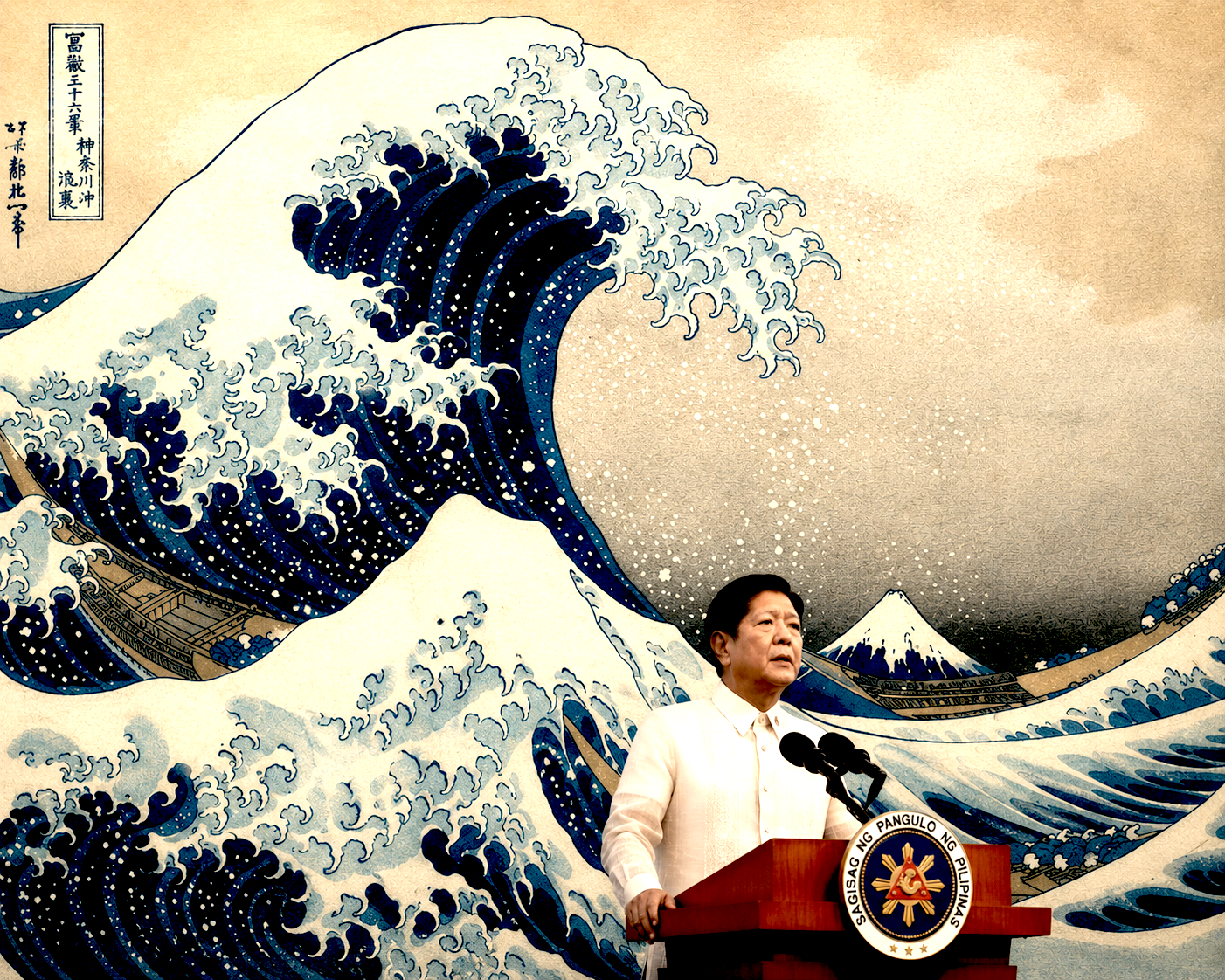
But last year, BBM dropped a bomb at the SONA that I suspect even he didn’t realize was going to be that big. His “Mahiya naman kayo!” broadside against corruption set off a further and indeed continuing series of explosions, all the way to the impeachment trial of VP Sara Duterte, as well as a Kanagawa-sized wave of expectations that now hovers over the last two years of his administration.

So what will or should BBM talk about this afternoon? My short list:

1. An acknowledgment of the economic crisis our people are suffering, and an announcement of meaningful measures to bring some relief. Talk about horrendous power bills, jeepney drivers pulling 16-hour days, seniors collapsing at ayuda lines: this is reality for most Filipinos today.

           2. An update on his professed campaign against corruption; what next after the ill-conceived and underpowered Independent Commission on Infrastructure? Corruption bridges economics and politics, with public money being used by and for political power. I doubt that BBM will directly address Sara’s impeachment—best for him to stay above it and let the prosecution do its job—but it remains a corruption and accountability issue, and should be taken in that context.

            3. A resolve to pursue these priorities over his last two years. He won’t and can’t use the word “redemption”—a mountain of skepticism still stands in his way there—but I’m sure he’s aware that people are watching what he’ll do next. In the end, it won’t be speeches but deeds that will make the difference—but as he learned last year, a few words can make big things happen. If I were the President—which every presidential speechwriter has to fearlessly assume for a few hours—the best way to think of the next two years is to think of forever.



              Qwertyman No. 207: Invicted

              Qwertyman for Monday, July 20, 2026

              WHEN I teach speechwriting—like I’ll be doing again this semester as part of my course in Professional Writing—I tell my students to avoid using quotations from obscure philosophers, great writers like Shakespeare, and even the Bible if it’s highly unlikely that the speaker they’re writing for would have read them in his or her real life and understood what they were saying. 

              Few people are truly that learned—not that they have to be to render good public service—and the last thing you want to see and hear is your client squinting at and struggling with a sonorous phrase he or she never saw before. Especially if they’re politicians, I’d much rather that they poach “hugot” lines from pop culture that their listeners can relate to, with disarming and self-deprecating humor rather than malice aforethought. 

              A lot’s been said about VP Sara Duterte’s obvious reference to William Ernest Henley’s oft-quoted poem “Invictus” at the abbreviated “press conference” she held on the second day of her impeachment trial at the Senate. “In this bloodbath and bludgeoning,” she intoned, “I will be bloodied but unbowed.” Lit-savvy netizens quickly jumped on “bloodied” being a misquote, the actual word in the verse being “bloody,” but in the context of her premise about being bludgeoned in a bloodbath (never mind how cheesy that alliteration sounds), “bloodied” makes better dramatic sense, positioning her as the unfortunate receiver of an injurious action, perhaps even more victim than victor.

              I wouldn’t put it past VP Sara to have known the Henley poem, which many Filipinos of a certain age would have encountered at some point, like Joyce Kilmer’s “Trees.” Indeed, it’s the very popularity of the poem—plus again that awful alliteration that’s the hallmark of a speechwriter reaching for cheap effect (also note: “bloodied” sounds ridiculously inevitable after “bloodbath,” yes?)—that accounts for its hokeyness. 

              Did a PR consultant put her up to it? (“Go in there, say these lines, then exit forthwith.”) We can’t say. But something tells me that’s the way VP Sara herself wanted it. The speech and the action were entirely in character with someone who sees and represents politics as theater, where broad gestures visible from across the room and the archipelago—the bullying of sheriffs, for example—matter. With the Dutertes, everything has to be punchy, dramatic, theatrical, staged. DENR giving you problems? Dump truckloads of trash right in front of their office. That’s the kind of gesture the DDS faithful lap up as creative, courageous, and even inspired.

              So when Sara sneaks into the Senate (the lions’ den!) to give her little speech but quickly departs before she can even be called to the witness stand, let alone bludgeoned, we’re supposed to take that for both bravery and cunning—or at least her supporters are.

              On February 18, 2026, when she declared her intention to run for the presidency, she used a series of statements ostensibly begging forgiveness for once having allied herself with her tormentor.

              Mga kababayan, humihingi ako ng paumanhin sa inyong lahat. Patawad kung tinulungan kong mahalal si BBM bilang Pangulo ng ating bansa.

              Patawad kung hanggang ngayon ay marami pa ring Pilipino ang nalulunod sa baha nang dahil sa malawakang korapsyon.

              Patawad kung lantaran ang pang-aabuso sa ating mga institusyon para sa pansariling interes ng mga pulitiko.

              Rhetorically, this usually works. She (or her speechwriter) is employing a device called anaphora, which repeats key words or phrases with incremental changes. It’s effective because it establishes a certain cadence, a regularity of structure that implies you’re in command of your material and know and mean what you’re talking about. The best-known example from modern history comes from Martin Luther King Jr., who declared in 1963 that “I have a dream that one day this nation will rise up… I have a dream that one day on the red hills of Georgia… I have a dream that my four little children will one day live in a nation where they will not be judged by the color of their skin…” 

              Now, Sara Duterte is no MLK, but she was saying things her own people needed to hear. It wasn’t a speech to persuade BBM’s followers much less Kakampinks to seriously consider her as the better alternative. It was a speech to malign the enemy, a litany of grievances to justify her turnaround and to pass some moral ammunition for her troops to shoot with. Never mind that “malawakang korapsyon” and “pang-aabuso ng institusyon” are precisely the issues that have now landed her in impeachment court. As with Donald Trump, she’s learned that the best way to deal with political mud is to throw it right back at the accuser.

              She has no problem working up her minions with these verbal broadsides. But beyond the home crowd, the problem with VP Sara is that she can’t seem to sustain an extended, rational, and unemotional argument. If I were her handler, I would worry that, on her own, she might prove incapable of discussing specifics, of fleshing out policy, of speaking beyond platitudes and generalities. You can imagine how she would respond to the cool but relentless questioning of an Atty. Ligutan or an Atty. Diokno. She would sputter and explode, and walk off the stand. 

              I’ve gone through her speeches on her OVP website, and they betray little of whatever originality she may be capable of. The major pieces—an education keynote in South Korea, for example—are competent, but pedestrian and undistinguished, patently outsourced. Her talks to grade-schoolers focus on the “4 Be’s”—“be kind, be humble, be happy, and be careful”—which is all well and good if you can inspire them by personal example.

              It’s not that she’s unintelligent; her feral brain knows what it needs to do to survive.

              In her mind she has already dismissed the Senate trial as a fruitless exercise. She’s confident she has the votes to be acquitted, and they can rail at her as much as they want and work themselves blind trying to prove her a crook, but in the end the votes will break her way, her misdeeds will be deemed expunged, and best of all, she will emerge triumphant—bloodied but unbowed—and even more powerful, which is all that will matter leading up to 2028.

              That’s why she can afford to ignore whatever summons they send her way, and deprive her prosecutors and the public of the spectacle of her appearance at the witness stand. Her absence, heavy with mystery, is within her control. Her testimony, fraught with danger, will not be. That is cold calculation, intelligence of the hardest kind.

              And that’s why she can’t give a damn what Lit profs like me say about her spouting “Invictus” in lieu of testifying—she’s boxed herself into that character, which makes her sound like she’s fighting when she’s not.

              Qwertyman No. 206: The Unfinished Building

              Qwertyman for Monday, July 13, 2026

              AS I noted in a Facebook post last week, attending a graduation at the University of the Philippines, as I did last July 5th, always brings a tear to my eye, especially when everyone sings “UP Naming Mahal” at the closing. No matter all the heartaches, disappointments, and challenges we may have gone through in UP as a student, teacher, administrator, and alumnus, and no matter all our disagreements over failed policies, missed opportunities, and misdirected priorities—as an institution, this university of the people remains immutably noble in purpose, an ideal constantly being realized. 

              More than 5,000 students graduated from Diliman last week, as well as many more thousands in UP’s eight other constituent universities across the country. Thousands came away with honors—raising the question of whether our students have really gotten that much better, or if our standards seem to be getting laxer; the debate goes on, although no one’s taking anything away from the laureates. This was, after all—as UP President Angelo Jimenez noted—the last pandemic batch to graduate, who entered UP in extremely difficult circumstances, tied down to Zoom, without the benefit of campus life for a significant period.

              I sat at the grandstand in Quezon Hall as a professor emeritus among the university’s officials and guests, recalling how I had stood on the other side of that amphitheater more than four decades ago, wondering what the future would be like (short answer: 35 more years in UP). I would become a professor, an administrator, and a retiree, as deeply engaged in university affairs as I had been as an activist toting a molotov cocktail (which I never threw) at the Diliman Commune in 1971. 

              That morning’s guest speaker was former Ombudsman and Justice Conchita Carpio Morales, whose biography I had written, so I was glad to run into her at the processional, and I urged her to give everyone a piece of her famous mind. “I’ll be gentle today,” she told me, smiling. Taking off on this year’s commencement theme of “Gumagalang” or “respectfully,” she spoke on the need for respect of the law at a time of great confusion over who and what to follow. 

              “In a world increasingly divided by arrogance, intolerance, and indifference, the call to gumalang (respect) is not merely timely, but urgent,” she said. “As a magistrate, it pains me to see lawmakers alleged to be lawbreakers. Rules bent, redefined, or misinterpreted to suit individual or group interests. There is little paggalang for those who have limited or no voice at all. The powerless have become dispensable…. The rule of law is the bedrock of democracy. Sadly, in many parts of the world today, the rule of law is being disregarded…. Unfortunately, what we increasingly see today in many places is the rule of man, where the exercise of power depends less on the law and more on the whims, preferences, or interests of those who hold office.” At the same time, she emphasized that “respect” could not be used as an excuse for authoritarianism, or for stifling contrary voices. (And before you ask, no, I didn’t write or draft those words for her. Nobody writes CCM’s speeches but herself, and if you did, she’d very likely pepper your draft with corrections, as generations of her law clerks well know.)

              That was particularly apt in UP, where the commencement ceremonies ended with the customary (by now) lightning rally, and while some slogans sounded rather tired, this year’s emphasis on fighting corruption gave it a particular urgency. UP Diliman’s graduation was taking place on the eve of the opening of the impeachment trial of Vice President Sara Duterte at the Senate, titanic confrontation on both sides of which prominent UP alumni were ranged. 

              The irony of the moment could hardly be overstated. Historically, UP has been known to be a bastion of dissent, a haven of nonconformists and rebels of all stripes and colors. I often cite the examples of then UP President Rafael Palma’s daughter Fe, who took part in the first documented student protest action in 1933, a boycott prompted by a tuition fee increase, and of President Manuel L. Quezon being lambasted for extravagance by a young hothead named Ferdinand Marcos. 

              Since the 1960s and 1970s , UP has acquired—inaccurately, I think—a reputation for being a breeding ground of communists, a convenient target for such Red-taggers as the NTF-ELCAC and a good excuse for its billions in funds. (Which reminds me: they should set up an NTF-ELCAC to seek and weed out the corrupt.) People forget that for every Joma Sison we produced a Juan Ponce Enrile; for every Benito Tiamzon a Fabian Ver; for every Lean Alejandro an Alan Peter Cayetano; for every Lorie Barros a Pia Cayetano. 

              As I emphasize whenever I can, even at the height of student activism, the radical Left was always in the minority in UP as it probably was elsewhere; we were just noisier, better organized, more determined, and literally ready to die for our cause. 

              What the usual UP narrative also often ignores is the fact that many of us from the Left who survived the First Quarter Storm and martial law moved toward the liberal middle—indeed, some even to the far Right, becoming its ideologues, executors, and apologists. 

              Surveying this year’s crop of bright and starry-eyed graduates, hundreds of them finishing with high honors, I wondered how many of them would, in the next twenty or thirty years, materially contribute to our people’s well-being, and also how many to its deterioration. I don’t think anyone goes to graduation with malice aforethought, but life has a strange way of shaping and testing character in a way that classrooms simply can’t. As we learned in martial-law prison, sometimes it’s the most seemingly inflexible who prove the most brittle and break.

              At the ceremonies, pointed comments were made by some deans presenting their graduates about all the unfinished buildings on campus—the new Faculty Center has been a decade in the making, with the refurbishment of Abelardo Hall and the UP Main Library trailing closely behind. These delays can largely be traced to mismanagement under the old DPWH, a couple of projects possibly even tied to the Discayas. 

              But it struck me that the truly unfinished building to contemplate is the university itself, in constant reconstruction under pressure from AI, global rankings, and the needs of the people it remains accountable to. Just having marked its 118th anniversary, it could yet be the Sagrada Familia of our national aspirations.

              Penman No. 487: A Prize for AI?

              Penman for Sunday, July 12, 2026

              LAST MAY, the literary world was rocked by the news that the winner of the Commonwealth Literary Prize—a short story titled “The Serpent in the Grove” by a little-known writer from Trinidad named Jamir Nazir—had been written using AI. Words like “fraud” and “hoax” flew out quickly into cyberspace. Probably suspecting something was off, someone had used an AI-detector app called Pangram to scan the piece, which returned an unequivocally damning judgment: “100% AI-generated.” 

              Along with other Commonwealth winners, the story had been published in the respected literary magazine Granta. Given the uproar, the Commonwealth Prize judges reviewed Nazir’s drafts, and pronounced the work authentic; Granta severed its ties with the foundation giving the prize, but has retained the story on its website anyway for all to see and evaluate.

              And that’s exactly what I did—go the website and read the work for myself before coming to any conclusion of my own.

              Now, it’s not as if literary hoaxes are anything new; it’s happened before, and it’s even happened here. Long before AI, plagiarism and outright invention (a crime in the case of nonfiction) were practiced not only by the lazy and untalented but also by the cunning. Among the most notorious cases in the US were those of James Frey, who fabricated large sections of his bestselling memoirs, and Janet Cooke, whose Pulitzer-prizewinning story for the Washington Post turned out to be based on an entirely fictional character. Here in the Philippines, a postal clerk named Jose Marco duped generations of Filipinos into believing that the Code of Kalantiaw and a novel by Fr. Jose Burgos titled La Loba Negra were the real thing.

              The fraud in these cases was uncovered not by programs like Pangram or GPTZero but by dogged scholarship—in the case of Kalantiaw, through the work of the historian William Henry Scott, who showed that Marco’s “code” had words that weren’t in use until centuries later.

              Even with software, proving literary deception today is a lot more difficult, because creative writing almost by definition is, well, deception of the highest order, extremely liberal in its methods and means, and devious (without being necessarily evil) in its motivations. Fiction especially is intrinsically ambiguous, unlike journalism which rests on fact. So how can anyone be sure that this prizewinner was faked?

              “The Serpent in the Grove” is not a very long short story at less than 3,400 words, and the controversy aside, is certainly an interesting if not significant one in many ways: freshness of language, simplicity of plot but complexity of character, power of imagination. It talks of a man named Vishnu who, enamored of a vamp he meets at the bar, contrives to drown his wife Sita in a well; she falls into it but then manages to crawl out with a neighbor’s help. Sita and even their young son seem to understand exactly what has happened, but no one brings it up and they somehow manage to survive into old age keeping that terrible truth unspoken. 

              Some people have savaged the story after the scandal broke, in the way people change their minds instantly about someone after being told that person served time for rape or murder. Personally—and this could well be an unpopular opinion—I found it rich and engrossing, at least partly because of very same startling metaphors that got flagged as AI giveaways. It’s not an easy read, with its localized English, and I could see how Western readers attuned to the kind of language you hear at Walmart would find it painfully artificial (my friends in the Midwest found Nick Joaquin “too lush” when I had them read him). I don’t write that way myself, which is probably why it intrigues me even more. Here are some random excerpts:

              “Sita moved quiet as if sound were taxed. Nineteen and brown like dust after rain, she turned roti dough with a rhythm that came not from joy but from endurance.”

              “Marsha lived two bends down. If the village had a mouth, it was hers. Big in the way of women who never apologize to furniture, she had a laugh that shook dust from joists and a voice that could soften to coax a child from a ledge. She knew the ways of men hollowed by want until only one thing remained. She noticed the fresh-cut path and the way land bore witness. People talk about bush like it dumb. But bush keeps memory the way hair keeps scent.”

              “Sita lifted two planks and slid them aside. Wood complained in a voice too near speech. She lowered the pail until rope slackened. Smell rose—old wet, crushed jasmine, frog skin. On the second haul, the board beneath her shifted the way a tired man shifts in his sleep. The plank gave one long groan and swallowed its word. Stone, shoulder, hip; shock of cold tearing breath. One foot banged and screamed. The wall was slick as lizard. She clawed moss and slid. Water took her and would not return her.”

              So what did the software flag? Unlikely metaphors, it said, like the vamp “had the kind of walking that made benches become men.” Or that a character “smiled like sunrise over a sink.” It noted that there were nearly a hundred metaphors in such a short piece. It claimed that in the sentence “Coffee and cocoa leaned wild on a slope that wanted either rain in teeth or none at all,” the phrase “rain in teeth” made no sense, was a hallucination. 

              But at this point, my own gut was telling me to trust Pangram less than the author. Call me dumb, but I find “rain in teeth” rather fetching. Any first-time workshopper would get that.

              So would I have given the story a prize? That would depend on its competitors, which I haven’t seen, but it’s surely a story I would teach, both for its own merits and for its alleged employment of AI. I might even do that this incoming semester, when, for the first time in many years and possibly the last, I’ll be teaching an undergraduate class in Professional Writing. It’s a course I designed and had been teaching for two decades, but the big difference this time is that we’ll be dealing with AI—which is something that I don’t intend to ban outright (like Canute commanding the waves) but to grapple with head-on, negotiating the line between one’s imagination and what AI might do. I can foresee how controversial this will be, and I recognize the adamant opposition to AI from many writers and artists on both aesthetic and ethical grounds, but at 72, this could be my last look over the horizon. (I’ve already declared that I will no longer judge literary contests nor take part in literary workshops except in my own classes, so this will be my arena for engaging with AI.)

              I wouldn’t be surprised if, in the future (and if it hasn’t happened already), some smartass with an ax to grind enters a wholly AI-generated story or poem into the Palancas, only so that when trusting judges make it win, he or she can declare them and the entire literary Establishment (yes, that cabal of superannuated gatekeepers who keep ignoring one’s literary genius) a bunch of fools.

              Right now, what I’m thinking is, if you can come up with the kind of prompt that produces “The Serpent in the Grove,” then you deserve a prize—maybe not the Commonwealth one, which is still an open question, but at least one for inventiveness and audacity which seem to remain in short supply in what I’ve been reading, with or without AI.

              Qwertyman No. 205: Selective Religion

              Qwertyman for Monday, July 6, 2026

              LET’S ASSUME that you’re one of the leaders—if not the Great Leader himself—of the Iglesia Ni Cristo (INC), with 3 million followers at your beck and call. You get word that one of your most prominent members, a sitting senator of the Republic, is going to be charged soon with plunder for admittedly pocketing P75 million in private donations without reporting it either as a campaign contribution or as personal income. 

              But you don’t bother yourself with the legal niceties of the case; they’re not important. What alarms you is the fact that one of your staunchest protectors—and not just of the INC, but of the Dutertes with which your church has cast its lot—is facing prison. It’s not the legal case, not a technical matter of proving plunder; while the senator himself seems to be taking things in stride, making noises about his willingness to go to jail, you know that it’s more existential than that. 

              It’s your own power that’s under threat, that’s being tested by the ingrate you helped to seat in the Palace. His presumptive successor, on whom you’ve bet all your marbles, herself stands to be impeached in the Senate for all manner of grave financial wrongdoing. You need your senator’s vote for her to escape the noose. Her once-formidable alliance is thinning by the hour—whether by their own commission (one has had to disappear to save his own neck, another is already in prison, also for plunder) or through deft politicking by unseen hands. 

              There could be more desertions down the road, as the impeachment trial starts this week. You know these characters; they’ve all come to you for your blessings, your quid for their quo, and you know how fickle allegiances can be, especially under pressure. But you have your own pressure to exert. You need to remind them of that cordial but heavily nuanced conversation in your office, of the vast difference 3 million votes can make in the senatorial tally. (More on this later, but let’s get on with our scenario.) So what do you do?

              You call the faithful out to the streets for a show of numbers, for the kind of visual impact that the network news and social media tend to magnify. You decide to hold this at the EDSA Shrine among other places for whatever symbolism it might carry, never mind that Mother Mary, so central to the EDSA spirit and experience, holds no special place of honor in INC belief. The night before, your organizers send out text messages ordering your people out to EDSA as early as 5 am; every “lokal” has to be represented. You know that you can rely on what your members have had ingrained into their minds and bodies: unquestioning obedience to authority. (Some of their T-shirts will declare this openly: “Obey and Never Complain”.)

              You beam with pride and pleasure as the crowds begin to gather at dawn, catching the drowsy city by surprise. You manage to choke off the city’s busiest and most important highway, convincing yourself and your own people that a day or two’s disruption of work and traffic is a mild inconvenience compared to the issue at hand. Ah, the issue—yes, let’s go with “selective justice,” which is clearly at work in the plunder case they whipped up against the good senator. Why him? Why now? What for? 

              This was the senator bravely threatening to unmask the biggest crooks in the highest echelons of government—never mind that he himself was now being unmasked for palpably gross misdeeds. You trot out a small parade of notoriously unsavory politicians—but then who else have you got?—to amuse the gathering. Never mind the irony of an Imee Marcos crying “Walang uwian!” at the very place that sent her and her family packing off for Hawaii forty years ago (we don’t know if she stayed the night huddling with the INC masses—or went home as senators are wont to do after their speeches). 

              Nowhere in this spectacle did God or religion visibly figure—what the INC’s conception of justice was, how the Dutertes and Marcoletas would spread God’s dominion over the earth, how individual INC members (especially senators) were supposed to discern right from wrong except by executive fiat, and how the reported INC practice of cornering certain lucrative government posts after elections fulfills God’s mandate. 

              Sure, they can fill up streets, and hold parts of a city hostage for a few days. They can make it look like they centrally matter, and perhaps in some swing situations they do, as did the support they allegedly threw behind Bam Aquino last year. 

              But here’s the bottom line. The INC’s reputed 3 million members comprise voters and  non-voters including children. Studies put the real number of voting INC members at less than 1.4 million, and even less in terms of who actually shows up at the polling booths. SWS chair emeritus Mahar Mangahas puts it at “around 5 percent” of all voters. 

              Do they vote as a bloc? Yes—but not absolutely. The 2016 TV5-SWS Exit Poll showed that 77.2 percent of INC voters supported Rodrigo Duterte. SWS data also indicate that  around 20 to 25 percent of INC voters do not vote for church-endorsed candidates. So 75 to 80 percent do vote by command—but whether they do so because of obedience or because the INC tends to endorse popular candidates has yet to be determined. So the discipline and the reliability are there to some extent, but it’s a power that can be easily overstated and just as easily abused.

              The greatest damage wrought by the INC in its EDSA excursion was neither to the traffic situation and much less to the case against Sen. Marcoleta. It was to its own image as a religious faith to be taken seriously as such, a body of belief driven by godly wisdom. By consistently supporting morally compromised politicians, it has revealed itself as a political instrument, manipulable and deployable, for reasons and purposes known only to its leaders. 

              And that’s sad because I do have some INC friends, upright people for whom I have a deep respect, and whom I would be glad to hear from on the issues I raised above. I’ll promise them fair representation in this space—but they’ll have to speak for themselves and not their leaders, to the extent that that’s even possible.