Qwertyman No. 202: Oh, Ateneo

Qwertyman for Monday, June 15, 2026

WITH SO much already having been said and posted about last week’s saddest story—the tragic drowning of two Ateneo student-athletes in a training activity far off-campus—it seems pointless to add anything more. But as a former university administrator (with that other big school at the other end of Katipunan Avenue, the University of the Philippines), I feel compelled to think aloud and wonder what we should and could have done had this happened to us across the street.

The Ateneo university administration has been roundly (and I believe fairly) scored for not saying and doing enough in the immediate aftermath of the apparent accident to establish what happened, determine accountabilities, and provide sympathy and support to the bereaved. What drowned in Aurora were more than two boys and their hopes; into the depths went their school’s hard-won reputation for a culture of caring.

Institutional mindsets would reflexively call this “damage control,” but “damage control” sounds profoundly inappropriate and inadequate in these circumstances—the greatest damage done was that to the families of Rene Baterbonia and Divine Adili, and it is permanent and cannot be undone. Even to a people inured by tokhang, the heartrending video of a mother’s grief cuts to the bone.

The damage to the university’s reputation is substantial but, in the thick-skinned way these things go, fleeting and survivable. What people are calling for is justice, and let the damage fall where it may. In an academic universe increasingly driven by global ratings, a university’s reputation should seem to matter more, but where in the statistics do factors like compassion count? 

I know how difficult it is for academic bureaucrats to respond to a crushing crisis like this. My old job at UP, aside from teaching English and creative writing, was that of Vice President for Public Affairs, which meant that I was both the university’s spokesperson and shock absorber, the one who had to face the likes of Ka Tunying at seven in the morning to answer questions about all the rich kids in UP, fraternity hazing, communists on campus, and UP’s squatter problem.

It was understood that I was there to help promote and protect the university’s image, at a time when that image was being battered from both right and left, often from critics at the very top of the same government that we were dependent on for our annual budget. For the sake of that budget—which had its own critics—we had to tread a thin line between cooperating with authority and preserving our autonomy and academic freedom, a process fraught with conflict and, yes, sometimes hypocrisy, as when we had to smile in the face of politicians we would otherwise have cursed. While each little and isolated case may have been challenging and disturbing, eventually they all became administrative routine, necessarily tolerable.

But for every institution, there comes a defining moment when more than budgets or reputations are at stake, when its very spirit itself is under question and under threat. That moment seems to have arrived for Ateneo, a great university unlike many others, even unlike UP, founded as it is on Christian and indeed Ignatian principles that include magis or the striving for excellence for God’s greater glory and cura personalis or caring for the whole person. As Fr. Pedro Arrupe, SJ put it, a Jesuit education aims at producing “men and women for others.” UP has its “Serve the People,” but its secular character imposes less of a spiritual and more of a political mission on its community.

This is why the Ateneo administration’s seeming inadequacy of response to the accident, beyond its terse initial announcement, comes as a perplexing disappointment to many, on top of the awful pain and grief caused by the deaths themselves. In the very least, a statement providing more details of what happened, committing to a thorough and impartial investigation, and offering support to the affected families would have eased many initial concerns. 

Ultimately an institution’s image is made more by what it does than what it says, but the saying is also part of the doing. I would have arranged an immediate meeting between the Ateneo president and team coach and Rene’s family—and at least by Zoom with Divine’s—for them to personally explain what happened and to make the necessary amends.

Despite efforts to politicize and capitalize on the issue, I myself believe that what happened was a terrible accident, albeit a preventable one, with better foresight. Almost exactly a year ago, I lost a good friend, Don Rodis, to a rogue wave and riptide that pulled him into the waters off Los Cabos in Mexico; one minute he was just strolling on the beach, the next he was gone. 

That’s nature at its indifferent and cruelest worst, which, beyond preparing for, we can do little about. Human nature also arises spontaneously, in the shock, grief, and even anger that followed the accident. But human agency is something else—the “what could and should have been done’s,” both before and after the event.

I can imagine, as administrators would have instinctively responded, that Ateneo’s academic and athletic managers first called the lawyers in to find out who was responsible for what and what the university’s liabilities were. It’s a logical institutional reaction, but again Ateneo could have risen above that to show true compassion, which should come instantly and unbidden, without lawyers or preconditions. I have no doubt that the likes of Fr. Flavie Villanueva, Fr. Albert Alejo, or Fr. Robert Reyes would have rushed to and embraced the grieving mother if they could. 

(It has been a bad week for Ateneo in more ways. The athletes’ deaths obscured the passing of another prime Atenean talent, the poet and professor Rofel Brion. Rofel once said that “I write mostly about small, ordinary events, and in doing so, I capture them. I hold on to them and never let them go. And this, I guess, is how I pay homage to them.” This was his way of living the Ignatian principle of finding God in the ordinary. )

I have many friends at Ateneo and have even taught there—once as a substitute for the late Prof. Doreen Fernandez when she was unwell, and another time as the holder of its professorial chair in creative writing. While not particularly religious myself, I am a strong believer in its mission and in its products. I appreciate its efforts to diversify and to bring in more poor scholars into its fold. 

If Ateneo is as great as its history suggests, it will use this instance to reflect deeply on what it wants to be, and to be regarded as. I have no doubt that with sincere introspection and self-criticism, it will find the best ways to do right by the families of Rene and Divine, to run a fit and humane athletics program, to set the right policies and put the right people in place, and to reassure its community that it has recovered its true Ignatian spirit.

Qwertyman No. 123: A Forgotten Hero

Qwertyman for Monday, December 9, 2024

A HANDSOME book—as handsome as its subject—was launched last week by the Ateneo University Press, a biography of another unsung Filipino hero who would have faded into oblivion had it not been for the efforts of an American expat in the Philippines with a deep sense of history. 

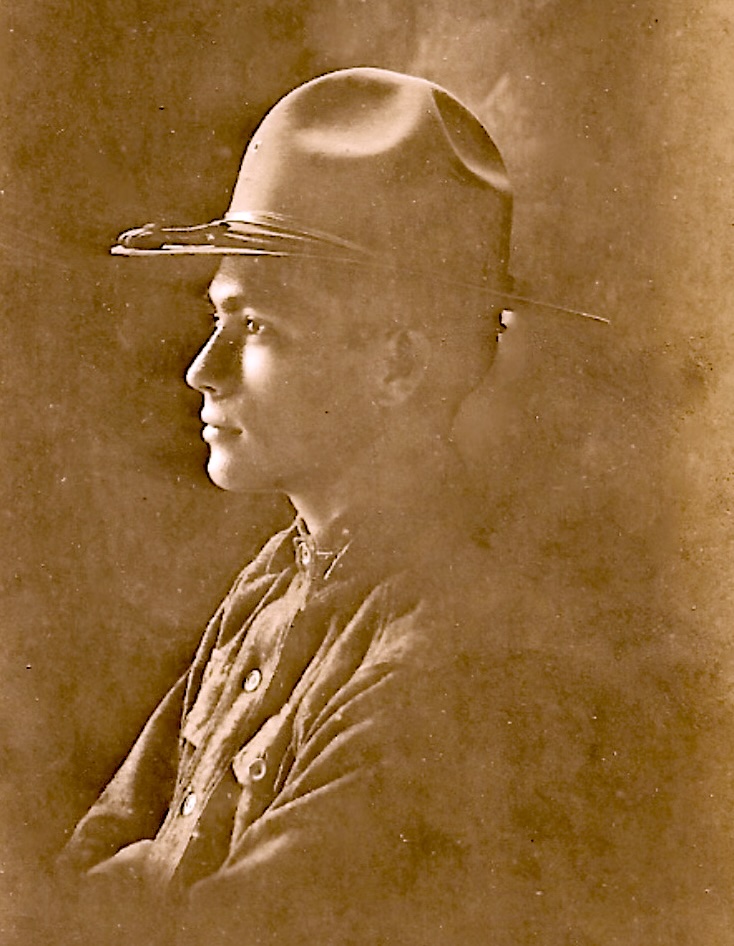
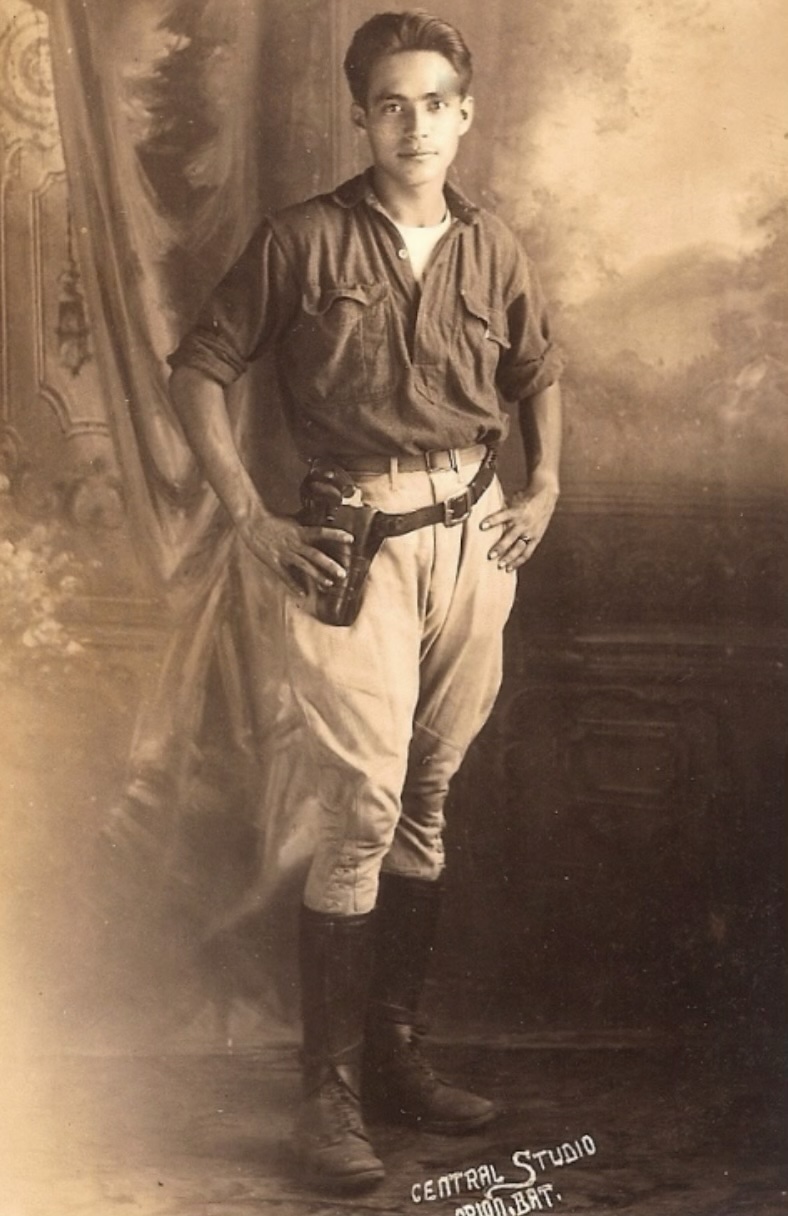
The hero was Col. Narciso L. Manzano, the highest-ranking Filipino in the US Army during the Second World War, and the man who rescued his memory is Craig Scharlin, a former English teacher, gallery owner, and biographer who served for some time as Manzano’s personal secretary fifty years ago. I had met and known Craig earlier as the author, with his wife Lilia Villanueva, of the biography of Filipino-American labor leader Philip Vera Cruz; when he asked me to help him put together what eventually became The Manzano Memoirs: The Life and Military Career of Colonel Narciso L. Manzano, I agreed, especially after hearing his story of the life of this remarkable man. 

Craig had learned that the MacArthur Library in Virginia had a 260-page handwritten autobiographical manuscript that had been written by Col. Manzano in 1948, to which were later added another memoir written in 1983 for his grandchildren; his son Jaime had also written a family history. Craig acquired copies of all these and the necessary permissions to publish them; I helped stitch the manuscripts together into a more coherent whole and edit the text.

Though born in Manila in 1899, Manzano grew up in Atimonan, Quezon before leaving at age ten for Spain where his family hailed from. He was a mestizo through and through: Filipino by birth and allegiance, Spanish by blood, and American by military service and later citizenship. After returning to Manila and studying Engineering at UST, he signed up to join the US Army, hoping to fight in the First World War, which ended too soon for him. He went to the US for further military training, and served back home as a Philippine Scout, and then as a colonel in the US Army Corps of Engineers under Gen. Douglas MacArthur.

It had been one of Manzano’s pre-war missions to map out the Bataan peninsula carefully in preparation for War Plan Orange 3, which MacArthur eventually discarded. It was in this zone that Manzano would first earn praise for his bravery. As Craig’s introduction tells it, “It was Manzano, along with his American co-commander, Lt. Col. Skerry, who led their engineers in setting the explosives to blow the bridge at Calumpit, the last and most vital bridge in Central Luzon…. When Gen. Wainwright decided the bridge had to be destroyed to halt the rapidly advancing Japanese invading forces, the Army engineers assigned this task led by Manzano were on the wrong side of the bridge, the Japanese side. Manzano requested that Skerry wait to blow it until he and his men could get across… but Wainwright had no choice: the bridge had to be blown as the Japanese were advancing too fast in order to save the entire American and Filipino forces and allow them time to retreat to Bataan…. Somehow Manzano, along with another of his American officers was able to evade the Japanese on their own and made their way with all their men to Bataan.”

Working in intelligence in Bataan, he was later captured and imprisoned in Camp O’Donnell; upon release, he was quickly assigned to develop an intelligence network in Luzon, at which he proved exceptionally capable. His wife Charo was arrested and imprisoned by the Japanese. But he pressed on, and when his network was exposed, he moved to Mindanao from where he hoped to be taken by submarine to Australia so he could properly advise MacArthur, who was getting poor intelligence. MacArthur’s lackeys scotched that plan, forcing Manzano to improvise as a guerrilla until MacArthur returned. He later moved to the US with his family, where he died in 1986, proud of his life’s work despite being embittered by the betrayals he had to suffer, and disappointed at being passed over for the generalship he had expected.

That’s not even half of the story; brimming with the candor of a man with nothing to lose, Manzano’s memoirs are full of vignettes and reflections about people at war, and Manzano can be painfully scathing in his estimations of those he felt had betrayed his country. He whittles down MacArthur and his aides for what he saw to be their foolish and costly unwillingness to listen to lifesaving intelligence (an opinion shared by historians such as Hampton Sides, who wrote that “MacArthur’s judgement, clouded by his gargantuan ego, was sometimes deeply, dangerously flawed. The men who fought under him, and the civilians who happened to get in his way, often paid a terrible price.”) Manzano was highly critical of MacArthur’s abandonment of War Plan Orange 3, and even said that he would have testified in support of Japanese Gen. Masaharu Homma had he been asked.

He not only believed President Jose P. Laurel to be a collaborator, but plotted the failed operation to assassinate him on the golf course at Wack Wack. For this alone, the book should be well worth reading; I among others have a contrary view of Laurel, but Manzano was there and we were not. Manzano has spicy opinions of other wartime and postwar personalities whom we have named streets after—again, quite an eye-opener. He reserved some of his choicest words for Ferdinand Marcos, whom he called “a poser, a phony, a fake, a war profiteer.”

In his introduction to the book, Craig Scharlin recalls his first meeting with Col. Manzano in San Francisco in 1975: The movie “Scent of a Woman” with Al Pacino had not yet come out. However, the character Pacino played in that movie, Frank, was a retired lieutenant colonel in the United States Army. As portrayed by Pacino, the character had Old-World charm, dressed impeccably, and even in his older age had ramrod-straight posture, showed strength of character and conviction, and the demeanor of an officer who had commanded other men and led them into battle. But he also carried scars of resentment and a certain sadness, a lament of unfulfilled destinies, of real battles won and others lost. And of course it was all Al Pacino—short, dark, brooding, yet still incredibly charismatic.

“That was the man I met in 1975 in a well-appointed penthouse apartment on Nob Hill in San Francisco. The only difference was that this wasn’t Al Pacino nor a fictional movie character, but the real deal—a retired US Army colonel named Narciso L. Manzano.”

Meet the rest of the man in the book, which you can order here: https://unipress.ateneo.edu/product/manzano-memoirs-life-and-military-career-colonel-narcisco-l-manzano.

Qwertyman No. 57: An Invitation to SERVE

Qwertyman for Monday, September 4, 2023

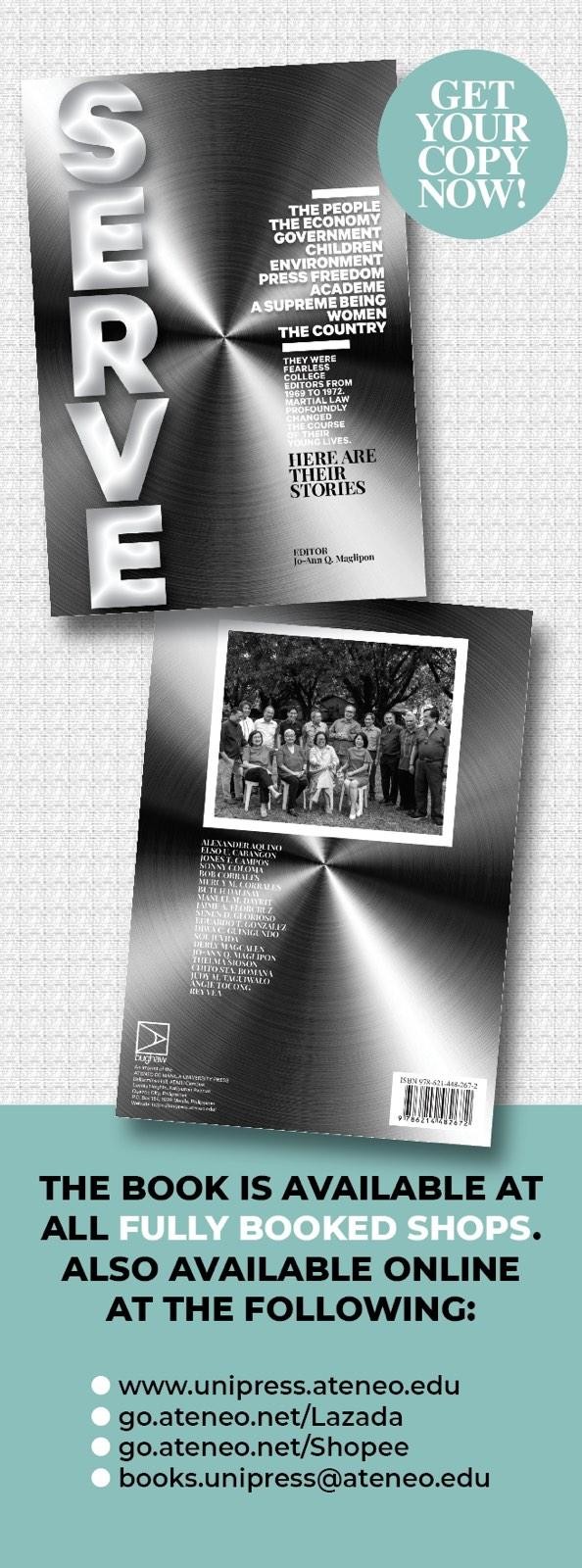
AT 5 PM next Saturday, the 9th of September, a new book will be launched at Fully Booked in BGC. Published by the Ateneo de Manila University Press and simply titled SERVE, the book has 19 authors—yes, I’m one of them—and one editor, the much-respected Jo-Ann Maglipon. What connects all is that they were college editors during the first Quarter Storm of the early 1970s, and survived to go on to distinguished careers in media, education, business, and public service. The book dwells much less on martial law—a previous volume titled Not on Our Watch: Martial Law Really Happened, We Were There that came out in 2012 dealt with that—than with its aftermath, and the afterlife that the activists of our generation were fortunate to have, given how many of our comrades gave up their lives to the cause of justice and freedom.

What did these activists do after martial law? What are they thinking now? Some of the names in this book will be familiar to the contemporary reader, who may not even have known of their activist background (reg-taggers, pay close attention).

Some of us—like Jimi FlorCruz, Sol Juvida, and Thelma Sioson San Juan—remained journalists all their working lives, stationed in very different places and capacities but bound by a commonality of interest in the truth. Others like Sonny Coloma, Manolet Dayrit, Ed Gonzalez, Diwa Guinigundo, the late Chito Sta. Romana, and Judy Taguiwalo took the path of government service, finding themselves in a position to effect real change, although sometimes under very difficult if not adversarial circumstances. Yet others including Angie Castillo, the late Jones Campos, Mercy Corrales, and Senen Glorioso found fulfillment in entrepreneurial and corporate work, applying their progressive values to management. For Elso Cabangon, Bob Corrales, and Diwa Guinigundo, their circuitous journey led to a re-encounter with their spirituality, and to embracing their faith as their personal advocacy. Like many veterans of the First Quarter Storm, Alex and Edna Aquino were able to build new and productive lives overseas, without yielding their investment in Philippine concerns. Quite a few of us—Derly Fernandez, Ed Gonzalez, Judy Taguiwalo, Rey Vea, and myself—chose to pursue our activism in academia, if only to ensure the transmission of critical inquiry to another generation. 

The authors were under no compulsion to conform to an ideological standard, except to extol the spirit of service to the people, the overarching theme of their youth and now their continuing commitment, indeed their legacy. There’s pathos in these accounts, but also humor and, inevitably, irony, perhaps the defining tone of our postmodern age: Thelma Sioson San Juan finds herself seated across Deng Xiaoping’s granddaughter at a Ferragamo show in Beijing’s Forbidden City; Manolet Dayrit learns of his appointment as Secretary of Health on a visit to President Gloria Macapagal-Arroyo in Malacañang; Ed Gonzalez becomes president of the Development Academy of the Philippines under President Joseph Estrada, but then joins EDSA 2; Sonny Coloma looks out the window of his Malacañang office to where students like him had demonstrated against Marcos.

With most of the writers here now in their seventies or inching close to it, we could have been chronicling the joys of grandparenting, journeys to far-off places, exotic menus, succulents and bromeliads, and homeopathic remedies for the aches of aging. Having retired from the formal workplace, we thought we had settled into a privileged and imperturbable kind of peace, earned over decades of political, economic, and spiritual struggle. 

We celebrated our seniorhood as the ultimate victory, for a generation that did not expect to live beyond thirty, and not because of some acquired disease but because of the throbbing cancer at the core of our society that claimed many of our peers in the prime of their youth. We may have thought for a while that we had defeated and expunged that cancer, only to realize that it had never left, was always there, lying cruelly in wait for a chance to ravage us again—and not only us this time, but our children and grandchildren as well.

And so—albeit no longer lean and shaggy-haired, perhaps benignly forgetful of car keys and personal anniversaries—we gather again at the barricades we put up against a fascist dictatorship fifty years ago, of which our memories remain surprisingly and painfully sharp. They say that the old remember distant things more clearly than what happened yesterday, and we offer proof of that. The experience of martial law coded itself into our DNA, and even the few among us who surrendered their souls to Mephistopheles cannot shake away that indelible past—one we bear with pride, and they with guilt and shame.

This time our barricades consist not of desks and chairs but of memory itself and, more formidably, of hope, courage, and a continuing faith in the good. Beyond memoirs, more than recollections of our youthful selves, we now present the stories of the lives we built and the paths we took after martial law, along with our reflections on how time and experience have reshaped us, clarified our values, and strengthened our resolve to serve our people in multifarious ways. 

Our view of politics inevitably evolved over time as the world itself changed over the past five decades. These essays and stories cover a wide range of themes and treatments, and demonstrate how “serve the people” has grown and evolved with its advocates, taking multifarious forms from working in civil society and practicing good governance to promoting artistic expression, academic freedom, and insightful journalism. We wish to prove that even the worst of times and the worst of leaders are not only survivable but can be changed, so that whatever lies ahead, the better Filipinos in us will prevail.

Given the number of authors and their families and friends, we expect a full house at the launch, so you might want to wait and get your copy of the book from Fully Booked or from AdMU Press’ online channels. However the book finds its way to you, it will be worth your while.

Penman No. 453: The Distance to Brillantes

Penman for Sunday, August 6, 2023

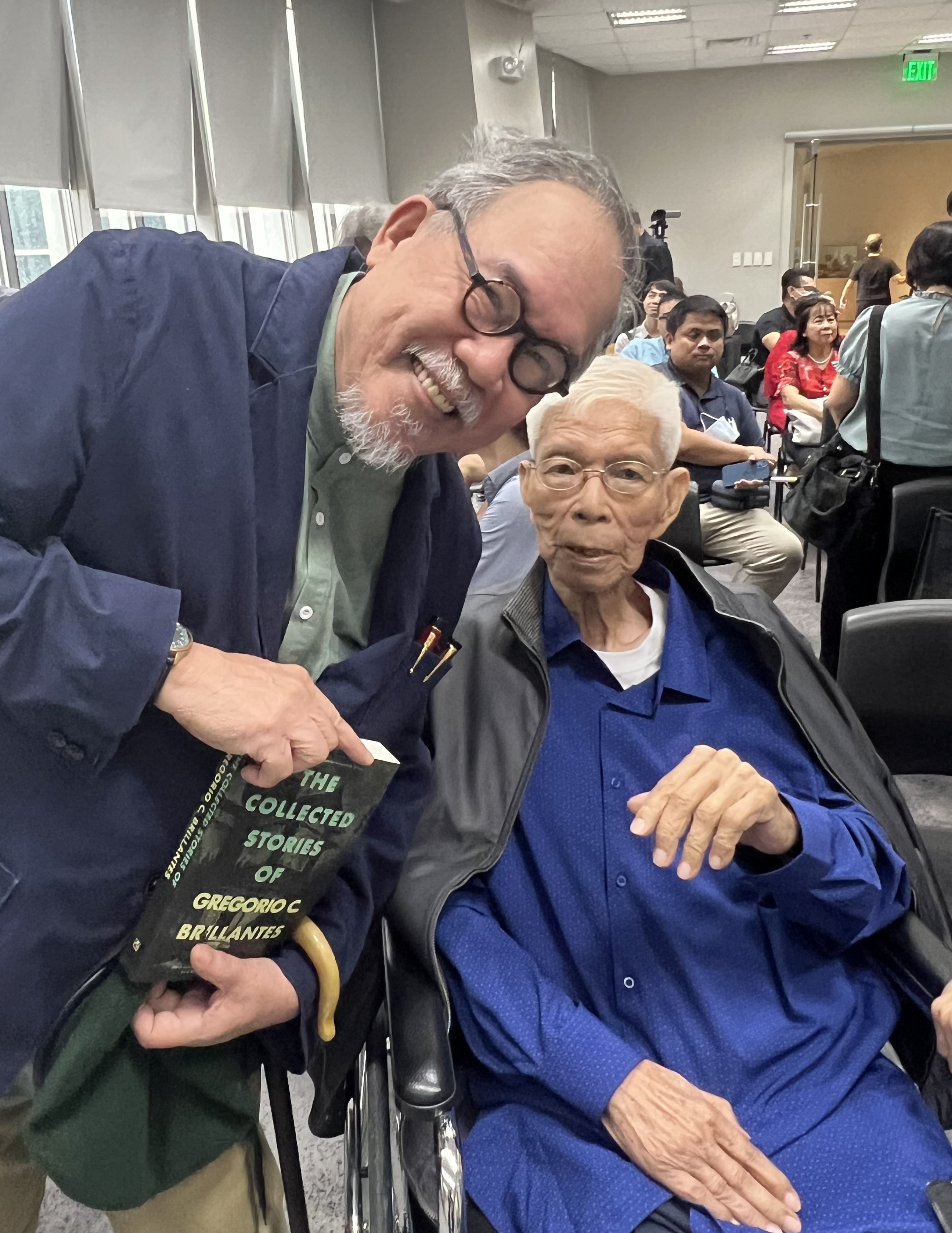
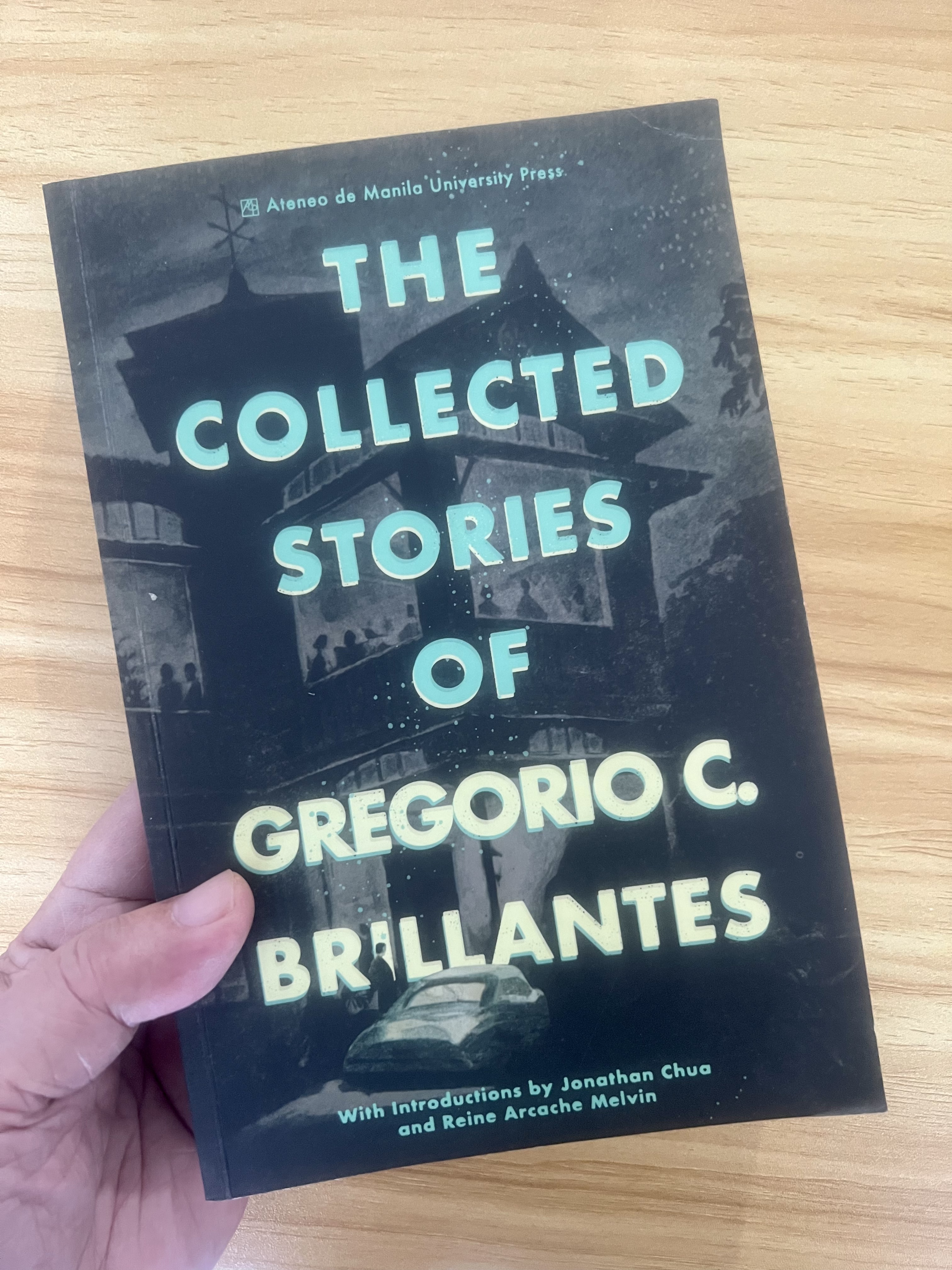
I’VE OFTEN written about how Gregorio C. Brillantes has been the bane of my writing life, a fellow short story writer and Palanca Hall of Famer whom I never had the pleasure of seeing in second place after me (the reverse has been the natural order of things). When the Ateneo Press recently launched his Collected Stories and asked me to speak at the event, I felt like a jealous juvenile again at 69, with the 90-year-old Greg in a wheelchair in front of me, and cheekily boasted that, at last, I had one over him: his collection had 39 stories while mine (Voyager and Other Fictions, 2019) had 44. 

Of course, it was a hollow boast, because any one of Greg’s stories is easily worth two or three of mine. That’s how highly I hold this man in my esteem, and why I wrote this blurb for him: “Few writers turn me into a blushing fan. Gregorio C. Brillantes is one of them. Like his papal namesake Gregory the Great, who wrote a massive 35-volume commentary on the Book of Job, Greg Brillantes has been an untiring and unsparing chronicler of his time and place…. His fiction is infused with power and luminosity; he surprises, but never screams.” 

In an art card that Ateneo Press used to promote the book, I said further: “More than a master of language, Gregorio Brillantes is a master of our Filipino sense and sensibility, particularly those parts we find hard to put into words or to recognize as our truest selves. We see life in his stories as through a gossamer screen that filters out  the harshest light; that screen is his own sensibility, suffused with a deep and tolerant understanding of pain as pleasure’s shadow.”

(The young Greg with John Updike.)

But really—putting all the fanboy talk aside—why Brillantes? What did I and my students—and what can every young writer of fiction—learn from him?

To get right down to brass tacks, I’ll take one of his best-known stories and dissect parts of it that should show what not only good but masterful writing is all about. 

“The Distance to Andromeda” has been mistakenly described by some as a science-fiction story, but it is not, although science fiction figures prominently in it. Without going into what the story means, what Brillantes demonstrates here, technically, is his acuity of observation and grasp of relevant detail, which is basic to any writer’s armamentarium. Too many young writers fuss over the elements of what their Ultrawave Galactic Terminator Machine should contain, glossing over the seemingly inconsequential gray matter of daily living that congeals into human drama. 

In “Andromeda,” the boy Ben’s post-apocalyptic fantasies are foregrounded by domestic business. See how Brillantes constructs a scene: “He dribbles an imaginary basketball toward the kitchen, skidding on the floor, feints and jackknifes a neat shot through the door. His sister-in-law Remy is giving her baby his supper of porridge from a cup. The child gurgles a vigorous greeting at the boy, and Remy laughs at the wonder of her son’s knowing the infant-accents of his language. The kitchen is bright and intimate with its rich cooking smells: Pining bustles about the old Mayon stove, and the girl with the pigtails smiles her crooked-toothed smile from the lithographed calendar on the wall.”

It doesn’t seem much and the young reader may feel bored by the lack of “action,” but note how, in fact, the scene is full of action—physical and emotional action, of the kind absent from too many stories being written today about morose characters sipping cappuccinos at Starbucks and ruminating over their wayward romances and work-life balance. “Get your characters off their butts,” I always tell my students, and Brillantes does.

A Brillantes story is an accretion of impressions, ideas, and emotions. It’s that kind of preparation that earns Brillantes the right to orchestrate this kind of paragraph later in the story: “He catches the streak of a shooting star from the corner of his eye. Instantly his waiting becomes a sharp alertness: he holds his breath and the strangeness comes into him once more, the echo of an endless vibration. But it is no longer an abstract aching for the relief of words: it speaks within him, in a language full of silence, becoming one with his breathing, his being, and the night, and the turning of the Earth: incomprehensible, a wordless thought, an unthought-of Word: like the unseen presence of One who loves him infinitely and tenderly. The fear has gone, the lonely helpless shrinking he felt on the bridge, walking home: love surrounds him, and no evil can touch him here, in his father’s house.”

For a story written in the author’s mid- to late twenties, “The Distance to Andromeda” already lays out, in full, Brillantes’ talent and vision, his familiar themes of family and love, of doubt and faith, of Rilke’s God “who holds this falling / Gently in his hands, with endless gentleness.”

It is a story that I myself could not have written, as I inhabit a more sordid and much sadder world in my fiction, with little to draw on but my characters’ residual sense of goodness for their salvation. Brillantes celebrates—consecrates—the mundane joys of the middle class, even as he underscores their fragility and transience. I write as well about these people—doctors, teachers, boys on the verge of manhood—but they tend to be more visceral in their responses. My other literary hero and model is Bienvenido Santos, who can make music of melancholy, and I try to straddle the breach between these two gentlemen, although again my characters prefer the low life.

But young writers: read Gregorio Brillantes. Understand what truly breathtaking means by reading two of my favorite stories of his: “The Cries of Children on an April Afternoon in the Year 1957” and “The Flood in Tarlac.” If you read them and still wonder what good fiction is, then you might as well be looking up at the sky to find Andromeda, because that’s how far you have to go.

Penman No. 279: That Schoolboy Spirit

IMG_3628

Penman for Monday, November 27, 2017


UNTIL A couple of Saturdays ago, the last basketball shot I saw in a live full-court game was taken by the greatest of them all—Michael Jordan. This was sometime in 1989 or 1990; I was a graduate student in Milwaukee, and my friend Peter enticed me out of Shakespeare class, waving an extra ticket to the Bucks-Bulls game at the downtown arena. MJ was in town—it was literally going to be a once-in-a-lifetime chance to watch an NBA game, with Michael Jordan playing, for free. Screw Macbeth! MJ did not disappoint; with the Bulls trailing by two in the final minute, he sank a three-pointer in the final seconds, and while we were supposed to be Bucks fans, we all jumped in our seats to cheer him, screaming our heads off.

I’ve never been a huge basketball fan, although I very briefly covered the MICAA for a newspaper in the pre-PBA days and followed the NBA back when Kareem Abdul Jabbar was still Lew Alcindor. But I vicariously enjoy sport in all its varieties, from American football and baseball to boxing and badminton, as much from the game itself as from watching the players and the other watchers. There’s something about a surge going through a crowd that senses something magical about to explode on the arena or the court that lights a long-dormant fuse in me and brings me back to my boyhood, when my father took me to the Besa Boxing Arena and the Rizal Coliseum for an afternoon’s throaty mayhem.

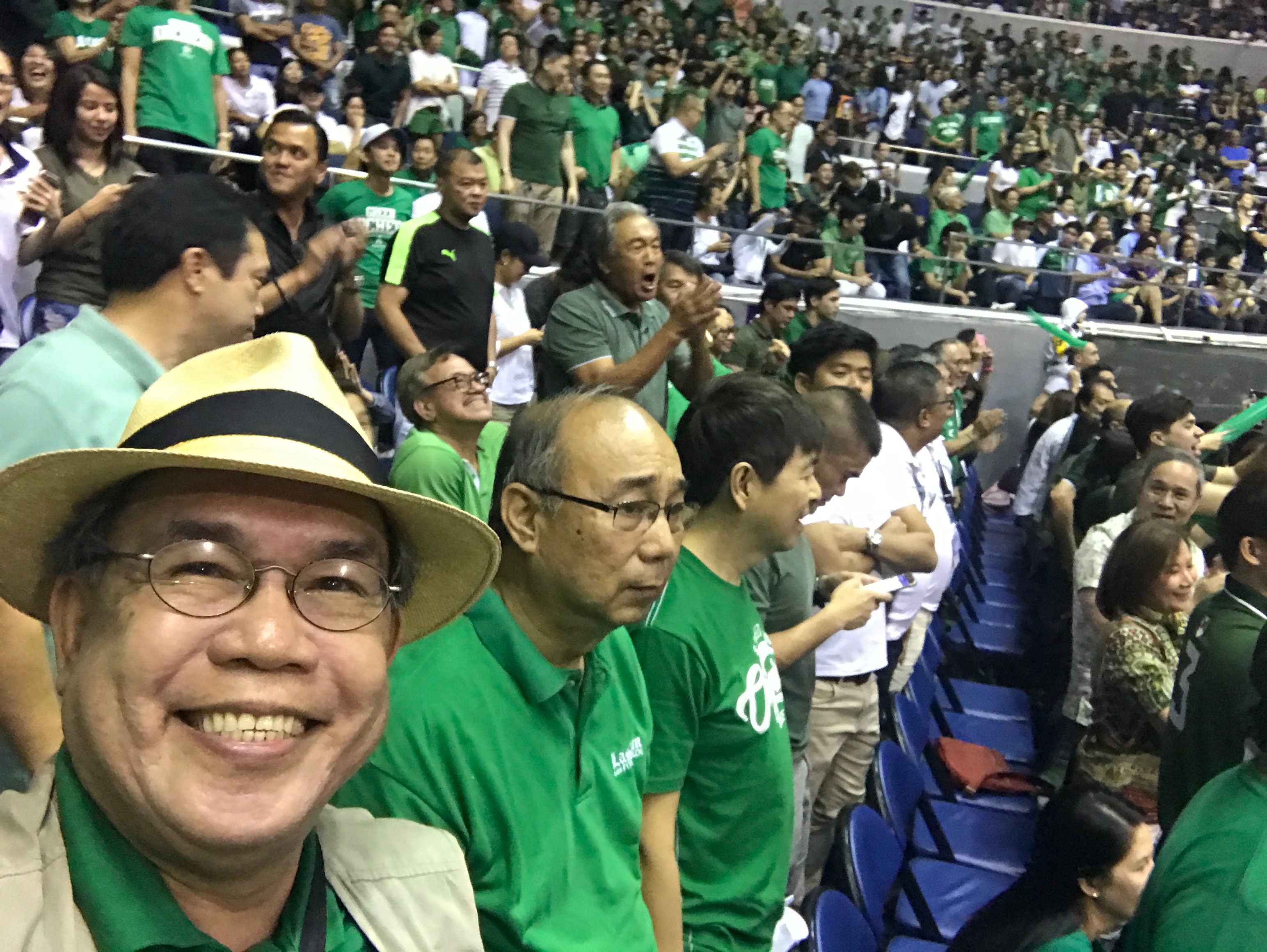
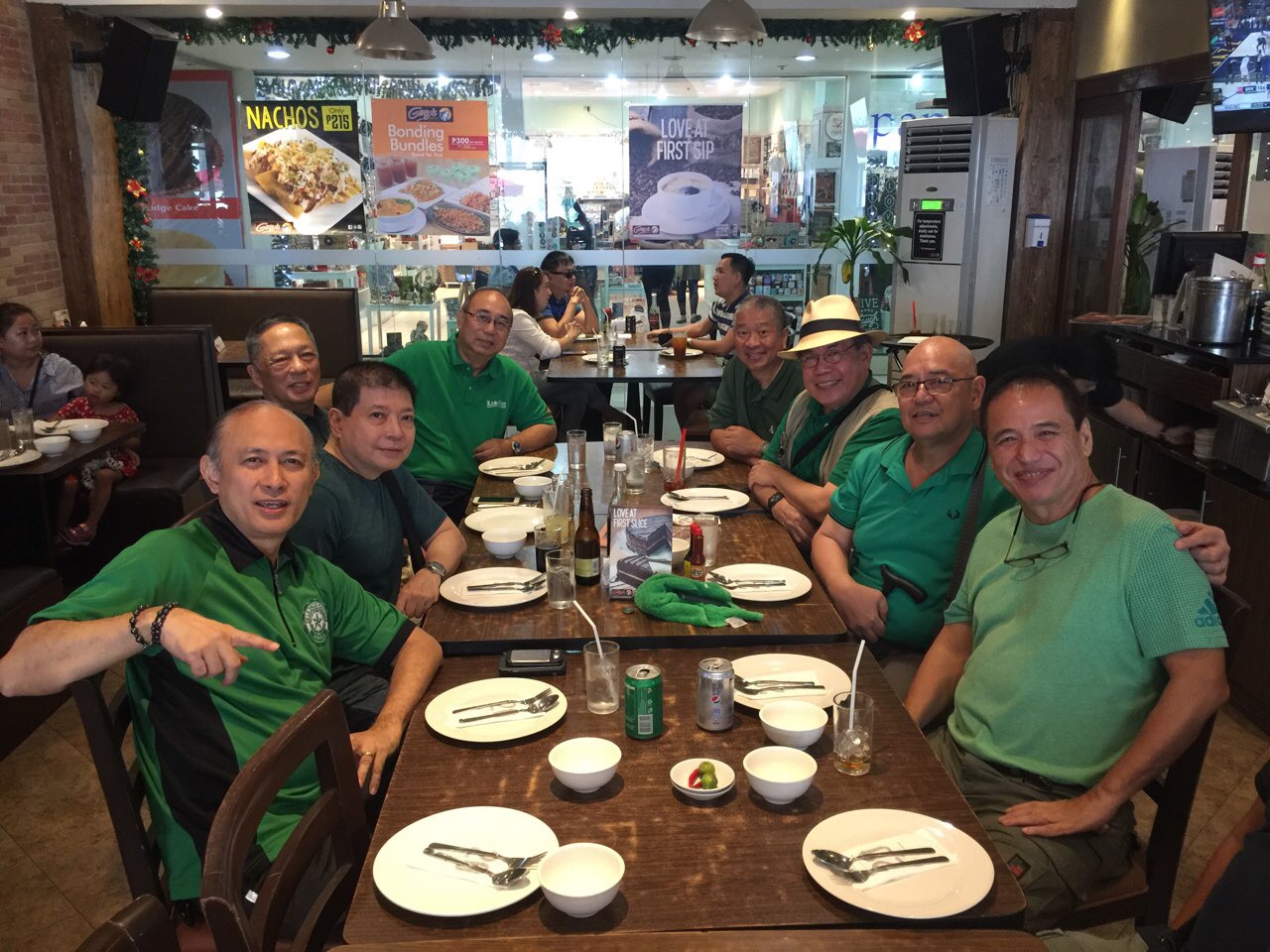
So I could hardly resist when a friend from grade school, who’s so modest I have to call him by his initials JV, invited me and the La Salle Green Hills gang to watch the La Salle-Ateneo game at the Big Dome last November 12. Ever the resourceful fellow (which explains his success in business), JV had managed to secure a certain number of tickets that enabled an impromptu reunion of some guys in our Viber group.

Of course every Pinoy barkada thinks of itself as special, but this one had a genuine claim to fame: our class was accelerated twice, saving us precious time. (And money, for those rarities—destitute La Sallites—like me.) I’ve written about my La Salle sojourn (Prep-Grade 7, 1960-66) elsewhere, the sum of which is, it’s the school I owe my preparation as a writer to, not to mention the supportive friendship of some very fine gentlemen. I went on to the Philippine Science High School, UP, and grad school in America, but I always treasured my schoolboy years in Green Hills and the love of books and language that they left me with.

How much better could it get? One minute I’m watching His Airness drop a game-winning trey, and nearly 30 years later I’m holding a golden ticket to the biggest game of the season so far. (Lest I be accused of treason to UP—which I should be cheering, after all, as a university official—I just haven’t had a chance to attend a live game yet, but was following and rooting for them all the way on the S&A channel, and I promise to come courtside next season.)

IMG_3587

First, we had to dress for the occasion, and while most of my buddies had closets full of green shirts, green socks, and presumably green underwear (JV even wore electric green sneakers), I had to reconnoiter several malls and department stores the week before the game to locate the perfect XXL polo shirt in shamrock green. We assembled four hours before gametime for a long and leisurely lunch in a nearby restaurant—for some of us, our first reunion in over 50 years, a long green-shirted line of seniors who’d last seen each other in khaki shorts, talking maintenance meds over crispy pata and cerveza negra. (Here’s one to us, guys—JV, Billy, Beyey, Dennis, Butch DG, Toffy, Mike, Conrad, and Jun!)

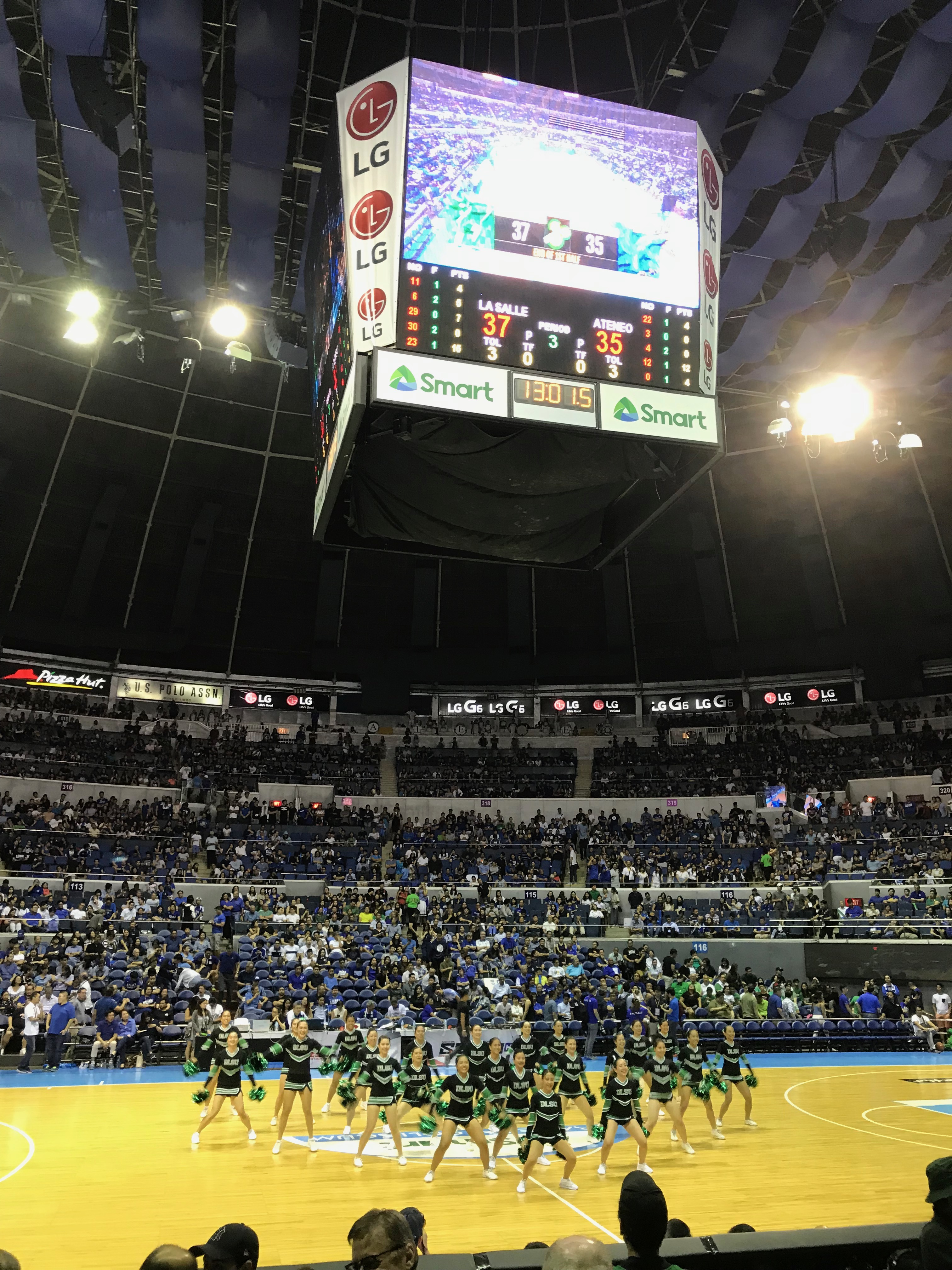
No matter how inured you might be to sports and competition, there’s no way you can escape the peculiar tingle and sizzle of a La Salle-Ateneo game, from the minute the drums unleash their tom-tom thunder from way up in the bleachers to the second the final buzzer sounds and sends half the gallery into hysteria while plunging the other half in utter despair.

It’s a rivalry that they say goes back to 1939, when La Salle beat Ateneo for the NCAA championship for the first time (27-23—sounds more like a halftime score these days). It’s come a long way since, and I don’t know who’s keeping track of the historic score, but every La Salle-Ateneo game feels like the deciding match of a best-of-three finals, going by the sheer electricity around the arena.

The last time I was at the Araneta Coliseum was two years ago to watch a revival concert of the Zombies; well, this was anything but a zombie crowd. Between spotting all the celebrities in the stands, appreciating the, uhm, fine art of cheerleading, and trying to catch up with new cheers and fight songs that I’d never mouthed before, it was sensory overload for a solid hour, an excursion into a culture I’d read about but had never visited.

I won’t bother you with the details of the game itself, which predictably went the cardiac route, with the Archers going down by as much as 12 in the third quarter, only to unload a 10-0 bomb in the closing minutes that led to an extremely satisfying outcome, 79-76, and just like that afternoon in Milwaukee nearly three decades gone, I found myself screaming and shaking like a broken radiator.

On the way out of the coliseum, a foot-wide grin still plastered to my face, I met a couple of blue-shirted colleagues from academia, whose baleful looks I couldn’t (and didn’t really want to) banish with my most effusive greetings.

IMG_3617