Qwertyman No. 224: On “disdain” and decorum

Qwertyman for Monday, November 16, 2026

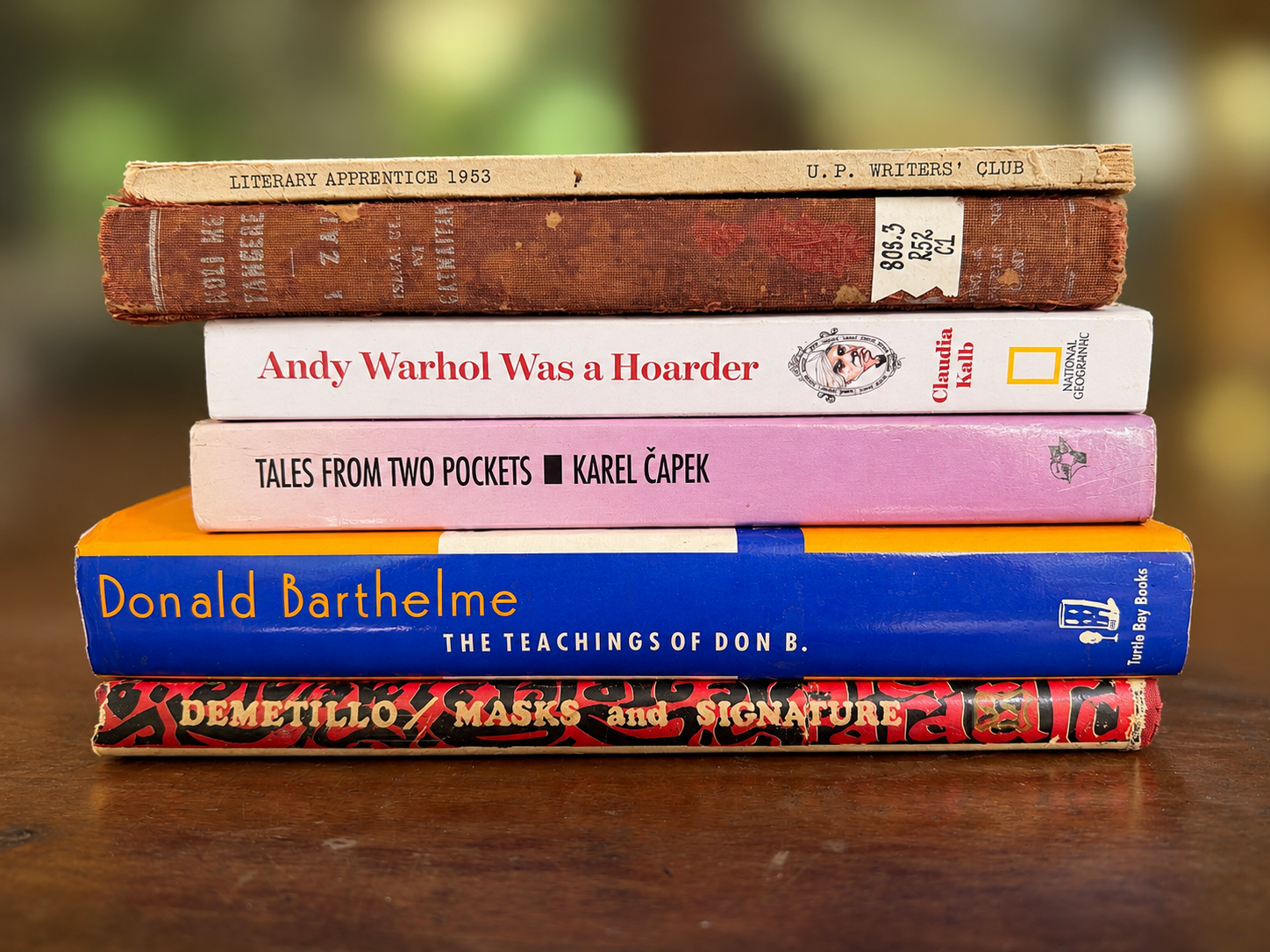
FOR OVER thirty years now, I’ve been teaching a course in UP—Creative Writing 198, Special Topics: Professional Writing—which I myself designed to give undergraduates a foretaste of what it’s like to write for a living. They may know enough Shakespeare, or Villa, or Woolf, and some might even be writing prodigious fiction or poetry. But many don’t have the foggiest idea of writing neither for school nor for literary fame, but for a client or an employer like an ad agency promoting a bar of soap, a newspaper with daily deadlines, or an NGO needing a script on vasectomy (yes, I did that once). My first-day lecture begins with this dictum: “There’s writing that you do for yourself, and writing that you do for others. Don’t ever get the two mixed up.”

While I’ve been retired for seven years now, I’ve exercised my privilege as professor emeritus to continue teaching a class a semester. And while I’ve focused on teaching graduate courses, I’ve occasionally made an exception for CW 198, so I can keep in touch with our young students and hopefully give them the benefit of my half a century of experience of writing to put food on the table and gas in the tank. I did that again this semester, and with barely a month left for classes, we moved last Thursday to what will likely be our last major project: the speech.

In this exercise, I want my students to assume another person’s voice, know him or her inside out well enough to anticipate his or her thinking on a given topic, and to produce a draft speech that will project his or her ideas clearly, positively, and sympathetically—all this, regardless of what you yourself may feel about your client and that person’s principles (or lack thereof). In other words, in a professional setting, you could find yourself working for someone dubious or even spiteful, but short of resigning (an option I’ve taken more than once), your professional obligation remains to serve your client or principal to the best of your ability, like a good lawyer might.

So our speech assignment runs this way: I write down our current senators’ names on 23 slips of paper, and have my 12 students pick one out of a hat, and then I write down 12 themes or topics—education, national security, arts and culture, the environment, the economy, etc.—and have them choose one as well. If you pick Robin Padilla to speak on science and technology, tough luck, but it’s not entirely inconceivable—heck, the guy was on top of constitutional reforms, right?—and you’d still have to give it your best shot. Whoever they get to write for, I tell my students to empathize, to pick their words carefully, and not to condescend. The client might decide at the last minute to toss your draft aside and to extemporize, but you’ve done your job.

This was on my mind when I heard Sen. Pia Cayetano’s pained lament at the Senate impeachment hearing last week, accusing the prosecution of indifference to the idea of supporting young athletes, because it had questioned Atty. Mans Carpio’s purchase of over P250,000 worth of Nike shoes for Filipino players competing in Kuala Lumpur. These were her exact words:

“Prosecution, I’m warning you. I will not hide my disdain. I will not. I cannot, I cannot. I don’t even know where to begin…. Is it the prosecution’s intention to make a parent relinquish their parental duty in terms of rearing their child in the manner they feel is the best to promote character, leadership, teamwork, just because one of the parents becomes a public official?”

What caught my ear was the word “disdain”—an emotionally laden word, one not used carelessly or casually, and I’m sure the good senadora didn’t mean for it to be taken lightly. Although I wasn’t certain what exactly the word was aimed at—disdain for the prosecutors, disdain for their alleged intention?—it piqued my attention enough for the English professor in me to look up the word’s provenance, because it seemed to me to be, shall we say, out of place?

With a little help from AI, I found this: “Disdain is the feeling that someone or something is beneath your notice. It differs from plain dislike in that it carries a claim of superiority, and Merriam-Webster glosses it as an arrogant or supercilious aversion to what is regarded as unworthy. The word is built on worthiness. It came into Middle English from Old French desdeign, based on Latin dedignari, from de- (reversal) plus dignari, ‘consider worthy’ (from dignus). That makes it the mirror image of deign: to deign is to consider worthy, and to disdain is to consider unworthy.”

The chase led me back to Chapter 2 of El Filibusterismo, where on the steamship Tabo, Isagani says that Doña Victorina “gazed at me with (a) disdain” when she learned he was a lower-deck passenger.

Now, Sen. Pia is, of course, no Doña Victorina, shall we agree? But her outrage, presumably on behalf of all unshod student athletes and the parents and generous sponsors seeking to give them proper shoes, does imply a certain moral superiority. How dare the prosecution question such a well-intentioned expense, as if charity were immoral and in this case possibly even criminal?

Never mind that the outburst was, in the context of the proceedings, entirely tangential if not irrelevant. I should tell my CW 198 students that “Sometimes, your client will deal with an issue by not dealing with it—by changing the subject, indeed by making oneself the subject.” But maybe I should reserve that for the advanced, graduate-school version of the course, on evasive argumentation.

I had to rewatch the video to make sure Sen. Pia wasn’t reading off some notes; she was not. Her remarks were unscripted, apparently heartfelt—and therefore even worse, because this was instinct at work, and her “disdain” reveals how detached she feels from the substance of the trial, picking up only on the parts that sound like prompts for another stage entrance, another aria.

I offer my students lifetime technical support, so if some of them ever make it to the Senate staff and get to write speeches for their bosses (some have), I might be able to give them some advice on how to make their clients sound more likeable and or at least less annoying. Sometimes you do that just by shutting up when you have nothing pertinent and sensible to say—to use another big word, by observing decorum. Otherwise, disdain goes both ways.

Qwertyman No. 223: Lessons from America

Qwertyman for Monday, November 9, 2026

LIKE MANY liberals—heck, like most people with any sense of sanity and decency left in them—I rejoiced at the total repudiation of Donald Trump and his Republican Party in the November 3 midterms. As one of millions of Filipinos with children, siblings, and other kinfolk in America, and one of the billions of earthlings injured in all kinds of ways by one man’s megalomania, I had been praying hard for this moment, if only to remind myself that divine justice remains possible in this sordid world.

All in a few weeks, we saw Lula push back the fascist right in Brazil, a student-led anti-corruption coalition win in Serbia, and Netanyahu stalemated in Israel. And now this. At this moment of giddiness, can we Filipinos be faulted for imagining that we, too, are due for epic change in the Philippines?

With our presidential elections coming up in two years, are there applicable lessons to be learned from the American experience to ensure the triumph of democracy and the return of accountability and good governance?

We can feel tectonic shifts happening belowground as VP Sara Duterte’s impeachment trial advances, likely to be resolved before the year ends. Whether she’s shut out of 2028 or somehow qualifies to run, the Dutertes remain a formidable force. And while a bruited Baste Duterte-Robin Padilla ticket seems designed to make us gag, it won’t be a joke if and when it happens, taking note of survey findings that 60 percent of Filipinos remain unconvinced that Sara is guilty of corruption, a mountain of evidence notwithstanding.

It’s no comfort that President Bongbong Marcos, who’s been getting a free pass from middle forces for trumpeting a noisy but sputtering anti-corruption drive, just showed his true colors by looking away while his allies in Congress cooked up a pork-heavy budget and then lately by appointing a baggage-laden Chief Justice whom critics expect to provide the Marcoses with political insurance. We’re definitely not feeling that “reform” vibe that we thought, for a feeble instant back there, PBBM himself was interested in stoking.

What’s a good and smart Pinoy democrat (small D) to do? Herewith, some propositions from this pedestrian kibitzer and his equally non-pundit friends, whom I polled for their ideas. They’re not graven in stone, and I could be somewhat off or dead wrong, but these could be starting points for a longer and deeper conversation among Pinoys sick and tired of seeing Marcoses, Dutertes, and the same old dynastic names in their future.

1. Build a big tent. This will mean sharing platforms and maybe even beds and breakfasts with some people you’d rather not be seen with, but tolerance and cooperation will be key. Those partners could and should include “soft” and persuadable Marcos and DDS supporters whose allegiances are anchored less in any kind of ideology than in unmet needs.

The Democrats didn’t win just because of their registered base. Especially in the red states, they were buoyed up by millions of disaffected Trumpers who felt ignored or betrayed by their marmalade hero, who splurged billions on wars and decorative pet projects while ordinary Americans suffered at the gas pump and the grocery. Here, we can’t win if we can’t pull over some of the 60 percent who still believe the evidence vs. Sara is weak. We need to ask the BBM and DDS faithful: What have they done for you? Are your lives any better now?

A broad alliance will include extremes, but it should be firmly driven by the moderate core, lest it lose its way in infighting, which some progressives are particularly good at. If you’re the kind of activist who’d rather lose at the polls than compromise or concede 1 percent of your preciously inflexible agenda, then we might admire your steadfastness, but electoral, united-front politics clearly isn’t for you. Principles are important, but your insistence on absolute correctness could lose you the whole project, and leave the common enemy rolling on the floor.

2. “It’s the economy, stupid.” This was Bill Clinton’s mantra when he took on and won over George H. W. Bush in 1992, but it clearly remained relevant in the 2026 midterms, and will continue to do so, the worse things get.

For Pinoys, this means prioritizing economic and welfare issues over ideology: food on the table, gas in the tank, education for the children, and affordable drugs and care for the sick. The candidate who can’t promise these and show how they can be delivered will be irrelevant.

We need to tie corruption to poverty, and dynastic politics to corruption—reduce big talk to gut issues, plot the short line from bad politicians to popular hunger and misery, and above all, craft concrete solutions that offer hope.

3. Organize well and communicate well. Translate that big tent to strong, broad, ground-level organization. Involve faith-based groups, which have large, committed constituencies. Connect to the local—Senate hearings get the headlines, but local needs and issues get the votes. Everywhere across the US, and again especially in hostile territory, Democrats made deep inroads through skillful organization and reaching out to the disaffected. (Also take a page from Lula’s super-effective digital blitz in Brazil.)

And of course it helps enormously to have a solid, capable, and personable candidate like Texas Sen.-elect James Talarico, possessed of a sharp mind, a good heart, and a compassionate voice, all indicative of an inner strength. We need someone of his likeable kind to deflate the showy bluster of a Robin Padilla by offering a more attractive and substantial alternative.

Victory in 2028 isn’t the end or the ultimate objective. It should simply be the beginning of expanded opportunities to get the right things done, and to undertake what was near-impossible in a previous administration, like leaving the budget totally pork-free, prosecuting and punishing the corrupt, and putting public money where it’s most needed and where it matters.

All that said, the most outstanding prospect remains the obvious one: Leni Robredo, who exemplifies the best of good governance in both substance and style. If only she could think of the country as a bigger Naga (in a far different way from how Rodrigo Duterte thought he could turn it into a greater Davao), many of these initial concerns would vanish, and we can all focus on getting her and us across the finish line.

(Meme from Threads)

Penman No. 491: The Online Bookstore

Penman for Sunday, November 8, 2026

WHEN WAS the last time you walked into a real, physical bookstore, scanned the covers and spines, flipped through the pages of an interesting book, and took it to the counter to check out?

That still happens, of course, especially in bookstores that have smartly embedded themselves in malls to catch the passing traffic, coming to a head in the big bookfairs where overflow crowds have been seen since the pandemic. The oft-touted fear that the printed book is dead in this age of the Internet, when books have been available in electronic format online for decades now, was decidedly overblown.

At least in the Philippines, e-book sales have remained low, and e-book reading never really took off. A National Readership Survey conducted by SWS for the National Book Development Board in 2023 showed that only about 15% of both adult and child readers prefer e-books over physical ones. Local publishers are working to enlarge this small market, adding e-book versions to their offerings of new publications.

But even in a country where nearly seven out of ten Filipinos use the Internet, very few have dedicated e-book readers (aside from their phones, on which reading long text can be a pain), and then there’s piracy, which allows free downloads of nearly anything you might be looking for, if you know which buttons to press. Filipinos want books they can hold, put aside, and return to their bookmarked page at their convenience.

But something has been happening to bring the digital and analog world of books together. Increasingly, book sales have shifted online, even for established publishers, and especially newer and smaller outfits with little hope of getting precious shelf space in bookstores heavily tilted toward foreign titles.

When people ask me where they can buy my books—because they can’t find them in the usual places (and sadly, neither can I)—I tell them to go to Shopee and Lazada, where many publishers now post their books, saving money on store displays and, more importantly, making their inventories accessible to every Pinoy from Aparri to Zamboanga. Whether we talk about eBay or Temu, and for all its flaws, the Internet has been a great equalizer, and the improvement of local delivery services like Lalamove and LBC has opened vast new horizons for both buyers and sellers.

Two weekends ago, I had a totally new experience, after having been invited to join National Book Store’s BookTok Festival. TikTok has become one of the Internet’s hottest sales platforms, and I knew they sold shirts, shoes, and bags on TikTok, but books? Yes, tons of books, as it turns out. They had me sit for an hour in front of a camera signing books and waving hello as full-throated agents pitched my books to buyers, who were promised delivery of signed copies within a few days. I must have signed a hundred books in that hour, and when we finished, all our stock—including our display copies—was sold out; at one point, we had over 100,000 views. And I was just one of many authors lined up for that weekend. Live selling can’t work for sleepyheads, but if you can take the frenetic pace, welcome to the future of book selling.

But there’s one special corner of the online book market that I have a soft spot for—the used book market, particularly for Filipiniana. Pinoys my age will recall going to C.M. Recto to pick up cheap used textbooks and pocketbooks (at least before BookSale became a thing). That marketplace has gone online, in such Facebook forums as the Filipiniana Bibliophile Group, where I’ve found such gems as books previously owned or signed by H.R. Ocampo, Amado V. Hernandez, and R. Zulueta da Costa, among many others. Because of these online book communities, I’ve been able to acquire, for not too much, a first Philippine edition of El Filibusterismo, published by Chofre in 1903, the very first edition of the UP Philippinensian yearbook, published in 1915, and probably the oldest extant copy of the Philippine Collegian, from 1922. (I have to add that, like other collectors, I get most of my antiquarian books on eBay and other online sources like AbeBooks and todocoleccion.net. You’d be surprised how much Filipiniana remains out there, as far away as Argentina, where I found a first edition of Aventure d’un Gentilhomme Breton by a favorite author, Paul Proust de la Gironiere.)

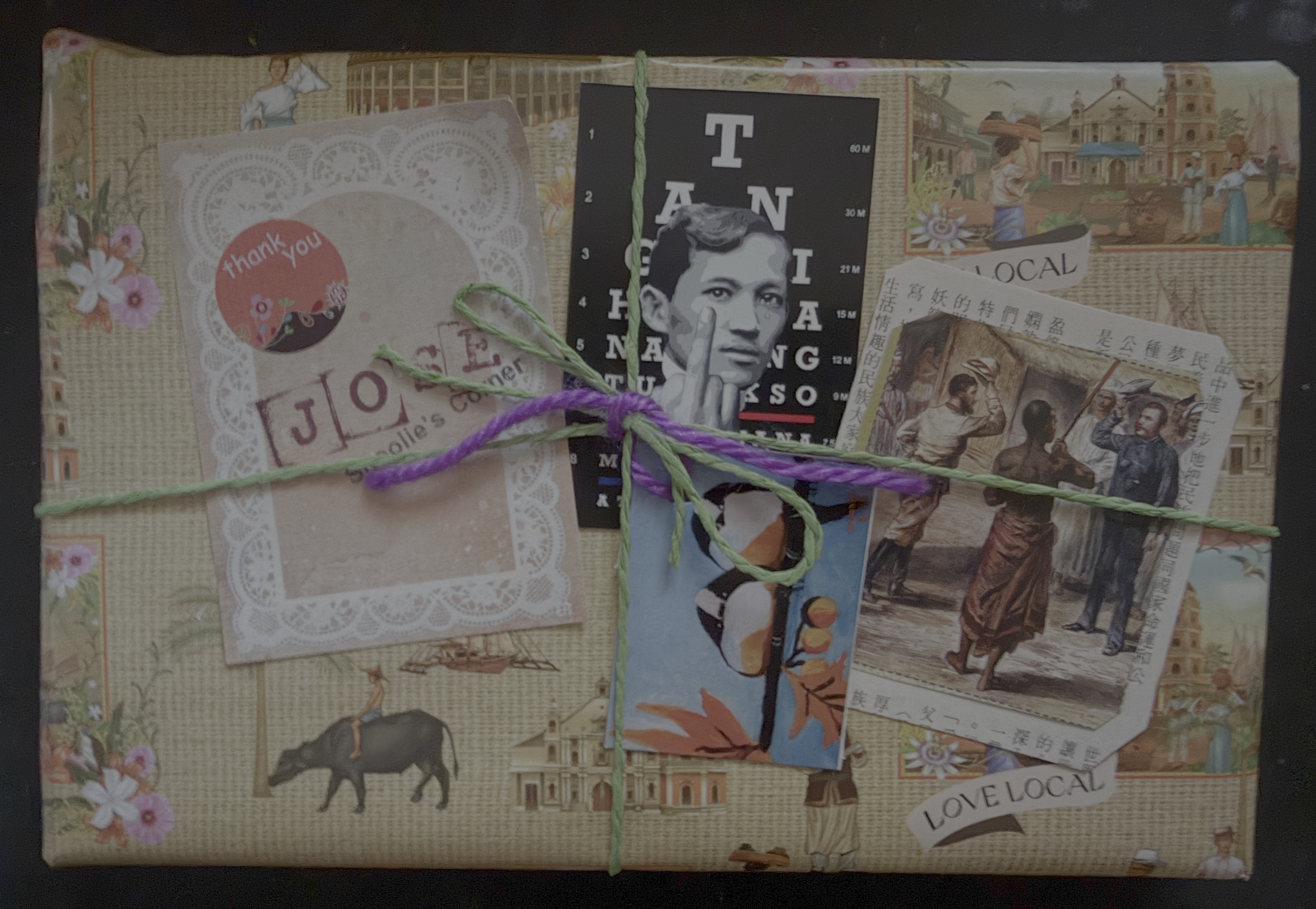
Another pleasure has been making the acquaintance of suki sellers such as a lady who goes by the trade name Shoolie’s Corner (she’s asked me to keep her identity private, although she’s well known in book and cultural circles). A lifelong reader, “Shoolie” traces her love of books from childhood trips with her father to the bookstores of Avenida and Raon, through a college turn toward “subversive” and Asian-history titles bought at Popular Bookstore in Doroteo Jose, to decades of hunting secondhand shops in Manila, Hong Kong, Singapore, Portland, San Francisco, and Vancouver.

The pandemic supplied the turning point. With her food-delivery work limited to daytime and with cash short, a friend suggested she sell her books. Foreign titles drew no buyers, but her Filipiniana sold at once, beginning with a gold-edged Vibal edition of the Boxer Codex, which she let go of cheaply and still regrets. “I began buying books I liked to read. The earliest ones were Ambeth Ocampo’s Looking Back series, Builder of Bridges by Jose Dalisay Jr. (thank you!), and Batis by Jose Victor Torres.”

Since then, Shoolie has cultivated a coterie of faithful buyers, drawn as much to her offerings as to her painstakingly pretty and unique packaging of each book sold. You buy a book from her, receive it from a rider, and you simply don’t want to tear the wrapper apart because it’s an artwork in itself. “I buy books that I like to read, then sell them after reading them. It’s a win-win situation,” she says. “I sell not only books but the experience of buying books from me: receiving a book like a gift, even though in reality the reader paid for it. I want my books to arrive in style, with bookmarks, tassels, and all, wrapped securely with strings and stickers.”

Another suki is Remy Cabaltera, who runs an antique shop at Ali Mall called Remnants and who also sells books on FBG. She patiently consolidates my picks and has Lalamove deliver them to me in batches of half a dozen. All these acquisitions go to what I call my Tsundoku Library, for reading at a more leisurely time, probably in my nineties when I can’t do anything else but flip pages.

In the meanwhile, happy bookhunting—and as they used to say of the Yellow Pages, let your fingers do the walking, on your laptop’s or phone’s keyboard.

Qwertyman No. 222: SGV: Eight Decades of Excellence

Qwertyman for Monday, November 1, 2026

I’M NOT an accountant and never took an accounting subject—I couldn’t tell you the difference between “book value” and “equity” if my life depended on it—but as fate would have it, I’ve been privileged to have an inside view of the Philippine accounting profession as an author and even, to some extent, a confidant.

It all began twenty years ago when I was asked to write the biography of the man whose name is synonymous with Philippine accountancy itself—Washington SyCip, or “Wash” as generations of Filipinos knew him. Most of us, myself included, probably grow up thinking that nothing could be more boring than an accountant’s job (but then again, there’s the elevator operator)—all those days and nights poring over ledgers and scribbling notes and figures with a fine-tipped pen.

That impression went out the window when I met and got to know Wash—a certified genius who graduated from college at 17, summa cum laude, and soon began teaching students older than he was. He took his master’s and became a CPA at 19—but was too young to legally practice, so he went to the US for his PhD, only to be caught there by the war. Upon hearing the rumor—a false one—that his father Albino had been executed by the Japanese, Wash signed up with the US Army, which promptly realized they had a prodigy on their hands, and assigned him as a codebreaker in Calcutta, where he spent most of the war. At war’s end, on the voyage home, Wash faced a choice: return to the US and take up a job as an accountant for Women’s Wear Daily, or stay and start his own firm. He chose the latter and founded what would become the accounting giant SyCip, Gorres & Velayo, or SGV as we’ve known it since.

Wash died in 2017—characteristically enough, on a flight to America, the other pole of his storied life. The firm that he started has just marked its eightieth year, and again I’ve been fortunate to have been asked to write its commemorative book, published by SGV as SGV 80 Years: Celebrating a Continuing Legacy of Integrity, Excellence, and Purpose. (Last year, I also wrote A Century of Philippine Accountancy for the Philippine Institute of Certified Public Accountants, marking the profession’s centenary in the Philippines.)

SGV’s rise to the top of an industry once dominated by British and American firms and its continuing leadership in a new century is a study in corporate culture—in an organization’s adherence to core beliefs and in how a generation of leaders builds on previous ones to keep the firm not only alive but at the cutting edge of its profession.

With its absorption of Fleming & Williamson’s audit practice in 1958, SGV became the country’s largest firm and completed the Filipinization of the profession. In the 1960s and 1970s, it became the first Asian multinational, with member firms from Taiwan to Singapore. By 1971 SGV it was serving 63 of the country’s top 100 corporations.

A big turning point came in the early 1980s, when the Philippine economy weakened and could no longer support the regional network, so in 1985 Wash and his partners joined Arthur Andersen’s global organization, trading independence for technology, training, and reach.

Arthur Andersen’s implosion in the early 2000s led to another crisis, resulting in SGV’s tying up with Ernst & Young, a productive global association that continues to this day. Then Country Managing Partner Cesar Purisima steered the firm through that period deftly and later reorganized SGV into market circles, which later evolved into market groups, to make the firm more responsive to its clients’ needs. Its emergence from crisis also brought to the fore the concept of stewardship—of the firm as something held in trust—first enunciated by CMP Dave Balangue and developed by CMP Vic Noel, as a “reminder to the Partners that we are not owners of the Firm but rather its stewards…. We had to think of SGV as more than a business, but as an institution that it was our duty to perpetuate.”

It was CMP Itos Cruz who pushed that further into one of SGV’s central tenets—what it calls “purpose,” by which SGVeans aim “to leave the Firm stronger than we came in, so we could help the Filipino people better. Whatever increase we bring to the value of SGV, we leave it to the next generation to build upon. We clarified our corporate purpose accordingly: to nurture leaders and enable businesses for a better Philippines.”

When the pandemic hit, SGV was prepared, because CMP Wilson Tan had providentially just refreshed the firm’s business continuity plan. As a result, SGV was able to shift to remote work almost overnight, to pay salaries early, to get its partners to take a temporary cut, and to lay off no one. Today, under Rosing Fajardo—the firm’s second female CMP—SGV employs nearly 6,000 across four service lines, adapting to a business and political environment marked by rapid technological change, the challenges and opportunities of artificial intelligence, and the issues of sustainability, demographic change, and geopolitics.

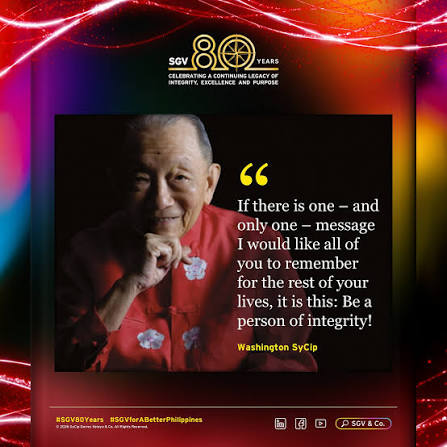
Key to SGV’s longevity and success has been its adherence to integrity, a principle laid down by Wash SyCip from the very beginning, when he said of SGV’s predecessors that “One group practices discrimination by color of skin, the other practices discrimination by blood. So I sought to get the best people to join me. I told them that even when I get married, I’m not going to have my children in the Firm. There should be complete meritocracy.” (Indeed, all of Wash’s three children have pursued other careers.) SGV has been known to drop major clients over issues of misreporting.

One way SGV has maintained that integrity has been to draw a clear, sharp line between its business and its ties to government. While many ex-SGVeans have joined government in high positions from Cabinet secretaries to House Speaker and Prime Minister, they’ve done so knowing they were taking a one-way road. Wash SyCip himself laid down that rule: “We don’t want people to think that we are putting somebody in government so that he would have influence when he rejoins us, because that would affect our integrity… If we lose them to government, then that is one of our contributions to our developing nation.” Cesar Purisima recalls Wash telling him that he should “look at government the way a moth looks at light.” (It certainly deserves to be noted, to be fair, that some of SGV’s contributions to government could have served and performed far better had they kept “integrity, excellence, and purpose” at heart after the transition.)

At a time when there seems to be a dire shortage of these qualities in public life, SGV’s history reminds us how the private sector can help bring out the best in us—with exemplary leadership and good corporate citizenship.