Qwertyman No. 222: SGV: Eight Decades of Excellence

Qwertyman for Monday, November 1, 2026
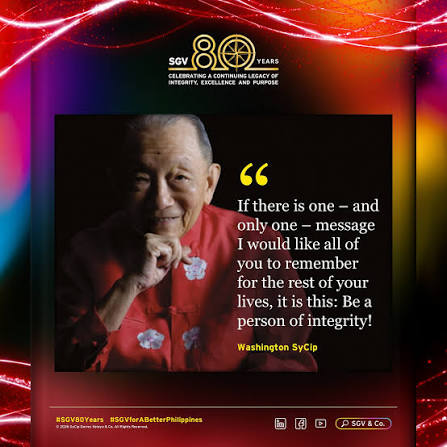
I’M NOT an accountant and never took an accounting subject—I couldn’t tell you the difference between “book value” and “equity” if my life depended on it—but as fate would have it, I’ve been privileged to have an inside view of the Philippine accounting profession as an author and even, to some extent, a confidant.

It all began twenty years ago when I was asked to write the biography of the man whose name is synonymous with Philippine accountancy itself—Washington SyCip, or “Wash” as generations of Filipinos knew him. Most of us, myself included, probably grow up thinking that nothing could be more boring than an accountant’s job (but then again, there’s the elevator operator)—all those days and nights poring over ledgers and scribbling notes and figures with a fine-tipped pen.

That impression went out the window when I met and got to know Wash—a certified genius who graduated from college at 17, summa cum laude, and soon began teaching students older than he was. He took his master’s and became a CPA at 19—but was too young to legally practice, so he went to the US for his PhD, only to be caught there by the war. Upon hearing the rumor—a false one—that his father Albino had been executed by the Japanese, Wash signed up with the US Army, which promptly realized they had a prodigy on their hands, and assigned him as a codebreaker in Calcutta, where he spent most of the war. At war’s end, on the voyage home, Wash faced a choice: return to the US and take up a job as an accountant for Women’s Wear Daily, or stay and start his own firm. He chose the latter and founded what would become the accounting giant SyCip, Gorres & Velayo, or SGV as we’ve known it since.

Wash died in 2017—characteristically enough, on a flight to America, the other pole of his storied life. The firm that he started has just marked its eightieth year, and again I’ve been fortunate to have been asked to write its commemorative book, published by SGV as SGV 80 Years: Celebrating a Continuing Legacy of Integrity, Excellence, and Purpose. (Last year, I also wrote A Century of Philippine Accountancy for the Philippine Institute of Certified Public Accountants, marking the profession’s centenary in the Philippines.)

SGV’s rise to the top of an industry once dominated by British and American firms and its continuing leadership in a new century is a study in corporate culture—in an organization’s adherence to core beliefs and in how a generation of leaders builds on previous ones to keep the firm not only alive but at the cutting edge of its profession.

With its absorption of Fleming & Williamson’s audit practice in 1958, SGV became the country’s largest firm and completed the Filipinization of the profession. In the 1960s and 1970s, it became the first Asian multinational, with member firms from Taiwan to Singapore. By 1971 SGV it was serving 63 of the country’s top 100 corporations.

A big turning point came in the early 1980s, when the Philippine economy weakened and could no longer support the regional network, so in 1985 Wash and his partners joined Arthur Andersen’s global organization, trading independence for technology, training, and reach.

Arthur Andersen’s implosion in the early 2000s led to another crisis, resulting in SGV’s tying up with Ernst & Young, a productive global association that continues to this day. Then Country Managing Partner Cesar Purisima steered the firm through that period deftly and later reorganized SGV into market circles, which later evolved into market groups, to make the firm more responsive to its clients’ needs. Its emergence from crisis also brought to the fore the concept of stewardship—of the firm as something held in trust—first enunciated by CMP Dave Balangue and developed by CMP Vic Noel, as a “reminder to the Partners that we are not owners of the Firm but rather its stewards…. We had to think of SGV as more than a business, but as an institution that it was our duty to perpetuate.”

It was CMP Itos Cruz who pushed that further into one of SGV’s central tenets—what it calls “purpose,” by which SGVeans aim “to leave the Firm stronger than we came in, so we could help the Filipino people better. Whatever increase we bring to the value of SGV, we leave it to the next generation to build upon. We clarified our corporate purpose accordingly: to nurture leaders and enable businesses for a better Philippines.”

When the pandemic hit, SGV was prepared, because CMP Wilson Tan had providentially just refreshed the firm’s business continuity plan. As a result, SGV was able to shift to remote work almost overnight, to pay salaries early, to get its partners to take a temporary cut, and to lay off no one. Today, under Rosing Fajardo—the firm’s second female CMP—SGV employs nearly 6,000 across four service lines, adapting to a business and political environment marked by rapid technological change, the challenges and opportunities of artificial intelligence, and the issues of sustainability, demographic change, and geopolitics.

Key to SGV’s longevity and success has been its adherence to integrity, a principle laid down by Wash SyCip from the very beginning, when he said of SGV’s predecessors that “One group practices discrimination by color of skin, the other practices discrimination by blood. So I sought to get the best people to join me. I told them that even when I get married, I’m not going to have my children in the Firm. There should be complete meritocracy.” (Indeed, all of Wash’s three children have pursued other careers.) SGV has been known to drop major clients over issues of misreporting.

One way SGV has maintained that integrity has been to draw a clear, sharp line between its business and its ties to government. While many ex-SGVeans have joined government in high positions from Cabinet secretaries to House Speaker and Prime Minister, they’ve done so knowing they were taking a one-way road. Wash SyCip himself laid down that rule: “We don’t want people to think that we are putting somebody in government so that he would have influence when he rejoins us, because that would affect our integrity… If we lose them to government, then that is one of our contributions to our developing nation.” Cesar Purisima recalls Wash telling him that he should “look at government the way a moth looks at light.” (It certainly deserves to be noted, to be fair, that some of SGV’s contributions to government could have served and performed far better had they kept “integrity, excellence, and purpose” at heart after the transition.)

At a time when there seems to be a dire shortage of these qualities in public life, SGV’s history reminds us how the private sector can help bring out the best in us—with exemplary leadership and good corporate citizenship.

Qwertyman No. 93: A Century of Philippine Accountancy

Qwertyman for Monday, May 13, 2024

IN MY long life as a professional writer—aside from being a fictionist, journalist, and academic—I’ve occasionally been asked to write books for both private and public institutions and individuals, usually to commemorate an important milestone. My clients have included banks, power and energy companies, accounting firms, NGOs, business tycoons, politicians, and thinkers. 

While it’s a job, it’s also been a great learning experience for me, particularly when I’ve had to deal with topics like oil exploration, steel manufacturing, and geothermal energy. I begin to understand how things really work in our economy and society, seeing the cogs and wheels that turn industry, create jobs, and produce things people need. I meet people I never would have run into otherwise, people with interesting stories to tell about themselves and their work.

Probably the most famous of those people was Washington SyCip, the legendary founder of SGV & Co., once one of Asia’s largest and most highly respected accounting firms, whose biography Wash: Only a Bookkeeper I wrote back in 2008. When people tell me how boring the lives of accountants must be, I tell them the story of Wash, who wasn’t just an academic prodigy who graduated summa cum laude from college at 17, but who also served as a US Army codebreaker in India in the Second World War. Granted, not many accountants lead lives as colorful as Wash’s, but to suggest that there’s no drama in accountancy is certainly mistaken. 

I discovered this in my latest (and very likely my last) commissioned book, A Century of Philippine Accountancy, which will be launched this week by the Philippine Institute of Certified Public Accountants (PICPA) Foundation. The book is a compendium of both big and small stories, an institutional history that also delves into the personal struggles and triumphs of key people in the industry.

The centennial book comes a bit late, because the Philippine accounting profession formally traces its beginning to March 17, 1923, when the Sixth Philippine Legislature passed Act No 3105, “An act regulating the practice of public accounting; creating a Board of Accountancy; providing for examination, for the granting of certificates and the registration of Certified Public Accountants; for the suspension or revocation of certificates and for other purposes.” Six years later, the PICPA was established within the private sector to represent professional interests.

Of course, some form of bookkeeping was being practiced in the Philippines long before that. Given the Philippines’ vigorous trade with other countries such as China even before Spain’s arrival in 1521, there must have been some early form of record-keeping maintained by both natives of the islands and their foreign trading partners. Accounting in early China was said to have reached a peak during the Western Zhou dynasty (1100-771 BC); the Chinese developed sophisticated methods of accounting to keep track of such basics as revenues, expenditures, salaries, and grain. In Spain, regulations began to be applied regarding the accountability of companies starting with Queen Juana and her son Emperor Charles V in the 1500s. Manila’s galleon trade with Mexico, which lasted from 1565 to 1815, required meticulous bookkeeping, and archival records still exist of the cargo manifests of the galleons; these records show, for example, that audits of the ships’ cargo revealed discrepancies in capacity that suggested smuggling (whereby space meant for such necessities as water was reduced to make way for profitable goods).

Since 1923, the profession has grown in the Philippines by leaps and bounds to nearly 200,000 registered CPAs, employed in over 8,000 firms and partnerships. Based on the number of Publicly Listed Companies (PLCs) they audit, six firms dominate the industry: SGV & Co. (Ernst & Young); Isla Lipana & Co. (PricewaterhouseCoopers Philippines); R.G. Manabat & Co. (KPMG Philippines); Reyes Tacandong & Co. (RSM Philippines); Punongbayan & Araullo (Grant Thornton Philippines); and Navarro Amper & Co. (Deloitte Philippines). In keeping with the times, many local firms have affiliated themselves with large global partners to avail themselves of the latest technology and expertise. (For a bit of trivia, the first Filipino CPA was Vicente F. Fabella, the founder of what is now Jose Rizal University.)

The profession is governed by the Board of Accountancy (BOA), which administers the CPA Licensure Exam at least once a year. The BOA in turn is supervised by the Professional Regulatory Commission, along with other professional boards. The BOA and PRC work closely with the Securities and Exchange Commission (SEC), which is responsible for ensuring the integrity of the country’s financial system and its institutions.

The 1997 Asian financial crisis highlighted the importance of quality assurance and adopting international financial reporting standards in accounting. With the help of the Asian Development Bank and the World Bank, the major players in the profession—PICPA, BOA, PRC, and SEC, among others—undertook studies to reform the industry, resulting in the Philippine Accountancy Act of 2004. The SEC also initiated an Oversight Assurance Review to extend and strengthen reforms further. What the book chronicles most significantly, according to former SEC Commissioner Antonieta Fortuna-Ibe, is the Filipino CPA’s rise to global respectability and prominence, because of the industry’s relentless efforts to raise its standards and to keep pace with the latest developments in financial technology. Ibe stood at the vanguard of many basic reforms in Philippine accountancy, and was behind the push for a book to mark their centenary.

The profession will need to adapt to the ever-changing financial landscape. As SGV’s Wilson Tan puts it, “While we have yet to see how new technologies such as the Metaverse and the integration of AI into work applications will impact the accounting profession, CPAs of the future will need to likewise evolve their skills and capabilities. Foundational changes will need to be made in the curriculum to integrate learning that encompasses non-financial reporting matters, use of technology, data, and analytics, and cybersecurity, among others.”

Personal integrity, as ever, lies at the bedrock of accountancy. The BIR’s Marissa Cabreros reminds everyone that “Every CPA being asked to sign a financial statement must give weight to the purpose of their signature. If it has your signature as a CPA, we expect that you reviewed and recorded that properly. But unfortunately, sometimes lapses happen and CPAs forget what they signed for. An accountant must always have the importance and value of her signature in her heart.” Wash SyCip could not have put it any better.

Accountants and other members of the public interested in getting a copy of the book can email Lolita Tang at lolitatang@yahoo.com for more information.