
Qwertyman No. 110: The Truth Shall Make You Mad

Qwertyman for Monday, September 9, 2024
I’M WRITING this on a Friday morning with no particular topic in mind, threatening to be overwhelmed by a slurry of depressing and outrageous news flooding my inbox. As a news junkie, I get my foreign news in digests from the New York Times and the Washington Post, and of course I look up all the major local news websites. You’d think that would be enough, but of course I have to open CNN and the BBC online as well—and occasionally, when I feel obliged to do so, Fox News, if only to see what those people are saying. And then I turn the TV on to CNN, BBC, Al Jazeera, and Channel News Asia for onsite reportage and commentary, especially from a non-Western perspective. 

For all my efforts, this is what I got today, which I’m sure many of you did as well:

“Ugandan Olympian Rebecca Cheptegai dies after being set on fire by boyfriend” (CNN)

“Accused Georgia school shooter Colt Gray, 14, received gun used in massacre as Christmas gift from dad” (New York Post)

“Israeli attacks in Gaza kill 35 people as polio vaccinations continue” (Al Jazeera)

“Trump says he’d create a government efficiency commission led by Elon Musk” (AP News)

“Woman testifies husband drugged her for years, recruited dozens to rape her” (Washington Post)

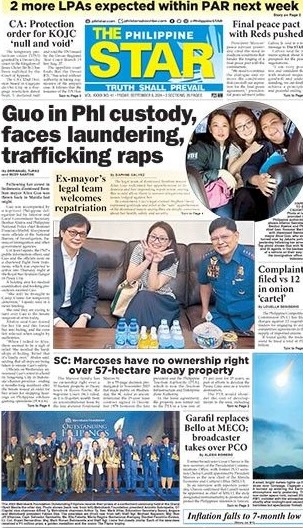
“What was behind the viral photo of Guo, Abalos, and Marbil?” (Rappler)

On a day like this, you have to ask yourself, “What has the world come to?” followed quickly by “Do I really want to know?” You emerge with a sense of a world gone mad, a moral universe you no longer recognize, playing by different rules for different people. Each one of those news items I mentioned above was enough to make me retch. 

While the loss of human life naturally rises to the fore of our concerns, how does one diminish the horror of being abused while unconscious over 70 times for years, or the cruel irony of vaccinating children only to bomb them afterwards? On which planet is it all right for a father to buy his young son—already known and reported to be prone to violence—an AR-14-style assault rifle for Christmas? (Answer: Not Mars but the United States, thanks to lax gun laws and even laxer parental supervision.) And speaking of that country, what do Americans think they can expect from a government run by two egomaniacs?

Let’s go to that viral snapshot, which I saw with my morning coffee, when I was still half-asleep and not too sure of what exactly I was looking at—the secretary, the escapee, and the police general seated on a sofa, all smiling into the camera, with a raft of refreshments on a table before them. 

No, I immediately thought, surely this was from the recent past, when all was still peachy between Ms. Guo and the administration. Or could it have been another of those clever AI pastiches, mounted to embarrass our honest and hard-working officials in hot pursuit of a wanted criminal? How else could you explain Alice’s sweet smile and finger gestures, and the equally benign countenances of the gentlemen beside her? Where was even the slightest trace of the loneliness and fear that were said to have driven our favorite chinita into self-exile, which would have left her haggard and despondent? 

Not having read anything else at that point, I almost made a comment on the first FB post of that image to the effect that “No, no, this can’t be true, this is all fake!” Providentially I held back, and looked for what I was sure would be a vehement denial from those concerned that the picture was ever taken. Instead, I found a story and a video of the good secretary explaining that he had no idea what Ms. Guo was doing as their “documentation” photo was being taken. Good Lord, I thought—if that wasn’t the chummiest picture I’d ever seen of captors and their captive, like something from a high-school reunion. So, okay, the smiles can be explained away—Alice was relieved that the Philippine police will now secure her from all threats; Abalos and Marfil were happy to have completed their mission. Does that call for refreshments, for a toast? Where did decorum go?

Sometimes I wonder if we read the news just to get all riled up—like poking yourself in the eye—as proof of life, or of our ability to still think and figure out right from wrong.

There’s a great article by Brett and Kay McKay on a website called artofmanliness.com titled “Is There Any Reason to Keep Up with the News?” It notes that “In The News: A User’s Guide, philosopher Alain de Botton draws on the ideas of Hegel to posit that in fact, the news in modern cultures has in some ways replaced ‘religion as our central source of guidance and our touchstone of authority.’

“Morning and evening prayers have been substituted with checking one’s news feed immediately upon rising and retiring to bed. While the faithful once sought inspiration in scripture, it’s now in the news ‘we hope to receive revelations, learn who is good and bad, fathom suffering and understand the unfolding logic of existence. And here, too, if we refuse to take part in the rituals, there could be imputations of heresy.’

“If the news represents a new kind of faith, it is surely one of our least examined. The media rarely does stories on itself—reports that might examine their actual worth and credibility.”

The article goes on to dissect our hallowed reasons for following the news—e.g., our desire for the truth and for the betterment of humanity—only to show how narrowed and pliable the truth can be, and how the news actually dehumanizes people (quoting Stalin: “The death of one person is a tragedy; the death of one million is a statistic”) rather than sharpens our humanity.

This I know: if the news is still the bringer of truth as I knew it to be, then this morning’s news has made me mad, in both senses of the word.
Penman No. 162: To Be a Journalist (2)

Byline

Penman for Monday, August 17, 2015

LAST WEEK’S look back at my early days as a journalist brought back a flood of memories that hadn’t crossed my mind in ages, so I’ll beg my reader’s indulgence with this extended reminiscence of what it was like to be a young newspaper reporter just before martial law was declared in September 1972.

Come to think of it, that first stint in journalism didn’t last too long, from April to September of that fateful year. (I keep saying “first” because I would return to newspapering more than 20 years later in 1993, as an editorial writer and then Lifestyle columnist for the late, lamented newspaper TODAY.) To recap, I was 18, and my bosses at the Philippines Herald had taken a chance on a college dropout who barely knew a thing about professional newspapering but who seemed to be able to string sentences together decently enough—and fast.

Man, was I fast—I was so eager to impress my editors that I jumped at assignments the way a dog goes after a ball, and when my editors found out about the new boy in the room, they assigned me to fill up half of Page 5—the features page—every day. The topic was up to me. That sounded like the most wonderful thing in the world—imagine, my own corner of the newspaper, all mine to fill up!—for about three days. I took stories out of history books and turned them into features; I wrote about the latest crazes like fun houses and pool halls; and when, inevitably, I ran out of ideas, I took a bus out to Tagaytay, got off, and looked around for anything that I could weave a feature story from (I saw a drug rehab center in the distance and got a story out of that; I did the same thing in Muntinlupa another day and interviewed a Death Row convict).

Thankfully my editors pulled me out of Page 5 and designated me a general assignments reporter—meaning, I would report for work every morning and take on whatever odd assignment they tossed me. But before I could do that, and to give me some training, they had me spend a few weeks each on a specific beat—police, sports, and City Hall. On each beat, a senior Herald reporter took me under his wing, and while they may not have been too happy to babysit me, I soaked up their streetsmarts and tried not to be a nuisance (not always successfully—we were covering a MICAA basketball game when Jun Pantig saw that I was cheering for one team at courtside. “Stop cheering!” he shushed me. “You’re a reporter, you shouldn’t be taking sides!”)

Of all the beats I was assigned to, the most exciting and instructive was police. I took the graveyard shift at the old Manila Police Department headquarters and from there covered mayhem at its worst—an 18-year-old American girl who shot herself in the mouth at the Dutch Inn; a nighttime fire that razed a hospital in Dapitan (I can still recall the sickening thud of falling patients who jumped off the roof in desperation; my specific task, early that morning, was to count all the bodies in the morgues); demonstrations at the US Embassy where I could see the police preparing for an assault on the rallyists, many of whom happened to be my friends (prompting me, again, to break journalistic protocol by picking up the injured in our service jeep and bringing them to the hospital).

I grew inured to the sight and smell of blood, and I can say, today, that I had no better preparation for the kind of realist fiction that I would come to write than those weeks on the police beat, confronting death by the day (which didn’t make me feel any braver, but rather more aware and respectful of the finitude of life).

It was all very exhilarating, even in the most difficult and trying of moments; sometimes the toughest tests took place in the newsroom itself—once, for example, I was driven close to tears by having to rewrite a story half a dozen times to please an editor who, I now realize, was teaching me a valuable lesson in verbal economy.

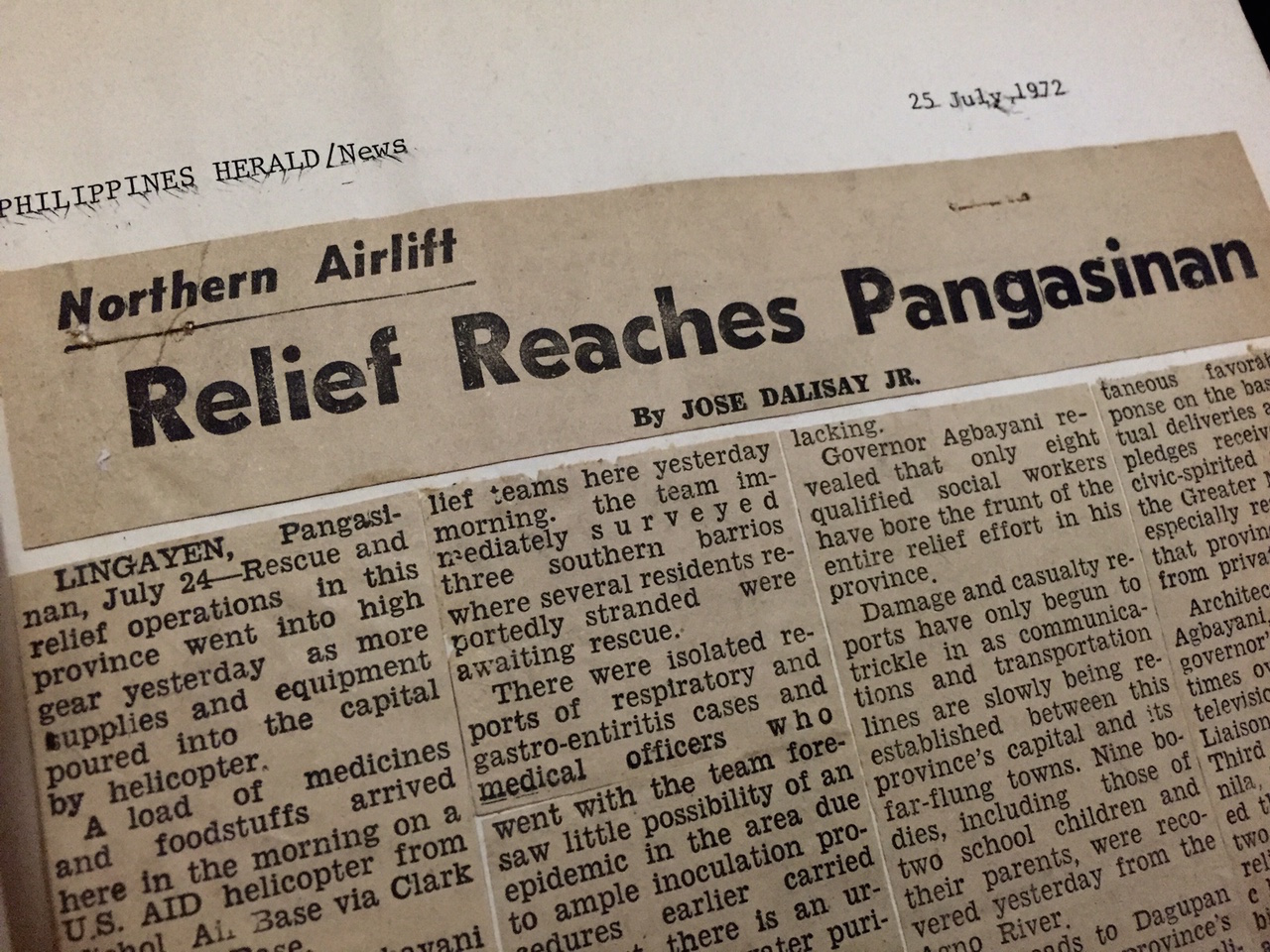
Coming off the beats as a general assignments reporter, I looked forward to and did get some assignments that no other teenager would have experienced. At the onset of the biblically catastrophic July-August floods of 1972, I was put on board an amphibious ship that sailed in the night from Manila to Lingayen Gulf, and I covered rescue operations in Pangasinan, riding rubber rafts and flying out in a US Army helicopter that dropped us off at Clark Air Base, then still busy with the Vietnam War. Also at about that time, I volunteered to go to Isabela to cover the reported landing of a shipload of arms by the CPP-NPA, convinced (wrongly—it turned out to be the MV Karagatan episode) that it was a military hoax that I could heroically unmask; sensibly, my bosses told me that I was too young—they didn’t say too foolish—to undertake the mission. Instead, I stayed in Manila, and interviewed Mrs. Marcos in Malacañang about her relief efforts in front of a mountain of Nutribuns.

Like I said last week, I soon resigned in solidarity with a union strike at the Herald, and was half-surprised when management accepted my resignation. I finagled my way to a spot at Taliba (in the Manila Times organization that it had been my dream to join one way or the other) as suburban correspondent, and it was in that capacity—albeit outside my assigned zone in Makati—that I filed, or at least called in, the last story of my brief reportorial career. It was the night of September 22, 1972, and I was on the UP campus, not as a journalist but as an off-hours activist hanging out with comrades and fraternity brothers to denounce the imminence of martial law.

I should’ve sensed something when I saw my brod Bobby Crisol, son of the Defense Undersecretary, suddenly being spirited away by his dad’s security men. Shortly after, we heard gunshots in the distance. I ran for the nearest phone and called the night desk: “I have a scoop!” I said breathlessly. “I can hear gunfire—UP is under attack!” (It later turned out that the Iglesia ni Cristo radio station was being taken over by the military.) What should have been the biggest story of my young life fizzled out with a laconic reply on the other end of the line. “So are we,” said the fellow I spoke to. “There are soldiers in the office. It’s martial law!”

Within four months, I would be in prison, still aged 18. Another year later, I would get married, on my 20th birthday. Life seemed terribly short, and I was in an awful hurry, hardly imagining I would last on to seniorhood.

Today, I tell my Creative Writing majors that they may think of themselves as God’s gift to literature, but until they’ve spent a week or two as a reporter, sniffing out a story, they should shut up and be happy they can write odes to the moonlight without an editor screaming at them for a tighter rewrite.