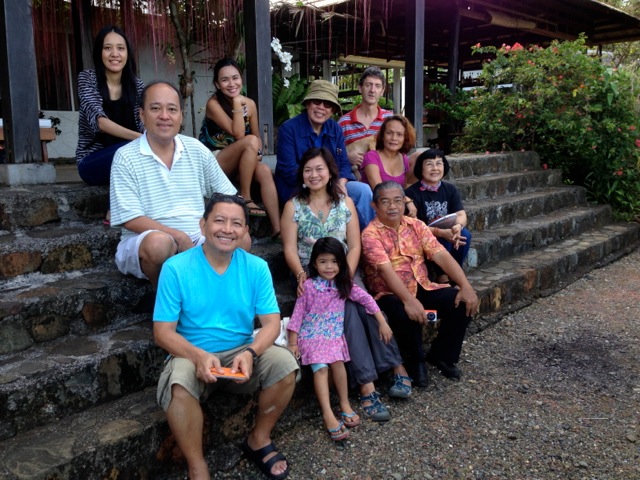
Qwertyman No. 62: Remembering Ed Hagedorn

Qwertyman for Monday, October 9, 2023

LIKE MANY Filipinos, I was surprised to hear last week that former Puerto Princesa mayor and Palawan congressman Edward “Ed” Hagedorn had passed away aged 76. It was a peaceful death, according to reports, which might have raised some eyebrows among those who knew him and his colorful past. Beyond surprised, I felt genuinely sad, because I had met the man and been much impressed by what he had been able to achieve, despite the brickbats thrown his way by his enemies and critics until the very end. (Only last July, the Sandiganbayan found him guilty of malversation of public property for failing to return some firearms issued to him when he was mayor.)

Hagedorn was one of those larger-than-life figures who stick in your memory like a barnacle. I came to know him two decades ago when he needed someone to write a book about Puerto Princesa’s regreening; I was available and happy to fly down to Puerto to see for myself what the buzz was all about, and looked forward to quiet beachside chats over beer and broiled squid. Instead I found myself rattling in the front seat of Hagedorn’s SUV on earthen roads at breakneck speeds, absorbing his stories, which never failed to make me wonder, “Is this guy for real?” But he was—a true politico, to be sure, who ate controversy for breakfast, but also a game-changer who left an indelible imprint on the community he served, just as Dick Gordon did for Subic and Bayani Fernando did for Marikina.

In memory of that man, let me share some unpublished notes I took for that project (which itself was overtaken by events, but that’s another story). Flash back to the early 2000s, and say hello to Ed Hagedorn:

With his well-combed pompadour, mestizo looks, and neat moustache, Hagedorn looks like a cross between actor-turned-President Joseph “Erap” Estrada and rebel-turned-Senator Gregorio “Gringo” Honasan. The resemblance goes beyond the physical, and the key lies in the movement of these men from the fringe to the center, in their mutation from outcast to power player.

For a man once feared as a teenage toughie, gambling lord, logger, and survivor of at least two assassination attempts, the two-term mayor of Puerto Princesa, Palawan, can be surprisingly gentle and charming. He speaks with an easy smile and a quiet, slightly raspy voice, the golden pin of a Christian dove bright on the collar of his gray bush jacket. He knows that the past hangs on his shoulders—something he has the honesty and the good PR sense not to deny—but he speaks much more enthusiastically about Puerto Princesa’s future, and its own transformation from sleepy island town to a global model for ecotourism, as acknowledged by no less than the United Nations.

Hagedorn appreciates the irony of his situation, and attributes his conversion to a religious faith that he now applies with a fanatic’s fervor to his job. Mayor since 1992, Hagedorn drove his former partners in crime out of the city, set down clear and strict environmentalist policies, especially those having to do with illegal logging, illegal fishing, and waste disposal. Today most of the land within Puerto has been reforested; a “Baywatch” program patrols the water; and a cigarette butt on the open street is about as common as hen’s teeth.

The story of Puerto Princesa’s regreening into a world-class showcase of Philippine environmentalism is an inspiring one, but the Hagedorn story is clearly the stuff of action movies. In fact, not one but two movies have already been made about the flamboyant mayor, who reconnoiters the city in his Chevy Suburban, wearing his trademark wraparound Cazal sunglasses and Rolex wristwatch (“It’s fake,” he says with a grin). 

He doesn’t drink, but until a few years ago couldn’t quit smoking, needing the nicotine to keep him going on typical killer workdays that begin at 6:00 a.m. and end at around 1:00 or 2:00 a.m. the next morning. (He kicked the habit in 2002.) “When I came into office in 1992,” he says, “I inherited the grand total of P26,000, plus one tractor and two dump trucks. In three years, we were able to pave 340 kilometers of roads—just 1,000 kilometers more to go!” Appalled by the city’s conditions when he assumed the mayorship, Hagedorn declared a state of calamity to gain access to P20 million in calamity funds; the government balked at his move, but the courts have since upheld the mayor. He talks about setting up International Environmental University on a large estate already blocked off in Puerto for environmental development.

People wait along the road for his SUV and flag him down. He stops to listen to an assortment of complaints; a secretary takes down notes and his instructions. Like a good politician, Hagedorn has a phenomenal memory: hosting several hundred guests at a banquet at a major hotel, he greets all the luminaries present by name, without notes. The next day he takes his guests to a bayside sari-sari store for a snack of cheap sweet biscuits and soft drinks; the tab comes out to P155; he hands the giggling storeowner a P500 bill and tells her to keep the change. “Don’t evict, develop,” he says of a squatter community that had sprung up on the bayshore. He has also set up 160 low-cost housing units on 100-square meter lots, payable at P500 a month for 25 years. Like an automatic wristwatch, the man’s mind is constantly working, kept alive by motion.

In quick succession, the mayor answers the typical interviewer’s questions:

“Is there anyone next to God whom Edward Hagedorn fears?” Answer: “My wife Ellen!”

“Whom did you grow up admiring the most?” Answer: “The Godfather!”

“Any political plans?” A job, he says, that would let him do more for the environment.

When Joseph Estrada was forced out of the Palace in early 2001, his staunch friend Ed Hagedorn stood by him to the end. That probably cost him the governorship in the election that May, when he challenged incumbent Gov. Joel Reyes for the job, running under the fallen Erap’s standard. We’ve heard that many trees have also fallen since in Palawan’s forests—one of them, reputedly the province’s largest, said to have been carted off to become a centerpiece for a politician’s house. 

I remember remarking then that to call Ed Hagedorn a saint would send St. Ignatius of Loyola—himself a colorful character in his time—into a spasm, but Edward Hagedorn is beginning to look like someone we’ll sorely miss when those trees start coming down for some bigshot’s dining table.

Penman No. 70: Digital Detox and Ambrosia in Puerto Princesa

Penman for Monday, October 28, 2013
AFTER MORE than 20 years of being a digital junkie—usually traveling with nothing less than a Macbook Air, an iPhone, an iPad mini, a standby dual-SIM Nokia, sometimes a Nikon DSLR, two digital voice recorders, and a boatload of spare chargers and batteries—I never thought the day (much less the week) would come when I could pretty much do away with the cellular phone and the Internet.

But very recently, it happened—thanks to a writers’ retreat organized by a tirelessly dedicated Fil-Am writer and hosted by two of the most wonderful and interesting people I’ve ever met. (If this normally reserved writer runs out of superlatives this week, it will be for good reason.)

Almira Astudillo-Gilles has two master’s degrees and a PhD in Sociology, and could have been set for life working in business or academia, but she’s chosen the prickly path of creative writing to find another form of fulfillment. Having published a prizewinning book for children and a novel set in the Philippines, among other works, Almi—whom I met last year at the Philippine Studies conference in Michigan—put her mind to establishing a restful retreat for writers in need of a little solitude to recharge and to get some new work done. Marshaling her organizational resources and with the help of some private and institutional sponsors, Almi led our group to the first Adverbum Retreat for Writers at a hillside villa in Palawan.

IMG_4458

In the group, aside from Almi and myself, were writers Edgardo Maranan, Ricardo de Ungria, and Jhoanna Lynn Cruz, and guests Joel Tan-Torres and his daughter Marjette, who had writing projects of their own; my wife Beng, of course, was with us, bringing her drawing and painting kits along.

The hillside villa is about 1 ½ hours by van from downtown Puerto Princesa, way past Iwahig and a little beyond Napsan, on a road that alternates between patches of smooth concrete and gravel the size of pomelos. (Technically speaking, the villa is just out of Puerto, in Sitio Bubusawin, Barangay Apurawan, municipality of Aborlan. You’d have to remember that Puerto Princesa is the country’s largest city in terms of land area, at almost 254,000 hectares, a bit larger than Davao.) If you’re looking for city comforts, go no farther than the new Robinson’s mall downtown.

I’d have to say that, as a certified metrophile and mall rat, I was daunted and distressed by the villa’s promise of a complete “digital detox—guaranteed NO Internet and NO cellular connection”; I hadn’t gone offline for more than a day in years. I’m not on Facebook, but I check out eBay, PhilMUG, and the news a dozen times a day, and with four book projects in the works, I felt like I was about to vanish into the dark side of the moon. I was placated only by the promise that, should the isolation prove intolerable, we could get a cellphone signal by venturing out farther into the boonies or on the water. And probably worse than the digital detox, I’m a self-described culinary philistine who hates cheese and anything vaguely Frenchy and who thrives on canned sardines and instant noodles; the prospect of being fed fresh vegetables spiced up by offerings from the backyard herb garden sent me into a panic, so I stocked up on ramen and chocolates at the grocery before boarding the van to the villa.

As it turned out, and to my own great surprise, my fears and anxieties proved largely groundless. The detox was made easier by the loveliness of the villa itself—a symphony in wood and stone, perched on a hillside overlooking a long trackless curve of beach and ocean (the silken beach alone would make you wonder why you’d need to go to crowded Boracay), under the shadow of cloud-enshrouded mountains. More than the place, we were relaxed by its owners—a Filipino-Belgian couple whose love for one another and for life itself is manifest in the way they keep their villa and feed and treat their guests.

Gielens

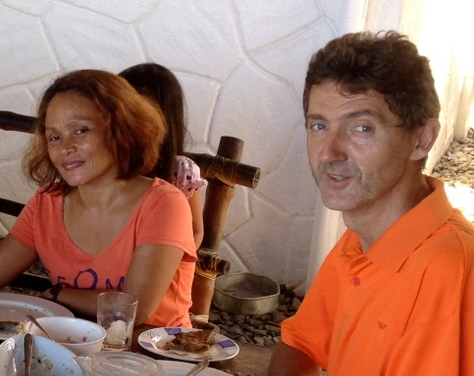
Theresa Juguan is a livewire, a brilliantly imaginative chef who may not have been born with a silver spoon in her mouth but who more than made up for the lack of privilege and opportunity with pluck, inspiration, and a single-minded determination to show the world just how good she could be. Theresa trained as a midwife, but discovered that she had a gift for baking, and was soon delivering fresh loaves and cupcakes instead of babies. The baking led to cooking, which she does with a liberal dash of the herbs she grows in her garden and, she says, “with emotion.”

Unlike most chefs we watch on TV, she doesn’t feel the need to taste what she’s cooking every five minutes or so; she knows in her bones, she says, how the dish will turn out. One guest remarked on the exquisiteness of her pork, which she had served him untasted; she doesn’t eat pork herself and can barely touch it. During our stay, we were served such seemingly simple but delectable creations made with crayfish, octopus, spring rolls, chapatti, and free-range chicken, most of it prepared with as little salt as possible, if any, to let the natural flavors of the ingredients pop.

Theresa also happens to be a talented and impeccably tasteful architect and interior designer, having designed and laid out the villa pretty much by herself. The very first thing that greets visitors to the villa is a striking trellis from which hair-like roots hang like a diaphanous pink curtain.

Her Belgian husband Herwig Gielen—you can call him “Gilles” (pronounced JIL)—was a businessman in the Philippines who one day found himself facing a very irate and demanding client—Theresa—and who was immediately captivated by her gutsiness, very much unlike the sweet, docile, marriageable types that expats like him tended to meet. If Theresa is an earth-goddess type, Gilles is a lanky, amiable god, indeed more shepherd than deity, in the attention he devotes not only to his wife and to the villa but to every small detail that will enhance the guest’s experience, from the virgin coconut oil and citronella concoction he prepares against insects and their bites to the ice for their cocktails and the generator that lights the place up after sundown.

As if the place needed yet another secret charm, you might get to meet Theresa’s five-year-old granddaughter Zanique (Theresa had been widowed before meeting Gilles), whom Beng and I instantly fell for like tipsy dominoes. She doesn’t talk much, preferring the company of her lola and her pet puppy Nitro, but she loves to draw and, not surprisingly, to cook, imbibing Theresa’s mastery of the kitchen.

Surprisingly, after being in operation for a couple of years, the Gielens had never really come around to finding a real name for their place—a visitor called it an “amazing villa” and the name (entirely true) stuck—but they took advantage of the presence of so many writers to cast about for another name, and my suggestion (ahem) was deemed acceptable: henceforth, this corner of Eden will be called Ambrosia, The Amazing Villa, after ambrosia, the food of the gods.

And let me thank Cebu Pacific for sponsoring the flights of the writers on this retreat (some members of the group, including Beng, paid their way through for the presumptive privilege of our company, and we think this can be a model for future workshop-retreats where aspiring or non-professional writers can spend some time and discuss their work with the pros). Since Beng and I are hopelessly footloose but can afford little more than budget fares, we’ve been traipsing all around Asia on one Cebu Pacific promo or other and I’ve been writing regularly about these trips and flights, but the Palawan trip was the first time I actually got a free ticket from CP. When our flight back to Manila was delayed for four hours by maintenance work on NAIA’s radar and runway congestion, Cebu Pac handed out packed lunches to the waiting passengers—nothing on the level of Theresa’s gourmet creations, but welcome nonetheless.

I’ll talk more about the retreat itself and about another place in Puerto well worth visiting—the new Hotel Centro downtown—in a forthcoming column. In the meanwhile, you can check out the Gielens’ place here and here (and you can write Gilles at herwiggielen@yahoo.com for more information—they have a home in downtown Puerto and attend to their email there; do give them some time to respond, as they may be away at the villa).

All I can add is, when my iPhone began chirping back to life on the road back in Iwahig, I felt a deep pang of regret; my message-less and therefore trouble-free week was over. Bon appetit!