Qwertyman No. 102: Retaining the Fools

Qwertyman for Monday, July 15, 2024

A RECENT Rappler report on “The Philippine Senate: From statesmen to showmen” by James Patrick Cruz told us much of what we already knew, but didn’t have the exact numbers for—that political families dominate that institution, that most of them come from the big cities, that most of them are men, that older senators (above 50) outnumber young ones, and that many come from the glitzy world of entertainment and media.

Surprisingly (and why am I even using this word?), most senators are highly educated and even have advanced degrees, mostly in law. However, the study says, “the high educational background of senators has not produced ‘evidence-based policymaking.’…  Some lawmakers, for example, have used the Bible to argue against the reproductive health law in a secular setting and have relied on personal experiences in discussions on divorce.”

And not surprisingly, the academics consulted for the study concluded that “If you want better policy, we should go for better inclusion, better representation, and not just be dominated by political families.” Indeed, from the very beginning, it notes that “Political analysts have observed a decline in the quality of the Philippine Senate over the years. The shift from a chamber filled with statesmen to one dominated by entertainers and political dynasties has become evident.”

And then again we already knew all that. What the Rappler study does is provide a historical overview—quantitatively and qualitatively—of how the Philippine Senate has morphed as an institution over the decades, reflecting changes in the electorate and in Philippine society itself. It opens with resonant passages from the speeches of political leaders from a time when the word “senator” bestowed an aura of respectability and consequence upon its bearer. 

It quotes the luminous Jose W. Diokno: “There is one dream that we all Filipinos share: that our children may have a better life than we have had. To make this country, our country, a nation for our children.” Sen. Jovito R. Salonga, another legendary figure and war hero, follows with “Independence, like freedom, is never granted. It is always asserted and affirmed. Its defense is an everyday endeavor—sometimes in the field of battle, oftentimes in the contest of conflicting wills and ideas. It is a daily struggle that may never end—for as long as we live.”

It’s entirely possible—and why not?—that this kind of elevated prose can be uttered today by a senator or congressman backed up by a capable speechwriter, if not AI. The question is, will they be believed? Will the words ring true coming out of their speaker’s mouth—especially if that speaker were one of today’s, shall we say, non-traditional senators, reared more in showbiz and social media than in Demosthenes? 

“Non-traditional” applies as well to political families, which notion we can expand beyond DNA matches to communities of convenience, of shared geographical, economic, and cultural origins—the entertainers, the media stars, business moguls, the Davao boys, and so on. (There’s probably no better guide to how traditional families have ruled the Philippines than An Anarchy of Families: State and Family in the Philippines, edited by Alfred W. McCoy and published by the University of Wisconsin Press in 2009.)

It might also be that the problem lies not so much or not only in the dynastic nature of Philippine politics, as in the fact that the quality of these families has badly deteriorated. And by “quality” I don’t mean anything by way of economic or social candlepower—none of that “de buena familia” silliness. (To be sure, no family—however celebrated—has ever been perfect, coming with its fair share of black sheep, eccentrics, and outliers. Our social lore abounds with barely whispered stories of the abusive father, the spendthrift mother, the gay son—yes, in Pinoy archetype, gay is wayward—and the mad daughter.) 

I suppose we keep looking for some defining virtue, a reputation founded on academic excellence, intellectual prowess, philanthropy, moral ascendancy, and the like. How many families in the Senate and Congress today can lay claim to that kind of legacy? Today, prominent families achieve and maintain their status through their economic and political clout, through popularity or even notoriety, and even through sheer staying power, thanks to the muscle memory of many Pinoys in the voting booths.

In 1998, in my biography of the accomplished, fascinating, and resolutely revolutionary Lava brothers, I noted that “For anyone familiar with the history of the Philippines over these past one hundred years, it will not tax the truth to suggest that so much of that history has been family history. In many ways, modern Philippine history is an extended family picture album in which a few names and facial features keep recurring, with only the characters’ ages, expressions, poses, and costumes changing from page to page. Most ordinary Filipinos have lived in the shadow and by the sufferance of such dynasties as the Marcoses, the Lopezes, the Aquinos, the Laurels, and the Cojuangcos, among others—families which have ritually sired presidents and kingmakers, tycoons, rakes, sportsmen, and society belles. But none of them were like—and there may never be another Filipino family like—the Lavas.”

For those who never knew them, over the mid-20th century, five Lava brothers—Vicente, Francisco, Horacio, Jose, and Jesus—emerged from a moderately affluent landowning family from the heartland of Bulacan to become progressive intellectuals, some of them even leading the Partido Komunista ng Pilipinas. Ironically, these were no workers or peasants. Vicente, a government pensionado, held a PhD in chemistry from Columbia University; Horacio and Francisco also held advanced degrees in economics and law from Berkeley and Stanford, respectively; Jose was a lawyer-CPA whose University of the Philippines thesis was adjudged the best of his class; Jesus was a medical doctor, also graduating from UP.

Just so we know, the Lavas and their comrades were operating legally and openly right after the War, and were even elected to Congress under the Democratic Alliance in 1946—only to be expelled on trumped-up charges of fraud and terrorism, with their votes on the key parity rights issue discounted. Under threat of extermination, they went underground, followed by two decades of bloody struggle.

That’s what happened to one family with real brains and convictions, even pre-NTF-ELCAC; we expel the thinkers and retain the fools.

(Image from constitutionnet.org)
Qwertyman No. 19: The Real Maria Ressa

Qwertyman for Monday, December 12, 2022

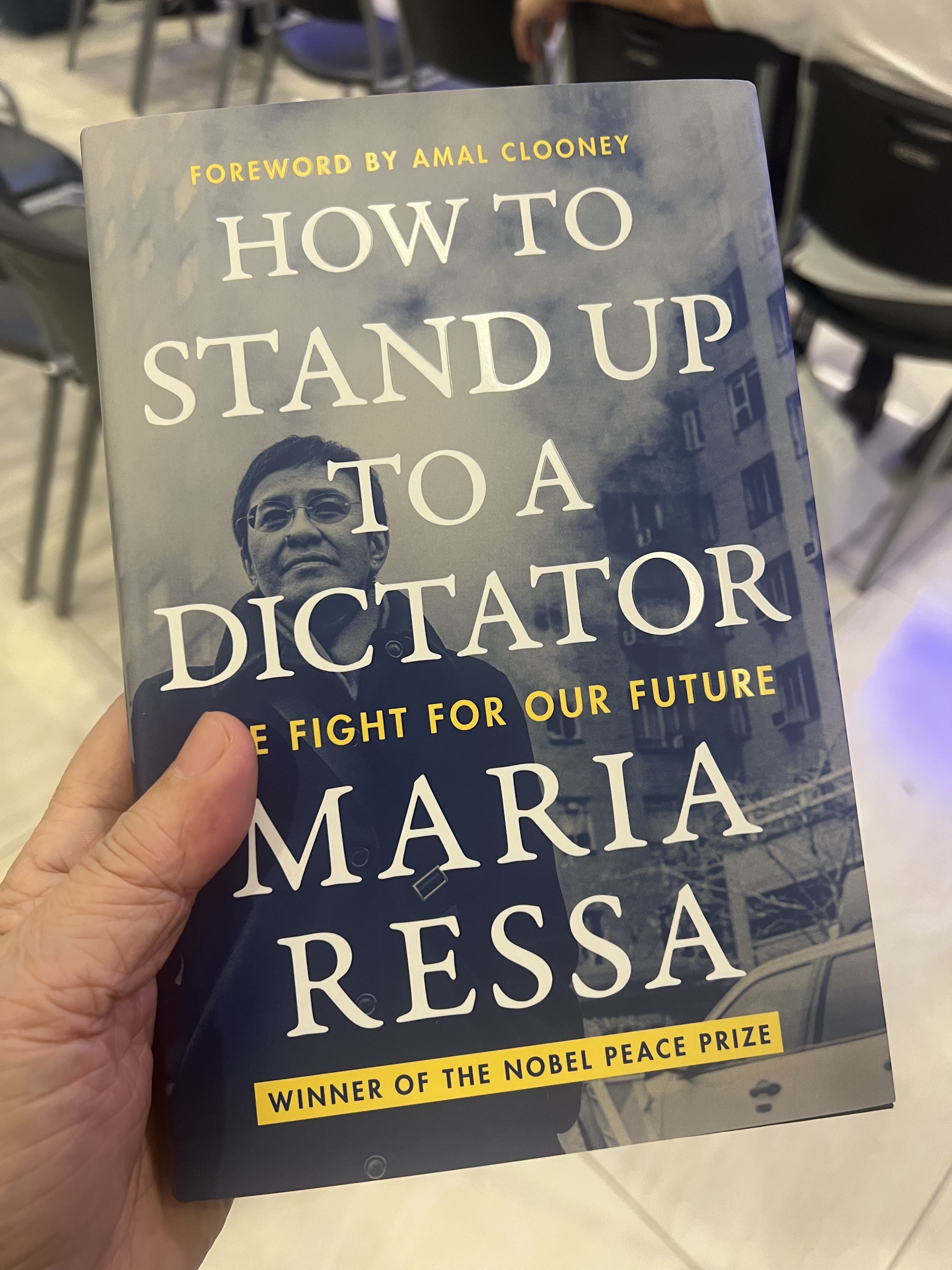
I WAS very honored to speak last Saturday at the launch of Maria Ressa’s new book, How to Stand up to a Dictator: The Fight for Our Future (Harper, 2022). I’d read an advance copy of it a couple of weeks ago, and to cut to the chase, if you’re thinking of buying a book to read for the holidays or to gift to friends, look no further. This book, for me, is among the year’s best in nonfiction.

I have to emphasize that word—nonfiction. As we all know we live in times when fiction has taken over as the most influential form of human discourse, particularly in the political arena. As a practicing fictionist, I should be happy about that, but I’m not and I can’t be, because so much of it is bad fiction, crudely written—and surprisingly, infuriatingly effective, at least with a certain kind of reader. 

Maria’s book cuts through all that. It’s undisguised, old-fashioned, in-your-face truth-telling, told in the same voice and tone we’ve become familiar with over the years of listening to her reportage over CNN. I’m sure that, like me, many of you wondered the first time you heard her: “Who was this little brown-complexioned woman speaking with an American accent?” She looked Filipino, but how come we’d never seen her before?

This was all before she rose to prominence—some would say notoriety—as the moving spirit behind Rappler, and subsequently to global fame as a Nobel Prize winner for Peace. We identified with her travails, shared her anger and sadness at the abuse she has received, and rejoiced in her victories, whether in the courts or in the larger sphere of public opinion. 

But how well do we really know Maria Ressa, and whatever drives her to be who and what she is? This book takes us to the person behind the phenomenon, and answers many questions we may have had about her and her stubborn advocacies.

The book’s title sounds like that of an instruction manual—which it is, and also is not, being part autobiography, part journalism, and part testimonial. As a manual for freedom fighters, it emphasizes the need for collaborative and collective action against seemingly insurmountable forces. Those forces now include the Internet, which, as Maria documents with both precision and profound dismay, has morphed from a medium that once held all kinds of liberative promises into a medium for mass deception and targeted assault. She draws her counsel not from some esoteric guru or academic paradigm, but from some very basic values that have informed her own life—the Honor Code she followed in school, and the Golden Rule.

“That’s what I lay out in this book,” she says, “an exploration into the values and principles not just of journalism and technology but of the collective action we need to take to win this battle for facts. This journey of discovery is intensely personal. That’s why every chapter has a micro and a macro: a personal lesson and the larger picture. You will see the simple ideas I hold on to in order to make what have—over time—become instinctive but thoughtful decisions.”

It’s this constant back-and-forth between the personal and the political—and at some point they become inextricably fused—that forms the fiber of Maria’s narrative and gives it strength. Her convictions are grounded in personal experience; they have not been paid for—as the hacks in the journalistic trade will allege, seeking to bring her down to their own level—except in the coin of personal suffering under the constant threat of imprisonment and violence.

But we learn from this book that trauma is nothing new to Maria. (We also learn that Maria Ressa wasn’t the name she was born into, but to find out her birth name, you’ll have to buy the book.) From her abrupt relocation from Manila to America at the age of ten, to her journalistic immersion in the horrors of conflict and disaster in Indonesia and Ormoc, the book chronicles Maria’s quest for truth, meaning, and purpose in her life, and that of others. She stresses the importance of remembering the past to make sense of the present, quoting TS Eliot’s phrase, “the present moment of the past.”

And so can we, she seems to suggest, even in these times of high anxiety, when we can see the vultures hovering over such once-sacrosanct treasures as our pension funds, while billions more go to feed the dogs of an increasingly untenable counter-insurgent war. The big words we have become used to tossing around—truth, freedom, reason, justice, democracy—they all come down to a personal choice to do the right thing, and the courage to do it. 

Nowhere is this matter of choice more evident than in the fact that Maria is here in the Philippines, having willfully subjected herself to our brand of justice, however imperfect it may be, instead of escaping to the safety of America or another haven, which her dual citizenship if not her celebrity can certainly afford her. She will see her own story through to the end, in the locale where it matters, among the people to whom it matters most.

I’ve often remarked, as a creative writer and professor of literature, that in this country, the writers most in danger of political persecution and retribution are really not fictionists or poets like me. Not since Rizal has a Filipino novelist been shot dead for what he wrote. For sure, we have lost many brilliant writers to the struggle for freedom and democracy—Emman Lacaba, and most recently Lorena Tariman and her husband Ericson Acosta. But they were killed by the State not for what they wrote—the State is illiterate when it comes to metaphor—but for what they allegedly did.

Rather, the most imperiled writers in the Philippines as in many other places are the journalists who speak the language of the people and of their plaints in terms too clear to ignore. They could be radio announcers like Percy Lapid, or the victims of wholesale murder in Maguindanao, or high-profile and exemplary targets such as Maria Ressa. It would have been easy for her to lash back at her critics and tormentors with the same viciousness. But, she says, “I will not become a criminal to fight a criminal. I will not become a monster to fight a monster.”

That, too, is a difficult choice, and one I am sure we are often tempted to cast aside. But Maria’s equanimity in the face of savagery shames us back into our better selves. It will be that kind of quiet resolve that we will need to survive and prevail. After all, we survived martial law. We can survive this regime—with agility, patience, and courage. But don’t take my word for it. Read Maria’s book to know that we can, and why we must.