Qwertyman No. 56: The Rule of Rules

Qwertyman for Monday, August 28, 2023
HAVE A problem? No worries—the Philippine government will make a rule to fix it (maybe). Don’t have a problem? No matter—the Philippine government will make a rule to give you one.

Some days it feels like all that government exists for is to make new rules, because, well, it’s the government, and so it has to look and sound like one. Never mind what the preamble to our Constitution states, imploring the aid of Almighty God to “establish a Government that shall embody our ideals and aspirations, promote the common good, conserve and develop our patrimony, and secure to ourselves and our posterity, the blessings of independence and democracy under the rule of law and a regime of truth, justice, freedom, love, equality, and peace.” Forget the rule of law and all that jazz; all hail the rule of rules.

Two pronouncements by our hallowed poohbahs caught our attention in recent weeks. 

The first was an order from the Vice President and Secretary of Education, DepEd Order No. 21,  directing in its implementing guidelines that all public schools must ensure that “school grounds, classrooms and all their walls and other school facilities are clean and free from unnecessary artwork, decorations, tarpaulins, and posters at all times…. Classroom walls shall remain bare and devoid of posters, decorations, or other posted materials. Classrooms should not be used to stockpile materials and should be clear of other unused items or items for disposal.”

Why? Because these were distractions to learning, explained the good secretary, presumably including in her edict the pictures of past presidents, national heroes, posters of Philippine birds and plants, TV-movie idols, Mama Mary, cellphone and softdrink advertisements, half-naked women, CPP-NPA recruitment posters, the periodic table of elements, weapons of Moroland, and the winking Jesus. 

I actually found myself agreeing with the removal of some of these popular items of wall décor, especially the pictures of politicians, which doubtlessly produce anxiety and despair in those who might contemplate them seriously. The good presidents will make you ask, “Where did all that goodness go?” The bad ones will invite only dismay and even self-loathing: “How did these jokers even make it to Malacañang? So you can still be that kind of person and become President? What on earth were we thinking?” This leads to even more profound and troublesome questions about the nature and practice of democracy, which a poorly trained and underpaid sixth-grade teacher will be hard put to answer, undermining whatever little authority she still exerts over her students. (To her credit, Sec. Sara reportedly removed her own picture from a classroom she visited.)

But Rizal, Bonifacio, Mabini, Tandang Sora, and the usual pantheon of Philippine heroes decking our classroom walls? Will removing their visages encourage students to think more deeply about their Science or Math problems, or will young minds simply drift off to Roblox, Taylor Swift, and Spongebob Squarepants? Will making our classrooms look as bare as prisons (and even prisons have calendars and pinups) lead to a spike in student attentiveness and performance? What does it say of DepEd—with all the academic resources and intelligence funds at its disposal—that directives like this are issued apparently on a whim and without prior and proper study? Where was the attention to science and education that the secretary was aiming for?

The other new rule that sent us screaming to our group chats was the imposition of new guidelines for foreign travel by the Inter-Agency Council Against Trafficking, announced by the Department of Justice, supposedly to curb the incidence of human trafficking, which we all acknowledge t0 be a serious problem. But is this a serious solution?

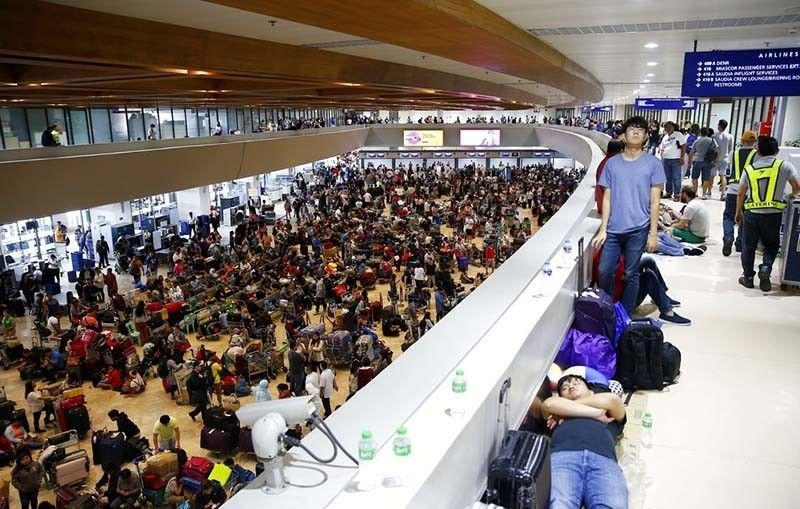
Under the new guidelines, Pinoys going abroad to see the sakura in Tokyo or to watch the New Year’s Eve ball drop in Manhattan won’t get past NAIA immigration without showing their flight and hotel bookings, proof of their financial capacity to afford their trip, and proof of employment. That’s a lot of paperwork to bring along, and if you’ve seen how long the queues can get at NAIA even without these papers in the way, you can imagine what they’re going to be like with each single document having to be scrutinized by an immigration officer. There’s an even longer list of additional requirements for people traveling under sponsorship and for OFWs—including a requirement for a child traveling with his or her parents to present a PSA-issued birth certificate, which was already a requirement for that child to have been issued a passport.

Exactly what this rigmarole adds to the reduction of trafficking is unclear to my muddled mind, because it seems to me that any good trafficker worth his or her illegal fees will be smart enough to produce the fake documents their wards will need to slip through airport security. As experience has shown, it isn’t even fake documentation but corruption and connivance that have greased the wheels of trafficking. 

Which reminds me, I received a letter some time ago from an expat Briton and a longtime Philippine resident named Thomas O’Donnell, complaining about such unnecessary requirements as the filing of annual reports by foreigners in this country. The Philippines has a reciprocity agreement with other countries such as the UK, Thomas says, but the UK doesn’t require Philippine residents there to do the same thing. So was it—like many of our other rules—just something to keep our bureaucrats occupied (or possibly, profitably occupied)? Where was the fun in the Philippines, Thomas lamented, and how was a fellow like him supposed to love it? 

Having lived here for 23 years, Thomas clearly has found other, countervailing reasons for staying on, but he has a point. Despite an anti-red tape law in the books, we still invent ways to complicate the simplest things. And answer me this: if the DepEd chief thinks that bare walls can lead to clearer thinking, shouldn’t we declutter our travel processes as well, so we can all sit in the departure lounge in peace with an hour to spare, waiting for our flight (that will likely be delayed, but that’s another story)?

Penman No. 144: Postscript to the Palancas

Penman for Monday, April 13, 2015

FIRST OF all, let me express my belated thanks to Mrs. Sylvia Palanca Quirino and the Palanca Foundation for responding promptly to our recent appeal for them to reconsider and rescind what many writers thought were rather onerous rules for this year’s Palanca Awards competition. That has happened—we’re basically back to the old rules, which prospective entrants can read on the Palanca website. I do have to remind people to mind the check box on the entry form, where you need to indicate whether you’re giving your express permission for the Foundation to publish your work in full, in case it wins.

We can understand the Foundation’s desire not just to give away monetary prizes for literature as it’s done for over 60 years now, but also to develop a readership for good writing. That’s why it’s important to strike a balance between the authors’ rights to their work and the sponsor’s need to share some of that work with the public for whom it’s presumably being written. As someone who’s come to be associated, and happily so, with the Palanca community, I’m relieved that this little tempest was dealt with expeditiously and reasonably by the Palancas and their lawyers—with the personal and gracious intercession, of course, of Mrs. Quirino.

I should note that both sides came away with the clear understanding that the rules are a work in progress—as are the Palanca awards themselves—as the literary and publishing environment itself continues to evolve in ways no one could have predicted, say, 20 years ago. They will be reviewed and modified as the times require, but meanwhile, it’s back to the old rules (minus the retroactivity provision, which turns out to have been there before with hardly anyone noticing; at least the recent discussion surfaced that). Thanks, too, to other stalwarts in the literary community such as Krip Yuson, Karina Bolasco, and Andrea Pasion-Flores who also worked behind the scenes to help clarify and resolve issues.

On the sidelines, this brouhaha raised some old, perennial questions, mainly from younger writers. For example, I received another message on my blog asking if it’s absolutely important to join the Palancas and win a prize or two to gain literary recognition. My answer has always been, of course not—not absolutely. I’m sure that many accomplished authors never joined the Palancas nor won one of its many prizes; quite a few, both old and young, disdain the idea of joining for their own reasons, chiefly the distastefulness of seeming to curry favor with the literary Establishment.

From a practical standpoint—and I’ve always been a practical man—I have no doubt that a Palanca award or two, or better yet a dozen, can help perk up the CV and gain some attention from editors, publishers, and grant-givers (if that sort of thing is important to you at all, because it may not be and doesn’t have to be, if you’re independent-minded and/or have independent means).

That may sound a bit crass to the idealist, but it’s never really been just about the money—which is appreciable but not all that much in the grand scheme of things. It’s about the inner lift you get from a bit of validation from one’s peers and seniors (and again, if you don’t need or want that validation, feel free to look elsewhere).

And that, too, has practical effects, as the encouraged writer produces more (and, over time, hopefully better) work. Writing is a lonely job; there’s very little popular but credible criticism in this country that deals with contemporary literature, especially of work written by writers 40 and below. With very few readers and critics about, the only quick check you might get on your work could be that prize (ie, from your readership of three judges)—or its absence. It’s a sad thing to note, in a way, but that’s how it is.

Are the Palancas an infallible gauge of literary merit? Of course not. Any juried award involves people, and anything involving people is bound to be subject to human error and bias. You’ll hear ugly stories from some joiners about how they were cheated out of their well-deserved award by narrow-minded judges promoting their own favorites, but absent any direct proof, I’ll have to put this down to the natural quirks of the process. (I do respect the possibility that these plaints aren’t just griping by sore losers, but a reasoned critique of what some see as the ossification of an institution.)

I can’t speak for everyone else, but I’ll just say what it was like for me. When I began joining the Palancas in the mid-1970s, I didn’t know anyone and nobody knew me. I was a college dropout, and hadn’t even gone to a writers’ workshop then. I took my chances, and lost more times than I won. I won a share of second prize the first time I joined, in 1975 when I was 21 (after which I naturally felt like God’s own child), but this was followed by a straight and miserable four-year losing streak.

Whenever I lost, I felt sick to the stomach and couldn’t wait for another year to roll over as quickly as possible. But I didn’t curse the heavens or the judges. After sulking for a week, I went back to my desk—reading writers I could learn from—and wrote more stories and plays (many of them lousy ones for sure, but even bad work strengthens some muscles) and joined and lost and joined again.

At some point, I began winning more often than I lost—yes, that felt good and it got addictive—but when I had won enough, I stopped joining and focused on more important things, like teaching. (Everyone’s free to join and seniorhood shouldn’t prevent anyone from duking it out with the youngsters—hey, we semi-retirees can still write about steamy sex!—but my personal sense is, there’s a time to look for other thrills.)

It comes down to this: one or two or even a whole raft of Palancas won’t make you a writer, or make you as a writer. They’ll give you a helpful leg up and make you feel like a king or a queen for a week—you’ll certainly be the most famous writer in your barangay—but ultimately, the awards will only be as good as you make them, as you parlay them into good, sustained writing and publishing.

Forget those three-person boards of judges and their foibles; worry about the faceless thousands of readers out there you’ll never see, but who will all have something to say about your work (or worse, prove indifferent). At some point, stop worrying about prizes; worry about your next book. That’s what people should best remember you by.

(This year’s competition will close on April 30. Check out www.palancaawards.com.ph for more information.)

[Image from gmanews.tv]