Penman No. 79: Men of Letters (1)

ImagePenman for Monday, December 30, 2013

I’M AN incorrigible pack rat; I keep restaurant receipts and bus tickets from the 1970s, business cards from associates long forgotten or even departed, and notes and memos from various points of my engagement with one bureaucracy or other. These odds and ends molder in a large wooden baul that sits in a corner of my office, a chest Beng and I bought for our daughter’s wedding but which somehow stayed with me (our unica hija Demi will still get that baul, contents and all, on one of her visits home from California). Other old letters I keep in a leather briefcase, itself now an artifact, a souvenir from my first trip to the US in 1980.

I was rummaging through the papers in that chest and that briefcase a few weeks ago, looking for something I could contribute to the benefit auction we were holding for Writers’ Night, when I stumbled on some letters I’d received (and some I sent—I dutifully Xeroxed my outbound mail then) from writer-friends. The most interesting ones were those that opened a window on my friends’ minds as writers and as persons—as young men, really, on the road to emotional, intellectual, and artistic maturity.

One of those friends I exchanged long letters with was the late Bienvenido “Boy” Noriega Jr., very probably our finest playwright, and something of a prodigy who headed the Policy Coordination Staff at the National Economic and Development Authority in his early 20s; Boy went to Harvard in 1978, when he was 26, for his master’s in Public Administration, but cross-enrolled in theater courses at the same time. Another was poet Fidelito Cortes, who beat me out to a Wallace Stegner fellowship at Stanford in the mid-1980s (and who made up for it by greeting me in San Francisco with the gift of a Stanford sweatshirt when it was my turn to come in 1986). I also wrote letters to film director Lino Brocka, who preferred to use the telephone to respond (quite often forgetting, when I was in Milwaukee, that it was 2 am when he was calling from Quezon City).

Boy always hand-wrote his letters in small, fine script; Lito, like myself, used a typewriter; our letters went on for pages and pages, reporting on what we were writing, seeing, and thinking at that time, aware that we were standing on the doorstep of our lives’ great labors.

This week and next, let me share some excerpts from our exchanges, leaving aside more personal references. I’m translating Boy’s from the Filipino original.

Harvard U, 3 Nov 78

Dear Butch,

My drama course is the most exciting of all my subjects. We’re studying all the major dramatists. We’re done with Ibsen, Strindberg, Chekhov, Wilde, Shaw… Wagner, Dumas fils and Buchner, and soon to follow will be Brecht, Pirandello, Beckett, Miller, Williams, O’Neill, etc. The best for me are still Ibsen and Chekhov—Ibsen for characterization and Chekhov for his mastery of dramatic devices such as economy in dialogue, choice of moments, verbal counterpoint, and so on. You know, it’s only now that I’ve discovered how Chekhovian my [three-act play] Bayan-Bayanan is. When I get back home, I can return to it and give it a final revision because I know now how I can still tighten and improve it. One more thing I admire about Chekhov is his lifestyle—shy, pensive, self-assured.

I don’t know if I can still write for the CCP [Literary Contest]—I’m too pressed for time. What about you, are you all set for this, or are you working on your Filmfest entry first? My dilemma in joining contests always seems to be that I worry about how to write my play in a way that the judge who’s in a hurry will grasp. If it isn’t well-made (meaning, it has a very clear plot), it could be hard to appreciate or to draw attention. I guess that if Chekhov joined our contests, he’d lose…. His style is so refined compared to mine. Once, for example, he was asked what the “character” of one of his characters was, and he answered, “He wears a yellow tie,” and everything was in that answer.

19 Jan 79

What are the entries to the Manila Film Festival—are they any good? Have they started the songfest? These would be good to get into—I have a lot of ideas for songs, about country and love and life—but I need to look for a good composer and a good singer….

There must be many more good playwrights such as Sophocles, Shakespeare, Racine and Moliere, but I still don’t know them well enough. I’d like to understand them all—because I’d like to teach drama someday (as a sort of sideline in case I become a full-time writer). It looks like I keep looking to [Rolando] Tinio as a model—whatever is in my field, I’d like to know.

…. The more I learn here, the more I’m aware that there’s so much I don’t know. The truth is, I need philosophy, psychology, and more to put everything together in my head. What I’m doing now is crash education. My letter’s getting awfully long. I’m just trying out the ideas I’ve been picking up. That’s because I don’t have any students yet. I remember when PETA asked us to give a lecture about our plays. I feel like I wasn’t able to say anything. The audience’s orientation was also so different. That will never happen to me again. I will also organize my ideas.

…. This will be all for now, because I’m getting sleepy. It looks like both of us keep writing such long letters. I hope we’re not just repeating ourselves. But it seems to me that we’re progressing.

2 March 79

About some of the points you raised in your letter—you’re right about speechwriting there. The Philippines or the world won’t change because of one speech. I’ve tired of this myself. The problem there is, every presidential speech has to be a speech to impress. It would be easier if it were just a speech to inform. Another problem is that we still lack in achievement and vision, so it’s really hard to impress. If there’s truly a lot to show, there wouldn’t be much need for talk, right?

…. The finitude of everything probably remains debatable. Or maybe I’m just being optimistic—I suspect that man will always discover something to overcome natural forces…. In general, I think I’m still optimistic. Maybe this is because I believe there’s a God who guides our actions. The “meaning” of life probably just doesn’t manifest itself in its consequences (in its practical results) but in the way life is used. Could be in some small things (small acts of charity, love, etc.) that we sometimes fail to notice.

…. There was a point in my brief life (before I turned 21) when I asked myself these things—what was the purpose of life? Why are people the way they are? And so on. Every now and then, I still raise the same questions, but I’m no longer dismayed, like I used to be. I’m no longer surprised, either…. When I come home, I’ll write some essays (I’m preparing my topics)—I’d like to be able to contribute to the field of thought. I have so many plans.

Boy Noriega died of cancer in 1994 at 42; I was away on a writing fellowship in Scotland, working on what would become Penmanship and Other Stories, when I heard about it. I later put his letters to me together and gave copies of them to his family. Next week, some fun with Fidelito.
Penman No. 78: My FQS Project

CEGP Penman for Monday, December 23, 2013

FOR SEVERAL weeks now, some friends from way back—more than 40 years back—have been getting private messages from me, inviting them to take part in what could be an important historical project—important not only to our generation, but more especially to those who have come after us, who know so little about their past.

I’ve just begun what I consider to be my lifelong dream project: The First Quarter Storm: An Oral History. It’s not as if I don’t have enough books to write; at the moment, I’m working on five books in various stages (two nearly done, two halfway through, and this one just started), not to my mention my third novel, which has had to sit on the back burner. I’m no Superman, but I write books for a living, and take on every engagement as a privilege and a responsibility. Still, this one’s a special self-assignment.

After writing biographies and histories for such varied personalities as the Lava brothers, the business icon Washington SyCip, and the former Marcos associate Rudy Cuenca, I felt the time had come for me to do something for my own generation, whose political awakening came about in the late 1960s and early 1970s.

That was one of the most politically charged periods in recent Philippine history, a time many Filipinos my age call the “First Quarter Storm” or FQS, referring to the tumultuous years just before and after the declaration of martial law by President Ferdinand Marcos on September 21, 1972.

Those few months around martial law were both frightening and exhilarating, murderous and ennobling, challenging a generation of young Filipinos to offer themselves up to the altar of revolutionary resistance. The martial law regime would last for 14 years and claim thousands of lives, and cause deep damage to Philippine democratic institutions. By the time a peaceful street revolt restored democracy in 1986, the course of Philippine history and the complexion of that FQS generation had been irreversibly changed.

And yet today, 40 years later, many principals from the martial law regime remain entrenched in power along with pretty much the same ruling elite that prospered under martial law. Despite more democratic space, the same deep-seated problems of poverty and injustice remain. It is as if nothing has been learned—most Filipinos born after 1986 have no inkling of what happened before them—which is not surprising, because a definitive history of martial law and the FQS has yet to be written.

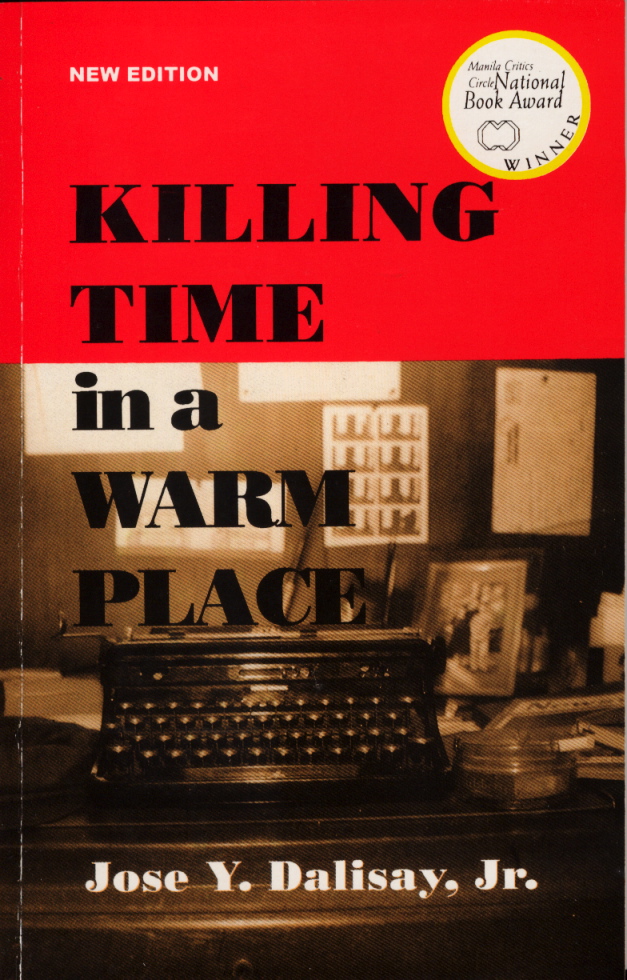
I’d like to help in redressing that amnesia by writing an oral history of the First Quarter Storm, a project that will involve conducting in-depth interviews with many of the surviving principals from that period—from the resistance, the government, the military, the religious, and ordinary citizens—while they are still alive and accessible. My interest in the subject is both personal and professional. As many readers know, I myself was imprisoned for seven months as an 18-year-old student activist in 1973, an experience that became the basis for my first novel, Killing Time in a Warm Place (Anvil Publishing, 1992).

I’ll focus less on the broad sweep of policy than on personal narratives, contextualizing these against particular flash points of the FQS. These personal accounts, I think, will reach deeper into the consciousness of Filipinos today and allow them to grasp the realities and implications of martial law more effectively than an academic paper could.

I’ll be looking for personal stories—including but not limited to or focused on the most harrowing cases of torture and imprisonment (although we’ll certainly have those, unavoidably and necessarily). I’ll be looking for stories of everyday life both aboveground and in the underground; of people preparing for demonstrations and for war, of dealing with separation from family and loved ones, of watching from the sidelines (or even the other side of the barricades), of trying to live an ordinary life amid the chaos, of achieving some kind of balance between the personal and the political. I want stories of courage, of doubt, of heroism, of betrayal, of commitment, of guilt, of loss, of survival. I’ll also be looking for funny, poignant, ironic stories. And then I’ll have an update on everyone interviewed—what they did and what they became after the FQS—for a brief epilogue.

I have no overarching agenda for this book, just an honest recording of people’s memories (as flawed or as self-serving as they may turn out to be), before those participants in and witnesses to history vanish. I don’t mean for this book to be a manifesto or an indictment or any kind of political treatise; I will maintain strict journalistic and scholarly neutrality, endeavoring to gather a multitude and a variety of voices. I will be contextualizing what people say with some factual background, but I will not editorialize or romanticize or make judgmental commentary. Rather than take an obvious stance, I will let the book’s stories speak for themselves, and will leave it to the professional historians and political scientists to use the book as material for their critical evaluations. (In the interest of full disclosure, let me acknowledge a grant from the National Historical Commission of the Philippines, which kindly offered their assistance after hearing about my project, as part of their own project for the documentation of the martial-law period.)

I’ve begun with a small group of people I know, which I expect to enlarge over the next year that I will devote to this project. (So far, they’ve included former SDK and later GMA spokesman Gary Olivar; former UP Vanguard and UPSCAn Ed Maranan; UP activist stalwart Rey Vea; former Makibaka member Sylvia Mesina; Cebu firebrand and now Judge Meinrado Paredes; colegiala-turned-activist Joy Jopson Kintanar; former UP Student Council Chairman and Upsilonian Manny Ortega; and Jesus Christ Superstar and Afterbirth mainstay Boy Camara, among others.) Of course, I’ll remain open to suggestions about whom else to reach out to. I’m particularly interested in stories from the military and the police, as well as from government officials, businessmen and ordinary citizens who may have vivid memories of that period. I’m interviewing people who were active in the Visayas and Mindanao. Sometime next year, on a visit to the US, I will also be interviewing US-based former activists and other principals.

If you think you have an interesting first-person story from that period that you can share with others—whatever your political position was then, or may be now—send me a message at my email at jdalisay@mac.com. (I’m not surprised—I do feel doubly responsible—when some interviewees tell me that “I’m telling you my story so my children will know what really happened and what I did.”) I can’t promise to include everyone’s story in the final manuscript, which will be subject to space and other editorial limitations (I’ll be sending everyone whose story will be included a copy of the text, for their final revisions and approval); but I can promise to be fair, and to render what people tell me as faithfully as possible.

By so doing, I hope that this book can contribute to a deeper understanding of how democracy has been challenged and has survived in the Philippines, and to continuing efforts at national reconciliation, by bringing out the human and more personal aspects of a nation in crisis and a society under stress. This way, it might also provide guideposts for the thinking and behavior of young 21st century Filipinos facing their own choices and challenges as individuals and as citizens. Wish me luck!

Penman No. 77: Writers at Their Best

wn13_1Penman for Monday, December 16, 2013


WRITERS’ NIGHT 2013 went off last Dec. 6 in UP Diliman with nary a hitch, thanks to tremendous support from the Philippine writing community (and, of course, from my staff at the Institute of Creative Writing). It was a night of celebration that began early, with the Filipinas Copyright Licensing Society (FILCOLS) holding its general meeting and handing out historic (and substantial!) first checks to Filipino authors whose works had been used with permission in textbooks.

This was followed by the presentation of the 13th Madrigal-Gonzalez First Book Award, an annual recognition of the best first book by a Filipino author writing in English or Filipino (the award alternates between these two languages, so the award covers publications for the past two years in each language; it was English’s turn this year). This P50,000 prize—established and generously endowed by the Madrigal-Gonzalez family through Atty. Gizela Gonzalez-Montinola—has become another important rite of passage for Filipino writers, and over the years it has gone to such talents as Angelo Lacuesta, Luna Sicat Cleto, F.H. Batacan, Ellen Sicat, Vicente Groyon, Kristian Cordero, Rica Bolipata Santos, Zosimo Quibilan, Adam David, Lualhati Abreu, Lawrence Ypil, and Will P. Ortiz.

The actual awarding is preceded by a lively forum featuring the finalists, who remain unaware of the winner until the end of the ceremony. This year’s board of judges was chaired by prizewinning fictionist Charlson Ong, with poet Mookie Katigbak-Lacuesta and Prof. Shirley O. Lua of De La Salle University as members. It was a banner year for the University of Sto. Tomas Publishing House, whose books accounted for five of the six finalists.

The citations that the judges prepared for the finalists were little gems in themselves, so to give you an idea of what our best new writers have been producing, let me quote from those citations:

Daryll Delgado, After the Body Displaces Water (UST Publishing House, 2012): “In After the Body Displaces Water, Daryll Delgado draws upon both romantic and realistic traditions in fiction, the personal as well as the political, to deliver an outstanding debut collection. Here are tales of the post-EDSA uprising generation who navigate through the murky mire of lost certainties, failed expectations, of promise and compromise. Here, water, cleansing, life-giving yet dangerous, is prime element. Water is memory: malleable, mesmeric. It suggests the comfort of the womb and of early death, but must finally give way to the body, to present and authentic self. These stories offer up no easy answers only uneasy angles, uncanny ways of seeing as ‘through a glass darkly.’”

Marc Gaba, Have (Tupelo Press, 2011): “’Stories are about the dropped stitch,’ writes an American fictionist. The dropped stitch interrupts the pattern and disturbs an existing order. To stretch a metaphor: when this happens, a stitch falls off your needle and unravels for several rows beneath the row you are working on. At some point in your writing career, you are going to drop a stitch.
You will forsake what you know for what you don’t know.
Writers less fearless would try to reach that dropped stitch, slide a crochet hook into its loop, and mend a rent in the pattern.
But Gaba’s poems are about the dropped stitch—the one that makes the reader imagine a pattern because it has gone completely missing. His is the stitch that unravels the whole.”

Anna Maria L. Harper, Agueda:
A Ballad of Stone and Wind (UST Publishing House, 2012): “Rare is the Philippine historical novel, rarer still one with a woman main character. Agueda may be an attempt at national allegory, but its richness of detail make it a quite engaging read. Though treading familiar ground, the book visits nooks and crannies of our past usually ignored by historical texts. We catch glimpses of our forebears—rich and poor—heretofore unseen and gain further insight into who and why we are. Who knows, in time, its heroine may become as familiar to readers as the likes of Maria Clara and Salome?”

Neal Imperial, Silver Fish, Hook of Moon (UST Publishing House, 2012): This collection affirms the power of language in all its majestic simplicity and frugality, as if self-denial is a form of art. The seeming effortlessness of the poems’ cadence complements the stream of images and metaphoric turns which seek to stir the mind of the listener, such verses as ‘We hear the silence / of dead birds / combing the wind / for wings / stuffed / in the belly of a gun,’ ‘To love an older woman / is to bleed / on a bed of salt,’ or ‘You are too-much-food / too late…” This engaging work claws at our heart, like ‘the hook of moon.’”

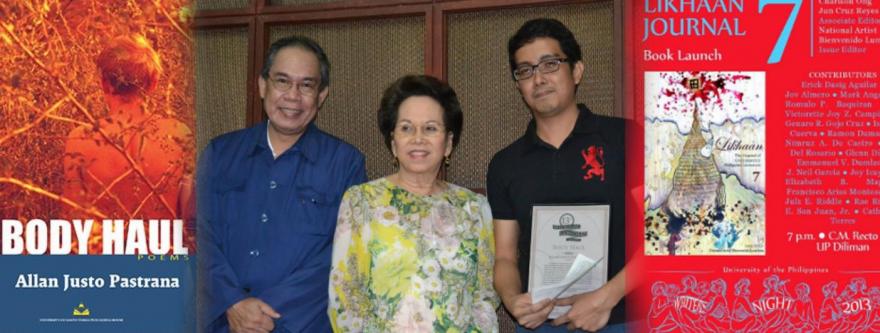
Allan Pastrana, Body Haul (UST Publishing House, 2011): “Called at turns difficult and lyrical, Pastrana’s poetry is deeply personal (and to the casual reader, hard to inhabit). His poems pose a difficult conundrum, for despite their apparent inaccessibility, an internal music moves them. Pastrana must be credited with such precise notation. Each of his themes seem set to an appropriate time signature—nostalgia, desire, childhood, domesticity—each one is given a clipped and particular music. It is music first that draws the reader into the writer’s milieu, uncertain of what he might find there, or if he will find anything at all…. First and last is his music. First and last is music of such virtuosity that Pastrana must be one of our finest poets.”

John Jack Wigley, Falling Into the Manhole: A Memoir (UST Publishing House, 2012): “This selection of essays shows the author’s deep-reflective investigation of his identity, whether as a boy growing up in the City of Angels, as a novice traversing through the muddled metropolis of our sad republic, or as a determined man embarking on a delicate quest in the land of his white forefather, a land deemed an earthly paradise by Spanish conquistadores. The personal narratives are unabashedly candid and sensitive, infused with humor and irony, and peppered with thrilling bits of pop culture. This book is both a delightful and heart-ripping read.”

The winner was Allan Pastrana, of whose work the judges had this further to say: “Like Orpheus’ lyre, Body Haul lures us with its refreshing variations of songs, stories, and tall tales. Like a prophet’s rod, it bestows spirit to birds, forces the word ‘trap’ to speak in three different languages, and illumines a path out of Eden to a re-worlding of stars and love. Pastrana’s kingdom is nonetheless that of a sophisticated intellectual, whose appreciation for music, literature, and the visual arts obtrusively yet gracefully seeps through the many fine verses in the collection.”

The evening’s highlight was an auction of writers’ memorabilia that we held for disaster relief, particularly for writers hard-hit by supertyphoon Yolanda. Beyond their craft, here were writers at their best, donating choice items and dipping liberally into their pockets to help out their fellows.

The money we raised came chiefly from a 1940s Parker Vacumatic fountain pen donated by yours truly (won by Jimmy Abad for P18,000 in spirited bidding over film director Auraeus Solito); a Smith Corona Portable Classic 12 donated by Paolo Manalo (won by a member of the Inkantada Band for P5,500); two manuscripts of works by Gregorio Brillantes and myself (won by Andrea Pasion-Flores for P4,200); and assorted manuscripts, author’s proofs (including that of Soledad’s Sister), and other memorabilia donated by Jimmy Abad and myself (won by rocker-news anchor-novelist-etc. Lourd de Veyra for P6,000). Poet Alan Popa went home with a drawing by fictionist Merlinda Bobis, donated by Chari Lucero, for P2,200. We’d also like to thank our other donors, buyers, and supporters—among them, National Artists Bien Lumbera and Rio Alma, poet Cirilo Bautista, and other writer-friends like Efren Abueg, Amelia Lapeña Bonifacio, Alma Miclat, Richard Gappi, Carlo Clemente, Dolores Mose, Francis Quina, Khavn de la Cruz, the NBDB, and the Chancellor’s Office of UP Diliman—for their generosity. We were all winners! See you all again in Writers Night 2014.


Penman No. 76: A Lesson in Description

Penman for Monday, December 9, 2013


NOW AND then I walk my students in Creative Writing through a lesson in description, which—as I’ve often noted in this corner—is at best always more than a rendition of the physical setting and the people and things in it. In the hands of a skilled or a gifted writer, a plain object can acquire a strange and memorable luminosity. Sometimes all it takes is the uncommon but logical and precise choice of a word, such as when William Faulkner describes a campfire as being “shrewd,” struggling and managing to keep alive despite the wind. At other times good description requires the writer to step back and to set things in a larger context, balancing fine detail with the broader sweep of memory and understanding.

I don’t even need to draw on the likes of Faulkner or Greg Brillantes or Kerima Polotan to demonstrate what I mean. Take this passage from a story submitted to my fiction class a couple of semesters ago by a young student named Katrina del Rosario, part of a story titled “Paying Respects.” Rather quiet in class, she more than made up for her reticence with this outpouring of brilliant prose:

The first Dayaos had been very successful farmers, and the land burst with green and trees and stalks and vines heavy with bright fruit; now only one or two Dayaos farmed the land, with the most magnificent of trees cut down to build houses. The elders remembered entire lives lived underneath the shadows of trees and grown roofs of vine, childhoods spent working the fields. They did not remember it as work. They remembered instead the bits of sugarcane that could no longer fit into carts and the sap sticky on their chins as they tore off strips of the bark with their teeth; getting lost in entire walls of tall grass that needed to be cut down; the cool of the mud and manure against their knees in the middle of a field exposed to all the ghastly splendor of a high sun; as small children, play was pretending to chop wood for the hearth and desiring to be old enough to pound the rice, watching in awe as their mothers tossed the grains into the air like a high wave and catching it again, cooking kangkong in hot water in their small toy pots made of clay. Everything they needed could be found on trees, in the fields. They had been perfectly comfortable. They were never hungry. Home was where the land began, and ended; living was the certainty of land and its fruit.

What’s even more interesting about this example is how little use it makes of adjectives and adverbs—the crutches that beginning writers often employ to carry the burden of description (“he snarled angrily,” “the bright, sunny morning,” etc.). “Write with nouns and verbs!” I keep reminding my students.

There are many ways of describing the same scene, but one approach I offer student writers is the option of gauging one’s emotional and psychological distance from the subject, and rendering the scene accordingly.

Depending on your purpose, you can choose to describe a person, thing, or place in one of several alternative modes. Your purpose, of course, will depend in turn on the kind of fiction or scene you are working on. I made up the following examples (so you’ll forgive me if they sound cheesy) to illustrate these alternatives.

What I call the technical/objective mode is strictly that, a seemingly factual, no-frills rendition of the scene, as a police report might put it:

The apparition was reported by a male witness, 45 years old, a farmer and a native of the town of Libmanan, Camarines Sur where previous sightings were said to have occurred. The man, Angelo Camagay, described what he saw as a woman in her early thirties, about 5 ft. 4 in. tall, and with distinctly Caucasian features: light brown hair, blue eyes, and fair complexion. She was clothed in a full body-length white robe of soft material; Camagay could not remember seeing footgear of any kind. She appeared before him at about 5:45 am on the opposite bank of a stream where he had paused to draw water in his bamboo container, prior to working in the fields.

Somewhat warmer and more detailed is the neutral/realistic mode. It’s still a fairly straightforward description without much emotional coloring, but we see things more vividly:

Augusto dipped the thick, three-foot length of bamboo trunk into the water; it had been severed at the nodes, with a hole cut into the top and a wooden handle attached to one side. Now the cool, clear water gurgled into the hole as Augusto held the container down, feeling the stream swirl around his wrists and the bamboo struggle to keep afloat. Later, in the heat of noon, the same water would slake his thirst and wash the paddy mud off his hands. Augusto looked up; it might have been a bird bursting out of the trees that caught his eye; but it was a woman on the opposite bank, blinding in her pure white robe. She, too, was white of skin; her hair was a light brown, and she stood closely enough for him to see that her eyes were blue. He could not see her feet, which were lost in the lush grass. She seemed younger but somewhat taller than his wife. Augusto knew that in all of his forty-five years in Libmanan, he had never seen anyone like her; but some of his townmates had, and now he believed them.

And finally—though perhaps with the greatest degree of difficulty—one can go into the lyrical/romantic mode, which involves a certain degree of abstraction and sublimation, and certainly a more pronounced attitude, not to mention some linguistic dexterity:

Rough the palms that trapped the water, brown the arms that fought its surge. Come into my bamboo cup of cups and fill me in my driest need, my limpid blood of morning. Come. And Augusto looked up for an instant, thinking that a great white bird had exploded in the trees, flushed out by his presence. But no bird there, no stark familiar creature of his town’s well-traveled woods. Maria, Ave Maria, oh fair oh pure oh thou footless light disconsolate. Eye of sky, hair of corn, I come to you. And bathed in her sudden radiance, Augusto thirsted as he had never had, but as others had, and now he saw, and now he knew.

Whichever mode the writer employs, he or she should remember that the best description always does more than physically describe: it prepares and conditions us for what is about to follow, and, working with the narrative, provides a context against which we can understand characters and their situations better.


LAST WEEK’S piece on the forgotten master Constancio Bernardo—whose 100-year retrospective dazzled us when we attended its opening last Wednesday—prompted the following recollection from the Davao-based poet Ricky de Ungria, who also paints and draws occasionally:

“My first teacher in the arts was Ms. Katy Bengzon of DLSU. I took a summer class there in Taft when I was still in high school and copped a prize for a watercolor of mine. My second teacher was Constancio Bernardo. My father enrolled me in a summer class of his at the old CMLI gardens somewhere in Quezon City. He taught me how to do landscapes in watercolor. In fact in one of my old sketchpads he showed me how to do shadows of leaves on trees. Very calm, soft-spoken and gentle man, as I remember now. All this to tell you how much I appreciate your piece on him today because I knew so little of him.”

Flotsam & Jetsam No. 34: Pens Noir

I DIDN’T realize how much more interesting my favorite pens could look until one afternoon this week when—during a long and rather boring meeting at the office—I played around with the two pens in my pocket and with my iPhone, and then applied the “noir” filter in my Camera app. Then I went home and took a few more shots of my other pens. Voila—a whole new way of looking at fine pens.

Penman No. 75: A Writers’ Auction, and Shakespeare in Asia

DalisayBrillantesPenman for Monday, December 2, 2013

THIS IS going to be a very busy and exciting week on the literary front at the University of the Philippines in Diliman. First off, the UP Institute of Creative Writing will be hosting Writers’ Night on Friday, December 6, sustaining what’s become a longstanding annual tradition. Meanwhile, on Thursday and Friday, the Department of English and Comparative Literature will also be hosting its first international conference on “Shakespeare in Asia,” bringing together leading Shakespeare scholars from around the region and the US to affirm the Bard’s continuing relevance to global literature and society.

(It should also be mentioned that Philippine PEN will be holding its annual Congress December 3-4 at the Henry Sy Sr. Hall of De La Salle University, with the theme of “Literature of Concord and Solidarity: The Writer as Peacemaker,” and that FILCOLS—the Filipinas Copyright Licensing Society, Inc., which manages copyright payments for Filipino authors—will be holding its annual general meeting at the Claro M. Recto Hall in UP Diliman at 4 pm, December 6, just before Writers’ Night proper.)

Writers’ Night will consist of three segments, after the FILCOLS meeting: the awarding of the annual Madrigal-Gonzalez Best First Book Award, which this year will go to a Filipino author writing in English, and the launch of the 7th annual edition of Likhaan: the Journal of Contemporary Philippine Literature, which the UPICW publishes. Capping the evening will be a live auction of writers’ memorabilia, featuring donations by writers—including three National Artists—for the benefit of other writers left in dire need by recent disasters in the Visayas. We’ve received word that while no one we knew died in the wake of supertyphoon Yolanda, some writer-friends were badly savaged by the storm; while lives are of course the first priority, the loss to a writer of his or her home, and books and manuscripts among one’s few belongings, can also be deeply traumatic. We hope to be able to address some of these needs through the auction.

Writers’ Night actually debuted with an auction in 1996—I can’t believe it was 17 years ago!—and it was a blast. I came away with several handwritten manuscripts donated by Greg Brillantes and Cirilo Bautista, as well as a novel (Villa Magdalena) signed by Bienvenido Santos. Gina Apostol went home with NVM Gonzalez’s chair.

This year, to spice things up, we’ve solicited donations from National Artists Virgilio Almario (a signed copy of his very first book), Bien Lumbera (two CDs of his songs, also signed), and Frankie Sionil Jose (yet to be confirmed, but hopefully a book or manuscript). Poet Jimmy Abad has very graciously given an important group of his manuscripts, including the handwritten draft of the early poem “Fugitive Emphasis,” and more than a dozen copies of various issues the trailblazing and now rare Caracoa poetry journal from the 1980s. Alma Miclat is donating a copy of the hardbound edition of her late daughter Maningning’s book Voice from the Underworld, signed with her Chinese chop.

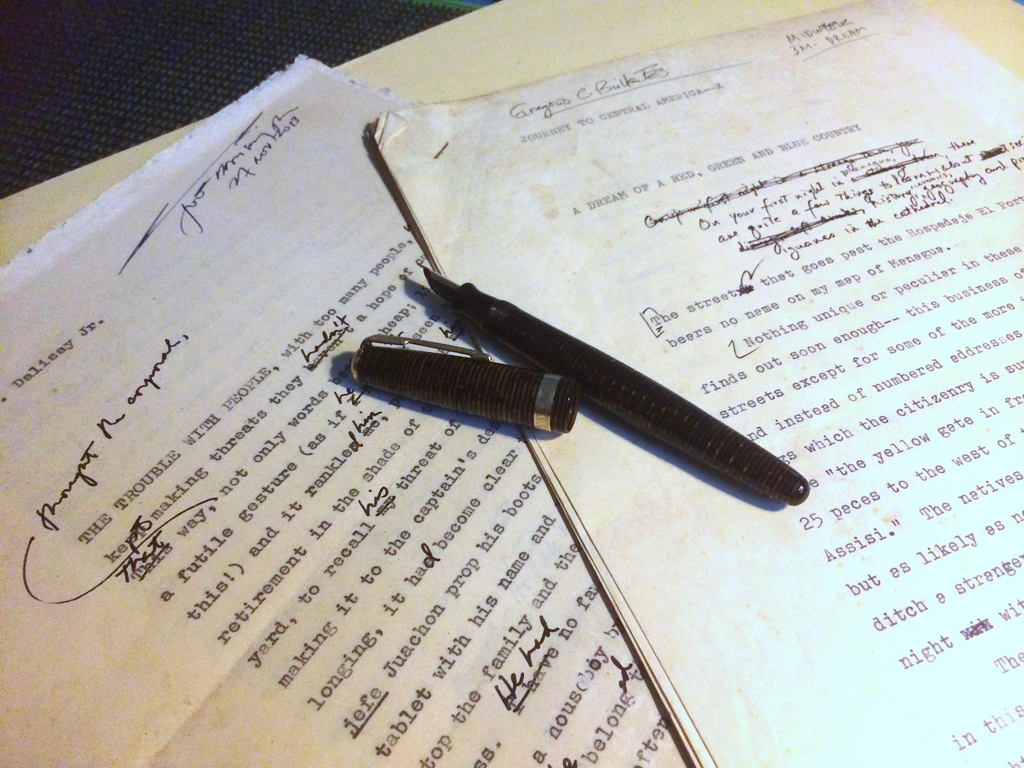
And to acknowledge how kind the Fates have been to me this year as they have been harsh to others, I will be donating a fully-functional, like-new Parker Vacumatic fountain pen from the early 1940s, in golden-pearl finish with a smooth, fine 14K nib, a pen I’ve actually written with and written about in my story “Penmanship”; although it’s about 70 years old, the pen is ready to write, and will carry a lifetime personal service warranty from me (if it ever breaks down, I’ll fix it for free). I will also be donating the signed original 11-page typescript of my 1986 short story “The Body,” with my edits on it, and re-donating one of the three Brillantes manuscripts I got in 1996, the signed, edited 6-page typescript of the essay “A Dream of a Red, Green, and Blue Country,” chronicling a visit to Nicaragua. (I’m sure Greg won’t mind; he’s one of the most generous people I’ve known, and I wish he could join us on Friday; come to think of it, if he hadn’t donated these papers to us in 1996, they might’ve joined the soggy mess that Ondoy made of his formidable library.)

Between now and Friday, we’ll expect more donations from writers (who can also donate books for the benefit book sale—it’s been a Writers Night custom to bring and toss a book into a box as a kind of admission fee). Bring your donations over to us at the UPICW in Diliman, or contact our admin officer Ronnie Amuyot at 0922-811-4449 if you need yours to be picked up. We’ll try to be as liberal with the live auction as we can—we’ll take cash, checks, and promissory notes, and you can even leave your bids with or text them to Ronnie before the auction if you’re away. We’ll display some of the choicest items at the Faculty Center before Writers Night itself.

Writers’ Night is free and open to all Filipino writers, writing and literature students, and their friends. Do come and join us at CM Recto Hall, UP Diliman, from 6 pm up this Friday; there’ll be food and drinks, and a lot of goodwill to go around.

JUDY CELINE Ick was an 18-year-old sophomore sporting a punk hairdo when we first met in Prof. Sylvia Ventura’s Shakespeare class in the early 1980s (a returning student, I was a decade older), and sharp as she was, you wouldn’t have known then that she would go on to become UP’s and one of Asia’s top experts on Shakespeare, completing a doctoral dissertation on him at the University of Massachusetts-Amherst on a Fulbright grant. I was finishing my own PhD in Wisconsin when she came over, and Judy and I would trade notes, sharing a passion for English Renaissance drama (the over-the-top theatrics of which would put your typical Viva/Regal movie to shame); but while I was just enjoying the verbiage and the swordplay, Judy’s focus on Shakespeare was deep and intense.

That focus has logically led to Dr. Ick convening the first international conference sponsored by the UP Department of English and Comparative Literature on  “Shakespeare in Asia” this Thursday and Friday, Dec. 5-6, also at the Faculty Center.

Like the old days, Judy wrote me a long note to root for her guy: “I’d really like to see our fellow academics and literary aficionados get a taste of what is a burgeoning field on the global Shakespeare scene. Asian Shakespeare is hot!—the subject of many critical collections, journal special editions, conference panels, and now even a tenure-track specialization in some of the more prestigious universities in the world.

“And why not? Around Asia Shakespeare has been produced and reproduced in the most exciting ways. Many regional theater companies continuously stage highly-imaginative versions of Shakespeare in local theater forms like Beijing Opera, Noh, Kathakali, Kabuki, wayang kulit, etc. The Japanese have elevated the Shakespearean anime and manga into an art form. (But then, of course, they also have Shakespearean manga porn (!)—itself a distinct métier.) Bollywood has produced critically acclaimed versions of Macbeth and Othello among other Shakespearean films. Even that award-winning Chinese martial arts film, The Banquet (starring your favorite Zhang Ziyi) is an adaptation of Hamlet. [Penman’s note—I’m more of a Michelle Yeoh fellow.]

“Sadly, many Filipinos are unaware of just how exciting Asian Shakespeare is. Our ability to read Shakespeare in the original, unlike many of our Asian neighbors, has proven both a blessing and a curse. While we are able to revel in the joys of the Bard’s very words, our imagination of his work has been very limited by that Englishness. Exposure to the vibrant work of our neighbors in Asia can change all that.

“A few months back, I had the surreal privilege of spending a day in Taipei with Stephen Greenblatt. We were the only two foreign guests at the inauguration of the Taiwan Shakespeare Association. He was there because, well, he was Stephen Greenblatt—eminent Shakespeare scholar, general editor of the Norton anthologies, longtime chairperson of Harvard’s English department, and author of some of the most influential literary criticism of the twentieth century. At some point, we got to talking about Asian Shakespeare and I was very inspired by what he had to say. ‘The Anglo-American hegemony,’ he asserted, ‘has just about played itself out and Asia is really where everything is now turning. Even Shakespeare.’

“I don’t think you’ll hear a clearer voice for the ‘Anglo-American hegemony’ in our profession than Stephen Greenblatt yet even he recognizes the coming primacy of Asian Shakespeare. I don’t think we Filipinos should get left behind because we have much to contribute. The conference is an important first step as it offers a far-reaching introduction to the field. We’ll have the top Shakespeareans from Taiwan, Japan, Korea, the US and India talking about how they play out ‘Asian Shakespeare.’ We’ll also feature films and filmed performances from India, Japan and China. Of course, Filipino artists who have boldly adapted Shakespeare will join in dialogue. The whole affair is capped off with an exciting new theater piece called ‘Have Thy Will,’ a staging of the sonnets devised and directed by Ron Capinding featuring some stellar performers—Ricky Abad, Frances Makil-Ignacio, Dolly De Leon, and Teroy Guzman. More info is available at the conference website: http://conference.up.edu.ph/shakespeareinasia2013/.”

Thanks, Judy—and this, Yolanda, is our response to you: a mightier torrent of words, a stronger companionship among writers. To quote one of my favorite Shakespeare sonnets (55), “Not marble, nor the gilded monuments / Of princes, shall outlive this powerful rhyme.”

Penman No. 74: Constancio Bernardo, the Forgotten Master

AT MACULANGAN PhotographyPenman for Monday, November 25, 2013

THE STORY goes that when the noted abstractionist Josef Albers met Constancio Bernardo at Yale, where the young Filipino had gone to study on a Fulbright grant, he hailed the Filipino “not as a student, but as a peer.” Albers went on to predict that Bernardo—who completed both a second bachelor’s and an MFA degree at Yale—would become a resounding success upon his return to the Philippines in the early 1950s, given his abounding talent.

Indeed, Bernardo had left for the US with high hopes and with his mentor Fernando Amorsolo’s blessings; Amorsolo had reportedly singled out Bernardo as the student most likely to surpass him, especially since Constancio was then working in the same traditional figurative style of which Amorsolo was the acknowledged master.

Sadly and surprisingly, Albers’ rosy prediction would fail to materialize. Bernardo did come home after his Fulbright, but instead of being welcomed warmly by Amorsolo et al, Bernardo—now an accomplished and committed abstractionist—was shunned. He would continue to serve UP, teaching in the School (and later College) of Fine Arts as a teacher and administrator, and his body of work would continue to, establishing him firmly—in the words of art critic Leonidas Benesa—as “second to none in this country” in the field of abstraction, “particularly of the geometric-planar, optical-painting variety.”

For all that, Bernardo would never achieve the celebrity and commercial success enjoyed by his peers like H. R. Ocampo, Vicente Manansala, Carlos “Botong” Francisco, who—despite whatever vicissitudes they may have encountered in their own careers and lives—went on to be named National Artists. As trailblazing and as influential as Bernardo’s work was, he would be cited (again by Benesa, in 1978) as “the most underrated of the exponents of modern art in the Philippines.”

When he died ten years ago, in 2003, Constancio Bernardo was, effectively, a forgotten master, a luminary of Philippine painting whose star burned fiercely but in a dark and distant corner of the galaxy. (As it happened, I was UP’s Vice President for Public Affairs at the time, and attended Bernardo’s wake in my official capacity. Despite my own abiding interest in the visual arts, it was my first albeit belated encounter with Bernardo and his work, leading eventually to an invitation from the family for me to sit on the board of the Constancio Ma. A. Bernardo Foundation, which I accepted.)

It’s high time, then, that Filipinos rediscover and appreciate this lost master in their midst, a need that will be addressed starting this Wednesday the 27th, when a comprehensive retrospective exhibition of Constancio Bernardo’s work opens at the Ayala Museum in Makati. Including about a hundred representative works, the retrospective also coincides with the centenary of Bernardo’s birth, and will be on view until February 28th next year.

According to the exhibition notes penned by the art critic Carina Evangelista, “the exhibition provides the first opportunity to view the full range of Bernardo’s œuvre from a career span of more than sixty years and highlights his canvases of abstraction, lauded by a number of critics from the 1950s onward as among the most important examples of Philippine modernist painting but increasingly overlooked as the decades passed. While included in a number of group exhibitions and the subject of 22 solo exhibitions including retrospectives at U.P. Baguio in 1969, at the Museum of Philippine Art in 1978, and at the Cultural Center of the Philippines in 1990, Bernardo remains to be on the margins of the annals of Philippine art history. Dedicated to his lifelong art practice and his teaching career at the University of the Philippines, Bernardo staunchly resisted the limelight, eschewing the social scene of the art world and opting to work tirelessly in his studio.

“Within abstraction, his paintings ranged from geometric abstraction to Op art and abstract expressionism—each series structured with a formal mastery and infused with a depth of feeling singularly his. Obdurate in his self-effacing silence in his lifetime, his body of work preserved by the Museo Bernardo Foundation Inc., and CMa Bernardo Foundation for Fine Arts, proves to be the clearest evidence of enduring artistic expression.”

AT MACULANGAN Photography

To writer Francine Medina, “Constancio Ma. Bernardo has an indispensable place in Philippine art history. A prolific artist, he painted every day till his last breath, producing an impressive range of works from self-portraits that chronicled his quiet yet intense life; uncannily realistic still life paintings and nudes; to his highly praised fields of color in his ‘Perpetual Motion’ series. It was just that art was a necessary almost organic function that he needed to accomplish everyday.

“There was a palpable sense of completeness in the way he approached his works, a proof of his great involvement in each piece. He mixed his own paints, diligently worked in his studio, and made his handiwork complete by creating the frames for his art works.

“His quest for the ultimate painting was such that when he felt a work was not at par with his self-subscribed standards, he would paint over it or, as his closest peers would attest, throw it away, never to be seen or worked on again.”

It’s too bad that I never got to know the man when he was alive. I’ve made friends of many artists, and while they generally and understandably aren’t as voluble or as articulate as my writer-friends, many have led very interesting lives that deserve to be known and written about, quite apart from their creations. My wife Beng was a Fine Arts student at UP when Bernardo taught there, but being a Visual Communication major, she never got to study with him, unlike her contemporary, the former Fine Arts dean and modernist Nestor Vinluan, whose paintings clearly show Bernardo’s influence. She remembers him, however, as a quiet and kindly man, with a rather formal demeanor, someone who spoke only when he had to and who chose his words well.

In this restrospective exhibit, Constancio Bernardo’s works will speak for themselves, and hopefully lift him and his legacy out of the obscurity they don’t deserve.

(Let me acknowledge and thank Constancio’s son, the retired anthropologist Angelo Bernardo, for providing additional source material on the painter.)

Penman No. 73: A New Home in Erehwon

IMG_2568Penman for Monday, November 18, 2013

I HAD a good chat with Metro Manila Concert Orchestra founding music director Josefino “Chino” Toledo recently at the inauguration of the MMCO’s new rehearsal space at the Erehwon Center for the Arts in Quezon City. Also a gifted composer and conductor, Chino is a fellow professor of mine at the University of the Philippines, and a batchmate under UP’s Arts Productivity System. We’ve run into each other during UPAPS ceremonies, but never really got to talk until the Erehwon event.

But let me digress a bit and say something about Erehwon itself first. Founded a couple of years ago by businessman Rafael Rivera Benitez, Erehwon is actually a big white building nestled in a corner of Old Balara in Quezon City (you can find the map and more details on www.erehwonartworld.com) that Raffy converted and devoted to serving as Metro Manila’s newest arts mecca—a studio cum gallery cum performance space cum residency and meeting venue.

Raffy himself is an old friend and compadre of mine, someone I spent one of life’s most privileged experiences with—prison time and space in Fort Bonifacio under martial law, when both of us were in our late teens. He made his mark in the baking and printing businesses, but late in life (he very recently turned 60), Raffy decided to pursue another passion—patronage of the arts, giving rise to Erehwon. (People our age will remember the late, lamented Erehwon Bookshop in Ermita—which was right next to my old NEDA office on Padre Faura, providing me with a perennial excuse for an extended lunch break. That Erehwon, however, has nothing to do with the new one.)

And now, thanks to Raffy Benitez and Erehwon, the Metro Manila Concert Orchestra will have a new home through a venue grant offered by Erehwon to the MMCO, which until lately was lodged with Miriam College, where Chino Toledo also held certain responsibilities. Its arrangement with Miriam having ended, the MMCO needed a white knight to come to its rescue, and that turned out to be Erehwon, which has also been seeking partners to work with in arts promotion.

Erehwon couldn’t have found a better partner than the MMCO, which was established in June 2000 and has since become one of the country’s leading semiprofessional orchestras. I asked Chino what set the MMCO apart from the others, and he told me that they were especially receptive to new and young Filipino composers and musicians. I noticed, during the inauguration, that the orchestra’s musicians were predominantly young, most of them clearly in their 20s and 30s. That’s exactly the kind of push our young musical talents need, particularly as orchestral music, like theater, involves the effort of a community working as one, and an individual really succeeds only insofar as he or she can find membership and nurturance within that community.

The MMCO now counts about 50 musicians in its ranks, coming from various schools in the metropolis. (“The number of people in an orchestra will vary depending on the piece,” Chino told me, “but at full complement, an orchestra like the New York Philharmonic could have as many as a hundred members.”) They hold an average of one concert a month, and practice at least twice a week. The conductor, Chino explained, functions as the team coach, and the concert master acts as the captain ball, leading the execution of the coach’s plan.

Funding is always a problem, Chino added; as a semi-professional orchestra, the MMCO does its best to pay its members what they deserve, but as with most other artistic endeavors, it’s love of music that really drives the group and Chino himself forward, and sustains the commitment of a faithful corps of supporters that include Executive Director Chinggay Lagdameo and MMCO Foundation President Corazon Alma de Leon.

Here’s hoping that the MMCO’s move to Erehwon will result in a new season of growth and prosperity for the orchestra and for Philippine music as a whole.

SPEAKING OF cultural initiatives, last week marked the staging of the fourth Philippine International Literary Festival (formerly known as the Manila International Literary Festival), spearheaded by the National Book Development Board in cooperation with four universities in Manila—the University of the Philippines, Ateneo de Manila University, the University of Sto. Tomas, and De La Salle University—and the Ayala Museum. The urban setting was deliberate, because this year’s festival theme was “Text and the City,” focused on how centrally the city figures in Philippine and regional literature.

I joined a panel at UST with colleagues Jing Hidalgo and Charlson Ong in a discussion of how the city informs our writing. In broad terms, I noted that the city, not surprisingly, has figured in a major way in Philippine fiction, particularly in English, because most of the fiction published in the Philippines has been written by city-based middle-class writers. It has often been presented as the site of violence, poverty, and corruption, in contrast to the romantic conception of the countryside as a place of peace, plenitude, and spiritual regeneration. In more politically aware writings, however, that line has become blurred, as the feudal roots of urban wealth and power become more clearly exposed.

Our focus on the familiar city, however, comes at a great price—the near-absence of new writing that deals with the Philippine countryside in anything but a romantic mode. (By “romantic” here I mean I mean not only the highly idealized representations of rural maidens by the likes of Fernando Amorsolo, but also my politicized generation’s expectation of ascending into the mountains—joining the armed struggle—as a kind of revolutionary apotheosis.) As it happened, I was in Baler, Aurora that weekend, and rushed back to Manila at dawn to make it in time for the UST event. On the six-hour ride, over mountain roads with a view of the great ocean, I remarked how conspicuously absent the sea and the mountains were in our contemporary literature, despite the fact that we pride ourselves in being a vast archipelago. Our stories today take place in Starbucks Katipunan, or in some cozy corner of Bonifacio High Street that may as well be another country.

IMG_2722

In UP, I was happy to introduce an old friend, the Singaporean fictionist Suchen Christine Lim, a guest and featured speaker of the festival along with other international writers including the Hong Kong-based fictionist Xu Xi and cultural critic Peter Swirski. Suchen is a delightfully gifted writer whose title story in the collection The Lies That Build a Marriage (available at National Book Store) blew me away; her prose is crisp and to the point, but her command of character displays the depth and sophistication of her perception.

I noted how the Philippines and Singapore have had a long and special literary relationship, probably nurtured by the fact that we share the same colonial language, English. Among writers, Frankie Sionil Jose was a contemporary and good friend of Edwin Thumboo; Krip Yuson, Charlson Ong and I have had fruitful contact with Kirpal Singh, Robert Yeo, and Chris Mooney-Singh; our younger writers like poet Joel Toledo (who’s doing a PhD in Singapore) have their counterparts in Alvin Pang and Joshua Ip. Some years ago, Filipino and Singaporean poets got together to produce a joint anthology titled Love Gathers All. You’ll note that all of these pairings are between men, so it’s refreshing and important to remember that women writers have also figured prominently in Singaporean literature, aside from Suchen Lim—the fictionist Catherine Lim and the playwright Stella Kon among them.

Next year, Singapore will host the Asia-Pacific Writers and Translators conference, followed by us in 2015. It’s events like these that will help put the Philippines where it deserves to be, squarely on the global literary and cultural map.

Penman No. 72: Martial Law in Three Filipino Novels

KillingPenman for Monday, November 11, 2013 

LATE LAST month, I flew down to Davao for a group organized by the chair of the National Historical Commission of the Philippines, Dr. Maris Diokno, for a roundtable discussion on narratives of martial law. The Martial Law Historical Advisory Committee, created by Administrative Order No. 30, had been tasked to collect, evaluate, and preserve documentary and other materials pertaining to the Philippine martial law experience, and this roundtable was an early but vital stage of that process, a thinking-through of basic assumptions and expectations from participants in and scholars of that period.

I was invited not only because of my activist background and imprisonment under martial law, but because I’ve written a novel and some stories about it, and will write yet more—a nonfiction oral history of the First Quarter Storm, for which I’ve been given a grant by the NHCP. I’ll say more about this project in a forthcoming column, but in the meanwhile, let me share excerpts from a brief think piece that I contributed to the Davao roundtable (which, incidentally, was both insightful and moving, attended by the likes of martial law veterans Joy Jopson Kintanar and Judge Meinrado Paredes, as well as younger scholars and writers Leloy Claudio and Roby Alampay). Here’s what I wrote:

In his review in Philippine Studies of Azucena Grajo Uranza’s Bamboo in the Wind—one of the first and few novels to have dealt with our martial-law experience—Fr. Joseph Galdon quoted another writer, Linda Ty-Casper, who wrote that:

Literature is one way [by which] history, which too often reduces life to dates and events, can animate life so that man is returned to the center of human existence. It is man, after all, not nations, who feels the hunger caused by economic recessions and market fluctuations, who suffers separations and dislocations from social upheavals, who catches the bullets and bombs of war. It is in man’s flesh and bones that the events of history are etched. Individuals die, while their country goes on. It is in literature that generations of images representing man are preserved. It is in literature that we can recover again and again the promise of our resurrection. It is the house of our flesh in which we can refresh, restore and reincarnate ourselves.

I’m beginning with this quotation because I’d like to suggest that, in some ways, the best way to remind Filipinos and to make sense of what happened to them under martial law is through fiction rather than factual narrative, because fiction requires and creates a wholeness of human experience. Young Filipinos, especially, need to see martial law as a story—a continuing story with consequences reaching into their generation and even the next.

Considering that the Marcos era lasted more than 20 years—from his first election in 1965 to his forced departure in 1986—it’s a bit surprising that not too many Filipino novels have been written about Marcos and martial law. (I should immediately qualify this statement by saying that, actually, not too many Filipino novels have been written, period. As a literary form, the novel—whether in English or Filipino—has never been our strong suit, unlike the Indians and the Chinese.) You would expect that martial law, in particular, would have left a thick scar or welt on our literary consciousness and imagination, in the same way that many survivors of martial-law prison were plagued by intense, recurring nightmares long after their incarceration. In fact, however, we have barely dealt with it in our literature, and if our children today know little if anything at all about martial law, it is because we have not written enough about it, and have left the little that we have written out of the curriculum.

Online can be found two very interesting and fairly comprehensive listings and discussions of the literature we have produced on our martial law and martial law-related experience. The first is a lecture delivered by the writer Edgardo Maranan in London’s School of Oriental and African Studies in 1999 and published by the site Our Own Voice in 2007, titled “Against the Dying of the Light: The Filipino Writer and Martial Law.” The second is a reading list compiled by a blogger and bibliophile who calls himself “rise.” Both lists contain and discuss works of fiction, poetry and nonfiction produced during and after martial law, material that now generally falls under the rubric of “protest literature.”

Understandably perhaps, it takes time, will, and bit of distance to process—with the benefit of hindsight and a freer imagination—a traumatic experience like martial law. In my case, it took nearly 20 years after my imprisonment to try and make sense of it in a novel. I’m not even sure, at the end of things, if I succeeded. But it’s important in any case to make the effort—for our creative writers to inscribe their own history of our political and social experience—because the writerly imagination is a powerfully intuitive tool for sense-making. Creative writing is integrative, rather than analytical; it puts things together, rather than taking them apart, as scholarship and criticism tend to do.

Today, I’ll focus on how three novels—I’m immodestly including mine—have represented our martial law experience in its various aspects. At least one of these three novels—two in English and one in Filipino—would be how our students today encounter, if at all, martial law and its causes and effects. The novels I am referring to are Dekada ’70 by Lualhati Bautista, first published in 1988; Bamboo in the Wind by Azucena Grajo Uranza (1990); and Killing Time in a Warm Place by myself (1992).

What the three novels share most strongly is a narrative of how martial law came about and what its immediate effects were. Of the three, Dekada ’70 offers the broadest sweep of things, covering the whole decade as it follows the individual paths that the members of the Bartolome family take. It is also the most unabashedly didactic, presenting long and detailed expositions of the political situation obtaining at that time, an approach that literary aesthetes might find too direct but which, when you think of it, is probably the only explanation young readers will have of an episode that to them might as well be ancient history.

All three novels are basically grounded in the specific experience of the middle class, taking note of its bright-eyed idealism and yet also its vulnerability to vacillation and co-optation. In this respect, Bamboo in the Wind attempts to cover the broadest ground, reaching across the social spectrum to present the plight of peasants under feudal tenancy as well as to display the clannishness of the elite. It ends just after the declaration of martial law, on the portentous note that “It was going to be a long night,” as indeed martial law would be, for the next decade.

My semi-autobiographical first novel Killing Time in a Warm Place is focused on the person and the growth of its narrator, Noel Bulaong, who has provincial roots but grows up in Manila, studies in UP, becomes an activist, is imprisoned under martial law, and then, upon his release, joins the government service as a propagandist no less; faithless, loveless, and friendless, he leaves for the United States to study and live there, coming home only for the death of his father, where the novel begins. Of the three novels, it is the most personal, although Dekada ’70 can also be read as Amanda’s story, the making of a feminist in the crucible of political and personal turmoil.

To my mind, the most important contribution these three novels make to the discourse on martial law is not even and not only their depiction of the horrors and excesses of martial law—the obligatory scenes, you might say, the arrests, the tortures, the rapes, the thievery, the brute exercise of State power over the people. It is their exploration of the element of collusion and complicity—of how we, in a sense, allowed ourselves to be ruled by a regime that promised peace and progress for the price of a little national discipline.

In Dekada ’70, Julian Bartolome Sr. gives the regime every benefit of the doubt, convincing himself of the government’s good intentions, despite Julian Jr.’s deepening involvement in the Left. In Killing Time, Noel Bulaong does a 180-degree turn and joins the dark side—an acrobatic maneuver that many former activists, including me myself, performed, caught in a bipolar world. Having left the Left, it seemed that one had little choice but to cast one’s lot with the Right, and it’s no surprise that many ex-activists became the sharpest thinkers and most active doers of Marcos, Cory Aquino, Ramos, Estrada, and Arroyo. Bamboo in the Wind delves into how martial law benefited the elite, especially those factions that sided with the regime, and how it sought to corrupt intellectuals with progressive inclinations. In other ways, these novels speak of guilt and redemption, of how we are defined by family and class, of abject betrayal and astounding heroism.

These novels are far from perfect, and we can argue all day about what they failed to say and how they may have misrepresented this and that. But writing and promoting works of fiction like them may yet be the best way we can remind our people, especially this “selfie” generation, of the fact of martial law in the Philippines, and of its continuing legacy.

Penman No. 71: Writers on Retreat

Penman for Monday, November 4, 2013

BY WHICH I don’t mean writers pulling back or running scared (for which, to be persnickety about it, the prepositional phrase should be “in retreat”), but rather writers doing something they need to do every now and then, if they are to produce more noteworthy novels, poems, and plays—recharge, rewind, recover, then write and rewrite, preferably in some form of isolation or seclusion.

As I reported last week, I went with a small group of writers and friends down to Palawan on the first Adverbum Retreat for Writers organized by the Chicago-based Almira Astudillo-Gilles. We stayed at Ambrosia, The Amazing Villa (which, as it turned out, is just past Puerto Princesa in Sitio Bubusawin in Barangay Apurawan, in the municipality of Aborlan), run by Herwig Gielen and his wife Theresa. The idea was to give writers some R&R while they worked on their current projects, and in this case it was in a place remote enough that we were out of text, email, and Internet contact for a week (except for literally a few moments, twice, when we drove out to another barangay and sailed out to a point about 30 minutes offshore to catch a weak cellular signal and a few messages).

Writers’ retreats—some private and personal, some institutional—have had a long and colorful history. The Huffington Post’s UK edition has a list of 19 of the more unique ones, including a rotating hut that George Bernard Shaw built in the bottom of his garden near Hertfordshire; Dylan Thomas had a boat house in Wales, Virginia Woolf a hut in Sussex, J. K. Rowling her Edinburgh café, and George Orwell a house on a remote Scottish island. And Henry David Thoreau, of course, had Walden Pond.

Rowling’s caffeinated sequestration aside, modern retreats have evolved into much more sociable residencies, where not just one but several writers inhabit a home together for some time, each with his or her own space to work on an individual project. This setup acknowledges the fact that, in most cases, writers need not only to write but also to talk, preferably with fellow writers who understand what the whole fuss over words and ideas is all about, if only for an hour or two each day before each one slinks back into his or her own burrow.

While they may engage groups of writers, a writers’ retreat or residency isn’t like a workshop, where the focus is on helping younger and newer writers with matters of craft and other professional concerns. A residency is a gathering of peers, and while socialization is encouraged, privacy is respected, and no detailed reports or submission of outputs is expected, on the understanding that mature artists will proceed and produce at their own pace, without need of overbearing guidance or monitoring.

I’ve been privileged to attend a few of these residencies—which, until we had Adverbum in Palawan, were all overseas. One of the most popular ones (at least among writers) was the Hawthornden International Retreat for Writers in Lasswade, Midlothian, Scotland, about 45 minutes by bus out of Edinburgh. More than a dozen Filipino writers have now gone to Hawthornden over the past 20 years, including the likes of Krip Yuson, Ricky de Ungria, Danton Remoto, Marj Evasco, Rofel Brion, and Eric Gamalinda, and, among the younger ones, Sarge Lacuesta, Mia Gonzalez, and Chingbee Cruz.

I went to Hawthornden in 1994, thanks to a British Council grant (you have to apply directly to Hawthornden for a fellowship, which covers board and lodging in the 15th-century castle, but it used to be, in pre-recessionary days, that the British Council provided funds for the round-trip fare). The castle has several rooms for residents, each named after a famous writer (I stayed, I think, in “Boswell”), and you get your name inscribed on that room’s door once you submit the published proof of your work after your residency. The fellowship lasts for about four weeks, and you share the castle over that period with three or four other writers from around the world. There may be more staff than fellows at any given time, and the only time you meet the others is at 6 pm, when you “foregather” for sherry before dinner. Breakfast is at your own time and pace, and lunch (usually a generous sandwich and lentil soup) is served on a tray at your door, as if you were in some exclusive prison. (There is, in fact, a dungeon-like prison beneath the tower, but thankfully no writers have had to stay there; another of Hawthornden’s features is its proximity to Rosslyn Chapel, recently made famous by The Da Vinci Code, which had yet to be written when we were visiting it.)

Rather more opulent were two other residencies I later attended in Italy: the Rockefeller Foundation’s Bellagio Center in northern Italy, near Como and Milan, in 2002, and Civitella Ranieri in 2011. Bellagio was a medieval palace turned into a villa and a haven for artists and scholars by the Rockefeller Foundation, and today it offers residencies to a broad range of academics, artists, and professionals. When I went there to work on Soledad’s Sister, my fellow fellows comprised an American architect, a Russian pianist, a British Bible scholar, a South African novelist, and a South African arms expert, among others. The batches in Bellagio were much bigger, at about ten to a dozen per month-long batch. Like Hawthornden, what it took was an application consisting largely of a proposal for a work-in-progress, and samples of one’s past work. (I should add that I failed on my first application, but made it on my second try, so nothing is ever guaranteed with these things.) Many Filipinos have also gone to Bellagio—among them F. Sionil Jose, and many in the Hawthornden group, the usual suspects—including non-artists such as lawyer Raul Pangalangan; next year, fictionist Menchu Sarmiento will be going there to work on a new book of stories.

Civitella Ranieri is another medieval castle in Umbria, just outside Perugia, but here admission is by invitation only, and it’s limited to artists (writers, painters, musicians, dancers, filmmakers, and so on). Among other Filipinos, poet Mark Cayanan and novelist Miguel Syjuco were Civitella fellows this year, preceded by artist Lan Tuazon (2012), writer Gina Apostol (2009), and musicians Chino Toledo (2004) and Ramon Santos (1999).

How productive can one get in these places? I suppose it depends on your own work habits and, in a sense, on the setup of the place and the fellowship itself. I hate to admit this as a digital junkie, but I produced the most work—four new stories and a short novel in a month—when I was offline in Hawthornden, having gone there in pre-digital times; I did write “Penmanship” on a 286-SX laptop and a floppy disk, but otherwise had no cellphone or wifi to distract me. Bellagio was good for a few chapters, but the villa’s intensely social schedule (and the overpowering beauty of the scenery) proved surprisingly less than ideal for sustained work. Civitella Ranieri resulted in 30,000 words of new fiction and final revisions on a book of poetry. And Palawan? I did final revisions on a biography, and edited several chapters for a friend’s book of travel essays.

Could I have gotten all this new work done at home, in the boonies of Diliman? Maybe. But distance strangely provides more clarity and urgency to things we take for granted in too-familiar surroundings, and a lake or an ocean to view outside one’s window can only help the imagination and refresh both body and spirit.

LET ME take this opportunity to acknowledge and to thank another of our Palawan sponsors, aside from Cebu Pacific—the Hotel Centro in downtown Puerto Princesa, where we stayed for the final night of our getaway. I’ve been to Puerto often, and can say that this new 111-room hotel is one of the city’s finest, located close to its most important locations. The rooms are clean and well-furnished, with free wifi (a godsend after a week’s digital dieting), and a very attentive staff who can also arrange special package tours around the city and Honda Bay and to the Underground River for you. The Sicily Bar on the fifth floor is set up for meetings and conferences. We had a sumptuous poolside dinner under a tent, a perfect point of re-entry to urban living after a week of sylvan solitude. Check them out at www.hotelcentro.ph for more details and reservations.