Penman No. 8: A Hotel with a View

Penman for Monday, August 13, 2012

A MONTH ago, I was invited out to lunch by Bobby Laurel and his sister Sallie Laurel-Lopez, who both help manage the Lyceum of the Philippines University which was established by their grandfather, the late President Jose P. Laurel, Sr., in Intramuros 60 years ago. I’m writing a biography of Bobby’s and Sallie’s father, the late Sen. Sotero “Teroy” Laurel, and we’d set up the lunch to interview some old Laurel family friends.

The interviews went well, as I’d expected. What came as a pleasant surprise was the venue for our lunch—the Bayleaf Hotel, specifically its 9 Spoons restaurant on the 9th floor. Bayleaf is just a few steps away from the main LPU campus. Externally, the nine-story building blends in with the Spanish colonial architecture of the district; it was an old building acquired from the Licaros family, and subsequently and brilliantly renovated by TI Vasquez Architects & Planners. Its interiors and amenities couldn’t be more modern, with five function rooms that can accommodate up to 500 people, and large LCD TVs and wi-fi access all over the place.

I saw these rooms and the Bayleaf’s suites myself, having asked for a guided tour of the place after a sumptuous lunch at the 9 Spoons (so named after the nine children of Teroy and Lorna Laurel; and before I forget, the crowd favorite at the 9 Spoons lunch buffet—the crunchy bagnet—is to die for). The 57 rooms—which start at around P4,000 a night, including breakfast—are very smartly appointed.

On top—literally—of all these is the Bayleaf’s killer feature, which isn’t even in the building itself: the view. The Bayleaf’s roof deck offers a 360-degree view of Manila Bay, Intramuros, and has quickly become the hotel’s choicest spot. The weather permitting, you could do worse than sit here at sunset with friends, sharing a cold beer.

The Bayleaf’s facilities tie in neatly with the Lyceum’s offerings in Culinary Arts and Hospitality Management, among its strongest programs today (historically, the school had been known for its Law, Foreign Service, and Journalism programs). LPU President Bobby Laurel, however, clarified that “We’re running Bayleaf as a business first, and as a training ground second. I’d describe it as a 3-4-5 star hotel: 3-star price, 4-star amenities, 5-star service. We got the best people we could find to run it. This is going to be an investment, a learning experience that we can duplicate in the other campuses if we do it right.” An avid and talented amateur photographer, Bobby also did some of the pictures in the hotel and the Cioccolata coffee shop on the ground floor.

The next time you’re in Intramuros and feel like having a hearty lunch or a cool drink at day’s end, give Bayleaf a try. Better yet, stay overnight and enjoy the view. I never thought I could say this about a city whose infernal traffic and grime I’ve resigned myself to embracing, but from the Bayleaf’s roof deck, Manila never looked so good.

* * * * *

SPEAKING OF Manila, I don’t get my fellow Manileños who’ve been griping about how badly Manila was portrayed in The Bourne Legacy, with its visual emphasis on the city’s poorer districts. I wonder what they were expecting when the Bourne people came over and said they were going to shoot here. Greenery? Bonifacio High Street? They can get that more cheaply—miles and miles of it—in Southern California.

Of course Manila isn’t all poverty (don’t we know that, every time we ride or drive into one of its gated communities, leaving our pedestrian IDs at the guardhouse), and of course it isn’t fair to portray just one side of things. But movies aren’t about fairness, especially action thrillers with the singleminded purpose of pumping more adrenaline into your bloodstream. They’re about achieving a certain effect, a mood or a backdrop against which the plot can move forward without too many distractions.

If there’s anything to complain about in the movie, it’s how the plot—so rich and complex at the beginning—seems to peter out in the end, after the long and well-executed chase scene. I don’t mean this to be a spoiler, but this movie is begging for a sequel (as if it wasn’t already a sequel to a sequel). Since Jeremy Renner and Rachel Weisz—who turned in very creditable performances—have already sailed off into the sunset (and more literally than you think), I don’t imagine we’re going to see more of Manila in this franchise’s future. Time to hit the slums of Mumbai?

* * * * *

THE RECENT flood—all the more infuriating to many because it didn’t even have a name—reminded me of my own baptism as a reporter for the Philippines Herald back in 1972. I was 18, a freshman dropout who’d wangled his way into a reportorial job at a broadsheet, realizing the dream of my albeit brief lifetime.

I’d been with the Herald for just a few months writing mainly news features when what would be called the July-August floods of 1972 broke over our heads and turned Manila and much of Central Luzon into a giant bowl of mud soup, like Ondoy a month long. That truly was a downpour of biblical proportions.

I did some research at Public Works and realized that the flood plans for Central Luzon hadn’t been reviewed or revised since 1935. I wrote that story up, and got it into the front page—the first time anything I wrote was ever worth the front page, so I’ve kept the clipping to this day.

But more interesting things were in store for me. I reported for work one morning, only to be told to return that evening and to pack a change of clothes. I was going to be sent out on a Navy ship to cover relief operations in Pangasinan, which was still heavily flooded. The ship turned out to be an LST, a Landing Ship Tank, which seemed to me to be a large metal box floating on the ocean—that’s certainly what it felt like when we sailed in rough waters along the coast that night.

The next morning my photographer and I disembarked in Lingayen Gulf, wading into the water like an invading army, and plunged into the wettest excursion of my life. The US bases were still around, and the folks at Clark had sent a big rubber raft along, and I clambered aboard, half-reporter and half-flood victim, to get stories from the flood. We spent a cold night at the governor’s house amidst bags of relief goods, after I’d phoned in my story to a deskman who took it all down on a typewriter with the phone clenched between his cheek and shoulder (ever wonder how newsrooms worked before cellphones and email?).

The following day an American helicopter arrived, a Jolly Green Giant they might have been using in Vietnam, and we hopped aboard—not knowing that its next stop was Clark Air Force Base. Stepping out of the chopper—smoother than any plane I’d ever flown, although I hadn’t flown too many then—I saw and gawked at all those warbirds on the Clark tarmac and imagined for a minute what it would be like to be transported out of this infernal wetness into some place like California; but I settled for the chocolate cake at the commissary (another word added to my vocabulary).

Sunny California would come into my life eight years later. Back in the office the next day, the desk then sent me out to interview Mrs. Imelda Marcos in Malacañang about the Palace’s relief work. She met me in front of a mountain of Nutribuns. I don’t remember much of what she said—charmed witless, I suppose. What can I say? I was eighteen, with hardly a notion that, just a few weeks down the road, an even darker and longer storm was about to fall all over the islands.

Flotsam & Jetsam No. 5: What a Fish!

We played this hand at the 10-20 table at the Metrocard Club last night (or make that early this morning), and it shows exactly why I’m such a fish who can’t resist making awful donkey calls, despite my illusions to the contrary.

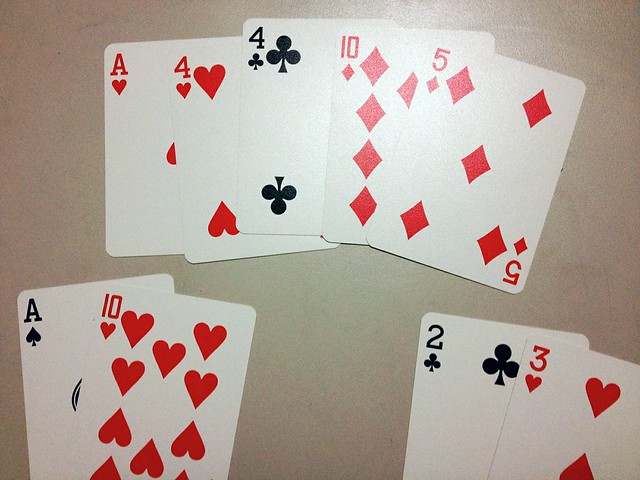
The flop was A-4-4.

The “villain” (not a derogatory term in poker–just the guy or gal you’re betting against) bet 100. I said, what the heck, and called.

The turn was a 10. The villain thought a bit and bet 160. I tanked, figured that I had lost more than a thousand already and had to go home soon, and called.

The river was a 5.

I sighed and went all in with my remaining chips, bringing the pot to around 3,000. The villain tanked for about three minutes, trying to figure out what I had. “Please make him call,” I prayed to the poker gods. “Please, say call!” Finally, wanting to fold but too curious to let go, the villain called, and showed an A-10, good for top two pair. I turned over a 2-3 offsuit for a baby straight. I thanked him, slugged the chips into a rack, and went home. What a fish!

Flashback No. 5: Miracle at Big Ace

Flotsam & Jetsam for Oct. 11, 2009

AS SOME of my friends know, I’ve become an intensely addicted poker player. I’ve won a couple of tournaments, but as pokeristas go, I’m not a very good one (a “donkey,” in poker parlance, who can’t help making bad calls out of sheer hubris or dumb curiosity and enriching the rest of the table in the process), but one besotted enough about the game to be reading books by the likes of Daniel Negreanu instead of Thomas Pynchon, and watching video replays of classic poker games on YouTube instead of the new Pinoy indie movies that have “important” written all over them. My excuse is that I’m gathering material for my next novel (I am!) but it’s really to get away from everything else I have to do, especially anything having to do with words more elaborate than the only four words you need to know in poker: “call,” “check,” “raise,”

or “fold.”

Yesterday, a Saturday, I joined a group of poker enthusiasts from pokermanila.com to play in the first PokerManila Inter-Collegiate Tournament at the new Big Ace Liberty Club along Shaw Boulevard. I was part of the UP Maroons “seniors” team—meaning, I guess, anyone with a UP student number earlier than 80-xxxxx. My pair of aces got painfully cracked by a straight and I busted out of the tournament early. So I moved over to the cash game, at the 25-25 table (the so-called “blinds” or mandatory first bets are 25 pesos), and promptly began losing again. Story of my poker life!

But I hung on, because aside from the pot or the money on the table, we were all going for the “High Hands” promo of Big Ace, which gives special prizes to the day’s best hands as of 12 midnight (a neat marketing ploy, of course, to keep you glued to your seat way past bedtime). That deadline passed and I had hit nothing better than a full house of jacks (JJJ77), and others were hitting quads and even a straight flush, so I said I’d cut my losses and pack up after another “orbit” (a complete turn around the table; for a glossary of poker terms, see here).

Now here’s what happened in one of those last few deals, where I had just about P1,500 worth of chips left.

My hole cards (the two cards every player is dealt) are 7h-8h. I often make donkey calls (way too often!) and I can’t resist suited connectors (the 7 and 8, same suit), so I say, okay, here’s where we make a gallant last stand, and I call the blind (the minimum bet), as do several others.

Now comes the flop (the first three “community” cards on the table): 5h-Kh-3s.

Aha, I say—a four-flush! I need just one more heart to complete a flush, which is probably enough to win, so I make a bet of about 200, forcing two or three players out, but one player goes all in for 850, and the next guy calls! Of course I call, and I think someone else after me also calls. So now we have a monster pot all of a sudden, and we all get up on our feet and people around us start following the action.

The turn (the fourth card, second to the last) is 6h. I hit my flush! But the guy beside me goes all in with his remaining chips, so I happily call, and we have a side pot of about 1,200.

Now everyone shows his cards before the last or “river” card is drawn. Player A, the original raiser, has Ad-Kd (ace and king of diamonds). So as far as I’m concerned, he’s drawing dead to my flush (no way he can win). But Player B turns up his cards—Ah-Qh! Suffering Jesus! He has the nuts (the highest possible flush, with an ace-high, short of a straight flush, or five cards of the same suit, in sequence)!

So now I’m showing K-5-6-7-8, all hearts, against B’s A-K-Q-5-6. I have a very faint hope of making a straight flush—either 4-5-6-7-8 or 5-6-7-8-9 of hearts—but another player has already folded the 4h, so my one and only out is the 9. That’s one card in a deck of 52!

The dealer draws the river card, and… drumroll… it’s the 9 of hearts! The crowd goes wild, I go nuts with the nuts, Player B is stunned speechless (as I certainly would be), and I get my name on the leader board for the next day’s High Hands, since it’s already 12:30 am.

Two deals later, I get up and cash out, to make doubly sure that my day has a happy ending. Hallelujah!

(You’d wish poker was like this every God-given day, but sadly, it ain’t necessarily so.)

Flashback No. 2: Watch That Watch

Man Overboard, October 1999

WE PINOYS love watches; it’s the timekeeping we hate, or at least ignore. While an American without a wristwatch is a pretty common sight (and not for lack of money, either), a Filipino without one might as well be naked. If we have cash to blow, a new watch will be up there somewhere on our “wannabuy” list.

It’s never enough that we have one watch to mark the days, hours and minutes by; there’s nothing duller for Juan than to be looking at the same old clockface and wristband day in and day out. And so we acquire a few—one for the office, one for the beach, one for the evenings, and a couple of spares, just to be sure. The only thing we may each have more of than watches is shoes, but that’s another story.

An awareness of time—or the time—is one of the things you usually pick up from years of living abroad, in places where buses and trains miraculously arrive and depart on schedule, as though their drivers’ lives depended on it (and they do!). The balikbayan comes home hoping to see the same—and immediately gets discombobulated by the two-hour wait for his baggage at the airport, and the four hours it takes him to get from one end of EDSA to the other. Over the next few days, he gets stood up at three appointments, he hears the maid get on the phone to her cousin in Tacloban for an hour, and he misses the start of a movie because the theater’s clock was running ten minutes ahead. Soon he gets the idea that no one really knows what time it is, and even if they did, nobody particularly cares.

It’s one reason why Western-style terrorism is never going to get off the ground in this country. You can’t have clockwork precision if no one gives a hoot about the clockwork. What would be the point of exploding a bomb, say, at precisely 10:15:30 am, at which instant the President is supposed to be entering the hallway to address a group of reformed investigative journalists, if the bomber’s clock runs five minutes behind Malacañang’s? (And this presumes, of course, that the President—did I say this President?—got up from bed when he was supposed to.)

Yes, sir: time to the Pinoy is an infinite resource, spent by the wise and saved by the stupid. It does make some sense, given our fatalistic streak. Que sera, sera, no matter what you put down on your Palm Pilot or Claris Organizer, right? We count our lives in the grand sweep of years and cycles, not in the loose change of minutes and seconds: “Hey, it’s May! Time to dance in Obando and see in the carabaos in Pulilan!” and “Did you see that downpour yesterday? My, my, the rainy season has indeed begun!”

I felt mighty proud the other day when I set all the computers, watches and clocks I found around the house to Vremya time (a little redundancy there, “vremya” being the Russian word for “time”, and also a nifty piece of software that synchronizes your Mac over the Internet with the exact time kept by the world’s atomic clocks). At last, I thought, here was world-class precision down to the second, right at home!

The pointlessness of the whole exercise became obvious when I hurried my wife Beng along to catch a merienda meeting with her friends that was due to start in 35 minutes and 23 seconds, halfway across the planet. “What’s the rush?” she protested, trying to choose between the red blouse and the green one. “No one will be there for another hour, and I’m not even sure that So-and-So’s coming.” She was, of course, late—and wondered why no one showed up, granting even the ample privilege of “Filipino time”—until she realized that she had the wrong day.

Still, just between us ube-and-macapuno, puto-and-dinuguan-loving Pinoys, you’d have to admit that a new watch on the wrist is always cool. You feel a new sense of purpose; you want to check the time every 30 seconds or so, and you keep wishing someone on the street would ask you, too. The feeling lasts for about two to three days—and then you forget about your new toy; a week later, you scratch the glass while trying to fix a flat, or worse, when you trip one the sidewalk while adoring your wrist. Grumble, grumble: it looks like Julia Roberts with a surgical stitch running across her nose down to her neck. You toss the watch into the desk drawer to join half a dozen others in various states of disfavor or disrepair.

I’ll admit to having three or four wristwatches beneath the bedside lamp—but none of them too precious to mourn the eventual loss of, and nearly all of them a few years old. Hmmm.… Sure sounds like time to get a new one!

Flashback No. 1: Another Pen Story

Since I’ve opened this new blog with very little in it yet, I thought I might as well fill the wait between my weekly Star columns with selected reposts (or, in some cases, just posts, since they’d never been posted before) from columns past—from Penman, which began in the Star in 2000; Barfly, which ran in Today from 1994 to 1999; Man Overboard, from Men’s Zone in the early 2000s; T3; and Manileño from Filipinas magazine from 2003 to 2010. So here goes.)

Penman for August 21, 2000

FOR PHILIPPINE Star readers who may not know me from my earlier incarnations (no offense meant to the Gautama; the only thing Buddha-like about this Butch is his midsection) and who may be wondering about the column title, “Penman” refers both to a story I wrote a few years ago, “Penmanship,” and to my long and abiding fascination with old fountain pens, about a hundred of which I’ve collected over the past 15 years.

Most of these beauties from the 1920s up to the 1940s came from antique fairs and garage sales in the American Midwest, where I lived for a few years, and from more exotic nooks and crannies such as a backstreet pen shop in Edinburgh and a sidewalk vendor in Saigon. Some I’ve received as generous gifts from friends (a clutch of Parkers and Sheaffers from Franz Arcellana—pens he actually wrote his stories with—and a breathtaking Japanese maki-e lacquered pen from poet Jimmy Abad).

Now and then—say, after a few months without adding a new-old pen to the trove—I satisfy my urges by getting one on the Internet or, less often, by taking a deep breath and paying full price at the local mall (although I once found a very nice pair of new Parker Duofolds selling at practically half-price in a department store in Cebu). Still even more rarely, I’ve come across some astounding bargains in my own backyard—an antique stall in Ermita (a Montblanc 146 and a much-sought-after 1959 Sheaffer PFM V for P650 each), and a stationery shop in Binondo (a rather uncommon Parker VP for P350).

Never mind what these names mean, if you know or care nothing about pens: just think of them as exquisitely lovely, useful, and—to some people who collect them for more than aesthetic reasons—quite valuable objects, some which have sold at auction for over $10,000 (no, that’s not your grandfather’s Wearever or Esterbrook, for which you’d be lucky to get enough for a movie and a hotdog sandwich). I have an awful suspicion that most of the good pens we must have once had in this country—any colony with a highly-literate bureaucracy should have been swimming in a sea of blue-black ink—would have long had their gold nibs pulled and melted down in the smithies of Meycauayan to make someone a pretty trinket or a gleaming incisor.

Imagine my surprise when, last weekend—on one of those trips to the mall where the sleepy-eyed husband gets deputized by the wife in resolute quest of a wedding present—I strayed into a tiangge stall selling the usual santos and hardwood benches and spotted, in a corner of a glass case, the unmistakable flat-top cap and gold pocket clip of a 1920s pen. I asked to see it, and my hands shook as I confirmed that I was holding a near-perfect example of a Swan Eternal No. 48, a huge fountain pen as fat as a cigar (it’s a boy thing, this pen envy) in a gold-trimmed rosewood finish and the biggest nib you ever saw, a No. 8 (most fountain pens, by comparison, sport nothing bigger than a No. 2). The patent date on the clip said “Jan. 19, 1915” although the pen itself was made, according to my trusty references, between 1924 and 1929. Hallelujah! But first I had to ask, in a dry croak, “How much?”

The man behind the counter consulted a woman who was doing the books. “Five hundred,” she said casually. I felt faint: P500 for a fancy Bic may be outrageous to you, but if they had ten of these and I had P5,000 on me I would have bought them up and retired on the profits. The pricing also told me that the sellers had probably found the pen among other effects in a large estate (you had to be very rich to own an accessory like this in the late ’20s) and had, themselves, paid very little if anything for it; many old pens come as bonuses to buyers of many-drawered antique cabinets, or even of cigar boxes, where they tended to be kept and forgotten.

I forked the money over. The man hesitated and my heart skipped a beat. “I’m sorry,” he said, “but we don’t have a small box to put it in.”

“Oh, that’s all right,” I managed to say, taking full and final possession of the Swan and sticking it into my pocket, where I was certain that God Almighty had always intended it to belong. Surely, there was more than a touch of justice here. How many times, during my months in England, had I revisited and salivated over the fabulous pens on Portobello Road, going home to Norwich with little more than a jar of bagoong and a packet of Chippy from the Filipino food store at Earls Court? Just how many of the half-dozen Pinoys who can tell a Swan Eternal from a Rubber Ducky stumble into one, in a mall buzzing with Nokia ringtones, and get to bring it home for the price of a phone card?

I treated Beng out to a lunch of noodles and siopao and proudly showed her my prize find. She herself prefers to pick up old blue and ruby-red bottles, but has developed a grudging respect for and even some expertise in my objects of choice—once spotting, at a cowshed fair in Ohio, a circa-1930 lapis-blue Parker Duofold Junior which I bought for $5 and later traded for my first Montblanc. “It’s gorgeous,” she agreed, “but you should have asked for a discount.” Spoken, I suppose, like a true shopper.

But this wasn’t shopping, Beng. This was serendipity, for which I can only thank my lucky stars and, yes, you, for dragging me out of my Sunday-morning stupor to find kitchenware for newlyweds.

Penman No. 1: Mall-Asia, Truly Asia

Image

Penman for Monday, June 25, 2012

EVERY TIME I visit Malaysia, I can’t help thinking that this is the country we could have been, had our history taken another turn—with wide, perfectly flat roads, tall, smartly designed buildings, swaths of greenery, speeding trains, and bustling industry.

Singapore gives me the same feeling, but it’s much too small for true comparison’s sake; Malaysia, on the other hand, is just slightly larger than the Philippines in terms of land area, although its population of 28 million is less than a third of our 93 million, and there’s surely a point to be made there somewhere. Malaysia today is predominantly Muslim and we identify ourselves as Christian, but let’s not forget that Manila began as a Muslim settlement.

Both countries underwent long and painful periods of colonial rule, and Malaysia’s experience—at least in parts of it like Malacca—was even more complicated than ours, with Portuguese, Dutch, British, and Japanese invaders successively lording it over the land. When Malaysia declared its independence in 1957, we Filipinos might have had reason to think of this neighbor as a backwater good for little more than rubber trees.

Today, of course, the laugh is on us. Somewhere along the way, both Malaysia and the Philippines endured long stretches of strongman rule—Malaysia got Mahathir, we got Marcos. Guess who got the better autocrat. We can argue that Malaysia’s had all that petroleum and palm oil to bank on, but it’s not as if we started out with nothing.

These impressions bore down heavily on me last week as I touched down in Kuala Lumpur on Malaysian Airlines with a media group from Manila and was whisked away for a lakeside lunch in Putrajaya, Malaysia’s gleaming new federal capital district just outside KL. Like many things Malaysian, Putrajaya was thoroughly planned, and incorporates cutting-edge green technology. “There’s no airconditioning in these buildings,” our guide Jeffrey pointed out in the 32-degree heat. “They use a watercooling system to keep the temperature down.”

We were in Malaysia to cover the launch of the 1Malaysia Mega Sale Carnival, an annual extravaganza (ongoing until September 2) featuring massive discounts nationwide on goods, including luxury branded items prized by visitors such as affluent Singaporeans, who stream across the border for fun and shopping. Such sales may seem like exercises in frivolous excess to plebeians like me more accustomed to dumpster diving in the nearest ukay-ukay, but it’s big and serious business to Malaysia, which attracts over 24 million tourists—just a few million short of its total population—every year. Last year, Malaysia earned 58.8 billion ringgit—almost P800 billion—from tourism, the third-largest dollar-earning sector of the Malaysian economy. About a third of that, P250 billion, was accounted for by shopping.

Except for a few items like cars (which are highly taxed to encourage the use of mass transit), shopping is largely duty-free in Malaysia, and you don’t have to go to the international airport to get the best prices. (While nowhere near as comprehensive as Singapore’s Changi and Hong Kong’s airport, KLIA has much more to offer than Narita or Incheon—and free wifi.)

Malaysia may be best known to outsiders for its resorts, beaches and nature walks in Penang, Langkawi, Kota Kinabalu, and the Genting Highlands—the kind of dreamy getaways you see on those distressingly effective “Malaysia, Truly Asia” ads (which scuttlebutt has it were conceived by a Filipino)—but shoppers around the region equally appreciate the fact that the country has 300 shopping malls and centers covering 90 million square feet. Including office space, its biggest mall—Berjaya Times Square in KL—sprawls across 7.5 million sqft, nearly twice the footprint of our Mall of Asia.

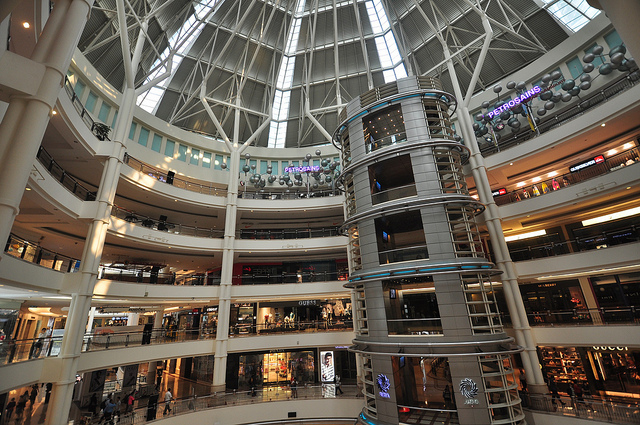
The malls serve the full range of clienteles and price points, from the upscale Starhill and Pavilion in downtown KL to the more pedestrian-friendly BB Plaza a few blocks away. Even the landmark 88-story Petronas Towers have an in-house mall. “Within a one-kilometer radius in Bukit Bintang, you can find 3,000 shops,” said Joyce Yap, the head of a merchants’ association in that prime shopping district. The malls attract not only shoppers but diners as well. “Food and beverages are a huge draw—nobody here has time to cook!” said Kung Suan Ai, VP of the Malaysia Shopping Association.

The proliferation of shopping centers was such that I told Jeffrey, “Your country should be called Mall-Asia.” Three generations of malls have now been built since the first mall, Ampang Park, was built in 1973. We were billeted in the four-star Boulevard Hotel in Mid Valley, a KL suburb that sprang up 15 years ago apparently for one main purpose: yes, shopping, and the hotels to house the shoppers in. The Boulevard is connected to its two sister hotels—the Cititel and the Garden—by an underground walkway that is in fact the basement level of the huge Mid Valley Megamall.

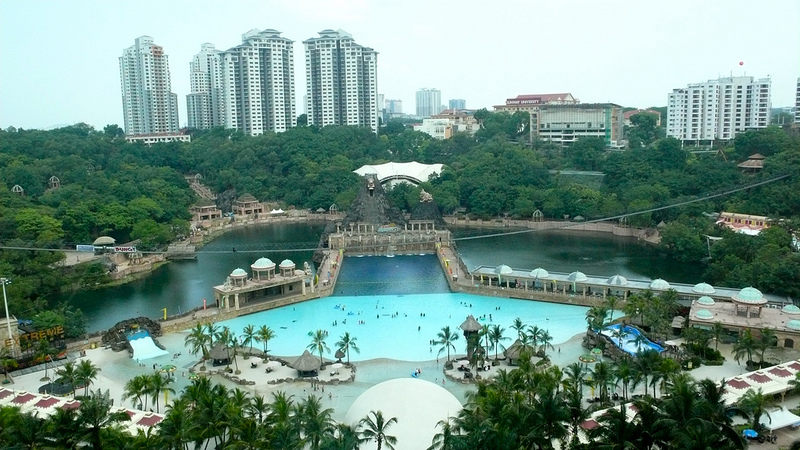
The Mega Sale’s formal launch was held at the Sunway resort complex, another example of private enterprise turning a hole in the ground—in this case a lagoon left by a disused tin mine—into a business opportunity. Sunway is a water theme park, hotel, and mall all in one, and if it’s a bit over the top—it’s Egypt, Vegas, and Versailles altogether—the locals don’t seem to mind, trooping to the resort in family-size droves.

Our visit included an overnight side trip to historic Malacca, two hours away by van—a city of 20 museums, a busy night market on Jonker Street, a river cruise, and a spectacular view from a revolving tower more than 300 feet high. Lunch at the Restoran Peranakan gave us a taste of traditional Chinese-Malay cuisine, but it was the dinner fare at Capitol Satay—a fourth-generation family concern whose special peanut sauce has become so legendary that customers queue up for three hours at the door—that occasioned a feeding frenzy among us. The gustatory treats continued the next day with heaping servings of shaved ice laced with fruits, beans, and corn, which the locals call cendol; a fancier dessert closer to our halo-halo is air batu campur or “ABC.”

The Mega Sale was a huge success with my young Filipino companions, who had the fashion sense, the budgets, and the bodies to deserve and display the pretty things that lend glamor to days that begin at noon and end with the next dawn. Me, I found the one store that had the most special objects I desired in Malaysia—a shop called PenGallery in downtown KL—and walked out with another fountain pen I surely didn’t need but just as surely wanted. After I found a lovely pewter-and-onyx pendant for Beng at the Royal Selangor boutique, my shopping was over, and so was our journey to another future we might have had.

Next week, I’ll relate the highlights of my conversations with three outstanding and yet very different Malaysian artists—the iconic cartoonist Lat, the shoe designer Jimmy Choo, and the maverick painter Charles Cham.