 A stall selling all kinds of fireworks and firecrackers in Puerto Princesa.
Flotsam & Jetsam No. 6: They Mean It
Reply

A stall selling all kinds of fireworks and firecrackers in Puerto Princesa.

Penman for Monday, July 16, 2012
THE RECENT passing of Dolphy, inarguably the most talented and best-loved Filipino comedian of his generation, brought back some warm memories—not just of me as a kid enjoying Dolphy and Panchito do their “song translation” routine every Sunday on “Buhay Artista”, but also of what could have been a historic opportunity to work with this comic genius in a non-comic way.
The time was the late 1970s, and I had just started out in my screenwriting career with Lino Brocka, for whom I had already written some scripts. Lino and I would go on to do more than a dozen movies together, but the big one that got away was a project that Lino had lined up for Dolphy, Pilar Pilapil, and the very young Niño Muhlach, who had already been introduced as a dramatic sensation in Tahan Na, Empoy in 1977. Shortly after Empoy, which was a big commercial success, Lino was asked by a producer—Jesse Yu of Lotus Films, who had bankrolled Empoy—to think of a project that would involve Dolphy.
Lino then asked me to work up a storyline and a treatment, and we came to the agreement that it would be interesting if we took Dolphy out of the gay comedies he had become famous for (such as 1969’s Facifica Falayfay) and put him in a straight, dramatic role. After a week or so (that was all the time we had back then, when movies were routinely shot within a month), I came up with a storyline I tentatively titled Si Abe, Si Bugoy, at Si Pilar (yes, I liked Pilar Pilapil’s name so much that I decided to keep it for the character) where Abe was a kutsero driving his caritela in the Binondo area, Bugoy was his nephew and sidekick, and Pilar was a lady of the night. It shouldn’t be too difficult for you to guess the rest of the story from there (cut me some slack—I was only 23, and enamored of Fellini, neorealism, and all that jazz).
In any case, the movie never got made; the reason I heard, which could have been true or not, was that Dolphy thought it too abrupt a departure from the norm, his norm. I was crestfallen, but soon got busy with other Brocka projects like Inay (my personal favorite of all my Brocka scripts, a light domestic comedy starring Alicia Vergel) and Mananayaw (with Chanda Romero, breathlessly described by the movie blurb thus: “She’s Wild… and Dangerous! It Takes More Than Love To Tame Her!”). Meanwhile, Dolphy did go on to work with Lino and another very talented scriptwriter, Dandy Nadres, on the delightful 1978 Lotus melodrama Ang Tatay Kong Nanay, where Dolphy played a gay parent caring for a young son, Niño Muhlach.
I never did get to write a script for Dolphy, which was too bad (certainly more for me than for him). In those days I would’ve given my right arm for the love of art, and what the client wanted still mattered less to me than what my feverish imagination was urging; I had convinced myself, rightly or wrongly, that I could’ve written a script that Dolphy would have loved, once he had actually read and acted it out.
I don’t think that I ever got to meet Dolphy in person, either (not that I met all that many stars; despite scripting two dozen movies, I never became an industry insider, although I remained a lifelong fan of such fine actors as Dolphy, Nora Aunor, Vilma Santos, Gina Alajar, and Jacklyn Jose—and, of course, Sharon Cuneta, for whom I wrote three movies).
Well, I did get to write for Dolphy—in a way, in another capacity. When his autobiography—told to Bibeth Orteza and titled Hindi Ko Ito Narating Mag-isa (Quezon City: Kaizz Ventures, 2008)—was about to be published, I received a request to read the manuscript and to write a blurb for the back cover, and I was happy to oblige, a full three decades after our little Binondo project got aborted. Here’s what I said about that book, and about the man:
“This is an extraordinary memoir of an extraordinary man who has gifted generations of Filipinos with laughter, but whose own life has been a struggle to balance life and work, to meet the demands of family and fatherhood, to tame his prodigious passions. This story is told with searing candor and compassion, not only by Dolphy himself but also by the many people whose lives he touched (and, in many instances, brought forth)—his women, his children, his friends, his colleagues. I haven’t read a biography like this, ever, and the uncensored, unmediated first-person accounts strike home with a power and a poignancy you’d be hard put to find in any screen drama. There are moments of humor and irony as well, and all in all we gain a truly moving picture of a brilliant but complex man whom we feel like knowing, in many senses, for the first time.”
Today, with Dolphy gone, these words sound truer than ever, and I would urge you to go look for a copy if you really want to understand Rodolfo V. Quizon, beyond the well-deserved but familiar praises following his death. I was abroad during the book’s launch, but I soon received my copy, autographed thus: “To Butch Dalisay, Thank you for the extraordinary blurb. You are a gem of Phil. Literature. Mabuhay ka and God bless, Dolphy.”
I don’t know if Dolphy was just being his gracious self, or if he had actually read one of my novels or stories, but what I really wanted to tell him—forget the novels and the stories—was, “Naku, Dolphy, kung alam mo lang, I would’ve written you a script you would’ve been so proud of—sayang!” The sayang, again, was more mine than his, because he certainly didn’t need my skills to prove his acting genius. (One favorite Dolphy scene of mine—I’m not sure from where now—has his impoverished character sniffing a dried fish suspended over the dining table, and then sending the fumes down his gullet with a handful of rice.)
I’ve been asked since, “Does Dolphy deserve the National Artist Award?” I’ve always thought so, but it’s a good thing that the Palace didn’t succumb to the enormous pressure to give it to him in a hurry, just because it seemed like he was about to go. He’ll get it, in good time, for the right reasons. If he’s where most people seem to think he is, looking down at us with an arched eyebrow, he’ll see it happen, and crack a smile, tip his hat, turn on his heel, and saunter off, whistling.
[Dolphy’s pic from http://www.inquistr.com]
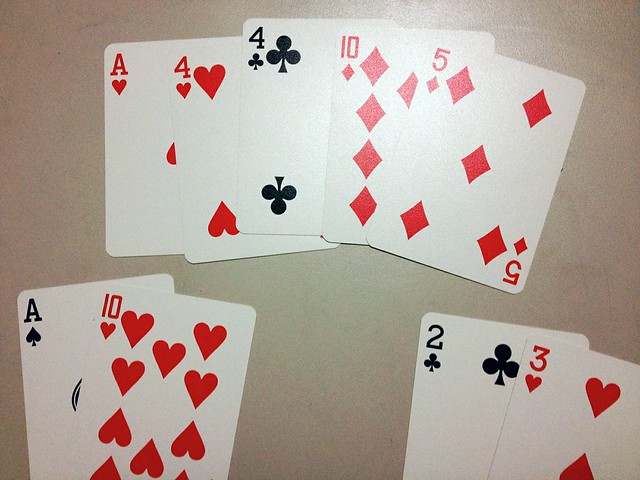
We played this hand at the 10-20 table at the Metrocard Club last night (or make that early this morning), and it shows exactly why I’m such a fish who can’t resist making awful donkey calls, despite my illusions to the contrary.
The flop was A-4-4.
The “villain” (not a derogatory term in poker–just the guy or gal you’re betting against) bet 100. I said, what the heck, and called.
The turn was a 10. The villain thought a bit and bet 160. I tanked, figured that I had lost more than a thousand already and had to go home soon, and called.
The river was a 5.
I sighed and went all in with my remaining chips, bringing the pot to around 3,000. The villain tanked for about three minutes, trying to figure out what I had. “Please make him call,” I prayed to the poker gods. “Please, say call!” Finally, wanting to fold but too curious to let go, the villain called, and showed an A-10, good for top two pair. I turned over a 2-3 offsuit for a baby straight. I thanked him, slugged the chips into a rack, and went home. What a fish!

Penman for Monday, July 9, 2012
(This is being posted a little late, after WordPress hiccups lasting about 12 hours.)
EVERY OTHER semester, I get to teach a graduate class in Creative Nonfiction at the University of the Philippines, alternating with my friend Jing Hidalgo, who’s probably the foremost expert on the subject in the Philippines, having written a manual and a reader for CNF, as we call the genre.
“Creative nonfiction” may be a relatively new term in academia, compared to “the short story” or “the essay”, but it covers many kinds of writing that have been around for ages—including and primarily, yes, the essay. There’s a lot of variety but no great mystery to it—you could be writing about food, Tibet, your old car, religion, painting, your grandmother, or hypoglycemia; the important thing is that you’d be dealing with matters of fact and opinion, employing the techniques of fiction.
As Lee Gutkind, who popularized the term beginning in the early ‘80s, puts it, “Although it sounds a bit affected and presumptuous, ‘creative nonfiction’ precisely describes what the form is all about. The word ‘creative’ refers simply to the use of literary craft in presenting nonfiction—that is, factually accurate prose about real people and events—in a compelling, vivid manner. To put it another way, creative nonfiction writers do not make things up; they make ideas and information that already exist more interesting and, often, more accessible.”
Looking back in my own practice, I realize that I’ve done more work in CNF than in fiction—not only because I enjoy doing it, but also because it provides me with a living, which fiction simply can’t, at least not in this country. I’ve written quite a number of commissioned biographies, and while there are certainly limits to what you can put in such works—as differentiated from independent, critical biographies such as a professional or academic historian (which I am not) might do—they allow and call for the exercise of a broad range of CNF techniques: description, narration, dialogue, and contextualization, among others.
This semester, for the first time, I’ve decided to depart from the usual CNF syllabus—which has students writing about themselves, their families, their loves, and their peeves—and have my class do a little of what I’ve been doing, Biographical Writing. To my recollection, nobody has ever taught it in UP, at least in our department; but the truly novel thing about teaching it is, I believe, in getting students to leave themselves behind and to start focusing on others. (I’m disallowing them from doing autobiographies or memoirs, and from writing about their families or loved ones.) At least for this semester, I want writers to see art not as something touchy-feely or inevitably, intimately personal, but as an approach to the capturing and the representation of the external. Their subjects need not be big names—indeed, I’d prefer biographies of ordinary people, suspecting that in them reside the true aches, plaints, joys, and fantasies of the nation.
In our second meeting, I gave the class an overview of what, for me, makes for great CNF—although you could apply these just as well to other kinds of writing. I named seven elements—three C’s, three P’s, and one L—to guide my students in their work. Here they are:
1. Comprehension. How well do you understand your subject—both the person, and his or her context? This understanding is not a premise, but a goal, of the project. We can have some idea in the beginning of what we’re writing about, but we don’t really know him or her until we undertake the writing—which is to say, the subject doesn’t grow larger but actually smaller and more human in our eyes.
2. Clarity. Descriptions, statements, and explanations should be made as clearly as possible, even if their meaning may be ambiguous. Readers should never be in doubt that they are looking at, say, a green umbrella wet with rain, or dealing with a character whose sadness is laced with guilt. Concrete objects are easy to render clearly, but abstractions and complex emotions require more skill and sensitivity to capture and present.
3. Correctness. Did you get everything right, and represent everything as fairly as you can? The good CNF writer doesn’t invent, ignore, or change the facts, even as the final appeal of the piece will depend on his or her interpretation of them.
4. Precision. A good writer will find the exact word for the object or the situation—or the exact shade of green or brown, as the writing situation may require.
5. Proportion. How much of the subject should you cover, to what degree of intensity? How do you distinguish between the important and the trivial? Given, say, a 7,000-word limit for a brief biography, how do you make a 90-year-long life seem not too long, and a 35-year one not too short?
6. Perspective. Given the same set of facts, one writer’s interpretation and presentation of them can prove to be more mature and circumspect than another’s. That maturity and circumspection could come with age and experience, but it can also be acquired through wide reading and scholarship. I tell my students—mostly English majors—that literature is just a starting point for the CNF writer, who needs to cultivate an interest in and develop a working knowledge of history, politics and public affairs, business and economics, and science and technology. Perspective can also be a matter of both angle and distance, of the writer’s attitude towards and closeness to the subject and of the writer’s ability to put things in context.
7. Language. Sadly, even with all of the above, if you don’t have the language, then you can’t write. Language’s first and foremost task is communication, but at its most challenging and exhilarating, language is the writer’s way of expressing the otherwise inexpressible. In the very least, I look for competence—command of the sentence and its structure; no huge and recurrent problems with grammar, spelling, and punctuation; some degree of fluency; clarity and forcefulness of expression. The outstanding student will write not only with competence but brilliance, which is not be confused with an exotic vocabulary (often resulting in a forced and artificial elegance) but which rather makes the most out of the simplest words, finding the extraordinary in the ordinary.
Biographical writing clearly isn’t for everyone, especially since we’re mostly interested in ourselves. But again, as I keep reminding my students, writing about others is the best preparation for writing about oneself, because it should lead to greater and more honest self-awareness—and besides, the writer’s self is never lost in a biography; it’s there, in the questions one asks, in one’s choice of detail, in one’s appreciation of another person’s life. As a way to learn and to practice writing, biographical writing will also exercise the student in a way that writing poems, stories, or essays won’t; if the poem is the hundred-meter dash and the novel the marathon, the biography is the triathlon, requiring not just strength and endurance but versatility, pacing, and the ability to cope with ever-changing environments.
I’m looking forward to reading a good semester’s crop of biographies, of ordinary lives rendered extraordinarily.

Flotsam & Jetsam for Oct. 11, 2009
AS SOME of my friends know, I’ve become an intensely addicted poker player. I’ve won a couple of tournaments, but as pokeristas go, I’m not a very good one (a “donkey,” in poker parlance, who can’t help making bad calls out of sheer hubris or dumb curiosity and enriching the rest of the table in the process), but one besotted enough about the game to be reading books by the likes of Daniel Negreanu instead of Thomas Pynchon, and watching video replays of classic poker games on YouTube instead of the new Pinoy indie movies that have “important” written all over them. My excuse is that I’m gathering material for my next novel (I am!) but it’s really to get away from everything else I have to do, especially anything having to do with words more elaborate than the only four words you need to know in poker: “call,” “check,” “raise,” or “fold.”
Yesterday, a Saturday, I joined a group of poker enthusiasts from pokermanila.com to play in the first PokerManila Inter-Collegiate Tournament at the new Big Ace Liberty Club along Shaw Boulevard. I was part of the UP Maroons “seniors” team—meaning, I guess, anyone with a UP student number earlier than 80-xxxxx. My pair of aces got painfully cracked by a straight and I busted out of the tournament early. So I moved over to the cash game, at the 25-25 table (the so-called “blinds” or mandatory first bets are 25 pesos), and promptly began losing again. Story of my poker life!
But I hung on, because aside from the pot or the money on the table, we were all going for the “High Hands” promo of Big Ace, which gives special prizes to the day’s best hands as of 12 midnight (a neat marketing ploy, of course, to keep you glued to your seat way past bedtime). That deadline passed and I had hit nothing better than a full house of jacks (JJJ77), and others were hitting quads and even a straight flush, so I said I’d cut my losses and pack up after another “orbit” (a complete turn around the table; for a glossary of poker terms, see here).
Now here’s what happened in one of those last few deals, where I had just about P1,500 worth of chips left.
My hole cards (the two cards every player is dealt) are 7h-8h. I often make donkey calls (way too often!) and I can’t resist suited connectors (the 7 and 8, same suit), so I say, okay, here’s where we make a gallant last stand, and I call the blind (the minimum bet), as do several others.
Now comes the flop (the first three “community” cards on the table): 5h-Kh-3s.
Aha, I say—a four-flush! I need just one more heart to complete a flush, which is probably enough to win, so I make a bet of about 200, forcing two or three players out, but one player goes all in for 850, and the next guy calls! Of course I call, and I think someone else after me also calls. So now we have a monster pot all of a sudden, and we all get up on our feet and people around us start following the action.
The turn (the fourth card, second to the last) is 6h. I hit my flush! But the guy beside me goes all in with his remaining chips, so I happily call, and we have a side pot of about 1,200.
Now everyone shows his cards before the last or “river” card is drawn. Player A, the original raiser, has Ad-Kd (ace and king of diamonds). So as far as I’m concerned, he’s drawing dead to my flush (no way he can win). But Player B turns up his cards—Ah-Qh! Suffering Jesus! He has the nuts (the highest possible flush, with an ace-high, short of a straight flush, or five cards of the same suit, in sequence)!
So now I’m showing K-5-6-7-8, all hearts, against B’s A-K-Q-5-6. I have a very faint hope of making a straight flush—either 4-5-6-7-8 or 5-6-7-8-9 of hearts—but another player has already folded the 4h, so my one and only out is the 9. That’s one card in a deck of 52!
The dealer draws the river card, and… drumroll… it’s the 9 of hearts! The crowd goes wild, I go nuts with the nuts, Player B is stunned speechless (as I certainly would be), and I get my name on the leader board for the next day’s High Hands, since it’s already 12:30 am.
Two deals later, I get up and cash out, to make doubly sure that my day has a happy ending. Hallelujah!
(You’d wish poker was like this every God-given day, but sadly, it ain’t necessarily so.)

MET THESE, uhm, ladies in an ukay-ukay (used clothing) store in Puerto Princesa.

WE WERE on the road in Hawaii a few years ago, enjoying the scenery, when I spotted this clump of deep red earth against the greenery and a long shrouded box beside it. Was someone about to be buried there, or was I just imagining the kind of pleasant passing we all hope for?
This being the Fourth of July, and my daughter Demi having taken her oath as an American citizen a couple of weeks ago, I thought I’d repost this piece I wrote for the now-defunct San Francisco-based magazine Filipinas a few years ago.

Manileño for January 2007
I HAD a very pleasant and engaging semester as a visiting professor at St. Norbert College in De Pere, Wisconsin, last fall, a welcome break from my teaching duties at the University of the Philippines, where I should be back in harness by the time you read this. Not only did my stint at SNC allow me to introduce the Philippines to about 50 of my own students, only three of whom were Filipino-Americans; I was also able to speak before several groups of students and compatriots in other schools—the University of Michigan, the University of California at San Diego, and Marian College in Fond du Lac, Wisconsin.
With UCSD having one of the biggest Asian-American student populations among US universities, my encounter with the students there after my formal talk proved the longest and most challenging. Here, a student raised a question that I would hear in other places: what was the best thing Filipino-Americans could do for Filipinos and the Philippines?
I’m sure that it’s a question that occupies Filipino-Americans all the time, and for which there are any number of answers, some easier and more obvious than others.
When a supertyphoon hits the Philippines and ravages the land, then relief goods are always welcome; when poor Filipino boys and girls can’t go to school despite their talents, their lives can be changed by scholarships from Fil-Ams who also worked their way up the educational and economic ladder. Many US-based doctors make regular pilgrimages home on medical missions to poor communities. Some Philippine schools receive loads of used books and computers from their alumni in America.
All of these efforts are noble and much appreciated, for sure. A few of them may have been undertaken more to burnish the image of the donor than to uplift the lot of the receiver, but in the end, it doesn’t matter: some public or private good has been done.
At the same time, such humanitarian projects are basically defined by a relationship of dependency, with America as the perennial giver and the Philippines as perpetual receiver. It’s a relationship that, like I told the students in San Diego, can sometimes grate on both sides, with Fil-Ams feeling like the only thing they’re useful for is another donation to another needy cause, and Filipinos feeling like they’re seen as little more than mendicants.
It gets worse when—dependency or not, and whether out of frustration, bossiness, or a genuine concern—some Filipino-Americans dispense quick and easy prescriptions for the cure of Philippine maladies as though nobody back home had the brains or the guts to come up with such ideas on their own.
One such bromide Pinoys often hear is, “Why don’t you just unite behind the President and stop bickering with one another?” Sounds good, but it makes me wonder why more than two million Filipino-Americans can’t get together under, say, just one dozen regional associations and one alumni association for each major university or college, and elect a congressman or US senator among themselves.
The fact is that the best and worst of our culture manifest themselves on both sides of the ocean. Our generosity, our sense of self-sacrifice for the good of the family, our commitment to education, and our industry and resourcefulness have helped us back home as much as they have gained our compatriots a firm footing in American society. On the other hand, the same sorry habits of inggitan, intrigahan, and siraan have fragmented Filipinos in Manila and Manhattan, in Cebu and Chicago, in Davao and Detroit (I’m using these cities metaphorically, but I’m sure you can supply the damning details). One of the worst examples I heard of recently had to do with the visit some years ago of a Philippine president to a Midwestern city—only to find two competing Fil-Am organizations holding two separate programs in two hotels facing each other across the street.
So what did I tell the bright and idealistic Fil-Am students who asked me what I thought they could best do for the Philippines?
Be good Americans, I said—whatever that may mean to each of them. Get engaged in America’s political processes, and make a difference in your own sphere of action. Vote not just for fellow Filipino-Americans—although a few more such voices in high places could help the community as a whole—but for political leaders who will make responsible decisions that will benefit peoples everywhere, including Filipinos.
As the world’s only remaining superpower, America needs all the critical intelligence (and I don’t mean military intelligence) it can muster, and Filipino-Americans can make themselves heard on both domestic and foreign-policy issues, instead of simply going with the flow and making themselves as inconspicuous as possible.
And what’s our claim to being in a unique position to tell Americans and American leaders something they don’t know? Well, we lived with America for half a century. As I often tell my American friends, we were their first Vietnam; and yet we also view America with much greater affection—some would say unreasonably so—than they can ever expect from Afghanistan or Iraq.
Overseas charity is good for the soul and is always welcome; but as they say, it begins at home, as does good global citizenship.

Penman for Monday, August 6, 2007
(This went viral when I first came out with it five years ago, and I’m republishing it here to show that, hey, we haven’t changed one bit!)
IT COULD be that I’m just getting old, but lately I’ve been dismayed and depressed by the state of manners on the Internet. I help moderate a message board (www.philmug.ph) that now has over 9,000 members, and I’m a member myself of several more such virtual hangouts devoted to everything from electronic gadgets like iPods and Palm PDAs to fountain pens and heritage conservation. (The one thing I avoid, perhaps surprisingly, is any public forum made up of writers and wannabe writers, for reasons you’ll find shortly.)
Our Apple users and fans club (that’s basically what it is) has been a generally pleasant and helpful group, ever ready to dispense free and quick advice about everything from the difference between SATA and PATA drives and between FireWire 400 and USB 2.0 (and, of course, between Mac OS X and Windows Whatever). But some weeks on the board can be more vexatious than others, and last week was one of those, with an inordinate number of people, it seemed to me, venting their assorted resentments, rages, and anxieties, caring little if their rants produced or provoked similarly negative vibes in others.
Never mind what those specific issues were; they matter little to anyone but geeks. It wasn’t the questions or issues that disturbed me so much as the way they were raised and pursued—often with undisguised meanness, if not malice aforethought, and with no concessions to diplomacy, compromise, and good-natured humor. Indeed, what used to be the domain and the art of ironic humor has been taken over by sarcasm and verbal battery.
It isn’t just on this message board I moderate, either; it’s all over the Internet, this creeping outbreak of ill will and gutter behavior that ironically seems to afflict those with the money and the education to buy computers and get DSL service. Over at another forum I frequent—devoted to the arcane pursuit of fountain pen collecting—two grown men were bashing each other a couple of weeks ago over, believe it or not, the exact configuration of solid-gold 1940s Sheaffer pens. Here’s how part of that discussion went:
“I would be most interested in your assertion that in general, a sample size of 0.1% of the subject population cannot produce a statistically significant result. Merely characterizing a survey’s characteristics as ‘lunacy’ without providing a shred of supporting math is, to put it mildly, uncompelling, and your embedded assertion that the ratio of sample size to population is the determinant of statistical significance calls into question your grasp of statistical theory.”
That, at least, was an intelligent and even illuminating if occasionally pungent debate. (The other side responded: ‘Your penchant for avoiding the issue being discussed and branching off on some tangent is pretty typical of your discourse. Try and stay focused.”) Most “flame wars”—as these long-distance quarrels are called—employ considerably blunter language, chiefly because, I suspect, the antagonists possess the linguistic skills of ten-year-olds, and in many cases are just a bit older. Endearments like “Moron!” routinely get exchanged in these flame wars, which erupt with the spontaneity of a scuffle in the schoolyard during recess, usually between boys trying to sound like men, and also usually over the presumption of some exotic expertise, although I’ve yet to witness a flame war over prescriptions to end global hunger.
It’s in the nature of the Internet, of course, to host these brutal and often unrefereed skirmishes. Some surfers see the Internet as an open and wide frontier where no rules obtain and manners don’t matter. The Web’s anonymity encourages boorishness, recklessness, and other behavior that might land you in court, in jail, or in the hospital in the real world. People tend to shoot their mouths off and say the cruelest things online because there’s no sense of public accountability. Slinging mud from behind an alias, you can’t get sued, you can’t get slugged, and your mother won’t even know.
Some people mistakenly presume that what’s said on the Internet will stay there. (Well, here’s proof that it won’t; there’s no such thing as an online whisper—and, surprise, print still matters.) I’ll bet anything that the people in my forum who feel alluded to in this piece will be caterwauling again tomorrow, to screech that I dragged their private plaints and torments out into the open—as if posting a message that could reach 9,000 members weren’t public enough.
Now, we didn’t need the Internet to realize that the world is full of idiots and bigots, and that most of us, yours truly included, will occasionally be a bit of both, given the right astral configuration and the way we wake up in the morning. One thing I happen to be openly and proudly biased about is Apple and nearly anything that rolls out of its Cupertino, CA plant. (And yes, friends, I’ll be first in line for the iPhone when they release it here next year.) But when Apple drops the ball—as, like any other big company, it will from time to time—there will be no louder complainers than we the faithful, who should justly feel abandoned and betrayed. So admittedly we’re not immune to these seizures of what will seem to others a silly passion, and now and then we might even raise our voices in defense of a block of plastic.
But that’s entertainment, and it has little to do with the witless vitriol that I’ve been catching around the Web—again, not only here, and not only now. Years ago, almost when the Internet was just beginning to take root in this country, I joined an online group of Filipino writers based here and in the US, and for a time that exchange proved useful and cordial. But as the group grew in size and variety, the chemistry changed; one day I found myself being savaged by a fellow I’d never met and never heard of, for some strange reason I couldn’t figure out. It wasn’t worth the aggravation; I had better things to do than to explain or defend my writing and myself to complete strangers, and I swore from then on to limit my Web time to things I could enjoy as a respite from literature, which I reserved to my private practice.
But even in literature—and especially in its newest form, the blog—it seems that ranting has taken over prose and poetry. Many blogs are amusing, a few are highly informative and thought-provoking, but a vast multitude barely get beyond retching, whining, venting, cursing, and putting everybody else down.
Aside from the pervasive meanness, I’ve been bothered by another recurrent note in the message traffic: the brazen sense of entitlement that many young people seem to possess and brandish, almost like a weapon. Over at PhilMUG, we’ve had an 18-year-old brashly demanding that someone give him/her (on the Web, where people use pseudonymous nicknames or “handles”, you never know) a free computer. “Gimme a Mac!” cried this newbie in his/her very first post. “I damn need one!”
In this “gimme, gimme, gimme” culture, the world owes everyone a Lamborghini, and people don’t need to work or suffer for the things they want. All they have to do is scream like they did for their baby food, and the object of their desire should appear at their feet and make mewling sounds. If it doesn’t, then that’s good enough reason for another rant.
Forgive me if I suspect that these are people—many of them in their surly mid-twenties—who’ve never been truly whacked by life over the head, who’ve never laid their lives on the line for a cause larger than themselves, who’ve never stared into the barrel of a gun, who’ve never spent a day in jail, and whose daily crises consist of having to choose between the mocha latte and the cappuccino.
Thankfully, some of them grow up. I once had a student who kept loudly complaining that the Palanca Awards for Literature were rigged, because he joined them year after year and never won a thing. Surely there was some grand conspiracy to deny him his due. When I could no longer stand his whining, I lost my temper in public (think of it as doing a Pinatubo after 600 years of dormancy) and suggested to him, perhaps a bit too sharply, that the simpler reason for his spectacular string of losses was to be found in himself. (I could’ve added—meaning no offense to the generous Palancas—that with the number of prize categories open at that time, any fool and his dog was bound to win one sooner or later, if you just submitted enough entries with the consistency of a parking-ticket dispenser.) Well, either my sermon challenged his spirit or his number was up, but he soon won a Palanca, and I was truly happy for him; I doubt that he’ll be thinking the same sullen thoughts now.
A few weeks ago, I had occasion to discuss the poetry of Anne Sexton in class, and if you know anything about her—apart from her plaintively powerful poetry—it would be the inescapable fact that she committed suicide, in 1974. A beautiful and brilliant woman, Sexton had grappled with her demons all her life, and took to poetry as a means of taming them. She would even write that “Poetry, after all, is the opposite of suicide.” That she ultimately took her own life doesn’t detract from the quality and the legacy of her poetry. (In “Wanting to Die,” she would say that “… Suicides have a special language. / Like carpenters they want to know which tools. / They never ask why build.”) This leads me to think that those who can write poetry, do; those who can’t, rant.
Can’t the world use a little kvetching, however inartistic? Sure, it can—it had better, or otherwise we’ll end up wallowing in treacly (and very possibly shallow) good feelings. But there’s a difference between the ranter who just rants, and the ranter who disses the world then picks up a chisel or a compass to change it—or a pen, to write beautifully and even blissfully of one’s pain, ultimately to transform it into something more valuable and enduring than this season’s hemline or tomorrow’s gadget.
AM NO big fan of George Bush the First, but there’s no better way to describe what I found in the parking structure at Eastwood a few years ago.

 Pinoy Penman 3.0