Qwertyman No. 167: Stranger Than Fiction

Qwertyman for Monday, October 13, 2025

IF SEN. Alan Peter Cayetano and his cohorts in the Senate minority wanted to rile the people even more, they couldn’t have done it better than by having Cayetano challenge Sen. Tito Sotto for the Senate presidency, at the same time that he was floating his supposedly heroic idea of having all elective officials resign because the public was fed up with them.

He had to know that that was exactly the kind of antic that made people throw up at the mention of certain names—a dubious pantheon of the corrupt, the bought, and the compromised. But he did it anyway, employing his imagination to yank public attention away from the burning issue of the hour—the massive flood control scam and its ties to many lawmakers—in the direction of Mars, and the possibility of honest (never mind intelligent) politicians inhabiting that planet.

Why he did that is anyone’s guess, but mine would be that anything to stop the momentum building up at the Blue Ribbon Committee under Sen. Ping Lacson was good for the minority, many of whom were increasingly being threatened by the exposure. If Cayetano had resigned first (and forthwith!) to provide proof positive of his noble intentions, the distraction would have been worth our time, but of course that was never part of the plan. 

The plot to unseat Sotto—brazen and shameless in its purpose—was more credible and worrisome. It fizzled out but remains potent, simmering just beneath the surface. Lacson’s resignation as BRC chair was probably a concession to forestall Sotto’s, but the situation in the Senate is so volatile that it can’t take much for the leadership to switch while we’re brushing our teeth. 

All we seem to be waiting for is that point of utter desperation when the beleaguered, fighting for their political lives and possibly even their personal freedom, ignore all considerations of decency and public sensitivity, weasel their way back into the majority, and deliver the Senate to its most famous watcher from the gallery: Vice President Sara Duterte, whose fate still hangs in the balance of an impeachment vote that has yet to happen.

That vote and its implications, let’s all remember, was what triggered all of this. Premised on rampant corruption within her office, her impeachment, had it passed the Senate, would have barred her from running for the presidency in 2028 (and, for PBBM, from the resurgent Dutertes wreaking retribution on their erstwhile allies). But this isn’t really just about Sara—it’s about all those other trapos who’ve cast their lot with her, whose fortunes depend on her absolution in the Senate and ascension to the Palace. 

Former Senate President Chiz Escudero, who dragged his and the Senate’s feet in that process, has now dropped all pretensions to impartiality, calling the impeachment “unconstitutional” in a speech that would only have pleased the Vice President, a title he himself might be auditioning for. He did his part well, with what many saw to be the ill-considered assistance of the Supreme Court, to freeze the impeachment complaint. 

And there that matter sat, until PBBM—whether unwittingly or presciently—(and here we’ll go fast and loose with the idioms) shook the tree, opened a can of worms, threw mud at the wall, and unleashed the kraken by exposing the trillion-peso infrastructure scandal now rocking the country. He might have done this to suggest a link between the alleged corruption in the VP’s office and even larger acts of plunder emanating from her father’s time in Malacañang, a deft political move. But reality overtook his imagination, and now the issue’s grown far beyond that into his own administration, his own responsibilities, his own accountability. 

That said, and however we may have felt about him, PBBM has done us all a service by drawing the curtain on the systemic rot in our society and governance, for which he, Sara, and their cohorts have all been culpable, directly or administratively. By doing so he rendered himself vulnerable as well, and the VP’s forces are now zeroing in on that vulnerability to deflect attention from their own predicament. 

Thus the barrage of “Marcos resign!” calls (as opposed to the Left’s “Marcos and Duterte resign!”), which has become shorthand for BBM out, Sara in. (It was on that key point that the rumored September 21 coup plot reportedly first stumbled, with the plotters balking at the alternative.) It also explains the slew of professionally produced reels on Facebook and other social media calling for the military to depose the President—ironically, something so openly seditious that Digong Duterte’s NTF-ELCAC would have instantly pounced on them, but which BBM and his crew seem to be shrugging off, at least for now. 

What tempts our imagination in this fraught situation—where public trust in our politicians and even in the courts is hitting critical lows, and where no clear and short path to change seems visible until 2028—is the possibility of military intervention, whether by martial law or on its own volition. I’ve been assured by friends who know better that this military of ours today is much more professional in its mindset than its predecessors, and that it will abide by the Constitution. I sincerely hope they’re right, because if there’s anything that all the parties in this mess can probably agree on, it’s that boots in the streets won’t bring us any closer to a functioning democracy. 

I’m reminded in this instance of one of my favorite literary quotations, from Mark Twain who said (in so many words) that “Of course fact is stranger than fiction. Fiction, after all, has to make sense.” If you had told me three years ago that we are now relying on a dictator’s son to save us from an even worse alternative, and in the process—if almost by accident—expose corruption so foul that we are back on EDSA demanding not regime change but the rule of law, I would have called you a lousy fictionist with a runaway imagination. Yet here we are.

Qwertyman No. 166: Though the Heavens Fall

Qwertyman for Monday, October 6, 2025

IT’S BEEN the rising refrain of some friends in media, academia, and the coffeeshop crowd—mostly somewhat to my left—to insist (and, I believe, arguably so) that there is nothing fundamentally different between BBM and Sara, between the families and factions of the ruling class they represent, and between their lust for power and money. Therefore, the correct call to the people in this situation, regardless of the consequences, can only be “Down with both of them! BBM and Sara, resign!” Those Latinate lawyers had a term for it: “fiat justitia, ruat caelum”—let justice be done, though the heavens may fall. 

For the plotters of a recently rumored coup, the heavens falling would have meant the replacement of both Marcos and Duterte with a 30-person junta that would include, as juntas go, retired military generals, civilian leaders, and a couple of clergymen. (What, no writers and artists? Thumbs down!) That plot was dead even before it got off the ground, and perhaps thankfully so—a 30-person junta already sounds worse than a 24-person Senate, and something in me resists the idea of having Catholic priests (or Protestant pastors, or Muslim imams, etc.) in any kind of executive capacity in government.

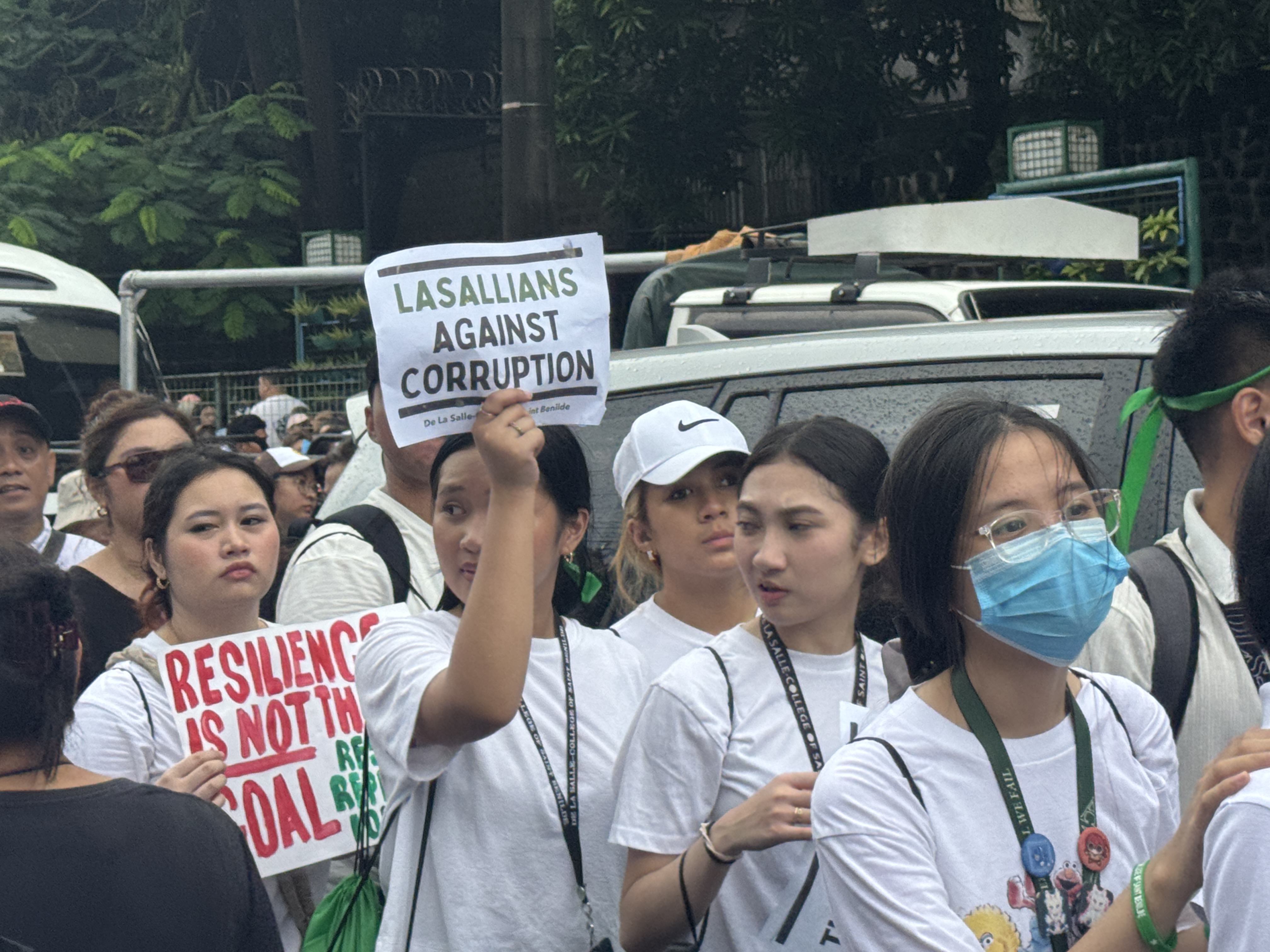
Yes, the people are marching in the streets and are in the mood for the public execution of their plunderers. Our trust and confidence in our leaders has been so badly abused and misplaced that we are now drowning in cynicism and disbelief, certain only in the fact that we are being stolen from by someone, somewhere, somehow.

Nevertheless I sense no great appetite for a revolutionary regime change that will only unsettle things even more. If anything, what we want is certainty and predictability—that the law will be applied and take its course, that the wrongdoers will be identified, prosecuted, and punished, and that proper and ample restitution will be made for their crimes, so that we can all move along as a reasonably functioning society. 

Not to say that everything will be just peachy once the robber-contractors and their patrons are exposed and put in chains, but that the alert will have been sounded, the people awakened, and the bar raised much higher for aspirants to public office in 2028 and beyond. The progressives and middle forces couldn’t have been handed a greater gift: corruption has to be the top election issue, because it affects the poor more visibly now than any other, especially those who can’t escape the floodwaters while their congressman jets off to France.

It’s a problem and a crisis big enough for another EDSA (not to mention all the coup attempts that followed EDSA), but the first EDSA taught us that a sudden change of people at the top, no matter how good the replacements are, doesn’t guarantee deep and lasting change; it merely opens the door for a new set of crooks to come in, and for some old ones to return. EDSA 1 wasn’t a waste; aside from the relief it brought, it was a lesson we needed badly to learn. But have we?

Until our electorate learns to recognize and to vote for its own best interests, no amount of EDSAs short of the bloody revolution and the mass guillotining we’re all trying to avoid will change the composition of the Congress, the Senate, and the executives they work with. The current crisis is the best and also the most painful teaching point to have come along to show Filipinos who and what exactly they’ve been voting for, and who’s been paying for all those dole-outs come Election Day—no other than themselves, from the money that should have been spent on keeping them alive and well. Vote for the corrupt, and you kill yourself and your family. You are being bribed today to be stolen from tomorrow.

The challenge now is to get that message through, make it stick, and not allow it to be muddled by clever counter-propaganda and by possibly well-meant but adventurous calls for regime change. 

Coup or resignation, neither nor both of these will happen. The coup was stillborn and could have led to worse. If the Marcoses and Dutertes are as thick-skinned as their critics make them out to be, then they will brazen it out, ruat caelum

The way forward can be lit up by the facts that will emerge out of the many parallel investigations now taking place into the infrastructure scam and wheresoever it may lead—not just at the Independent Commission on Infrastructure, but also in the even more independent media.

The enemies of the truth know how easy it is not just to distort the truth, but to destroy the truth-sayers. They did it to Leila de Lima with the sordid expose of a private relationship that, even if it were true, was her own business. They put NBN-ZTE whistleblower Jun Lozada behind bars.

Unlike many others, I am willing to let the albeit imperfectly constituted ICI do its work—but quickly and transparently, please—and to judge it by its results. We can expect that no one facing the ICI will come clean with the truth, the whole truth, and nothing but the truth. We will be dealing instead with a complex puzzle, putting it together piece by irregular piece until the broad and inescapable picture of systemic corruption emerges, with every part and element detailed—from delivery boys and drivers to district engineers to Cabinet-level officials to congressmen, senators, and ultimately to the highest offices of the land. 

The Vice President is already involved—it was the corruption in her office, after all, that led to her impeachment in Congress. Inevitably this circuit of corruption will come around to the Office of the President and to its signing power over whatever budget proposal it receives and presumably reviews; the only question will be that of BBM’s personal culpability and what of it, if any, can be proven.

That could yet be the ultimate test of BBM himself, of our democracy, and of whether, after all’s been said and done, it may time for another regime change outside of the ballot box; fiat justitia, ruat caelum.

Qwertyman No. 164: The Great Pinoy Flash Mob

Qwertyman for Monday, September 22, 2025

AT THE Manila International Book Fair last week, a young man approached me to have his copy of my new book Windows on Writing signed, and took the opportunity to ask if there was hope for this country, as many of his fellow millennials didn’t seem to think so.

I kept my smile on, but was deeply saddened by the question. I wasn’t surprised by it, because you hear it every day, everywhere, from Pinoys young and old alike. The dramatic and sickening revelations involving massive corruption in our infrastructure programs only seem to have reinforced that sense of despair over our future.

One regular reader who must be about my age also wrote me to ask, “Where is the outrage of the youth over the corruption scandals now plaguing the country? Why are they not marching in the streets like you did at Mendiola and EDSA?”

Before responding to him—and this column is that response—I had to ask myself, is that so? Indeed I get a lot of memes about corruption in my Facebook and Viber feeds, but these come from people either my age or with the same liberal-centrist disposition. Beyond these, apart from predictable pickets by the militant Left, I haven’t come across the kind of sustained, youth-driven rebellion that challenged if not toppled repressive regimes in Hong Kong, Korea, the Arab world, and now Nepal, among other places. 

But can young Filipinos be ignorant of or indifferent to what’s going on? My gut tells me no, that surely the billions of flood control funds diverted to acquiring luxury cars, California mansions, and buxom bedmates must appall and anger the young as much as us Boomers, who grew up turning lights off and eating our plates clean. After all, it’s their future that’s being stolen from right under their noses. They have much more reason to protest today than we did in 1971, when we teenagers triggered what became the Diliman Commune over a 10-centavo-per-liter increase in the price of gas.

I’m guessing that placard-bearing street marches have fallen out of fashion with the young, except again for the radical few. Today young people wear their pain on their sleeves, and also broadcast it online. Even for political causes, it’s much easier and safer to mount a virtual demonstration, through reposts and likes, with perhaps greater effect. The crooks get named and shamed, the battle lines get drawn, and demands and expectations get laid down, all at the press of a button. And after all, wasn’t this what grizzled First Quarter Stormers like me have been asking for all these years—that the art and science of protest move past the tired clichés of red flags and raised fists?

But then I’m writing this before the September 21 protest rallies—that would have been yesterday—where, despite everything I’ve just said, I expect a huge turnout of young Filipinos, provoked beyond patience and cynicism by the revolting disclosures of massive corruption among their elders. This corruption saga—and we’re watching  just the beginning of it—could yet be the most unifying factor for Filipinos in our modern history, even more than tokhang, the West Philippine Sea, Manny Pacquiao, and Jollibee spaghetti.

For once—and maybe just this once—it doesn’t matter if you voted for BBM, Leni, Digong, or PNoy, or if you support Gaza, Charlie Kirk, same-sex marriage, or transgender bans, or if you listen to Frank Sinatra, the Eraserheads, Yoyoy Villame, or Bini. We all got screwed by the system, which is not saying that systems are neutral (they’re crafted after all by politicians and their ethics or lack thereof), but that corruption on this scale effectively achieves a democracy of the abused. It’s that Great Pinoy Flash Mob, if you will, that went out to the rallies yesterday—perhaps not entirely cohesive or coherent, taking baby steps out of factionalism into a nascent nationhood, welded by the consuming heat of their fury and indignation.

We can’t tell for now what will become of this reconstituted parliament of the streets—if it will hold together and clarify around the most basic and most urgent of its concerns, or if, as some predict and even hope, it will weaken and dissipate over arguments about objectives and tactics and a fundamental mistrust of the fellow on your left and right. We certainly don’t lack for skeptics, pessimists, and cynics who tend to see any and every move by the hero-figures in this play as futile, as it’s all been scripted and the rich and powerful will always win.

If there’s one thing that we liberals and leftists are especially good at, it’s handwringing and doomsaying to the point of paralysis, because we like to believe that we’ve scoped out the territory, researched the history, studied all the characters, plotted out all their possible moves and motives, and found a hundred smart ways to say “This won’t work.”

That “independent commission”? Not independent enough, poor choice of chairman and adviser, beholden to this and that. Forget it. That Luneta rally? DDS-infiltrated, with violence possible. PBBM? Wasn’t he the original nepo baby, and his family the topmost plunderers of them all? Shouldn’t we just have another go at a bloody revolution to take all the bastards out?

When you think about it, on a certain level, all that could be true. And then again, one can be very smugly correct and yet totally unhelpful. When people want to express their anger and see some action, you respect that emotion—or risk irrelevance, as the Left was at EDSA (which arguably and ironically the Left had laid much of the groundwork for, but then ignored as a rightist coup). For me, let that albeit imperfect ICI get to work; the “I told you so’s” can follow later; this drama needs to be played out, if the real villains are to be revealed.

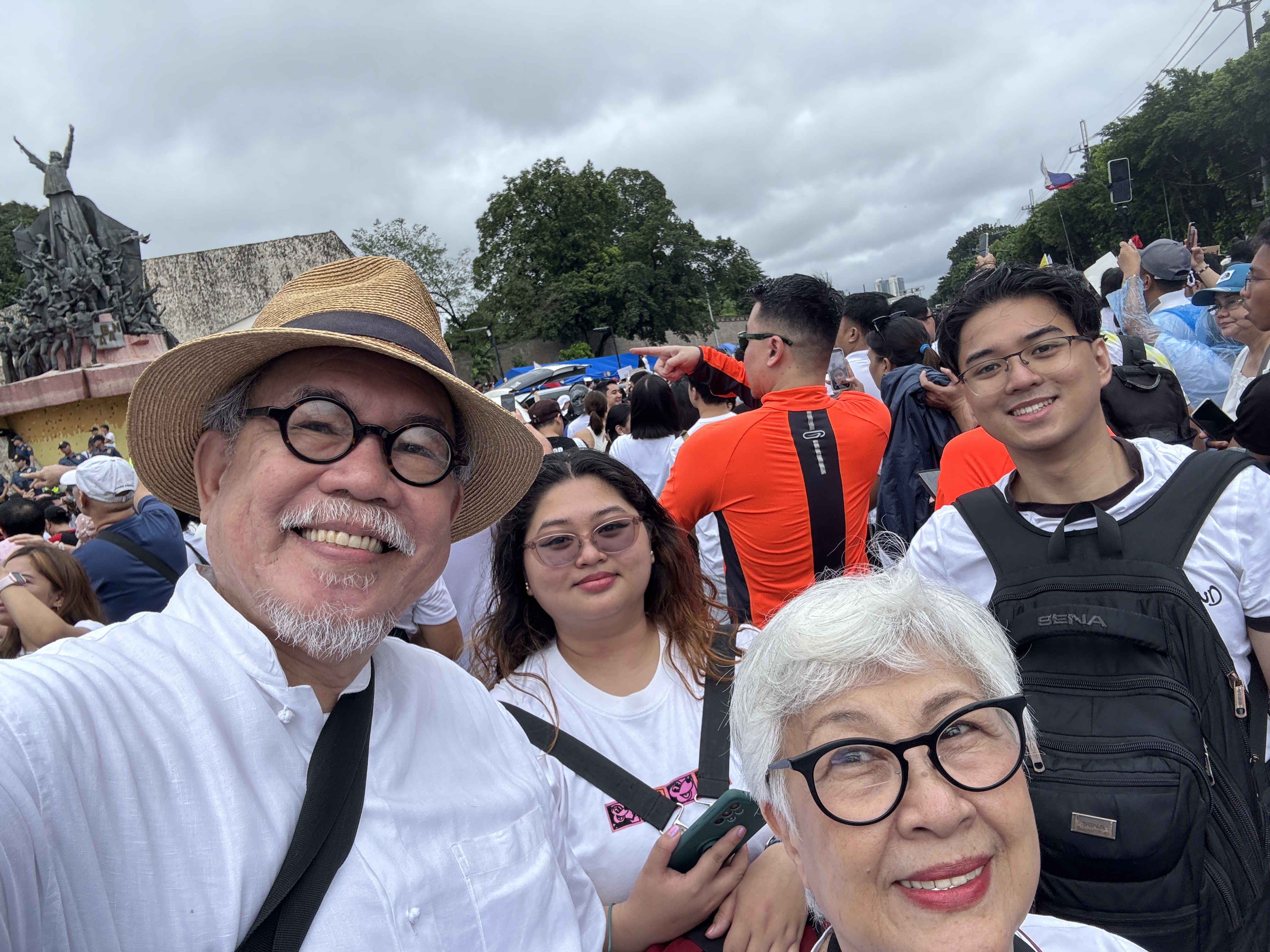
The flash mobbers who went to the Luneta and EDSA yesterday weren’t being foolish; even in their rage, they held out hope, and especially for the young, their very presence was the hope, a cry for justice echoing across the generations. 

We can’t say what will happen next, but something good might yet come out of all this woefulness and despair, if we don’t listen too closely to our inner analyst. Instead of shunning the DDS, for example, I think this corruption crisis is a good opportunity to find common cause with them and even bring some of them over. The catastrophic flooding in Davao despite the billions given to the Dutertes in flood control money should be an eye-opener for their supporters—just as it should be a reminder to us that the DDS are Filipinos, too, with legitimate rights and grievances. 

If this trillion-peso corruption crisis helps us realize the substance and spirit of our nationhood, then it will have served a positive if costly purpose.

Qwertyman No. 135: Fighting the Truth

Qwertyman for Monday, March 3, 2025

BEAR WITH me as I begin this Monday’s piece with a quotation about last week’s celebration (or non-celebration, from another point of view) of the 1986 EDSA People Power uprising. It really doesn’t say anything we haven’t heard before, but I want you to read it slowly, giving it the full benefit of its sincerity and passion. If you were at EDSA as I and my family were, and no matter how distant a memory those four days in February may seem to be now, these words should still provoke even a flutter of patriotic fervor, and a wistful thought that, perhaps, the EDSA spirit does live on in these troubled times. 

“Martial law, declared by Ferdinand Marcos Sr. in 1972, left a dark legacy; countless lives were lost, freedoms were stripped away, and power was concentrated in the hands of a few. As we remember those who suffered and fought for our liberties, we must remain vigilant, especially now, when the threat of authoritarian rule once again looms over our nation. People Power was more than just a revolution; it was a testament to the collective strength of the Filipino people in demanding truth, justice, and accountability. It is also a reminder that we must remain united against any form of oppression…. Let us honor its legacy by ensuring that history is never distorted, our rights are never trampled upon, and our democracy remains intact for future generations. May the darkest times in our history never happen again.”

Just the kind of resonant exhortation you’d expect from a staunch defender of civil liberties and human rights, right? 

But would your appreciation of these words change just a bit if you knew that they were spoken not by the likes of a Leila de Lima or a Kiko Pangilinan, but by Davao City Mayor Sebastian “Baste” Duterte, whose EDSA Day message this just happened to be?

Truth? Justice? Accountability? “United against any form of oppression?” Where were these noble words when the good mayor’s dad was president, and announcing blatantly on various occasions that ““My order is shoot to kill you. I don’t care about human rights…. Let’s kill another 32 every day. Maybe we can reduce what ails this country…. I will assume full legal responsibility…. My mouth has no due process.”

That “legal responsibility,” of course, has yet to be assumed, full or otherwise. Instead, once he fell out of power, that man (and, last we heard, lawyer) who flaunted his wanton disregard of the law suddenly found religion, and the gumption to say this when his buddy Apollo Quiboloy and his cult followers were raided by the police:

“Our country has never been in a more tragic state as it is today. Rights have been trampled upon and our laws, derided…. We call on the remaining decent and patriotic members of our government not to allow themselves to be used and to be abusive and violent in enforcing illegal orders…. We call on all Filipinos, regardless of political persuasion, to offer prayers for peace and justice, and to spare our people of the unwarranted tension brought about by the reign of fear and terror by people sworn to uphold the law and protect the citizens of this country.”

It makes sense that this statement was published rather than spoken, because I can’t for the life of me imagine how The Great Punisher could say “unwarranted tension brought about by the reign of fear and terror” with a straight face and not burst out laughing—or maybe his listeners would, if they weren’t seized by, well, fear and terror.

Not to be outdone, on a recent sortie to Cebu, embattled Vice President Sara Duterte reportedly declined to answer questions about her impending impeachment trial in the Senate, preferring to leave the matter to her lawyers, but was quoted as saying that she was banking on her “loyalty to truth” to see her through. Ummm, okay…. Now can we please hear the truth, and nothing but the truth, about Mary Grace Piattos?

I suppose it’s a sign of how low the value of words like “truth,” “freedom,” and “justice’ have fallen when the very people accused of spitting them into the garbage now spout them like nobody’s business. Perhaps we shouldn’t be surprised that they’re doing this, given the success of Donald Trump at doing the very thing he says he hates, e.g. weaponizing the justice system. There must be pages of advice in the 21st century edition of Playbook for Politicians for just this kind of brazenness, maybe under the Chapter “Reversals of Fortune.” What’s surprising—and scary—is how they continue to be believed by followers such as “Ging C.” whose fervor led her to gush, on PRRD’s FB page, “By God’s favor VP Sara you will win this fight. God of truth is on your side and those people who fight the truth!” (Ooops….there’s a “for” missing there somewhere, but really, does it matter anymore?)

And lest we think only the Dutertes have mastered the art of dissimulation, let me leave you to guess who the character implicated in the following quotes is.

On Independence Day in 2018, someone posted on Facebook that “Freedom is every human being’s birthright. But to claim that right, the time always comes when we are called to fight for and defend that freedom. The Philippines and her people fought long and hard, sacrificed life, limb, treasure and more to achieve our independence 120 years ago. The call for liberty and sovereignty was answered by our heroic ancestors, sacrificing their all at the altar of honor and freedom and country.

“Today we remember, and in remembering, we consecrate that memory of all the courageous and selfless Filipino patriots—our heroes—who gave their lives for that freedom, and to whom we forever owe our status as a free, independent and sovereign nation in the community of nations. Let them long live in our minds, our hearts, in our very souls, the heroes of our great country, our beloved Philippines.”

In a speech before the Kapisanan ng mga Brodkaster sa Pilipinas last November, the guest of honor declared that “Now, more than ever, our democracy depends on an informed and vigilant citizenry…. With the 2025 elections ahead, I am committed to protecting our journalists in championing fearless and credible reporting. Together with KBP and our partners in media, we will stand firm against disinformation, ensuring that every Filipino has access to voices of truth.”

I would love to cry “Amen!” Wouldn’t you?

Qwertyman No. 69: Tabi Kayo Riyan!

Qwertyman for Monday, November 28, 2023

WHEN THE EDSA busway—a special lane just meant for public utility buses—was inaugurated in June 2020, I was among the many millions of Metro Manila motorists and commuters who breathed a sigh of relief and said, “Finally! Somebody’s come to their senses and did what had to be done.” 

It wasn’t going to banish the traffic problem for good—that burden still lies with our woefully inadequate mass transit system—but it applied a logical solution to a particularly oppressive aspect of our urban existence, the infernal sludge that tossing private cars and public buses into the same slurry produces. The traffic’s still bad in many spots on busy days and hours, but at least you could see some order in disorder. For this driver in his car, I can even find some ironic humor in watching buses speed down their lane while I struggle like a jockey in the middle of the pack to keep a nose ahead of the big SUV sniffing at my flank.

We’ve seen these special bus lanes in use elsewhere—most notably in Jakarta and Bangkok—and they seem to work. (Bangkok’s bus lanes have been around since 1980; Chicago adopted the world’s first bus lane in 1940.) London has set aside about 80 kilometers for 24/7 bus lanes, but some other roads also have designated bus lanes during peak hours; the fines are stiff, going up to as much as P11,000 for an infraction.

Here in Manila, according to the Management Association of the Philippines (MAP), just 550 buses transported as many as 450,000 people a day along EDSA as of December 2022; in its 30 months, the busway accommodated 154 million passengers. That’s a lot of traffic and a lot of people, and the true social benefit of a bus lane isn’t that these buses and their passengers are being shunted aside for our cars to move a little faster, but that those passengers—most of them the workers and wage-earners to whom we owe our other comforts—get to work and get to come home to their families sooner. It’s tacit acknowledgment that their lives are hard enough, and every bit of relief counts. In a sense, it’s social justice in practice. 

But now comes a proposal from the Metro Manila Development Authority (MMDA)—already approved by the Department of Transportation (DOTr), we’re told—to grant exemptions to the President, the Vice President, the Senate President, the Speaker of the House, and the Chief Justice, riding in five-car convoys, to use the bus lanes. Even more, senators and congressmen are also being considered for exemption (emergency vehicles and properly identified government vehicles are already exempted).

It might be argued, at least in theory (since the mischievous will ask for proof), that the big poohbahs have important national business to attend to, requiring their expeditious transport from Point A to Point B. (In Jakarta, only the President and the VP are exempt.)

The same cannot be said for senators and especially congressmen whose business it is to know the situation on the ground and to bring relief to their commonest complaints. Chief among those complaints for millions living in the metropolis is the horrendous traffic, a three-hour immersion in which should be part of every politician’s initiation into public service. 

As even Patricia Evangelista noted in her landmark book, Some People Need Killing, President Noynoy Aquino—for all of his virtues—lacked and almost disdained the common touch. But he understood the fundamental relationship between a leader and his people, and what he may have wanted in empathy, he compensated for in correctness. His proscription against the use of sirens and alarms to open a Moses-like path through traffic for government officials may seem trivial but sent absolutely the right message to citizens for whom “Daang Matuwid” might as well have been just another throwaway slogan. 

Sadly, our “wang-wang” culture—which, as a STAR editorial noted just last week, involves “not just the actual use of sirens and blinkers by VIPs whether in government or in the private sector, but the mindset itself that it’s OK to jump the line and that public officials deserve such VIP entitlements”—has crept back after PNoy, with a vengeance. 

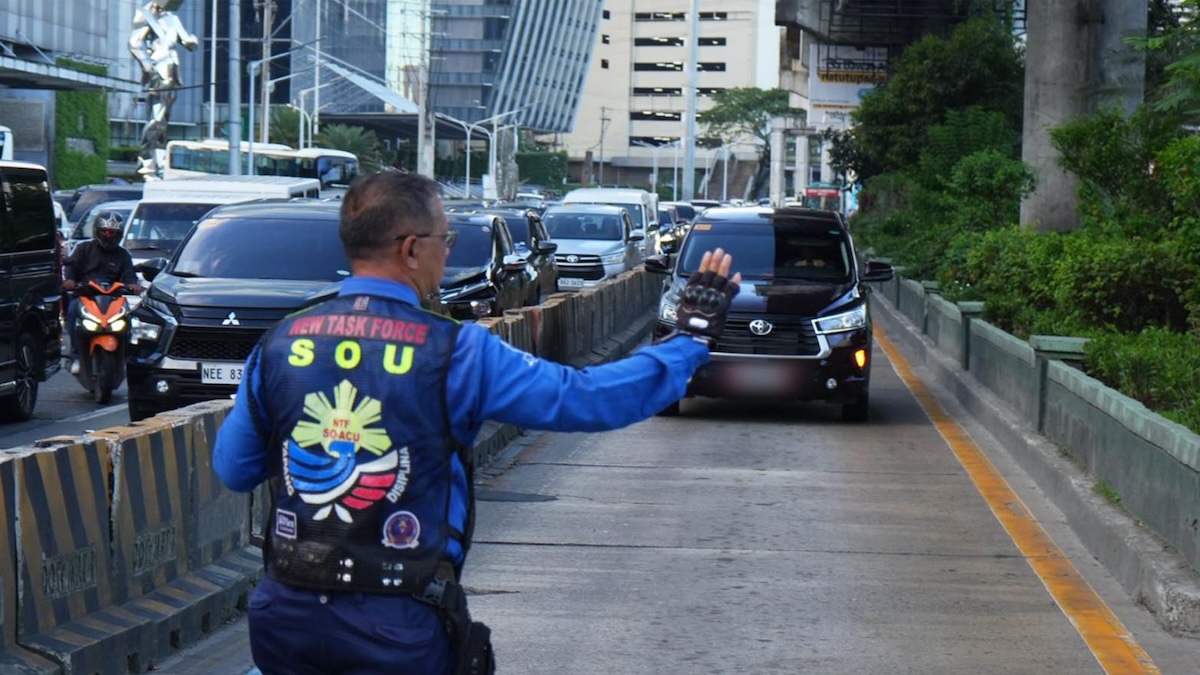
The convoys of black, tinted SUVs with their sirens screaming “Tabi kayo riyan!” have become ubiquitous once again, flaunting the perks of power. The MAP deplored this by stating that “Accommodating convoys of officials demonstrates inconsistency of public policy: favoring the privileged few over the overwhelming majority of the commuters and motorists who deserve an efficient EDSA busway.” I’m sure that you and I have shorter and less Latinate words to say every time one of those convoys brushes past us on EDSA and along that larger avenue we call Philippine society.

That society, for better or for worse, takes its cues from the top. When our presidents behave, we (or most of us, at least) try to walk the straight and narrow; when they steal, their minions feel emboldened if not empowered to fill their own pockets; when their mouths spew obscenities like sewers, rudeness and vulgarity become excusable, and even fashionable.

In the Tang dynasty, the Emperor Taizong was known to be a wise ruler, and even wrote The Zenghuan Executive Guide, a kind of management manual. Among his best practices was the employment of “remonstrants”—as many as 36 of them—whose job was to provide the Emperor with “remonstrances,” to tell him to his face what he was doing wrong. “I often sit quietly and reflect on myself. I am concerned that what I have done may … cause public discontent. I hope to get advice and remonstrance from honest men so that I am not out of touch with the outside world,” Taizong was quoted as saying.

There’s no record of whether the Emperor Taizong’s soldiers pushed other wagons and pedestrians aside on the road to make way for the imperial train, but I suspect not. I just wonder, who will be our Taizong, and who will be his remonstrants?

(Photo from topgear.com.ph)

Hindsight No. 7: Disinformation and Democracy

Hindsight for Monday, February 28, 2022

(Image from designtaxi.com)

LAST FRIDAY—the 36th anniversary of EDSA 1—I spoke to a group of university students who wanted to know what I thought of Filipino democracy. 

I told them that at EDSA, along with millions of other Filipinos, I jumped for joy at the news that Ferdinand Marcos had fled with his family. We did not know—and might not have cared too much then—that they had brought two planeloads of gold and cash with them to Hawaii. All we wanted to hear was that they were gone, presumably for good, and that we were off to a fresh start at peace, freedom, justice, and prosperity. The darkness of the past twenty years would lift, and a new Philippines would emerge, truly democratic and firmly opposed to any form of despotism.

Today we realize what a fantasy that was, what a temporary reprieve. Under Rodrigo Duterte, if the polls are right, most of our people have once again embraced authoritarian rule, implicitly accepting its attendant excesses. The dictator’s son is back, and may even become our next President—to the delight of his supporters for whom martial law never happened; or if it did, then it was a golden age to which we will soon be returning, an age of new roads and bridges, clean streets, industrial peace, Miss Universe pageants, and eternal sunshine. 

Indeed it would be as if the past half-century between 1972 and 2022 were a confused and hazy dream, and now we were waking up where we had left off yesterday, when Ferdinand E. Marcos was poised to “save the Republic and build a New Society.” His son is making sure that we don’t miss the connection by heralding his entrance at his campaign rallies with the anthem of martial law, “May Bagong Silang.” Most of his followers today have never heard that song, or understand its chilling context, or the price we paid—in blood and in billion-dollar loans—for that “new dawn.” To them, it is a catchy jingle, in marching tempo. It comes with the smell of money and power in the air, the promise of a shower of gold for the hopeful masses. 

This, of course, is also a fantasy, but a powerful one—and I think I will be correct to surmise that many of the students I addressed, and even their teachers, fully believe it. And why not? They were never taught in school about the horrors of martial law. Instead, they were told that those were good times, that the Marcoses were good leaders who were deposed by their enemies and the CIA, that rich people don’t steal, and that the Marcos billions came from the gods, Yamashita, and anywhere but the Philippine treasury. That diet of lies has now become a catered banquet. 

The biggest enemy of democracy today—more than at any other time in our or even the world’s history—is disinformation: the willful distortion or fabrication of information to create false beliefs or impressions in the minds of people, turning bad to good, wrong to right, and vice versa. 

This is happening not only here in the Philippines, but in many other places around the world—including America, where Donald Trump has been pushing the “Big Lie” of a stolen election, despite the lack of any credible evidence. Even earlier, in what has by now become a cliché, Josef Goebbels thundered that if you repeat a lie a thousand times, it becomes the truth. 

During and after WWII, military experts engaged in what was called “psywar” or psychological warfare to weaken the enemy’s mental defenses, lower morale, and make people switch sides. This was done through radio, leaflets, newspapers, and other media available at the time.

Today the prevalence of the Internet and social media has magnified the means for disinformation by a magnitude of millions. And this is scary, because according to a recent survey, every other Pinoy can’t tell real news from fake. How can a society so prone to disinformation—to fake news—function well as a democracy?

Last month, the Akademyang Filipino (on whose Board of Trustees I serve) sponsored a forum on the topic of “Can Democracy Win in May 2022?” Most such questions are meant to be rhetorical, with obvious answers. But this time, the more I thought about it, the more I was bothered by its actual complexity. The problem, I realized, is that we no longer have a clear and common idea of what “democracy” means.

There are as many definitions of democracy as there are politicians eager to appropriate it. “Democracy” has to have been one of the most ambiguous and most abused words of the 20th century, going into the 21st. When a brutal totalitarian state like North Korea styles itself as the “Democratic People’s Republic of Korea,” you know something somewhere has gone awfully wrong. Dictators will call their actions democratic—as Ferdinand Marcos and Muammar Ghaddafi did—by asserting that they are acting on behalf of the people, a responsibility that presumably entitles them to extraordinary powers and compensations.

In my layman’s understanding, democracy is the rule and exercise of power by the people through representatives they choose by a free and fair election. It seems simple, but immediately we can see how vulnerable this definition of democracy is to interpretation and manipulation. What is a “free and fair” election? Does it simply mean an election free of vote-buying, coercion, and fraud?

If a candidate wins more than 51% of the vote without obvious coercion or cheating, then will that candidate have won a democratic election? But what if those voters had been fed provably false information? What if they willingly believed that information to be true, and voted on the basis of it? Would this still be democracy at work? 

Arguably, yes, because democracy never promised only intelligent outcomes. Elections are emotional, not rational, exercises. This disturbs me deeply, but again I have to ask myself, am I idealizing democracy as something that can be perfected? Or should I just accept that democracy, like society itself, is inherently messy, mercurial, and manipulable? 

What kind of democracy do we Filipinos have, and what kind of democracy do we want? The vote this May will help provide the answer. 

Penman No. 417: From Cory to Covid: An Alternative History

for the Star’s 35th anniversary, July 2, 2021

WHEN THE Philippine STAR was founded 35 years ago, we were still enveloped in the euphoric glow of having successfully deposed a dictator peacefully and installing an icon of democracy in his place. I was one of that happy throng on EDSA celebrating what we believed was a new dawn of hope, a fresh opportunity for our people to grow in freedom and prosperity. Like many writers, I ran out of metaphors and superlatives to describe that moment, which seemed nothing short of miraculous. 

Nowadays it has become commonplace—indeed even fashionable in some quarters—to revise and reject that narrative, and to claim that it was a foolish mistake to have replaced a seasoned politician with a rank amateur. Martial law wasn’t so bad; no wanton thievery took place; only a few were hurt for the good of the many; we were never so disciplined, and our streets were never so clean.

How we came to this point—like the resurgence of Nazism in Europe and of racism in Trump’s America—is for me the great mystery of those 35 years, an arc of sorts marked by Cory on one end and by Covid on the other. There’s certainly no pot of gold at the end of this rainbow, as should happen in fairyland—which we rather quickly realized, right after EDSA, was not where we were.

For some such as Jose Rizal, Alexander the Great, Wolfgang Mozart, Manuel Arguilla, Bruce Lee, Eva Peron, and, yes, Jesus Christ, 35 years was a lifetime. You could have been born in a hospital while the tanks were massing at EDSA, and died this year of Covid, gasping for breath in that same place. Had that happened to me, I would have protested and pleaded, albeit inaudibly through my tubes, that it wasn’t fair, that I deserved a peek over the horizon, at least through to the May election, to see if it was worth the wait—or not, and then slink into sullen slumber. 

During that time, I grew from a young father and a writer on the verge of a teaching career to an aching retiree surrounded by old books and creaky machines, and I have to wonder if our nation fared better and learned as much. Or should I say “unlearned”? At EDSA I learned to hope, to trust in the ideal and the good again, to have positive expectations of the new century looming ahead. FVR and his “Philippines 2000” thumbs-up may have seemed hokey at the time, but there was a genuine spring in that step, a sense of things going in the right direction. And then they began falling apart, the old mistrust and suspicions returned, and we took one president down and nearly succeeded with yet another.

But it wasn’t just us. The closing decades of the 20th century were a time of sweeping changes all over the world. Soon after Marcos fell, a tide of reform and revolution washed across Eastern Europe and eventually into the Soviet Union itself; that union collapsed, the Berlin Wall fell, and it seemed like the era of dictators and despots was over, but it was not. With Hong Kong in its navel, China morphed into a commercial colossus, proving that freedom and capitalism do not necessarily go together. The 1997 financial crisis shook the planet.

After 9/11, whatever remaining hopes we had of a better new century vaporized, and the new specter of terrorism now stalked the globe. Barely had ISIS retreated from the sands of Syria when a new and even more insidious plague, Covid-19, threatened to annihilate mankind. 

Others will remember this period as the age of cocaine, corporate greed, mass shootings, and, generally speaking, a culture of excess, of over-the-top indulgence on whatever floated your boat: drugs, sex, money, power, toys. Very few people had actual access to them, but the media—that’s another whole story—kept glorifying vice as virtue, until many began to believe it well enough to dream. It was Dickens’ “best of times and worst of times” all over again.

That would be the sober—and sobering—summary of what tomorrow’s history books will be saying about those decades. But of course—and thankfully—it wasn’t all politics and the misery that often comes with plays for power.

There’s a part of me that wants to tell the story of these past 35 years as the rise of consumer technology toward near-total domination of our daily lives. Humor me as I recall little vignettes to show what I mean.

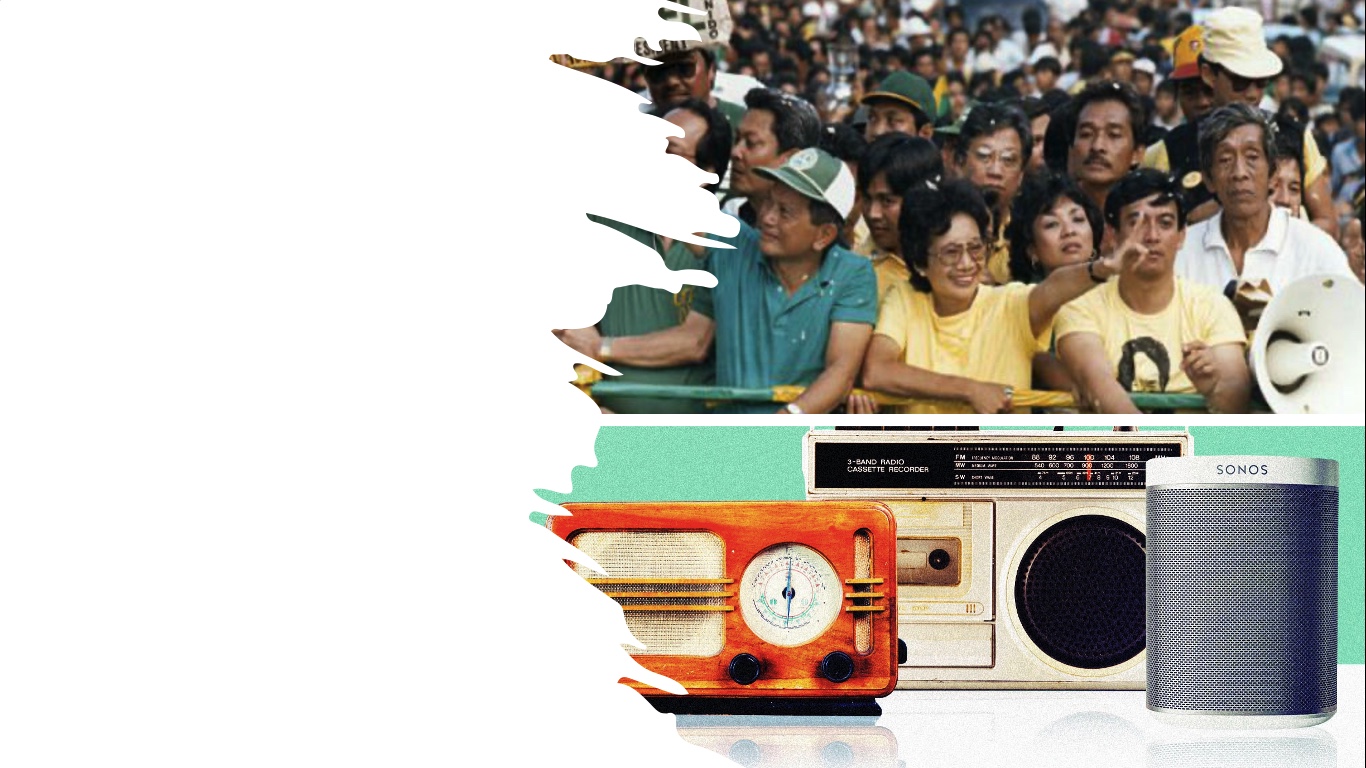
When the EDSA uprising broke out, we heard the news over a big black Panasonic radio-cassette player that I had picked up years earlier at the Zamboanga barter trade place (along with the obligatory sotanghon and White Rabbit candies). It was—beside our 12-inch, black-and-white, red plastic-bodied TV—our news and entertainment center in the boonies of San Mateo. It sat on our dinner table, accompanying our meals like a permanent guest, sometimes directing the conversation.

When it spewed out the news that something dramatic was taking place at EDSA, and when we heard Cardinal Sin calling on people to go, we knew we had to. Not long after, we piled into my VW Beetle, turned on its radio for updates, and headed for the trenches. For the next few days or so, radio was king, whether at home, in your car, or in your pocket (yes, boys and girls, there was pocket radio; TV was around but only the coolest people had portable versions).

I missed out on most of the Cory years because I went to America for my graduate studies, and there I became anchored to the payphone for my calls home, clutching a handful of quarters to feed the machine. I had hand-carried an Olympia typewriter to write my thesis on, but then I discovered computers, and in 1991 I lugged home a 20-pound behemoth with all of 10 megabytes to fill up. I felt like a gunslinger—I was going to write the next Noli, protect the weak, and get justice with one floppy disk after another.

Nothing would define the ‘90s more than the personal computer, and I soon equated the machine with creation, the blinking cursor with a challenge to produce. I drooled (and lost the plot) when I watched Scully and Mulder hunched over a super-sexy PowerBook 540c in the X-Files, and when I got my own, it was like Moses receiving the tablets—with a trackpad and an active-matrix display. 

Soon another gadget emerged with which we felt even more tethered to some central brain: the pager, whose insistent buzz enhanced our importance, even if it all it asked was where you were and could you please come home. Fake news had yet to be invented as a cottage industry, but a lot of it, I’m sure, went through EasyCall and PocketBell.

By the time the next EDSA happened, we had something far snappier and more personal than radio with which to undertake regime change. Yes, I was now writing speeches on a Mac, but the messages flew thick and fast on a new gadget—the cellphone. If EDSA 1 succeeded because of radio, this iteration flew on the wings of SMS, the millions of texts (the jokes, the rumors, the calls to action) whose accretion would spell the end for an inebriated presidency. 

As it happened, 2001 would be memorable for another image seared into our consciousness: the collapse of the Twin Towers, brought to us slightly delayed and in full color by satellite TV. We’d had TV before, of course, but had always seen it more as Comedy Central, a box to gather the family around. CNN changed that, and brought the world’s torments to our living rooms. Cheaper TVs, one in every room, had long fragmented the family, especially when Betamax and VHS, the precursors of Netflix, became available.

A few years later, a cellular phone call and a recorder almost took another political giant down, causing millions to gasp and laugh as the tape was replayed on TV and radio over and over. “Ang importante hindi madamay yung sa itaas,” said a female voice, which was exactly what happened. That year, 2005, was also the year a platform called YouTube was born—and thanks to YouTube, the tape can still be heard, for all digital eternity.

Indeed, video, the Internet, and social media would soon change the political and cultural landscape, not just here but the world over, although the Pinoy—perhaps in response to that elusive quest for Olympic gold—has towered over much of humanity in terms of Facebook usage (and earlier, in SMS transmissions). One way of putting it would be that we are the world’s champion usiseros and chismosos, resorting to Twitter or Instagram at the merest hint of an idea, no matter how malformed. 

Today we have an abundance of information and information sources at our disposal—and yet we seem to be as ill-informed as ever, with opinions shaped and manipulated by Sith Lords in the Dark Web. Dismissing newspapers and editors as gatekeepers of the truth—which not all of them have been—we create our own versions and peddle them instantly for a thousand “likes,” the supreme accolade of the early 21st century. Most others might prefer to be simply receivers and forwarders of whatever crosses their screens, the passive agents of mindlessness.

Thirty-five years ago, we drove to EDSA on pure conviction that it was the right thing to do. Without Twitter or even SMS, no one could tell us “Right on!” or “Me, too!” We listened for scraps of news and turned them over and over in our hushed minds; we could be killed; we could be free; would our friends be there; what else did we study for. It was a long drive from San Mateo to my in-laws’ place in Project 4, where we parked the car and walked to EDSA. It was a lot of time to think. 

Thirty-five years is a lot of time, but looking around today, with Filipinos still dying by the gun or by drowning in one’s own fluids in some alien hospital, I have to wonder how this narrative arc from Cory to Covid will end—or how much longer it will go, at least in my lifetime, which naively still yearns for a happy ending.

Penman No. 218: History and Irony

11884866_supreme-court-extends-status-quo-ante-order_e9546b1e_m.jpg

Penman for Monday, September 26, 2016


I’D NEVER heard of Ramon Cualoping III and Marco Angelo Cabrera until their names were linked to the recent flap involving the use of no less than the Official Gazette in an apparent effort to sanitize the memory of Ferdinand E. Marcos by removing any reference to martial law—you know, the martial law that Marcos invoked to impose his dictatorial rule on his people from 1972 until he was deposed by a popular revolt in 1986. (Yes, he technically lifted martial law in 1981 but he continued to rule with a rubber-stamp legislature.)

Some Googling revealed that Cualoping was an Ateneo Communication Arts graduate, batch 2004, while Cabrera graduated from San Beda in 2013 and interned briefly with the Department of Foreign Affairs; he had also worked for Sen. Bongbong Marcos. Those are both fine backgrounds for jobs at the Presidential Communications Operations Office—just the kind of posting on which many young writers and lawyers aspiring for a political future have cut their teeth—and I can surmise from the dates provided that Messrs. Cualoping and Cabrera must be in their mid-30s and mid-20s, respectively—too young, therefore, to have personally known what the Gazette expunged.

In the interest of full disclosure, I was a government propagandist myself at an even younger age—19, fresh out of martial law prison. Having dropped out of UP and having worked for the Philippines Herald and Taliba just before martial law, I got a job with the PR section of the National Economic and Development Authority. The irony of going from writing incendiary flyers to trumpeting such new government projects as Pantabangan Dam wasn’t lost on me. But I was getting married and needed a job, and all the old media jobs were gone save for the Express and the Bulletin, so I was thankful for whatever came my way. (I would much later write hundreds of speeches for FVR, among other Presidents and political clients—mostly to pay the rent, occasionally for the sheer privilege—so don’t look at me as some crusading journalist.)

I don’t know what drove Messrs. Cualoping and Cabrera to the Palace; I’m assuming their motives were loftier than mine. I also don’t know what made them officially forget (hey, it’s the Official Gazette, right?) that FM declared martial law. I suspect they knew what happened, but chose to ignore the most salient fact about Marcos’ life, for reasons only they can tell. To his credit, Communications Secretary Martin Andanar effectively reprimanded his staff for the deliberate oversight and corrected the record.

I’ll leave further chastisement of these two gentlemen to the netizens who broke the story. From one PR pro to another, what I can tell them is this: I understand the job you have to do and even your private allegiances, but there are things—very big things much bigger than yourselves—that you just can’t sweep under the rug. Denying martial law or its disastrous effects on our society and economy is like telling Jews that the Holocaust never happened, or was actually a good thing. I salute you for your cheek, but what on earth were you thinking?

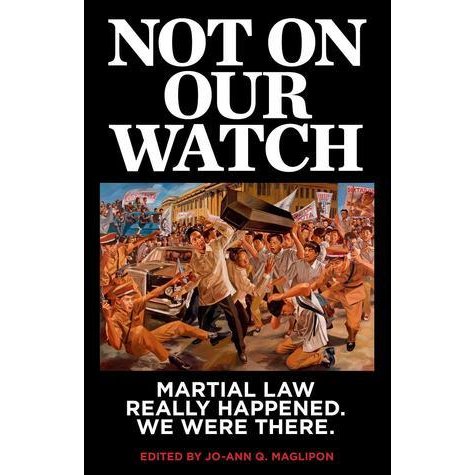
There’s a book I’d like to recommend to these two, one which I and a dozen other writers—all students during martial law—put out four years ago on the 40th anniversary of Proclamation 1081, titled Not on Our Watch: Martial Law Really Happened, We Were There. (For more on that book, see here: http://www.philstar.com/sunday-life/806191/lest-we-forget.) I wasn’t too enamored of the long title at that time, but now I appreciate the emphatic clarity of the thing; it’s just the sort of book martial law amnesiacs and deniers need to read.

16136602._UY475_SS475_.jpg

But even as we review history, there’s one thing that seems to have escaped many: the current debate about how to look at martial law and where to bury Ferdinand Marcos isn’t about the past; it’s about the future, and what kind of people we are and want to be.

I know that millennials tend to get beat up on because they don’t know enough about martial law, which is hardly their fault since we didn’t teach them enough about it. But it isn’t just them. When people my age express bewilderment over how Bongbong Marcos came so close to becoming Vice President despite his dad’s misdeeds, and how the Marcoses have survived so handsomely, I have to remind them that even under martial law, those of us who opposed Marcos were in the distinct minority. Most Filipinos supported martial law, actively or passively, or it wouldn’t have lasted so long. Like the Germans who supported Hitler, most Filipinos stood by while we faced the truncheons and firehoses—and even applauded 1081, early on, as the antidote to Communism (1972’s “war on drugs”). So what should we be so surprised about?

That’s why I’ve never referred to EDSA 1 as a revolution, because it wasn’t one in terms of changing anything fundamental in the structures and workings of our society. It was a popular uprising, a street revolt led by another faction of the ruling class, with broad support from the metropolitan middle class. That doesn’t mean I didn’t feel euphoric that February, and I still get teary-eyed when I remember the moment; I guess the poignancy comes from knowing what came afterward.

I have no doubt that if the Palace incumbent were to declare martial law today for whatever reason, a majority of Filipinos would support him, although a noisy few of us would be up in arms. Martial law ca. 1972 was also like that, and remained popular for many more years, especially among amoral businessmen who sang its praises until it hit them in the pocket. And then it all went downhill.

Contrary to what you might expect, I don’t see Marcos as a one-eyed ogre, but rather as a calculating Macbeth, keenly aware of his actions and perhaps even troubled by them. In my own turn with revisionism, I’ve even managed to convince myself—as I told the BBC in a recent interview on EDSA (a part which never got aired for lack of time)—that Ferdinand Marcos may have done us a final act of kindness by leaving without ordering a bloodbath. It’s an arguable notion (one I wouldn’t put on the Official Gazette) and it doesn’t change the fact that his regime took what it could until we bled, but as a fictionist and playwright, I like to imagine characters to be more complex than they seem.

A couple of years ago, at a cultural function in Quezon City, Mrs. Marcos preceded me by a few steps down a narrow staircase. She was clearly having a hard time navigating the stairs, and she looked back at me apologetically to say, “Hijo, I’m very sorry I’m keeping you.” I smiled and said, “It’s all right, Ma’am, please take your time.” I felt amused and strangely triumphant.

History is sometimes best seen as a series of comic and tragic ironies, which straight journalism and certainly government tabloids can’t dispense. Come to think of it, who gives a hoot about the Official Gazette? If you want to lie and get away with it, try fiction. I’d be happy to see Messrs. Cualoping and Cabrera in my graduate workshop.