Qwertyman No. 151: For Don, a Meditation

Qwertyman for Monday, June 23, 2025

(Photo of Los Cabos by Kurt Nichols)

I WAS looking for a topic for this column last week when it occurred to me that I had been staring it in the face, in the news and in the Facebook feed that, like for many, my days begin and end with. It was the omnipresence of death, in its many forms and guises, swift and slow, painless and agonizing, arriving on whispery feet and crashing through one’s roof or window. 

“A screaming comes across the sky,” the line with which Thomas Pynchon famously begins his novel Gravity’s Rainbow, was how death and destruction came last week to hundreds in Kiev, Tehran, and Tel Aviv, in missiles and drones designed and manufactured for but one purpose: to deliver death by inexact algorithm to place-names plotted on digital maps. 

In India we marveled at the horror and the mystery of one survivor escaping a catastrophic plane crash barely a minute after take-off: a moment when most of us would have just begun to fidget with the entertainment controls, wondering whether to take in a comedy or a thriller for the next two hours and what the meal choices will be. 

In Minnesota, a MAGA gunman stalked Democratic lawmakers and their families, shooting four and killing two on a long list of intended targets—murders that a Republican senator reflexively attributed to “Marxists not getting what they want.”

Most appalling was the report of Israeli tanks firing into a crowd of Palestinians lining up for food in Gaza, an incident that led to about 60 deaths and more than 200 wounded, for which the Israelis apologized with this statement: “The IDF regrets any harm to uninvolved individuals and operates to minimize harm as much as possible to them while maintaining the safety of our troops.”

As if the news isn’t enough, every time we scroll through our social media accounts, more deaths emerge, in the now-familiar solitary-candle meme and in the garlanded portraits of the recently departed. Facebook has become our new obituary page, our book of condolences, our virtual wake. The friend or the kinsman in us takes the loss with the requisite pain and grief; the enemy with muttered thankfulness, or more rarely forgiveness; the human with relief, that we are reading and not being read about.

Death in the news is meant to outrage us, and it still does, at least for a while, especially senseless and preventable death, willful murder, and patent genocide. But sadly we can only take so much, even with the keenest of consciences; there is something in our brains, a control or shut-off valve, that says “Enough” and leads us back into the immediate and comprehensible present, back to chocolate cupcakes, Torx screwdrivers, tomorrow’s court hearing, and Lola’s birthday. This, we remind ourselves, is life, the only one we have, our chief responsibility above all others to live and to give meaning to. 

We try to make sense of death as much as we do of life, and for those of us of a certain age, that means the acceptance of its inevitability. I suspect that those of my generation who came of age under martial law and fought it, who saw dozens of our comrades die, can do that with more equanimity than most, never having expected to live beyond twenty-five; every year and decade since has been a grace note, a blessing we have been careful not to waste. We are lucky to have come this far, and can leave without regret.

The Buddhists have what they call maranasati, the practice (says Google, meat-eating me being decidedly non-tantric) of contemplating one’s own mortality to cultivate mindfulness, reduce fear of death, and appreciate the present moment. The practical Swedes have döstädning, celebrated in The Gentle Art of Swedish Death Cleaning: How to Free Yourself and Your Family from a Lifetime of Clutter by Margareta Magnusson, a Nordic Marie Kondo who advises us to downsize and clean up our mess before we croak to save some grumpy nephew the trouble of sorting out which things go to the trash and which go to the resale shop. 

Speaking of which, my devotion to Japan-surplus stores and their wonderful bargains is tempered by the knowledge that most of these items were likely made available by the peculiarly Japanese practices of hikikomori, or withdrawing from society and living alone, and the even sadder kodokushi or “lonely death,” where the bodies and belongings of the forgotten might be found days after their passing. But then, as a collector of vintage fountain pens and antiquarian books, I am well aware that these precious objects have passed through many lives and survived their owners, and will certainly survive me, which is strangely reassuring. They offer proof of an afterlife—maybe not paradise, but the life of the people and things you leave behind.

In a way, death’s predictability (or the illusion thereof) is comforting, because we think we can therefore prepare for it, as for the coming of a friend who will lead us away by the hand, down to the smallest detail. Despite her surprisingly good health, my 97-year-old mother has written out her DNR instructions, and a year ago we made a light-hearted trip to the mall to pick out her funeral dress, in a deep, pacific blue. Well before my father died of an aneurysm almost thirty years ago—he was a chain-smoker and a candidate for early passage—I had written out a scene in my first novel where the protagonist comes home to his father’s wake, which was my way, the privilege of imaginative writers, of cushioning the real pain when it struck; when it did, I still wept like my father’s child.

I’m writing this because I’m actually not very good at dealing with death and processing grief, as detached or as flippant as I may sound about it. I avoid or don’t stay long at the wakes of friends because I tend to say the lamest things. 

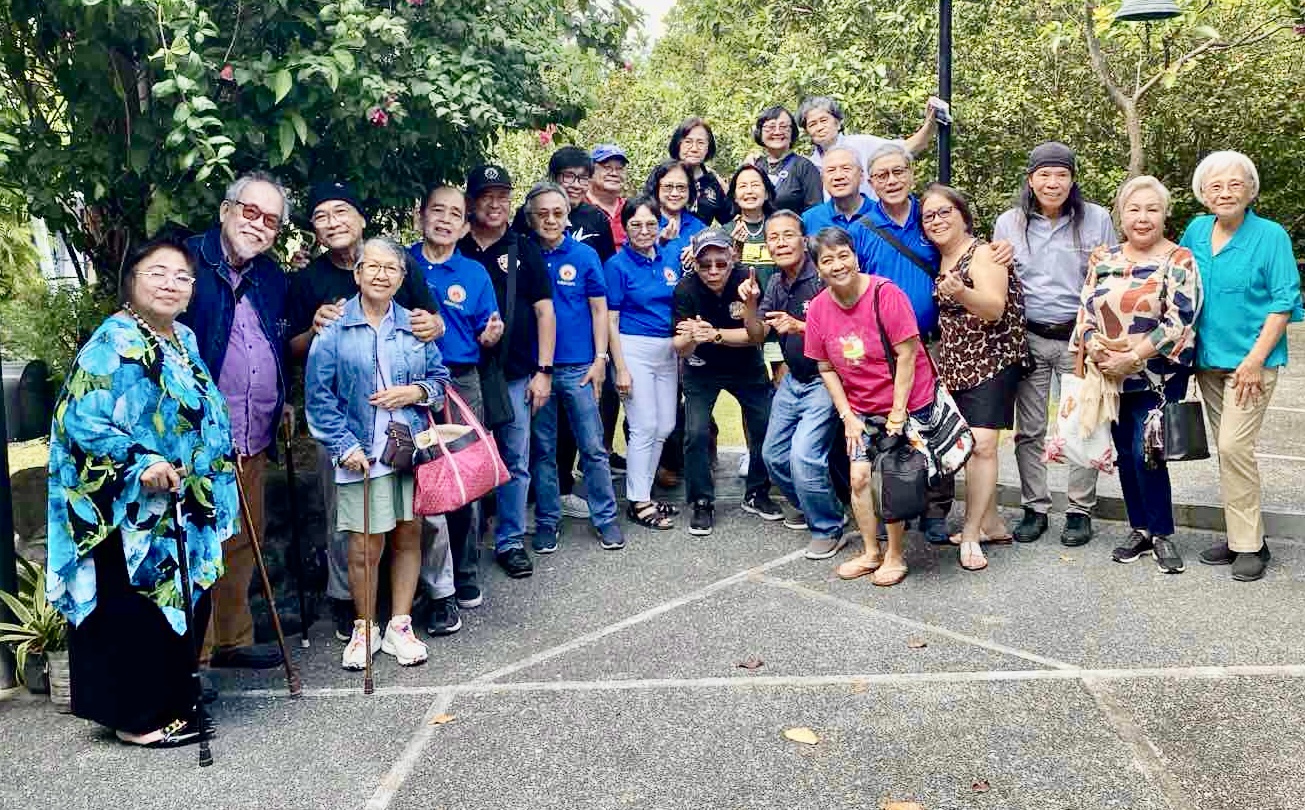
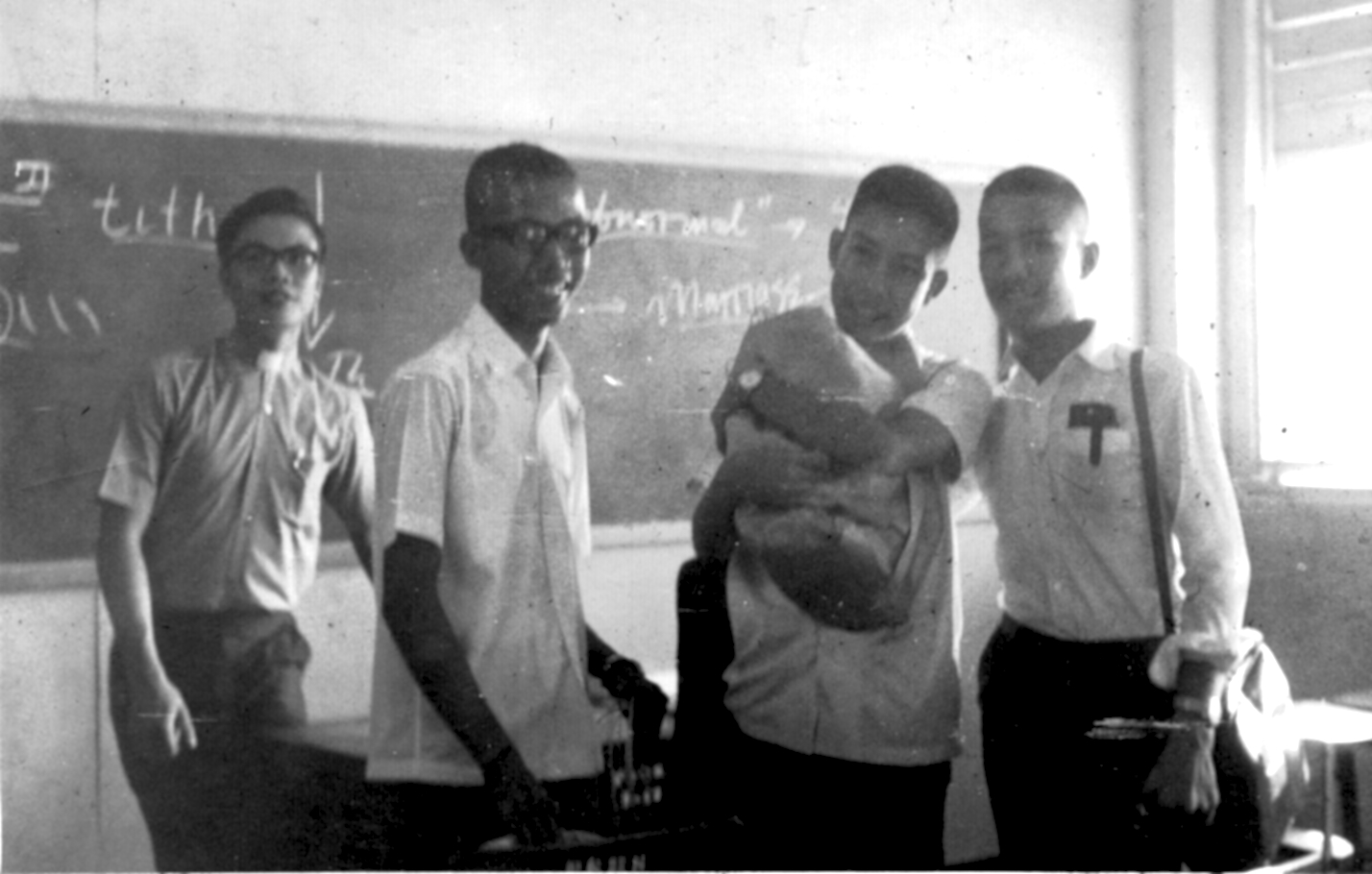
Last week I lost good friend—a high-school classmate named Don Rodis, brother to lawyer Rodel and producer Girlie, whom more people know—our Philippine Science High School batch’s livewire and indefatigably perfect host, to those visiting him in San Francisco. On vacation with his family in Los Cabos in Mexico, Don was strolling on the beach when a rogue wave known by the locals as the mar de fondo caught and swept him out to sea. Despite a massive search, his body has yet to be found. We are all stunned and awash with grief, but what struck me was how pretty that beach was from all the pictures, how blue and inviting its waters. And now I’ll say a stupid thing, for Don: rather than dying from a rocket to your head, or rotting from within, or freezing alone in Yamagata, sometimes we die in beauty’s arms. 

(Don Rodis, 1954-2025, with his wife Jocelyn)

Qwertyman No. 141: Purity and Perfection

Qwertyman for Monday, April 14, 2025

LAST WEEK, former Commission on Audit Commissioner and senatorial candidate Heidi Mendoza—a staunch exponent of good governance and nemesis of crooks—drew flak from some people who would have been her natural allies on the liberal side of the political spectrum: the LGBTQ community. At issue was her expressed disagreement with same-sex marriage, as a personal belief she did not seek to impose on anyone else. That still wasn’t enough for some same-sex marriage advocates, who announced their withdrawal of their support for her candidacy.

Of course both Heidi and her detractors have a right to their opinions, but I can’t help thinking that the only people chuckling at this situation are avatars of neither good governance nor gender rights, but the enemies of both.

Heidi Mendoza hasn’t been alone in this position of being seen to have been right on many things but wrong on—well, something, but something big enough to destroy and erase whatever good they’d done before. “Being seen” is important here, because it’s a matter of perception; like beauty, “wrongness” is in the eyes of the beholder. 

Today’s social media is populated by such beholders who can’t wait to see personalities make what they deem to be mistakes, and often to point those out with all the hawkish attentiveness of dancesport judges and the ruthless certitude of Pharisees. 

I’m sure you’ve come across many more such instances of people whom you thought you knew and whose ideas you had largely agreed with, only to find them—suddenly one morning—the object of the nastiest vitriol the Internet can be capable of dishing. Once blood is spotted in the water, the sharks start circling and a feeding frenzy follows. Many comments simply echo the previous one, seeking to be even louder and crueler; little attention is paid to context and nuance.

Witness what has happened just these past few weeks:

A political scientist and commentator who had grown a substantial following for his liberal positions got skewered for comparing Mindanao to sub-Saharan Africa. Never mind his explanatory reference to a scholarly study which made that comparison based on certain criteria. In the verbal shorthand of a TV interview, the soundbite was all that mattered to many.

An expert on infectious diseases—globally recognized in that field—was savaged for opining that former President Rodrigo Duterte should have been tried by a Philippine court instead of being bundled off to The Hague. Never mind that the good doctor made it clear that he was against EJK and all the wrongs that the old man is now in the dock for. Netizens seemed to take it against him that he tried to explain how many Mindanawons felt about Duterte, and that he had worked under that administration to help stop Covid during the pandemic.

A prominent journalist and exponent of ethical journalism—also a fervent convert to evangelical Christianity—upset and lost many friends when he declared his disagreement with the idea of transgender athletes competing with their biological counterparts. (It was a view shared by a former student of mine, a lawyer and legal scholar of the same religious persuasion.) This man’s longstanding commitment to the truth and to justice seemed trivial compared to what he had to say on this one issue.

No doubt these issues are centrally important to some, the litmus test by which they judge people’s character and their “true colors.” But which color is truly “true”—the mass of blue or the spot of yellow? And what effect does single-issue politics have on the big picture?

I wonder what all those Arab-Americans who withheld their vote for Kamala Harris because she didn’t sound pro-Palestinian enough are thinking now that the man they effectively helped return to power is speaking unabashedly about Gaza as “an incredible piece of real estate.” I know that some continue to insist that they did the right thing in holding on to the one issue that mattered to them, and of course it was their right to do so. But I can’t help thinking of all those Fil-Ams who trumpeted the Orange Guy’s alleged support for the rights of the unborn, in disregard of all the pain and misery he’s causing to the born. 

Me, I’m as liberal as they come, with all of that word’s pitfalls and contradictions. I believe in civil liberties and human rights, in free speech, in freedom from censorship, in the equal application of the law for all. I also support divorce, same-sex marriage, abortion rights, transgender rights, and gun control. I stand neither with Zionists nor Hamas but for peace for the people of Israel and Palestine. I believe in and pray to God—a God who is good and just—but mistrust organized religion and both extreme Right and Left (indeed, anyone who claims to know how life should be lived) and resist doctrine of any kind, whether Church, State, or Party. If you’re my FB friend and you find any of these too reprehensible for comfort, feel free to unfriend me, or to stop reading this column. 

I have to admit that, following major upheavals like the 2022 election and the Duterte arrest, I’ve lightened my roster of Facebook friends by offloading a number of characters whose preferences I loathed. I didn’t have any qualms about that, because they were “friends” only in the shallowest Facebook sense of the word. (I find Facebook useful, but blame it for its degradation and devaluation of “friendship.”) Most had never interacted with me, and neither of us would miss the other.

But there are friends you have in real life who are arguably worth more than their politics or religion. By this I don’t mean that they fatten your bank account or make your life easier (although some might); if anything, they remind us how much more complicated people and life can be, and how ideological purity or moral perfection may ultimately be less important (and certainly more boring) than the challenge of finding some common ground and surviving together. In continuing to talk with them, we talk with ourselves and those parts of us still capable of doubt and wonder. 

So disagree as I may with her on this particular point, I’m voting for Heidi Mendoza. I suspect I stand a better chance of convincing her to support same-sex marriage than of straightening out the crooks and dimwits eager to take her place in our already benighted Senate.

Hindsight No. 9: Only the Stupid

Hindsight for Monday, March 14, 2022

(Image from the diplomat.com)

MY BELATED foray into Facebook and the whole FB notion of “friends” led me to ask myself if—in these contentious times—it would be wise to apply a political filter to the many “friend requests” I receive every day, 90% of which come from total strangers.

My simple, old-fashioned liberalism said no. Keep it open. If I were confident in my beliefs, values, and principles, then I shouldn’t fear the presence of contrary ideas, which could be a springboard for a lively and high-minded discussion of alternative futures. 

Maybe I could even make fast friends from the other side, people who were equally concerned about our country’s situation and the need for capable leadership. Maybe we could even meet sometime for coffee or a few beers, engage in playful joshing about other’s politics, and end the day with a soulful rendition of “Kumbaya” around a bonfire. We could show the world the true meaning of unity, love, compassion, and all those nice words politicians can’t resist mouthing every five seconds.

It sounded good—at least in theory. Agree to disagree, turn the other cheek, and all that. Embrace the enemy, and the burrs, bumps, and other imperfections of democracy. Celebrate political diversity as a strength. Accept whatever happens in May as the sovereign will of the people, and yield gracefully to the new president’s wisdom. 

I wish I could say that that I took that high road—but I didn’t; I couldn’t. I did leave the door wide open on my first month on FB, during which I said yes to practically every request that came my way, and kept all my posts public. Soon enough, as my political preferences became obvious, I began to be cursed and trolled. Okay, par for the course—you express an opinion, you expect blowback. I tolerated it for a while, and then I asked myself—do I really want or need this, in my personal space? Were these silly comments enlightening me in any way, except to prove how much savagery you can draw from the tiniest scrap of brain? 

And so I learned the other side of Facebook that everyone else seemed to be adept at: delete, block, mute, unfriend. I began screening every “friend” request to reject dubious characters outright, including and especially those openly campaigning for candidates perpetually too busy to attend public debates. Now, I realize I’m being politically suicidal that way, by hunkering down in my hermit’s cave and refusing to participate in the time-critical mission of conversion. So please don’t do what I did, and be nice. 

But forget the trolls—that’s like talking to your toilet. So far, my toilet’s been telling me this: “Our guy will win. Look at the polls. It’s over. Only the stupid think otherwise.” I flush it all down, but it keeps floating back up. 

Seriously, going beyond paid-by-the-click trolls, I want to find an intelligent, articulate supporter of He Who Will Not Debate and ask just one question: “Why?” 

Do such people exist? They certainly do—I’ve personally known quite a few. Brilliant, eloquent, educated in the world’s best schools, well-traveled, at the top of their professions. They will claim to have been there, done that; some may even have been torchbearers and ideologues for the Left. Somewhere along the way, for reasons known only to them, they make a complete about-face, declare liberal causes dead, and cast their lot with the same people they once found repugnant. They become the gurus of the Right, the stylists of a fashionable authoritarianism they try to invest with narrative inevitability. 

Odd as it may seem, like Franco and his fascists, they will profess to be servants of God, and can be judged only by Him. They are not in it for the money, they will insist, although they live very comfortably. They affect a carapace of cynicism—they support He Who Will Not Debate, not out of love nor confidence in his admittedly mediocre talents, but because he will win, like it or not, so they are already thinking ahead to how he can be manipulated by his No. 2, their real horse. They are in it for the long game.

Sure, they’re smart, or seem to be. The only problem is, they’ve lost a fundamental sense of right and wrong. They’re beyond outrage. Proficient at turning fiction into “fact,” and inflated by their proximity to power, they mistake cleverness for conviction, and survival for salvation. In the end, they believe in nothing but themselves; they are their own echo chambers. “I don’t care what people think about what I think,” one such pundit told me, and it told me enough. 

So if and when I ask these people “Why him?”, I don’t expect a gush of praises for the fellow’s virtues, but rather a PowerPoint lecture on why he will win, regardless of everything. “Only the stupid,” they will remind me, “look at elections in terms of good and evil.” 

Even academics can over-analyze things and ignore or forget the basic question: Is it the right and the good thing to do? “Realpolitik”—a pet word of cynics—is no excuse for resignation and acceptance. 

All the scholarly explanations for Vladimir Putin’s Russo-centric world view can’t justify Russian aggression. Putin may have a right to feel threatened by a pro-NATO Ukraine, but he still doesn’t have a right to invade it and shell it to pieces. And we need to say so. As so often happens, to pose as “neutral” in this case (ostensibly because we have no dog in this fight) is to support the oppressor. We do have a dog, and it isn’t so much Ukraine itself but justice. 

So when I choose my Facebook friends, I choose people who still believe passionately in truth, freedom, and such things as the strategists of the Dark Side find foolish and irrelevant. I choose people who will restore and reinforce my faith in humanity, and who will remind me that we, too, are in this for the long fight, way beyond May 9.

“Only the stupid” may refuse to surrender in the face of looming annihilation, but I’ll take the Zelenskys of the world anytime over its Putins. 

Penman No. 435: A Dying Swan at Midnight

Penman for Sunday, February 6, 2022

YOU’VE BEEN reading about some of my book-buying adventures and the most unlikely places I’ve found some of my most valuable books—like a 1551 book of English essays under a lamppost in Cubao, a signed first edition of Carlos Bulosan’s America Is in the Heart at Jollibee on Commonwealth Avenue, and an 1868 two-volume facsimile of Don Quixote at a McDonald’s on that same road.

Now here’s an incredible story that happened to me one night a couple of weeks ago—very late that night, just as I was about to go to bed. Beng had just finished another episode of another interminable K-drama, and I was too sleepy to switch to my own program (typically some violent crime show, which gives me a good night’s sleep). And then as I always do, I checked my messages on my laptop before moving from the La-Z-Boy to the bed, and I saw something that instantly woke me up again.

Let’s backtrack a few days earlier to another idle moment when I was poking around the usual FB sites for garage-sale and Japan-surplus flotsam and jetsam—the “antique” Coke trays (probably China-made), the Ambassador furniture sets, the bobblehead figurines, the wooden fruit bowls, etc. And then I came across a rack of paintings being sold for just P1,000 each—most of them quite awful and not even worth the price, even to a bottom-feeder like me.

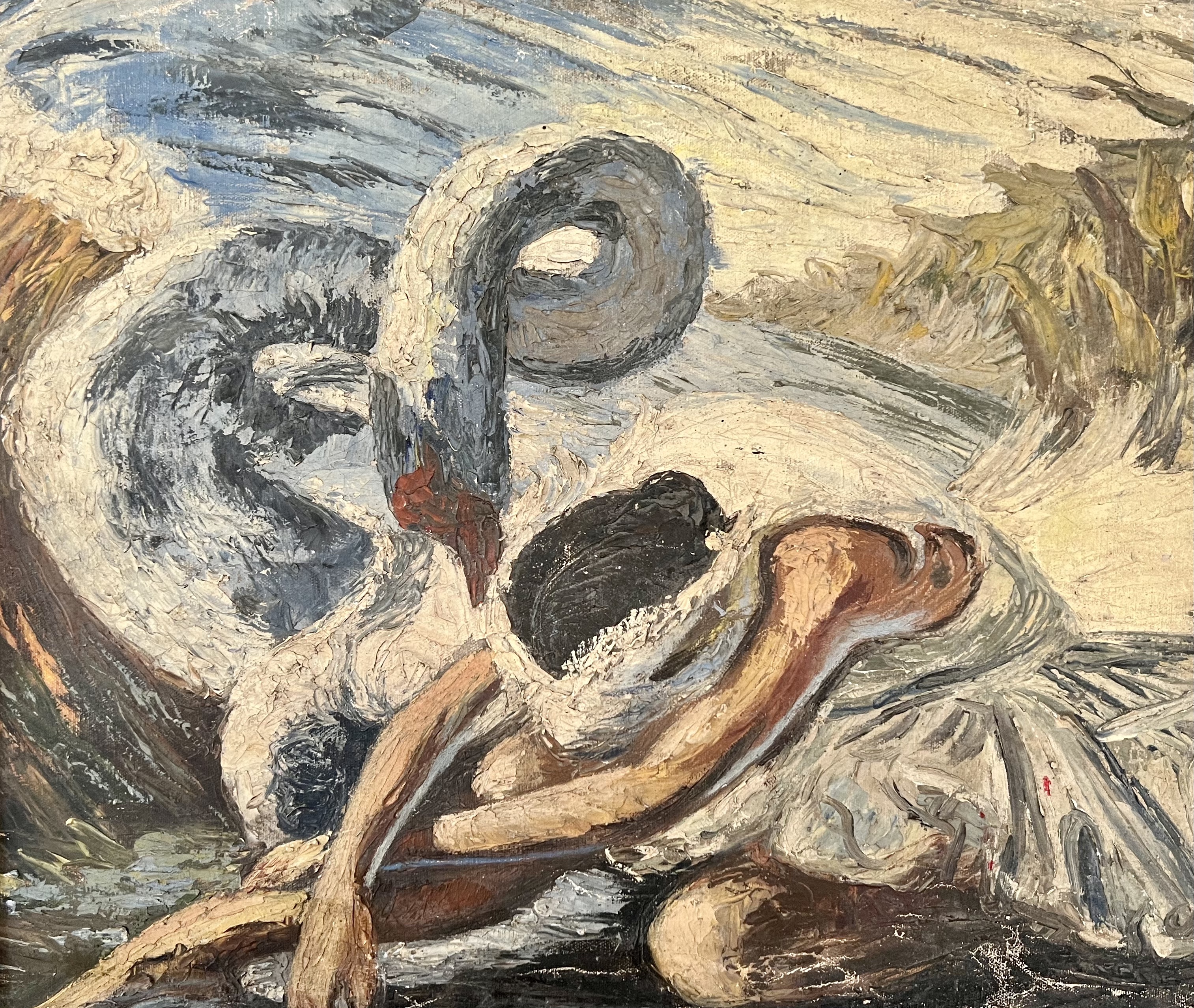
But then I spotted a painting that had rather intriguing lines and colors, one that was clearly different in theme and treatment from the nipa huts and carabaos that populated the other canvases. 

In the foreground was a young woman in a white dress—a dancer immediately came to my mind—set against what first seemed to me a backdrop of the sea, a huge curling wave threatening to envelop her. But there was another element, aside from the strange shape of the “water”, that didn’t make sense: an orange something near the woman’s face.

And then it all snapped into place: the background figure was a swan with one wing outstretched and the other practically smothering the woman, and the orange thing was its beak. What sprang to my mind was Leda and the Swan, the old Greek myth that has been one of art and literature’s most reinterpreted and most referenced stories (where Zeus, in the guise of a swan, rapes or seduces Leda, and has two children by her). 

This could not have been done by a naif painter; it took some education and sophistication to take on a subject like that, and to represent it with both grace and power. This painting could not have been a recent work; its strokes and colors belonged to another age. It felt old, in a good way. I thought that it had to be decades old, possibly even pre-war.

I immediately messaged the seller to reserve the painting for me. For P1,000, it was a no-brainer. Usually the seller would respond within minutes, and we would do the GCash and Lalamove song-and-dance within the hour. But the day passed with no response. I messaged him again that night, and next morning I still heard nothing back. Another day passed; I had saved the picture of the painting on my phone and returned to it now and then, stewing inside, increasingly annoyed by the seller’s silence.

And then I got the message: did I want it? Of course, I messaged back quickly. It will cost you P1,000, he said. Sure, I said, give me your GCash number. I hope you can book it for pickup now, he said, because I’m leaving very early tomorrow morning—unless you want to get it in the afternoon. No, no, I said—I’ll book it right now. It was 11:30 pm, and Beng was sound asleep. 

And so it happened that just past midnight, a Lalamove rider roared up to my gate to deliver the painting, which I examined immediately. It had been very badly framed, with ragged edges of the painted canvas hanging over the back. Since the edges had been pulled over, I could find no signature. Still it was every bit as powerful as I had thought it to be, the colors laid on in a thick impasto. 

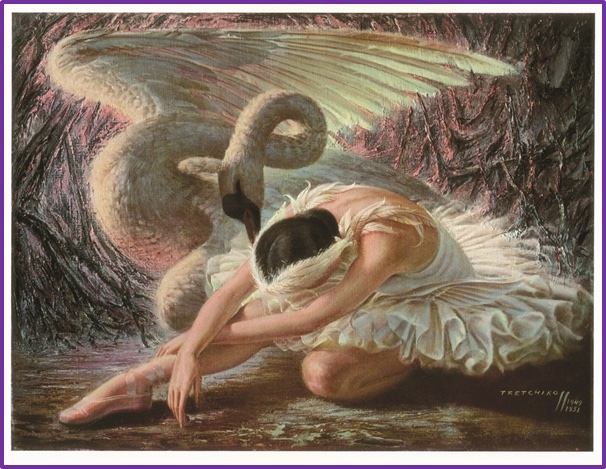
So the mystery was, who painted it, and when? I posted it on FB the next morning, and immediately the writers and artists in my group identified it with Leda and the Swan. I felt vindicated. And then my Toronto-based friend, the poet Patty Rivera (whose husband Joe also paints), posted a link to a story from South Africa, where a painting by a Russian-born artist named Vladimir Tretchikoff was up for auction. It was titled “The Dying Swan,” from the ballet by Mikhail Fokine; Tretchikoff had even persuaded the great ballerina Alicia Markova to pose for him in 1949, when he began the work (one of two he gave that title).

So my midnight acquisition was a copy done by a local painter in the 1950s, possibly by an amateur or even a student. Was I disappointed? How could I be, especially for the price I paid? Tretchikoff’s original was clearly much finer and more radiant; but my rougher copy, in Patty’s words, showed more “torment and despair.” When Beng restores this and we have it reframed, it will have its own life and energy, and the swan will die, over and over again, which means it never will.

Penman No. 433: Finally, Facebook

Penman for January 16, 2022

My Lifestyle column in the Philippine STAR, “Penman,” has now been moved to every other Sunday, to avoid the awkwardness (and extravagance) of having two of my columns appear in the paper on Mondays. My takeover of F. Sionil Jose’s “Hindsight” on the Op-Ed page debuts tomorrow.

I WAS sixteen years late to the party, but I finally gave in and opened a Facebook account last June under my name, initially just for family. A few weeks ago I began accepting “friends,” of which I now have about 600, and I don’t intend to add too many more, although time and tolerance could change that reticence as well.

I resisted joining Facebook all those years for all the reasons some of my real-life friends remain staunch holdouts. Foremostly, it seemed to diminish and commodify the idea of friendship, replacing what should have been forged over conversation, coffee, and even conflict with a few keystrokes. Even now, looking at the roster of my newfound “friends,” I know—and do not really regret—that less than half of them are people I have actually broken bread or raised a toast with.

Honest to God, not being a politician, I don’t need 5,000 friends; I wouldn’t even know what to do with 1,000 of them. If they all pledged to buy my next book, then maybe I’d reconsider and lower the bar by a foot or two, in the cause of promoting literacy and my Fountain Pen Rescue Fund.

And then of course Facebook is a total timesuck, defined by the Urban Dictionary as “the void that gets created by engaging in an activity that seems like it will be short but ends up taking up huge amounts of time.” It’s just not human not to read and then not to respond to comments on your posts, and then not to read the posts of others and not to react to them.

Every “tag” might as well be a distress call; somewhere out there you’re being praised or reviled, and you just have to pause that report you’re drafting for the Board of Regents or that article you’re refereeing for the Journal of Linguistics to see what Cookie has been saying about that encounter in Boracay or Chef Dodo’s opinion of your dinuguan recipe.

As it is, even deciding who gets to be your Facebook “friend” or not raises all kinds of vexing and time-consuming moral dilemmas. I don’t know how others do it, but I review nearly every request I receive, going through that person’s profile—and not just our common “friends”—to see who and what’s behind the name. My rule of thumb is, if I really know you—and like you—then you’re in; if I know you by reputation, I might even feel honored, and click “confirm.” If I’ve never met or heard about you at all—which isn’t your fault or any fault for that matter—then I evaluate your application for virtual “friendship” using my shamelessly subjective criteria.

First, I check to see if you’re a real person, or that you are who you say you are. Early on in this “friendship” game, I received a slew of requests from impossibly pretty and shapely ladies, which made me wonder why I had waited sixteen years to enter paradise. (They all seemed to have one or two common “friends” with me, always the same persons, so I know who’s been extraordinarily amiable out there.) Out of curiosity (I swear!), I accepted one such request, and almost instantly got a private message that invited me to become her digital pen pal, because she was lonely and unoccupied in some far-off country. I wanted to tell her to buy my book of funny essays, or even my short stories, to relieve her boredom, but I had an inkling that creative nonfiction wasn’t going to be the bridge between us.

I checked out her posts—all of them suggestive of her good health and weight maintenance, and of her preference for clothes that did not consume too much fabric (kudos for sustainability)—only to notice that they had all been posted on the same day! My wonderment quickly turned to dismay, realizing that I, among other papas of the world, was being suckered into hell by this honeypot, who was very likely some ugly fellow like me named George or Brando. And so I sadly punched “delete,” as I did for the many others who would follow in Ms. Lonely’s wake.

Second, I check to see if you’re interesting and if we’ll get along. If all you can show me are endless updates of your profile picture—here’s me on the beach, here’s me with my dog, here’s me with a balloon, here’s me lifting weights—then we really don’t need each other, thank you. I have a soft spot for all kinds of artists, and I don’t necessarily just go for the famous or abundantly talented ones; I’ve signed in struggling young people because I admire honest effort.

If you’re a benign plantita proud of your grandkids, your succulents, and your muffins, you’re in—the world needs you! If you became my friend just to sell me something, you’re out (unless you buy my book first). Now here’s a killer: if I see even the slightest sign of you supporting dictatorship, book-banning, EJK, and fake news, you’re out. (I know we’re supposed to make friends across the political divide, hold hands, and sing “Kumbaya,” but I didn’t join Facebook to get my daily dose of aggravation.)

Penman No. 148: Why I’m Not on Facebook

Penman for Monday, May 11, 2015

FOR THE umpteenth time, last week, another person asked me, with profound astonishment, why I wasn’t on Facebook. I told him that, in my seniorhood, I wanted to lead a quiet and peaceful life, and that Facebook was antithetical to that ambition.

From what I hear, Facebook is this century’s Colosseum, and that a fracas on Facebook can be far more entertaining than the event in real life. I knew that it had been a busy week, to say the least, on that website (or, I should say, in those millions of websites). There was that “literary tempest” that my fellow STAR columnist Scott Garceau adverted to in a recent piece, the Pacquiao-Mayweather fight, and the Save-Mary-Jane-Veloso movement, among other contentious causes.

I learned about these things not because I’m on Facebook, but because my wife Beng is. She’s up in bed before me every morning, pecking away at her iPhone in the gathering light, responding to the planetary call for “likes” and “tags” and “status updates” and whatever else goes on in the FB universe. When she senses me stirring awake, she gives me the lowdown on the state of the world, leaving the less interesting and less important matters to CNN and the BBC.

That world would be much happier and more peaceful if more of humanity were like my bedmate, but it’s not. “Avoid loud and aggressive persons, for they are vexatious to the spirit,” counsels the albeit apocryphally attributed Desiderata—which is as good as saying, avoid Facebook, for it is the Republic of Vexation, the domain of loud and aggressive persons who would like nothing better than to get a rise out of you and spoil your day.

Of course I’m told it also exists for friendship and global harmony—the spirit in which Beng and some of her friends upload quotations from the Dalai Lama and such peaceable people—but I’m convinced that they’re in the distinct minority, for which a separate Facebook might as well exist. While we’re at it, let’s do a bit of taxonomy and map out the possible sub-Facebook realms out there, the establishment of which could lead to a more tolerable era of co-existence all around.

Facebook Lambs (or should that be Facebook Koi, for a more Asian touch?) could include everyone like Beng—the tree-huggers, the lifesavers, the Kumbaya singers, the people who will find goodness in the worst of places. Easy to please, they’re also easy to hurt, and when they hurt, they bleed.

Facebook Monkeys do what monkeys do: screech and thump their chests a lot, to say: “Look at me and at what I’m doing! Am having XXX brand of cornflakes and YYY brand of yogurt for breakfast, folks, and here’s five pics to prove it! Isn’t that interesting???”

Facebook Vipers do what vipers do: strike and bite at anything that moves, especially anything that gets within a whisker of their precious scales. Some days I imagine Facebook brimming with reptilian malice, filling me as well with illiquid emotions, until Beng pulls me over to show a child singing a heavenly carol on her FB page.

So why do I shun FB? (I’ve been told, by the way, that there’s a “Butch Dalisay” FB page, but I have nothing to do with it, and have no idea what it contains.) I’ve been asked this question many times before, and my serious and rather ironic answer has always been that I can’t abide using the word “friend” for people who really aren’t that. I do believe that one of the worst things that Facebook has done to language and to human relationships has been to cheapen the meaning of “friend” and, corollarily, introducing the notion of “unfriending” someone with a keypress, just like that.

I still prefer to make my friends over coffee, on a bus or a boat trip, laughing at the same silly movie, pulling for the same desperate cause, arguing the merits and demerits of some poem or passage of prose. And when you stop being my friend, I won’t even waste a sliver of bandwidth on it; a cosmic silence is all you’ll get (although my deepest friendships can endure years of stasis).

I said “ironic,” because it’s a bit odd that I find myself arguing for more human contact when, at this stage of my life, I actually want and seek less of it for myself. I’m not misanthropic, but I feel happy to keep company with just a very few people I can trust and relax with, mainly family. I hardly attend parties or big social events unless required to do so by work or inescapable obligation. I dread making and taking phone calls, especially any call beyond three minutes. (You’ll best get a response from me by email.)

But never mind me; I do recognize Facebook’s matchless utility for most people. I know that serendipitous connections can be made online that would have been impossible otherwise, and if you’re tracking down that crush you last saw in the 1970s—or 50 pounds in the blissful past—there’s nothing like FB to make that happen. Like a loaded gun, Facebook all by itself isn’t evil; it’s people who are, or can be, and FB is just another enabler of the dark side, as well as of its sunnier converse.

So it’s not even the malice I’m evading, because you’ll find that elsewhere anyway, or perhaps I should say, it’ll find you. It’s more likely the way Facebook—in all its goodness and badness, for better or for worse—can take over people’s lives, basically by engrossing them in the issues of the day (as in this hour, this minute) rather than troubling them with historical hindsight and such corn. (And who needs a lengthy editorial and well-considered opinion when you can offer up your precious gut feelings, along with your barangay’s, as a workable and certainly more credible substitute?)

There’s a facebookhaters.com, but I don’t see myself signing up with those folks. Facebookhaters.com is completely serious but unironic—I can just see it devising and promoting a 12-step withdrawal program—which isn’t the way to grapple with a hyper-sophisticated Hydra like FB.

I can’t and don’t actively hate Facebook, knowing how vital it is to the lives of millions; what would I do with Beng all those hours she won’t be on FB? As it is, I can play poker all night, knowing she’ll never be alone and idle, as long as she has her phone (a tip for spouses—get your mate an unlimited data connection, and you’ll never have to babysit them again). That’s one thing to thank FB for.