
Qwertyman for Monday, September 4, 2023

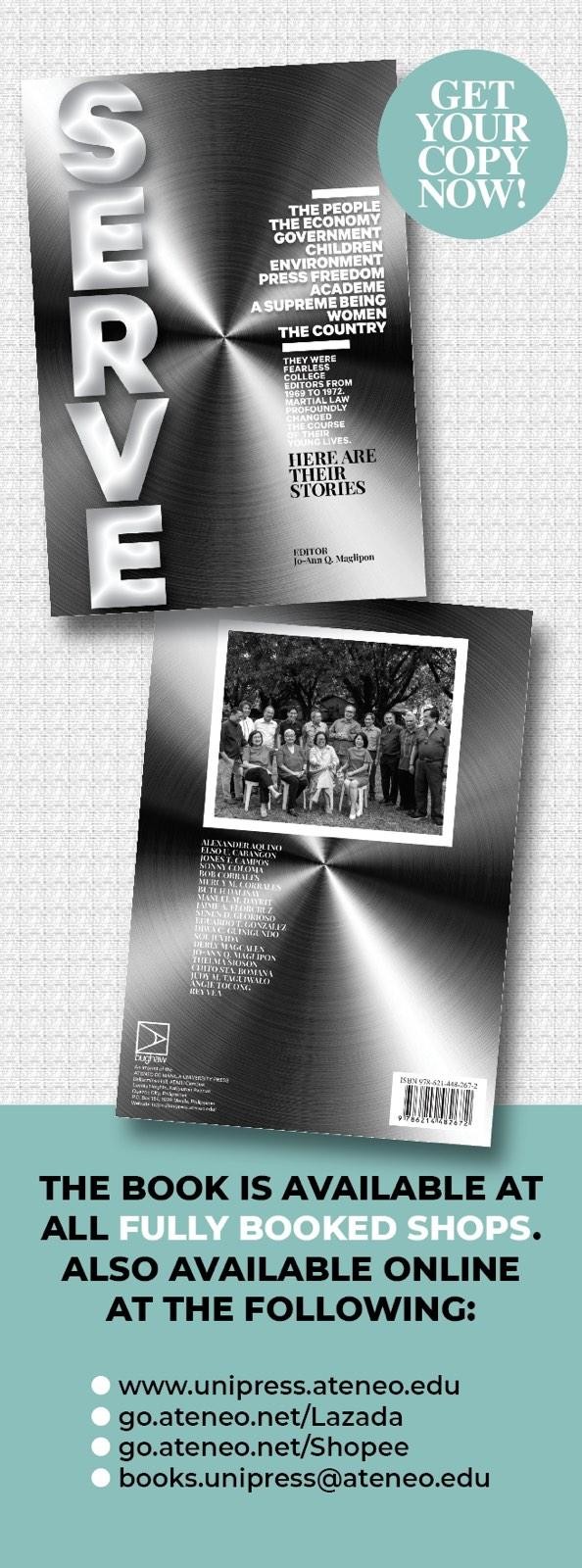
AT 5 PM next Saturday, the 9th of September, a new book will be launched at Fully Booked in BGC. Published by the Ateneo de Manila University Press and simply titled SERVE, the book has 19 authors—yes, I’m one of them—and one editor, the much-respected Jo-Ann Maglipon. What connects all is that they were college editors during the first Quarter Storm of the early 1970s, and survived to go on to distinguished careers in media, education, business, and public service. The book dwells much less on martial law—a previous volume titled Not on Our Watch: Martial Law Really Happened, We Were There that came out in 2012 dealt with that—than with its aftermath, and the afterlife that the activists of our generation were fortunate to have, given how many of our comrades gave up their lives to the cause of justice and freedom.
What did these activists do after martial law? What are they thinking now? Some of the names in this book will be familiar to the contemporary reader, who may not even have known of their activist background (reg-taggers, pay close attention).
Some of us—like Jimi FlorCruz, Sol Juvida, and Thelma Sioson San Juan—remained journalists all their working lives, stationed in very different places and capacities but bound by a commonality of interest in the truth. Others like Sonny Coloma, Manolet Dayrit, Ed Gonzalez, Diwa Guinigundo, the late Chito Sta. Romana, and Judy Taguiwalo took the path of government service, finding themselves in a position to effect real change, although sometimes under very difficult if not adversarial circumstances. Yet others including Angie Castillo, the late Jones Campos, Mercy Corrales, and Senen Glorioso found fulfillment in entrepreneurial and corporate work, applying their progressive values to management. For Elso Cabangon, Bob Corrales, and Diwa Guinigundo, their circuitous journey led to a re-encounter with their spirituality, and to embracing their faith as their personal advocacy. Like many veterans of the First Quarter Storm, Alex and Edna Aquino were able to build new and productive lives overseas, without yielding their investment in Philippine concerns. Quite a few of us—Derly Fernandez, Ed Gonzalez, Judy Taguiwalo, Rey Vea, and myself—chose to pursue our activism in academia, if only to ensure the transmission of critical inquiry to another generation.
The authors were under no compulsion to conform to an ideological standard, except to extol the spirit of service to the people, the overarching theme of their youth and now their continuing commitment, indeed their legacy. There’s pathos in these accounts, but also humor and, inevitably, irony, perhaps the defining tone of our postmodern age: Thelma Sioson San Juan finds herself seated across Deng Xiaoping’s granddaughter at a Ferragamo show in Beijing’s Forbidden City; Manolet Dayrit learns of his appointment as Secretary of Health on a visit to President Gloria Macapagal-Arroyo in Malacañang; Ed Gonzalez becomes president of the Development Academy of the Philippines under President Joseph Estrada, but then joins EDSA 2; Sonny Coloma looks out the window of his Malacañang office to where students like him had demonstrated against Marcos.
With most of the writers here now in their seventies or inching close to it, we could have been chronicling the joys of grandparenting, journeys to far-off places, exotic menus, succulents and bromeliads, and homeopathic remedies for the aches of aging. Having retired from the formal workplace, we thought we had settled into a privileged and imperturbable kind of peace, earned over decades of political, economic, and spiritual struggle.
We celebrated our seniorhood as the ultimate victory, for a generation that did not expect to live beyond thirty, and not because of some acquired disease but because of the throbbing cancer at the core of our society that claimed many of our peers in the prime of their youth. We may have thought for a while that we had defeated and expunged that cancer, only to realize that it had never left, was always there, lying cruelly in wait for a chance to ravage us again—and not only us this time, but our children and grandchildren as well.
And so—albeit no longer lean and shaggy-haired, perhaps benignly forgetful of car keys and personal anniversaries—we gather again at the barricades we put up against a fascist dictatorship fifty years ago, of which our memories remain surprisingly and painfully sharp. They say that the old remember distant things more clearly than what happened yesterday, and we offer proof of that. The experience of martial law coded itself into our DNA, and even the few among us who surrendered their souls to Mephistopheles cannot shake away that indelible past—one we bear with pride, and they with guilt and shame.
This time our barricades consist not of desks and chairs but of memory itself and, more formidably, of hope, courage, and a continuing faith in the good. Beyond memoirs, more than recollections of our youthful selves, we now present the stories of the lives we built and the paths we took after martial law, along with our reflections on how time and experience have reshaped us, clarified our values, and strengthened our resolve to serve our people in multifarious ways.
Our view of politics inevitably evolved over time as the world itself changed over the past five decades. These essays and stories cover a wide range of themes and treatments, and demonstrate how “serve the people” has grown and evolved with its advocates, taking multifarious forms from working in civil society and practicing good governance to promoting artistic expression, academic freedom, and insightful journalism. We wish to prove that even the worst of times and the worst of leaders are not only survivable but can be changed, so that whatever lies ahead, the better Filipinos in us will prevail.
Given the number of authors and their families and friends, we expect a full house at the launch, so you might want to wait and get your copy of the book from Fully Booked or from AdMU Press’ online channels. However the book finds its way to you, it will be worth your while.
 Pinoy Penman 3.0