Penman No. 31: The (Ink and) Paper Chase

Oxblood

Penman for Monday, January 28, 2013

ONE THING that fountain pen fanciers rather quickly realize is that their obsession (read: expenses) won’t end at buying another Parker, another Sheaffer, or another Pelikan. You can have bread without butter, or even without coffee on the side; but you can’t write without ink and paper, so that anyone who habitually buys and collects pens soon metamorphoses—even without meaning to—into an ink and paper hoarder as well.

Indeed, inks and papers have become collectibles on their own, and not necessarily together. I have friends who couldn’t care less about pens, but for whom the sheer texture and even the faint aroma of paper can trigger paroxysms of pleasure. These are the people who seek and haunt stationery and art-supply shops, pawing through exotic papers from Thailand, Japan, and Italy, paper that might not even end up being lettered on but pressed into some other service. (And while we’re on this subject, please, please never say “stationary” to refer to writing paper; it’s “stationery” with an E, referring to “stationers”—the people who, in medieval times, sold books in fixed places, as opposed to peddlers who went around with their wares.)

My wife Beng, a watercolor painter and professional art restorer, has one such mecca on 3rd Avenue in New York City, on the second floor of which, up a steep flight of stairs, can be found an astounding array of the world’s finest art papers. But when she visits, Beng’s not looking for paper to paint on; instead, she wants a delicate, silk-like paper made in Thailand that she can use to lay over and stabilize patches of paintings where the paint has begun to flake off.

Forty years ago, when I worked briefly as a printmaker (another of the many hats I’ve worn—and I still wear them now, the real ones!), I too rhapsodized over art paper—the thicker and creamier the better—and on good days or for special jobs, I’d splurge on Strathmore paper, whose texture somehow made any print I designed, however poorly, look rich.

Indeed, it seemed rich of me to get so picky about my papers when, just a few years earlier in my mid-teens, the only paper I knew and cared about was bond paper (the kopong bond we bought at the corner store for 5 centavos a sheet), ruled pad paper for school, and yellow legal pad paper. For special purposes, there was oslo paper and onion skin, and maybe when we got moony we bought some fancy stationery at the bookstore (mine had a picture of the Beatles on every sheet) to write the crush of the moment on (yes, all I’ve ever had in my meager arsenal all my life has been words, words, words).

I still look for good paper these days, but it’s no longer to woo the wenches with (better not, says Beng) nor to pen my next novel on, but simply to test my nibs and inks, like a driver might look for a pristine stretch of track on which to lay some nasty rubber.

And what’s to like and not like about paper? While many kinds of paper—especially the smooth ones—may all look the same from the top, on the microscopic level, they could vary a lot, in terms of the makeup of the fibers and how closely they’re packed together. That means that when the ink flows out of the pen’s nib and gets onto the paper, it will either hold together and more or less stay in one place, or spread out like mad through spaces in the fibers and saturate the paper in such a way that the ink will bleed through, or be visible from, the back side of the sheet.

This latter process is called “feathering” and “bleeding.” You’ll know that your paper feathers when the line you write quickly becomes thicker and fuzzier, sometimes to the point that the letters become hard to read; bleeding or bleed-through, on the other hand, is obvious when you turn the page over and can see the ink. Feathering, I think, is worse than bleed-through; at least you can write on just one side of the paper and still have something crisp and clear, but paper that feathers horribly will leave you with one big blur.

As a general rule, cheap paper—thin, with loose wood-pulp fibers—will feather and bleed. More expensive papers, such as those that use linen, will tend to be thicker and more compact, and therefore offer a more pleasant writing experience. A simple pad or notebook could cost many hundreds of pesos, especially if they sport leather covers and other accoutrements.

In our pen club, the Fountain Pen Network-Philippines, members are forever on the hunt for good but affordable writing paper, even as we may indulge ourselves in the occasional pad of proven performers like Clairefontaine and Rhodia, available in some local bookstores. One sad and surprising discovery that fountain-pen users make early enough is that the iconic Moleskine notebook—whose design I love and have offered whole essays to—isn’t fountain-pen-friendly at all, showing awful feathering and bleeding.

Thankfully, many alternatives to (and copies of) Moleskine now exist, some dearer and others cheaper. A recent experience of mine seems to prove a point. Feeling more expansive than usual on my birthday, I went to the bookstore and spotted a very handsome-looking, leather-bound Jadeco notebook with what appeared to be excellent paper; the tag price of nearly a thousand pesos made me gulp, but what the heck (as I often rationalize these days), at 59 I can excuse anything. I picked it up, paid for it out of my birthday budget, and soon confirmed my expectation that the paper would hold up well to runny fountain-pen ink. The following day, on another sortie to National Book Store, I saw a small spiral notebook (that’s all it says on the kraft-paper cover: “Notebook”) that cost all of P28; on a whim, I bought that, too, and discovered to my chagrin that it performed almost just as well as the Jadeco. I would later learn from friends that some good compromises can be found in the middle of these extremes; I found another one myself a week later, at Fully Booked, under the brand-name Schützen—a regular-sized spiral notebook for P285 that didn’t feather and bled just minimally.

This brings us to inks, which really deserve another column-piece on their own (which I’ll do some other time). Let’s just say for now that inks can even be more bewildering and exhilarating than paper, given the seemingly infinite range of colors and hues you can produce from a mixture of water and pigment. Some inks are also thicker and more saturated than others; some are permanent, and others washable. Some specialty inks, like De Atramentis, can even carry the scents of fruits, flowers, and wines.

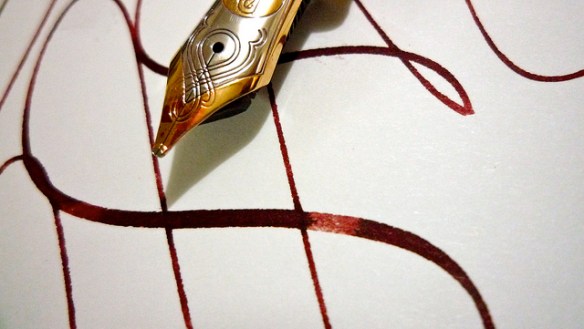
I’m not a very adventurous person ink-wise, and for the longest time wrote only with black, blue-black and brown inks; green, bright blue, purple, and red (not to mention yellow and orange) were simply out of character for me. They still are, but I’ve since nudged my range a bit to include Diamine Oxblood (a robust maroon) and Rohrer & Klingner Sepia (a greenish gray reminiscent of old manuscripts) in my small stable. I’m still on the hunt for the perfect blue-black, alternating between the Parker, Pelikan, Montblanc, and Lamy versions. Most days, I just liberally mix things up, turning my desktop into Inkspot City. (Better than alchemy, drop in at Scribe Writing Essentials in Eastwood Mall for a plethora of inks such as J. Herbin, not to mention many fine pens.)

Do take note that the final appearance of your ink will depend not just on chemistry, but on the paper quality, and also on the pen and the nib you use—a wider nib like a stub will deliver a thicker line that shades beautifully as it moves along; that’s what sends pen pushers into seventh heaven.

And what do I write with these exquisite implements? Aside from the occasional signature, absolutely nothing meaningful. I’ve come to realize and to accept that this is how I relax and make myself feel good: by taking hold of a pen worth what someone else more practical might have paid for a fridge or a flat-screen TV, and doing nothing more with it than doodling for hours on premium paper. I liken it to driving around on a lazy weekend to nowhere in particular, just enjoying the scenery and the sweet hum of a perfectly tuned engine. Such are one’s pleasures on the doorstep of one’s dotage.

Penman No. 29: Some Things Meant to Be

Penman for Monday, January 14, 2013 

MY LATE father Jose Sr.—Joe to his friends—would have turned 90 this coming Saturday. An incorrigible chain smoker, he died of an aneurysm in 1996, and there’s hardly been a day since when I haven’t thought about him. Whenever I travel, which is fairly often, I find myself talking to my dad to tell him, “Tatay, I wish you’d seen this, and this, and that.” He was a simple man whose feet never left his country nor, pretty much, his home; his joys were in the kitchen and in the garden, and his favorite pastime was doing crossword puzzles.

Indeed, in his own way, he was a man of words, a gifted writer who—like I would do, myself—ghost-wrote speeches for far more powerful but much less articulate men. As modest as our circumstances were, there were always books and magazines at home, and even before I could read or write, my father fired up my imagination by reading stories to me at bedtime. In brief, I would not have become a writer had it not been for him.

Nor, speaking of my quaint obsessions, a fountain pen collector. In his last days my father wrote with a cheap plastic Bic ballpen—the kind you can now buy by the box and forget or throw away after a few uses—but in his prime he had some Sheaffers and Parkers that he would load up with blue-black ink, whose ability to bloom into a dark-hearted rainbow on a wet napkin brought me endless fascination. Regretfully none of his fountain pens have survived—which is probably why, as with most enterprises driven by some deep longing, I keep amassing pens, as if they would somehow bring my father back.

Now, begging your indulgence, here’s where this memory detours into the story of a pen and of a box.

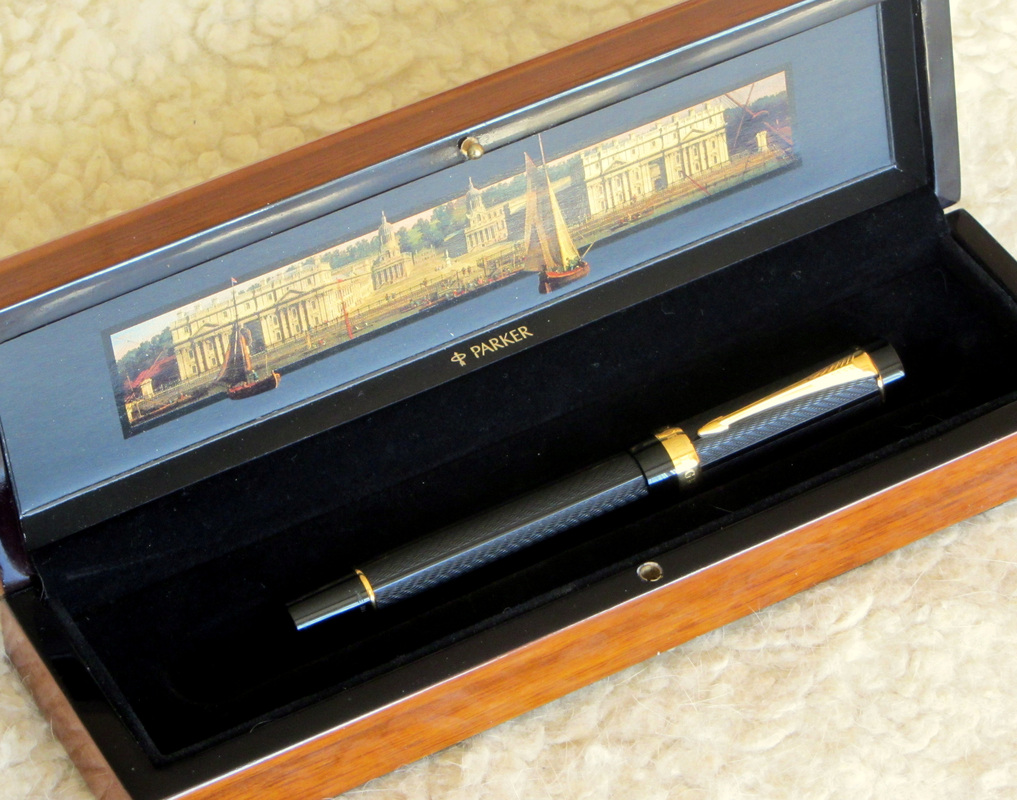
A few weeks ago, after months of eager questing, I acquired what collectors call a “grail” pen—an object of acute desire, usually for reasons of great beauty, scarcity, or some sentimental connection. In this case, it was purely a matter of esthetics and collectability: the Parker Duofold Greenwich Centennial would simply be a big, black, overpriced pen to most sensible people, but to me it was the noblest of the modern Duofolds, a reincarnation of a classic 1920s line that established the Parker name for the rest of the century. Made specifically to commemorate the Royal Observatory in Greenwich, England—which Beng and I visited around the time the pen was made in 1999—the pen was a special edition with a limited run, and had become rather hard to find.

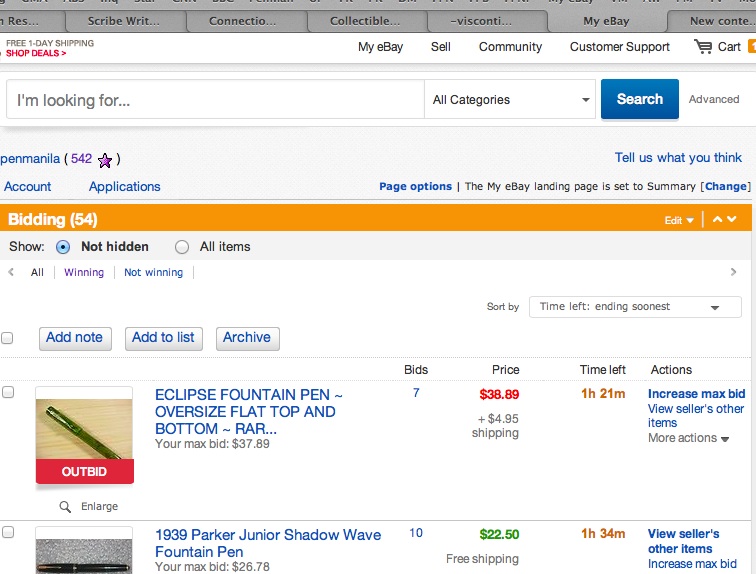
When I found one on eBay at a price I could afford, I was ecstatic, filling my posts about the find with smileys and dancing bunnies. It was near-mint, the chevrons incised into its black cap and barrel deep and lustrous, its gold fittings rich and warm. Its regal nib was a joy to write with. I couldn’t have asked for more—or perhaps I could, as it came to me without its presentation box. Pens of this caliber always came in pretty wooden boxes in themselves worthy of collection, and indeed, in one discussion of the Greenwich in a forum I frequented, another collector had reported seeing “a small but fancy box with what appeared to be a European cityscape picture on the inside of the box cover.” I wasn’t sure why, but that description sounded oddly familiar to me then.

When the pen arrived from the US I put it to happy use, doodling away, writing loopy notes to no one. The Greenwich was truly an impressive pen and it sat haughtily in my pocket, but now and then I would be besieged by the collector’s constant fear of losing or dropping a valuable pen, and I would begin wishing that I had its box to put it to bed in, before I scored the exquisite chasing on the pen or, worse, let it slide out of my attention in one of my poker binges. But then of course, I didn’t have its box, and I couldn’t bear to stick it in anything beneath its stature.

And then, a few nights ago, something strange happened. As I was idly surfing away to more pleasant distractions (meaning, more pen-related Websites) in the middle of finishing the draft of another commissioned piece, I stumbled on a picture of the Greenwich in its original wooden box. And at that instant, the familiarity of the box and of its pictured scene overcame me, as I realized that, of course, I’d had that box somewhere in the house, somewhere in the very room I was in. Years ago, I had found the varnished receptacle in a thrift store in America, and had been taken by its plaintive beauty—plaintive because it was clearly a box for some majestic Parker pen (the Parker name was proudly emblazoned on it), but it was empty, and I had no idea then what model its proper occupant might have been.

I bought the box for a couple of dollars, and brought it home with me to the Philippines, where I decided that it would house the most precious pen in my collection—my dad’s battered Bic ballpen, the last thing he wrote with before he died. So I was certain I had it somewhere, and I began ransacking my den, pawing through shelves of empty pen and ink boxes (you can imagine what a collector’s nest looks like). Sure enough, there it lay behind a stack of ink bottles, the box that opened to a “European scene”—a cluster of neoclassical buildings foregrounded by a sailboat on the water. (I would later discover that it was a depiction of the Royal Naval College at Greenwich, seen from the north bank of the Thames.)

It was the box that had been designed for—and only for—the rarefied Parker Duofold Greenwich Centennial, and by some stroke of what the poets called serendipity, I had found the box years before I found the pen. I took my father’s crystal Bic in my hand and smiled, thinking, “Tatay, what strings did you pull to make this happen?”

So I put the Parker where it was meant to rest, and now I had to find new and no less suitable quarters for the Bic. Fortunately, on the same shelf was an old Japanese box, gleaming in black lacquer, that I had found in another discount store on Avenida Rizal, and which would originally have carried chopsticks. I didn’t think Tatay would have minded the switch, being an excellent cook.

And finally, I resolved that, in honor of Jose Quinton Dalisay, Sr., the Greenwich pen would henceforth use nothing but blue-black ink, a choice its golden nib seems perfectly content with. My other pens can gorge on Diamine Oxblood and other fancier concoctions, but I had been soundly persuaded that some things are just meant to be. (And here’s to a happy 90th, Tatay!)

Penman No. 28: Traveling with Pens

Vacumatic

Penman for Monday, January 7, 2012 

IT’S THE day before New Year, and I’m on my way to Kuala Lumpur with Beng for the last jaunt of the old year and the first of the new one. In my shirt pocket is a 1999 Parker Duofold Greenwich Centennial, a big black pen I’ve had for just a few days and which I’m putting through its paces; in my bag is a leather two-cigar case that’s transporting not Cohibas but two more Parkers—another Duofold, an orange International from around 2008, and a Vacumatic Oversize that goes all the way back to 1938.

I don’t even know why I travel with fountain pens. Lord knows how many valuable ones I’ve lost on the bus or in some stranger’s car, where it’s probably moldering under the back seat alongside an ossified wad of gum. (Probably the most valuable pen I lost, I didn’t even see. Twenty years ago, my grad-school friend Joe mailed me a pen in a box along with a book—I grabbed the book and threw away the box. “How was the pen?” asked Joe when I thanked him for the book. “What pen?” I asked. “The silver-filigree vintage Waterman that I tucked away in a corner of the box. It was meant to be a surprise,” Joe said. This was a couple of days after the box had gone to the dumpster in Milwaukee.)

It’s not like I write novels on the road, or write anything substantial, period, with my fountain pens. I have a thick pad of gorgeously creamy Clairefontaine paper at home, and all I ever write on it is “This is a Parker Duofold from 1931” or “This is a Bexley with a broad nib that I stubbed” or “This Waterman 52 flexes oh so nicely” and pages and pages of figure 8s. If I ever become truly famous, I suppose that pad of doodles and scribbles will be worth something to someone, but they’ll be disappointed if they’re expecting to find the first line of a new novel or some deep dark secret in it.

I keep that pad on my desk for whenever I get a new pen—maybe two or three times a month—for its ritual initiation: I’d write “This is a Pelikan M600 in tortoise” and see how the nib performs. I like my nibs broad, wet, and stubby, and if they aren’t any of these three (I do keep a few fines and mediums unmodified), I work on them with very fine 2500-grit sandpaper, finishing off the job with an 85-peso nail buffer from a Korean cosmetics shop (it always raises eyebrows when I walk into one of these mall shops and get three nail buffers all at once).

It takes care and patience, but there’s a lot you can do to improve the flow of ink in new pens, whose nibs will sometimes be “hard” writers requiring just a bit of tweaking to perform optimally. Beyond the flow, modifying the nibs themselves requires special knowledge and more than a dash of daring; I can stub or flatten nibs and make them write more smoothly, but it takes the skills and workbench of someone like my friend JP Reinoso to turn them into crisp cursive italics. For even more difficult jobs like straightening bent tines or adding iridium or tipping material to old nibs, we go to the best of the world’s so-called “nibmeisters”—people like John Mottishaw, Greg Minuskin, Mike Masuyama, and the now-retired Richard Binder.

But where was I? Oh, traveling with fountain pens. As I was saying, it’s something no one really needs to do these days. In fact, I also bring along a ballpoint or a rollerball pen for the inevitable task of filling out immigration and customs forms, especially those that require duplicate copies. (It was the necessity of the carbon copy, back in the ‘40s, that would eventually spell the death of the age of soft-nibbed fountain pens and the start of the world’s love affair with the ballpen or the “biro” as it was first called, after its inventor Laszlo Biro.)

A vintage fountain pen in your pocket might even spell fashion disaster inflight. Today’s air cabins are properly pressurized, and I should say that I’ve yet to have a pen burp on me airside and cause an inky bloom on my shirtfront, but there’s enough anecdotal evidence out there to suggest that not all pens or filling systems may be so well behaved. Conventional pen wisdom says that you fly with your pen either completely empty or completely filled.

Being a gambler, I travel with fully loaded pens. I might write a line or two with them on the road in my Moleskine notebook, but again it’s not the writing I carry them with me for—for that menial task, I have the trusty MacBook Air that I’m typing this piece on, in seat 7-D of our AirAsia flight. So what is it that I need to bring three pens for to an exotic destination like KL—where, ironically, I’m going to be picking up five more pens for friends from PenGallery (www.pengallery.com), one of Asia’s and the world’s best pen shops?

I suppose my pens are like the kids or pets I never had—and I know, I know, sometimes kids are better left at home, but you still want to know that they’re safe and that they’re where they’re supposed to be, and what better place can they be but right with you? I can’t possibly bring all of my dozens of pens along—I keep about nine or ten of them in the daily rotation—so I choose favorites for the week, and perhaps go for a mix of old and new, of ink colors (my staples being blue-black, which reminds me of my father’s writing, and oxblood, which lives up to its sanguinary promise), and of nib sizes (a fine or a medium for note-taking, a broad stub for signatures). A pen’s pleasures are both visual and tactile—the smooth curl of a line or a letter on the page, the feel of a precisely tuned instrument at your fingertips. Knowing that these pleasures are literally within reach, wherever I may be, gives comfort.

I like my modern Duofolds (a reprise of a classic design from the 1920s) because of their heft and balance, but I’ve taken the burgundy 1938 Vacumatic out of its 18-year storage and put it in my cup of daily writers after convincing myself that if I had a pen this precious but never used it, then I would have foregone one of life’s rarest privileges. (Yes, this is the very pen I found in Edinburgh in 1994 and which provoked the writing of the short story “Penmanship,” a desperate attempt to justify the impulse buy of the pen and to recover its cost.)

As you can see, I’m something of a Parker partisan, although I like and collect all kinds of pens, including the relatively inexpensive but ever-reliable TWSBI and Lamy. I have nothing against Montblancs—I have quite a few of them and treasure one of my 149s for its ability to write a sharp wet line even after weeks of being left unattended—but I remind my corporate and lawyer friends that there are other fine pens out there without a white star on the cap, such as Pelikans and Sheaffers, and they don’t all come with five-figure price tags. (Try Scribe Writing Essentials at Eastwood Mall and the pen counters at National Book Store for more options, or join our pen club at http://groups.yahoo.com/group/fpn-p/ for more information and great company.)

Speaking of vintage pens, I found a couple of noteworthy ones just before Christmas in an antiques shop in Quezon City. I had taken Beng out to lunch at a Japanese restaurant and right beside it was Siglo, which we hadn’t visited in ages. There under glass were two pens that had been waiting all that time for me: a 1920s Waterman safety pen inscribed “Conchita”, and a 1947 Parker 51 once owned by a “Julian T. Navarro.” Some pen collectors don’t like these personalizations, but I’ve never minded them, taking them as provenance and proof that these once were more than objects for someone’s collection.

Vintage pens

Like I told another collector-friend, I see myself much less as an owner than a caretaker of things that will pass on and give delight to someone else, and hopefully revive some tender memory of me. I have no way of knowing who “Conchita” was, but thanks to the wonders of Google, I was able to locate the obituary of Julian T. Navarro, who was born in the Philippines in 1907 and who died in California in 2003. He had been a war veteran, and then a contractor, and would have been 40 when he got the Parker in 1947—a man just approaching his peak at the end of a devastating war. I can just imagine him writing with that Parker, its now heavily tarnished gold cap gleaming in his hand. What hope and optimism would have flowed out of that pen.

I suppose that’s why I bring these babies home, and carry them around with me wherever I go.

KRIP YUSON already wrote the literary tributes I would’ve offered for the late Emy Arcellana and Jerry Araos, so let me just add my fervent sympathies to the families of these dear departed friends. Their lives enriched and brightened ours, and they will be much missed. Beng had visited Jerry just a week or two before the end, and he had told her, “I want to go home.” And so he did.

Flotsam & Jetsam No. 11: Pen & Inkwell

ALMOST AS soon as we landed in New York, Beng and I ran off to one of our old haunts, the Sunday flea market on the Upper West Side. These were my two neat finds: a Waterman 412 1/2 PSF fountain pen in silver filigree from 1915 (still a bargain at $150), and a brass inkwell, in dire need of restoration but a pretty piece (at a pretty price–$10!).

Penman No. 6: The Two Helen Richeys

Penman for Monday, July 30, 2012

ONE OF the things that users and collectors of vintage items like fountain pens have to deal with is the fact that these objects were once owned by people who are now, to put it starkly, dead. Through some circuitous route, something that they once held and possibly cherished has come down to us, making its way halfway around the world and providing another lifetime of service and pleasure to its new owner.

Quite a number of the 100+ vintage pens in my collection have names inscribed on them. Since these pens come mainly from the 1930s and 1940s, and since a fountain pen (especially a gold-nibbed one as opposed to a “school pen” that kids like me learned to use in the 1950s and 1960s) would have been something that adults would have owned, it’s reasonable to assume that these names belonged to persons long gone.

Some collectors don’t like these inscriptions and engravings, seeing them as imperfections that drastically lower the monetary value of the objects they’re imprinted on. I strongly disagree. I take them as part of the pen’s provenance, a direct link to the man or woman who once held the pen in his or her hand—who wrote letters of love and joy or anger and sorrow, who signed checks that grew a business and cards that made someone’s day. Few things are more private and personal than a pen—it told your deepest secrets, and you can choose and customize a nib to write exactly the way you want it to.

When I started collecting pens thirty years ago, there was no Internet as we know it today, so there was no way short of spending hours poring over genealogical records to establish just who someone like “F. J. QUIRK”—the donor of my first Parker Vacumatic—was. By the time I got hold of a pen-and-pencil set of Parker Mandarin Duofolds belonging to “BLANCHE SAVIDGE” a few years ago, it took me only a few seconds to discover that Blanche had died at age 95 in December 2007; she had been a longtime teacher in her community in Pennsylvania, had never married, and was described as a “staunch Republican.” Or was she indeed my Blanche? Another Blanche Savidge, born ten years later in 1923, died in 2010 at the age of 87 in El Paso, Texas (curiously enough, she had also been an active Republican). The likelihood, of course, was that it was the Pennsylvania Blanche who owned my Duofolds, because I got them in November 2008, when the Texas Blanche was still alive.

This puzzle came to mind again a couple of weeks ago when I received a bunch of old pens from my sister Elaine in Virginia—pens I had picked up on eBay, with the idea of keeping a few and selling off the rest. One of the pens in the batch was a sweet little Sheaffer Balance in red-veined gray pearl and gold trim from 1934 (after you deal with these pens for a few years, you’ll know their names and birthdates by heart). I had expected something bigger—most of the time, you never really know when all you have on eBay are the pictures, with very little description—so I decided, to help recover my costs on the other pens, that this Sheaffer would go to the pile for sale, as pretty as it was.

Before posting it for sale, however, I gave in to my curiosity and Googled the name on the pen: HELEN RICHEY. The pen looked so fresh and the name was embossed so sharply in gold that it appeared that the pen had been used very little, if at all, these past 78 years. Assuming that Ms. Richey had been at least 20 when she received the pen—it was a high-end Sheaffer that a parent or a spouse might have given Helen on a graduation or a birthday—she would be approaching 100 today, were she alive.

What I found on Google and Wikipedia floored me. There were, inevitably, a number of Helen Richeys that appeared in the search, but at the top of the list were two—the first, an Australian dancer who still serves a judge on the Australian edition of Dancing with the Stars; scratch that one out. The other prominent Helen Richey was a pioneering woman aviator (or “aviatrix,” as they used to be called), the first woman to be hired as a commercial pilot by a US airline. Born in 1909, this Helen once partnered with Amelia Earhart in a transcontinental air race, finishing creditably, and was the first woman to carry mail by air and among the first to teach flying. Sadly her life and career took a tragic downturn: an all-male pilots’ union forced her out of the cockpit, and she committed suicide in 1947.

What an amazing life that was; what an education I’d had in just five minutes, and what an honor it would be if I had the flying Ms. Richey’s pen in my hand. The year this Sheaffer was made, 1934, was also the year Richey won the first national women’s air race in Pennsylvania, and the year she was hired by Central Airlines, a precursor of United. Might the Sheaffer have been a presentation gift, quickly put aside in her rush to return to the cockpit?

As fascinating as that scenario was, I then remembered that the pen came to me from a seller in Illinois, and so I Googled “Helen Richey Illinois”, and discovered yet another Helen Richey, a lady who had been born in Gerlaw, Illinois in 1919, and who had died in the area in February 2012. Suddenly it made more sense for her to be the pen’s Helen; I had bought the pen on eBay in May, a few months after her death, presumably as part of her estate. While she was no barnburner, this Helen had also lived a full life, working in a local school.

And that, I thought, was that—until I did some figuring and realized that the second Helen would have been only 15 when the pen came into the stores and into her purse; not impossible, but unlikely. Furthermore, this Helen had had two husbands—William Nicol and then John Richey—so that “Richey” was her second husband’s surname (John died in 1995). So she got the Sheaffer only after her second wedding; her eldest son George Nicol still lives in Texas and whose age is given by LinkedIn at around 60-64, putting his birthdate at between 1948 and 1952, suggesting that Helen didn’t get married until she was at least 28. Even if she was with William for only a few years before marrying John, she still would have had to be in her 30s—in the early 1950s—when she got the Sheaffer with John’s surname on it.

Given that the 1950s were flush with swanky new pen designs, why would anyone give a loved one, or even oneself, a pen from 1934? Was it possible, even vaguely, that the other, the airborne Helen, whose timeframe accounts much better for the pen, had some Illinois connection? I’ve yet to find out.

More strange connections exist: if this were the flyer’s pen, I’d give it to my son-in-law, who works in the aviation industry and who collects aviation memorabilia in San Diego, California, where a pictorial biography of Helen Richey can be found at the Air and Space Museum.

I’ll leave it to those with sharper genealogical skills and better resources to tease this mystery out. In any case, now that I know this much about both Helen Richeys, I’m keeping the pen, which has suddenly made a friend, across the years and miles, of perfect strangers.

 (Helen Richey’s photo from mckeesportheritage.org)

Flashback No. 1: Another Pen Story

Since I’ve opened this new blog with very little in it yet, I thought I might as well fill the wait between my weekly Star columns with selected reposts (or, in some cases, just posts, since they’d never been posted before) from columns past—from Penman, which began in the Star in 2000; Barfly, which ran in Today from 1994 to 1999; Man Overboard, from Men’s Zone in the early 2000s; T3; and Manileño from Filipinas magazine from 2003 to 2010. So here goes.)

Penman for August 21, 2000

FOR PHILIPPINE Star readers who may not know me from my earlier incarnations (no offense meant to the Gautama; the only thing Buddha-like about this Butch is his midsection) and who may be wondering about the column title, “Penman” refers both to a story I wrote a few years ago, “Penmanship,” and to my long and abiding fascination with old fountain pens, about a hundred of which I’ve collected over the past 15 years.

Most of these beauties from the 1920s up to the 1940s came from antique fairs and garage sales in the American Midwest, where I lived for a few years, and from more exotic nooks and crannies such as a backstreet pen shop in Edinburgh and a sidewalk vendor in Saigon. Some I’ve received as generous gifts from friends (a clutch of Parkers and Sheaffers from Franz Arcellana—pens he actually wrote his stories with—and a breathtaking Japanese maki-e lacquered pen from poet Jimmy Abad).

Now and then—say, after a few months without adding a new-old pen to the trove—I satisfy my urges by getting one on the Internet or, less often, by taking a deep breath and paying full price at the local mall (although I once found a very nice pair of new Parker Duofolds selling at practically half-price in a department store in Cebu). Still even more rarely, I’ve come across some astounding bargains in my own backyard—an antique stall in Ermita (a Montblanc 146 and a much-sought-after 1959 Sheaffer PFM V for P650 each), and a stationery shop in Binondo (a rather uncommon Parker VP for P350).

Never mind what these names mean, if you know or care nothing about pens: just think of them as exquisitely lovely, useful, and—to some people who collect them for more than aesthetic reasons—quite valuable objects, some which have sold at auction for over $10,000 (no, that’s not your grandfather’s Wearever or Esterbrook, for which you’d be lucky to get enough for a movie and a hotdog sandwich). I have an awful suspicion that most of the good pens we must have once had in this country—any colony with a highly-literate bureaucracy should have been swimming in a sea of blue-black ink—would have long had their gold nibs pulled and melted down in the smithies of Meycauayan to make someone a pretty trinket or a gleaming incisor.

Imagine my surprise when, last weekend—on one of those trips to the mall where the sleepy-eyed husband gets deputized by the wife in resolute quest of a wedding present—I strayed into a tiangge stall selling the usual santos and hardwood benches and spotted, in a corner of a glass case, the unmistakable flat-top cap and gold pocket clip of a 1920s pen. I asked to see it, and my hands shook as I confirmed that I was holding a near-perfect example of a Swan Eternal No. 48, a huge fountain pen as fat as a cigar (it’s a boy thing, this pen envy) in a gold-trimmed rosewood finish and the biggest nib you ever saw, a No. 8 (most fountain pens, by comparison, sport nothing bigger than a No. 2). The patent date on the clip said “Jan. 19, 1915” although the pen itself was made, according to my trusty references, between 1924 and 1929. Hallelujah! But first I had to ask, in a dry croak, “How much?”

The man behind the counter consulted a woman who was doing the books. “Five hundred,” she said casually. I felt faint: P500 for a fancy Bic may be outrageous to you, but if they had ten of these and I had P5,000 on me I would have bought them up and retired on the profits. The pricing also told me that the sellers had probably found the pen among other effects in a large estate (you had to be very rich to own an accessory like this in the late ’20s) and had, themselves, paid very little if anything for it; many old pens come as bonuses to buyers of many-drawered antique cabinets, or even of cigar boxes, where they tended to be kept and forgotten.

I forked the money over. The man hesitated and my heart skipped a beat. “I’m sorry,” he said, “but we don’t have a small box to put it in.”

“Oh, that’s all right,” I managed to say, taking full and final possession of the Swan and sticking it into my pocket, where I was certain that God Almighty had always intended it to belong. Surely, there was more than a touch of justice here. How many times, during my months in England, had I revisited and salivated over the fabulous pens on Portobello Road, going home to Norwich with little more than a jar of bagoong and a packet of Chippy from the Filipino food store at Earls Court? Just how many of the half-dozen Pinoys who can tell a Swan Eternal from a Rubber Ducky stumble into one, in a mall buzzing with Nokia ringtones, and get to bring it home for the price of a phone card?

I treated Beng out to a lunch of noodles and siopao and proudly showed her my prize find. She herself prefers to pick up old blue and ruby-red bottles, but has developed a grudging respect for and even some expertise in my objects of choice—once spotting, at a cowshed fair in Ohio, a circa-1930 lapis-blue Parker Duofold Junior which I bought for $5 and later traded for my first Montblanc. “It’s gorgeous,” she agreed, “but you should have asked for a discount.” Spoken, I suppose, like a true shopper.

But this wasn’t shopping, Beng. This was serendipity, for which I can only thank my lucky stars and, yes, you, for dragging me out of my Sunday-morning stupor to find kitchenware for newlyweds.