Qwertyman No. 175: A Lid on a Dream

Penman for Monday, December 8, 2025

LAST WEEK I used the words “tone-deaf” and “cross-eyed” to describe certain quarters with admirably exact and exacting political positions, people of stature and authority—but who then do or say something incomprehensibly off-the-wall that betrays a fundamental disconnect with reality, or with what most people feel. 

In the wake of last weekend’s huge anti-corruption rallies at the Luneta and EDSA, critics were quick to chastise, albeit politely, Cardinal “Ambo” David for seeming to drive a wedge between the two crowds by declining to ally himself with those calling for a transition council. Was he being unnecessarily divisive? 

I almost thought so (we were out of town and couldn’t attend either rally), until I read the statement from Tindig Pilipinas explaining that “The organizers chose… not to adopt calls for the simultaneous resignations of both the top two leaders of the country, or a transition council, because they recognize how easily such demands can be weaponized by insidious forces waiting in the wings…. There have always been differences because the people… are not homogenous. Unity arrives when a critical mass comes together to effect change, through the open and deliberate discussion of differences between actors of good will.” I think that’s something I can understand and even identify with; difference is not necessarily division, for so long as we share a common overarching goal.

“Disconnect” seems more applicable to the case of Trade Secretary Cristina Roque, who got a ton of bricks dumped on her head on social media for proposing that P500 could be enough for a Pinoy family’s noche buena, or traditional Christmas-Eve meal. What planet is she living on, most comments asked. Doesn’t she know that the current price of (name your ingredient) is X per kilo at (name your public market)? What do they expect us to eat at noche buena, canned sardines? Why don’t the DTI secretary and her undersecretaries stick to P500 for their own noches buenas? And so on. 

Never mind that the government later whipped out its calculators to prove, mathematically, that a P500 Christmas dinner was possible—and here’s the magic menu, if you missed it, from the Philippine News Agency: ham (500g): P170; spaghetti noodles (250g): P30; macaroni (200g): P24; mayonnaise (220ml): P121.30; cheese spread (24g): P12; queso de bola (300g): P211.60; fruit cocktail (432g): P61.76; all-purpose cream (110ml): P36.50. 

Maybe it all adds up when you punch the “equals” sign, but not politically, it doesn’t, because a Pinoy Christmas isn’t a numbers game. It’s laden with emotion and not a little illusion—the fantasy of a family coming together for a shared meal, despite the past year’s tribulations, of a door opening and Papa or Ate making a surprise appearance from Dubai with presents in hand, of sick Junior miraculously rising from his bed, to ask for some sweetened ham.

Giving them the benefit of the doubt, I know the DTI meant otherwise, to show possibilities rather than limits. But that P500 figure dropped like a lid on a dream, a clattering reminder of how difficult things are rather than how hopeful we should be. I guess it’s just the old playwright in me, attuned to the urgings of human hearts and minds, that keeps scripting this scenario of mismatched intention and reception.

At the bottom line, it’s never a good idea, whatever the math says, for the well-off to tell the poor to live within their means, and especially to blame them for their poverty (like “You make yourselves poor and miserable because all you do is make babies, you lack initiative, you don’t save for a rainy day” etc.). That just makes them resent you even more, and start asking questions like, how’d you get so rich, anyway? 

Now of course Sec. Roque never said or even suggested any of those nasty things. All she probably really meant was, hey, let’s all have a merry Christmas—look, even you can afford it at this price point, with the economy doing so well. But again—ooops—up goes the red flag, because however the government may argue that the Philippine economy is performing at a faster clip (reportedly 4.0 percent during the third quarter of 2025) than even neighbors like Singapore, Malaysia, and Thailand, that can’t mean much to consumers grappling with the rising costs of living (in New York and much of America, the “affordability” issue that the Democrats have seized upon as a winning theme, and which Donald Trump of course dismisses as a figment of his enemies’ imagination). 

It doesn’t help that Christmas comes at yearend, a time for stock-taking and reflection, for year-on-year comparisons of one’s well-being. What was 2025 all about? Did it make our lives any better, or give us something to feel better about in 2026? I suppose that depends on whether you’re looking at the problem (can you help it, if it’s right in your face?) or at the solution (which remains largely wishful thinking).

True, it was good that—by design or inadvertently—President Bongbong Marcos opened a can of worms with that speech on corruption, leading to the flood-control exposés and to an explosion of public outrage not seen since EDSA days. But now those worms are all over the place—some crawling back to the Palace—and it looks like Junior’s going to need a nuclear solution to bring them under control, at the risk of some damage to friends and family, maybe even himself. Whatever happens, the people’s awareness and rejection of massive corruption can’t be undone, and will be a major issue come 2028. That’s progress by any standard. We’ve rediscovered our voice, found our footing, and won’t be duped or silenced. 

On the other hand, it’s never good to realize you’ve been stolen from in the crazy billions. If PBBM can only get that money back into the treasury—and toss in a few billion of his own—then we’d have a truly merry Christmas to look forward to in 2026, with considerably more than P500 to budget for the holiday ham.


Qwertyman No. 138: Dutch Entertainment

Qwertyman for Monday, March 24, 2025

AS I’VE mentioned here before, I was a prisoner once—under martial law, for more than seven months, when I was eighteen. I had been arrested without a warrant for unspecified offenses against the State, on the strength of an Arrest, Search, and Seizure Order (ASSO) issued by Defense Secretary Juan Ponce Enrile. ASSOs were literally a catch-all piece of paper, meant to capture anyone whose face the regime didn’t like. I was sleeping at home when military agents barged in, and scooped me up in front of my terrified parents.

Our prison stood on a patch of land where the upscale BGC stands now; when we looked out at night we could see the neon lights of Guadalupe flashing. We had a small library in the back, TV in the mess hall, chess, calisthenics, and rumor-mongering for entertainment. It wasn’t too bad when there were just 40 of us occupying two Army barracks in the early months of martial law, but when we grew to over 200, the harsh realities of prison life set in, and people began escaping through the barbed wire.

These recollections came back to me last week as I thought about the surprise arrest and deportation of former President Rodrigo Roa Duterte to a holding cell in the Netherlands while awaiting trial by the International Criminal Court.

By any legal reckoning, he’s going to be there for a while—he won’t be arraigned until September—so like it or not he’s going to have to adjust to his new abode over the next few months, like we had to in Bicutan.

His subalterns and supporters can make all the noise they want outside his prison, in the Philippines, and wherever in the world a DDS chapter exists, but RRD’s time ahead in Scheveningen will be largely spent in quiet and solitude.

From what we’ve seen online of his holding cell, Digong’s digs aren’t plush by any standard, but seem fairly adequate and comfortable—just spare enough to suggest to its occupant that he is in some kind of retreat, where he can ponder his worldly actions and contemplate the afterlife. Indeed the room—with its military cot and washbasin—evokes priestly economy, in stark contrast to the sybaritic excesses its previous tenants must have been accustomed to in their prime. In fairness to the incumbent, that lifestyle is something he has never been associated with; part of his popular appeal stems from his image as a man used to sleeping on hard beds and dining on the simplest fare.

There is a large flat-screen TV in the room, through which Digong can follow the news of the world and—given the way that world is going—feel upheld in his conviction that a hard fist and a knock on the head always makes things right. His heroes—Donald Trump, Vladimir Putin, and Xi Jinping (notably the same despots “quoted” by his trolls as expressing their support for him, like character references)—seem to be doing all right, keeping the world safe from the rule of law.

He might learn that the Dutch music industry is undergoing a boom on the strength of songs like “Anxiety” by Doechii and “Guilty” by Teddy Swims. Football, tennis, and golf are the favorite sports of the Dutch, although Digong might also be amused by a Frisian sport called klootschieten, which involves throwing a ball and sometimes drawing blood. Dutch cinema is a small industry, but The Punisher should still be thrilled by local crime classics like “Murder Story” (1989), “Gangsterboys” (2010), and “Accused” (2014).

Should RRD prefer interesting human conversation, I doubt he’s going to get it from the likes of Harry Roque, whose own tribulations must be coming out of Digong’s ears (“I want to go home, and you want to come here?”). If there are any CPP-NDF holdouts left in Utrecht, I’m sure they’ll have  a lot to talk about on a prison visit, going back to the Left’s early flirtation with their “nationalist” ally.

But truth to tell, if I were the former President, I would spend my time in Scheveningen writing my memoirs. I wrote a novel about my government-sponsored Airbnb experience, but given his bluntness, fiction probably won’t be RRD’s best suit.

I suspect Digong is a lot more articulate and maybe even more urbane than he lets on, because no Chief Executive could possibly be that vulgar and that ill-mannered without it being an act (you can imagine him rehearsing those PI’s before the SONA and turning up his collar to look even more roguish). All his life, he has presented himself to be a man of menace, projecting unforgiving brutality, steeping his hands into a cauldron of boiling blood to strike fear into his foes—but couldn’t all that have been just a show in the name of, uhm, good governance? 

The alternative narrative could go thus: In truth and deep at heart, all by his lonesome in his corner of the darkened Palace, he may have been a sensitive and tortured soul whose conscience reared and roared with every fresh report of another tokhang victim, who felt the anguish of every wife and mother like a stab to his own tender heart. He had done what he had to do for the noblest of purposes—the salvation of his suffering people from the stupor of narcotics (about which he knew something himself, but it was only to ease the pain from a motoring accident—all other uses were criminal).

RRD’s memoirs would not only be a spirited defense of his life—an apologia pro vita sua, as they used to be called—but a full, tell-all accounting of everything everyone ever did: henchmen, enemies, beneficiaries, and erstwhile allies alike. If he says he can’t get justice at the Hague, then at least he can dispense some of it from the safety of his albeit involuntary confinement.

Now that would not only be edifying but entertaining, wouldn’t it?

Qwertyman No.112: Reversals of Fortune

Qwertyman for Monday, September 23, 2024

“ROQUE VS. Roque.” I wish I’d thought up that line, but it was Rappler—yes, that pesky news organization that’s caused many government officials past and present to choke on their soup—that used it for one of their stories on the continuing saga of Atty. Herminio “Harry” Lopez Roque.

In an article posted on September 7, 2020, Sofia Tomacruz reported how Roque had lawyered for the family of Jennifer Laude, the transgender person killed by US Marine Joseph Scott Pemberton in October 2014. On September 3, 2020, Pemberton was ordered to be released by a Philippine court, prompting Roque—still in crusader mode—to recall Laude’s death as “symbolic of the death” of Philippine sovereignty. 

A few days later, however, his current boss, President Rodrigo Duterte, granted Pemberton an absolute pardon, claiming that the convicted murderer had not been treated fairly by Philippine justice (only to add, a few moments later, that as far as drug users were concerned, “Be cruel!”). Spokesman Roque then defended the move as a presidential prerogative—and later rationalized, in his “personal opinion,” that Duterte had made the move to secure American vaccines given the ongoing pandemic. So much for Philippine sovereignty.

It wasn’t the first and certainly not the only time Harry Roque had to eat his own words.

He lawyered for the families of the victims of the 2009 Maguindanao Massacre, where 58 people were killed; eleven years later, as presidential spokesman, he said that “justice had been served” with the conviction of two Ampatuan brothers, despite the acquittal of 56 others. 

But in what has to be the most ironic of these reversals, let’s give a listen to Harry Roque ca. February 2018. Duterte’s nemesis, former Justice Secretary Leila de Lima, had just marked her first year in detention, falsely charged with involvement in the illegal drug trade in what clearly was political vendetta. (The charges would be dismissed and de Lima released—but only after almost seven years.) 

In a news briefing, Roque gloated: “Happy anniversary on your first year of detention. May you spend the rest of your life in jail!” Calling de Lima “the mother of all drug lords,” Roque claimed that “Senator de Lima’s incarceration shows that the criminal justice system in the Philippines is alive, effective and working.” 

Fast forward to September 2024. Asked to explain by a congressional probe how and why his assets in his family business rose from P125,000 in 2014 to P67.7 million just four years later, Roque refused to comply, and was cited in contempt and ordered arrested. On Facebook, he defiantly claimed to be a victim of injustice: “I am not a fugitive because I violated the law. It’s only Congress that considers me a fugitive, and I don’t care. The way I see it, if Congress cited me in contempt, I think Congress is cited in contempt by the people of the Philippines.” 

He had earlier been placed under 24-hour detention in the House, which was investigating him in connection with his ties to a notorious POGO. “I will not wish, even on my fiercest political opponents, to be deprived of their personal liberty and freedom,” he had sonorously spoken of that experience, amplifying his persecution with a reference to a rather more famous political prisoner: “Worse than hunger, said Mahatma Gandhi, is to lose your freedom.”

Let’s forget for a minute that lifetime imprisonment was exactly what Roque had wished on his fierce political opponent, Leila de Lima, who spent 2,454 days in incarceration without even being convicted (even longer than Gandhi, whose total jail time amounted to 2,338 days in colonial South Africa and India). So harrowing must have been his 24 hours in House detention that—faced with the prospect of a few more days in the guest room of an august chamber he once inhabited as a proud member—he declined to yield himself to further scrutiny, and vanished. Given his aversion to discomfort, we can be sure it will only be a matter of time before he resurfaces, perhaps leaner and sexier for the experience.

Indeed, never mind the news, which most people will forget in a week. Worry about scholarship, which, while obscure and often useless, has a way of defining you in perpetuity because of its pre-AI presumption of truthfulness. Harry Roque, I discovered, proved worthy of an academic paper titled “Turn-Taking Strategies of Secretary Harry Roque as a Presidential Spokesperson: A Conversation Analysis” by Janine Satorre Gelaga of Caraga State University, from which I quote:

“Roque had an aggressive and confrontational way of speaking, often responding to criticism or questions from the media with sarcastic comments and eye-rolling…. Roque’s conversation style did not develop understanding, let alone promote public trust…. As Geducos (2021) has put it, “Roque has been at the center of controversy for many remarks that did not sit well with the public.’”

To say the least. How the mighty have fallen, but then again, what can soldiers of fortune expect but, well, reversals of fortune? 

Qwertyman No. 88: Wanted: Gentlemen

Qwertyman for Monday, April 8, 2024

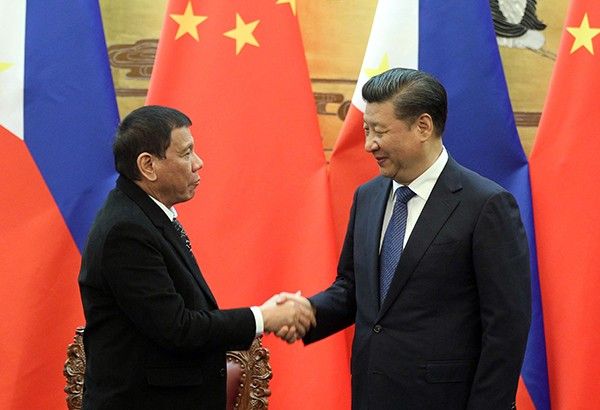
A SHIPLOAD (let’s get that consonant right) of questions has been raised over the “gentleman’s agreement” alleged to have been entered into between former President Rodrigo Duterte and China’s Xi Jing Pin over the disputed Ayungin Shoal in the West Philippine Sea. China has suggested as much, complaining about the present administration’s “inaction” over what it apparently considered a done deal.

According to former Duterte spokesman (should we also call him “former human rights lawyer”?) Harry Roque, Duterte and Xi did pledge between them to “maintain the status quo” in the troubled zone, meaning, there would be no rebuilding or reinforcement of Philippine installations there—specifically referring, I suppose, to the hopelessly decrepit BRP Sierra Madre that has to be the sorriest and loneliest maritime outpost in the world. 

Chinese Coast Guard cutters have routinely tried to block Philippine vessels attempting to resupply the Sierra Madre. A month ago, four Filipino sailors were injured when they were water-cannoned by the Chinese, and their ship rammed. Our resupply ships have been running these Chinese gauntlets to reach the marines on the grounded Sierra Madre, which symbolically enforces our claim to the Spratly Islands, or that portion of it we call the Kalayaan Islands group. This was precisely the kind of situation that Duterte and Xi reportedly tried to avoid with their agreement.

Upon hearing his former colleague’s explosive revelations, former presidential counsel Salvador Panelo quickly went on the air to dismiss them as the fabrications of a publicity-seeker, assuring the public that Digong himself had denied the report. He added that his old boss would never have sold out the country that way. In fact, Panelo claimed, Duterte had brought up the Philippines’ arbitral victory against China at the Hague with Xi—a judgment Duterte had ironically threatened to toss into the wastebasket as nothing more than “a piece of paper.” Roque then went on to explain that the “gentleman’s agreement” covered not just Ayungin Shoal but the entire West Philippine Sea, enlarging its scope exponentially. If it was a lie to begin with, as Panelo suggested, well, the lie got much bigger.

This spectacle of two Duterte mouthpieces not just speaking at cross-purposes but putting each other down would be immensely entertaining if our national territory and patrimony weren’t at stake. It doesn’t really matter who between these two, uhm, gentlemen is right, or whom we end up believing. What’s clear is that either way, beyond token whimpers and some lip service to sovereignty, Duterte and his crew never did much to defend Philippine territorial and maritime rights in the WPS, debating with their local critics on the issue more than with the Chinese, even waging a vain effort to denigrate the Hague ruling and those who had fought so hard for it. 

Given the new administration’s popular pivot toward a more aggressive stance on China, we can understand if Duterte and his boys seem scrambling to be seen as having been patriots all along. Who knows, maybe they were, and maybe we poor kibitzers were just too dumb or too dense to see that. 

Remember when Duterte made that famous “wastebasket” remark in May 2016? Then-spokesman Roque tried to spin that by saying no, no, no, you have to “apply the proper construction” (his exact words) to that statement—meaning (hold your breath), “He really didn’t mean it that way. Instead, go back to his UN speech where he vowed to defend the Philippines against China. When he said ‘I’ll throw this into the wastebasket,’ he wasn’t speaking for himself, he was speaking from the point of view of the Chinese.”

Huh? Forgive me if I can’t wrap my non-lawyerly mind around this “proper construction,” let alone explain why a Philippine president should be expressing the Chinese view.

To help sort this mess out, Sen. Risa Hontiveros has called for a hearing to find out if, indeed, Duterte and Xi had, as the young ones put it, an “MU” over Ayungin and the WPS. Predictably, Panelo thinks this probe will be a “waste of time,” insisting that the reported “gentleman’s agreement” never happened. 

Another newspaper quotes an anonymous Chinese official saying, like Roque, that it did. Under the reported terms of the deal, China would allow the Philippines to resupply the BRP Sierra Madre for as long as it did not reinforce or rebuild the ship. (How the agreement supposedly applies to the entire WPS as Roque claims remains murky.)

One would think that a true, broader, and more meaningful “gentleman’s agreement” in the West Philippine Sea would involve the non-building of offensive structures and bases, the avoidance of violent confrontation, respect for our fishing rights, and freedom of navigation for all nations in international waters—all of which the Chinese have flouted with impunity. Instead—and if true—all our former president did was to ask the Chinese for permission to resupply our own aging and ailing vessel, in exchange for a promise to let it rot. Whether that’s treason or patriotism, you be the judge.

Pending further inquiry, I myself suspect that some kind of bargaining did take place, but I somehow doubt that it was a gentleman’s agreement. For that you’d need at least two gentlemen in the house.