Qwertyman No. 139: Filipinos for Nothing

Qwertyman for Monday, March 31, 2025
THERE’S A part of me that wants to stop beating up on the Dutertes, lest I be accused of being part of the Marcos propaganda machine (which stands to benefit from all this anyway, whatever I say), but like the gift that keeps on giving, the D’s and their people just won’t let me let them be. Being no lawyer, I’ll have nothing to say on the legality or otherwise of the former President’s arrest and forced departure for the Netherlands—except to opine, as others have, that justice sometimes works in mysterious ways.

My beef for this week is how the Duterte Agitprop Department (let’s call it DAD, like Elon Musk’s DOGE) has spun the whole ICC affair in the public sphere. These days, you never expect people to stand on the truth and nothing but the truth in these political matters. But you do hope for s0me degree of sophistication, for the kind of professional finesse that will justify the multimillions that any PR crew tasked with saving Rodrigo Duterte’s skin—or barring that, at least his reputation—will have been budgeted.

There are three propositions by the Duterte camp that I want to focus on, among many others that have arisen since the arrest.

First, his supposed global allies and endorsers. 

Donald Trump, for example, reportedly took precious time out from dismantling American democracy to declare that “We will protect Rodrigo and the Filipino people from the oppression you are facing…. I and the United States will not allow any of our allies and friends to suffer, and we will impose sanctions against the Marcos Administration for the unlawful act they did.” Why, he had even called Xi Jinping—not about tariffs, not about Taiwan, not about American forces in the Philippines—but about the “serious matter concerning our good friend Rodrigo.” For his part, Xi Jinping—who on a state visit to Manila did say “Our relations have now seen a rainbow after the rain” in response to Duterte’s more prosaic “I simply love Xi Jinping!”—supposedly brought up the Duterte arrest and the ICC in his opening address to the Boao Forum for Asia. Not to be outdone, another Duterte hero, Vladimir Putin, was reported to have threatened (someone—not specified) with “grave consequences” for Duterte’s arrest, as it violated the Rome Statute (which Russia incidentally pulled out of in 2016).
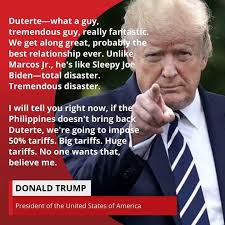
It’s all good when a national leader of superlative virtue and achievement has been so badly wronged that the world takes notice and his peers rise up in alarm to protest the injustice. But really—Donald Trump, Xi Jinping, and Vladimir Putin, all of them prime candidates for the ICC’s hospitality (Putin already is, along with Benjamin Netanyahu)? Never mind that all these supposed endorsements turned out to be fake; they still elicited applause from the DDS faithful, which I suppose was the intended effect. Q: Would it have been too much to expect an endorsement from the likes of Pope Francis? A: Yes.

Second, that call for OFWs to stop remitting their earnings home in a “Zero-Remittance Week” protest.

Our overseas workers contributed nearly $40 billion to the Philippine economy last year, so someone at DAD must have figured it would be brilliant to prick that bubble in the name of remitting Duterte home. But yet again, really? 

Granted, PRRD created the Department of Migrant Workers and the OFW Bank, and brought home hundreds of thousands of OFWs during the pandemic. Former OWWA chief Hans Cacdac even called him “the father of OFWs.” I don’t doubt that the Duterte name has a lot of traction in our expatriate communities, and that flexing a bit of their economic power in a week-long protest will ring some alarm bells, but you might as well ask people to chop off a finger to prove their fealty. For how long do you imagine will Pinoys postpone housing amortizations, tuition payments, maintenance meds, and grocery expenses to protest even the crucifixion of Jesus Christ?

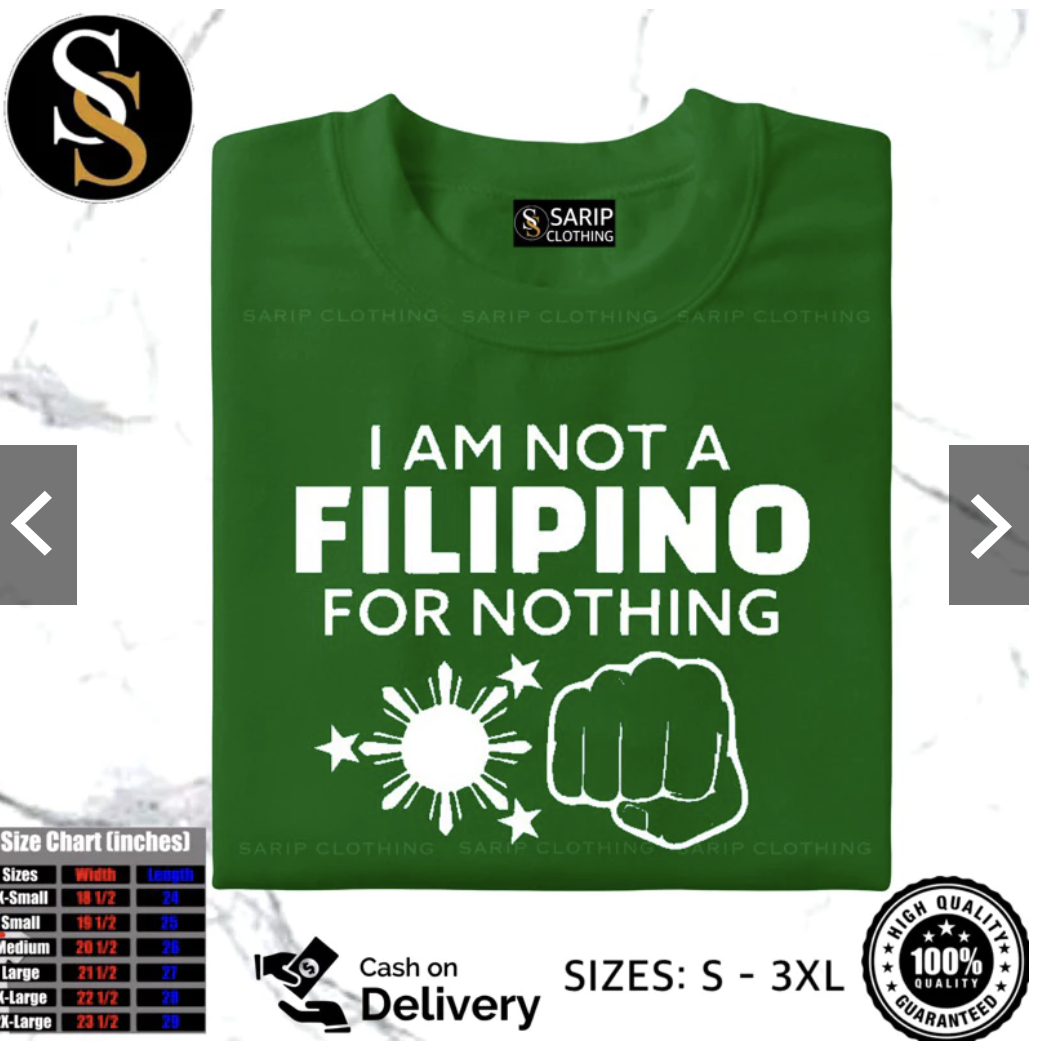
Lastly, and perhaps closest to my propagandist’s heart, there’s that inexplicably vague “I am not a Filipino for nothing” slogan.
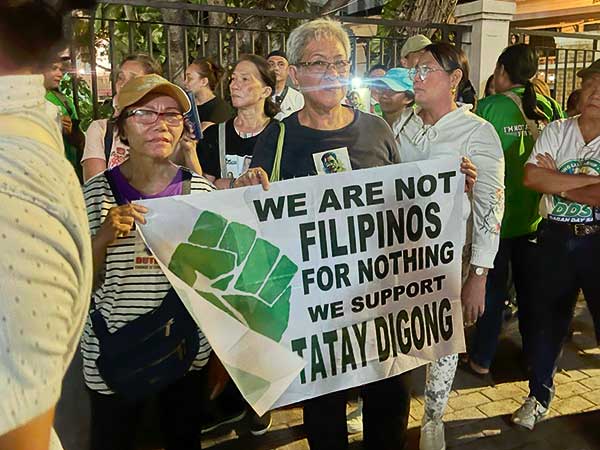
Sure, it sounds brave and bold—like it actually says and means something. But does it, really? I’ve been turning the statement around and around in my head and maybe I’m extraordinarily dense and unreceptive but I just don’t get it. In rhetoric, double negatives are often used to suggest or even emphasize the opposite (the technical term is “litotes,” as in “That’s not a bad idea” or “She’s hardly destitute”). 

Rarely do double negatives make good copy for T-shirts and streamers, if you want to rally the masses. Well, there was Winston Churchill’s “We shall never surrender” (arguably a double negative) speech on the occasion of the Battle of Britain in June 1940, but that statement was preceded by a string of powerful positives: “We shall fight in France, we shall fight on the seas and oceans, we shall fight on the beaches, we shall fight on the landing grounds, we shall never surrender.”

Ninoy Aquino—who must be rolling in his grave at being compared to Digong Duterte—famously said “The Filipino is worth dying for,” a slogan ironically made all the more resonant by the fact that it turned out to be self-fulfilling. I doubt that Duterte will carry his emulation to that extreme, but he or his handlers can learn from its clarity and brevity, which contribute to its emotional appeal. “I am not a Filipino for nothing” means, well, nothing. It says nothing about freedom, justice, peace, love, patriotism, godliness, courage, or integrity—none of the grand ideals and ideas that our heroes exemplified. Might it be because these notions were never really associated with a president whom we best remember for his crude expletives and constant exhortations to kill? 

“Sampalin ang ICC!” sounds much more honestly him. It still sounds lame, especially given where he is right now, but it seems more purposeful, and should look good on a green T-shirt.

Qwertyman No. 49: The Best We Can Do?

Qwertyman for Monday, July 10, 2023

“IS THIS the best we can do?” That question has been ringing in my mind since a couple of weeks ago when two issues came up that, for me and apparently many others, define the level of mediocrity to which governance and decision-making in this country has sunk. Both concerns have already been well ventilated in social media, which is far more scathing and cruel than a Monday column like mine can afford to be—I hate to start my readers’ week with something likely to leave them with an upset stomach—but let’s just think of this as a gargle to relieve our mouths and throats of unpleasant flavors.

First, ex-Atty. Larry Gadon. I don’t know the guy; I’ve yet to meet him and frankly I hope I never have to. I’ve heard the diatribe for which he was rightfully disbarred by the Supreme Court. It’s an awful slurry of verbal excrement that no one but its own source deserves to experience, and there’s doubtlessly more where it came from, disbarment or not. I can live with that, because I know that there’s an even higher court that will render judgment on this fellow and his kind, and it will come with a harshness commensurate to the totality of one’s character. 

What I find more odious is what came after: the Palace’s affirmation of its trust in its appointee as Presidential Adviser on Poverty Alleviation, and Gadon’s own vague reference to certain corporate managerial skills that supposedly qualified him for the job. I had been chatting with a lawyer the day after the disbarment, wondering what Malacañang would do next. “Oh, that won’t get past Justice Bersamin,” he said, adverting to the Executive Secretary. “Just you wait, they’ll take him down.” The next day Bersamin issued a lame press release echoing Gadon’s argument that he didn’t need to be a lawyer, anyway, to take on the Cabinet-level, Salary Grade 31 post, alleviating at least one person’s shortage of cash. (As Full Professor 12 in UP, after more than 30 years of teaching, I retired at Salary Grade 29. Am I envious? Of course I am—shouldn’t anyone be?)

At this point I was pulling hairs off my balding head. So, okay, he doesn’t need to be a lawyer to lead poverty alleviation. But what else does he bring to the job? Is choosing him the best BBM can do? Or does his selection merely confirm what Palace critics believe to be the lack of any genuine commitment to effective and legitimate governance, to give way to the dispensation of favors to political allies? Just when even skeptics were beginning to give their grudging approval to some appointments that made sense—Jimi FlorCruz as ambassador to China and Gibo Teodoro to Defense being two of them—we slid right back into the muck of patronage politics.

Does BBM think so poorly of the poor that he would entrust their fortunes to a man who, using the Supreme Court’s own words, was booted out of lawyering for his “misogynistic, sexist, abusive, and repeated intemperate language”? How will Presidential Adviser Gadon deal with the hundreds of poor women who will be flocking to his office seeking relief for their plaints? Now that he’s beyond the pale of the Supreme Court, will Gadon feel suitably chastened, or will he be emboldened to spread even more nightsoil around the yard? (The dramatist in me is whispering that true character will assert itself, and bring on its own downfall.)

Issue No. 2, the new “Love the Philippines” tourism slogan and the plagiarism mess that followed with its video. I never liked the word or expression “Meh,” which seems a lazy way to express dissatisfaction, but as 99% of social media seems to agree, “Love the Philippines” was triple-meh, totally uninspiring and unimaginative, and visually cluttered. I’m not even complaining about the P49 million reported to have been paid by the government to the ad agency that conceptualized the slogan; we know that the right few words, properly chosen, could make a world of difference in sales, many times more than the investment. (Nike’s “Just Do It” campaign, credited to the American Wieden+Kennedy agency, reportedly boosted Nike’s worldwide sales from $877 million in 1988 to $9.2 billion ten years later. We don’t know how much Nike paid for those three words, but its trademark and stunningly simple “swoosh” was drawn by a female college student who was paid $2 per hour in 1971.)

I also understand that we seem to be too self-critical and terribly hard to please when it comes to tourism slogans, maybe because they’re supposed to encapsulate and project our national identity—on which we have yet to arrive at a consensus, a century and a quarter onward. 

Dick Gordon’s “WOW Philippines” and the subsequent “It’s More Fun in the Philippines” earned their share of brickbats. But whatever those criticisms were, I’d have to agree that either one of them is infinitely better than “Love the Philippines,” whose imperative voice sounds tonally off. (Not to mention its susceptibility to parody, which the Palace’s PR watchdogs should have caught—a “Rob the Philippines” meme has been making the rounds, a tamer verb choice than others I’ve seen.) 

Social media is abuzz with what reportedly happened behind the scenes and what a Palace-favored director supposedly did to screw things up—but again, I’m not even going there, and will limit my dismay to the poor result that often emerges when money, politics, and egos get the better of creatives. The use of video clips from foreign sources to prop up a campaign for Philippine tourism was almost absurdly hilarious and totally inexcusable, and it’s hard to believe that a company as experienced and reputable as the contracted ad agency would have done that knowingly, although it owned up to it. 

At any rate, these missteps don’t do any good for any administration trying to earn the people’s trust, and the ultimate question is, what are they going to do about it? The answer will tell more about those in charge than the minor figures in these scandals.