Penman No. 101: The Digital Tourist (2)

photo 2Penman for Monday, June 16, 2014


LAST WEEK I wrote about some websites that you could check out if you’re planning to go on a trip, especially to some place you’ve never been before. Practically everything today can be planned online, from choosing destinations to booking flights and hotels and buying travel insurance. But what about when you’re already on the road?

This is where travel apps come in—“apps” being those small programs or applets (little applications) that come with your tablet or smartphone, or that can be downloaded to them. These apps can be lifesavers—literally, when you’re lost close to midnight in the bowels of a subway station in a strange city, without the foggiest idea how to get back to your hotel. Some will require an Internet connection, but many won’t, after their initial installation—and that’s when you’ll be happy and relieved that you had the foresight to install them when you could, before you even left for the airport. Whatever I’ll list here won’t be your only options—in many cases, there may even be other, better apps other will know about—but these are the ones I’ve roadtested myself, over many years of traipsing around the planet, with PDA (remember those?) or smartphone in hand. (Do note that I use an iPhone, but many of these apps gave their Android counterparts. For IOS devices, go to the App Store.)

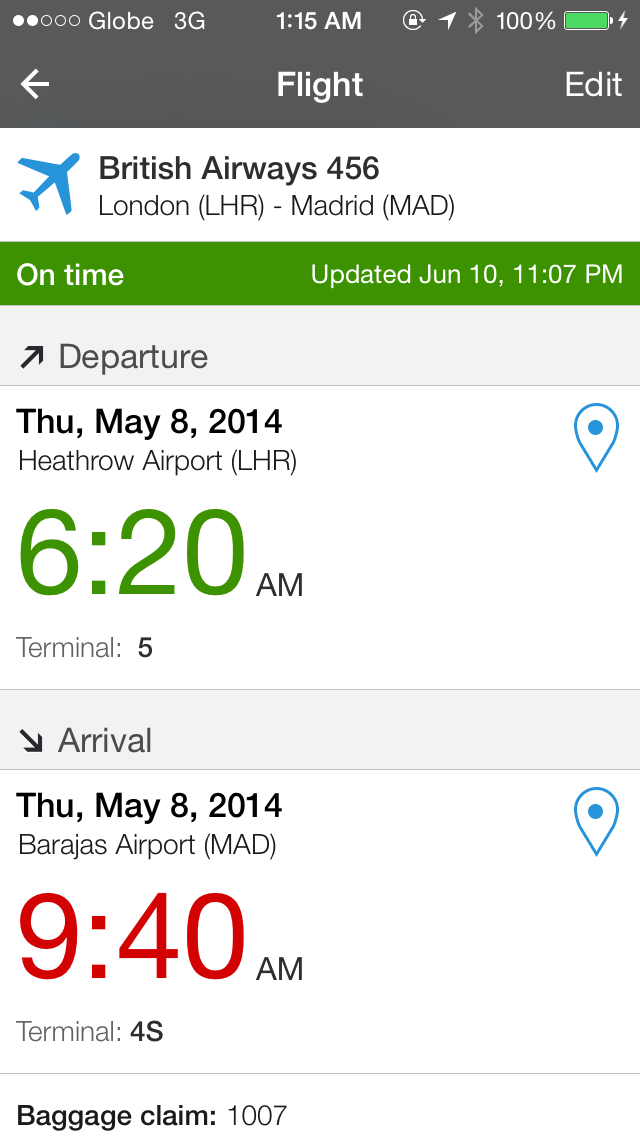
Trip planning. If you travel often, you’ll need an all-around planner to organize your trips—remind you of your itinerary, make your bookings, check your flight status, provide weather forecasts, convert currencies, and such. Your datebook can take care of some of these things, but not all. For many years now, my reliable sidekick in this department has been an app called WorldMate, which can do all of the above, and more (it can also calculate tips).

WorldMate’s strongest feature is its flight planner and notifier, which comes in really handy when you have a string of flights to take in a mad dash from one airport, one terminal, and one gate to another. Let’s say you’re flying Delta to Detroit via Tokyo Narita, or Cathay to London via Hong Kong. As soon as you make your booking and receive it in your email, all you do is forward your confirmation email or e-ticket to trips@worldmate.com. WorldMate will automatically digest that email and reflect your itinerary on the app on your phone or tablet—and, if you’ve configured WorldMate to sync with your datebook, it’ll show up on your calendar as well. If your flight gets delayed, WorldMate will advise you of it. It will give you your terminal on arrival and departure. (WorldMate has a free basic version and a paid Gold version with more features.)

Flight tracking. You’re dashing to the airport in a cab, late for your flight, and you don’t even know which terminal or gate it will be leaving from (and if you’re really unlucky, you’ll be in Madrid, where Terminal 4 is several kilometers away from Terminal 2, and Terminal 4S takes another 20 minutes to get to); you’re praying like mad that your flight’s delayed. At this point, your friend is an app called FlightBoard, which tracks scheduled flights—arrivals and departures—at airports all over the world in real time. A similar app called FlightAware allows you to track all the flights between two airports for a given day, and to zero in on a particular one; if it’s up in the air somewhere over Siberia, it will show exactly where it’s supposed to be on a global map, much like you’d see on those onboard monitors. Both FlightBoard and FlightAware are free. (These apps are also good for when you’re meeting someone in Arrivals.)
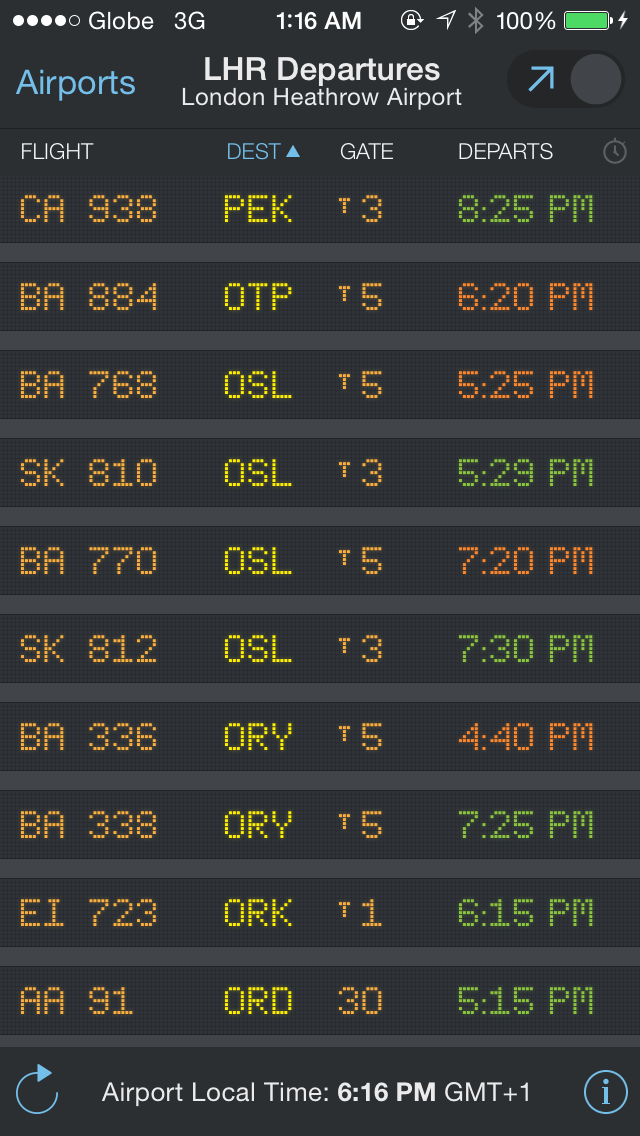
photo 3

Getting around. Once you’ve reached your destination, there are two things you’ll almost certainly need to get around: a city map, and a local transport (subway and bus) guide. Many airports will give you free city maps on arrival, and they’re fun to spread out on the table over breakfast to plan the day, but they’re a hassle to unfold at streetcorners and in the middle of the plaza to locate where you are and where you’re going (and at that instant, you might as well wear a T-shirt saying, “I’m a lost tourist—please, victimize me!”).

A good map stored in your digital device—without needing to go online, as you would with Google Maps—can save you a lot of anxiety, if not a lot of footsteps. On our recent sortie around Europe, I was glad to be guided by one invaluable resource: Ulmon maps of Barcelona, Venice, Florence, and Paris. All of these maps were free, and could be blown up to the level of individual streets and even alleys; if you feel lost, you could input the name of the nearest street, and it will locate your neighborhood in relation to popular landmarks. Clicking on the name of a hotel will give you rates; public transport stops are also indicated.

Speaking of public transport, nearly all the major cities of the world have some kind of subway or metro rail line, and this gives me an opportunity to introduce my favorite travel app of all time—and I mean that almost literally, because I’ve been using it in its various incarnations since 1999, or 15 years, an eternity in digital time. It’s called Metro, and it’ a guide to the world’s subways, metros, and bus lines. I first used Metro on my Palm Pilot when I was navigating around London, and the app—though regularly updated—has remained essentially the same. You choose a city (say Paris), and decide that, from your hotel on Avenue Foch, you want to go to the weekend flea market at the Porte de Clignancourt. You input “Avenue Foch” and “Clignancourt” and tap an icon, and Metro will yield the information that the shortest subway route will take 16 stops involving one change (at Barbes-Roucheouart—thankfully, you don’t need to know how to pronounce these names), for approximately 33 minutes total. Each subway stop is identified, as well as the direction of the train you should be taking. The best thing about Metro? It’s absolutely free, and works offline.
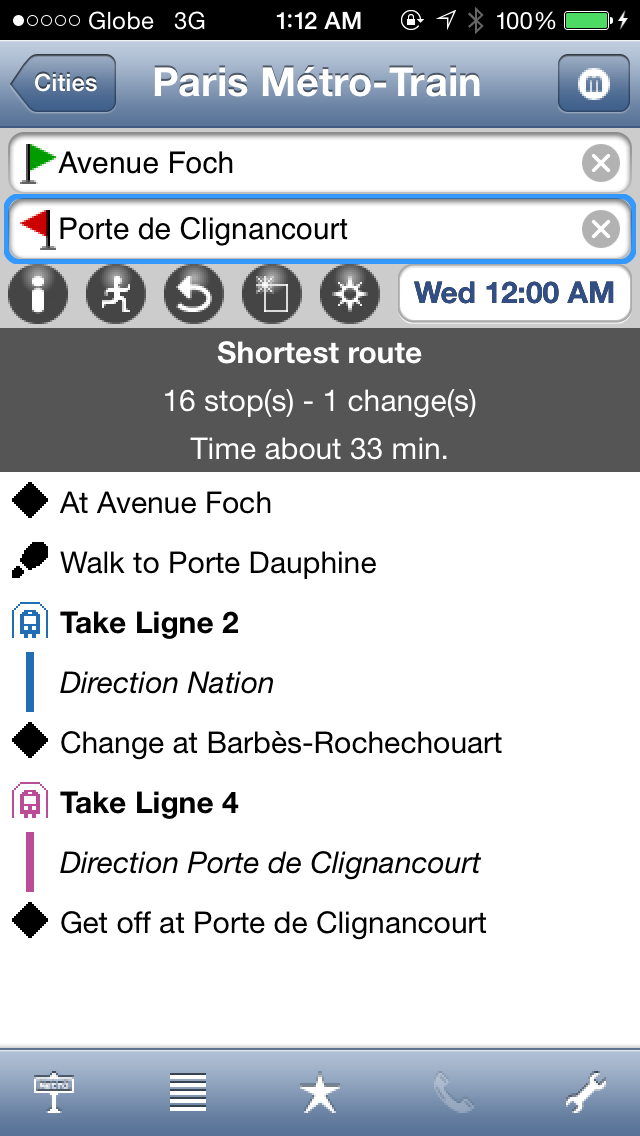
photo 1

This list of apps could go on, but as travel is complicated enough, let’s keep it simple: for as long as you have these apps (WorldMate, FlightBoard, Ulmon Maps, and Metro), your next trip will be much less of a headache, and you can enjoy the view out the window rather than wonder and worry over where your train is going.

(Let me just add, before I forget: these apps will be totally useless if your phone or tablet is dead; I always travel with a universal adaptor, an extension cord, and a power bank for extra juice. If you blow air into my pants, I could go on a spacewalk.)
Penman No. 100: The Digital Tourist (1)

L1090980Penman for Monday, June 9, 2014


SOME FRIENDS who perhaps still miss the days when you dressed up for plane flights (even if it was only to Hong Kong) and carried your paper ticket in a cardboard sleeve asked me upon our recent return from Europe to draw up a digital roadmap for tourists. In other words, what kind of digital resources can tourists and travelers avail themselves of to ensure better, cheaper, and safer travel? By “digital resources,” we mean things that you can find online on the Internet, like hotels and their rates, or carry around with you on your mobile phone or laptop, like travel apps that can record and remind you of your bookings.

It used to be that all you needed in your carry-on was an alarm clock, the kind with two brass bells that roused you like your mother from your jetlagged slumber (if you remembered to set the alarm the night before). But now we travel with smartphones, laptops, tablets, and a raft of batteries, chargers, and adapters, the better to maintain that indispensable virtue, connectivity, also known as your digital tether to home, office, and social network. (All this should make us want to ask why we even left home and what a vacation is supposed to mean, but as everyone knows all too well these days, leaving home means bringing as much of it with you.)

So herewith, some of my favorite digital-travel tips and tricks:

Where to go. While our destinations are often chosen for us (a conference here, a wedding there), sometimes we actually have that rare and precious option of deciding where to go, budgets and schedules permitting. Everyone will have his or her own bucket list—I’d still like to visit South America, Scandinavia, and Eastern Europe someday—but Beng and I prefer to go around Asia for quick, cheap holidays, and are always on the lookout for special deals from regional airlines. Sign up with Cebu Pacific and Philippine Airlines, among others, for regular advisories on their packages. This way, we’ve visited Beijing, Kota Kinabalu, Hanoi, Shanghai and many other places nearby at giveaway fares (about P5,000 round-trip, all-in, for two of us to Beijing). Be open and adventurous, and be ready to book a trip months in advance to get the lowest fares. That also allows you to reconfigure your calendar around those trips.

How to get there. Again, check out airline offers, as well as travel agency packages. Make sure to factor in taxes and surcharges, which can bloat the final bill. What you want to get is the “all-in” price. Factor in baggage allowance; some airlines will charge you even for your first checked bag, especially on local flights. Budget airlines can offer aggressively low fares, especially off-season (that’s why we went to Beijing in December—freezing, but fewer fellow tourists to nudge you around), but it won’t hurt to check as many rates as you can. There are many online guides where you can check prices and book flights—Expedia, Orbitz, Travelocity, etc.—but I use SkyScanner (skyscanner.com.ph) a lot; it gives you the price in pesos, and immediately identifies the lowest price, with many other options. Sometimes it’s also good to check directly with the airline; recently, I found that Air France, on its own website, was offering a flight from Paris to Madrid that was lower than anyone else’s. Also, sometimes, cheapest may not always be the best for you. Cebu Pacific has great regional fares, but they often mean arriving in your destination around midnight, costing you a day and some anxiety in a strange airport. Adding a little more could also mean extras like a better plane and a better layover (we chose to fly BA to Madrid and back via Heathrow, to try out the new A380 and even marginally revisit London, one of our favorite cities). For local travel, don’t forget to explore your train and bus options—ground travel may be slower and not always cheaper, but you’ll see a lot more of the country.

Where to stay. Beng and I are lucky to get special rates from the Starwood chain (Westin, Sheraton, Le Meridien, etc.) because our daughter works there, but when we have to find other hotels, then TripAdvisor and Booking.com are our best friends. As a rule, I never book a hotel (even a Starwood one) without checking the TripAdvisor reviews, which can reveal problems like “great hotel, but terrible location” or uncover pluses like “free, strong wi-fi, two minutes’ walk from the Metro.” TripAdvisor can rank hotels according to your budget and other preferences, assigning one to five stars. Once, on a lark, Beng and I decided to go slumming in Hong Kong and stay in the cheapest dive we could find, so I reversed TripAdvisor’s rankings and found a one-star place on Nathan Road. It was cheap—and fun; we survived! Booking.com is another great guide to hotels and bed-and-breakfast places; they allow you to book often without any downpayment, cancellable without penalty within 24 hours of your stay. I booked our Venice hotel in Mestre and our Madrid airport hotel on this site. (A tip about Venice and Mestre—hotels in prime tourist spots like Venice can cost a fortune, but staying in places like Mestre, a very short train ride from Venice, can save you precious euros better spent on food and sightseeing.)

What to do. Every destination will have scores of travel guides online, but again, TripAdvisor’s thousands of reviews will give you a good sense of what’s worth visiting and what you can forego, especially on a tight budget and schedule (we passed up going to Halong Bay in Vietnam—pretty pictures, but a very pricey day trip). Like I wrote in a recent column, this is where we often let Serendipity take us by the hand and just let one streetcorner lead to another. Unlike many others, travel for us isn’t racking up a series of posed shots before famous landmarks; it’s about seeing what most other people will miss, or doing what most other tourists won’t. I don’t necessarily mean “going native,” which no one can honestly do on a three-day parachute tour, but finding or straying into unusual places, like that dusty, forgotten museum in Shanghai filled with dinosaurs and ancient, mummified Aryans, or that bookshop in Hanoi selling bright purple ink for 20 pesos a bottle.

Before I forget, and even before you begin your digital tour, scan, save, and upload (to one of your own email accounts) copies of your passport, visas, and travel insurance. (Yes, you can and should book travel insurance online—it’s one of those things you’ll be happy to never need.)

Next time, I’ll list and discuss specific apps—WorldMate, Metro, and FlightBoard, among others—and other tools (maps, photos, currency exchange) to help make that next trip of yours a more pleasant and fulfilling experience—as long as you don’t lose your tablet or smartphone.

Penman No. 69: The Girl with the Ukulele and Other Random Jottings

IMG_0021Penman for Monday, October 21, 2013

WHENEVER I travel, I jot random notes down. These notes are observations of the local scenery, things I’m likely to forget five minutes after I’ve seen them unless I find the compulsion and the patience to record them. Note-taking is a habit that anyone starting out as a writer should cultivate, whether mentally or physically. It keeps you attentive to detail, and even the most cursory image (“green umbrella”) can regenerate a whole scene and situation when you look at it again, once you have it down on paper or at least on some silicon wafer.

Ironically, I was never much of a note-taker in class, priding myself in storing whatever my professor had to say in what used to be a prodigious memory; I even found a perverse delight in walking into an open-book exam with nothing but pen and paper. Such was the foolish brashness of youth, since undone by crumbling synapses and flickering pinpricks in the brain.

When I signed up with The Philippines Herald and Taliba just before martial law, I learned how to use a notebook—the classic reporter’s notebook with the spiral top—and a Parker Jotter ballpoint. While not much of a ballpoint fan, I’m convinced that there’s still nothing more efficient than a button-operated Jotter for writing notes on the fly; the more popular because pricier Cross ballpoint—everyone’s idea of a Christmas present in the 1970s and 1980s—required two hands to put in business. The rollerball and the felt-tip pen (remember the Paper Mate Flair?) gave you a much smoother glide on the page, but they needed to be uncapped, and the ink offered the best proof of Murphy’s Law by drying out at the worst possible times.

At some point, I acquired and used a matte-black Sheaffer fountain pen—I still have it in the collection—but as dearly as I’ve come to love fountain pens, I’d be the first to admit that they’re not the best tools to carry on the road for random note-taking, as they combine all the clunky disadvantages of the other pens (two-handed operation, uncapping, sudden dryness) and usually cost more besides. Also, fountain pens need a steady supply of ink, and some of that ink will inevitably find its way to your shirt pocket in a blue-black bloom.

Another problem that often comes with fountain pens is the lack of suitable paper. Unlike ballpoints and rollerballs, fountain pens and the inks they use tend to feather and bleed through on porous paper—you’ll see the ink running into the fibers of the paper, making a thin line look fat and splotchy and the letters barely readable. Unfortunately, most of the paper used on notepads these days (including that in the iconic Moleskine) isn’t fountain-pen-friendly. I do persist in using fountain pens to write some notes with—for how else would I justify carrying two to three of them with me at any given time—but to avoid feathering and bleed-through, I use a Midori notebook, whose paper has a much tighter grain (you can find good, inexpensive paper at the bookstore, through trial and error).

Like many other human activities, note-taking changed, of course, with the advent of digital technology, and I eagerly embraced the Palm Pilot when it first came out in 1997, sticking with it through its many incarnations until the Treo in the mid-2000s. (My favorite of the lot was the sexy, blade-like Palm V.) The Palm had its own unique simplified shorthand, and I got pretty good at it, using a stylus. After the Palm came the BlackBerry, whose nifty keypad I also mastered well enough to write whole articles on.

And then came the iPhone and its total lack of a physical keypad or a built-in stylus. While I was one of the earliest adopters of the iPhone in 2007 (and yes, before you ask, I just picked up a 5s, which I’m calling my iPen), I had a hard time shifting to a virtual keypad. Indeed, if not for Apple’s FaceTime—which allows me to chat almost everyday with my daughter Demi in San Diego and my sister Elaine in Virginia for free—I might’ve stayed with the BlackBerry, which ironically has also morphed into something iPhone-like in the meanwhile.

But practice makes perfect, and I’ve trained myself to tap and peck away using the iPhone’s and iPad’s Notes app for everything from casual jottings to scenes for the novel-in-progress and paragraphs toward a column like this one. The beauty of the process is that you can simply email the note to yourself when you’re done, and thereby move it to your laptop or desktop for the final touches.

And what, pray tell, did I take note of during my recent trip to Jakarta? Herewith, my passing observations (in italics) and subsequent commentary:

Silaw. The Indonesians have the same word for “glare” or “blinding light”; also for “leech” (linta), which was brought up, not surprisingly, in a discussion about politics and politicians.

Stylish new buildings without the quirky bling of the Shanghai skyline. I was much impressed by Jakarta’s urban architecture, if only by its clean lines, with hints of native elements. Again, nothing as showy as Shanghai on the other side of the river. Like Manila, however, Jakarta could be 21st-century upscale one minute and Third-World, fish-sauce funky the next, just around the corner.

Bajaj. Pronounced bah-jay, the Indian motorcycle brand, now applied to Jakarta’s version of our tricycle and of Bangkok’s tuk-tuk.

Menteng. A district in Jakarta, where our Ibis Budget hotel was located. At the same time, said our host, “This is where Jakarta’s old rich live,” to which I replied, “Ah, we have our own Menteng, but we call it Forbes Park.” Huge, tree-shaded mansions.

Jalan Surabaya. A few blocks from our hotel, Jakarta’s antiques row, aimed at the tourist market; some real artifacts, to be sure (among them, curiously, an LP of Nora Aunor titled “Let Me Try Again”), but many items probably dodgy. Was looking for vintage pens as usual but didn’t find anything beyond a bruised Sheaffer Targa or two. Ho Chi Minh City’s Le Cong Kieu Street is vintage-pen heaven by comparison.

7-11. They were all over the place—one in front of our hotel, with knots of people forming just outside the door. Why? Ah, the free wi-fi, which you can access on your phone.

Girl with the ukulele. One of the first sights that greeted me, late at night on a street in Menteng, as my hotel-bound taxi whizzed by: a girl of about 15, carrying a baby, presumably her sister, and a ukulele. Behind her was an older man, also with a ukulele. What was going on? Likely the Jakarta version of our streetcorner seekers of alms.

Dilarang merokok. “No smoking”—but they do, anyway. Indonesian cigarettes are advertised all over, even on TV, although they never show anyone really puffing away.

No forks. The conference I attended offered packed lunches of rice, chicken, some kind of fish sauce, veggies, kropeck—all good—but only a plastic spoon and no fork. Everyone around me dug into their lunches, one-handed and fork-free.

Busway. They don’t have a subway, but they do have busways that segregate the buses on major roads from the rest of the traffic. It seemed very efficient, and I naturally wondered why we didn’t have the same thing in Metro Manila (we do, but they’re busways in the mind, eminently negotiable, not on the road; Jakarta’s busways were blocked off by a fixed concrete ridge).

Airport tax 20 USD. Or 150,000 Indonesian rupiahs, which is considerably less than $20, but which I didn’t have by the time I was leaving, because no one told me about the airport tax. I hate airports (like ours) which charge you a fee for using them, as if you had any other choice. Heck, anytime I’m in an airport, I’ve already paid someone a lot!

Penman No. 67: Found in Translation (2)

IMG_2078Penman for Monday, Oct. 7, 2013

AS YOU read this, I should just be returning from Bangkok from another conference of writers and translators, and I’ll be reporting on that encounter next week.

But before anything else—and given this context of world literature in which I’ve been immersed for the past two weeks—let me voice my concern over a development I’d heard about in my absence pertaining to some contemplated changes in our high school curriculum. With our educational system shifting to the K-12 scheme—which I’m in favor of, just to be clear about that—our teachers and school administrators have had to review the curriculum to adjust it to the opportunities presented by the extra class time.

The plan being prepared by the Department of Education and the Commission on Higher Education was for high school seniors to have two semesters of literature—regional and world literature, meaning, literature by Filipinos outside of Manila and literature written by everybody else. Those of us who teach literature in college were elated to hear about this, because we see how valuable literature is to exposing young Filipino minds to the dynamic realities and challenges of the world around them—beginning with us as still a nation-in-progress, which regional literature helps to build, and with our growing engagement with Southeast Asia and the rest of the planet, which world literature makes sense of and amplifies.

Comes now the news that the DepEd has decided to compress these two semesters into one and to treat both regional and world literature as one subject, which doesn’t make sense for the teachers of these subjects and disperses the intended focus of our concerns in these areas. Makes me wonder what we added those extra semesters for, and, worse, if literature is going to continue to be treated as a disposable frill without any real bearing on national development. Have any of our government officials figured out by now that part of the reason we have a “Zamboanga hostage crisis” or a “Mindanao problem” is that we’ve never really introduced and explained ourselves to ourselves—which is what art and literature do for a people? Let’s hope that the DepEd rethinks its position on this matter, before it’s too late and before we fall farther behind our Asean neighbors in using culture as a foundation for nationbuilding.


AND NOW back to Jakarta, where I spent a few days with a large group of very enthusiastic and talented translators-in-training and with experienced translators and language specialists from as far away as the UK and Norway. As Kate Griffin of the British Centre for Literary Translation put it, the Jakarta workshops were something of a “translation boot camp,” a quick and memorable immersion for the participants into the unique challenges and wonders of translation as a bridge between cultures. (The BCLT promotes the translation of foreign authors into English, in support of what it calls “bibliodiversity,” the opening of minds and hearts through a richer and more accessible fare of reading material.)

As I reported last week, the experience of having parts of my second novel Soledad’s Sister translated into Bahasa Indonesia (where it reads as “Saudara Perambuan Soledad”) reminded me of other fruitful encounters I’d had with my previous translators: Clara Nubile, who translated Soledad into Italian for Isbn Edizioni, Marta Alcaraz, who translated Killing Time in a Warm Place into Spanish for Libros del Asteroide, and Jean-Pierre Aoustin, who translated Soledad into French for Mercure de France. I’d had lively discussions with all of them, especially Jean-Pierre who turned out to be an old Manila hand and who met with me on a recent vacation here.

I think it was Salman Rushdie who once said that “the most interesting parts of a language are the untranslatable ones.” Be that as it may, translators have to do their best to come closest to an author’s original intentions, knowing that it is an impossible and fruitless task to strive for 100% fidelity and accuracy, but creating a space for negotiation and understanding between cultures in the middle of the two languages, the source and the target.

Clara, I recall, asked me to describe what kind of a criminal operation a bukas-kotse gang was. Marta had a load of questions about juego de prenda, the tuta in “Marcos Hitler diktador tuta!”, and why I had chosen to call the ruling party under martial law the “PNR, or the Party of the Newly Risen”; I explained to her that the actual martial-law government party was called the Kilusang Bagong Lipunan, or Movement for a New Society. I used PNR as something of a private joke, as the initials also stand for Philippine National Railways (a reference to how everything was railroaded under martial law) and for the Filipino phrase “puwede na rin,” or “it will do” (a reference to mediocrity). Jean-Pierre wondered about my use of “laundry on the clothesline” and if it had any cultural resonances; I told him that we Pinoys still hang our clothes out to dry, and that you can half-expect to find your favorite jeans and shirts gone from where you left them if you don’t watch out.

In other words—literally, I guess—translation involves much more than figuring out equivalents for individual words and phrases; the translator keeps looking for similar, familiar experiences in the target culture to convey a working sense of the author’s meaning.

In Jakarta, my group and I—with the Bali-based translator and art critic Arif Prasetyo facilitating—went over words and phrases that the Indonesians had flagged. Why did I use “cloud-curtained” to describe a rainy evening instead of just “rainy”? (Because it was the novel’s opening scene and I wanted a touch of the theatrical.) Why did I say “a million gas stoves roared to life”? (Because I wanted both the sound and the image of the gas fires coming awake, mirroring the headlights of motorists and even the flowers in the plane’s cargo hold.) When I wrote that the sudden downpour “blurred glasses and windows,” did I mean “eyeglasses”? (Yes, to set up a motif having to do with seeing and perception.) We had fun with the word duhat, which I’d kept in the Filipino original, not knowing its English equivalent; some Googling with images established that, in Bahasa, it was the local jamblang, also known as the duwet or the black plum (but if I’d used “black plum” in my novel, not a single Pinoy would have known what I meant).

Just as interestingly, my translators found a couple of mistakes in my novel, which I acknowledged with equal amounts of embarrassment and gratitude. One was a small typo, the other a major boo-boo: I’d said that the flight from Jeddah to Bangkok had “stretched the daylight with it,” but an alert member of the team who had actually been to Jeddah (I never had) noted that it worked the other way around, that one flew more quickly into the darkness. I promised to correct this in the next edition.

And so my adventure with the translators went, full of surprises and revelations. I learned much from listening to Kate Griffin talk about how, in the UK, interest in translation has been drummed up through popular word games, and how the BCLT (which is based at the University of East Anglia in Norwich, where I began Soledad’s Sister as a David TK Wong Fellow in 1999) combines teaching, research and expertise with an ambitious outreach program. Eric Abrahamsen, an American who has been based in Beijing for the past 12 years, spoke about how he helped form Paper Republic to band translators of Chinese together to professionalize their trade.

John McGlynn, an American translator who works with the Lontar Foundation which translates and publishes Indonesian writing into English, brought up the painfully obvious point: translators don’t get paid enough for their work. Ideally, he suggested, translators should get at least $20 (or, to us, P1,000) per page, given that the US State Department paid professional translators like him $30 per page for contracted work. In reality, however, Indonesian translators got a tiny fraction of that suggested amount. “Factor in the cost of printing and distribution, plus royalties for the author, and you really have very little left for the translator,” said John.

Indeed, translators around the world have a long way to go to attain the same respect and consideration given to the authors whom they lend their voices to, but like the writers themselves, they have no choice but to persevere, the unacceptable alternative being silence and ignorance.

Penman No. 58: Hello STOP Goodbye STOP

Penman for Monday, August 5, 2013

FROM INDIA, last week, came the news that the company that handles that subcontinent’s telegram service had sent out its last telegram, ending a facility that had been available to Indians since 1850. It was also from India that, two years ago, we received word of the demise of the last operating manufacturer of typewriters in the world, a company called Godrej and Boyce, which was still making up to 12,000 typewriters a year until 2009.

It might seem then that the horizon of obsolete technologies lies somewhere between Srinagar and Chennai, but of course we Pinoys know differently. For even in this age of Twitter, Instagram, SMS, and FaceTime, many Filipinos—the oldest and the poorest of us, that is—still have one foot firmly planted in the 20th century, and it will be a while before we’ll learn to let go, at least in our minds, of the things that made our life easier back in 1963.

A surprisingly comprehensive history of the Philippine telecommunications industry, written and published online by Federico and Rafael Oquindo, says that the Spanish began laying out a telegraphic service in the Philippines in 1867.

I’m not sure if we can actually still send paper telegrams to one another, since the old telegraphic companies have either died out or been taken over by telecoms giants more interested in moving money than messages. Your relatives would surely be more interested in receiving a MoneyGram from you, anyway, than your telegraphic best wishes. If you’re feeling wacky, you could also send them a singing telegram, which—for around P2,000—will include a box of chocolates to go with the guitarist and singer, and your favorite song.

But where has the old-fashioned, STOP-punctuated slip of paper gone? Gone the way of the horse-drawn carriage and the steam engine and the carrier pigeon, it would seem, replaced by faster, sexier, and maybe even cheaper ways of getting a message from A to B. In the US, Western Union sent its last telegram in 2006.

To be perfectly dry-eyed about it, few 21st-century citizens will miss and mourn the telegram. To send one, you had to go to an office and scrawl your message on a pad of paper—a message that, depending on your agent’s sharpness of eye and adequacy of mind, could come out garbled on the other end. The cost of the telegram was computed by the word, and how fast it traveled depended on how much of a premium you were willing to pay; I remember that “NLT”, or night letter, was the cheapest option, because you had to wait for some night clerk to attend to your message after everything else went out for the day. And then your telegram, encased in a flimsy plastic envelope, had to ride along with a bagful of others in the back of a motorcycle or even a bicycle to cross rivers and mountains to get to its recipient, two or three days after pushed your message across the counter.

It all seems too cumbersome and too quaint now, but there was a reason for the telegram’s popularity in its day. Very often, it went out to people and places without telephones (yes, there was such a country and such a time), and it was much faster than a regular letter, albeit more tight-lipped. Arguably, the telegram was unique in the power it conveyed and the significance it implied, for only the most important—both the saddest and the happiest—of messages merited a telegram.

Unlike SMS, or even the pager (remember EasyCall?) that preceded the cellular phone, the telegram was too slow for casual banter, too terse for courtship or argument. It worked best at bringing you the good news and the bad news: prizes won, loved ones lost, congratulations, condolences, reminders, pleadings.

I have a soft spot for the telegram, because it figured prominently in my literary career, starting with one I received in May 1969, informing me that I—then a high school senior—had won a national essay competition. Over the next two decades, at around this time of year, I would scan the horizon for the RCPI messenger, the bearer of the only telegram that mattered to me and hundreds of other aspiring Filipino writers: one sent by the Carlos Palanca Memorial Awards Foundation, telling us that we had won and inviting us to the September 1st awarding ceremony. (Our exuberant imagination supplied the rest of the unspoken message, which understandably would have cost the Palancas too much to tack on to their congratulations: “You’re a wizard of words, a literary lion, a paladin of prose whose works will sell a million copies, attract hordes of screaming fans, foment revolutions, and uplift human life and civilization!”) I did receive a number of those telegrams, a few of which I still keep as souvenirs, reminders of the Jobsian admonition to “stay hungry.”

There was one telegram I remember sending, sometime in the mid-1970s, from my small hometown in Romblon where I had gone on a short visit with my father and had quickly run out of cash, not having had much to bring in the first place. In desperation, I cabled my new bride Beng, whom I had to leave behind in Manila: “MISSUS I MISS US HONEY SEND MONEY.” And so she did.

And that’s all the old telegram companies do these days—send money to presumably happy recipients. Let text and Twitter take care of the bad stuff. If it’s the physical telegram itself you really want to send or to get, just so you can relive the good old days when people got inky fingers from writing long letters with fountain pens and licked postage stamps and waited for weeks to get something back in the mail, there’s hope for you. A company will still deliver a telegram to a Philippine address (and to over 200 other countries), for $24.95 plus 88 cents per word (no NLT option here); you’ll just need to go online at www.itelegram.com to avail yourself of this charming if pricey service.

SPEAKING OF other countries, it’s always good to read positive things about the Philippines when you’re abroad, even if they happen to be advertisements. In Hong Kong a couple of weeks ago, I beamed when I turned to the travel pages of a local newspaper and saw how many ads featured our national tourism tagline: “It’s more fun in the Philippines!” The ads offered special packages for Manila (read: the new Solaire casino) and other parts of the country (read: Boracay) via Philippine Airlines and Cebu Pacific.

Now, I’m one of those guys who—no matter how strongly I might criticize our foibles and follies back home—like to wave the Philippine flag when they’re on the road. Any chance I get, I invite my foreign friends to come and visit, allaying their usual fears by pointing out that they could get mugged in New York or robbed in Prague, anyway—they might as well enjoy our sunshine! Lord knows we need all the plugging we can get, with neighbors like Thailand roping in some 22 million tourists a year versus our 4 million.

I’m wondering now if it was schadenfreude—that wicked burst of pleasure you get when something nasty happens to your neighbor but not to you—that coursed through my veins when I came across an article in The Standard noted that traveling to Thailand was fraught with danger “from jet-ski scams to robbery, assault and even police extortion.” Hah! I thought—that’s what I’d been trying to tell my Hong Kong friends—it’s more fun in the Philippines!

Then I read on, turning the page: “Britain said Thailand is the country where its citizens are second most likely to require consular assistance, behind the Philippines.” Ooops! Sounds like we need to do a little more work in the Philippines.

(Image from philippinephilatest.net)

Penman No. 50: More Than Islands

IMG_1517

Penman for Monday, June 10, 2013

LAST WEEK, I realized another lifelong dream. Nearing 60, I’ve had the privilege of traipsing all over the planet, but I’d never been to Batanes, the northern spearpoint of our vast archipelago. The occasion was a seminar held by the National Commission for Culture and the Arts, specifically its Literary Arts committee, for the province’s teachers and writers on the development of local and regional literature. Truth to tell, we went there less to teach than to learn, so remote and strange was Batanes to me and my fellow committee members, who had come from as far down south as Zamboanga.

I can’t pretend to have discovered everything good and bad about Batanes in the few days we spent there, but we saw and heard enough to make us want to both rejoice and, occasionally, shake our heads in anger and sadness.

Happily there’s much, much more to celebrate about Batanes than to mourn. “Breathtaking” is almost an understatement for this cluster of islands. If there was such a thing as “panoramania,” or landscape overload, Batanes would be the cause of it, with seemingly endless and unfailingly spectacular views coming one after the other, just around the bend. The greenery covering the undulating hills is marked by a latticework of hedgerows, which act both as property boundary markers and as windbreakers. Despite the many first-class concrete roads beribboning the islands, Batanes is still clearly 4X4 country, better suited for cattle and goats than people, and no Batanes landscape would be complete without a cow or two in the picture, grazing placidly away even on the steepest of hillsides. Nearly everything on the main island of Batan happens in the shadow of the cloud-capped, 1,009-meter Mt. Iraya, although it should be fairly easy to find an undisturbed corner in one of the many coves around the island.

With a near-nonexistent crime rate, Batanes is one of those places where residents still keep their doors unlocked, where you can walk the highway at night without fear of being waylaid, and where—on my early morning strolls in the capital of Basco—I was greeted more than once with a beaming “Good morning!”

The “Basco Hymn”, with words and music penned by the mayor himself, Demy Marag, captures this lightheartedness well: “Hampas ng alon mo ay musika sa pandinig ko / Luntiang bundok mo, ginhawa’y dulot nito / Ihip ng hangin mo, haplos sa katawang hapo / Ngiting nasasalubong, ligayang totoo.”

You can find those words on one of the most useful and inexpensive PR giveaways I’ve come across, handed to us by Mayor Demy’s staff: a cardboard fan shaped like a kavaya, the leaf of the breadfruit tree, which the local people use as plates and food wrappers. Practical to begin with because of the withering heat, the fan was also very informative, in that it contained interesting facts about Basco—among them, that the population of the entire province is just somewhere above 16,000, half of whom live in Basco. The fan also highlighted Basco’s and Batan Island’s major tourist attractions.

Only in his mid-thirties, the poetically gifted Demy Marag is a Broadcast Communication graduate from UP; after graduation in 1998, he worked in the industry and with an NGO for a few years before eventually answering the calling that lodged his grandfather in the governor’s office decades earlier. A big sign just outside the municipal hall posts the mayor’s cell phone number and those of other key municipal offices; you can call them anytime. Now on his last term, Demy says that his biggest headache in Basco is zoning, with new buildings cropping up all over town, likely in response to the surge in tourism and commerce.

There are, of course, many other problems a remote province like Batanes has to contend with. Over a light merienda at the impossibly picturesque (had enough of these superlatives yet?) Fundacion Pacita, Basco’s energetic vice mayor, Ann Viola, explained how the typical Batanes resident, though not wealthy, was basically self-sufficient, producing enough for oneself and one’s family through fishing and farming. (You can appreciate this wiry self-containment in the fact that you’d be hard put to find an obese or even chubby Ivatan, and they don’t look emaciated, either.) Since transport costs are prohibitively high, producing goods for export poses a huge problem.

DSC_6610

Indeed, there’s literally a price to pay for all that glorious isolation: a liter of gas costs P70—which was cheap, said our guide, considering that it had shot up to P150 at some point a year ago. Bewilderingly, there are hardly any fresh fruits to be found in Basco—no bananas, pineapples, star apples, or jackfruit—and the only fruit that kept turning up on the dessert tray was the obviously imported apple, very likely from nearby Taiwan, which is closer to Batanes than much of the rest of the Philippines.

Tourism should be the province’s logical economic booster, and good, affordable bed-and-breakfast places like the Amboy Hometel, where we stayed, can be found. (For those with more elastic budgets, the Fundacion Pacita is a matchless choice.) Tours by van are readily available, taking you to the best spots—the Vayang rolling hills, the boulder-strewn Valugan beach, and the lighthouse on Naidi Hill, among many others. A day trip to nearby Sabtang Island, just half-an-hour away by ferry, is also well worth it, particularly for the stone houses of Savidug.

DSC_6695

It’s getting there that’s the big hurdle for most people. PAL Express and SkyJet fly three times a week from Manila to Basco, and a local airline called NorthSky makes a hop to Cagayan, but flights are sometimes canceled for lack of passengers. Only cargo vessels now dock in the harbor. As a regular one-way plane ticket to Manila costs about P9,000, a Basco native could spend his or her whole life without ever stepping on Luzon. “If you have a medical emergency and can’t be treated here, or airlifted to Manila, you’ll die,” said the vice mayor.

Another problem is the pernicious presence of poachers from Taiwan, who come down to the islands to steal the pretty arius tree, which they use for bonsai, and also fish the waters using state-of-the-art detectors—intrusions against which the local fishermen and Coast Guard are no match. It’s too bad that these criminal acts should spoil the relationship between Batanes and Taiwan, whose people—linguistically, for one—have much in common.

That remoteness and expensiveness, however, has its pluses for the locals. “It keeps the riff-raff away,” said a resident. “If it were that cheap to come to Batanes, we’d have drug dealers coming here before you know it.”

My message for the teachers and writers of Batanes was the same one I gave at the closing ceremonies of the recent Iligan National Writers Workshop. I was, I told them, an island boy, and proudly so—I was delivered by a midwife a short walk from the water’s edge in an island in Romblon, in a house with a straw roof and a bamboo-slat floor—and we Filipinos, come to think of it, all live on islands, some of them just bigger than others. But the challenge to our writers and teachers is to help us become more than a collection of islands. Our writers have to find and emphasize what we share in common as a people, even as we celebrate the things that make us unique. By building a bridge of words, Batanes can come much closer to the rest of the country.

I’d like to thank our guides—Chriz Annmarie Bayaras and Juliet Gulaga of the Batanes Heritage Foundation, Inc.—for a most productive week.


SPEAKING OF Iligan, MSU-Iligan Institute of Technology is capably led by Chancellor Sukarno Tanggol, a public-administration expert and another UP graduate who chose to return to his roots in Mindanao after serving as Ambassador to Kuwait to help raise the quality of education there. Dr. Tanggol recalled, jokingly, how he had lost all his poems and therefore his literary ambitions when his laptop got stolen years ago, but he’s making up for that by pledging his strong support for cultural programs in MSU-IIT, most notably the writers’ workshop and the institute’s resident performing company, IPAG.

The wonderful thing about attending a region-based workshop like Iligan’s is being able to listen to commentary and criticism in a flurry of languages—Filipino, English, Cebuano, Hiligaynon, and even more obscure ones like Higaunon (spoken in parts of Bukidnon)—and somehow, with some effort and patience—to make sense of it all. This is the nation in progress, the nation at work, rightly de-centered from Manila, celebrating the vibrancy and vitality of literary talent beyond the metropolitan mainstream.

A fantastic discovery in Iligan was the talent of a young Higaunon poet named Shem Linohon from Central Mindanao University. Though perfectly fluent in English, Shem has chosen to write in Higaunon, to help preserve his people’s language and experience. At one point, Shem broke down in tears as he recalled the depredations his people have had to go through at the hands of oppressors and landgrabbers; but more than anger, Shem has the skill with which to fight back, and we can only wish him and his people well. Another happy find was Carmie Flor Ortego of Leyte Normal University, who can write about a Homeric character like Penelope in Catbalogan. Bright and earnest, young writers like Shem and Carmie make me proud and happy to be a teacher of writing.