
Qwertyman for Monday, December 29, 2025
ONE OF the great regrets of my college life was that, for some reason or other, I never got to take a formal course in Philosophy, which might have helped me make sense of the moral sordidness permeating our lives today. Like many of you I’ve been particularly captivated by the question of why a presumably all-good and just God would allow so much evil in a divinely created world, and let good people go bad, from petty thievery to massive corruption in the flood-control billions.
I’ll get back to the billions later (I think you know where this is headed), but let me start with me getting scammed, albeit small-scale, on Christmas Eve.
It started with an ad on Facebook Marketplace, where I spend more time than I probably should in search of old pens, books, and the kind of odds and ends that bring joy to old men trying to buy their childhoods back. The item I saw was none of the above, but rather a decent-looking pair of second-hand jeans that I thought would fit me.
(Yes, because I’m larger than most Filipino males, and because threads today cost a fortune in the shops, almost all my clothes come used from the ukay-ukay, eBay, and FB. I’m a great believer in recycling—my mom used to dress us in B-Meg feedbag cotton, if you remember that—and at my age I have no qualms about wearing some dead man’s shirt, after a good wash.)
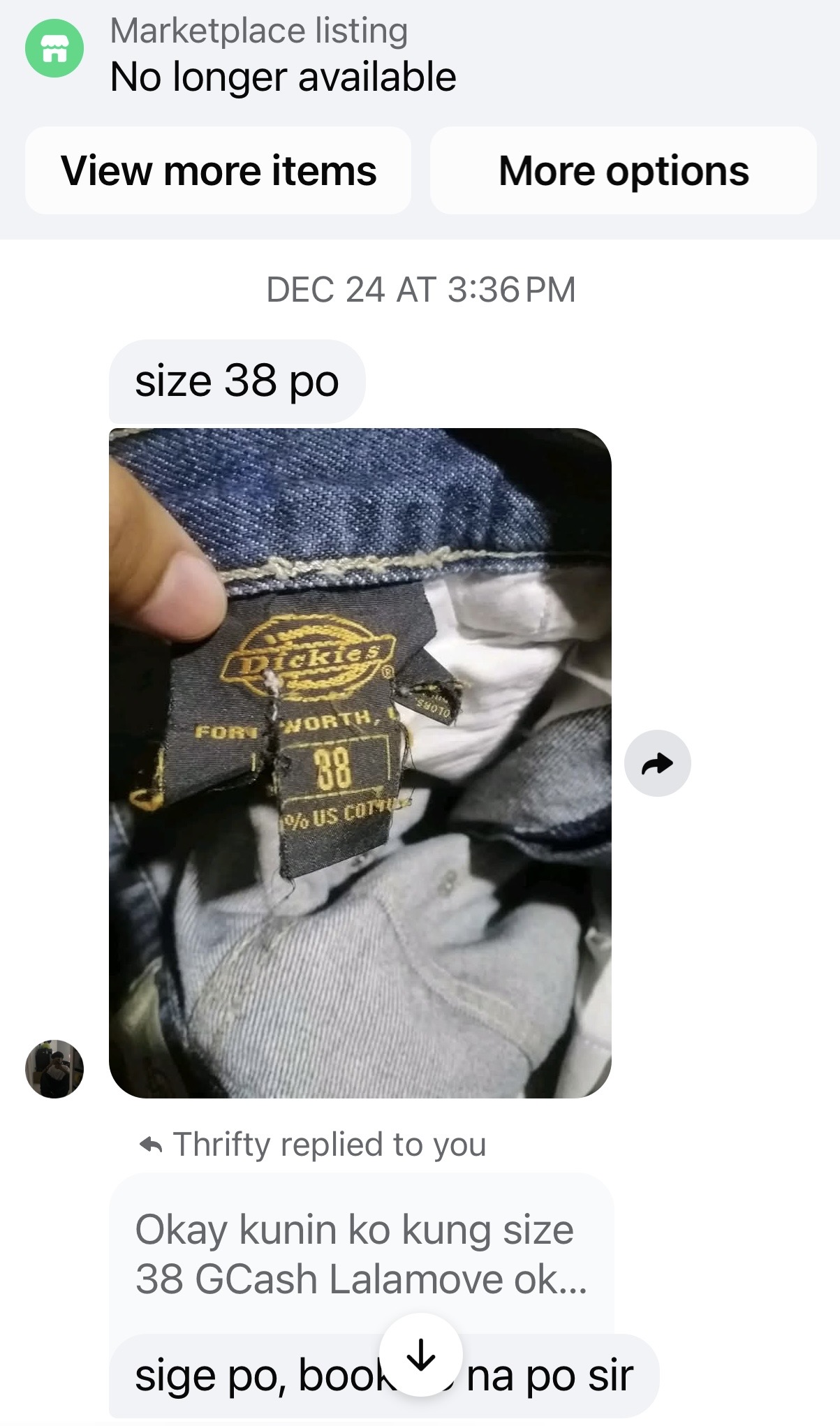
So I messaged the seller, whom we’ll call Mr. T, confirming the price in the mid-hundreds and more importantly the waist size. He promptly replied with a picture of the size tag, which delighted me, and he asked for and got my shipping details, offering to do the booking himself and send me the Lalamove cost, to my great relief. About fifteen minutes later he said he was having problems finding a rider—entirely plausible, since it was probably the busiest shipping day of the year—and so I offered to add a tip, which he offered to split with me. How nice.
Mr. T got a rider, I got the total price, and paid him without second thought. He sent me a picture of a rider bearing packages, one of which would have been my jeans, and I waited. I normally ask for the tracking, but this was pretty close and the amount was small so I didn’t bother, and besides Mr. T. very helpfully sent me updates (“He’s just five minutes away”) and even sent me a number to call. Fifteen minutes later, figuring the rider had lost his way, I called the number, and got an “out of reach” message. Holiday congestion, I figured. Thirty minutes, I called again; same reply. I messaged Mr. T on FB; messaged bounced, “Couldn’t send.” Our lively, Christmas-y conversation was over. I’d been scammed.
That wasn’t the first time it had happened to me, online or in real life. I’m no dupe, and know my way around the digital darkness, often warning friends myself about phishing scams and hoaxes, but the problem is, I’m a gambler at heart, and when it comes to small amounts, small bets, I gamble quite freely on the goodness of human nature, even in the knowledge that, at some point, I’m bound to lose. (To be fair, 95% of my online transactions have been problem-free and even profitable, so no, I’m not going back to writing checks and visiting bank tellers like some of my Boomer friends have.)
Of course, from the scammer’s point of view, those hundreds that trickle in from suckers like me soon turn into streams of thousands. And someone like me, familiar with loss, might afford to shrug it off, but there are kids out there who would be devastated if their P500 toy never came.
What fascinates me here is the tender, loving care with which Mr. T executed his plan, and kept me hoping until the very end. He could’ve shut me off the second he got his money, but no; he kept me hanging on, then dropped me at the very last minute. I can imagine him doing this with practiced efficiency, and I suspect not a little pleasure at being proven right about the gullibility of people.
Now the fictionist in me imagines that Mr. T wasn’t born with scamming in mind, and didn’t take Scamming 101 at Evil U. He might have studied Accounting or Pharmacy or even Philosophy, and even gotten good grades, until something clicked in his head one morning to try something different, putting self-love at the fore.
This is where I go back to wishing I’d read more of Immanuel Kant and his idea of the “radical evil” rooted in every individual no matter how good, just waiting to be activated. That resonates with me, because I couldn’t possibly do the fiction I do if I didn’t believe that the germ of evil resides in every good person, and vice versa. (In a sense I have to admire Mr. T for being the better fictionist, having put one over the pro.)
And this brings me in a roundabout way to something I’d been thinking deeply about these past two weeks, as I’m sure many of you have—that image of Cathy Cabral on the lip of that ravine, running her life through her head, mesmerized by the ribbon of light in the stream below. She knew what stood behind and ahead of her; only what lay below was unknowable and perhaps comforting. She was here to confront something greater than her fear of heights.
Never much of a conspiracist, even in my fiction, I have often found that the simplest truths and explanations are also the most difficult to accept. One of them is that there slithers a Mr. T and a Cathy C. in each of us, seeking a way out.












 Pinoy Penman 3.0