Qwertyman for Monday, April 13, 2026
BACK IN the early days of martial law, when I went underground, among the books I read in our safehouse in Makati was William Shirer’s monumental The Rise and Fall of the Third Reich, a comprehensive account of Adolf Hitler’s and the Nazis’ rise to power. While academics have critiqued its journalistic treatment as not being scholarly enough, the 1960 work remains an important contribution to modern political history, if only as an eyewitness account, with Shirer having been stationed in Germany from 1934 to 1940. I was particularly intrigued by his thesis—since much debated—that the German people, from ordinary farmers and workers to the most powerful industrialists, enabled Germany’s descent into totalitarianism, stemming from their Lutheran deference to secular authority.
That book and its implications for us, then just beginning to confront and comprehend dictatorship, instilled in me, as a playwright and fictionist, a fascination with complicity and collaboration. I also dug deeper into the history and culture of the Third Reich, particularly its propaganda. Even today, YouTube is rich with visual documentation of that dark period, from the burning of the Reichstag to the Nuremberg parades and, in that same city, the trials that laid bare a regime’s methodically murderous mind.
Its parallels to our time cannot be overemphasized. In the 1930s, the so-called “Hitler Myth” was sold by Nazi-leaning newspapers to promote Hitler as the restorer of German pride from the shame of Versailles and the economic ruin that followed the First World War. Germany could be great again. But Hitler also needed scapegoats to blame for the country’s woes, and so he singled out the Jews and the Communists for that purpose.
Like today’s American ICE, the Gestapo and the SS conducted raids to round up these enemies of the State, and Hitler launched wars to expand German territory and to proclaim the superiority of German arms. (When his troops invaded Poland on September 1, 1939, he proudly announced that “The German Wehrmacht is the strongest in the world!”) To celebrate his early victories and mythologize his legacy, Hitler planned to transform Berlin into Welthauptstadt Germania (World Capital Germany), invoking ancient Rome and Egypt to include a People’s Hall with a dome 16 times larger than St. Peter’s, a 100-meter Triumphal Arch, and a 120-meter-wide Avenue of Splendor for military marches. Donald Trump’s shameless renaming of the Kennedy Center and of a city airport in his own honor, his conversion of the historic East Wing into a ballroom, and his cheesy gilding of the White House furniture seem modest by comparison, but they betray the same Napoleonic grasp for imperial grandeur, though with much shorter reach.
By the time the last prisoner walked out of the Nazis’ concentration camp, the Second World War had claimed 40 to 50 million lives in Europe alone, causing untold misery and devastation to the many more who survived.
In all these, Hitler was supported by what we would call today the “billionaire elite”—familiar names that included Krupp, Thyssen, Bosch, and even a carmaker named Porsche. (A book should be written about carmakers—hello, Elon—and their politics. Henry Ford was rabidly anti-Semitic, even compiling his articles into a book titled The International Jew, and was admired for it by no less than Hitler, citing him in Mein Kampf as the example of a great anti-Jewish industrialist and awarding him in 1938 with the Grand Cross of the German Eagle.) Historian Alan Bullock would later excoriate the German right wing (hello, Republican Party) for forsaking “a true conservatism” and making Hitler their partner in a coalition government.
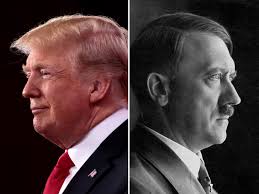
If there was ever any doubt that Donald Trump is the closest reincarnation we have today of Adolf Hitler (and, to his erstwhile ally Tucker Carlson, the Antichrist), that should have been cast aside by Trump’s recent threat that “A whole civilization will die tonight” unless Iran yielded, alongside his earlier statements that Iran deserved to be bombed “back to the Stone Ages where they belong” and that ordinary Iranians would be happy to be bombed to secure their freedom.
The horror of an American president making these outrageous pronouncements in utter ignorance of everything we value in (yes, let’s use his word) civilization—law, justice, culture, and common decency—is trumped (yes, let’s use that word) only by the continuing acceptance and magnification of his thoughts by a base on whose shoulders he rode to power. While some on the right finally denounced him as a “genocidal lunatic,” many others did not. Asked about the “civilization” quote, a Republican politician shrugged it off as “Trump just being Trump.” “Go into war to win,” said a MAGA supporter on Reddit. “Not drag it out like Vietnam. Y’all may not like the phrasing, but I like that he’s going into this with an ‘in to win at all costs’ perspective.”
The trouble is, the Iranian people whose freedoms Trump claims he champions (while decimating the same freedoms at home) are paying with their lives in bombings that don’t distinguish between Revolutionary Guards and dissidents. And we—7,000 kilometers away from Iran—are paying for those costs, much like the rest of the world that had nothing to do with Trump’s idiocy in launching a war he doesn’t know how to end. The rich will weather this storm like they always do, but mothers feeding their children with scraps of fish and jeepney drivers weeping at the end of a 14-hour workday are paying for a distant despot’s insatiable vanity.
When I think on these, and look at our world today, I marvel, aghast, at how easily people continue to succumb to a form of mass hypnosis, of enthrallment to a strongman figure like Donald Trump or Rodrigo Duterte, of deluding themselves into believing that their hero’s extremism would save the planet from some imagined social menace (i.e., people unlike themselves, a.k.a. aliens) at all costs.
What made Hitler and his horrific crimes possible? The assent and consent of his people, the initial indifference of the international community to his misdeeds, and the despot’s ability to weave lies stronger than the truth. Adolf Hitler and Donald Trump may be evil incarnate—but their enablers should be equally accountable to God and humanity.