Qwertyman No. 193: Evil Incarnate

Qwertyman for Monday, April 13, 2026
BACK IN the early days of martial law, when I went underground, among the books I read in our safehouse in Makati was William Shirer’s monumental The Rise and Fall of the Third Reich, a comprehensive account of Adolf Hitler’s and the Nazis’ rise to power. While academics have critiqued its journalistic treatment as not being scholarly enough, the 1960 work remains an important contribution to modern political history, if only as an eyewitness account, with Shirer having been stationed in Germany from 1934 to 1940. I was particularly intrigued by his thesis—since much debated—that the German people, from ordinary farmers and workers to the most powerful industrialists, enabled Germany’s descent into totalitarianism, stemming from their Lutheran deference to secular authority. 

That book and its implications for us, then just beginning to confront and comprehend dictatorship, instilled in me, as a playwright and fictionist, a fascination with complicity and collaboration. I also dug deeper into the history and culture of the Third Reich, particularly its propaganda. Even today, YouTube is rich with visual documentation of that dark period, from the burning of the Reichstag to the Nuremberg parades and, in that same city, the trials that laid bare a regime’s methodically murderous mind.

Its parallels to our time cannot be overemphasized. In the 1930s, the so-called “Hitler Myth” was sold by Nazi-leaning newspapers to promote Hitler as the restorer of German pride from the shame of Versailles and the economic ruin that followed the First World War. Germany could be great again. But Hitler also needed scapegoats to  blame for the country’s woes, and so he singled out the Jews and the Communists for that purpose. 

Like today’s American ICE, the Gestapo and the SS conducted raids to round up these enemies of the State, and Hitler launched wars to expand German territory and to proclaim the superiority of German arms. (When his troops invaded Poland on September 1, 1939, he proudly announced that “The German Wehrmacht is the strongest in the world!”) To celebrate his early victories and mythologize his legacy, Hitler planned to transform Berlin into Welthauptstadt Germania (World Capital Germany), invoking ancient Rome and Egypt to include a People’s Hall with a dome 16 times larger than St. Peter’s, a 100-meter Triumphal Arch, and a 120-meter-wide Avenue of Splendor for military marches. Donald Trump’s shameless renaming of the Kennedy Center and of a city airport in his own honor, his conversion of the historic East Wing into a ballroom, and his cheesy gilding of the White House furniture seem modest by comparison, but they betray the same Napoleonic grasp for imperial grandeur, though with much shorter reach. 

By the time the last prisoner walked out of the Nazis’ concentration camp, the Second World War had claimed 40 to 50 million lives in Europe alone, causing untold misery and devastation to the many more who survived.

In all these, Hitler was supported by what we would call today the “billionaire elite”—familiar names that included Krupp, Thyssen, Bosch, and even a carmaker named Porsche. (A book should be written about carmakers—hello, Elon—and their politics. Henry Ford was rabidly anti-Semitic, even compiling his articles into a book titled The International Jew, and was admired for it by no less than Hitler, citing him in Mein Kampf as the example of a great anti-Jewish industrialist and awarding him in 1938 with the Grand Cross of the German Eagle.) Historian Alan Bullock would later excoriate the German right wing (hello, Republican Party) for forsaking “a true conservatism” and making Hitler their partner in a coalition government. 

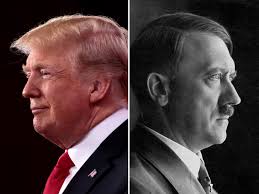
If there was ever any doubt that Donald Trump is the closest reincarnation we have today of Adolf Hitler (and, to his erstwhile ally Tucker Carlson, the Antichrist), that should have been cast aside by Trump’s recent threat that “A whole civilization will die tonight” unless Iran yielded, alongside his earlier statements that Iran deserved to be bombed “back to the Stone Ages where they belong” and that ordinary Iranians would be happy to be bombed to secure their freedom. 

The horror of an American president making these outrageous pronouncements in utter ignorance of everything we value in (yes, let’s use his word) civilization—law, justice, culture, and common decency—is trumped (yes, let’s use that word) only by the continuing acceptance and magnification of his thoughts by a base on whose shoulders he rode to power. While some on the right finally denounced him as a “genocidal lunatic,” many others did not. Asked about the “civilization” quote, a Republican politician shrugged it off as “Trump just being Trump.” “Go into war to win,” said a MAGA supporter on Reddit. “Not drag it out like Vietnam. Y’all may not like the phrasing, but I like that he’s going into this with an ‘in to win at all costs’ perspective.”

The trouble is, the Iranian people whose freedoms Trump claims he champions (while decimating the same freedoms at home) are paying with their lives in bombings that don’t distinguish between Revolutionary Guards and dissidents. And we—7,000 kilometers away from Iran—are paying for those costs, much like the rest of the world that had nothing to do with Trump’s idiocy in launching a war he doesn’t know how to end. The rich will weather this storm like they always do, but mothers feeding their children with scraps of fish and jeepney drivers weeping at the end of a 14-hour workday are paying for a distant despot’s insatiable vanity. 

When I think on these, and look at our world today, I marvel, aghast, at how easily people continue to succumb to a form of mass hypnosis, of enthrallment to a strongman figure like Donald Trump or Rodrigo Duterte, of deluding themselves into believing that their hero’s extremism would save the planet from some imagined social menace (i.e., people unlike themselves, a.k.a. aliens) at all costs. 

What made Hitler and his horrific crimes possible? The assent and consent of his people, the initial indifference of the international community to his misdeeds, and the despot’s ability to weave lies stronger than the truth. Adolf Hitler and Donald Trump may be evil incarnate—but their enablers should be equally accountable to God and humanity.
Penman No. 232: The Other Leni

2330687643.jpg

Penman for Monday, January 2, 2017


PROMPTED BY the rumors swirling around Vice President Leni Robredo and her possible replacement in that post by Sen. Bongbong Marcos in a January judicial coup, my ruminations drifted over Christmas to the Marcos legacy, and how differently Filipinos see it, and why. At my usual poker table, for example—where I face millennials more than fellow seniors—a question I often hear whenever the Marcoses come up in conversation is, “Why, were they really that bad?” I wouldn’t be surprised if it came from a 30-something, but it’ll typically come from someone my age or older, who lived through the same period—or did they?

Those of us who worry about the historical revisionism or amnesia that seems to have overtaken us may be forgetting something else—that, just like in Hitler’s Germany, the dictatorship wouldn’t have lasted that long without some significant degree of popular acceptance or complicity. One of my pet theories about our martial law experience is that those of us who fought it were in a distinct minority, still are, and will be again. Most Filipinos never had the Metrocom or the ISAFP breaking down their doors; most Filipinos never had a son or a daughter shot or raped or imprisoned because of their beliefs; most Filipinos were already too poor to feel they had been stolen from. Many seniors—with understandable appreciativeness, especially at this point of their dialyzed and hypertensive lives—will remember only the medical complexes that Mrs. Marcos built.

If the present administration felt confident enough that it could get away with the Marcos burial, it can only be because it thought this way as well, and gambled on it. It understood that for far too long—and in the increasingly rare instances when it was even brought up in school—martial law, Philippine-style, had been depicted as a war between President Marcos and the communists, not as a systematic campaign of oppression and plunder waged by a dictator against his own people. Now that the CPP-NDF was having coffee in the Palace, what was the problem?

If we’re talking about educating Filipinos—and not just millennials—about martial law, the case will have to be made that it was an economic, political, and moral disaster for all Filipinos—not just for the Left, not just for some businessmen, and not just for some rival factions of the same elite. We were all materially impoverished and morally compromised by it—and continue to be, despite EDSA’s flickering promise. (And if you still don’t know or can’t remember exactly what the Marcoses did, here’s a report from The Guardian to refresh your memory.)

I’ll let that contention simmer for now, because what actually led me to write this column, my very first of the new year, was an essay on another Leni that I was reading online, titled “Fascinating Fascism,” written by the late Susan Sontag and published in February 1975 in the New York Review of Books.

It must have been the image of some black-shirted (but surely well-intentioned?) young men giving clenched-fist salutes in front of the Rizal monument that led me to revisit the Hitler Youth and Nazi iconography—less to condemn it (let’s give the trolls a rest) than to see why it was so effective and appealing. There’s a scene from 1972’s hit movie Cabaret that might suggest why fascism, as Sontag says, can be so fascinating even and especially to ordinary folk, and you can watch that clip on YouTube here. It’s that of an angelic boy singing “Tomorrow Belongs to Me”—at least it starts that way—and it’s masterful moviemaking, showing within minutes how something so bright can be so chilling.

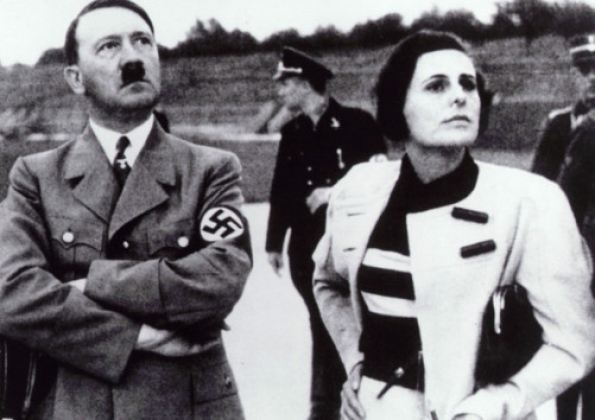
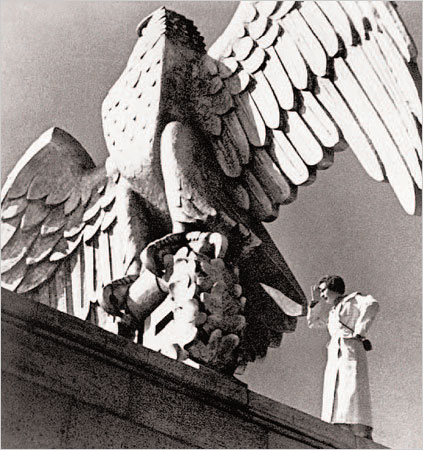
And speaking of moviemaking, this brings me to the other Leni—the German filmmaker Leni Riefenstahl (1902-2003), who directed the seminal Nazi propaganda films Triumph of the Will, about the party’s mammoth Nuremberg rally in 1934, and Olympia, about the 1936 Berlin Olympics. Her work would be hailed as technically brilliant and she herself as “an artist of unparalleled gifts” even by American critics—given especially that she was a woman trying to succeed in a male universe—and after the war, conveniently “de-Nazified,” she became something of a media darling, claiming that she had been politically naïve and knew nothing about the Nazis’ war crimes; she even joined Greenpeace and released a dreamy underwater movie on her 100th birthday.

triumph-of-the-will-leni-riefenstahl

(Photo from kinoimages.com)

But in her powerful essay on fascist aesthetics, Sontag cuts Riefenstahl no slack, painstakingly proving that contrary to Riefenstahl’s later assertion, she was a willing and willful collaborator of Hitler and Goebbels. The essay is a marvel both of scholarship and insight, something many writers today—who wrap themselves up in opaque critic-speak but yet fear or disdain to take a clear moral stance—can learn from. The full text can be found here.

This next leads me to a confession I’ve made before: that as a young screenwriter, I too was complicit in the making of a monumental film which would have been Marcos’ answer to Riefenstahl’s myth-making epics. It must have been around 1978 when I got word from Lino Brocka, with whom I had just begun to work, asking me to accompany him to a meeting called by Mrs. Marcos. It was the peak of martial law, and no one could say no, unless you were prepared to go to the hills or to march in the streets, as we obviously weren’t—not yet.

As it turned out, Imelda had summoned seven other leading film directors and their writers as well, and we were assembled at the Goldenberg mansion in Arlegui near Malacañang. Our marching orders—as Imelda would explain to us over the next many hours alongside her aesthetics of cinema (“No shots of squatter shanties!”)—were to produce an eight-part filmic history of the Philippines from Magellan to Marcos. Lino and I drew the Gomburza episode. We ended past midnight, after a personally guided tour of the premises and their precious artifacts, and were sent home with curfew passes.

The film was shot in pieces and later stitched together by the National Media Production Center—there’s a reference online to a “Kasaysayan ng Lahi” film being entered by the Philippines to an international film festival in Tashkent—but I never saw it and had no idea where the reels were kept until a friend told me a couple of years ago that they were stored somewhere in the offices of the Philippine Information Agency in Quezon City. In a sense I was glad that for some reason the film never hit Manila’s screens (at least not that I know of), as it would only have added to the perpetuation of a fable.

But then again, with a restoration underway (and I’m not referring to crumbling celluloid), it might yet play in your friendly neighborhood theater—and worse, in the blinding daylight. Like I texted a friend, somehow 2017 feels like 1971, all over again.

bn-mt815_0225ph_p_20160225035224

(Photo from wsj.com; photo of Hitler and Riefenstahl above from documentary.org)