Penman No. 427: Lights and Loudspeakers

Penman for Monday, November 8, 2021

THE ELECTION season is upon us, and for Pinoys for whom Christmas begins in September, November 15 can’t come soon enough to start figuring out who they’ll be voting for on May 9, a full half-year down the road. That date should really have been October 8, the official deadline for the filing of candidacies, but given our penchant to further complicate the already-complicated, we just had to set the stage for the last-minute substitution dramas we expect to happen by next Monday.

What couldn’t wait for November 15 or even October 8 was the onset of the propaganda war—the long series of campaigns and battles for our hearts and minds, with the prize being the right to seat someone you think you know and who thinks they know you in the Palace by the Pasig. And if there’s anything we can depend on to display Pinoy character and creativity at their best and worst, it will be a political exercise like a presidential election, during which people who had been largely content with watching telenovelas, munching sweet corn, playing pusoy, and sharing some kakanin with the neighbors suddenly rediscover their convictions, prejudices, longings, and peeves, and jump onto one bandwagon or another, many with knives drawn. (Of course, there are others who had been suffering in silence and gritting their teeth for the past five years, just waiting for the trumpet to sound from the top of the hill.) 

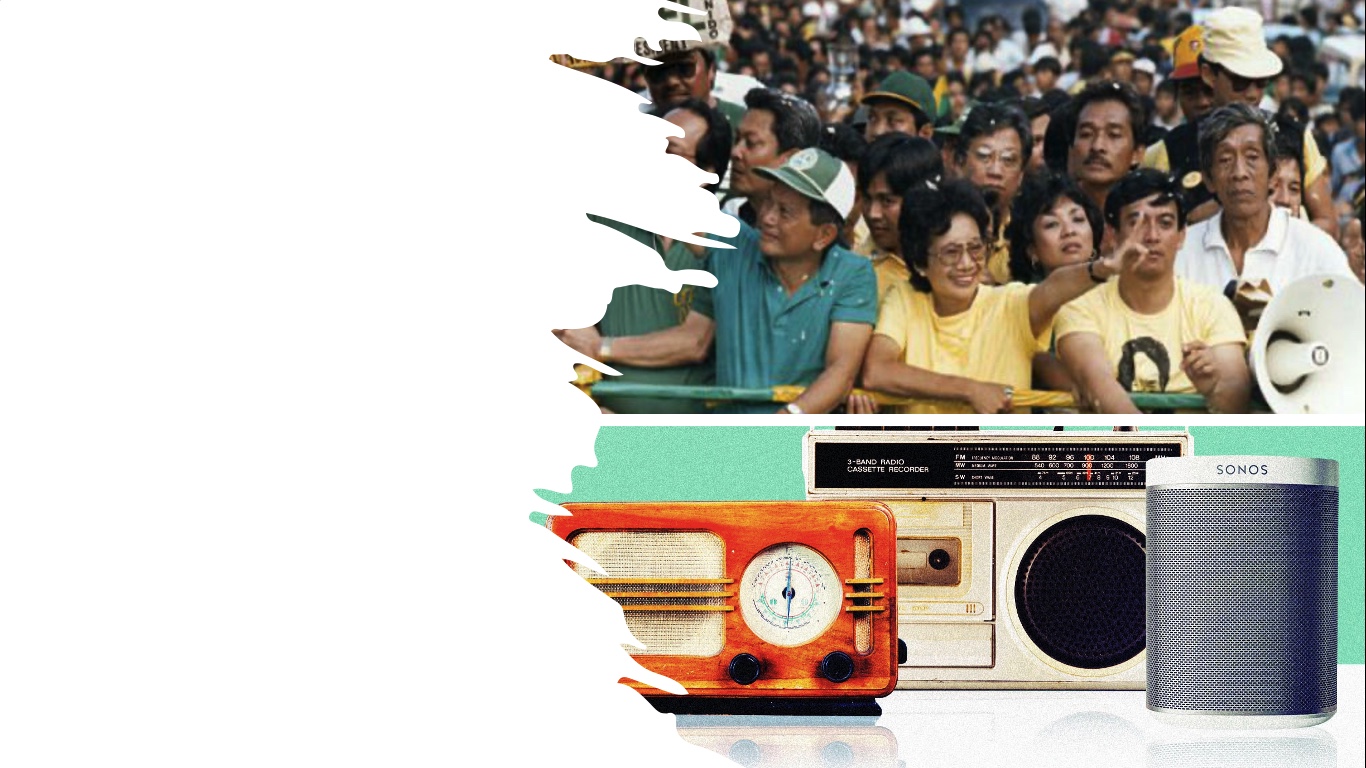
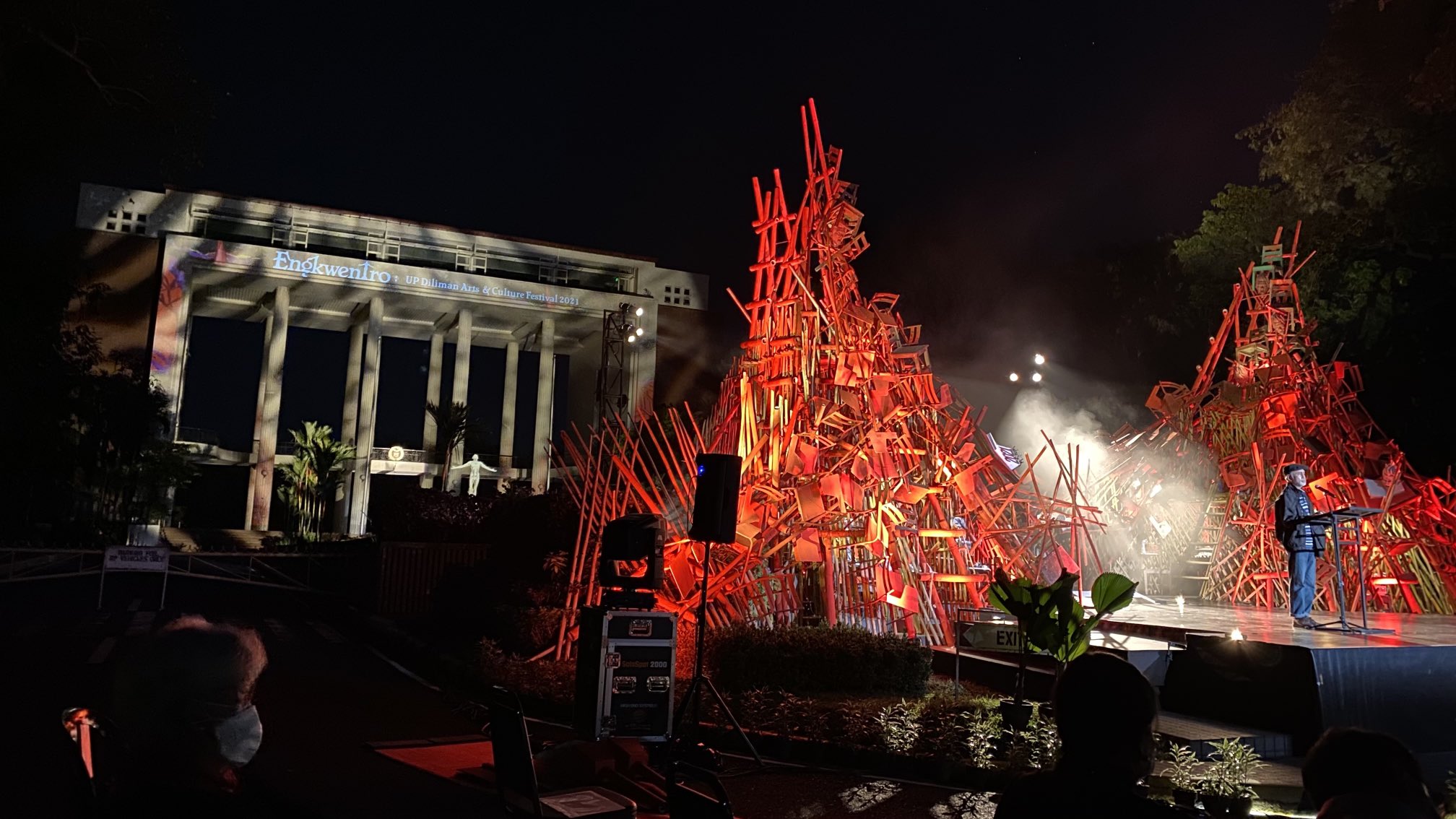
As a boy in the 1960s whose father kept getting roped into some politico’s campaign, I reveled in the hoopla that heralded every election. The contending parties held rallies in the plaza or the bukid (depending, I guess, on whose side the incumbent mayor was), and places more often attended by dog poo and carabao dung were transformed into one-night circuses. 

The stages were festooned with banderitas, and the lights and loudspeakers promised an evening of entertainment, at least from the movie stars, singers, and comedians whom the people really came for, before the real jokers running for congressman or mayor came onstage. Bands played as pickpockets worked the crowd. They gave away fans, hats, key fobs, stickers, and anything they could stamp a candidate’s face on, and if you were lucky you got a T-shirt—flimsy as hell and reeking of paint thinner or whatever it was they used for silkscreening. I’m sure some folks got more than that, but being too young to vote, I missed out on the serious stuff backstage.

The speeches were loud and bombastic, and you stood in rapt attention, feeling like a droplet in a huge surging wave about to engulf the nation. (Decades later, someone would call this “astroturfing.”) One particularly artful speaker might weave a tale of woe, of how the people had only themselves to blame for all the misery they had sunk into, because they had cast their lot with the other party in the previous election. (Decades later, someone would call this “gaslighting.”) Every candidate promised the moon, the stars, and a galaxy or two of blessings dependent on his or her election: more artesian wells, more puericulture centers, free dental clinics, free coffins, and a lechon for every barrio’s fiesta (loud applause). At some point, some bags of rice and boxes of milk might even go around, the word “RELIEF” overstamped with its new donor’s name.

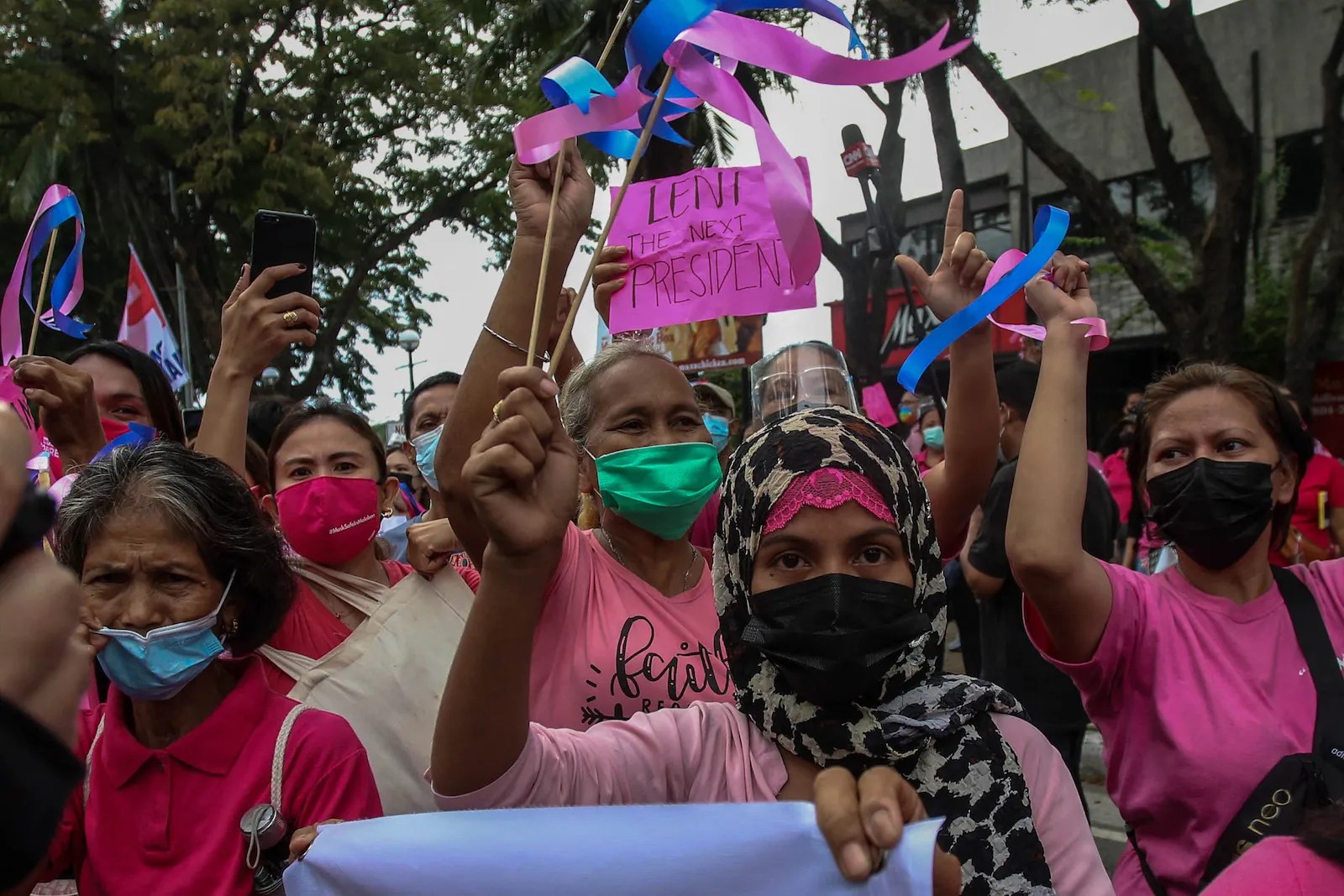
No self-respecting campaign today would not claim a party color or motif—pink, white, blue, checkered, etc. (What was that? Pink as well? Maybe I should have said “No self-respecting campaign today would claim another party’s color.”) Back in the day, this didn’t seem to be a big deal. The Nacionalista Party’s colors were red, white, and blue, while the Liberal Party’s colors were—well, red, white, and blue. At least, if you were a Liberal today and a Nacionalista tomorrow, which sometimes happened, you didn’t have to change your wardrobe or your paraphernalia.

Neither do I recall proprietary hand signs then, like the Cory-Laban “L” that helped to overthrow her predecessor, and FVR’s jaunty thumbs-up. Ferdinand Marcos flashed the “V” sign, but that had been around for ages, and is now more widely associated with young girls in white socks trying to look their cutest for the camera. I suppose it stands for “victory,” although the “V” word that springs to mind most quickly when I hear that particular name is “vaults.” (Is there such a word as “villions,” like a billion billions?) Mayor Isko has appropriated the “No. 1” sign, with the forefinger pointing up, as if to suggest he has nowhere else to go. (That other mayor who became President, which must inspire Isko, prefers raising the next finger.) 

Frankly Leni’s hand sign remains a bit of a mystery to me, and I haven’t seen one from the boxer and the police general. At any rate I doubt this election will be won with carpal contortions. After all, there are only so many things you can do with your fingers, and the Vulcan “Live long and prosper” hand salute is difficult enough to master.

The fight, as everyone says, has gone to the Internet and the airwaves, and while we may like to believe that everything has changed in half a century, the very players on the field tell us they haven’t—only the lights and the loudspeakers have. So now, as ever, truth, reason, and justice will remain the underdogs, and those who root and clap for the jokers will end up getting their pockets picked.

(Photo from asiatimes.com)
The President We Deserve

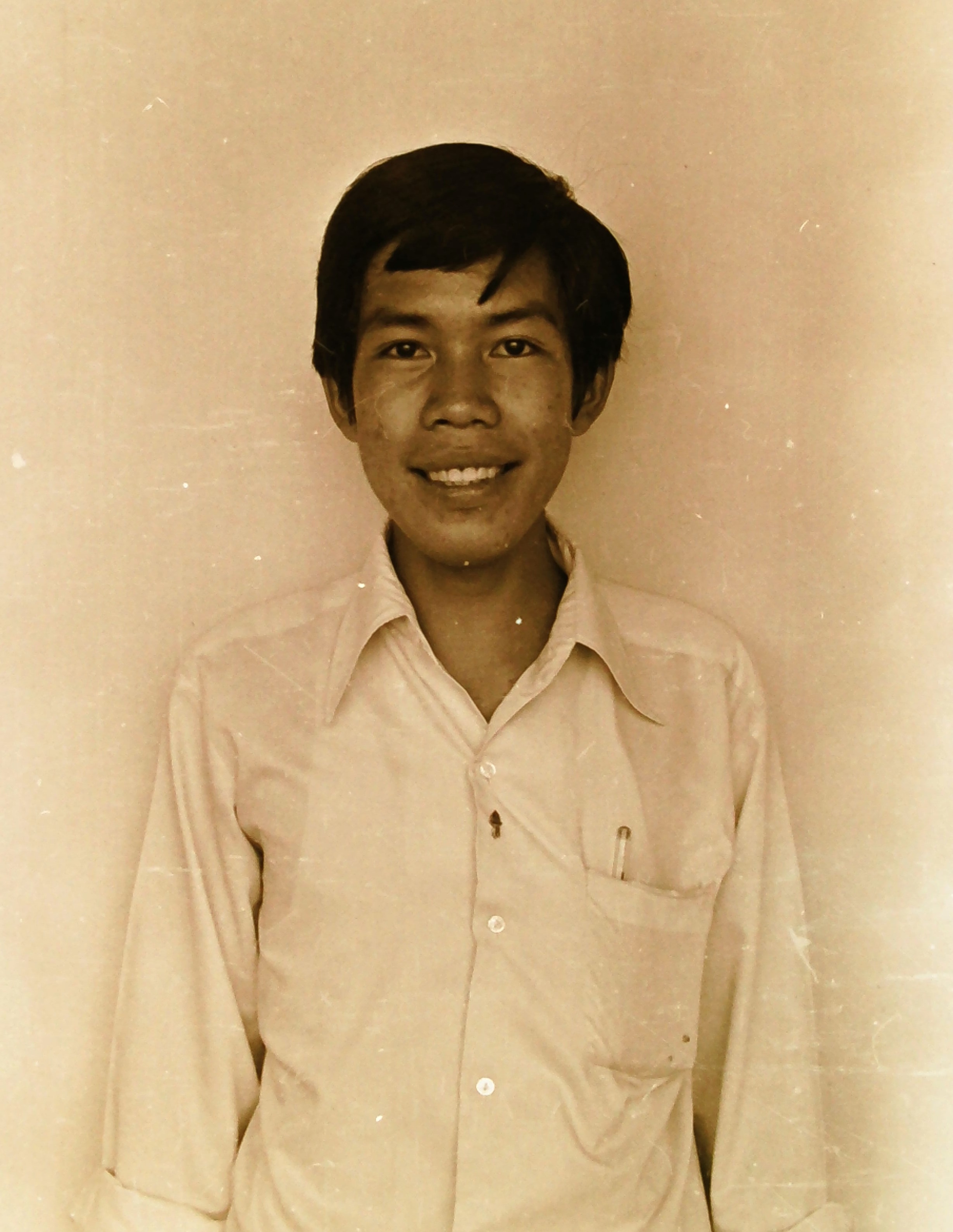
I GREW up a Marcos believer.

He was the guest of honor at my grade school graduation in 1966. Newly elected, he looked every inch the hero he said he was—handsome, dashing, gifted with a golden tongue. Watching him I thought that a President was a great man, greater than all of us.

Just seven years later, I spent most of my 19th year in martial-law prison. I was there because the President I admired as a child had lied to me. He said he wanted to make the Philippines great again. Instead he acquired more power and more wealth, for which he stole from both the rich and poor, and punished those who opposed him. 

That included young students like me. They called us “radicals” and put many of us in prison, and many of my friends suffered horrible deaths. Sadly, many more Filipinos didn’t care. Happy to see new roads, they did not know that billions that should have gone to their food, housing, and education went to secret bank accounts abroad.

I was at EDSA when Marcos left, and I was overjoyed that a good and honest woman would now bring change. But even Cory couldn’t do it alone. The system was too strong. Many Presidents followed Cory, some better than others, but the lust for wealth and power did not leave with Marcos. And instead of being remembered as the man who destroyed Philippine democracy, Marcos became a model for some of his successors, who not only buried him as a hero but who now want to resurrect him in his son.

When VP Leni Robredo offered herself for the presidency and said “Mas radikal ang magmahal,” I had to think long and hard about what she meant, and what kind of difference she would make in our lives and futures. Was she asking us, like Jesus, to love our enemies? After all the evil—the corruption, the oppression, and the despotism—we have been through, could we find it in ourselves to love those who clearly do not love us?

And then I remembered what another visionary, Martin Luther King, preached on the same subject. He said: “In the final analysis, love is not this sentimental something that we talk about. Love is creative, understanding goodwill for all men. It is the refusal to defeat any individual. When you rise to the level of love, of its great beauty and power, you seek only to defeat evil systems.”

And that’s when it struck me that the real enemy is not people, but the “evil systems” that have created and supported the Marcoses among us. It is not one man or family we must vote against, but what they represent.

The easy temptation is to focus on personalities and their shortcomings. The harder option is to fight for the good and the positive.

These are the values and ideals that many of our national leaders, by their speech and behavior, have forsaken over the past five years. These are what VP Leni reminds us are worth loving and living for. And in today’s environment of violence, fear, and falsehood, to love them is to be radical indeed:

God. Country. Freedom. Justice. Peace. Truth. Life. Beauty.

Big words, they take big hearts and minds to accommodate. If I can find that largeness in me, then I can be a radical again, and instead of imprisoning us, our new President will free us from our past to become the nation we aspire to be. And that President—the President we deserve—can only be as great as we ourselves can be.

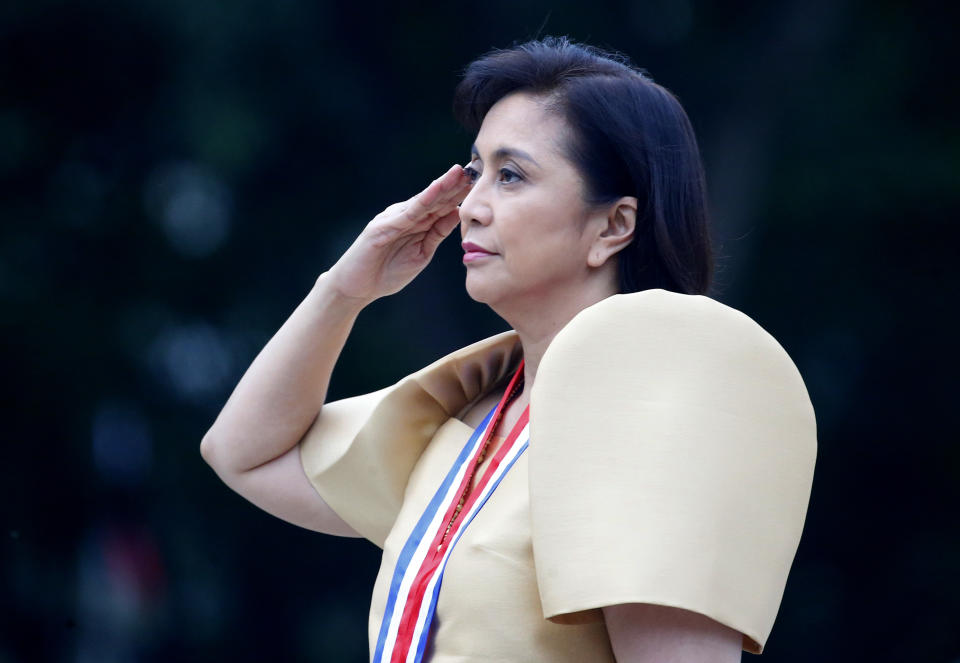
(Photos from ph.news and the Friedrich Naumann Foundation.)

Penman No. 425: Red Light, Green Light

Penman for Monday, October 11, 2021

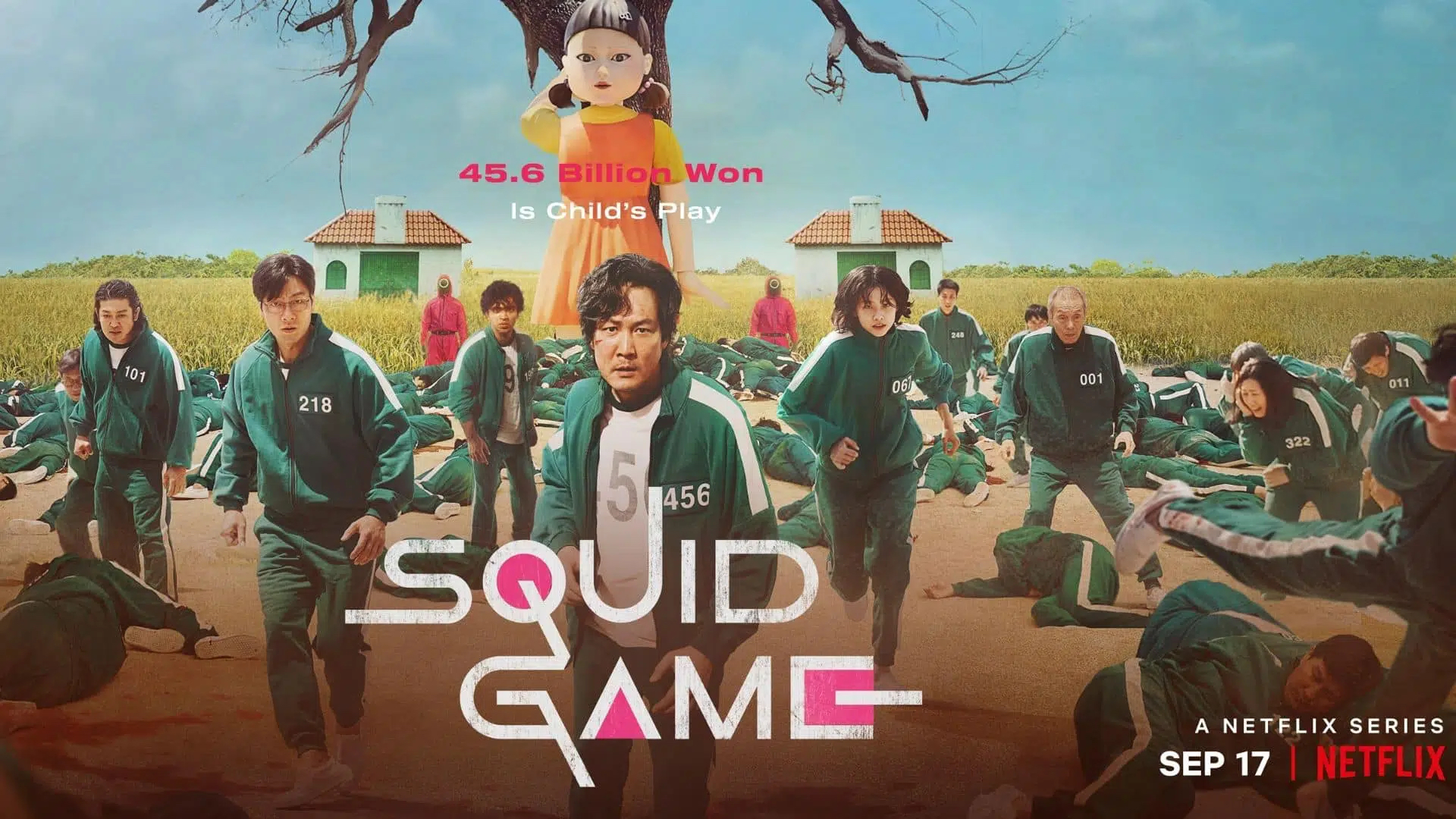
THOSE OF you who smiled when you read the title know what I’m talking about: none other than Squid Game, which is set to become the most viewed Netflix production of all time.

I’m still groggy from two nights of binge-watching, after making sure that my wife Beng was already asleep. She’s a Korea-novela fan—and I guess you can call me a reluctant convert, having little choice but to follow the travails of star-crossed lovers getting wet in the rain, slurping ramyeon, or running slow-motion into each other’s arms on a beach at sunset. But for some reason, Beng likes romance, not gore, and she steadfastly refused to reciprocate my constancy by watching Squid Game with me. 

She can’t understand it when I explain that violence relaxes me, releases the lion in my pussycat, exhausts my latent desire to pulverize my enemies and split a few skulls, and leaves me refreshed for another day of, well, typing. Beng’s favorite expression—which she uses several times a day, usually when watching the news or some TV drama, or when we’re driving past a mangy dog—is “Kawawa naman!” If she were a street in UP Village, it would be “Mahabagin.” 

That’s why, you see, she couldn’t possibly get through even one episode of Squid Game. The violence hadn’t even begun—Gi-Hun was just getting warmed up as the quintessential loser, trying to play good dad to his 10-year-old daughter—when I heard Beng mutter her first “Kawawa naman!” Rather than subject myself to a night-long litany of laments for pitiful souls, I agreed to switch channels and watch contestants try to outdo each other in applying hideous makeup onto hapless models. Beng couldn’t see me wincing in the dark, my tender aesthetics feeling the vicious assault of mascara wands and lipstick applicators.

But let’s get back to the show. After its release less than a month ago, Squid Game became a global sensation in no time at all, and it’s easy to see why. Even the venerable Washington Post intones that “Squid Game (is) much more than a gory dystopian thriller. It’s a haunting microcosm of real life, unpacking the many implications of inequality, which has in some way drawn each of the players to this battle for their lives.” 

Parents will be horrified to find that their kids can buy Squid Game soldier outfits online, complete with black masks and pink track suits, submachine guns optional. (When I clicked the link, I got a message saying “Sorry! This product is no longer available.” That can mean only one of two things: first, that the seller developed a conscience and pulled the item out, or second, that stocks were sold out—you win a prize of a trip to Busan if you guess the correct answer.)

So let’s get this clear, especially if you’re thinking of gathering the family around the TV for some quality time watching people’s shirts turn a splotchy red: Squid Game isn’t for kids, okay? The whole point of it is that it wants people to think they’ll be playing kids’ games—which is true, except that (this is hardly a spoiler now, after all the publicity), the losers die.

I’m not going to go into the kind of sociological soul-searching that will be the stuff of dissertations over the next five years, with titles like “Competition Theory: Neoliberalism, the State, and Squid Game in the Philippines, 2016-2022.” (If you want an honest-to-goodness, semi-academic chat about the show, the UP Korea Research Center will be hosting an online forum on Squid Game on Friday, October 15, at 3:30 pm.) 

I’m tempted more by the idea of staging our version of the game here, with life’s “winners” instead of losers as players, for a change. The reward will be—let’s see, what might the rich and powerful still want that they don’t already have? More money? Too easy; they have enough stashed away in the British Virgin Islands (legally, mind you—they did nothing wrong) to last three lifetimes. More happiness? Which means what—more likes on Instagram, more cover shots in the glossies, Ivy League placements for the kids, one mistress more, a new Lamborghini Huracan, another Patek Philippe, a new calling card saying “Senator of the Republic,” or something even loftier? Eternal life? Some families already have that—35 years after EDSA, you-know-who are still around.

How about this: the prize will be absolution for one’s sins, which technically will qualify one for entry into heaven, no matter what terrible things one may have done in life—stolen billions, murdered thousands, lied 90 percent of the time, cursed God and half the saints, you supply the rest. 

It could be voluntary, of course, because most of the players we’d like to nominate will never admit to sinning nor to needing forgiveness; they have willfully accepted damnation, and their choice must be respected. But I think it will be more fun if, in the 2022 elections, we took a special poll to vote for 456 politicians, public officials, generals, bigtime drug lords, profiteers, car-loving pharmaceutical executives, troll masters, and other crooks to constitute the players. 

How thrilling it would then be to put on a black mask, look over the track-suited multitude, appreciate the anxiety in their puzzled faces, and announce: “Green light!… Red light!” Boom. Boom. Boom. Sorry, Beng, hindi sila kawawa, and I could watch this all day.

Penman No. 424: The Analog Revival

Penman for Monday, September 27, 2021

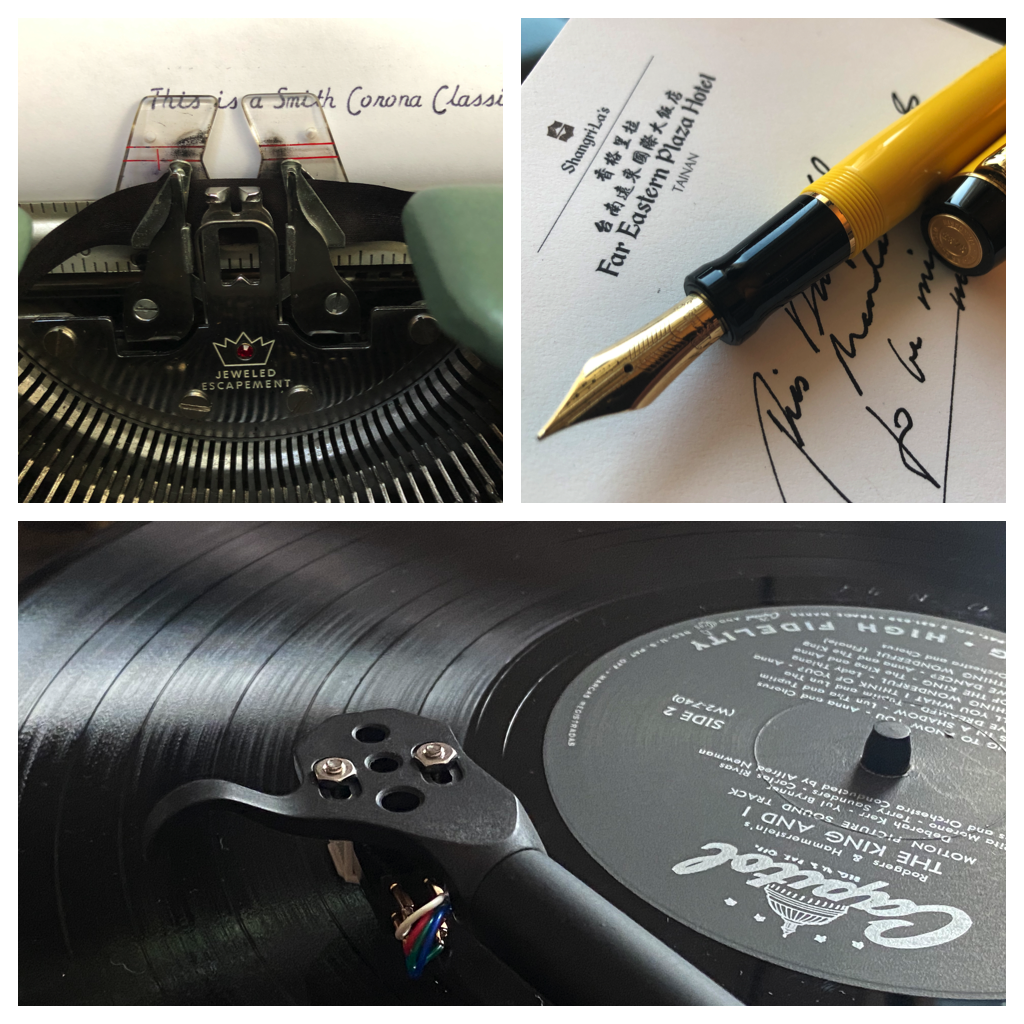
TWO YEARS ago, just before the Covid pandemic turned the world upside down, another and much less noticed reversal took place. Ending a 33-year trend, vinyl records outsold CDs—1.24 million records toting up $224 million in global sales, according to Music Times. You’d think that grandparents the world over had launched a conspiracy to buy out the remaining stock of Mantovani, The Lettermen, and the Ray Conniff Singers, but no—70 percent of the buyers were millennials under 35.

Audiophile Eric Teel says that “Music lovers have long treated vinyl with a kind of mysticism, using terminology like ‘warmth’ to describe a special intangible quality that some say eludes digital recording technology. Getting the most out of a vinyl record requires more effort than the simple huff of warm breath and a wipe on the t-shirt that many of us (shouldn’t, but do) give a CD to wipe off fingerprints before sticking it in a player.” In other words, there’s the sound, and there’s the ritual of choosing, cleaning, and playing the record—all before putting one’s feet up on a stool and sipping coffee.

Even earlier, in 2014, someone named Alex Lenkei wrote an essay on medium.com about another kind of hole he had fallen into—manual typewriters. Explaining why he found his way back to typewriters in the age of the Internet, Alex said:

“Like people, no two typewriters are the same. Each one feels distinctly different and has a different history of grade school assignments, covert love letters, prose and poetry, government propaganda, and wartime memos. The coldness of the keys under your fingers feels like the only truth in the world and the smell of metal and grease when you dig your nose into the typebars, the cavity of the machine, feels like the home of a serious writer.

“A typewriter is a miraculous tool for disconnecting in a time when we are all constantly connected to our smartphones or tablets. When I’m sitting down at a computer, I don’t know what I’m going to do next; I can get distracted very easily. In today’s increasingly connected world, production and focus in writing are being sacrificed for Facebook updates, tweets, and blog posts. There are a thousand distractions. But with a typewriter, I know I’m writing.”

The third analog instrument that’s made a comeback is—you guessed it—the fountain pen. According to the Washington Post, “In the 1990s, high-end, limited-edition pens took off…. The recession of 2008 dried up the ink on those for a while. The current fountain pen revival, penfolk agree, has been driven by an unlikely group: millennials. Yes, a generation that wasn’t taught cursive and whose members do most of their writing on a keyboard or smartphone screen has breathed new life into the old-fashioned fountain pen.

“’There’s less writing now, but when they do write, they want a good experience….’ That means premium pen, nice paper, unusual ink—stuff that looks good on Instagram…. A lot of the pens are used for keeping something called a dot journal or a bullet journal, which is basically a fancy to-do list.”

It’s obvious from these testimonials what’s been happening, aside from the fact of genuine oldtimers like me hanging on to their tools and toys: a whole new generation has reached far into the past for a new experience unavailable in the digital world—something tactile, something hands-on, something requiring more personal investment than a keystroke or tapping on “Play.” 

That’s nowhere more evident than in our local pen fanciers group, Fountain Pen Network-Philippines (fpn-p.org), which since its establishment in 2008 now counts over 11,000 members online. I’d say at least 70 percent of active members are below 40. The group’s original focus was fountain pen collecting, especially vintage pens, and old guys like me were happy just to ogle our pen-filled boxes and occasionally write some lines with black or blue-black Quink.

Our newest and younger members are clearly more excited by swatching colorful inks that shimmer and sheen, by learning calligraphy and journaling, and by just getting together as a community to enjoy a newfound passion. In other words, it’s not so much the object but the experience that matters most, asserting oneself in a digitized universe.

I also help moderate the Filipino Typewriter Collectors group on FB, and we’ve passed more than 1,000 members in less than a year. As with pens, most of our members are young, artistically inclined, expressive, and fascinated by using old tech to do 21st-century tasks. Again, I’m the crusty hardware guy who appreciates the machines as artifacts (having written books with them ages ago), while our newbies can still be thrilled by the clatter of keys on a platen and by the words they can form on a blank sheet of paper.

I grew up with vinyl, but came relatively late to the collecting party. We have a small, private Viber group that exchanges tips on where to find certain LPs cheap. We’re not learned enough to consider ourselves audiophiles fussing over “curve” and “coloration”; we just want to relive our youth by listening to the Beatles, Brasil ’66, and Marianne Faithfull. What’s surprising is, we have some teenage members who are discovering this music for the first time on vinyl, and liking it. Suddenly, their lolos and titos are cool again. There’s hope for the future yet!

Penman No. 417: From Cory to Covid: An Alternative History

for the Star’s 35th anniversary, July 2, 2021

WHEN THE Philippine STAR was founded 35 years ago, we were still enveloped in the euphoric glow of having successfully deposed a dictator peacefully and installing an icon of democracy in his place. I was one of that happy throng on EDSA celebrating what we believed was a new dawn of hope, a fresh opportunity for our people to grow in freedom and prosperity. Like many writers, I ran out of metaphors and superlatives to describe that moment, which seemed nothing short of miraculous. 

Nowadays it has become commonplace—indeed even fashionable in some quarters—to revise and reject that narrative, and to claim that it was a foolish mistake to have replaced a seasoned politician with a rank amateur. Martial law wasn’t so bad; no wanton thievery took place; only a few were hurt for the good of the many; we were never so disciplined, and our streets were never so clean.

How we came to this point—like the resurgence of Nazism in Europe and of racism in Trump’s America—is for me the great mystery of those 35 years, an arc of sorts marked by Cory on one end and by Covid on the other. There’s certainly no pot of gold at the end of this rainbow, as should happen in fairyland—which we rather quickly realized, right after EDSA, was not where we were.

For some such as Jose Rizal, Alexander the Great, Wolfgang Mozart, Manuel Arguilla, Bruce Lee, Eva Peron, and, yes, Jesus Christ, 35 years was a lifetime. You could have been born in a hospital while the tanks were massing at EDSA, and died this year of Covid, gasping for breath in that same place. Had that happened to me, I would have protested and pleaded, albeit inaudibly through my tubes, that it wasn’t fair, that I deserved a peek over the horizon, at least through to the May election, to see if it was worth the wait—or not, and then slink into sullen slumber. 

During that time, I grew from a young father and a writer on the verge of a teaching career to an aching retiree surrounded by old books and creaky machines, and I have to wonder if our nation fared better and learned as much. Or should I say “unlearned”? At EDSA I learned to hope, to trust in the ideal and the good again, to have positive expectations of the new century looming ahead. FVR and his “Philippines 2000” thumbs-up may have seemed hokey at the time, but there was a genuine spring in that step, a sense of things going in the right direction. And then they began falling apart, the old mistrust and suspicions returned, and we took one president down and nearly succeeded with yet another.

But it wasn’t just us. The closing decades of the 20th century were a time of sweeping changes all over the world. Soon after Marcos fell, a tide of reform and revolution washed across Eastern Europe and eventually into the Soviet Union itself; that union collapsed, the Berlin Wall fell, and it seemed like the era of dictators and despots was over, but it was not. With Hong Kong in its navel, China morphed into a commercial colossus, proving that freedom and capitalism do not necessarily go together. The 1997 financial crisis shook the planet.

After 9/11, whatever remaining hopes we had of a better new century vaporized, and the new specter of terrorism now stalked the globe. Barely had ISIS retreated from the sands of Syria when a new and even more insidious plague, Covid-19, threatened to annihilate mankind. 

Others will remember this period as the age of cocaine, corporate greed, mass shootings, and, generally speaking, a culture of excess, of over-the-top indulgence on whatever floated your boat: drugs, sex, money, power, toys. Very few people had actual access to them, but the media—that’s another whole story—kept glorifying vice as virtue, until many began to believe it well enough to dream. It was Dickens’ “best of times and worst of times” all over again.

That would be the sober—and sobering—summary of what tomorrow’s history books will be saying about those decades. But of course—and thankfully—it wasn’t all politics and the misery that often comes with plays for power.

There’s a part of me that wants to tell the story of these past 35 years as the rise of consumer technology toward near-total domination of our daily lives. Humor me as I recall little vignettes to show what I mean.

When the EDSA uprising broke out, we heard the news over a big black Panasonic radio-cassette player that I had picked up years earlier at the Zamboanga barter trade place (along with the obligatory sotanghon and White Rabbit candies). It was—beside our 12-inch, black-and-white, red plastic-bodied TV—our news and entertainment center in the boonies of San Mateo. It sat on our dinner table, accompanying our meals like a permanent guest, sometimes directing the conversation.

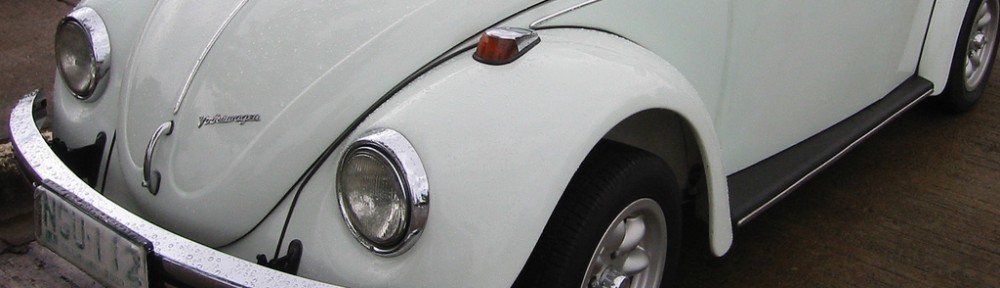
When it spewed out the news that something dramatic was taking place at EDSA, and when we heard Cardinal Sin calling on people to go, we knew we had to. Not long after, we piled into my VW Beetle, turned on its radio for updates, and headed for the trenches. For the next few days or so, radio was king, whether at home, in your car, or in your pocket (yes, boys and girls, there was pocket radio; TV was around but only the coolest people had portable versions).

I missed out on most of the Cory years because I went to America for my graduate studies, and there I became anchored to the payphone for my calls home, clutching a handful of quarters to feed the machine. I had hand-carried an Olympia typewriter to write my thesis on, but then I discovered computers, and in 1991 I lugged home a 20-pound behemoth with all of 10 megabytes to fill up. I felt like a gunslinger—I was going to write the next Noli, protect the weak, and get justice with one floppy disk after another.

Nothing would define the ‘90s more than the personal computer, and I soon equated the machine with creation, the blinking cursor with a challenge to produce. I drooled (and lost the plot) when I watched Scully and Mulder hunched over a super-sexy PowerBook 540c in the X-Files, and when I got my own, it was like Moses receiving the tablets—with a trackpad and an active-matrix display. 

Soon another gadget emerged with which we felt even more tethered to some central brain: the pager, whose insistent buzz enhanced our importance, even if it all it asked was where you were and could you please come home. Fake news had yet to be invented as a cottage industry, but a lot of it, I’m sure, went through EasyCall and PocketBell.

By the time the next EDSA happened, we had something far snappier and more personal than radio with which to undertake regime change. Yes, I was now writing speeches on a Mac, but the messages flew thick and fast on a new gadget—the cellphone. If EDSA 1 succeeded because of radio, this iteration flew on the wings of SMS, the millions of texts (the jokes, the rumors, the calls to action) whose accretion would spell the end for an inebriated presidency. 

As it happened, 2001 would be memorable for another image seared into our consciousness: the collapse of the Twin Towers, brought to us slightly delayed and in full color by satellite TV. We’d had TV before, of course, but had always seen it more as Comedy Central, a box to gather the family around. CNN changed that, and brought the world’s torments to our living rooms. Cheaper TVs, one in every room, had long fragmented the family, especially when Betamax and VHS, the precursors of Netflix, became available.

A few years later, a cellular phone call and a recorder almost took another political giant down, causing millions to gasp and laugh as the tape was replayed on TV and radio over and over. “Ang importante hindi madamay yung sa itaas,” said a female voice, which was exactly what happened. That year, 2005, was also the year a platform called YouTube was born—and thanks to YouTube, the tape can still be heard, for all digital eternity.

Indeed, video, the Internet, and social media would soon change the political and cultural landscape, not just here but the world over, although the Pinoy—perhaps in response to that elusive quest for Olympic gold—has towered over much of humanity in terms of Facebook usage (and earlier, in SMS transmissions). One way of putting it would be that we are the world’s champion usiseros and chismosos, resorting to Twitter or Instagram at the merest hint of an idea, no matter how malformed. 

Today we have an abundance of information and information sources at our disposal—and yet we seem to be as ill-informed as ever, with opinions shaped and manipulated by Sith Lords in the Dark Web. Dismissing newspapers and editors as gatekeepers of the truth—which not all of them have been—we create our own versions and peddle them instantly for a thousand “likes,” the supreme accolade of the early 21st century. Most others might prefer to be simply receivers and forwarders of whatever crosses their screens, the passive agents of mindlessness.

Thirty-five years ago, we drove to EDSA on pure conviction that it was the right thing to do. Without Twitter or even SMS, no one could tell us “Right on!” or “Me, too!” We listened for scraps of news and turned them over and over in our hushed minds; we could be killed; we could be free; would our friends be there; what else did we study for. It was a long drive from San Mateo to my in-laws’ place in Project 4, where we parked the car and walked to EDSA. It was a lot of time to think. 

Thirty-five years is a lot of time, but looking around today, with Filipinos still dying by the gun or by drowning in one’s own fluids in some alien hospital, I have to wonder how this narrative arc from Cory to Covid will end—or how much longer it will go, at least in my lifetime, which naively still yearns for a happy ending.

Penman No. 407: Fifty Februaries

Penman for Monday, February 15, 2021

FOR A certain segment of that generation called the “baby boomers”—people now in their mid-60s and 70s—this month will bring back memories both poignant and painful, harking back to a time when the unbridled fun of the 1960s (think of the Beatles, Woodstock, and Barbarella) was rudely replaced, top of mind, by the all-too-serious clamor of revolutionary politics.

I was 16 and a Philippine Science High School senior when I joined my first big march on January 26, 1970, and had just turned 17 when the nine-day-long “Diliman Commune”—whose 50th anniversary came last February 1st—was put up by students like me as a spontaneous response to what we saw to be an assault on the University of the Philippines campus by military and police forces.

I have many vivid memories of that uprising which I have dealt with in essays and in my first novel, the highlights of which include standing sentry at Area 14 with a kwitis and a home-made Molotov cocktail, as if either of them would have saved me in case of an attack; sneaking out of campus in Dr. Fred Lagmay’s little car to publish the Free Collegian; and being in the DZUP booth as a comrade played a tape of “Pamulinawen” (those of you old enough will know the reference).

Ironically, that anniversary took place at a moment when, once again and half a century after the Commune, UP and other universities were being tagged as leftist “havens” by people with very different ideas about what universities should be doing. This was the same half-century, come to think of it, that produced far more UP-alumni presidents, senators, congressmen, mayors, CEOs, entrepreneurs, lawyers, doctors, artists, scientists, singers, comedians, and even AFP officers than Red recruits. 

But let’s not go there. I don’t mean to engage in political polemics as much as to wonder how time and distance can change people—or maybe not. The freshman me, who carried that incendiary bottle during the Commune (and maybe thankfully never got to throw it), grew up to be a potbellied and balding professor of English, much to my own surprise. Ours was a generation (as our dear editor and my fellow time-traveler Millet might remember) that did not expect to live long, and so like Achilles, we did what we felt had to be done as soon as we could do it; history was theater and we were actors in it. Less than two years after the Commune, and fresh out of martial-law prison, I met Beng—to whom, against all odds, I remain married after 47 years.

To survive that long is both wonderful and perplexing, especially when we seem to be hearing the same refrains all over again. It’s hard to tell where you are when past and present seem indistinguishable in some ways, except that you now see an old man where the young buck was in the mirror. You pity the small boy at your knee who has to go through all that on his own; you want him to be safe and not take foolish risks as you once did—but he is even smarter than you, and you know he will.

They asked me to give a short speech in UP to commemorate the Commune, but instead of a talk I chose to write and read a poem (with apologies to Janis Ian) about what it was to be seventeen fifty Februaries past, and here it is:

AT SEVENTEEN

At seventeen I raised my left fist to the sky

And held, in my right hand, 

A bottle filled with gasoline—

And far more flammable,

Admixtured faith and folly,

Courage and a thumping fear

That my life would not last much longer than

That hour, at once so still and pensive,

The tall grass around my outpost

Silvered by some distant light.

A “Molotov cocktail” was what they called

That lethal brew, its ragged tongue the sacrifice

Of someone’s cotton underwear, its fuel

Of someone’s ride to Bulacan,

And my right hand, the young elastic limb

That would toss this long-tailed dragon to the sky

Against the dark-faced enemy, my arm,

Myself, the new, rough-hewn, imperfect

Oblation of that fraught age.

I was, I told myself, prepared to die

And perhaps I might have even 

Believed the lie. 

I never threw that bomb, nor any other

Of the kind. The enemy was more

Deceitful than I thought, refusing to appear

Just then—although I’ve seen him since, 

In the old FC and AS and Quezon Hall—

And I even stopped once to ask, “Excuse me,

Do I know you?” because I thought I did.

The intrepid and unwary die.

The articulate survive, to write poems

And raise fuseless cocktails with their right hands

While their left fingers cradle Marlboros

Or tap out the cadence of muted anthems

Once sung to red flags cresting in the wind.

These days I hold nothing

More menacing than hat and cane.

I should have feared, at seventeen,

That I would live this long, that I would know

Waywardness of memory and uncertainty of step—

And still, from time to time, looking down

The long, unfolding scroll of University Avenue,

Feel barricades of salvaged wood

And gathered stone rising in my chest.

Penman No. 404: Delightful Duos

Penman for Monday, January 4, 2021

I CONSIDER myself an interloper if not an informal settler in the world of art, having dabbled in printmaking, married a painter and art conservator, and collected midcentury landscapes. Back when we could travel freely, my wife Beng and I made a beeline for the art museums of whichever cities we were visiting, as eager to enjoy our old favorites (Matisse, Turner, Calder) as to discover new ones (Yayoi Kusama, Judy Chicago). 

Artistic preferences are of course entirely subjective; even within one’s range, and price tags aside, the art you admire may not necessarily be the art you want to hang on your wall and look at every morning. There’s art that you know is important (or at least that’s what the critics tell you) and which you might even be able to understand and write essays about, but which you also know will give you an enormous headache. 

I’ve often remarked in this column about how so much of contemporary art (yes, Philippine art, to which we might as well add Philippine literature) seems unrelievedly dark and depressing—no huge surprise, given our dystopic times. But surely art can do more than mirror or illustrate what we already, profusely, know: life is hard, and often painful and cruel.

That’s why I had to do a double-take when I came upon a painter online whom I’d never heard of (no offense meant) whose works, one after the other, exuded joy, delight, and wonder, and not in a fake-fiesta sort of way. Not since Beng and I encountered the teenage and already brilliant Jason Moss did I feel so genuinely intrigued by the figures that leapt out of this painter’s canvases. The artist’s name was Bayani Acala, and I was curious enough to write him and his wife Karen to ask, basically, how a painter could seem so happy and even serene in such unsettling times.

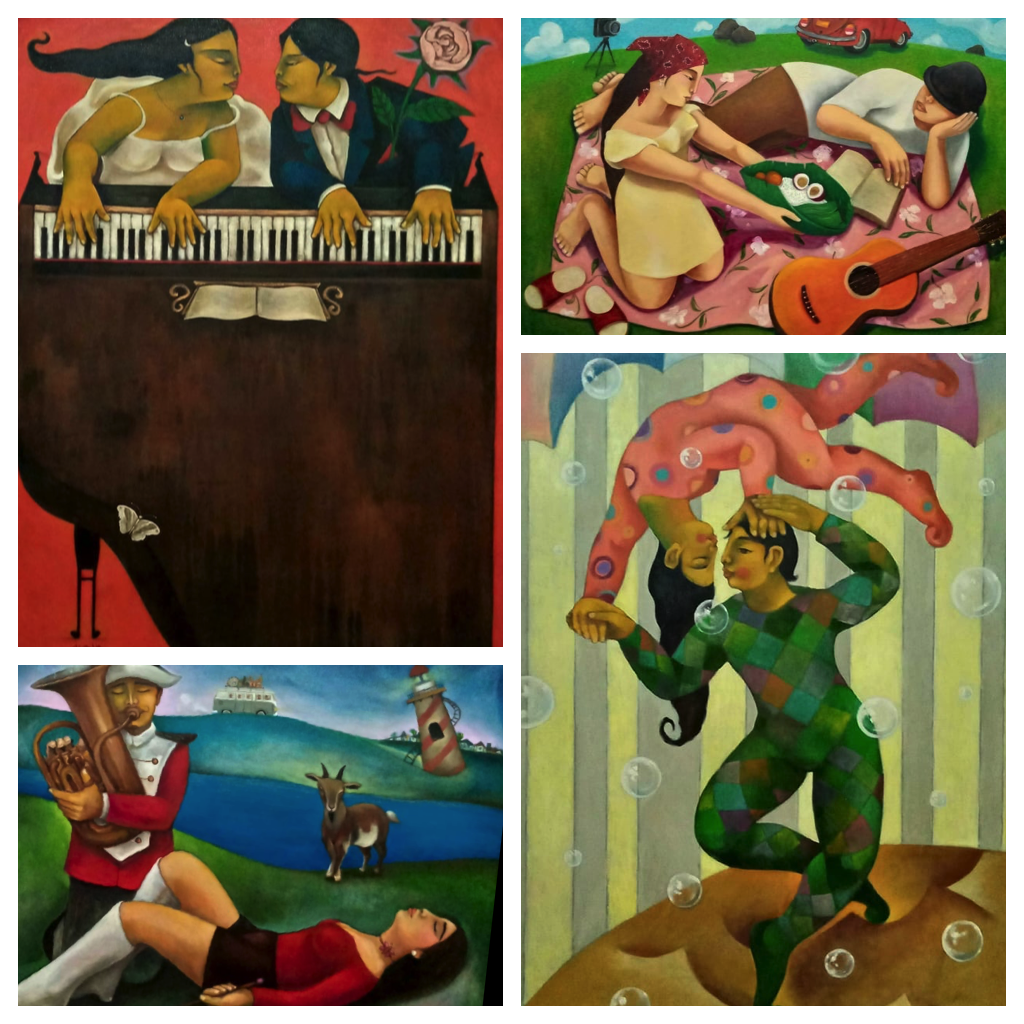
His paintings almost invariably depict couples in courtship—delightful duos who, if they are not in love, might shortly be. His favorite motifs include music, food, and dance, all things best done with someone else, but nothing too overtly sexual. His faces and bodies are unabashedly Filipino, romantic but unromanticized. Benignly curvy Volkswagen Beetles and Kombis dot his landscapes. When I look at a painting of his, Bayani Acala provokes in me that rarest of responses from a museum-hopper: not a sigh of awe or a pang of sorrow, but a big, wide smile.

Born in 1975 to a family of schoolteachers in Paete, Laguna, Bay grew up immersed in that town’s strong sculptural traditions. Graduating from UST in 1996 as an advertising major, he took a series of jobs as a graphic artist before freelancing. In the meanwhile, he was racking up awards and citations from Shell and Metrobank; the 2000s saw him joining a series of exhibitions, including shows in Singapore, Chicago, and China, and winning more prizes—most recently for sculpture and woodcarving, returning to his Paete roots.

“I grew up watching wood workers,” Bayani says, “not knowing the difference between woodcraft and sculpture. The workers in the shop didn’t allow us to play with chisels, so we played with mud and sawdust and molded them into saints.” Like any well-schooled artist, he admires Chagall, Botero, Munch, Lautrec, Kahlo, and Manansala, but he calls Amang Ibyok Pasawa, a Paete papier-mache folk artist, his hero, and counts the sculptor Angelo Baldemor and painter Gig de Pio among his mentors. (The reference to the Colombian painter Fernando Botero is especially useful; his voluptuous and colorful figures invited charges of triviality, which the artist countered by maintaining that “Art should be an oasis, a place of refuge from the hardness of life.”)

Happiness, Bay says, is essential to his passion; there’s already too much sadness around and he prefers to look past it. His artmaking makes him happy, and so he puts some of that back into his work. He describes himself as a simple man who enjoys biking, playing music, telling stories, and spending time with Karen and their daughter Ava. That may sound too plain and boring to those who expect if not demand agony of the true artist, but I assure you that many tortured artists will find that normalcy a blessing.

(While we’re at this, it’s interesting to note that academic studies have established that—believe it or not—artists tend to be happier than most other people. While the anguished examples of Vincent Van Gogh and Sylvia Plath may stick in the mind, research at the University of Zurich and Vanderbilt University suggests that creatives report higher job satisfaction than other professionals, although they also tend to suffer in terms of unstable employment.)

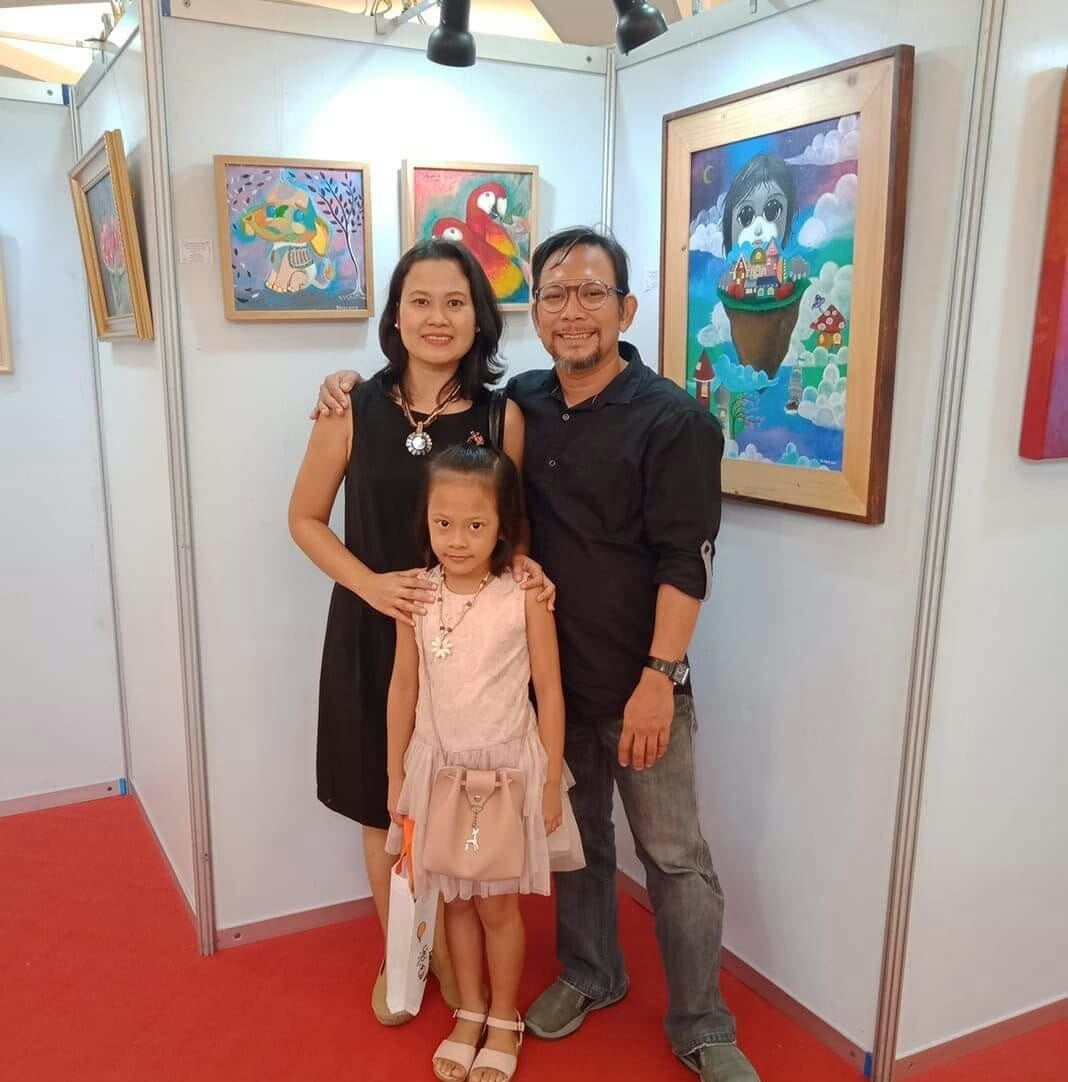
In Bayani Acala’s case, surely that happiness is owed in significant measure to his wife Karen, a computer programmer who has also taken up painting and with whom Bay has had two exhibitions. She’s the most avid promoter of Bay’s work online, which was how I came across his work in the first place. That makes them Delightful Duo No. 1.

Penman No. 403: Bad Times, Good Art?

Penman for Monday, December 21, 2020

IN MY last column, I wrote about how art and literature respond to times of great distress, like plagues and wars. My spoilsport proposition was that—against most expectations—crisis and chaos are not the best environments for great art, not just because the artists are too busy just trying to survive, but because it takes time, distance, and reflection to integrate, to re-order, the experience of falling apart.

Citing previous examples like Albert Camus’ The Plague and Daniel Defoe’s A Journal of the Plague Year, I said that this current pandemic will surely be the stuff of both bestsellers and ponderous novels, but the best writing about it will very likely not emerge for many more years, if not decades, to come.

If you need more proof, consider this: the best war stories were written long after the wars they dealt with. War and Peace by Leo Tolstoy, about the War of 1812, came out as a book in 1869. Stephen Crane’s The Red Badge of Courage, about the Civil War, was published in 1895; World War I’s All Quiet on the Western Front by Erich Maria Remarque in 1929; Kurt Vonnegut’s World War II-era Slaughterhouse Five in 1969; and Tim O’Brien’s Vietnam-era The Things They Carried in 1990.

That’s not to say that artists don’t or shouldn’t immediately respond to the tumult swirling around them. Something traumatic like plague and war can be both material for, and instigator of, great art.

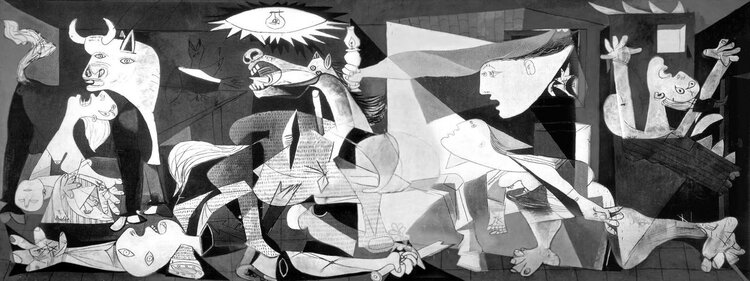
The one outstanding example that comes to mind is Picasso’s Guernica, made in 1937 during the Spanish Civil War. The story goes that Picasso was in Paris working on another commission when he heard about Franco’s bombing of the town of Guernica in April that year, whereupon he shifted his attention to producing the now-iconic antiwar painting, which he finished in five weeks. 

Another oft-quoted story is that of the composer Dmitri Shostakovich, whose Symphony No. 6 in C Major, which came to be known as the “Leningrad Symphony,” was premiered in Russia during the siege of Leningrad by the Germans in July 1942, and became a kind of anthem of Soviet resistance. In the more cinematic retellings of this episode, it is said that the Germans realized they would lose the battle when they heard the symphony being played by a ragtag band of Russian musicians on the radio.

On the German side, there’s the story of the Berlin Philharmonic persisting in recording Brünnhilde’s Immolation Scene and the finale from Wagner’s Götterdämmerung despite the Allied forces knocking on Berlin’s gates in April 1945.

These examples, with their heroic if not tragic overtones, seem to suggest that in periods of great disorder and distress approaching chaos, artists of all kinds rise to the occasion and summon up their finest talents in the service of—and here one is tempted to say “humanity,” but I am more inclined to say “order,” which is inherent in every artist. The desire for justice, for example, is a form of outrage over the disturbance of some natural equilibrium, a sense of fairness, and bringing music into the battlefield is a willful imposition of structure and narrative into the cacophony of war. These creative outbursts in the middle of the fray are also affirmations of one’s higher consciousness, a civilized rejection of the easier option to submit to brutishness.

This reminds me of Umberto Eco’s insightful description of how art works as “a minimum of order compatible with a maximum of chaos.” The artist’s impulse is to bring method into the madness, to see pattern and narrative in the mess of things. 

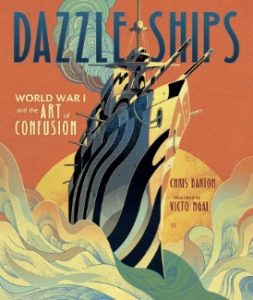
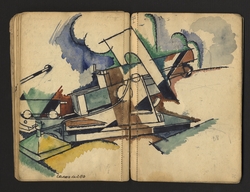
Sometimes art has responded to war in the most striking ways. There was a very close relationship between Cubism and the development of military camouflage in the aftermath of World War I, with Cubism providing the inspiration for the abstraction of natural forms, culminating in the so-called “Dazzle” ships whose wild geometric designs, by the marine artist Norman Wilkinson, were meant less to hide ships than to confuse U-boat rangefinders.

But for all these illustrations of disorder as the handmaiden of great art, I suspect that they are exceptions, and that the more commonplace product is that enemy of good art, cliché. 

Dystopic times invite posterization, where subjects can either be romanticized or demonized. There’s that overwhelming urge to settle for the literal or cartoonish depiction of the obvious, which would be hardship and pain, violence and sorrow, over and over again. I’ve often pointed out to my writing students—long before the pandemic—that the easiest thing to write is a lament about how terrible and unfair life is, and how awful one feels. Walk into any serious art gallery (real or virtual) and you’ll see that most works by young artists are predominantly dark and gloomy.

I’m not suggesting that we get all Pollyanish and paint an artificially happy world; but I do expect great art to be transcendent and complex, to move beyond the immediate and the literal and to remind us of the need for beauty and hope amid the suffering. Michelangelo did that with the Pieta, which is not only about a son’s passing but a mother’s deathless love. 

Bad times and bad things may even prefigure or provoke some inner good, as the poet Rainer Maria Rilke put it: “Perhaps all the dragons in our lives are princesses who are only waiting to see us act, just once, with beauty and courage. Perhaps everything that frightens us is, in its deepest essence, something helpless that wants our love.” 

Penman No. 402: The Brain That Will Not Sleep

Penman for Monday, December 7, 2020

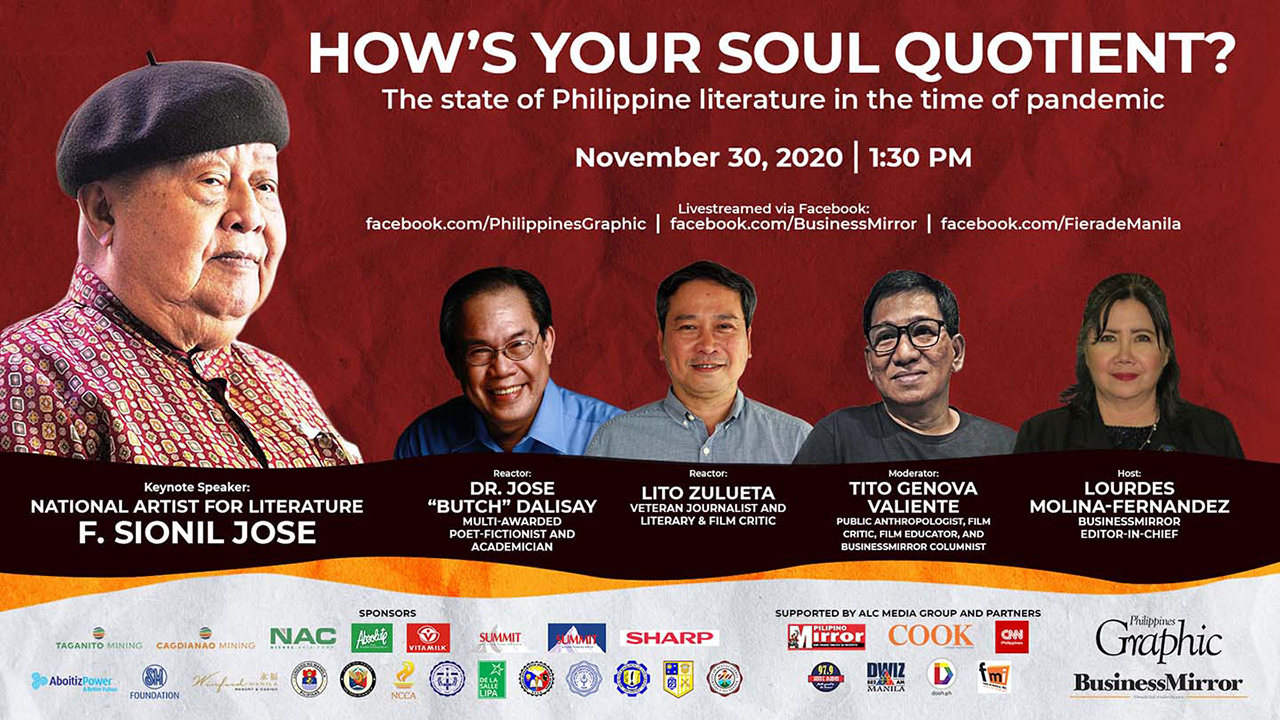
I APPEARED last Monday at a webinar sponsored by the Philippines Graphic and the BusinessMirror to react to a paper delivered by National Artist and fellow Philippine STAR columnist F. Sionil Jose on “Philippine Literature in the Time of Pandemic,” along with the essayist and critic Lito Zulueta. We had a lively discussion, with over a thousand students listening in, so it was a great opportunity to do some teaching (or preaching, of you will) about how writers work during great upheavals—in this case, the raging fire of a global pandemic. Here’s part of what I said:

Literature goes on. Literature cannot be locked down. It is a tongue that cannot be silenced, a brain that will not sleep, a nerve that will keep twitching even when hammered a thousand times. 

But the best literature about this pandemic will very likely not emerge for many more years, if not decades, to come. What we know is that the best writing is not produced in the heat of the moment. It takes a long time after a calamity or a period of deep distress, like a plague or a war, to write capably and insightfully about it. It requires distance and reflection.

Take, for example, three of the best-known works associated with the idea of a plague. Daniel Defoe’s A Journal of the Plague Year, which was about the bubonic plague that hit London in 1665, when Defoe himself was only five years old, was written more than half a century later, and published only in 1722. Edgar Allan Poe’s short story “The Masque of the Red Death,” which was published in 1842, was not even based on an actual plague but was rather highly allegorical. Albert Camus’ novel The Plague came out in 1947 but looked back to an actual outbreak of cholera in Algeria in 1849, almost a century earlier.

And the fact is that the plague itself is never the real subject of literature—it is what it does to people, to bring out both the best and the worst in them. The plague is merely the backdrop or the trigger for the exposure of human greed, corruption, and indifference, as much as it can provoke nobility, heroism, and humility. This is also how literature has dealt with war, beyond journalism and history, which are concerned with chronicling and interpreting the facts. The best war stories, from the Iliad onward, deal with human character under pressure.

I have no doubt that the time will come when we will see a substantial body of Philippine literature emerge out of this pandemic—novels, stories, poems, essays, and screenplays—that will remind readers of the future of what it was like to live in 2020, and it won’t just be about Covid and lockdowns, but OFWs, tokhang, Netflix, K-drama, Lalamove, and Donald Trump. 

In his talk, Manong Frankie spoke of “the need to be true to one’s self, to be engaged with self, our time and our place,” and it’s something with which I totally agree, because this is how literature refreshes and revitalizes itself over time, with each generation grappling with its own demons. Each generation is defined by a particular challenge—for my parents, it was the Japanese occupation; for mine, it was martial law; for my daughter’s, it was EDSA; for today, it is Covid and its political context.

The young writers of today are writing very differently—in content and treatment—from Manong Frankie’s generation and from mine—and they should. Writers should write about their times, for their times, in their own voice and manner, and if they write well and insightfully enough, their work will have meaning and value for generations yet to come.

I mentioned the political context of Covid, by which I mean that this pandemic has been accompanied and aggravated by the politics of ignorance, fear, and populism. All around the world, it has been used by politicians to aggrandize power and suppress opposition, and this is something literature will also have to confront. 

Thanks to the slippery pervasiveness of social media, the truth is being replaced with insistent assertion, and control of the narrative is on top of the political agenda. If you claim “I won!” and “He’s bad!” a thousand times, some people will begin to believe it.

In a sense, the most daring kind of fiction now is out of the hands of creative writers like me. It is being created by political propagandists who are spinning their own versions of the truth, and who expect the people to believe them. The short story and the novel are no longer the best media for this type of fiction, but the tweet, the Facebook feed, the YouTube video, and even the press conference. The conspiracy has emerged as the most popular genre of fiction—the idea that people are out to fool you or cheat you, but they can’t, because you have a more clever version of the truth.

Covid and fake news may be the most dangerous combination yet. But as I’ve been saying these past few years, the best antidote to fake news is true fiction, which will be up to you and me to write.

Penman No. 400: A Book for the Pandemic

Penman for Monday, November 9, 2020

I BEGAN writing this column 20 years ago, shortly after I returned from nearly a year in England on a writing fellowship that eventually yielded my second novel, Soledad’s Sister

It was an exciting but also a challenging time, that turn of the century. We already knew that the much-ballyhooed Y2K threat was a colossal bust, but little did we imagine that even more titanic and very real dangers were just around the corner. Indeed, 2001 would see another Philippine President unceremoniously toppled, and then 9/11 would change the world and our sense of security forever, in much the same way as today’s pandemic will leave its scars for generations.

But in August 2000, I was in a plucky and hopeful mood. I was 46, an age when people are supposed to be approaching their peak. Professionally, that was probably true—I would become chair of the UP English department and then Vice President in a few years’ time. As a writer, I had ten books behind me by then, making me all puffed up like a preening peacock, but I had no idea that three-fourths of all the books I would write were still ahead of me, at the end of which I would feel properly deflated.

Into this happy turbulence came a call from an old friend from activist days, Millet Mananquil, and an invitation to write a weekly column for the Lifestyle section of the Philippine STAR. I felt flattered and elated; what better way was there to start a new century with? 

Before I left for England, for some years, I had been an editorial writer at the newspaper TODAY. It was a tremendous privilege (and responsibility) to work alongside the brilliant boss man Teddy Boy Locsin, who pretty much let me sermonize about the day’s politics and last week’s crime wave, but all that heavy-duty pondering left me a nervous wreck, and I begged Teddy Boy and our Lifestyle editor, the late Abe Florendo, to give me a column on the back page, where I could try to sound funny and maybe even witty, and which I would do for absolutely free, just so I could decompress. That’s how “Barfly” came to be—TODAY got a new columnist for nothing, and I kept my sanity.

By the time I returned, TODAY had folded up, but Millet’s timely invitation gave me new reason to have fun with words—without having to write editorials! It’s been 20 years since then, and yes, I have all my “Penman” column-pieces on file, about 1,065 of them at last count. Most of those pieces are probably forgettable, written on the run about whatever caught my fancy. But having retired from teaching and beginning to feel the slings and arrows of seniorhood, I began thinking last year about choosing what I thought were the most amusing of the lot—from getting my zipper stuck in the open position on a long flight to South Africa to crawling on my knees at the UP parking lot in search of a lost pen (in the finest tradition, you might say, of Mr. Bean)—and sticking them into a book.

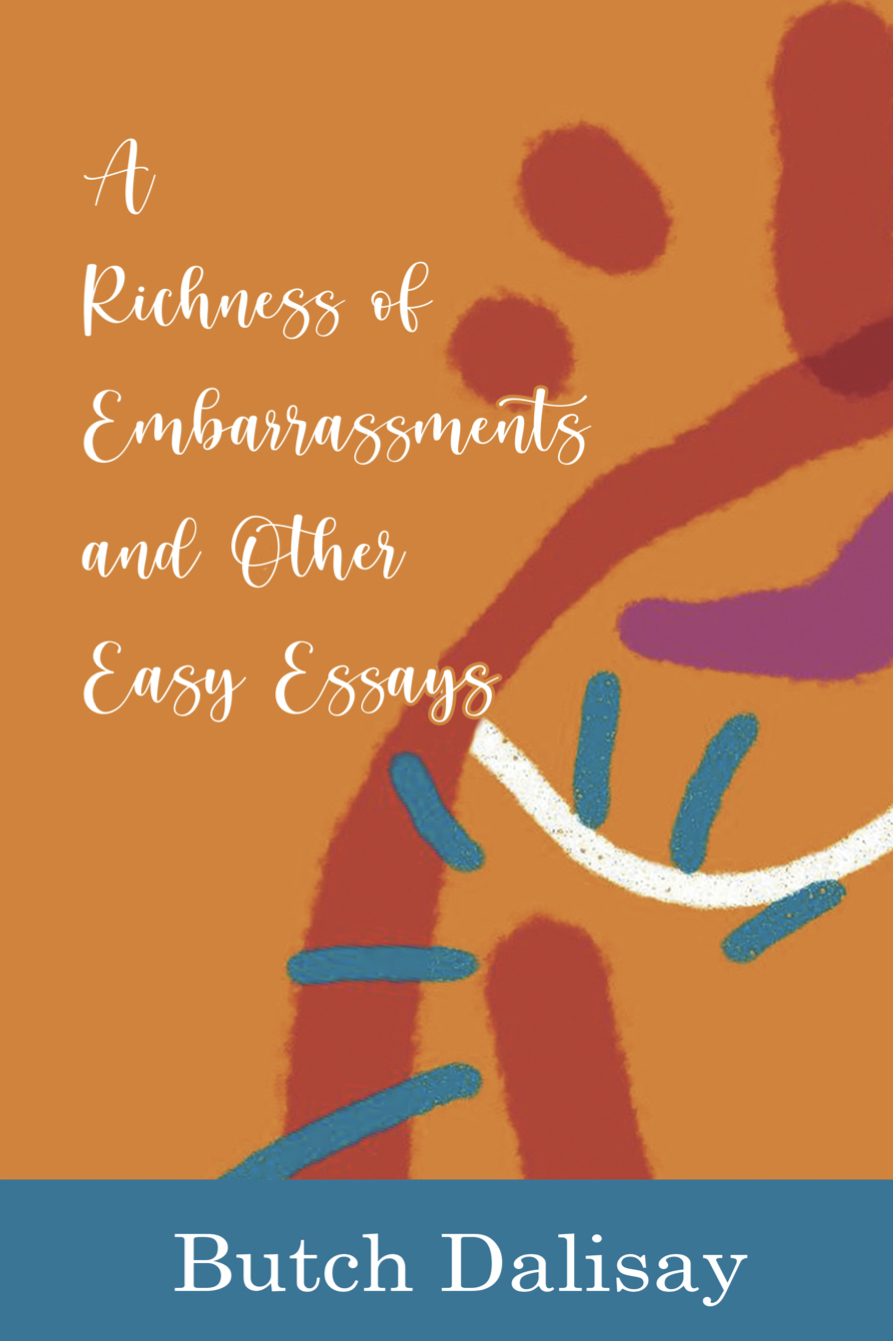
I’m delighted to announce that that book—A Richness of Embarrassments and Other Easy Essays—is out, published by the UP Press, with joyful cover art by Robert Alejandro. That it emerged in the middle of a pandemic means there’ll be no fancy launch with wine and canapes, but as my preface below suggests, it’s just as well, because you probably need to laugh as much as I do:

“The 110 essays in this collection were selected from many hundreds that I wrote and published for my Penman column in the Philippine STAR between 2000 and 2019, a two-decade period that saw me returning from a nine-month writing fellowship in England on one end and retiring from my teaching and administrative positions at the University of the Philippines (UP) on the other. 

“In other words, I grew old writing these pieces, but while picking and putting them together, I also realized what a fun ride it’s been, despite and sometimes because of the gross absurdities of Philippine politics and society. I decided to choose my more lighthearted pieces to entertain the reader and afford him or her a moment of relief and refuge, to remind ourselves that a gentle smile can be as precious and hard-won as a triumphal scream. Humor and comedy may yet be the best way of surviving a period seemingly intent on reducing us to tears and despair. 

“Critics have remarked how different in temperament my fiction is from my more popular Penman persona, and how I can dwell obsessively on such topics as fountain pens, computers, ramen noodles, vocabularies, Volkswagens, and of course my dear wife Beng. That’s because, as with my fiction, I believe that there can be great stories behind the simplest things (along with the suspicion that the simplest things are never really that simple). 

“But the bottom line is, I need a break, and so do you. I hope you enjoy reading these pieces—just a few at a time—as much as I enjoyed writing them. 

“My deepest thanks go to my friends and associates at the UP Institute of Creative Writing, particularly Roland Tolentino and Neil Garcia, for supporting the book, and to my editors at the Philippine STAR, chiefly Millet Mananquil and Igan D’Bayan, for bearing with me all these years.”

(The book can be ordered online from the UP Press store on Lazada at https://tiny.cc/boi1tz.)