A stall selling all kinds of fireworks and firecrackers in Puerto Princesa.
Category Archives: Travel
Flotsam & Jetsam No. 4: Better Halves

MET THESE, uhm, ladies in an ukay-ukay (used clothing) store in Puerto Princesa.
Flotsam & Jetsam No. 3: A Lovely Place to Lie

WE WERE on the road in Hawaii a few years ago, enjoying the scenery, when I spotted this clump of deep red earth against the greenery and a long shrouded box beside it. Was someone about to be buried there, or was I just imagining the kind of pleasant passing we all hope for?
Penman No. 2: Three Malaysian Artists

Penman for Monday, July 2, 2012
I REPORTED last week on our visit to Malaysia for the launch of the 1Malaysia Mega Sale Carnival—which is running until September 2—and on how impressed I was by Malaysia’s strides in its economy, particularly its infrastructure and tourism. The shopping aside, another part of that visit that I looked forward to was a chat with several Malaysian artists, feeling that, wherever you go, you can come closest to the earthly truth (and to visions of heaven and hell) by talking to the artists.
I’d arranged a meeting with a personal friend, Datuk Mohammad Nor Khalid, known to all Malaysians simply as Lat, the cartoonist behind the iconic Kampung Boy, published in 1979. His artistic talent was discovered at age 13, and Lat gained quick and enduring fame, endearing himself to his countrymen for his affectionate but also often mordant depictions of rural Malaysian life. Born in the village or kampung of Kota Bharu in Perak in 1951, Lat (short for bulat or round, which he was as a boy) worked briefly as a police reporter for the New Straits Times (serving under a colorful Filipino named Rudy Beltran who also played piano at night with a band called Rudy and the Gypsies, but that’s another story) before returning to his true vocation, cartooning.

I met and became friends with Lat when we were both Civitella Ranieri fellows in Italy a year ago. As the only Southeast Asians in the program, we bonded naturally; since neither of us had been to Venice before, we traveled there together, sharing a tiny room just outside the city center to save our euros. I was mightily impressed when, promenading along the canals, Lat was recognized and pounced upon by Malaysian tourists who asked him to pose with them for a souvenir shot taken by, of course, yours truly.
A simple, easygoing guy, Lat picked me up at our KL hotel in a cab—and again, our tour guides rushed across the lobby to greet him reverentially—and took me for coffee to the posh Royal Selangor Club, where he ruminated on how Malaysian life had changed since he left the kampung (having sworn not to live in KL, he now stays with his wife in Ipoh, about two hours away). Like his cartoons, his speech is laced by much laughter and more than a tinge of sadness.

“Many people have moved out of the kampung,” Lat said. “In my village there are only six houses left. My dad sold the house in the 1960s, but I bought it back in the 1990s. I would love to see the young sons and daughters of the kampung people do something about the places they left behind. The cement factories are taking over the countryside…. There used to be hundreds of us in Kota Bharu, but now, you can hold a feast for 70 people at most. Today we have roads, but all you see are lorries that carry sand, but no people.”
He adds: “Many Malaysians are rich with money, yes, but that’s all. You go to the fish market, most of the sellers there are millionaires—they earn more than one million ringgit (about P14 million) a year—but being a millionaire doesn’t mean much anymore. Even the poor can expect their basic needs to be met. Basic education is free, and students can get loans for college. But now we’re producing too many graduates and not enough good jobs.” His four children are all artistically inclined, working in media, theater, and communications, although none of them draw.
Lat acknowledges that a new generation of artists has taken over. “Young cartoonists today are mostly into manga. They should make their work more Malaysian. I don’t do much political commentary anymore, but new talent is emerging. There’s a young cartoonist named Zunar, who draws for the opposition newspaper—always controversial, but he’s very sharp and very steady.” Lat is, however, a firm supporter of former PM Mahathir, and later in his life became a devout Muslim, even as he idolizes Elvis Presley and can sing a mean tune. Important commissions still come his way, but, he says sagely, “The successful person is the one who can say ‘I don’t feel like doing it, I just want to relax.’”

My next interviewee was the world-renowned shoe designer Jimmy Choo, born in Penang, Malaysia in 1961 but a resident of the UK since the early 1980s. Our Philippine media group had been told that we would have ten minutes with the fashion icon, and since this was way out of my league, I prepared by reading everything I could about the man, poring over scores of shoe pictures, preparing half a dozen questions (including brilliant ones that never got asked like, “Is one shoe just a mirror of the other? Do you begin by designing the right shoe, or the left?”) and not the least by bringing along black leather loafers to supplant my scruffy Sanuks on interview day.
Jimmy Choo turned out to be a slim, avuncular figure, nattily dressed in an almost businesslike way. I made a point of taking a picture of his shoes—which he made himself, for himself—black, wingtip loafers. I popped my first question about the story or the narrative behind the shoe, any shoe.

Jimmy said: “When I design a shoe, the first thing I think of is the season—spring, summer, fall, winter. This year being the Year of the Dragon, I think of different dragons, and of the stories that can come out of them that can be linked to the shoe shape, the motion, the material, the story that could be presented to the press and the buyers that could answer the question of ‘Why was the shoe designed this way?’… The shape is very important. When I designed my first collection in 1988 for London Fashion Week, I had to think about how to catch the attention of the press. My designs are feminine—elegant, pretty.”
But the most important point that Jimmy made in those allotted minutes had to do less with the designer’s vision than the craftsman’s skills: “My father was a shoe designer. Forty years ago there were no computer games, so when I finished school and finished my homework, I watched my father make shoes. When I was eleven, I made shoes for my mum for her birthday. Designers are great and I respect them, but designers need skills as well. Not all of them can cut the patterns for the shoes they want. I’m very lucky to have this skill. When I went to the UK and I entered the Cordwainers College, I learned how to draw a shoe. I knew how to make them on the mold, but I couldn’t draw them. So it’s important to have all these skills…. It’s no different designing for men or women. My father did that for both men and women, so I learned to do that myself. I wear my own men’s shoes.”
A final, funny factoid came up when someone asked him about bags: “I carry my own bag. I’m a funny guy—I travel with four, five phones. I’ve got two SIM cards from HK, two from China, two from the UK, and so on, plus two or three cameras.”

And lastly, there was Charles Cham in Malacca. I can’t help assuming, when I’m about to meet an artist I don’t know, that the guy is going to be rock-star surly, especially at nine in the morning, when even I don’t want to be bothered by pesky questions about my work. That’s when we were scheduled to meet Charles in his shop, and it didn’t help that the bearded picture in his press handout and the impressive credentials that accompanied it—stints in France, New York, and Budapest, a write-up in the International Herald Tribune—suggested a formidable talent.
As it turned out, Charles—smiling Charles—was the gentlest, most congenial artist anyone could expect to meet, and it didn’t bother him to have to open his shop, called The Orangutan House, an hour early just to entertain us. The shop displayed some of his witty, whimsical paintings—he likes African masks, animal figures, and bright colors—and also served as a gallery of T-shirts, all of them for sale at very reasonable prices. The T-shirts are marked by his characteristic humor: one says—in Malacca’s heavily touristic context—“No pictures, please!” and another, showing the unmistakable profile of a condom, says “Play safe—Use Malaysian Rubber!”, an endorsement of Malaysia’s most traditional export and also of safe sex.
When I asked him about how he saw himself in relation to the contemporary Malaysian art scene, Charles said, without losing his wry smile, that he was definitely “an outsider.” His reported brushes with Malaysian officialdom may have caused him, not to mention his targets, some grief, but these, he said, were “unintentional.” Here, clearly, was a clever talent seeking to survive while pushing the limits of the possible in a society still bound by the rules in many ways. In his IHT interview, Charles Cham committed himself to “staying here and fighting.” From what I saw of his country, it was certainly worth staying in and fighting for.
(Lat’s cartoon above courtesy of etawau.com)
Penman No. 1: Mall-Asia, Truly Asia
Penman for Monday, June 25, 2012
EVERY TIME I visit Malaysia, I can’t help thinking that this is the country we could have been, had our history taken another turn—with wide, perfectly flat roads, tall, smartly designed buildings, swaths of greenery, speeding trains, and bustling industry.
Singapore gives me the same feeling, but it’s much too small for true comparison’s sake; Malaysia, on the other hand, is just slightly larger than the Philippines in terms of land area, although its population of 28 million is less than a third of our 93 million, and there’s surely a point to be made there somewhere. Malaysia today is predominantly Muslim and we identify ourselves as Christian, but let’s not forget that Manila began as a Muslim settlement.
Both countries underwent long and painful periods of colonial rule, and Malaysia’s experience—at least in parts of it like Malacca—was even more complicated than ours, with Portuguese, Dutch, British, and Japanese invaders successively lording it over the land. When Malaysia declared its independence in 1957, we Filipinos might have had reason to think of this neighbor as a backwater good for little more than rubber trees.
Today, of course, the laugh is on us. Somewhere along the way, both Malaysia and the Philippines endured long stretches of strongman rule—Malaysia got Mahathir, we got Marcos. Guess who got the better autocrat. We can argue that Malaysia’s had all that petroleum and palm oil to bank on, but it’s not as if we started out with nothing.

These impressions bore down heavily on me last week as I touched down in Kuala Lumpur on Malaysian Airlines with a media group from Manila and was whisked away for a lakeside lunch in Putrajaya, Malaysia’s gleaming new federal capital district just outside KL. Like many things Malaysian, Putrajaya was thoroughly planned, and incorporates cutting-edge green technology. “There’s no airconditioning in these buildings,” our guide Jeffrey pointed out in the 32-degree heat. “They use a watercooling system to keep the temperature down.”
We were in Malaysia to cover the launch of the 1Malaysia Mega Sale Carnival, an annual extravaganza (ongoing until September 2) featuring massive discounts nationwide on goods, including luxury branded items prized by visitors such as affluent Singaporeans, who stream across the border for fun and shopping. Such sales may seem like exercises in frivolous excess to plebeians like me more accustomed to dumpster diving in the nearest ukay-ukay, but it’s big and serious business to Malaysia, which attracts over 24 million tourists—just a few million short of its total population—every year. Last year, Malaysia earned 58.8 billion ringgit—almost P800 billion—from tourism, the third-largest dollar-earning sector of the Malaysian economy. About a third of that, P250 billion, was accounted for by shopping.
Except for a few items like cars (which are highly taxed to encourage the use of mass transit), shopping is largely duty-free in Malaysia, and you don’t have to go to the international airport to get the best prices. (While nowhere near as comprehensive as Singapore’s Changi and Hong Kong’s airport, KLIA has much more to offer than Narita or Incheon—and free wifi.)
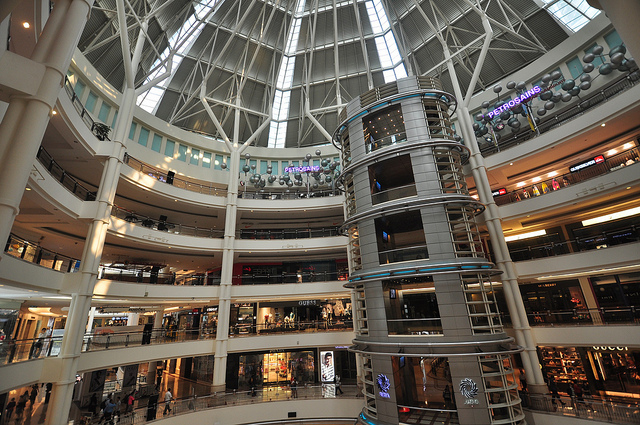
Malaysia may be best known to outsiders for its resorts, beaches and nature walks in Penang, Langkawi, Kota Kinabalu, and the Genting Highlands—the kind of dreamy getaways you see on those distressingly effective “Malaysia, Truly Asia” ads (which scuttlebutt has it were conceived by a Filipino)—but shoppers around the region equally appreciate the fact that the country has 300 shopping malls and centers covering 90 million square feet. Including office space, its biggest mall—Berjaya Times Square in KL—sprawls across 7.5 million sqft, nearly twice the footprint of our Mall of Asia.
The malls serve the full range of clienteles and price points, from the upscale Starhill and Pavilion in downtown KL to the more pedestrian-friendly BB Plaza a few blocks away. Even the landmark 88-story Petronas Towers have an in-house mall. “Within a one-kilometer radius in Bukit Bintang, you can find 3,000 shops,” said Joyce Yap, the head of a merchants’ association in that prime shopping district. The malls attract not only shoppers but diners as well. “Food and beverages are a huge draw—nobody here has time to cook!” said Kung Suan Ai, VP of the Malaysia Shopping Association.
The proliferation of shopping centers was such that I told Jeffrey, “Your country should be called Mall-Asia.” Three generations of malls have now been built since the first mall, Ampang Park, was built in 1973. We were billeted in the four-star Boulevard Hotel in Mid Valley, a KL suburb that sprang up 15 years ago apparently for one main purpose: yes, shopping, and the hotels to house the shoppers in. The Boulevard is connected to its two sister hotels—the Cititel and the Garden—by an underground walkway that is in fact the basement level of the huge Mid Valley Megamall.
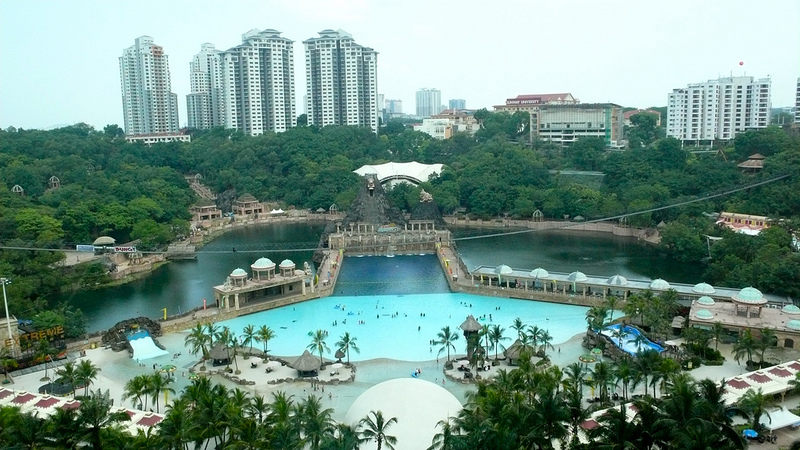
The Mega Sale’s formal launch was held at the Sunway resort complex, another example of private enterprise turning a hole in the ground—in this case a lagoon left by a disused tin mine—into a business opportunity. Sunway is a water theme park, hotel, and mall all in one, and if it’s a bit over the top—it’s Egypt, Vegas, and Versailles altogether—the locals don’t seem to mind, trooping to the resort in family-size droves.
Our visit included an overnight side trip to historic Malacca, two hours away by van—a city of 20 museums, a busy night market on Jonker Street, a river cruise, and a spectacular view from a revolving tower more than 300 feet high. Lunch at the Restoran Peranakan gave us a taste of traditional Chinese-Malay cuisine, but it was the dinner fare at Capitol Satay—a fourth-generation family concern whose special peanut sauce has become so legendary that customers queue up for three hours at the door—that occasioned a feeding frenzy among us. The gustatory treats continued the next day with heaping servings of shaved ice laced with fruits, beans, and corn, which the locals call cendol; a fancier dessert closer to our halo-halo is air batu campur or “ABC.”

The Mega Sale was a huge success with my young Filipino companions, who had the fashion sense, the budgets, and the bodies to deserve and display the pretty things that lend glamor to days that begin at noon and end with the next dawn. Me, I found the one store that had the most special objects I desired in Malaysia—a shop called PenGallery in downtown KL—and walked out with another fountain pen I surely didn’t need but just as surely wanted. After I found a lovely pewter-and-onyx pendant for Beng at the Royal Selangor boutique, my shopping was over, and so was our journey to another future we might have had.
Next week, I’ll relate the highlights of my conversations with three outstanding and yet very different Malaysian artists—the iconic cartoonist Lat, the shoe designer Jimmy Choo, and the maverick painter Charles Cham.