Penman No. 64: The Outsider in the Story

Penman for Monday, Sept. 16, 2013

AS MY literature students know, there’s only one kind of exam they can expect me to give them—a 90-minute, essay-type, open-book exam. This means that, over a class period, they’ll be answering two or three questions with short essays that they can compose with the help of their notes, their readings, and their brains.

The first time they hear this, some students will cheer, thinking that an open-book exam will be a walk in the park, and that they can catch up on two month’s worth of reading and comprehension with 15 minutes of furtive cramming. (As they like to say on Pawn Stars, “That’s not going to happen.”) The smarter ones know that the best way to get my attention from this point on will be to say something fresh, beyond spitting back what we’d already said in class or quoting some ponderous French critic.

Just like answering them, writing exam questions is something of an art. Ideally, you want to frame questions that are hard to answer but easy to check—in other words, you should be able to sense, within a couple of paragraphs, if the student has a handle on the material or not. You also want questions for which there are no set or obvious answers. In this way, literature and the humanities are different from math and the sciences, in that there is no one correct answer that, with diligence and practice, everyone can theoretically arrive at. I grade responses based on the student’s appreciation of the problem and his or her reasoning; sometimes I might even give a high mark to an answer that doesn’t directly answer the question, but which sets up and pursues such an interesting tangent or dissent that I find myself provoked and educated by it.

Over the years, I’ve built up a battery of questions that I periodically revisit, tweak, and let loose on a new batch of students. Today, I’m taking one of those questions out of commission by putting it out here in the open, and answering it myself. It’s a question I used a few weeks ago for my midterm exam in my course on The Short Story, and while I may change the phrasing from time to time, it basically runs this way: “The Irish writer Frank O’Connor once described the short story as ‘the story of the outsider.’ Using at least three of the stories that we’ve taken up in our reader, discuss how and why O’Connor could have made this statement about the short story.”

What am I looking for when I ask that question? The bottom line, of course, is evidence that the student has read and understood the stories in the syllabus—this is where my passing grade begins—but beyond that, going from competence to brilliance, I look for insight and (this being, after all, a course in literature) articulation. In the case of the O’Connor statement about the short story and the outsider, two immediate possibilities present themselves: one, the outsider as the typical or ideal protagonist in the short story; and two, the short story as the ideal form for the depiction and development of the outsider-character. So we’re looking both at substance or subject and form, both of which the Lit major and budding creative writer should have a keen feel for. (And before anyone lectures me about ending my sentences with prepositions, that’s one of those mythical no-no’s, like the split infinitive, that have been elevated by sheer repetition into dictum.)

Taking the outsider as subject, it’s not too difficult to find and cite instances where the protagonist in the short story is an outsider in society—a nonconformist, a rebel, an outcast. Perhaps the best known example of such a character I can cite is that of Sammy in John Updike’s 1962 story “A&P,” a 19-year-old clerk in a convenience store who quits his job when the conservative store manager admonishes three girls who come into the store in bathing suits, the beach being not too far away. Sammy seems to come to the girls’ defense—ironically, the girls don’t even notice his chivalry—but the girls are really just an excuse, a catalyst for an explosion that had been long brewing within Sammy, who sees most of his customers as “sheep” and who feels oppressed by his environment. So he dramatically, heroically, quits his job, but realizes almost immediately that a nonconformist’s life is not going to be an easy one, as the story’s ending unequivocally states: “… my stomach kind of fell as I felt how hard the world was going to be to me hereafter.” (Having taught it for nearly 30 years now, I’ve been using “A&P” as a kind of litmus test to sense the drift of the current generation. My own First Quarter Storm cohort would have roundly applauded Sammy’s idealism; not surprisingly, most of my present students thought he was irresponsible if not stupid to have quit his job to make a point.)

Another example of such a character is Paul from Willa Cather’s “Paul’s Case.” Although published in 1905, the story could easily be transported to the “selfie” present, given 16-year-old Paul’s egotism and high ambition; he thinks himself well above his peers in intelligence and taste, and imbibes the world of the theater, even if his only role in it is that of an usher. When Paul suddenly finds himself with several thousand dollars entrusted to him by his father for depositing in the bank, Paul runs away with the money to New York, lives the life of a prince for a week, then—with the long arm of the law just about to reach him—he hurls himself in front of an oncoming train. Here, the outsider willfully chooses to be one, the exclusion achieved by arrogance and self-delusion (or, to be more generous, by indulging the high-romantic impulse that most of us will suppress).

The outsider might also become one not by choice but by social fiat; Katherine Mansfield’s “Miss Brill” is one such outcast, one who feels herself to be in the very center of things, observing people in a park with directorial authority, only to be spurned by that society. Society can also exert its pressures subtly but no less firmly, as in the case of Miss Mijares in Kerima Polotan’s “The Virgin,” where a thirtyish spinster’s longing for a man’s touch overrides her primly preserved composure.

The more difficult part of the answer involves form and technique: what in the short story qualifies it as ideal for the exploration of the outsider-character?

The short story’s relative brevity, for one, compels the action to be focused on a crucial moment, often a decision to be made by the protagonist, that will reveal the truth of his or her character. In this sense, short story characters live in a pressure cooker; at some point, we expect them to crack and break, and it’s these moments of rupture that yield the most valuable insights into the human condition, whether it’s the extent of human greed or of our capability for love and self-sacrifice. Arguably, these moments create departures from the norm and transform the protagonist into something other than he or she was, rendering the protagonist an outsider unto himself or herself.

But the best answer I got in the midterm exam was something I hadn’t even thought of: the short story brings out the outsider in us, the readers, by creating sympathy for characters in situations that our ordinary, rational selves would probably avoid. And that’s the magic and the power of literature—its ability to transform and transport us into other realms and possibilities, so that, for one brief moment, we stand on the outside looking in, and see things about ourselves that we never saw before.

Penman No. 63: A Poet Speaks

CBautistaPenman for Monday, Sept. 9, 2013

NOW 72, Cirilo F. Bautista towers over the writers of his generation. Though primarily known as a poet in English, Cirilo—“Toti” to his friends—also writes formidable fiction in both English and Filipino. His books of poetry alone number a dozen, and have won the country’s most prestigious prizes, including the Centennial Prize in 1998. Until his retirement, he was a full professor and writing guru at De La Salle University, and had, at some time or other, taught at other major universities here and abroad. His poetry is deep and complex, conscious of the need to separate the emotional from the intellectual—difficult to many—but not without wit and humor.

Bautista has been nominated for the hallowed title of National Artist, and it’s an honor he would richly deserve and invest with the necessary achievement and gravitas. I can only hope that the bestowers of this award will take this view—shared by many in our literary community—when they sit down next to consider our National Artist awardees. I can be fairly sure that there will be great rejoicing and little dissension when that happens, unlike the controversy that met the last batch of dagdag-bawas “laureates.”

Last Sunday evening, I was privileged to hear Cirilo speak at the 63rd Palanca Memorial Awards for Literature at the Manila Peninsula. He had been asked by the contest sponsors to be evening’s guest of honor. Although forced to use a wheelchair by muscular dystrophy, Cirilo showed no sign of slowing down where his mind was concerned. That night, in a mixture of polemic and poetry reading, Cirilo lamented the diminished role of the poet (by extension, the artist) in Filipino society, diminished since the days of Jose Rizal, when poets were heroes and heroes were poets.

With his permission, I’m excerpting portions of his speech, in the hope that more Filipinos will take notice of their poets in general, and of one named Cirilo F. Bautista in particular. What follows are his remarks:

Small as the Philippines is, smaller still is its literary community—poets and fictionists caught in the bright dream of making a difference in its aesthetic and cultural development. Some are good, many are terribly bad. I speak of the good ones only since charity has no place in the critical evaluation of artistic excellence. To those who live with words, who are engaged in the art of counting syllables and harmonizing metaphors, whose constant fear is not finishing their work, to be poets in the Philippines is to live in a surreal world whose stress and strains shape their concept of existence. People regard you as a specimen of some strange thing to encounter, to examine, even to touch. But not of something to take seriously. You live on the border, on the periphery, on the edge of society, considered unique, but nothing more. The institution that you represent—the world of fine writing—has not made the priority list of any government in the history of the country, whatever our political fathers may say about the importance of cultural advancement. Poetry receives no significant financial allocation, no institutional support, no artistic infrastructure. Not that the poets should depend on the government, but that since the government is tasked with the overall progress of the people, certain measures must be taken to insure that poets do not wallow in the quagmire of neglect.

… Now we see manifestations of the absence of support for the poets. Poets are generally unknown in their own country. Few read them but in the lingering and strengthening vestiges of colonialism prefer the work of Western writers. We are led by the nose by American capitalist interest in the arts. We read what they give us, and have not been sincere and brave enough to assert our own taste and preferences.  Our culture is a borrowed culture, disguised as modernistic simply because it arrived on the Internet. But of the values that assert our roots, they seem to have been devoured by TV novelas and rock concerts. Our taste is largely a mixture of truncated native idealism and borrowed Western adventurism. That we adapt to them may be our virtue, given difficult times; that we are controlled by them may be our downfall. But like them we do. They appeal to that inexplicable part of us that needs to resolve the ironies and contradictions of our existence. And it is in this that, quite strangely enough, the poets seem naturally equipped to provide explanations.

… I am a veteran poet; as I have said, I have published some 12 books of poetry. None of them made a print run of one thousand copies. By American standards I should be rich from the sale of these books, but I am not. It seems they are read only by the inquisitive and misdirected. On a few occasions when, feeling generous, I give my books to relatives and acquaintances, they ask me why I am punishing them. Those who don’t like reading poetry considering reading it a punishment; that’s the only way of interpreting the situation. And poetry becomes a burden to society which has reached a certain stage of insensitivity to the stark harmonies of the soul. This baffles me. I can’t understand why in an affluent society like ours (we are called Third World only by the political elite who handle the greater portion of our national budget for self-improvement and establishing political dynasties), a true literary resurgence cannot take place, or why we cannot remedy the effects of a fractured culture and mismanaged patrimony. The elite in society do not buy Filipino books but patronize foreign ones. It is their pride to be amongst the first to have the work of this or that European poet or novelist, but they will ignore the works of their countrymen. Is this colonial mentality or crab mentality? They still find it difficult to believe in Filipino excellent artistry, or they will down to lower ground Filipinos who exhibit excellent artistry. I find this prevalent among the young who regard foreign shores as sources of cultural inspiration. Always the Filipino is never first in their appraisal.

… It is of course an error to belittle our poets. They have proven that they can compete with the best in the world, given certain assistance and patronage. Their works appear in international publications, they have won important prizes, they are invited to global conferences and festivals of art, they exchange ideas with prominent figures of contemporary literature. Why then are they not patronized in their own country? As I said, I’m baffled by this, short of saying what I don’t want to say—that like crabs we pull down those we perceive to be making names for themselves, and consign to neglect the products of those names. Some are even proud not to be readers of Filipiniana.

… We are proud to point to a poet as our national hero. A poet laureate reflects a country’s coming to terms with the importance of poetry in the overall conduct of its affairs, but mostly with the progress of its artistic sensibility. Poetry is a civilizing factor that drives away the rudeness and coarseness of practical existence. It confers on the individual a high sense of being-ness and a true perspective of life. The poet laureate serves as a bridge to connect the people’s aesthetic education and spiritual well-being. It is seeing their world in another way, and making connections with realities that seem hazy at the start. A moon is not a moon, flying is not leaving the ground—but something else. What? That’s the exquisite area of poetic discovery that only the knowledgeable may enter.

(Photo courtesy of the Cultural Center of the Philippines)

Penman No. 61: TSE, Sir Winnie, Neil, and Other Penmen

WritersPenman for Monday, August 26, 2013

A FEW months ago, I was thrilled to read the news that TS Eliot’s pen had been lodged with the Royal Society of Literature, replacing a quill pen that had been owned by Charles Dickens and used by the society’s fellows to sign themselves into the exclusive club. Now based in Somerset House in London, the society counts some 500 fellows among its members, and not surprisingly these have included some of British literature’s most illustrious names both ancient and modern, from Yeats to Rowling. (Fourteen new fellows can be elected to the society every year; they need to have published at least two outstanding books and gained the acclaim of their peers.)

The story, according to The Guardian, was that Dickens’ quill pen had understandably lost its sharpness, and that a replacement was therefore in order (members can also choose to use Lord Byron’s pen, reportedly still in fine shape). Eliot’s widow (his second, actually) Valerie had just died in 2012 and had willed his pen to the RSL, making the turnover possible. (Before we leave the subject of quill pens altogether, let me note that these medieval tools took a lot more to make than pulling big feathers from the butts of geese, including tempering in hot sand and sharpening with what came to be logically known as a pen knife.)

It took some Googling before I found a picture of Eliot’s pen, which was never identified in the news stories (picture above courtesy of The Telegraph). From what I knew of vintage pens, it was a Waterman in black hard rubber with two wide gold bands, on one of which was inscribed Thomas Stearns Eliot’s initials. It had been a gift from his mother Charlotte; Eliot had moved to England from the US in 1914 when he was 25, so the pen, which dates to that period or a little earlier, might have been a parting gift.

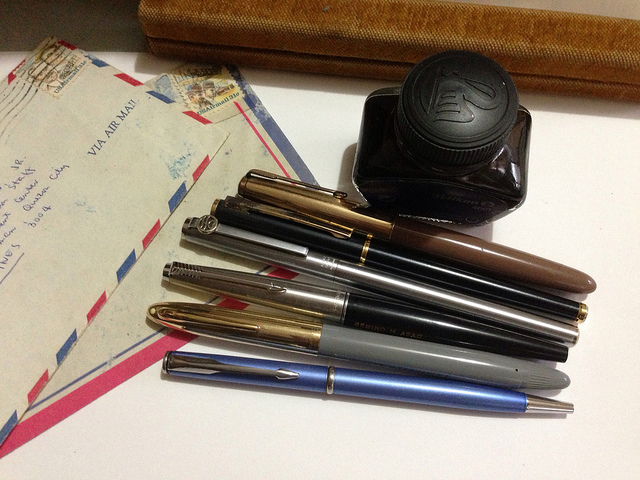
I remembered Eliot’s pen over last week’s rains when, with nothing much else to do at home (that’s not quite right—I always have something to write, but am a horrible procrastinator), I took out my pens for a ritual rubdown and came across a few I hadn’t seen in a long time. That was because these were special pens kept in a special corner—pens donated to my collection by writer-friends, pens they had actually used in their work. Over the years, as word got around of my fascination with fountain pens, generous friends and patrons like Don Jaime Zobel de Ayala and Wash SyCip have gifted me with lovely pens, which I continue to treasure.But the pens I’ve assiduously run after have been those of my fellow writers, especially older friends who started writing with them in the pre-computer age.

My little writers’ corner now includes pens from National Artists Franz Arcellana, NVM Gonzalez, and Virgilio Almario, as well as from dear friends and colleagues Doreen Fernandez, Jimmy Abad, and Jing Hidalgo. They range in kind from a Parker 51 from Franz and a Montblanc 220 from Doreen to well-used ballpoints from NVM and Rio. (I’m still hoping, one of these days, to be able to ask for pens from Bien Lumbera, Frankie Jose, the late Tiempos, and Greg Brillantes, among others.) Needless to say, these pens will never be sold on eBay. If and when we open a Writers’ Museum, or at least a permanent display like they have at the National Library of Singapore, I might consider loaning or passing them on, but for now they’ll stay with me in my man-cave, feeding my fetishist longings alongside books signed by Nick Joaquin, Jose, Brillantes, Bienvenido Santos, JM Coetzee, Frank McCourt, Kazuo Ishiguro, Junot Diaz, and Edward Jones. (Some of these—the non-Filipino ones, excepting Junot’s—I wouldn’t mind putting on the block someday.)

Before typewriters and word processors made everybody’s writing look like everybody else’s, writers and their pens enjoyed a special relationship, some more so than others.

Mark Twain, a friend to Filipinos in his staunch opposition to American imperialism, preferred the Conklin Crescent Filler, a pen that used an inverted half-moon of gold to press down on the rubber sac in the barrel to release ink. It was a very popular filling system in its time and Twain became something of a poster boy for Conklin, so when the company was recently revived (like so many other long-dormant pen makers, on the heels of a neo-traditionalist trend boosting fountain pen sales), it named its flagship pen what else but the Mark Twain.

But Twain’s popularity never came close to that of British Prime Minister Winston Churchill, who was reported to have used a Conway Stewart—a venerable British brand recently revived—through the dark days of the war. So formidable a figure was Churchill that not only Conway Stewart but Montblanc and Onoto have also come out with pens in his honor.

Onoto—another British pen maker, associated with Thomas de la Rue which used to print our banknotes in the pre-BSP days—also claimed Sir Winnie among its famous users. In the age before paid celebrity endorsements, catching someone popular using your product was good as an endorsement, and was free besides. The minders of today’s Onoto have come up with incontrovertible proof—a letter sent by the young Churchill in November 1915 to his wife Clementine from the trenches in France, where he talks about “the venomous whining and whirring of the bullets which pass overhead.” But the clincher for the company was the ending: “Send me also a new Onoto pen. I have stupidly lost mine.”)

Speaking of the French, Fountain Pens: History and Design quotes the French theorist Roland Barthes waxing ecstatic over his pens: “In the end, I always come back to fountain pens. The important thing is that they can ensure the graceful handwriting I care so much about…. I have too many fountain pens and don’t know what to do with them. Yet, as soon as I see one, I can never resist buying it.”

There’s probably no more famous user of a fountain pen today than Neil Gaiman, who employs quite a range of them, from among the 40 to 50 he reputedly owns—a TWSBI, a Pilot, a Lepine, a Delta, and a Visconti, among others—not just to sign books but to actually write his novels with. He lives, he says, in “a house full of Macs” and is a self-confessed iPod freak, but he told the BBC that, with pens, “I found myself enjoying writing more slowly and liked the way I had to think through sentences differently. I discovered I loved the fact that handwriting forces you to do a second draft, rather than just tidying up and deleting bits on a computer. I also discovered I enjoy the tactile buzz of the ritual involved in filling the pens with ink.”

Pen addicts (the fancy name is “stylophiles”) can never have just one pen to use, so we prefer to talk about “the rotation,” that merry-go-round of favorites we keep constantly inked and polished, ready to be taken for a ride. There’s a lot of debate in the group over whether one should carry one’s most precious pens; I’m of the school that believes that life is short and runs ever shorter, so that fine pens, like Rolexes and Patek Philippes, should be carried with pride and reasonable care. I can’t tell you how many pens I’ve lost in my practice of this carpe diem philosophy, but I have no regrets.

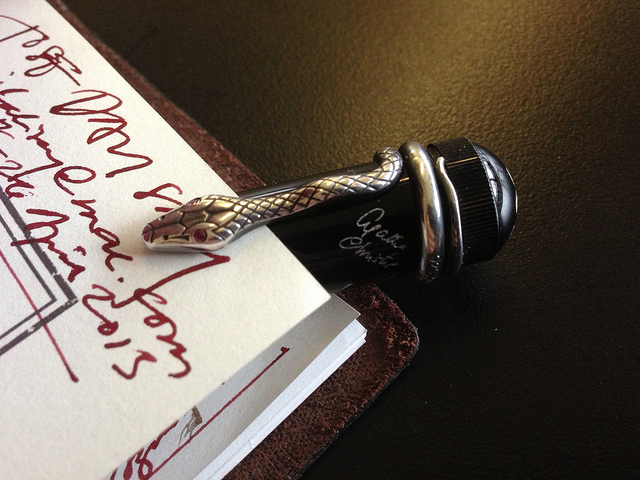
These days, my most faithful pocket companion and favored pen in hand is a 20-year-old Agatha Christie, a largish black pen with a clip in the form of a sinuous snake, a tribute to its exalted namesake and her penchant for mystery. This gorgeous pen has written nothing more noteworthy than, well, notes, but having it in my pocket puts a lift in my step, and even doodling with it puts me in a trance, poised as it were to write until its cache of ink (either Rohrer and Klingner Sepia or Diamine Oxblood) runs dry.

Agatha

In these digital times, of course, hardly anyone except Neil Gaiman really writes stories and novels with a pen anymore, and even this piece is being written on a MacBook Air, which is threatening to croak any minute now for want of juice. That was the beauty of the pen, a writing instrument you could pop into your pocket and pull out as the inspiration or necessity struck you, batteries and brownouts be damned. I’m sure that Tom, Mark, Winnie, Roland, and Neil would wholeheartedly agree.

Penman No. 60: Enter the Listicle

Listverse

Penman for Monday, Aug. 19, 2013


I WAS online last week looking up the rumors about the impending release of the iPhone 6 on September 10 when I glanced at the sidebar of the page I was reading and spotted a new word out of the corner of my eye. The word was “listicle”, and immediately I wondered if it was something cold, sweet, and edible, or some sinister medical malady, some unnerving imbalance afflicting grown men.

I clicked the link, and learned something new, thanks to Anna Lawlor of The Guardian: “The journalistic lexicon has a new entry; the ‘listicle’, describing a list-based article. From The Sunday Times’ ‘100 Best Companies’ to Buzzfeed’s ’31 Things You Can Make Out of Cereal Boxes’, listicles are equally beloved for their condensed information format and online virility and decried as lazy journalism for the perennial lunchtime ‘news snacker’.”

News snacker? What the heck was a news snacker? Farther down the piece was the definition: someone who engages in “checking news content far more frequently, for short, sharp bursts of attention.” In other words, that’s someone who checks out the headlines on his or her mobile phone or tablet five to six times a day.

I suppose that’s me—I’m online all the time, and can’t help peeking into the news, my eBay bids, and the chatter on my favorite fountain-pen and Apple websites every few hours—but I’m also old enough to still be reading the newspaper from the front page to the back page with my morning coffee, and to watch one or two TV newscasts before bedtime. So rather than a news snacker, call me a news glutton, which I almost had to be to pick up a new word and concept like “listicle.”

Come to think of it, we are in the full-blown age of the listicle, and you don’t have to look much farther than the STAR to realize that. Toward the end of every July, the STAR celebrates its anniversary by coming out with lists of anything and everything its inspired Lifestyle writers can put together (in my case, this year, I offered “27 bits of advice I give to young writers”).

If lists float your boat, then you have to be a regular on listverse.com, which serves up lists of such engrossing subjects as “10 strange non-sexual ways people have orgasms,” “10 creepy historical vampires you’ve never heard of,” and “10 unconfirmed victims of famous murderers.” (Talk about learning something new: from a list of “10 earliest versions of everyday technologies,” we learn that the first smartphone—with email, predictive typing, and some basic “apps”—was an IBM phone named Simon, which weighed a pound, was the size of a brick, and sold for nearly $1,000 back in 1994.)

But there were lists, of course, long before the Internet. In 1977, David Wallechinsky, Irving Wallace, and Amy Wallace compiled the first Book of Lists. Featuring such irresistible morsels as “famous people who died during sexual intercourse,” the book became a hit, and was periodically updated and reissued.

As you can see, some lists are more serious and some more ridiculous than others, although we should probably admit that silly lists are usually more fun to read. No one really talks much about lists like “10 things we need to do as a nation to move forward,” although we should. By their very nature, lists draw attention and achieve popularity because they seem to create patterns we’ve never seen before in the raw, undigested mess of our daily lives; patterns are intriguing if not mesmerizing, a kind of eye candy of the mind, but also reassuring at the same time, in that they bear the promise of an underlying logic to everything. Lists create mass, and mass creates credibility if not consequence.

To get on the serious side of lists, the first “listicle”—certainly the best known to lit geeks like me—has to be the “catalog of ships” in Book II of Homer’s Iliad, where every Greek and Trojan chieftain who took part in the Trojan War is listed along with a description of his home city and the ships he brought with him. There’s a lot of debate among scholars about the historical veracity of this catalog, there being a 500-year gap between the war and Homer’s own time, but some scholars have come to the all-too-human conclusion that, well, lists change and grow with time. As a website devoted to Greek studies puts it:

“An intermediate theory is that the catalogue developed through a process of accretion during the poem’s oral transmission and reflects gradual inclusion of the homelands of local sponsors by individual singers… In the most recent extended study of the Catalogue, Edzard Visser, of the University of Basel, concludes that the Catalogue is compatible with the rest of the Iliad in its techniques of verse improvisation, that the order of the names is meaningful and that the geographical epithets evince concrete geographical knowledge. Visser argues that this knowledge was transmitted by the heroic myth, elements of which introduce each geographical section… W. W. Minton places the catalogue within similar ‘enumerations’ in Homer and Hesiod, and suggests that part of their purpose was to impress the audience with a display of the performer’s memory.”

(Note to self: add “Edzard Visser” and “W. W. Minton” to a list of “names that sound like heavyweight professors’ names.”)

The sidestep to Homer and the literary catalog reminded me of another famous employer of the catalog, the American poet Walt Whitman (known to many of us as the author of that perennial declamation favorite, “O Captain, My Captain!”), whose epic Leaves of Grass surveyed the broad American landscape and used poetry to do what Instagram might have achieved in another time, taking snapshots of the passing scene, creating quick portraits of “newly-come immigrants,” “the squaw,” “the connoisseur,” “the one-year-wife,” “the paving man,” “the canal boy,” and so on.

At its best—and Whitman shows how—the listicle, or at least its literary form, can achieve a transcendent significance, a more-than-the-sum-of-the-parts meaningfulness that ordinary lists such as “the 10 best-selling burgers in America” can’t convey. Whitman scholar Betsy Eikkila explains it thus:

“Whitman’s catalog technique serves as a democratizing device, inscribing the pattern of many and one. By basing his verse in the single, end-stopped line at the same time that he fuses this line—through various linking devices—with the larger structure of the whole, Whitman weaves an overall pattern of unity in diversity. This pattern of many and one—the e pluribus unum that was the revolutionary seal of the American republic—is the overarching figure of Leaves of Grass.”

If that was a bit much for you, no problem. There’s always listverse.com and its promise of a yummy news snack to get you through another day of tedium at the office, and you don’t even have to choose between “10 of the slowest plants to ever bloom” and “11 cool facts about polar bears”—you can have them both, and more. They may be low on fiber, but hey, they’re high on sugar.

Penman No. 57: On Politics in Fiction

BaldwinPenman for Monday, July 29, 2013

I WAS in Hong Kong last weekend to talk to an international group of graduate writing students about a subject that, I proposed, we were all acutely aware of and very likely had done something in, but rarely dwelt on in creative writing class (although we do discuss it a lot in a reading or critical context): the relationship between literature and politics, or self and society. I’d put together a module that explored the way various authors from different environments have dealt with political subjects, primarily in fiction.

The selections I chose—15 short stories and three novels from all over—covered a range of specific issues from race to sexuality, and also a range of approaches and techniques. We discussed these examples, paying close attention to how the authors drew attention to their causes and concerns in an aesthetically satisfying and politically effective manner.

My students came from the UK, the US, India, New Zealand, and Singapore, and many lived in Hong Kong or mainland China. Therefore, they represented a broad range of social and political experiences, which also informed their responses to the fiction we took up. (We Pinoys—at least the older ones among us—are relatively immersed in political literature and discourse, given our history and our circumstances; whether as readers or writers, we can’t avoid Rizal, and why should we? Despite more recent forays into postmodernism, speculative fiction, and other fresher approaches, our fiction remains stolidly realist in the mainstream, compelled to account for the harrowing truths that drip from our headlines.)

We opened by discussing three stories that dealt with the thorny issue of race—thornier, of course, in some countries and societies than others. Race may not be as visible and as contentious a political factor with us Filipinos as it is in, say, Singapore or Malaysia, not to mention the US and the UK, if only because we have assimilated the Chinese, for example, so well into our bodies and body politic that it will be nigh impossible to mount anything anti-Chinese without cutting off our own noses. That doesn’t mean that we’re above or beyond racism, regionalism, and ethnic bias; this will raise some hackles, but I suspect that we Pinoys practice a benign racism in insisting that all our PBA imports should be black. It’s for this reason, among others, that I make sure I cover African-American material in my classes.

The three race-related stories that I chose were James Baldwin’s “Going to Meet the Man,” Nadine Gordimer’s “Six Feet of the Country,” and Alice Walker’s “Everyday Use.” Baldwin and Walker dealt with the African-American experience, and Gordimer with apartheid in South Africa. (I wish I’d found a Chinese or Malaysian story dealing with race issues, and will do that the next time I do this module.)

Not only were the Baldwin, Gordimer, and Walker stories gut-wrenchingly powerful pieces of prose. They also represented different approaches to the same presumptive subject of the search for racial equality and self-realization, and this was what I wanted my students to see: how you could be so potently political, so committed to your cause, and yet also so level-headed and so composed that you never lose control of your material, or otherwise strangle it with heavy-handedness.

“Going to Meet the Man” was published in 1965 at the peak of the civil rights campaign in the US, and Baldwin—one of America’s most prominent black writers—could have written a typical story featuring a black character struggling against injustice and racial oppression at the hands of the white majority. All these elements are in the story, but James Baldwin does the daringly unexpected: for his narrator, he assumes the voice of Jesse, a white sheriff. The mild-mannered Jesse is a patronizing racist who can’t understand how blacks could be so upset with their lot that they would march in the open and disturb the peace, forcing him to take punitive action. Jesse also has a far more domestic problem: he can’t get it up for his wife, and the only way he can solve that is to pretend, strangely enough, that she’s black. But the story’s most horrifying moment comes from Jesse’s past, from his recollection of a childhood “picnic” that turns out to be the brutal lynching of a black man.

Nadine Gordimer’s story, first published in 1953—four decades before the formal abolition of apartheid in South Africa—is also told from the point of view of a white man, a landowner who albeit reluctantly takes up the cudgels for his black workers when the white authorities make a ghastly administrative mistake and return the wrong corpse for the man’s relatives to bury. (“There are so many black faces—surely one will do?”) The white protagonist here acts not out of politically enlightened outrage, but rather out of a deep annoyance with the bureaucracy, as if he himself had been personally offended. (And yes, before you ask, the tragicomic mix-up of bodies here would inspire my own Soledad’s Sister many years later.)

Alice Walker would gain fame for The Color Purple, a sprawling novel with a large cast of characters, but before that she wrote the story “Everyday Use,” which focuses on the home visit of a young, college-educated black woman to her poor mother and sister. Told from the mother’s point of view, the story shows how differently the educated and politically empowered daughter Dee now acts from those she left behind—she wants her mother to give her a precious quilt, a family heirloom, that she plans to use as a piece of décor, and can’t understand when her mother refuses to give it to her, since the quilt has been promised to her sister Maggie, who’ll be putting it to everyday use. Thus, no matter how much Dee may have gained in the city in political and cultural sophistication (she has even changed her name to “Wangero” in her own affirmation of black power), she has clearly lost touch with her own roots, no longer able to recognize the truly authentic and truly valuable.

What’s there to learn for writers from these three examples?

First, that good, sharp authors reject the obvious, and are willing to take risks with their material and their treatment. For his central character, Baldwin chose the antagonist, the one more difficult to portray with fidelity, if you’re on the other side; rather than demonize Jesse, Baldwin presents him with not a little sympathy, making him even more alarming. Rather than the victim, Gordimer chose to focus on the man in the middle, the individual caught in a moral dilemma; the man’s bravado is ultimately ineffectual, but his decision to act challenges the reader more likely to fence-sit in the same circumstances. Walker takes on the natural protagonist with her all-black cast, but also highlights the important differences between them, reminding us that “race” comprises individuals and great divergences of experience and belief.

Second, that they don’t come to easy conclusions, and allow for the complexity and even the complicity of their characters to come through. You don’t do characters and their readers a favor by creating flawless heroes and thoroughly hateful villains. Real life very often lies somewhere in between.

In other stories by authors such as Gabriel Garcia Marquez, John Updike, Cynthia Ozick, and our own Merlinda Bobis, my students and I also saw how authors with very strong political messages to convey did so, more effectively, by employing restraint and ambiguity, rather than excess and unyielding certainty. In other words, the best writers trust the intelligence and the natural humanity of their readers to lead them to what is reasonable and just. If you want to write good political fiction, first create good art, and leave the sloganeering to the editorial writers.

(Photo from time.com)

Penman No. 56: Cheers for The Mango Bride

mango bride final cover copyPenman for Monday, July 22, 2013

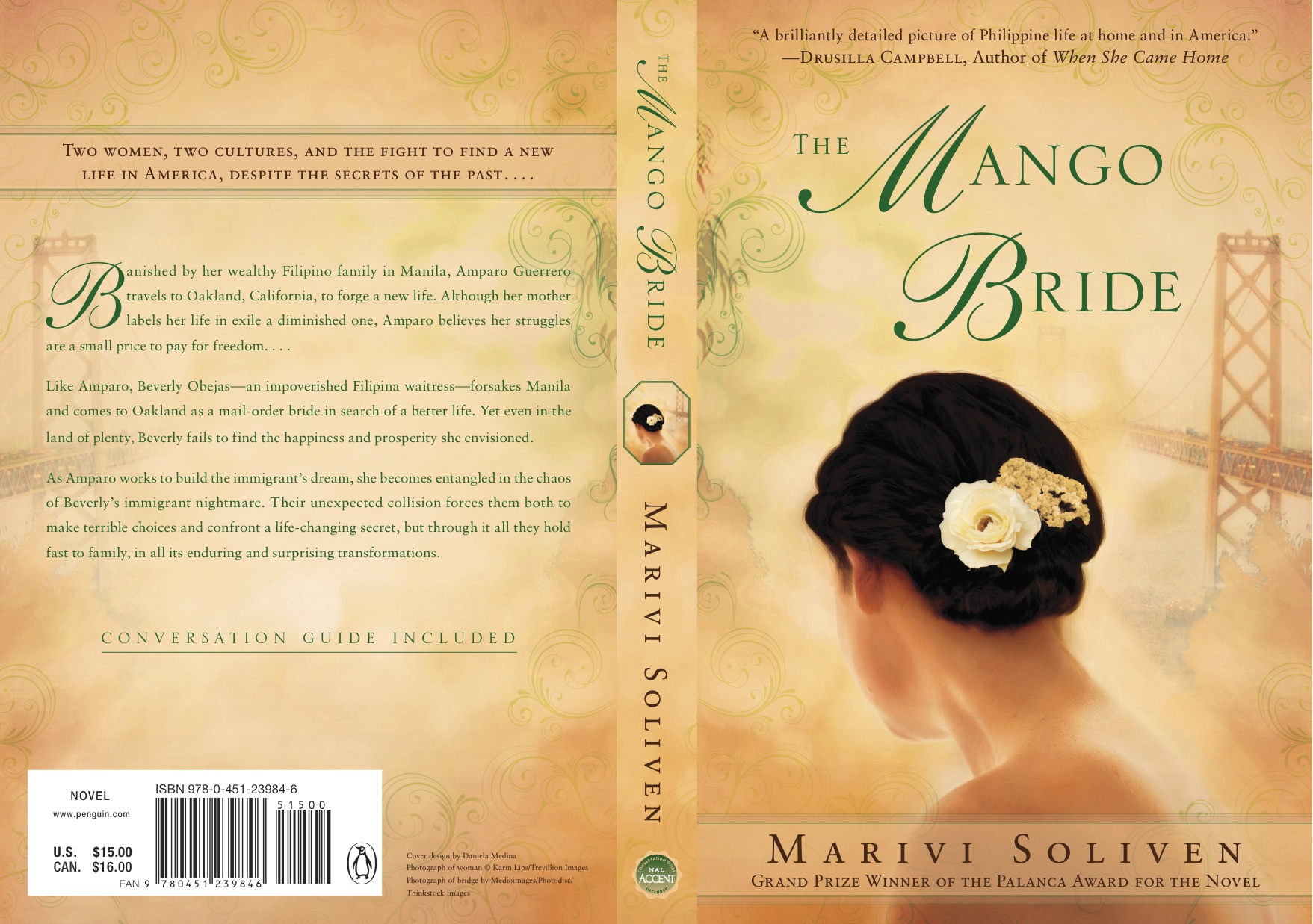
IT ISN’T every day or even every year that a Filipino author gets published by Penguin Books—I can think of only Jose Rizal, Jose Garcia Villa, Jessica Hagedorn, and Miguel Syjuco, off the top of my head—so when Marivi Soliven told me a couple of years ago that her new novel The Mango Bride (New York: NAL Accent, 2013) had been picked up by a division of Penguin, I immediately sent her a congratulatory note. But I didn’t realize the extent of Marivi’s achievement until I received a copy of the published book and read the novel in a mad dash to the ending.

Again, that doesn’t happen to me very often; given my crushing workload, it usually takes me weeks and even months to finish a new book, which is why I habitually decline invitations to do book reviews, not wanting to keep the authors and publishers waiting interminably. But Marivi’s case was different, because I was reading the book not as a beetle-browed critic, but as a mentor and a friend; as it happened, Marivi—whose husband John Blanco teaches literature at the University of California in San Diego, where they’ve been living for many years now—was also my daughter Demi’s English teacher in UP, and since Demi herself moved to San Diego, we’ve all kept in pretty close touch.

All this chumminess and this moving around has a point, and it’s directly related to The Mango Bride, which deals with the powerful tides, both social and personal, that continue to deliver many thousands of our countrymen to America. It tracks two Filipino women—the to-the-manor-born Amparo Guerrero, who gets banished to Oakland following an unwanted pregnancy that threatens to bring shame and scandal on her family, and Beverly Obejas, a plucky girl who also ends up in Oakland following the well-traveled path of the mail-order bride.

There is, of course, more in common between these two women than meets the eye, and it will hardly be a spoiler to say that their trajectories will cross. The task of the novel’s plot is to bring these two seemingly very different characters together—Amparo is a carefree college coed, while the orphaned Beverly works as a waitress—and when they do, toward the novel’s explosive climax, the author completes a narrative coup, with both dramatic inevitability and irony.

But more than a story of individuals, The Mango Bride is also a story of Filipino families rich and poor, which is to say that it presents Philippine society as an unfolding telenovela—bitchy matrons, philandering patriarchs, wayward sons, gay go-betweens, suffering servants, and all. This is, unabashedly, the source of the novel’s power, its appreciation of life in its broad, harsh strokes.

But unlike a telenovela, Soliven’s masterful prose lends the novel a fineness of detail that extends the pleasure of reading beyond mere plot and character into language. Here’s how she presents Amparo’s first experience of sex (as novelists know, a sex scene is always one of the hardest things to do well, and do freshly): “If there was something Amparo learned that first night, it was that the rhythm of passion was deeply satisfying for its simple circularity. Mouths making pillows of opposing lips, the call and response of interlocking sighs, a passel of caresses, cascading one into the other as waves folding into sea foam. Afterward, they gathered the thin sheets about them and curled into each other, chin to chin, chest to breast, dozing twins in a cotton womb.”

There’s a brilliant scene where Amparo tries to tell her boyfriend Mateo that he’s gotten her pregnant, but an elephant—literally—strides into the picture, having escaped from a circus and running red lights all the way down EDSA. It’s unexpected pay-offs like this that keep lifting the novel above the pedestrian, that remind us of an important literary talent at work, one with an unfailing feel for her material, whether we’re in Forbes Park or North Cemetery or a grocery in Oakland.

There will, I expect, be some complaining over the coincidences that mark the plot, but even here the improbable seems fated, precisely because of the novel’s implicit message: that we are closer to each other than we think, and might do well to acknowledge and accept that closeness while we can.

Marivi says that she began the novel in 2008 in the frenzy of NaNoWriMo (National Novel Writing Month—November, to most people) and completed it two years later. It won the Grand Prize for the Novel in the 2011 Palancas, but was extensively revised by Marivi for international publication.

If you want to buy the book and see if you can share my enthusiasm, it’s available at National Bookstore. But here’s the best part: if you want to meet Marivi herself and get her to sign your copy for you, she’ll be in town very soon for a series of readings and talks, thanks to NBS, which is sponsoring her visit.

She’ll be spending an afternoon with us in UP Diliman on Wednesday, August 7, from 2:30 to 4 pm at CM Recto Hall. The UP Institute of Creative Writing and the Department of English and Comparative Literature will co-sponsor the event, which is open to all. See you there!

SPEAKING OF new books, I was happy to have attended the recent launch of a rather unusual book—unusual because it’s a bilingual Spanish-English edition—titled La Oveja de Nathan (Nathan’s Sheep), by the late novelist Antonio M. Abad. Translated into English by Lourdes Castrillo Brillantes (a professor of Spanish at UP, and the lovely wife of our friend and literary kuya Greg Brillantes), the novel won the Premio Zobel in 1928, and was being published for the first time.

The Premio Zobel was initiated by the pioneering businessman Enrique Zobel de Ayala in 1920 to preserve the linguistic and cultural heritage of Spanish in the Philippines in the face of what Nick Joaquin would have called unbridled sajonismo. The Philippines and Filipinos had imbibed English like it was God’s own drink, and bold measures had to be taken to ensure the survival of Spanish in the new American age. Over the next many decades, the Premio Zobel did just that, and more, granting recognition to the best literary works written by Filipinos in Spanish, as well as the most valuable cultural contributions made by Filipinos to the cause of hispanidad.

Abad’s novel was one of the earliest winners of the prize (which Prof. Brillantes herself would later win), and its present publication by the Premio Zobel Collection, the Filipinas Heritage Library, and Georgina Padilla y Zobel (Enrique’s granddaughter) could not be more timely, as it deals with Filipinos caught between powerful political forces.

I’d have to admit that Sra. Georgina’s thoughtfulness in sending over an invitation to my house, with my name and address hand-lettered with a fountain pen, was what convinced me to drive across town in rush-hour traffic to catch the launch. Of course, the late author’s son, the poet Jimmy Abad, is also a dear friend, and Jimmy’s moving poetic tribute to his father’s legacy (delivered, in customary Jimmy Abad fashion, straight from memory) was well worth the excursion.

Penman No. 55: A Foray into Fantasy

TresePenman for Monday, July 15, 2013

WE HAD an interesting discussion in my graduate Fiction Workshop class the other week about fantasy.  I’d asked my students to do an exercise—a short piece of fiction with which they could introduce themselves and their work to the rest of the class at the start of the semester—and one of them had chosen to do fantasy. It was a very well written piece, to be sure, about a child who meets an elfin spirit in a tree in their backyard, but I wanted to push the limits of our appreciation of fantasy, if we were going there at all, so I didn’t let it go at that, and raised a few questions and possibilities.

As my students and readers know, I’m a hardcore realist myself in my own fiction, operating on the notion that there are enough mysteries and wonders to be found and explored in everyday life to have to invent more. That doesn’t mean I can’t or don’t appreciate fantasy, or science fiction, which I’ve enjoyed since grade school. Like most readers, I like to be transported to other worlds and other possibilities, as a relief—or, let’s face it, an escape—from the tedium of the here and now.

That said, there are fantasies and there are fantasies, and just because a story’s a fantasy doesn’t mean that anything goes, or that the rules of credibility and plausibility can be thrown out the window. I suspect that readers of fantasy can be just as discerning and demanding as readers of realist fare; they may even be so familiar with the genre and its conventions that they will be ultrasensitive to any radical departure, good or bad, and will feel grievously shortchanged if their expectations aren’t met. Freshness of treatment and insight is key. Fantasy stories that just repeat what’s been said and done before will fail to excite the reader, who’s always demanding something new and different.

So what, to my mind, is a superior fantasy? I’m going to give an answer that will sound a little strange: it’s fantasy that’s premised on the familiar, but takes off into parts unknown, if only again to reflect back on the familiar, or what we thought we knew. In other words, fantasy is ultimately not about complete detachment from reality, but rather the defamiliarization of reality. I’m sure that more sophisticated theorists out there have made pretty much the same point (theory isn’t my strong suit, and I’d much rather reason my way through a problem), but it’s really quite simple: by taking a step back from reality and looking at it from a distance, we notice fresh things about that we would have missed up close. Fantasy provides that distance, even a certain distortion that emphasizes some previously obscure aspects of a picture or a situation over others.

Like I said, I haven’t written much fantasy—the most fanciful story I wrote, back in 1978 (when our daughter Demi was four, thinking that she would read and appreciate it when she turned 12) was a pseudo-historical tale titled “The Mirror,” set in pre-Hispanic Philippines, about the arrival of the first mirror to our shores. I had fun doing that, so I can see how liberating this kind of exercise can be for writers who feel stifled by having to deal with what’s right before them. Reality can be claustrophobic, especially when it’s dark and narrow, as it often seems to be.

But if I were to write fantasy again—and this was what I advised my young student to do—I would play with the possibility of taking off from somewhere unexpected, some place or some point that doesn’t have the word “fantasy” twinkling above it in stardusted letters.

I’m fascinated, for example, by what would happen if our authors tried to fuse freewheeling fantasy with grungy realism, employing our most familiar and even our most sordid realities as a launching pad for a journey to the surreal and the irreal. Of course, like most things in art and literature, this has been done before by many fantasists and fabulists. As I suggested earlier, the best way to lie is to begin with the seeming truth, instead of a flagrant falsehood. (One great example of this approach is the graphic story contributed by Budjette Tan and Kajo Baldisimo to our Manila Noir book—which had a very successful launch at NBS Glorietta last July 6, by the way—which begins with a series of gruesome murders on the MRT and turns into a supernatural detective story.)

The imperative of this fusion is at its most urgent in our society, ridden as it is with poverty, violence, and corruption, and yet also uplifted and ennobled by the Filipino’s deep spirituality and by our unyielding imagination. I proposed to my students that in a society such as ours, even fantasy has a social function: not necessarily as an escape, but as a means with which—even briefly—to distance ourselves from our pains and to look at them without hurting too much, so we could deal with them better upon our inevitable return. For us, the most ambitious and the most meaningful fantasy will take our stark social realities into account: you can’t set great fantasy in Tagaytay Highlands, because living there is already a fantasy for most Filipinos; you’d be jumping off a very low platform if you did that.

I threw this impromptu suggestion into the discussion: instead of locating the encounter with the duende or the benign spirit in a backyard that already seems magical (nature—trees, waterfalls, caves, and such—is very often used as an entry point to the other world), why not set it somewhere you least expect a duende to appear (a place “most hostile to romance,” as Joyce put it in “Araby”)?

Think, for example, of a suburban bank branch full of people, toward closing time. A father, a mother, and their young daughter are there, because the dad needs to withdraw some cash to make a down payment on a second-hand car they’d been saving up for. The mom chats with the girl and fixes her ribbons while the dad does his business at the counter. It’s a pleasant day, and soft music plays in the background. Suddenly masked men barge into the bank and announce a holdup. A robber scoops up the dad’s money, but he begins to say something, and gunshots fill the air. (At this point, we don’t know yet if the father has been shot, or if the guards have opened fire.) The little girl is in utter terror, shaking in the iron grip of her screaming mother. At this point, the duende appears, suspending time, and maybe even the trajectories of bullets.

Unlikely? Of course. Corny? Could be. But it’s certainly less predictable than a leafy bower, or a cloud on a hilltop.

Again, I’m a hardcore realist, but I’d be the last to say that our people don’t need fantasy. We most certainly do, especially our poorest children, who’ve been battered and savaged by the realities of life, working in the streets or in some sweatshop when they should be in school, reading books and singing songs. They need fantasy to reclaim their sense of wonder, to see beyond the rust and grime and filth of their surroundings; they can be sustained and delivered not so much by fairy godmothers as by their imagination, which always offers hope.


FROM MY friend Jane Camens, the busybody behind the Asia Pacific Writers and Translators Association (APWriters), comes this message about a call for submissions to an international anthology of flash fiction—the term in vogue for very short stories (also called “short shorts” or “sudden fiction”). Flash Fiction International, to be published by W.W. Norton of New York, is seeking stories from anywhere in the world—especially the Asia Pacific. Jane says that “the stories should be under 750 words, in English translation or original English. Previously published work (within the last 10 years or so) is preferred. But new manuscripts are also considered. Submissions may be sent by email with attachment to Robert Shapard at his email rshapard@hawaii.edu . The submissions deadline is August 15. Submission limit is three stories.” Be so advised!

(Trese image from tumblr.com)


Penman No. 54: Calling All Filipino Writers

APWTPenman for Monday, July 8, 2013

I’LL BEGIN with a sheepish apology (and a word of thanks) this week, for a stupid mistake I made in my piece about hats a couple of weeks ago. I was in the car on my way to a meeting in Makati last Wednesday when I realized to my great horror that I’d written something very wrong, and resolved to fix the problem in the blog version of my column at www.penmanila.ph, but of course, before I could do that, an alert reader named “Nestie U” caught the error and pointed it out to me. I’d written that “felt” meant “mashed leather pulp,” but it’s certainly not—it’s wool, not leather. It probably won’t mean much to most people, but if we self-proclaimed wordmeisters don’t get finicky about words and what they mean exactly, then who else is going to care? Many thanks again, Nestie, for reminding me of what a confused and forgetful fellow I could be, sometimes.


THIS IS going to be a week of announcements, not because I’m too lazy to write a properly thought-out column—you know how I can go on and on about my pet causes and peeves—but because my involvement in certain literary organizations and concerns gives me access to news and information that (given the usual space limitations) might not even make it to the literary or culture section of most newspapers. (Here in the STAR, of course, we do our best to keep you abreast of the most important and interesting goings-on in the cultural front.) So let’s get on with the literary news—these just in!

For writers, the first and most vital announcement I have to make is a call for all alumni of writers’ workshops sponsored by the National Commission for Culture and the Arts (NCCA) to take part in a tracer study being conducted by the National Committee on Literary Arts, on which I sit as a member.

Most people don’t know this, but the NCCA—the government’s funding agency for cultural programs—has been supporting most if not all of the country’s major writing workshops for almost 20 years now. Without the NCCA’s substantial support, these workshops would have been forced to shut down a long time ago, or would never have become as highly developed as they are now. The workshops enable young writers to meet both their peers and their seniors, examine and affirm the writers’ talent, and initiate them into a community that can help sustain their productivity for life.

The UP workshop, for example, has been held every year for almost half a century, and while we now take only 12 fellows a year, we used to have more, so if you average everything at about 20 fellows per batch, we would have produced almost 1,000 alumni fellows since the beginning. Add to these the fellows who’ve gone to the Silliman, Iligan, Iyas (La Salle Bacolod), and other NCCA-supported workshops in the regions.

Like any other government agency, the NCCA has to be publicly accountable for how it spends the people’s money, so we at the NCLA thought of initiating a tracer study to see exactly how these workshops have helped our writers in their careers—say, in terms of books written and published and awards won for their work, among other criteria.

We’ve asked Dr. Christine Godinez-Ortega of MSU-IIT to be the project leader for the first phase of this project, and Christine and her team have formulated a set of questions that we’d like all workshop alumni from 1994 to 2010 to respond to. If you’ve attended and benefited from one of these workshops, please click on the link following and fill out the form.  http://www.msuiit.edu.ph/ research-extension/ncca/ tracer.php. Your response will go a long way to help sustain government support for the development of Philippine literature, as well as create a very helpful database and virtual network of all workshop alumni.

The second item on this week’s literary agenda is another call, this time for papers to submit to the “Reaching the World 2013” conference, scheduled for October 3-6, 2013 in Bangkok, Thailand. Spearheaded by the Asia-Pacific Writers and Translators Association, the conference is co-sponsored by Chulalongkorn University, the SEAWrite Award, and the Bangkok Metropolitan Administration.

Among many other Filipino writers, I’m one of the founding members of APWriters (www.apwriters.org), which has become one of the most active and viable organizations of writers and academics in the region. Last year, a formidable contingent of Filipino writers attended this conference, also in Bangkok, and our participation there left a very positive impression on the organizers and our fellow delegates, so much so that this year, I’ve been asked to head the Academic Committee that will receive proposals for papers and presentations.

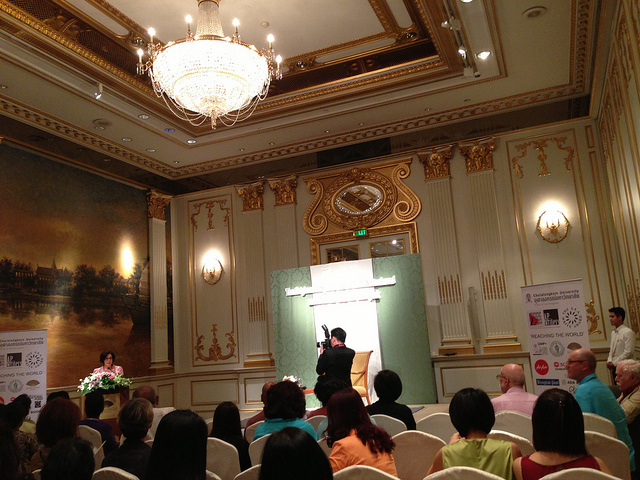
Bangkok has been named by UNESCO as the World Book Capital for 2013, which is why we’re returning there (aside from the fact that Bangkok and Thailand are worthy of visiting for food, fabulous sights, fantastic shopping, foot massages, and other pleasures anytime, given any reason or excuse). Its famed Oriental Hotel has also hosted the annual SEAWrite Award, honoring the region’s best writers. (That’s a session from last year’s conference in the pic above.)

“Reaching the World 2013” will bring together authors, literary translators, scholars, teachers of Creative Writing, publishing professionals, and others from Asia and beyond. This three-day international conference with workshops and a free public day will enable writers, readers, scholars, students, publishing industry professionals and interested members of the public to network and share their work.

APWriters is a fairly open and friendly organization, and you just have to be a writer, a translator, a teacher, or have an interest in either writing or translation to sign up. Even in the academic area of the organization and the conference, we try to remain accessible, preferring discussions on topics of broad application to obscure and highly specialized ones that only a very few can understand and appreciate.

This year, for the conference, we are inviting papers and presentations on the following subthemes: Teaching Creative Writing; Literary Translations; Cultural Identity; Food in Literature; Music/Art in Literature; Online Writing; Young Writers; Literary Fiction; Creative Nonfiction (including biography and memoir); Poetry; Genre Fiction; and other related topics. Our main focus, however, will be the teaching of writing.

To offer a presentation or longer paper with a focus on teaching and practice of creative writing, email me, Jose (“Butch”) Dalisay, Chair of AP Writers’ Academic Committee, at jdalisay@mac.com. Deadline: August 10.

To offer a presentation or longer paper on literary translation, email Eliza Vitri Handayani, Chair of AP Writers’ Translation Committee, evhandayani@gmail.com. Deadline: August 10.

If you’re teaching Creative Writing at a university which offers this discipline and would like to offer a half-day or full-day workshop, send a paragraph describing the workshop you’d like to offer along with a brief bio to AP Writers’ Board Member Xu Xi at xu.xi@cityu.edu.hk.

If you would like to read your poetry or discuss your creative writing on the panels at the public forum on Sunday, October 6, in the Bangkok Arts & Culture Centre, or if you want to launch a new book at “Reaching the World 2013,” email Jane Camens at admin@apwriters.com.

I’ve reminded the early birds who’ve already emailed me to express their interest in presenting a paper that they will have to produce a ten-minute-maximum version of their paper (and that time will include setting up PowerPoint, should they need it). I’ve noticed that here in Asia, we tend to be too respectful of each other in terms of extending time limits, which many paper presenters routinely ignore, droning on and on without compunction. Well, I’m going to pull the plug on any such miscreant (I think it’s a gross discourtesy to the next speaker and to the audience itself to speak beyond one’s allotted time), so please practice your presentation with an alarm clock before leaving home.

There’ll be a small conference fee (last year it was only USD$50 per participant) and we have no travel funding whatsoever to offer anyone, including ourselves, so save up and book a budget fare early, and see you in Bangkok in October!


Penman No. 53: Manila, femme fatale

Manila-NoirPenman for Monday, July 1, 2013

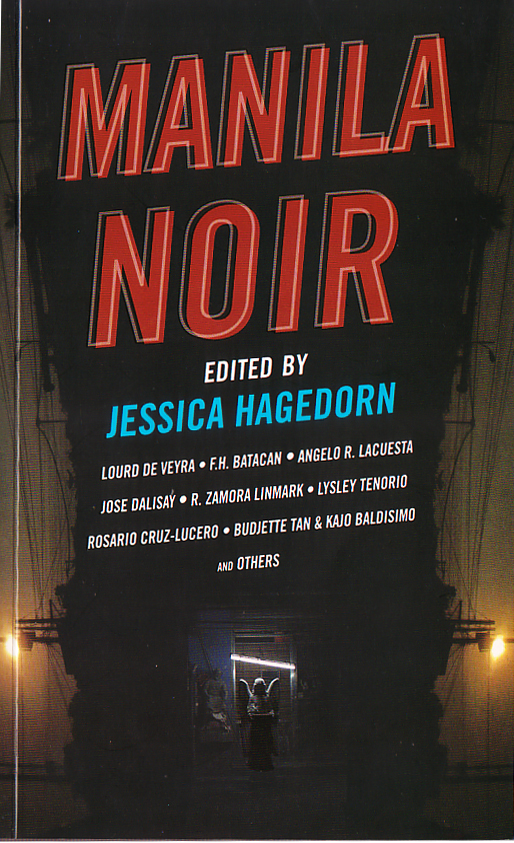
FIRST OF all, I’d like to invite my readers to the launch this coming Saturday of a unique and exciting new book, a collection of stories to which I made a modest contribution. The book’s title is Manila Noir, and it contains 14 stories written mainly by Manila-based authors, with each story focused on a specific district of the metropolis (mine, not surprisingly, was Diliman).

Edited by the accomplished Jessica Hagedorn, whose own Dogeaters made waves in international publishing in 1990, Manila Noir is the latest book in a long series published by Akashic Press—a series that includes books set in places as diverse as Chicago, Copenhagen, and Delhi. This local version (reprinted by Anvil Publishing) features pieces from Gina Apostol, Budjette Tan & Kajo Baldisimo, F.H. Batacan, Jose Dalisay Jr., Lourd de Veyra, Eric Gamalinda, Jessica Hagedorn, Angelo Lacuesta, R. Zamora Linmark, Rosario Cruz-Lucero, Sabina Murray, Jonas Vitman, Marianne Villanueva, and Lysley Tenorio.

Here’s what Publishers Weekly says about the book: “While certain cities in past Akashic volumes might appear to lack an obvious noir element, Manila (like Mexico City, which shares many of the same problems) practically defines it, as shown by the 14 selections in this excellent anthology. As Hagedorn points out in her insightful introduction, Manila is a city burdened with a violent and painful past, with a long heritage of foreign occupation. The specters of WWII (during which the city suffered from U.S. saturation bombing), and the oppressive 20-year reign of dictator Ferdinand Marcos live on in recent memory. The Filipino take on noir includes a liberal dose of the gothic and supernatural, with disappearance and loss being constants.”

As the French word for “black” suggests, noir is a mode of storytelling that dwells on the dark side of human nature, with crime as a central element or a specter hovering above the story.

In her introduction, Hagedorn herself notes that “I think of Manila as the ultimate femme fatale. Complicated and mysterious, with a tainted, painful past. She’s been invaded, plundered, raped, and pillaged, colonized for four hundred years by Spain and fifty years by the US, bombed and pretty much decimated by Japanese and American forces during an epic, month-long battle in 1945. Yet somehow, and with no thanks to the corrupt politicians, the crime syndicates, and the indifferent rich who rule the roost, Manila bounces back. The people’s ability to endure, adapt, and forgive never ceases to amaze.”

And this book, I guarantee you, will not fail to amaze. Join us—Jessica and my co-authors—for a round of brief readings, a Q&A, and a book signing session from 4 to 6 pm, July 6, at National Book Store Glorietta 1 in Makati. See you there!


IT WAS with deep sadness that I received, by text message, the news of the sudden passing of one of my dearest friends, Luverne Gueco. Luverne was also a brother in the profession, having served as foreign news editor at the Inquirer for many years. But more important to me than that, he was my kumpare, my confidante, and my partner in crime 30 years ago, when we were all in our mid-20s and romping through life like young men do. Luverne and I were part of a rather remarkable stable of writers and artists in the Economic Information Staff of the National Economic and Development Authority, a group recruited and supported by our visionary boss, Dr. Gerry Sicat.

It was a group that included former newsmen Jun Medina, Wilson Bailon, and Efren Cabrera; the now-Canada-based poet Patty Rivera; writers Fidel Rillo, Lilia Santiago, Jess Santiago, Reuel Aguila, Eric Caruncho, Joey Papa, and Minnie Quemuel; the future lawyer and now Undersecretary Rey Cruz; and let’s not forget a pretty artist named Beng, who worked with fellow artists Anna Nolasco and Herick Ventura. Not surprisingly, our immediate supervisor was himself an artist, the tenor Frankie Aseniero.

Although we were working under martial law, the NEDA then felt like a kind of Camelot, and we were all grateful for the little haven that Dr. Sicat created for long-haired, irreverent types like us (another officemate, albeit in another division, was the renowned playwright and another dear friend, the late Bienvenido “Boy” Noriega). As an ex-detainee, I failed my security clearance check, but Dr. Sicat took it upon himself to cover for me and sent me to the Development Economics program in UP to cool off for a year.

Luverne was in the thick of all this, one of the most dependable writers in the group. He had also been with the Left, and the stories he shared about what he had gone through seared themselves into my memory, so much so that I used the most painful one—about a rebel who took it upon himself to execute his wife after discovering she was an enemy spy—in my first novel, Killing Time in a Warm Place (1992).

After hours, our friendship developed in countless pool halls, beerhouses, and girlie bars (we were certainly no saints). We played pusoy, darts, and billiards with wild abandon. Luverne was a gifted pool player—this was the dawning of the age of the Pinoy pool champion, when Amang Parica was still king and young bucks like Bata Reyes and Django Bustamante were still hungry for glory. (I, on the other hand, was what the pros derisively called a “tama-bola,” a guy who could barely hit the target with the cue ball, let alone pocket it.) When Luverne married his wife Judith and became a dad, I became godfather to his son Elias. Luverne was always a motorcycle kind of guy, and had his share of bad spills, but when he went out looking for his first car, I convinced him to get the same car I already had—a VW Beetle.

Perhaps fittingly, Luverne collapsed while doing what he loved doing most—playing pool. I’m not sure if it was a stroke or a heart attack, but the end came swiftly. He was only 62.

I’m devoting all this space to the passing of someone who lived the quiet, uneventful life of a desk editor not just to mourn the loss of a friend, but also of the kind of friendship forged in the real world. Ironically, I didn’t see much of Luverne after NEDA—these past 30 years—and our last meeting was about a year ago, but there was never a moment during those decades when I wouldn’t have listed him among my six closest friends, people whom I could count on to help me in a bind, no questions asked, and to whom I would throw the same lifeline. How many people have earned your trust and affection like that?

I’m not on Facebook—one of the country’s last holdouts—for one stubborn reason: I can’t accept the Facebook definition of “friend.” To be my friend, we should have broken bread and maybe a few precious other things together; we should have rejoiced and despaired together; we should have found each other’s weakest spots, but let them be; we should have disagreed on many things, but agreed on more. On Facebook, “friendship” is a convenience, just as easily disposed of with a mouse click to “unfriend.” I’d much rather wait five years to talk to someone like Luverne and pick up where we left off as if those five years had been just yesterday.

Penman No. 51: A Kick in the Pants

Editing

Penman for Monday, June 17, 2013

MORE THAN a couple of times this past summer, in nearly all the writers’ workshops I attended as a lecturer or panelist—in Baguio, Hong Kong, Dumaguete, and Iligan—I found myself saying the same thing to some hapless fellow. I said it as nicely but as firmly as I could: “This needs a kick in the pants.”

By that I didn’t mean that the story in question deserved to be tossed into the trash bin. Workshop panelists of yore were wont to say such hurtful things, if only to watch the fellow on the hot seat squirm and burst into bitter tears, but I’d like to think that we’re long past that kind of cruelty. We do our best to be more helpful these days, and my comment was made in that benign spirit, as unfriendly as it may have sounded.

So what exactly was my beef?

It had to do with an observation I’ve often raised in this corner in respect of much of the new writing by young people that I come across in my classes and in workshops. And that’s the frustrating fact that many young writers don’t know what a real story is—a complete, fully rendered, emotionally engaging and satisfying story, the kind of story you’d like to read over and over again, and that leaves a welt on your memory for years afterward.

Here’s what I keep seeing young writers do: they’ll detail a character and a situation to bits, explaining all manner of complication besetting their hero. They can do this very well, being in possession of an English honed by TV, Hollywood, and Starbucks, an English they don’t just write but speak in everywhere they go.

But when things just begin to get really interesting—somewhere on Page 9, when something you didn’t expect looks like it’s just about to happen—the author pulls the plug and declares the story over, as if to dismiss the reader with a coy “That’s enough.” The idea seems to be that this intensely focused, microscopic investigation of a character and a problem—say, a young woman’s ironic inability to make meaningful connections to others, despite the fact that she works in a call center—is enough.

But it’s not—there’s been loads of exposition, but the story hasn’t really moved far beyond us knowing who this person and what her problem is. We’re still in the problem, which the author has worried like a bad tooth, but it hasn’t really been brought to a point of real drama—the kind of drama that gives us headaches and heart palpitations because we’re that engrossed in the conflict and its possible outcome. But how many stories written today leave you breathless like that, aching to turn the page?

Too many drafts I’ve seen resort to abrupt conclusions—premature ejaculations, if you will—because of the writer’s unwillingness or inability to take real risks with the story, indicating either a fear of the unknown (which no real writer can afford to have) or, in some cases, a lack of the kind of emotional maturity and sophistication you need to be able to navigate the dimly lit paths the human mind and heart can take. Instead of producing real dramatic substance, many young writers depend on tricks of language—on witticisms, for example, instead of wisdom—to carry the story.

And please don’t tell me they’re just trying to be “postmodern.” I know and can enjoy a good postmodern story when I see one—such as Donald Barthelme’s “The Balloon” or Dino Buzzati’s “The Falling Girl”, both of which I teach in my short story class. Postmodern stories have a very sharp edge—they need to, to gut the conventions that came before them. A poorly executed traditional story doesn’t bring it one step closer to being postmodern.

Just for the exercise, let me take up an example of the fully rendered, fully dramatized short story that I’ve been adverting to: “Paul’s Case,” written by Willa Cather in 1905. The story is set in Pittsburgh—even then already wallowing in industrial grime—where the artistically-inclined 16-year-old Paul is dreaming of bigger things, and spends his time as an usher in the theater, pretending to be bigger than who he really is. Now, many young writers would stop there in the theater scene, content to mark the irony between the glittering stage and the sooty reality of Pittsburgh outside. Not Cather: she forces Paul into a real dilemma by putting a large sum of money in his hands—money his father expects him to deposit in the bank; at this point, Paul snaps and buys a train ticket to New York City, the paradise of his fantasies. This would be Ending B for many writers, thinking that it’s enough for Paul to decide to leave Pittsburgh, come what may.

But again, not Cather: she brings Paul to New York, where he lives it up like a prince for a week, buying up clothes and treating himself to fancy meals, until the inevitable news comes that he is wanted as a fugitive and that his storybook life will soon come to an end. This should be good enough for Ending C: a long, last wistful look at New York’s dizzying opulence, then a step into an indeterminate future. But Cather goes further, not content with ambiguity: she brings Paul out to some desolate backyard out of town, where he makes a final if foolish gesture of defiance, hurling himself in front of an oncoming train, at which instant “the disturbing visions flashed into black, and Paul dropped back into the immense design of things.”

That’s what I mean by pushing the narrative to its farthest limits, subjecting the character to intense pressure, indeed to the breaking point (although Paul arguably never breaks in his composure, meeting the end with inimitable style). While I generally don’t like and discourage ending stories with the death of the protagonist (many writers use death as a convenient way out rather than thinking the problem through), here the death comes as a logical conclusion, the enactment of the final scene in Paul’s theatrical conception of himself.

Or take the case of Kerima Polotan’s 1952 classic, “The Virgin,” where the schoolmarmish Miss Mijares meets a man who—despite being beneath what she imagines to be her social station—awakens her dormant desires. Most student writers today would actually end with that encounter, with Miss Mijares getting all worked up about this handyman who can fix wooden birds. But Polotan, of course, can’t be content with just setting things up; she brings man and woman together, in a jeepney on a rainy night, and drops them off where they both don’t expect to be, until “her flesh leaped, and she recalled how his hands had looked that first day, lain tenderly on the edge of her desk and about the wooden bird (that had looked like a moving, shining dove) and she turned to him with her ruffles wet and wilted, in the dark she turned to him.”

So how do you bring a story to that memorable point?

When I tell my students that I want to give them and their stories a kick in the pants, I could be meaning one of two things:

1. As I explain above, I’d like them to push their narratives to a point beyond the visible horizon, to that “somewhere we’ve never been” that even the capable writer himself or herself will not have predicted until he or she began writing the story. (I never plot my stories beforehand; I may have a vague notion of how it will end, but I’d rather let the story itself lead me at some point, so everything remains fresh and wonderful, rather than plotted and predictable. If I can plot it, someone else can, in the same way—in which case, why even bother?)

2. I’d like them to step out of their comfort zones and immerse themselves in the cultural, social, and economic life of the nation. I suspect that this is, indeed, the deeper problem, one of cultural illiteracy and alienation: our young writers, especially those who grew up in privileged surroundings, know and may even care little about the rest of society, and therefore can’t have much to say about the world beyond their own gated villages and schools. Again I can appreciate fantasy and its attractions, but I think it’s tragic if a Filipino teenager knows more about Hogwarts than Cubao. The challenge I pose to my young spec-fic writers is to bring Hogwarts to Cubao, to find the extraordinary in the seemingly ordinary.

So, all together now: raise the stakes, and push the narrative! Bring us somewhere we’ve never been!