Penman No. 34: The Loneliness of the Long-Distance Writer

Foundation U

Penman for Monday, February 18, 2013

ONE OF the good things about holding the annual Taboan Philippine Writers Festival around the country and outside of Manila is the opportunity it provides to introduce us to writers whom we might otherwise have never known or heard about. Earlier this month, more than 40 writers from all over the archipelago gathered in Dumaguete, many of them meeting one another for the first time.

As I’ve noted on other occasions, writing is one of the loneliest professions; you’ll realize that when you’re working on a novel or a column like this one at 3 in the morning and all you have for company is the blinking cursor. Last week I wrote about the cliquism or the clannishness that our writing community has been accused of—not without reason. The truth is, like it or not, our best friends are often fellow writers, whom we count on for personal and professional support, since there’s hardly anyone or anything else out there to fall back on.

I think that’s entirely human—and, in our case, also entirely social, given how (despite this talk of a literary “elite”), we as a community are marginalized in the national mainstream. We may argue among ourselves, but on the whole, no one out there really gives a hoot about us and what we do, whether we’re Ramon Magsaysay awardees or some indie upstart trying to publish his or her first novel. So we close ranks, and find comfort in each other’s misery.

A big writers’ festival like Taboan goes a long way toward diminishing the writer’s loneliness, especially that of the writer working from the country’s geographical and political fringe—he or she can be lonely, yes, but certainly not alone.

Sometimes those connections to other writers cut across not space, but time. I was especially glad to have come to Dumaguete because of one session that—against all my expectations, for a Saturday morning that I would was itching to spend on the beach or on an airy hilltop—proved to be one of the most uplifting I’d attended in ages. It was uplifting not because the subject was a happy one—it was a gifted poet who, some suggested, may have killed himself at the age of 38—but because I discovered another Filipino writer whose luminous talent outlived him, not only in his books but in the inspiration that he provided others.

The writer in question was Artemio Tadena (1939-1977), and the session was held in Dumaguete’s small but picturesque Foundation University, Tadena’s alma mater. To be perfectly honest, not knowing Tadena or his work, we attended the session more out of a sense of duty than anything, but were rewarded by a brilliant discussion of a poet’s life and influence.

It was Myrna Peña Reyes, herself a fine poet and a friend of the late Artemio, who keynoted the session with a brief but moving account of Tadena’s life and work. Let me quote from that keynote:

“A high achiever with many talents, at 15, he won First Place for his water color painting representing the Philippines in an international UNICEF Contest that had gone around the world for judging.  In high school at the East Visayas School of Arts and Trade (now NORSU), he won First Place in declamation and oratorical contests, and he edited the school paper.

“At Foundation University where he earned an A.B. and a Law degree, he was English professor and English Department Head, as well as Head of the Office of Publications and Research at the time of his untimely death in 1977, the same year he also passed the Bar.  He had received the Most Outstanding Alumnus Award from Foundation in 1975.

“When we were already teaching at our respective schools, he at Foundation and I at Silliman, he would come over sometimes to the campus to look up people and to talk.  He did most of the talking, and I was a good listener.  It was always about writing and writers.  He admired Yeats and Hopkins and read Rilke and Pound and American poets like Robert Lowell and James Dickey, many others.  He favored Carlos Angeles and Edith Tiempo, among Filipino poets.

“He was a voracious reader, very well informed, and used a lot of what he gleaned from his readings in his poems.  For example, I know he didn’t speak French or Italian, but he used them in a poem or two.

“I recall borrowing books from the Library and seeing his written comments—in ink—on some pages.  He made copious marginal notes, quarreled with assertions in the book, approved of some, and left his comments as a permanent part of the book.  I recognized his distinctively beautiful cursive handwriting that he was most vain about.

“He published in national magazines and the Sands and Coral, and when the Silliman Writers Workshop was going on in the summer, he would come around to meet the writers and to go out drinking with some of the guys. Twice, he was an official Writing Fellow at the Workshop.  He was also a Fellow at the U.P. Writers Workshop held in Cebu in 1971.”

Tadena was a prodigious poet, publishing five collections of his poetry within seven years between 1968 and 1974. He won several Palanca Awards, including First Prize in 1974 for his last collection, Identities.

Sadly, hardly any of his books have survived, and although I had heard his name mentioned before, I had never really come across his work until that morning session in Foundation University. Aside from Myrna’s informative keynote, we also heard some very sharp commentary on Tadena’a poetry from two of his friends and former colleagues, the accomplished poets Cesar Ruiz Aquino and Francis Macansantos (incidentally, the same two fellows who took me in hand in the 1981 Silliman Workshop and infected me for life with their passion for poetry), who both acknowledged the older Tadena’s influence on their own work. Theirs were not fawning accolades, but sincere if sometimes critical evaluations of the craft of a poet imbued with a sense of the dramatic.

Artemio Tadena died of an asthma attack—some suggest he refused to take his medicine, although no one seems to have proof of that—in 1977, soon after he had passed the bar and while he was preparing for his first court appearance. One can only imagine what other wonders this southern light would have produced had he lived on.

I’ll close with another quotation from Myrna Peña Reyes’ keynote, describing the man’s poetry and providing a stirring example of it:

“From the poems, one senses a poet who thoroughly revels in the sound and flow of words.  In fact, one could say that he is literally drunk with words, sometimes, one feels, to excess, but the reader always feels he is reading poetry.  The same lyrical, eloquent, graceful facility and ease of expression that so impressed us in college mark the poems.  Many are moving, sharing wisdom of our human condition.

“In his writing style, Tadena was not an experimentalist.  Although his poems are complex, they are accessible.  His early models may have been the traditional British and Irish poets whose forms he borrowed (especially the sonnet), but his sensibility is modern, his style, his own.

“He is not a minimalist whose language is lean and spare, whose lines are short.  Although he has poems of regular line length, many of his poems’ lines are often long, dense, textured; his sentences compound and complex, often overflowing with clauses.  He uses the colon, semi-colon, and the dash unsparingly. For example, here is an excerpt from an early poem about a man and a woman in a tryst at a hotel, feeling very nervous about being seen:

“Although invisible eyes will always / Follow them wherever they go:  now, in noon’s bronze /Shifting for them into a haze

“Of gold where at first, enraptured / They gaze at each other; then suddenly look askance / To save nothing of this but the shared

“Absolution of each / Other’s need, each other’s fears—and what / Remorse can reach,

“And fortify, faithfully observed at first, and then / At first sight of each other woe- / fully abandoned.  Ears are clocks and / So is blood…” (In a Haze of Gold: The Other She)”

It may well be that there’s nothing lonelier than writing a poem, but nothing also assuages loneliness better than a poem.


Penman No. 33: At the Literary Table

Dumaguete

Penman for Monday, February 11, 2013

I’M HERE in Dumaguete City for Taboan, otherwise known as the Fifth Philippine Literary Festival, an annual gathering of writers from all over the archipelago, and even a few parts beyond. Dumaguete, of course, is inextricably linked with Philippine literary history as the home of the first and longest-running writers’ workshop in the country—the Silliman Writers Workshop, based in Silliman University—which explains its proud and rightful claim to be the “City of Literature.”

Scores of the country’s finest writers, especially in English, have passed through Silliman’s portals (in Silliman’s case, these are real portals, as iconic and as symbolic as the Oblation is to the University of the Philippines), thanks largely to Edith and Edilberto Tiempo, who started the workshop in 1962 after their return from the United States. I myself might not have thought of going back to school after having dropped out for ten years and of taking up fiction seriously after laboring as a playwright if it hadn’t been for the Silliman workshop, which I attended in 1981.

So holding Taboan in Dumaguete was in many ways a logical homecoming, and the fact that festival director Dr. Christine Godinez-Ortega (who now teaches at MSU-Iligan) is a Silliman alumna helped things along immensely. The university administration and the city government were very supportive, and the festival began on an appropriately celebratory note with a parade around the city on Thursday morning, led by National Artist Bienvenido Lumbera.

But it was the keynote address delivered shortly after by the Cebuano scholar and writer Dr. Resil Mojares that best reminded me why it’s important for Filipino writers and academics to go out of Manila and listen to what the rest of the nation has to say if writers are to help in achieving that sense of nationhood that’s eluded us for ages. Resil—whose level-headed scholarship and clarity of thought I’ve always admired—spoke on “The Visayas in the National Imagination” (there was some confusion about the topic, but in the end it didn’t matter).

He spoke of how complicated the writer-nation relationship can be: “A writer’s relationship to his or her country cannot be one of blind faith or easy self-love. I think there is much in what the Peruvian novelist Mario Vargas Llosa says about his relationship to his native Peru that we can recognize as our own. ‘For me,’ Llosa says, ‘Peru is a kind of incurable illness and my relationship to it is intense, harsh, and full of the violence of passion… [a relationship] more adulterous than conjugal… full of suspicion, passion, and rages.’ Yet, for all these, Llosa confesses to a ‘profound solidarity’ with the country. He says: ‘Although I have sometimes hated Peru, this hatred, in the words of the poet Cesar Vallejo, has always been steeped in tenderness.”

That relationship can get even more difficult when the writer feels like a stranger or second-class citizen in his or her own country, as a writer working outside the national center might be made to feel. This dichotomy between the “national” and “local” (or “regional”) writer has been a longstanding point of concern and conflict in Philippine literature for which there have been no easy answers. Dr. Mojares couldn’t have illustrated the problem more clearly than in this excerpt from his keynote:

“Perhaps we have to bow to the historical fact that it is where power is accumulated and concentrated that the ‘nation’ is most effectively imagined. It is where the ‘local’ ascends to the level of ‘national.’

“The literary situation today is that writers and works have to be recognized in Manila for them to acquire the status of ‘national.’ The center exercises the power to canonize and consecrate. A Cebuano writer who publishes in a ‘vernacular’ magazine with a circulation of 30,000 is merely a ‘local’ writer, while one who publishes a book of English poetry in Manila with a print run of 750 copies is ‘national.’ So effective is Manila’s consecrating power that a writer may start out in Dumaguete or Davao but Manila is where he hopes to ‘arrive.’ Dumaguete may be the ‘city of literature’ but it is not its capital.

“Some years ago, the poet-and-critic Virgilio (Rio) Almario asked me—with a hint of mischief and challenge—‘Where’s the new Cebuano poetry?’ I did not have a ready answer but assured him that there was a great deal of fresh, exciting work being done by young Cebuano poets. But Rio’s question did tell me that much of today’s Cebuano-language poetry—that circulates in manuscripts, poetry readings, small local publications, and Internet blogs—remains largely invisible outside of Cebu and Cebuanos, and that we (Cebuanos) have been remiss in defining and projecting to a wider audience what in this poetry is distinct, different, and deserving of ‘national’ attention. Yet, the encounter with Rio did remind me that indeed one has to be consecrated by readers and critics like Rio for one to acquire the status of ‘national.’ I say this without malice. Rio is a friend. But such is the politics of recognition.”

The discussion got even more lively in the plenary session following Resil’s talk, which was devoted to the topic of “Your Place at the Writers’ Table,” around the idea that while a national literature should ideally be inclusive, many writers still felt left out—not just because of the cultural and political distance between the center and the margins, but also because of the generational divide, and perhaps even of sheer snobbery on the part of “established” writers unwilling to yield ground to younger, fresher talent.

I’d meant to keep quiet and let others do the talking, but was prodded for my opinion on this “insider/outsider” argument, which I understand had been a hot topic online. Not being on Facebook, I caught on to it late, and composed a response that I circulated privately, from which I’ll quote:

Small as it is, Philippine literary society is indeed ruled in a way by cliques, barkadas, orthodoxies, and prescriptions. In some cases, these institutions and conventions may have made it difficult for new, alternative, and dissident voices to emerge and be heard.

I myself will indefensibly admit to being part of this ruling elite—I suppose by default, being the director of an institute of creative writing, a professor of literature, and a member of an NCCA committee that gives out grants. I’ve done well by the system (Silliman workshop, CW degree and MFA, Palancas, etc.) and the system, I think, has also done well by me.

But all this doesn’t mean that my mind is closed to new ideas or that I will shoot them down when I get the chance. Within the system, I have voted and even argued for writers and kinds of writing I personally don’t prefer, because I remain aware of what’s at stake, which is much larger than what I like. I have voted down my friends, denied them grants, and brought in people left out in the usual pollings , again because—as an old-time, squishy, hand-wringing liberal—I believe in fair play, imperfect as any cultural or political regime will always be.

By and large, the system works, if getting ahead the usual way is all you want: join a workshop, write like your mentors, win a few prizes, publish a book or two. But I keep reminding my students that this isn’t the only way to writing fulfillment and happiness, and that they’re free to choose other paths and listen to other gurus—but also, and again, that the alternatives won’t be easy. We all make our own choices—but we should do so with full self-awareness, mindful of the costs and benefits to ourselves and to society.

How important is writing to you? Whom or what do you write for? What do you expect to get out of writing? How do you want to be seen or remembered by others through your writing? I’ve answered all these questions for myself—the bottom line is that writing is my livelihood and profession; I’m less a romantic than a realist—but I can’t hazard an answer for others. As a member of the barkada, the best I can do is to enlarge the table and to bring others to it—if they even want to be there, in the first place; if they don’t, well, perhaps they shouldn’t mind too much if we dine in peace and enjoy each other’s company—and maybe even manage to write a good book or two on the side.

Penman No. 26: New Novelist in Town

OFW AwardPenman for Monday, Dec. 23, 2012

IT’S ALWAYS a pleasure to welcome a new novelist into our ranks, and today will be one of those happy days when we acknowledge the arrival—literally and figuratively—of a new talent in our midst, Dr. Almira Astudillo Gilles, or just Almi to her friends.

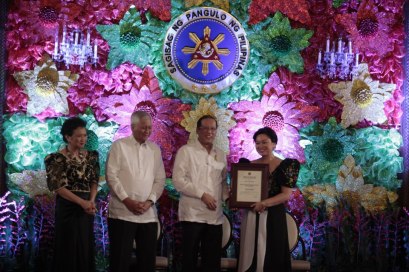
Almi flew in from Chicago as one of 29 recipients of the 2012 Presidential Awards for Filipino Individuals and Organizations Overseas, which were given out last December 5 by President Aquino at Malacañang. I had met her at the ICOPHIL conference in Michigan last September, although she had introduced herself to me by email earlier, as a fellow Filipino eager to make contact with other writers in the US and the Philippines.

Last December 9, Almi also launched her first novel, The Fires Beneath: Tales of Gold (San Francisco: Philippine American Writers and Artists, Inc., 2012), at the Ayala Museum. The novel deals with how a poor man’s discovery of ancient gold in the Philippine South changes him, his family, and his community. I haven’t finished reading the book, but I’ve been much impressed by her sharpness of eye and precision of language.

Writing about Quiapo and Binondo, for example, Gilles observes that “In Quiapo, the Golden Mosque is flanked by the Church of the Black Nazarene while the Binondo Chinese worship at Our Lady of China. On the sidewalks surrounding both places, vendors set up storefronts assembled from canvas, corrugated metal, or pieces of plywood, displaying items promising an easier spiritual journey. ‘Bypass purgatory,’ the vendors hawk. ‘Take one step closer to paradise… at a fraction of retail.’ Most believe, all pray. Both acts of nature and man cause great suffering. Metropolitan Manila lies beneath sea level and all it takes is one bad rainy season to show the inadequacy of the government’s flood control system. But the people take this all in stride. They buy both prayer beads and rubber boots.”

Since she was busy enjoying a well-deserved Christmas break with her family in the Philippines, I asked Almi to respond to a few questions I sent her by email, to map out the unlikely course she took to becoming a novelist from a professional background in the social sciences.

BD: Tell me something about yourself and your background.

AAG: I spent a few childhood years in Frankfurt, Germany where my father was assigned by the World Bank. Hence, English was the first language I learned formally. I was in premed psychology at UP Diliman and switched to AB psychology in my third year because I never intended to be a doctor and the subjects were getting harder. I graduated cum laude, and went to work for Sycip, Gorres, and Velayo (management consulting). After two years, I left for graduate school in the US, where I eventually finished a doctorate in social science, a master’s in political science, and a master’s in labor and industrial relations, all from Michigan State U. I also met my husband there, a doctoral student in economics, and got married there, on campus. My husband works in the telecommunications industry. I have a 22-year-old-son who works for Facebook and a 17-year-old daughter who’s starting college next year. I have a brother in Vancouver, Canada, and a brother and sister in the Philippines. My parents live in Manila.

BD: What started you writing?

AAG: I started writing poetry when I was about seven years old, and as I grew older I also started writing essays which were often published in the school newspaper. After graduate school, I joined the management faculty at De Paul University as adjunct professor, and taught at other area universities as well. At the same time, I had young children and my husband was traveling frequently. None of my childcare arrangements were satisfactory. After I grew dizzy and almost fainted in one of my classes (a night class for graduate MBAs), I went to see a doctor the next day and was diagnosed with hypertension, which apparently had been going on for quite a while. I then decided to quit teaching (I was teaching at campuses all over the Chicago area and would often get home around 11 at night) and try my hand at writing. My children’s book, Willie Wins, was published soon after, and I was hooked on writing. I started out writing for children since I had young ones of my own, and have published poetry, essays, short stories (one of which won a national award in the US), and plays for community theater. Now that my children are older, I thought I’d try something more adult, hence this novel.

BD: Where did the idea for this novel come from?

AAG: My friend’s sister was curator of the gold exhibit at the Ayala Museum, and she suggested I write a novel based on the discovery of the Surigao treasures. It took me about three years to finish, but I was working on other projects as well. I was fortunate that a video series of this story already existed, and I used that as reference.

I wanted the novel to reflect the tug between secularism and religiosity, and tried to delineate this struggle through my main characters (the gold discoverer and his family). Since I consider myself as a writer of the diaspora, I was careful to maintain a high level of authenticity about the Filipino experience (especially since the setting is the Philippines), while trying to appeal to American readers as well. Several chapters were workshopped at a master novel writing class led by a Northwestern University professor, and they were all white (no writer of color). While they liked the voice and style, they defined it as magical realism—a sad commentary on their knowledge of other cultures since the characters, setting, scenes were typical of a Filipino lifestyle. Some were also uncomfortable with my sentence construction (I tried to mimic the rhythms of Tagalog) but generally they liked the novel very much. In a writing workshop organization to which I belong, I’m the only Filipino writer (of English), and the only Filipino writer I know of actively publishing in the Midwest, so I feel I have to work extra hard to publicize my work and get the American readership to be more open to Filipino writing in English.

BD: What did your presidential award mean to you, and where do you go from here?

AAG: I write full time, but I guess you can say that days are filled with a lot of community organizing in addition to my writing projects. I’m very active in the Filipino American community in Chicago, and have a good working relationship with the Field Museum of Natural History. I try to promote Filipino culture whenever I can and am also invited by many schools to talk to students about multicultural writing. I’ve spoken at institutions and conferences all throughout the US, most notably at the Smithsonian Institution in Washington DC.

I’m humbled by the achievements of all the awardees—they are really exceptional people who have given so much back to the Philippines. I’m grateful that my writing has been recognized (Willie Wins is the most widely circulated Filipino American children’s book in the US, available in many schools and libraries, and is on the reading list of most multicultural publications), but I feel that a presidential awardee is obligated to continue to serve. My other passion is conservation and the environment (as president of the UP alumni group in Chicago, we raised funds for a marine study in UP Visayas), and I’m always trying to push both literacy and conservation. I’m encouraged by the feedback I get about my efforts because many have told me that I have motivated them to either write or start doing something to save the environment. I try to use the award to open doors so that I might do more, and the awards have been very effective in helping me to connect to others whom I might recruit for my cause.

AND SPEAKING of new novels, I’m awaiting an early copy of Marivi Soliven Blanco’s The Mango Bride, a comic romp through contemporary Filipino relationships, which will be released by Penguin in the US this coming April. Like Almi, the San Diego-based Marivi started out writing stories for children. Their examples should encourage more Filipinos, especially women, to make their mark in global publishing.

Penman No. 24: The Necessity for Nonfiction

NonfictionowPenman for Monday, Dec. 10, 2012

A FEW weeks ago, in Melbourne, I had the pleasure and privilege of speaking before a global audience of experts in and practitioners of nonfiction—that broad branch of writing that straddles everything from journalistic reportage, history, and philosophical essays to personal memoirs, travelogues, and cookbooks. I gave one of the four keynote addresses in that three-day-long Bedell Nonfictionow Conference; the other speakers were David Shields, on collage and appropriation; Helen Garner, on the central place of the interview in nonfiction; and Margo Jefferson, on the boundary between criticism and nonfiction. I chose to take a less technical and more social tack, and talked about why, more than ever, there’s a need for nonfiction in this age of the Internet, particularly in places off the global literary centers like the Philippines.

I wasn’t alone in representing the Philippines and its literature. Lawrence Ypil, one of our brightest young poets who’s doing a second MFA at the University of Iowa, this time for nonfiction, spoke about using family photographs to solve a mystery, and also introduced the work of Resil Mojares and Simeon Dumdum Jr. from his native Cebu. Longtime activists Bonifacio Ilagan and Marili Fernandez-Ilagan discussed the political possibilities of nonfiction in print, film, and theater; Boni also gave a comprehensive overview of recent political nonfiction from the Philippines. Their talks provoked much interest, and reminded me of just how far ahead of the curve our writing is in many ways, despite the obvious obstacles to writing in a society that doesn’t seem to value books much.

So I used my keynote as an opportunity to reintroduce contemporary Philippine literature to others, highlighting our work in nonfiction, particularly that of the late, great Nick Joaquin. Below is the full text of that 40-minute talk (because of space limitations, I was able to provide only an excerpt for the newspaper column version of this piece):

Thank you all for this great honor of having me as one of the keynote speakers for this conference, and for this opportunity to introduce another literature and another literary experience to a global audience, from which we Filipinos have been largely removed. And who, exactly, are we Filipinos? Just two days ago, a Gallup poll revealed that Filipinos were the most emotional people on the planet. We laugh and we cry with equal facility—so don’t be too surprised if this talk descends from the sublime to the ridiculous within a paragraph of each other.

This being a keynote, let me assure you that this talk will be about more than our domestic literature, and that it will connect to the greater issues of nonfiction in the world. But I have chosen to begin on a point of disconnection, from the periphery, because our vagrant experience presents some interesting possibilities for looking at how nonfiction—if not literature itself—has served self and society outside of the West.

Indeed, these past few years, I’ve traveled around various literary conferences around the world with a stock speech titled “Why You’ve Never Heard of Me,” by way of addressing the relative obscurity in which the Filipino writer has labored—even and especially in the company of our fellow Asians such as the Chinese, the Japanese, and the Indians who have understandably gained much greater international attention and prominence.

In sum, my thesis is that we Filipinos don’t write enough novels, and the novel has been the ticket to literary fame and consequence in 20th century publishing. It also hasn’t helped that, as a former colony of Spain and the United States, we are out of the Commonwealth loop. We no longer write in Spanish, and as for our writing in English—a thriving, century-old literature—the Americans (with the notable exception of Robin Hemley) don’t quite know how to receive it, despite its troubling familiarity, like the bastard child who suddenly appears at the door with an expectant smile. We also have a robust literature in our other national and regional languages, but again they hardly connect to the other native literatures of Southeast Asia, in gatherings of which the non-Bahasa-speaking Filipino has often been the odd person out.

That’s all the more strange when we consider the Filipino diaspora which—like that of the Indians, the Nigerians, and many other ambulatory nationalities—has taken our workers all over the planet. We are you maids, your nurses, your sailors, your entertainers. One-tenth of our population of over 90 million people now live and work overseas, in places as remote to us as Iceland, Angola, and Syria, providing not just the foreign remittances that keep our economy afloat but also a wealth of material for our literary imagination. Indeed it often takes the literary imagination, more than journalistic reportage, to sort out these experiences of dislocation.

But why even go abroad for alienation? If there’s anything colonialism does to the colonized, it’s to leave behind two states of mind, often manifested in two or more predominant languages, one of which represents the colonial elite. That’s American English in our case, and while it’s given us a global edge in the BPO or call-center industry—in which we now rank second, next only to India—it has produced no comparable literary dividends, with our literature in English trailing far behind India’s, and even behind translations to English from the Chinese and Japanese, in the attention of the world.

Thus we represent an insular experience. But like exotic species which—after a geological point of separation—have survived and mutated on their own in some tropical plateau or some literary Galapagos, literatures like ours can be interesting and useful objects of study, because they manifest both fundamental similarities to and striking departures from the biological mainstream. They speak back to the mainstream, as I am speaking today, and offer up a mirror—perhaps a somewhat distorted or distorting mirror—in which others can see versions of themselves.

Our insularity has resulted in some interesting courses of evolution. Given the absence of a market for novels, we have developed our strengths in poetry and the short story. Given further that there is no money to be made either in poetry or the short story—but also that these genres require little material investment—our writers have focused on producing the best art they can, rather than on satisfying a market (and there was, arguably, a market for these in our newspapers and magazines of the early 20th century, when they were part of the entertainment mainstream).

In the case of Philippine nonfiction, curiously enough, more titles have been emerging over the past 20 years—memoirs, biographies, histories, essays, travelogues, cookbooks, and motivational materials for business and religion. Most it not all of this production has been in English rather than in the national language, Filipino—not surprisingly, since books are expensive and considered non-essential items in a country still largely poor, and the people who can buy books at and for their leisure speak and write in English. (Parenthetically, this introduces another interesting element for further thought: if translating language means inevitably translating experience, what goes on in nonfiction in a foreign or borrowed, and especially a colonial, tongue? Whose stories tend to get told, and how, from what perspective?)

There has also been a perceptible rise in enrollments in courses and workshops for nonfiction, seen by many—correctly or otherwise—to be a less formidable and more accessible entry point to writing than fiction or poetry.

The rising global popularity of nonfiction is manifest in the region. A quick glance at the recent titles taken up by the Hong Kong-based Asian Review of Books will reveal a clear preponderance of nonfiction, covering such diverse topics as the undercities of Mumbai, Christianity in Communist China, the Thai monarchy, the Amritsar Massacre, the Jewish community in Shanghai, and Japanese ninjas. Not surprisingly, much of this nonfiction deals with China and India, being both the largest sources of and markets for such work. There is great interest in the West in these two countries, as well as in Japan and Korea, because their economies are umbilically tied to those of the West.

But let me go beyond money and markets, and talk about the necessity for nonfiction in less familiar and less mediagenic countries such as ours.

To state the obvious, nonfiction provides an alternative to fiction and of course to itself. In the first instance, I don’t simply mean the choice the reader faces at the bookshop at any given moment between buying a novel or a book of essays, but as a means to appreciating the truth, in which everyone is presumably interested and invested.

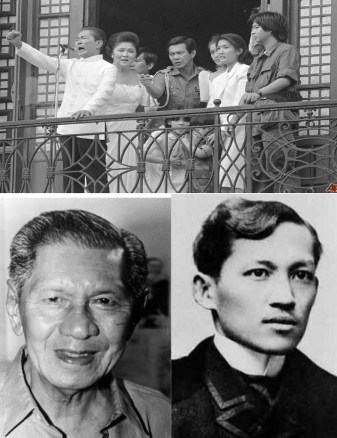
That truth can be particularly elusive in a country and society where there has been a longstanding tradition of suppressing it—in our case, the nearly two decades of the rule of Ferdinand Marcos, carrying over to his successors, one or two of whom turned out to be even more adept than Marcos in kleptocracy and in hiding the truth.

In this experience we Filipinos can hardly be alone, given the emergence and in many cases the continuing rule of autocrats, despots, and demagogues around the world, from Asia and the Middle East to Africa and Latin America. Personal accounts and testimonies are important in such places where an “official version” of events is often promoted, if not enforced.

While fiction might best capture the grotesqueness of life and the absurdity of the truth in many of these places—and I’ll get back to this later—it is nonfiction that bears the burden of presenting the facts on the ground, often at great risk to the author and even to the reader.

It was just a little over a week ago when PEN International marked the Day of the Imprisoned Writer—an issue I could personally relate to, having been imprisoned for seven months in 1973 at age 18 not for writing any earth-shaking novel but rather political flyers and such ephemera. Among those on PEN’s list of “focus cases” was Ericson Acosta, a young poet and activist who had been writing and filing reports on human rights abuses in the Philippine countryside. He has been held without trial since February last year—ironically, under the regime of President Benigno Aquino III, whose family has been canonized for its espousal of civil liberties.

The authoritarian State not only seeks to stifle the truth: it is an active and imaginative producer of fiction. In the Philippines, this was never more palpable than during the long years of martial law, from 1972 until the expulsion of the Marcoses—at least for the time being—in 1986. Let me share a few stories in this regard.

In 1964, just before he first ran for President, Marcos commissioned Hartzell Spence—an American author and editor of Yank magazine, who contributed the word “pinup” to the vocabulary—to write his biography, titled For Every Tear a Victory (later reissued as Marcos of the Philippines), of which a film version was later made. These biographies touted Marcos’ wartime heroism, for which he supposedly received 27 medals, thus becoming the most highly decorated soldier of the war on the American side. Most of these decorations were subsequently proven to be fake. Spence reported that Marcos sustained wounds from singlehandedly engaging 50 Japanese soldiers in a gun battle, a claim Newsweek later disproved. Marcos also claimed to have led a guerrilla force of more than 8,000 men, which the US Army dismissed upon investigation as “fraudulent” and “absurd.”

There was no doubt that Marcos was a brilliant fellow—he topped the bar examinations in 1939, having reviewed for the exams while in prison for allegedly shooting his father’s political enemy at night between the eyes; the young Marcos had been a sharpshooter with the ROTC, and was the natural suspect. He defended himself before the Supreme Court and was acquitted, and the legend was born. Indeed, it was easier to create and to promote the myth because the known facts in themselves seemed incredible enough.

Sometimes the myth was not about himself, but about the nation and its prehistory. In 1971, one of the biggest stories to rock the anthropological world was the discovery of the Tasaday, supposedly a Stone Age tribe that had somehow survived in the Philippine South in benign innocence, well into the 20th century. They made the cover of the National Geographic and were hailed as if Adam and Eve themselves had stepped wild-eyed out of Eden, until skeptical parties spoiled the fun by decrying the Tasaday as an elaborate hoax. As chronicled by Robin Hemley, more responsible investigation has since established that the truth very likely lay somewhere in between—that the Tasaday were neither quite that ancient nor that synthetic, but had lived largely by themselves for a long time. The Marcos government, however, felt deeply invested in validating the notion of a lost tribe, as it seemed to extend the arc of development even farther back, as if to say, “Look how far we’ve come.”

To make sure that the future got things right, in 1977, Marcos published a multivolume history of the Filipino people under his own byline, titled Tadhana, or “destiny,” for which he had actually commissioned some of the country’s most eminent historians.

To reach beyond the range of books, the Marcoses ventured into film. One of the most memorable projects I’ve ever worked on—if only because of its intentions—was an abortive film epic conceived and commissioned by Imelda Marcos, circa 1978, involving the production of a four-hour extravaganza on Philippine history from Ferdinand Magellan to Ferdinand Marcos. This was to be the Marcoses’ version of Hitler’s Triumph of the Will. But instead of having just one Leni Riefenstahl, Imelda wanted eight of the country’s top film directors and their scriptwriters to stitch the opus together, dividing four hundred years of Philippine history among themselves into a half-hour segment each.

As it was the height of martial law, there was no saying no to the Madame, and film director Lino Brocka took me along, as a 24-year-old rookie scriptwriter, to a meeting with Mrs. Marcos in a State guesthouse near the presidential palace where, over bottomless cups of coffee and increasingly crumbly cupcakes, she lectured us for at least six hours on how to make a good movie. The meeting lasted so long that we had to be issued special passes, because a 10 pm curfew was in effect, and we staggered home around 2 am. The movie was done, but for some reason was—and I should probably add thankfully—never shown and never seen in its entirety, not even by its makers. It remains one of the great mysteries of mythmaking under martial law—all those reels of footage devoted to the historical inevitability and apotheosis of Marcos, which must now lie in a warehouse somewhere in Manila and have themselves become historical relics.

But this kind of mythologizing did not begin nor end with Marcos, and it would be naïve to think that other Filipino leaders did not avail themselves of the power of fiction—or, otherwise, the power of silence.

Let me point out here quickly that while repression remains a very real threat in our society, Philippine literature and journalism are wonderfully wanton—we have no sacred cows, no taboos. We feel free to write as we please, if only because we suspect, with some justification, that the government is functionally illiterate, and doesn’t give a rat’s ass about what you say in your obscure novel or inscrutable poem. But this doesn’t mean that there’s no political backlash, when someone upstairs does read or misread your report in the newspaper, the magazine, or online.

Those genres tell us something, by the way—that, at least in the Philippines, nonfiction is a far riskier enterprise than fiction. Statistics kept by the international Committee to Protect Journalists show that 73 Filipino journalists have been killed since 1992. So far, no novelists or poets have figured on the death list.

Some of our journalists eat death threats and libel suits for breakfast. One of them has been Marites Vitug, a groundbreaking magazine editor and investigative reporter whose two books on the Philippine Supreme Court—and the shenanigans within, which culminated in the recent impeachment of the Chief Justice—have become two of the hottest nonfiction titles in town. I copyedited both books—doing the first one anonymously, asking my name to be left out of the acknowledgments—not necessarily because I feared for my life or freedom, but because I knew that the book would result in a libel suit which would be more an annoyance than anything; I had many foreign engagements lined up and a libel suit (two of which I’d already faced myself, one from the former President’s husband) would mean that I would have to secure permission from the court even to spend, say, a weekend in Hong Kong. Sure enough, Vitug got slapped with a libel suit and a death threat, which thankfully went nowhere.

But speaking of journalists, let me introduce a name that will be unfamiliar to most of you, by way of celebrating the indigenous explosion of creative nonfiction around the world.

Born in 1917, Nicomedes Marquez Joaquin, better known as Nick Joaquin, was, by popular acclamation, the greatest Filipino writer of his generation, a man who effortlessly straddled the worlds of street-level journalism and highbrow fiction. He practiced New Journalism well before the term was coined, and wrote true-crime fiction well before Truman Capote put it on the publishing map. To Nick—and to use his own words—journalism was “literature in a hurry,” and Nick Joaquin seemed to be in an awful hurry, producing an average of 50 feature articles a year, according to his biographer. He wrote these under a pseudonym that was also an anagram of his surname, Quijano de Manila. He would also write some of the most memorable Filipino short stories and plays of his time, in an English inflected with the exuberance of the Spanish he also knew and loved, but it was his unique reportage that made him accessible to a broad public. He took on all subjects—politics, crime, showbiz, and sports.

According to critic Resil Mojares, “He raised journalistic reportage to an art form. In his crime stories—for example, ‘The House on Zapote Street’ (1961) and ‘The Boy Who Wanted to Become Society’ (1961)—he deployed his narrative skills in producing gripping psychological thrillers rich in scene, incident, and character. More important, he turned what would otherwise be ordinary crime reports (e.g., a crime of passion in an unremarkable Makati suburban home or the poor boy who gets caught up in a teenage gang war) into priceless vignettes of Philippine social history.”

I’m going to read you a few short paragraphs of his prose, just to suggest his treatment of his material, and also his language:

In “Flesh and the Devil,” published in January 1962 in the Philippines Free Press, Joaquin introduced a story of white slavery by harking back to ancient mythology:

Proserpine, in classic myth the daughter of the earth mother, was kidnaped by the lord of the underworld and carried to hell. Rescued and brought back to earth, she found herself alien to its light and flowers; half of her heart had turned dark; she had eaten of hell’s pomegranates and must ever partly dwell in shadow.

The pomegranates of hell were news last week in the story of four girls who said they had escaped from hell after several months of an evil bondage; their flesh had been made merchandise. Three of the girls are 19 years old, but the fourth is a child of 15, and her name is Proserpina.

But he could be as hard-boiled as they came. In “The Mystery of the Murdered Bigamist,” published in May 1961, he reported on the discovery of a corpse:

He had been stabbed eight times in the left breast, his throat had been slashed, and he had been hit so hard in the face his left eyeball had sunk. He had been trussed up with a rope, his hands and feet bound together behind him, and he had been stripped of his wallet, watch, ring, and shoes…. In the ditch where he was found, the police found the bloodstained fragments of a letter in Pampango. The writing was almost illegible, but the signature was clear: Felino.

And always, Joaquin sets the piece in its larger context, as the enactment of an ageless drama. Reporting in 1963 on the bloody assault of a government office by private security guards gone rogue who had axed the skulls of their victims—also security guards—he would write that:

In the August 26 robbing of the Rice and Corn Administration’s main office in Manila, the security-guard culture, long a-ripening, has burst into saga and epic. The eyer is now the eyed, and the figure that has so long lurked at the edges of our consciousness has moved into the center of our attention. We stare at the symbol of our unsafeness.

Security guards were the victims, security guards were the villains… The tragedy happened within a special sphere, among an esoteric society or knighthood of men bound by their own codes, their own private rituals, a shared lore…. A couple of the invaders had been false to the code of the brotherhood and had been ousted, and returned in stealth and were let in, because they knew the secret words and rites.

Joaquin goes on to chronicle sundry acts of mayhem and mésalliance: the murder of a movie star’s delinquent son; the affair between a Filipino ambassador and a German baroness; an abortive shooting of an actor who later became President of the Philippines. Despite his many awards for his fiction and drama, he never considered journalism beneath him. In 1996, he said that “Journalism trained me never, never to feel superior to whatever I was reporting, and always, always to respect an assignment, whether it was a basketball game, or a political campaign, or a fashion show, or a murder case, or a movie-star interview.”

In 1977, his best journalistic pieces were compiled in several anthologies, under the titles Reportage on Crime, Reportage on Lovers, and Reportage on Politics, and eventually these selections grew to more than ten books; in addition, he wrote histories, almanacs, and a dozen biographies.

I brought up Nick Joaquin (who died in 2004) not just to introduce a name, but also to show that the New Journalism and creative nonfiction were laying down native roots in other parts of the world outside of the West—certainly not only in the Philippines—before we knew them by these terms. Joaquin’s Free Press pieces, which began in 1957, antedated Truman Capote’s In Cold Blood, which was published in 1966. Of course Capote never claimed to have invented the true-crime genre, and neither did Joaquin, and more thorough investigation will easily turn up far earlier examples from all around the world.

Indeed, we are often referred back to the Scotsman William Roughead, who began attending trials at age 19 and, in 1913, published the first of many collections, Twelve Scots Trials, which he called “adventures in criminal biography.” It’s instructive that Roughead lamented his publisher’s choice of that title, which he thought was too dry. He said that “Trials suggested to the lay mind either the bloomless technicalities of law reports or the raw and ribald obscenities of the baser press.”) You’ll note that in this desire to eschew “bloomless technicalities” and “raw and ribald obscenities” lies the fundamental impulse for creative nonfiction.

The highest crimes, of course, are often perpetrated by the State, and this again is where the greatest value of nonfiction lies, in unraveling the truth where the outcome could affect the lives and fortunes of millions. Sometimes the most significant outcomes are no more immediate and practical than an understanding of the past, especially when alternative histories face off against each other.

This is where nonfiction competes against itself, one version versus another. We often speak of nonfiction in the same breath that we say “the truth,” as if nonfiction and the truth were interchangeable, but this is something that everyone in this conference should know cannot always be so. Nonfiction is, in a sense, a process rather than a product, a way to establishing certain verities most of us can accept or agree with or recognize, albeit with some resistance.

Most notably, nonfiction is an arena for competing histories or interpretations of history. This again is particularly important where the formation of a people’s self-image is involved, especially in a colonial or postcolonial context.

Traditional historians, for example, have viewed and represented the uprisings of poor peasants in the Philippines as the epileptic seizures of cultist fanatics, rather than legitimate and inevitable revolts of the feudal oppressed. The communist guerrillas who fought the Japanese in the Second World War and struggled on against the American-supported postwar regime—much like the Vietnamese resistance—were presented as power-hungry troublemakers and stooges of the Soviet Union and Red China, disregarding their deep nationalist and anti-imperialist orientation.

These histories and their alternatives continue to be written in my country and, I’m sure, in yours. In my own nonfictional work, I’d like to think that I’ve contributed to this conversation through the biographies and institutional histories that I’ve been writing, about which I’ll say more in this afternoon’s panel discussion on nonfiction from the Philippines. Nonfiction is even more essential in this age of Facebook and Twitter, when every event is deemed newsworthy within five seconds of its occurrence, for even the worst—or some would say the best—of gonzo journalism bears some of the composure and the composition of art.

Nevertheless, the argument can always be made that sometimes the best response to fact is fiction—not the fiction of the State, but the fiction that emanates from deep within the individual’s heart and conscience, bodied forth by the free imagination. Fiction—especially the kind of realist, pre-postmodern fiction that still predominates in Asia—is relentless in its effort to make sense of events and of the characters who impel them. Our narratives tend to be straightforward, transparent or at least translucent rather than opaque, trading cleverness of presentation and virtuosity of language for what is seen—or hoped to be seen—as honest, heartfelt storytelling, the object of which is the understanding of character and the improvement of community.

Our national hero Jose Rizal was an excellent polemicist who scored the abuses and effects of Spanish colonial rule in one essay after another—but it was his two novels from the 1880s, Noli Me Tangere and El Filibusterismo, that captured both the obviousness of the need for some kind of revolutionary action and yet also the complexity and difficulty of making this choice. His farewell poem, supposedly written in his prison cell on the eve of his execution by firing squad, is impressed in the national consciousness.

Under martial law, when our presses were shut down and all the newspapers and magazines were producing hosannas, it was poetry, fiction, and drama that took up the fight—slyly, stealthily, employing such disguises and devices as we knew would escape the regime’s eyes and yet catch the public’s. In 1983, when Sen. Ninoy Aquino returned from exile in the US, only to be gunned down by an assassin at the airport—thereby precipitating a chain of events that would ultimately lead to Marcos’ downfall and departure—my reaction was to write not an essay, but a novella set in 1883, with a revolutionary agent returning from Hong Kong being assassinated on his homebound voyage.

I’ve also written a novel about those years, about growing up under Marcos and about our complicity in the whole project; but one of these days I’d like to embark on my dream project, which is an oral history of our martial-law experience through the eyes of various protagonists from all the sectors involved—the resistance, the government, the military, the businessmen, the citizens.

And then perhaps we will understand why, 40 years after they virtually proclaimed themselves rulers for life over one of the happiest and yet also the most dolorous people on the earth, and even long after the downfall and the death of their patriarch in 1989, the Marcos family remains staunchly embedded in our political firmament, with Imelda Marcos in Congress, her daughter Imee in the governor’s mansion, and her son Ferdinand Marcos Jr., now a senator, being groomed for the presidency. It was as if martial law never happened—and to many Filipinos, especially the young, it never did.

Simply put, the full story of this most traumatic episode in our modern history has yet to be told. Most of us never knew what happened behind the barbed wire; most of us never understood that the prison began well before the barbed wire, and extended into our homes and our subconscious. We cannot remember what we never knew, and we can never learn from what we cannot remember.

And this, ultimately, is the necessity for nonfiction—whether it comes in the form of personal memoir or national history, of comic musing or tragic reflection, of travelogue or cookbook, of political polemic or erotic encounter: it constrains us to confront the tangible world, reminds us of our vulnerable, mutable, insurgent physicality, and connects us to a shared past, present, and future. Today it connects me to you and our literature to yours, for which opportunity I once again am deeply grateful.

Penman No. 22: A Feast of Festivals

MILF3

Penman for Monday, Nov. 26, 2012

WHETHER BY design or sheer coincidence, November is turning out to be a kind of Literary Arts Month for the Asia-Pacific region, with a plenitude of literary festivals and conferences being held one after the other over the last four weeks.

First off—as I reported on last week—was the Reaching the World Summit held Nov. 5-9 in Bangkok, Thailand, under the auspices of the Asia-Pacific Writers and Translators Association and in conjunction with the SEAWrite Awards, in itself a major regional literary event. Going on at the same time, from Nov. 2 to 11, was the Singapore Writers Festival, featuring Michael Cunningham of The Hours as this year’s big name, backstopped among others by Marina Mahathir, a feisty political commentator who just happens to be the daughter of Malaysia’s famous PM.

And then, from Nov. 14 to 16, we had our own third edition of the Manila International Literary Festival, billed this year as “Read Lit District.” It was put together as usual by the inimitable and irreplaceable Andrea Pasion-Flores and the National Book Development Board, with the generous support of the Ayala Foundation, among other sponsors. And finally, the world’s biggest gathering devoted to nonfiction—the 2012 Bedell Nonfictionow Conference, with several hundred attendees expected—took place just last week from Nov. 21 to 24 in Melbourne, Australia.

I am, in fact, writing this in Melbourne as I await the opening of Nonfictionow, where I’ve been privileged to be asked to deliver one of the four keynote addresses. You’ll get a report from me very soon on how this conference turned out—and why, as I suggest in my keynote, there’s an even greater necessity for good nonfiction in this age of Facebook and Twitter, when almost any event is deemed newsworthy five seconds after its occurrence. More on this in the coming weeks.

Right now I’d like to focus on the MILF (something about that acronym keeps distracting me, and it has nothing to do with southern secessionists), the youngest of its kind in the region and perhaps necessarily the most modest, compared to its long-running forebears in Hong Kong, Shanghai, Sydney, Singapore, Bali, and Jaipur, among other places. But even at age three, it’s already shown both strength and precociousness, and the ability to attract both big-name writers and SRO audiences—many members of whom pay quite a bit of money just to listen—over its three-day run.

I’d have to admit that years ago, when Andrea first mentioned the NBDB’s plans to start an international literary festival in Manila, I was less than convinced that we could pull it off, having been spoiled rotten by the many others I’d attended abroad. How were we going to bring in world-class international authors? How many locals would turn up? Where were we going to hold the event?

As it turned out, all my misgivings went for naught. Practically since the beginning, the MILF has been a resounding success, attracting the likes of Pulitzer prizewinners Junot Diaz and Edward Jones last year and prizewinning Nigerian poet and novelist Christopher Abani this year, as well as international literary agents and editors, not to mention the usual suspects from the local literary community.

This time around, I sat on two panels—one on “Making the First Page Count” with New York-based author Tim Tomlinson and Soho Press senior editor Juliet Grames, and another with Chris Abani on “The Writer’s Demons.” Both sessions proved deeply instructive even for me, reinforcing the value of encounters like this even among old pros—just when you think you’ve heard everything, you haven’t.

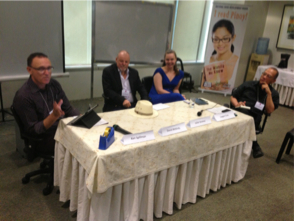
Most instructive of all was a session I attended on literary editing, featuring the prolific and versatile Australian author-editor Ken Spillman, the Hong Kong-based poet and editor David McKirdy, and again Juliet Grames. The session drew a full house—and a good thing it did, because literary editing remains a great unknown to most Filipino authors and publishers, leaving us with unpolished texts if unbruised egos. (Since Soledad’s Sister was picked up by an agent some years ago and subsequently by publishers and translators in Italy and France, aside from a US edition, I’ve had the good fortune—and the humbling experience—of dealing with literary editors, whose comments and suggestions proved insightful and helpful. No pain, no gain.) Here are some outtakes from what they said:

Ken Spillman: “The best writers respond well to criticism…. In my hands, on the average, the manuscript would be reduced by 10 percent…. I see editing as a partnership, helping the book become the best book it can be…. (In a good book) I suspect a lot of hard work has gone on behind the scenes but it is never evident in the reading.”

David McKirdy: “Don’t send a publisher something that’s neither fish nor fowl, and therefore unmarketable—like a combined collection of poems and prose. You should have a clear conception of your work. Don’t try to put lots of different things together—it doesn’t work.”

Juliet Grames, being the most experienced editor of the three, gave the longest and most novel presentation, beginning with the confession that she started off as a writer when she entered the publishing industry, thinking that she could learn the secrets of the trade from within, but soon found her calling as an editor. “Midwifery might be more for you than motherhood,” she said. Her first editing job was no earth-shaking novel—“It was No More Kidney Stones, revised edition,” she said with a wry smile—but it led to many others, and also impressed upon her the importance of the variety of projects a publisher undertakes. “Crime fiction supports the literary fiction that we publish,” she added.

Then like a teacher, she stood up and drew a series of Venn diagrams on the whiteboard: a set of diagrams each for readers, writers, and publishers. (If you’ll recall your high school math, Venn diagrams have to do with circles or sets and their intersections.)

Juliet explained: “For the reader, the three circles to consider are language, or words; story; and morals, issues, or topics. Readers read for these reasons, and my dream book would have all three.” For writers, it was passion, money, and message; for publishers, it was money, cachet, and ideology. Her final bit of advice resonated well with the audience: “Find yourself in these diagrams, and find and approach the right publisher.”

We are, of course, still a long way in the Philippines from having a passel of publishers to choose from, but then again the purpose of an international literary festival is precisely to remind our authors to expand their horizons beyond the local scene. With the right novel or nonfiction opus in hand, we might yet break into the global market of readers as have the Chinese and the Indians, and put Philippine writing squarely on the world’s literary map.

Penman No. 21: Literary Networking in Bangkok

Penman for Monday, November 19, 2012

BENG AND I had hardly stepped off the plane from weather-beaten New York when we were off again to sunny Bangkok, this time to attend a conference of writers and translators from all over Asia and the Pacific. I asked Beng to come along because we hadn’t visited Bangkok in a few years and had always enjoyed the place. Here, again, we were helped by the fact that our unica hija Demi works in the hotel industry, and she was able to find us a nice place in Sukhumvit—the Aloft, Bangkok’s iteration of a global chain of smart boutique hotels. More on the Aloft in a bit.

I was there to take part in “Reaching the World,” billed as Bangkok’s first international literary showcase, under the auspices of the Asia Pacific Writers and Translators Association (AP Writers for short) and the South East Asian Writers (SEAWrite) Award, hosted by the Faculty of Arts of Chulalongkorn University. I sat on the 2010-2012 board of AP Writers with fellow Filipino professor and STAR columnist Isagani Cruz, who served as its chairman.

A sizeable delegation represented the Philippine literary community in Bangkok, aside from Gani and myself: writer and scholar Cristina Pantoja-Hidalgo, who now divides her time between UP and UST; UP English department chair and Southeast Asian literature expert Lily Rose Tope; poet and UP professor Isabel Mooney; fictionist and UP Mindanao professor Jhoanna Cruz; poet and DLSU professor Dinah Roma; essayist and UP professor Jeena Rani Marquez; and UST literature professor Timothy Sanchez. Novelist Charlson Ong, this year’s SEAWrite awardee from the Philippines, joined the Bangkok conference in its last couple of days, coming from the Singapore Writers Festival which I had attended last year.

AP Writers emerged out of an earlier organization, the Asia-Pacific Writing Partnership founded by Jane Camens who had also helped establish the Hong Kong International Literary Festival. Jane, an Australian writer who has lived, studied and worked in the US, the UK, China, Macau, and Hong Kong, has been an indefatigable spirit bringing writers from all corners of the region together, and she will now serve as AP Writers’ general manager. The Sri Lankan-born but Hong Kong-based humorist and essayist Nury Vittachi will serve as AP Writers’ new chairman, backstopped by the Chinese-Indonesian-American fictionist Xu Xi, who runs the MFA low-residency program at the City University of Hong Kong, and by the translator Shirley Young-Eun Lee, who has roots in Korea but who read Classics and Persian at Oxford.

As you can see from just that small corner of the organization’s membership roster, AP Writers is both as regional and as global as you can get. This reflects an increasingly obvious fact in today’s literary world: international and inter-cultural exposure has become vital for writers, to expand both their perspectives and their networks. By “network” we mean here that web of connections that emanates from the writer and his or her work to the other people involved in the process of literary production and dissemination—agents, editors, translators, publishers, critics, booksellers, critics, reviewers, teachers, researchers, and, of course, students and general readers.

This year, in Bangkok, AP Writers paid special attention (and gave formal recognition, in its full name) to a vital but largely neglected member of that network, the translator. A literary work can’t be read beyond its original market unless it’s translated into another language, and that requires the skills of a very small group of specialists around the world. Literary translation isn’t just the kind of word-for-word interpretation you might get from a software program or even a live person—it involves the understanding and translation of one culture into another, the conveyance of nuances that, paradoxically, will never be perfect but will achieve interesting effects of its own. (I’m reminded of a quote attributed to Salman Rushdie, about the most interesting words of a language being the untranslatable ones.) In Bangkok, we were privileged to be in the company of some of the world’s best translators, including the Australian Henry Aveling, who has undertaken many translations from Indonesian and Malay.

We were also treated to a tour of the stately and historic Mandarin Oriental Hotel on the Chao Phraya River, probably the only hotel in the world where writers are revered. AP Writers held its business meeting there, after being regaled by Harold Stephens, an American expat and raconteur who’s written 30 books on travel and adventure and who also happens to be married to a Filipina, with stories of the old hotel from the days when the likes of Joseph Conrad (then still a ship captain), W. Somerset Maugham, Noel Coward, and Graham Greene stayed over. There’s a room and a lounge now maintained in their honor at the hotel—where, fittingly enough, Charlson would receive his SEAWrite Award later in the week from Thai royalty).

Readings and socials are an important part of any literary conference, and while some readings can be interminable (let’s face it: authors love to hear themselves), now and then you come across an entirely original voice. This time around that voice was that of Jang Jin-sung, one of Kim Jong-il’s favorite poets who defected when he could no longer take what was going in in North Korea.

The gut-wrenching hunger and desolation that Jang spoke of in his homeland contrasted, ironically, with the culinary and visual opulence of Thailand, which makes every visit there worthwhile. Beng was landing in the new Suvarnabhumi airport for the first time and was awed by the experience, even more so when the sleek commuter train took us from the airport to the city center for a mere 20 baht (about 30 pesos). We dropped our bags off at the Aloft—a jazzy, upbeat hotel with free wi-fi, a great buffet breakfast, and an iPod stereo player in every room—and dashed off in a cab to catch the weekend market at Chatuchak.

Thailand is a shopper’s and diner’s paradise but Beng and I contented ourselves with a bag for her and an iPhone case for me—and lots of fresh fruit, spicy chicken rice meals, and heavenly foot massages. It may not have seemed too auspicious when the printed menu in one streetside restaurant offered us “Steamed Crap,” but we survived the typo.

We came away much impressed by the Thais’ devotion to culture and literature, good reason for Bangkok to be named the World Book Capital for 2013 by Unesco (a distinction that, I bemoaned, Manila would probably earn by 2053). At the welcome dinner, Bangkok’s urbane and genial governor, M.R. Sukhumbhand Paribatra, ducked out of his busy schedule overseeing preparations for an upcoming world indoor football championship to break bread and share jokes with writers and translators. I’d like to believe we were well worth his and each other’s time.

Penman No. 14: Free Ericson Acosta

AcostaPenman for Monday, Oct. 1, 2012

LAST MONDAY, I wrote about recalling the horrors of martial law, which had been declared 40 years earlier. That same day, I had a chance encounter with a young woman named Kerima Tariman Acosta, whose husband Ericson has now been languishing in a Samar jail for a year—a political prisoner under a new regime four decades after martial law.

My interest in the case was piqued not just because of the obvious irony, but because Ericson was a former editor of the Philippine Collegian and a poet—in other words, a brother-in-arms as a writer.

Ericson was arrested on Feb. 13, 2011 by soldiers of the Philippine Army near San Jorge in Samar, without a warrant; Kerima says that he was carrying only his laptop, a cellphone, and some money, having been conducting human rights research in that militarized community on behalf of a peasant group, Kapawa. Later, however, his captors produced a grenade, which they claimed Ericson had in his pocket; they would later charge him with illegal possession of explosives, which Ericson vehemently denies, saying that the grenade was planted to link him to the New People’s Army.

Upon his arrest, says Kerima, Ericson was interrogated for 44 hours, tortured, and forced to admit that he was an NPA member. He was moved from detention in a military camp to the Calbayog sub-provincial jail, but soldiers from the local infantry battalion were sent to camp out in this jail to guard him.

Meanwhile, his case has been crawling through the courts. Prominent legal and artists’ groups have rallied behind Ericson’s release—including the National Union of People’s Lawyers, which has taken on his defense, the College Editors Guild of the Philippines, and International PEN, among others—arguing that he was arrested illegally to begin with and was tortured, and that the charge against him was manufactured on the spot. Still, he remains in prison, despite an urgent plea from his family for his release, or at least for an opportunity for him to be seen by a doctor, because he had been sick with renal and prostate problems even before his arrest.

I’ve been a firm believer in President Noynoy Aquino’s “Daang Matuwid” campaign, but something like this makes me wonder how well we’ve truly exorcised—if we have, at all—the demons of our martial-law past, particularly in terms of reining in the abuses of our military, and of educating them (and thereby ourselves) on the value of respecting human rights.

We’ve let convicted murderers and child-rapists go free, although PNoy’s men can say that that was under a previous and truly morally abominable administration. Ericson Acosta was arrested under PNoy’s watch. What’s worse, it turns out that Ericson is hardly alone. When human rights activists tracked him down in Catbalogan, they found five more political prisoners in the city jail. These activists estimate that more than 350 people still languish in Philippine prisons because of their political beliefs.

The President can reclaim the moral high ground not just by remembering what Marcos and his military did to his father—as he did on the 40th anniversary of martial law—but by acting differently and speedily to bring justice to these cases, as he would have wished someone did for Ninoy, and not simply fall back on the old Palace excuse of “Let the military do its job.” Experience shows that when you do that, you let the butchers loose on the people. I haven’t lost hope in reform within the military mindset, but it takes a Commander in Chief to set the tone and give the orders.

If the government thinks that the evidence against Acosta is strong and irrefutable, it should prove its case, and prove it quickly. Otherwise, it should free Ericson Acosta and the others like him—arrested for patently political reasons 40 years after martial law—to put that era squarely in the past.

* * * * *

ON A happier note, I’d like to mention a new book whose author exemplifies the best of what a Filipino can be and can achieve internationally. Dr. Jojo Sayson is a Fil-Am physical therapist and motivational speaker, a UST graduate who has done pioneering research work for NASA and who heads a foundation that helps children with cancer and other debilitating diseases.

His biography, Springboard to Heaven: The Jojo Sayson Adventure (Image Workshop Press, 2012)—co-authored and edited by biographer and film director James Riordan—chronicles the journey of a poor Manileño boy who leaves to work in the US with $170 in his pocket and who goes on to become a scientist engaged in finding solutions to the problem of lower back pain—not my back or yours, but that of the NASA astronaut, who has to endure weeks if not months of microgravity in space, which puts unusual stresses on the body. To understand this problem more thoroughly, Sayson himself went through microgravity training, and out this came a landmark paper published in Aviation, Space, and Environmental Medicine in 2008. Jojo must have enjoyed the experience, because he subsequently applied to join NASA’s astronaut corps as a mission specialist for 2013.

To quote from the book: “Astronauts report that the ‘fetal tuck or cannonball position,’ with knees-to-chest, relieves their back pain. The article presents research and references to describe the possible reasons for this relief, their clinical consequences and the rationale of the numerous proposed exercise countermeasures suggested for astronauts to perform in space to increase spinal loading. (These countermeasures also may prevent herniated disks which can occur post-flight.) The authors also suggest the possibility of employing, in conjunction with the countermeasures, a harness designed by Sayson to stimulate spinal compression and reduce disc expansion.”

That’s heavy technical stuff, but what’s more interesting and important for most of us Pinoys is to see another kababayan opening new doors abroad not just for Filipinos, but for humanity itself.

The book is now available at National Book Store, Powerbooks, and Bestsellers.


Doy, vic manarang, nilo tayag
gringo, mike defensor, gary olivar, miro quimbo, oying rimon

Randy david, raul pangalangan

Penman No. 12: Singapore’s Cultural Renaissance (2)

Penman for Monday, Sept. 10, 2012

ANYONE WHO doubts that Singapore is going through a cultural renaissance just has to drop by places like the Goodman Arts Center, the Arts House, the National Library Board building, and any one of the many museums that have sprung up around the city-state city-state celebrating everything from historical heritage to biodiversity and toys.

On a recent media visit to Singapore, I was shown by my hosts from the National Arts Council around many of these cultural hotspots, and they offered a wealth of insights into contemporary Singaporean society and its concerns.

Housed in what used to be a school run by the La Salle Brothers, the  seven-hectare Goodman Arts Center in the Mounbatten district opened last year and has quickly become Singapore’s largest arts enclave, serving as a studio, meeting place, and performance venue for both local and international artists. Studios in the GAC are generously subsidized by the government, and “There’s a long waiting line of artists wanting to use the center,” said Evan Hwong of The Old Parliament House Ltd., which manages the GAC.

Being a complex of converted school buildings, there is nothing particularly impressive about the GAC on the outside; but open one of the many doors and instantly a world of artistic creation meets the eye and swarms the senses. During our visit, we encountered Jerry Hinds, an expat Briton who’s helping young Singaporean cartoonists sharpen their skills not just in terms of drawing but also in sharpening their narratives; Iskander, a longtime transplant from the Netherlands, who’s working to help people see comics not just as entertainment but also as an art form; Sonny Liew, Malaysian-born but Singapore-based, who’s already drawn for Marvel Comics; Japanese artist Eriko Hirashima, who’s turning books into art objects in themselves; and Singaporean copywriter Amanda Lee and artist Winnie Goh, whose Studio Kaleido explores crossovers between visual and literary art.

Not only professional artists are welcome at the GAC. Ongoing at the GAC this month and open to the public are a batik painting workshop, a professional singing course in Mandarin, and classes in contemporary dance, hot glass bead-making, bookmaking, and pottery, among others.

Theater has always been particularly strong and popular in Singapore, and performance venues abound, such as the landmark durian-shaped Esplanade, the elegant Arts House at the Old Parliament Building along the river, and the Drama Theater of the School of the Arts.

We had a special encounter with an icon of Singaporean theater, the playwright and novelist Stella Kon, at the Peranakan Museum which had dedicated an exhibit to her play Emily of Emerald Hill, much performed and beloved of generations of Singaporeans since it debuted in 1982. Although born in Edinburgh (she later reacquired Singaporean citizenship), Stella is of Peranakan origins, referring mainly to the Chinese who settled centuries ago in certain places around the Straits of Malacca, particularly in Penang, Melaka, and Singapore. The Peranakans have contributed richly to the economy, culture, and cuisine of their host countries; most outsiders will recognize, for example, the sarong kabaya immortalized by the TV ad’s “Singapore girl,” a stylized version of traditional Peranakan dress.

Emily of Emerald Hill is a long dramatic monologue in English (most recently and brilliantly performed by the cross-dressing Ivan Heng) that takes the audience through the colorful life of Emily Gan, who rises from poor Peranakan girl to powerful matriarch. It’s a sad story but one that has resonated powerfully with its viewers (it’s being taught here in the Philippines by Dr. Lily Rose Tope, our new departmental chair in UP, in her Southeast Asian literature class), and it’s too bad that we didn’t get to see the play, but meeting the author herself as we walked through the Peranakan Museum was a special treat. “It used to be that being Peranakan was something of a disadvantage,” said Stella, “but today’s it’s become chic.”

The stories of the Peranakan—and much more—are lodged in the National Library of Singapore on Victoria Street, a breathtakingly modern building whose collections comprise not only the traditional hardbacks but a growing library of digitized e-books as well. (Just how far ahead Singapore is in the digital game struck me when I overheard someone mention a “Donate your old iPad” campaign being undertaken there for the use of schoolchildren.) “We don’t actually keep all that many books here,” a reference librarian told me, “because they’re sent out to the public libraries.” In other words, Singaporeans are busy reading. The National Library Board also runs a vigorous publishing program, and its products—such as an annotated bibliography of contemporary Singaporean literature in English—are available for free to anyone interested. The library’s collections are searchable online. At the time we visited, a large and groundbreaking exhibit featuring the letters of Singapore’s colonial founding father, Sir Stamford Raffles, was just about to open; there was also an exhibit upstairs of the personal memorabilia and writing tools (the pens were of particular interest to me) of some of Singapore’s most prominent writers. And here’s a travel tip: the best view of Singapore’s skyline can be had at the National Library’s Pod venue, open by special arrangement.

We ended our visit with dinner and music at Timbre at the Arts House, a bar and restaurant along the breezy riverfront operated by a group led by Danny Loong. Danny was himself a musician but has moved on to become one of Singapore’s leading arts managers and music entrepreneurs. (Danny told me that he was due to fly to Manila soon to judge at a blues-band competition; he’s also brought some Pinoy bands over to Singapore.) The music scene in Singapore was varied and dynamic, Danny told us—and we could hear that for ourselves, as a local trio essayed Bon Jovi on acoustic guitars. Some years ago, a Singaporean rap tune called “Why You So Like Dat?”—in Singlish, of course—was a big hit on the airwaves, and you can still catch it on YouTube. A message on the TV monitors at Timbre reminded the audience that they could send in their dedications to one another via SMS. It was a Monday, just the start of the work week, but the young Singaporeans around us were clearly enjoying themselves—and the great food and wide range of beers—at prices that weren’t going to bust anyone’s wallet.

It’s this kind of popular enthusiasm that Singapore’s cultural planners want to tap into, toward the creation of even more original material that would engage Singaporeans of all ages and levels. There’s a master plan behind all this, and it’s contained in the recently released Final Report of the Arts and Culture Strategic Review, which noted among others that “Since 1988, our cultural vibrancy has increased exponentially, with activities rising almost twenty-fold. Local audiences now have a year-round selection of festivals, fairs, events and activities to choose from. Demand for arts and culture has kept pace with vibrancy, with ticketed attendances and museum visitorship rising three-fold and eight-fold respectively.”

The review is a very detailed plan that our own cultural poobahs can learn a thing or two from—such a streamlining funding requirements for the arts (the NCCA, bound by COA procedures, makes our artists go through hoops of fire for the simplest things). And it should be noted that Singapore’s National Arts Council is backstopped by its Ministry of Culture, Community, and Youth—leaving us, again and parochially, one of the few large Asian countries without a Department of Culture to spearhead these initiatives at the highest levels of government.

On a more personal note, I was happy to be able to indulge myself this last visit in some of my favorite Singapore pastimes—feasting on the chicken rice at the Kopitiam, looking for bargains at the Sunday flea market on Sungei Road, and ducking into the Aesthetic Bay pen shop at ION Orchard for a bottle of ink. On my last morning walk, I stumbled serendipitously into a sidestreet that led me to Emerald Hill, the setting of that fabled play.

And even in Singapore’s smallest corners I found a Pinoy connection. Chatting with Kenny Leck, the owner of Books Actually (who publishes handsome little poetry chapbooks under the Math Paper Press imprint), I discovered that a Filipino poet—my old student and beer buddy Joel Toledo—lived just across the street in Tiong Bahru. Joel’s in Singapore to do his PhD, and has begun to make his mark there, with his Ruins and Reconstructions sitting on the same shelf alongside the works of Alvin Pang, Edwin Thumboo, and Kirpal Singh. I flipped through a copy of the Asia Literary Review in the bookshop, and found contributions by the Ateneo poet Anne Carly Abad and the Leyte-based poet Michael Carlo Villas. One way or another—and let’s not forget the forthcoming Singapore Literary Festival in November—Filipinos will figure in Singapore’s cultural reawakening.

Penman No. 11: Singapore’s Cultural Renaissance (1)

Penman for Monday, Sept. 3, 2012

I’VE BEEN to Singapore many times since my first visit in 1983—almost yearly, in fact, since 2008—but I don’t think I understood and appreciated the place as much as I did when I flew in again last weekend to cover the launch of this year’s Singapore Writers Festival. What I found was not only a vibrant writing and publishing scene, barely mindful of the censorship we instinctively associate with that city-state, but also an explosion of artistic talent in fields as diverse as cartooning, music, and theater. This week I’m going to report on the SWF and writing in Singapore, and next week I’ll talk about the other arts.

For Filipinos more accustomed to thinking about Singapore as a place for upscale shopping and high finance, the notion of “Singaporean culture and arts”may seem a strange one. Singapore, we’ve assumed, just buys and borrows someone else’s art. Indeed, thirty years ago, Singaporean writers were humble enough to acknowledge the fact that they had a lot of catching up to do. In his introduction to 1983’s Stories from Singapore, George Fernandez observed that “Multiracial Singapore is in the throes of evolving a national literature. In this field of national literature in English we are certainly only a fledgling, and we have much to learn from the older and more experienced countries like the Philippines and India.”

That was then. Today, the reality is that—thanks to substantial government support and to a newfound confidence among Singaporean writers and artists—Singapore has become a major cultural hub in Southeast Asia, attracting international talent while nurturing its own.

The Singapore Writers Festival—whose 15th edition will run from November 2 to 11—is a case in point. Formerly held every two years, its organizers have seen fit to turn the SWF into an annual event, bringing it up to the level of other regional events such as the Sydney Writers Festival and the Hong Kong International Literary Festival.

I was a participant in last year’s SWF, engaged in a very lively conversation with the British playwright and novelist Caryl Phillips, but it was different to be going backstage this time and to watch the event being set up. The festival was being launched more than two months in advance to start generating publicity and ticket sales, but our small press group (which included Susan Wyndham of the Sydney Morning Herald and Parisa Pichitmarn of the Bangkok Post) was treated to a preview of the kind of talent to expect at the festival itself, and to an introduction to the Singapore book scene.

Before we even met the authors, we met the books—and a familiar authorial accessory, beer. “Books & Beer” is a regular event that takes place around Singapore at different venues, and this time it was at Lil Papas Wieners Bistro at Tanjong Pagar Plaza, right next to the central business district. Aside from selling a mindboggling variety of craft beers from all over the world, Lil Papa’s features a revolving library operating on a simple principle: bring a book, and take one home. The crowd is decidedly young, but the books on the shelves go beyond perennial favorites Neil Gaiman, Haruki Murakami, and Alex Garland to include Anthony Burgess, John Fowles, and John Le Carre.

At Select Books on Armenian Street, we sat down with a group of Singaporean or Singapore-based writers—Hadijah Rahmat, who writes poetry and fiction in Malay; KTM Iqbal, a Tamil poet; Chow Teck Seng, a poet and fictionist in Chinese; Shamini Flint, an ex-lawyer from Malaysia whose crime mysteries and children’s books in English have sold over 500,000 copies since she began writing six years ago; and Neil Humphreys, a British humorist who has made Singapore his home and whose most recent book, Return to a Sexy Island, recently made Singapore’s bestseller list.

The multiracial composition of the group couldn’t have been more Singaporean, representing the four official languages (English, Malay, Chinese, and Tamil) and the experiences—both pluses and minuses—as well of each of these writers and the language they wrote in. Not surprisingly, Neil and Shamini found it easiest to break through to a larger market—Neil had just returned from a book launch in Malaysia—but even so, barriers remain. “I found that my publishers were much more interested in book with no Asian content,” said the eminently adaptable Shamini, whose books have gone as far as South Africa. Chow Teck Seng saw a way out of the madding crowd by publishing his poems with photographs and other catchy graphics that seem to have clicked with younger readers.

I was both relieved and distressed to find that Singaporean and Filipino authors had much in common. Books are expensive in Singapore, averaging about S$17 (almost P600) for paperbacks and $30 for hardbacks. With a population of 6 million, the market is inherently small. Translation grants—vital in a multiracial, multilingual society—are new and few. “We don’t read each other” was a lament I heard more than once, particularly across the linguistic divide. With the exception of Neil and Shamini, most local writers still need to keep day jobs, usually as teachers.

As for taboos and political no-no’s, they’re still in place—writing too pointedly about race and religion could land you in the hot seat, and Salman Rushdie’s Satanic Verses is still officially banned—but Singaporean writers have learned to test and push the limits. Humphrey’s solution is humor—lots of it. “I’m known as the foreigner who whacks Singapore and survives,” he said. “Regulation encourages creativity,” another writer told me. An anti-homosexuality statute is still in the books, but that hasn’t stopped Jee Leong Koh from writing and publishing overtly gay poetry. And sometimes the poetry comes from people you least expect to write poems, especially traditional sonnets, such as Joshua Ip—the pseudonym of a major in the Singaporean army—whose Sonnets from Singlish has been gaining some traction in the bookshops.

Speaking of book stores, there are around 40 of them in Singapore, including a few prized “indie” bookshops such as Select and Books Actually. The recent global closure of Border’s was a big letdown for book buyers, but old reliables like Kinokuniya are still operating, and even sell some local literature.

There’s a palpable sense of a cultural and literary renaissance in the place, and the forthcoming SWF will be sure to project Singapore’s cultural vitality even more strongly, with Pulitzer prizewinner Michael Cunningham (The Hours), travel essayist Pico Iyer, and Man Asian prizewinner Shin Kyung-Sook leading an impressive list of literary luminaries in attendance (including our own novelist Charlson Ong). All in all, the SWF will feature 138 local and 46 international writers in 200 events spanning ten days.

“And for the first time, we’re having a festival fringe focused on the origins of desire and sexuality in literature,” said the young and energetic festival director Paul Tan, from the National Arts Council. The staid riverside Arts House, which used to be the parliament building, will be hosting dicsussions on (surprise, surprise) 50 Shades of Grey and burning questions like “Do women write better sex?” and “Can you be a feminist and still enjoy women’s magazines?”

If only for that, it should be worth booking a visit to Singapore between November 2 and 11.