Qwertyman No. 125: The Young Dodong Nemenzo (1)

Qwertyman for Monday, December 23, 2024

IT WAS with deep sadness that we received the news last week of the passing of Francisco “Dodong” Nemenzo, the staunch Marxist, nationalist, and former president of the University of the Philippines. My wife Beng and I are spending Christmas with our daughter in the US and being an all-UP family, we all knew Dodong and were much affected by his loss. Beng had been a student of Dodong’s at UP, and I was privileged to serve under him as his Vice President for Public Affairs twenty years ago. But long before this, I had met him as a student at the Philippine Science High School where his wife Princess taught us History; he came to pick her up in the afternoon in his Volkswagen Beetle whose door was emblazoned with the Bertrand Russell “peace” sign.

We will be missing the many memorial events that will surely be held in his honor these coming days, so I thought of recalling Dodong in a different way from what most of his colleagues and comrades will be speaking about him. More than ten years ago, I interviewed Dodong for a book I sadly have yet to finish, and he spoke with me about his life before he became the fighting ideologue everyone now remembers him to be. Let’s hear him in this abbreviated excerpt:

“We went back to Cebu after the war. Everything was still in turmoil. I enrolled at the Miraculous Medal School, a Catholic school, and completed my third and fourth grade there. By the time I reached fifth grade, Cebu Normal School was opened so I graduated from there. After sixth grade, I spent a year in the seminary in Cebu. That was my parents’ plan ever since I could remember. I was the only boy among three children, and the eldest. My parents were devout Catholics, and they considered it an honor when a member of the family became a priest or a nun. Since I was an only boy they wanted me to become a priest. I stayed there for only a year, and then I quit. That was probably the beginning of my radicalization. The seminary back then was run by Spanish or Vincentian priests who were supporters of Franco. They looked down on Filipinos and despised Rizal. 

“I went to the University of San Carlos. It was a Catholic school but my father was unhappy with the Science instruction. Our science textbook used the question-and-answer method and my father didn’t like that. He examined my notebooks every day and corrected what my teacher said. He got mad when we were taught creationism, and he lectured me on Darwin and evolution. I answered my teacher back and the principal reported me to my father for my heretical tendencies. My father decided to free me from this nonsense and transferred me to the Malayan Academy, a private non-sectarian school that had very good teachers. I finished near the bottom of my class, failing in Conduct and Tagalog. 

“I entered UP Diliman in 1953. The rule then was that you were exempted from the entrance exam if you had an average of 82, but my average was around 77 so I had to enroll in a summer institute that was like a backdoor into UP if you passed 6 units there. I didn’t know what course to take. My father didn’t want me to take up Law and wanted me to become a scientist like him, but I reckoned that if I did that, I would always be compared to him and come up short. So I chose a course called AB General. 

“The advising line was a mile long. Jose ‘Pepe’ Abueva, a friend of my father’s, passed by and saw me in the queue. He asked after me and I told him that I couldn’t think of a course I really wanted. He tried to sell me on Public Administration, but I didn’t like to serve in a bureaucracy. He said there’d be a lot of opportunities abroad, scholarships, and if I did well I could join the faculty. He had a lot of arguments, but the one that persuaded me was ‘If you join Public Ad right now, I’ll sign your Form 5 right away, and you won’t have to join this crowd.’ 

“That’s how I ended up in Public Ad. When the dean of Business Administration tried to recruit me and my (Pan Xenia fraternity) brod Gerry Sicat who was then in Foreign Service to go into Economics for our master’s, Pepe Abueva again swooped in and told me to take up an MPA instead, and to join the PA faculty immediately. So I became a faculty member in my senior year, just before my graduation, as an assistant instructor. I probably had the longest title in UP: ‘research assistant with the rank of assistant instructor, with authority to teach but no additional compensation.’ I really wanted to teach, but had no actual assignment. I only took over the classes of professors who went on leave. 

“I never joined the UP Student Catholic Action or UPSCA. Well, maybe for one year, but I was never active and then I got out of it. I joined only until I met an UPSCAn named Princess. We always met in Delaney Hall. We were together in the student council. She was representing Liberal Arts, I was representing Public Ad. I joined in 1955, my third year, along with Gerry Sicat, Manny Alba, and Jimmy Laya. I became a liberal and distanced myself from UPSCA. 

“I idolized (Philosophy professor) Ricardo Pascual. I was looking for a cause, but these liberals were just fighting for academic freedom with no purpose. It seemed empty. I was under the influence of Pascual for some time, but we had no advocacy. I joined a short course in Social Order at Ateneo on the papal encyclicals on labor. My liberalism and my growing social consciousness merged and I started reading Marx and Huberman on my own, to find out what we were fighting for. There were a couple of professors like Elmer Ordoñez and SV Epistola who according to Bill Pomeroy had already reached that level of consciousness, but when he left they became liberals, they weren’t really organized.” (To be continued)

(Photograph by Rick Rocamora, used with permission)
Hindsight No. 11: A Political Playbook

Hindsight for Monday, March 28, 2022

I WAS rearranging the books and periodicals in my library the other day when I came across a copy of a journal from more than 60 years ago—the 3rd quarter, 1958 issue of Comment, self-described as “a quarterly of Philippine affairs… conceived in the observation that absence of thought has resulted from a prevailing atmosphere of conformity and dread of ideas.” 

It was quite an assertion to make, but the journal’s mainstays were up to livening things up in the Cold War chill that had turned many Filipinos—both in government and academia—into rabid anti-communists. On Comment’s editorial board were F. Sionil Jose, Onofre D. Corpuz, and G. Burce Bunao (on leave for their studies abroad were Alejandrino Hufana and Elmer Ordoñez). Then only in their early thirties or even younger, these men would count among the most prominent intellectuals and writers of their time. 

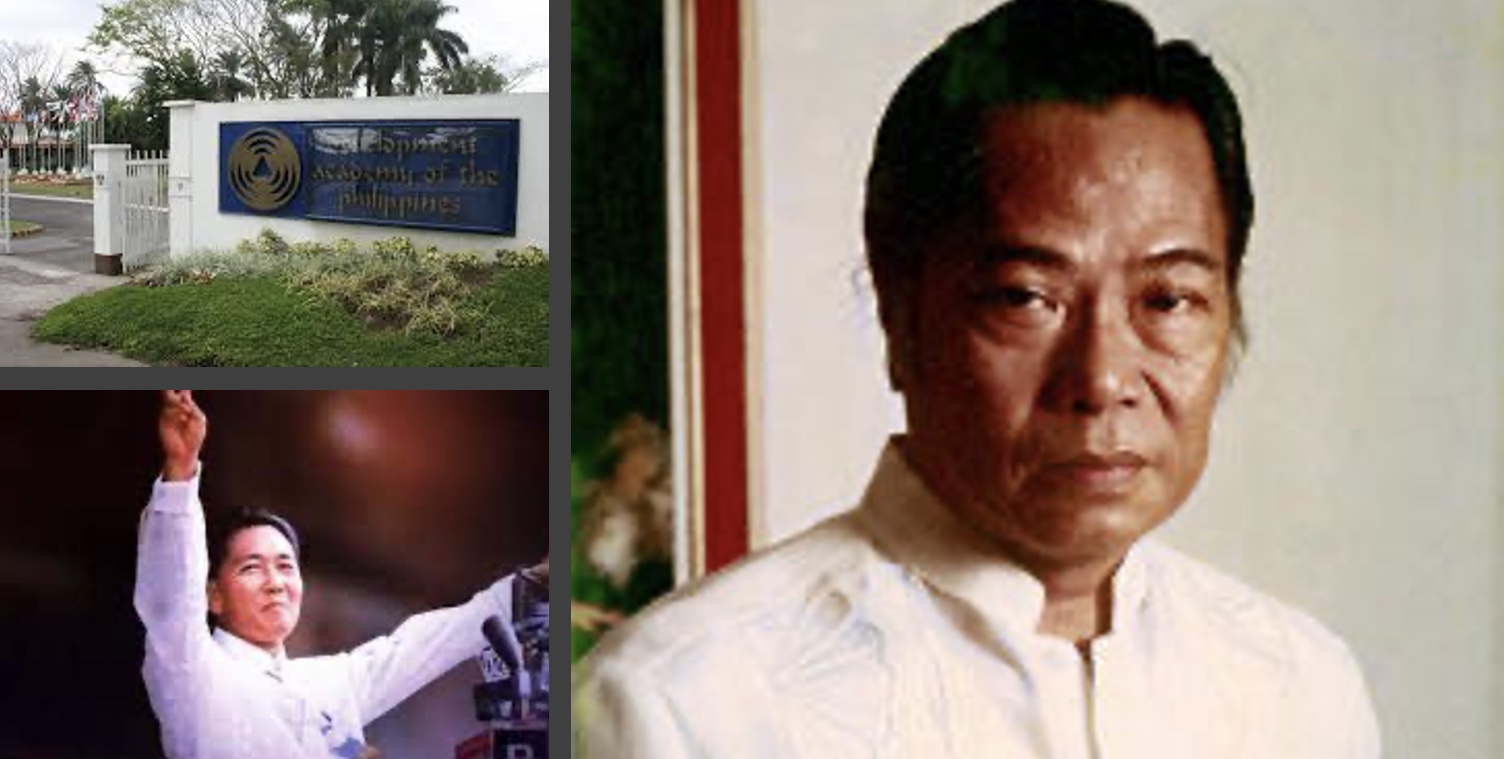
What particularly caught my attention was an article written by Corpuz on “Filipino Political Parties and Politics.” O.D., as he would be known, had just recently returned with his PhD in Political Economy and Government from Harvard, on the verge of a long and prominent—though sometimes contentious—career in public administration that would see him serve as Secretary and then Minister of Education, founder and president of the Development Academy of the Philippines, member of the Batasang Pambansa, and president of the University of the Philippines. 

Another political scientist and UP president, Jose V. Abueva, gave due praise to Corpuz upon the latter’s passing in 2013, citing his landmark scholarship in economic history. But Abueva also pointedly noted that O.D. was “soft in his judgment of Marcos’ authoritarian rule.” (Interestingly, Corpuz had described martial law as “an anti-democratic but constitutional coup” and EDSA as “a democratic but unconstitutional coup.”)

I was curious about what O.D. Corpuz observed of Philippine politics in the 1950s and if those observations would still hold today. Let me share a few choice quotations from the article, and you tell me if they don’t remind you on some level of what we’ve been seeing lately.

First, he notes the political centrality of the family and the elite:

“The importance and strength of the family and of its manifold of values, interests, ethics, and behaviors is one of the basic facts in the cultural context of politics and government in this country…. Close association between party and family was natural from the outset. 

“The first elections in this country in this century were municipal elections. This meant that, as a general rule, during the critical time when the foundations of political leadership were to be established in this country, those foundations had to be local…. The organization of national politics that later came after 1907 was essentially a superstructure resting on local foundations, in which the locally dominant families were the primary factor.”

I knew that only men could vote until 1937, but I didn’t know until I read Corpuz that, early on, you also had to own “real property worth at least five hundred pesos or paid at least thirty pesos of the established taxes annually” and read, write, or speak English or Spanish.

These requirements of maleness, wealth, and literacy lodged if not locked political power within the elite. Citing the French political scientist Maurice Duverger, Corpuz then goes on to classify political parties into “cadre” and “mass” parties, with practically everyone falling into the former category (the communists being the notable exception), comprising individuals bound by common interests and goals. These groupings were temporary, opportunistic, and shared the mindset of the elite from where their members came. These members also freely defected from one party to the other as circumstances required or suggested:

“The frequency of defections is a unique and interesting characteristic of Philippine politics. No party system abroad seems to breed that adventurous individual in whom ours abounds, who changes his party affiliation almost every season…. Defectors do not defect by themselves. They have personal and independent followings that go with them wherever they go, and it is these, as much as the defectors themselves, that are coveted by the parties.”

All parties needed money, and they knew where to get it:

“Cash contributions come in the form of large donations. M. Duverger calls this the system of capitalist financing…. The majority party would enjoy a positional advantage over the minority in the matter of contributions, forced or voluntary, from business firms. It is similarly favored when it comes to per capita levies from aliens, especially the overstaying Chinese, who render their donations unto Caesar during the Christmas and political seasons.” 

Corpuz predicts, presciently, that the old landed aristocracy would at some point be matched or supplanted by new wealth coming out of commerce and industry, which would then control the political levers. Ultimately, family trumps party and ideology; its survival and prosperity are what matter most:

“A somewhat more important factor is the existence of private and family interests that are not subordinated to the demands of administration unity or party discipline. Some families affiliate themselves to a party only as a tactical maneuver, with the basic aim of acquiring a means for aggrandizing family interests.”

Finally, Corpuz observes the existence of a significant “floating electorate”—today’s “undecided” or “convertible” voters—and how to win them over:

“In the Philippines, to a degree rarely matched elsewhere, the slogans of the parties belong to the corpus of political myths…. The lack of ideological meaning in the party platforms is often lamented… (arising from) the fact that the attitude of the floating voter is unpredictable…. As a minimum condition, they must not alienate the floating vote. In this case, therefore, the safest course of action for the campaign planners is to declare the party’s unswerving dedication to generalities.”

I’ll leave it to your imagination what those “generalities” might be today. But I have to say that for a minute back there, I thought I was reading a political playbook for the 2020s.