Qwertyman No. 196: Caught in the Crossfire

Qwertyman for Monday, May 4, 2026
THIS IS a piece I dread writing, knowing that I am bound to say something over the next thousand words that will almost certainly offend, dismay, and even enrage some people who might have thought better of me otherwise. But I also feel that it will be a gross dereliction of the duty that comes with the privilege of being published on this page if I avoided commentary on one of the most painful headlines to have sprung up this past week. 

I am not a political scientist, a theorist, or a coffeeshop regular with access to backroom information, so as I often do, I will draw on personal memory and experience—on the distant but insistent past—to reflect on the present.

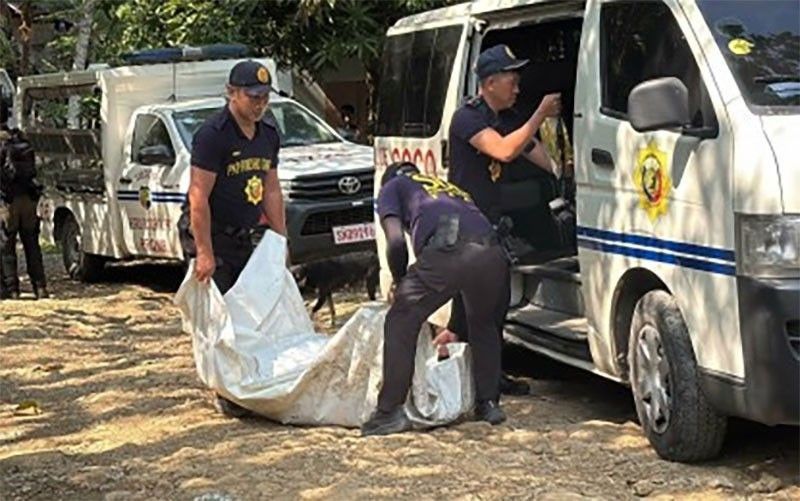
I refer, of course, to the recent deaths of 19 young Filipinos—two of them American citizens—at the hands of the Philippine military in Toboso, Negros Occidental in what the military described as an “armed encounter,” which a New People’s Army spokesman denounced as a “ruthless massacre” that included civilian students and activists embedded in the community.

It is not difficult for me to see how a bright young college student like Alyssa Alano would find herself in that far-off barangay, living with the locals and studying their way of life. I think she and her comrades knew the risks of being there and getting caught in the crossfire of a long-running war. Whether they believed or not in the armed struggle, they entered its deadly embrace. Even RJ Ledesma’s presence in a combat zone, I could understand. As an 18-year-old reporter at the Philippines Herald, I begged my editors to send me to Isabela, when we heard that a ship called the Karagatan had arrived to deliver arms to the NPA; I was certain it was a government plot (it was not) and wanted to discredit it. The desk sagely ignored me.

But one thing I can assume is that Alyssa & Co. were spurred by a genuine desire to serve the people, in that particular way, in that particular place and time. We may disagree with the methodology and certainly the results, but we can grant them the sincerity if not the nobility of their intentions. 

I recall a summer back in the early 1970s when I joined a cohort of UP Nationalist Corps members—mostly city-bred teenagers—in week-long “learn from the masses” trips to the countryside in Quezon and Bulacan where we lived with the common folk and subsisted on our purposely meager rations and whatever shrimp we could catch in the leech-infested river. There were no NPAs with us, nor did anyone indoctrinate us; we were there to realize our fundamental ignorance of and disconnection from the vast majority of our impoverished people. However, I have to admit that if the purpose of these sorties was to de-romanticize life in the countryside, to steer our perceptions away from Amorsolo’s gilded sunsets, the effect (at least on me) was the exact opposite. I came away even more convinced that struggle and sacrifice in the midst of suffering were heroic. The experience only confirmed what I had read in high school, in William Pomeroy’s The Forest, detailing the arduous treks of the old Huks in the mountains: I was looking at hard reality through a soft lyrical lens.

If I had not been arrested and imprisoned here in Manila in 1973, I would very possibly have gone on to the countryside, like many of my comrades did, and been killed within two weeks because of my sheer incompetence and ineptitude at guerrilla warfare, which most college boys and girls are simply not trained to do (and then again, quite a few learned and survived). 

And that perhaps was the most traumatic part of those times—receiving and viewing the horribly mangled bodies of our fallen friends, hearing the screaming at the UP Chapel over someone whose skull had been blown open: “That’s not him, that’s not him!” There was much criticism last week of someone’s use of “corned beef” to describe the Toboso dead as crassly inhuman, but I can confirm that it was a term we ourselves used—carne norte—for the bodies that came back shredded not even in hermetic body bags but in rice sacks.

Now we, too, have been caught in the crossfire, horrified by the wanton slaughter of our young but unsure of whom and what to believe in. An independent inquiry is absolutely called for, yes, to establish what happened, determine accountability, and define the rules of engagement in these circumstances. The brutality of that assault was barbaric in its execution. But exactly who are accountable, and what for?

I worry that these remarks could create more confusion than clarity. But sometimes we need to be unsettled or unmoored from our stoutest presumptions to begin to understand ourselves, and what we believe in, and why. One thing I’ve noticed about both extremes on the Left and Right is how certain they seem to be about everything, as if they had the whole universe and its rights and wrongs all figured out, and expect nothing less than absolute belief and compliance from their recruits and adherents. At one point in my life this was true of me; I could quote from Chairman Mao’s “Little Red Book” chapter and verse, and lived by its tenets (or at least tried to, inevitably failing in matters of personal discipline).

As I grew older, I began to appreciate the value of doubt, and even of skepticism. Mao may have been a brilliant revolutionary, but he also became a fat and filthy sexual predator (whose tomb I even visited twice in Beijing). The organ that generations of idealistic young people venerated turned out to be as murderous and as cynical as its professed enemies. 

If I were asked to advise a granddaughter or a nephew in college how to fight for justice and freedom, and if that girl or boy seemed intent on joining the armed struggle, whether as an observer or combatant (note that the military does not distinguish between them), this is what I will probably say: “I cannot stop you from doing what you so fervently believe in, because I would have done the same thing in my time. But think about this, before you go: your time is different, and many things have changed. I know that poverty and injustice have not gone away, and may even have worsened. 

“But if there is something that half a century of struggle has taught us, it is that violence, however justified, never really works; it will only be met with even greater violence, with tragic results for all. The harder battles to fight are right here—in the communities you know and can influence, for the issues that matter to them. You do not need to go far to reach the suffering and the underserved: they are around you, wherever you turn. 

“Fifty years ago we may have had little choice but to go underground; today we have civil society to embrace your causes. Call me defeatist, cowardly, or myopic, or even a comfort to the enemy; but I remain alive and fighting for truth, justice, and freedom the best ways I can, which include what I’m telling you now—the strongest weapons are in your hearts and minds, not in your hands.”

Qwertyman No. 125: The Young Dodong Nemenzo (1)

Qwertyman for Monday, December 23, 2024

IT WAS with deep sadness that we received the news last week of the passing of Francisco “Dodong” Nemenzo, the staunch Marxist, nationalist, and former president of the University of the Philippines. My wife Beng and I are spending Christmas with our daughter in the US and being an all-UP family, we all knew Dodong and were much affected by his loss. Beng had been a student of Dodong’s at UP, and I was privileged to serve under him as his Vice President for Public Affairs twenty years ago. But long before this, I had met him as a student at the Philippine Science High School where his wife Princess taught us History; he came to pick her up in the afternoon in his Volkswagen Beetle whose door was emblazoned with the Bertrand Russell “peace” sign.

We will be missing the many memorial events that will surely be held in his honor these coming days, so I thought of recalling Dodong in a different way from what most of his colleagues and comrades will be speaking about him. More than ten years ago, I interviewed Dodong for a book I sadly have yet to finish, and he spoke with me about his life before he became the fighting ideologue everyone now remembers him to be. Let’s hear him in this abbreviated excerpt:

“We went back to Cebu after the war. Everything was still in turmoil. I enrolled at the Miraculous Medal School, a Catholic school, and completed my third and fourth grade there. By the time I reached fifth grade, Cebu Normal School was opened so I graduated from there. After sixth grade, I spent a year in the seminary in Cebu. That was my parents’ plan ever since I could remember. I was the only boy among three children, and the eldest. My parents were devout Catholics, and they considered it an honor when a member of the family became a priest or a nun. Since I was an only boy they wanted me to become a priest. I stayed there for only a year, and then I quit. That was probably the beginning of my radicalization. The seminary back then was run by Spanish or Vincentian priests who were supporters of Franco. They looked down on Filipinos and despised Rizal. 

“I went to the University of San Carlos. It was a Catholic school but my father was unhappy with the Science instruction. Our science textbook used the question-and-answer method and my father didn’t like that. He examined my notebooks every day and corrected what my teacher said. He got mad when we were taught creationism, and he lectured me on Darwin and evolution. I answered my teacher back and the principal reported me to my father for my heretical tendencies. My father decided to free me from this nonsense and transferred me to the Malayan Academy, a private non-sectarian school that had very good teachers. I finished near the bottom of my class, failing in Conduct and Tagalog. 

“I entered UP Diliman in 1953. The rule then was that you were exempted from the entrance exam if you had an average of 82, but my average was around 77 so I had to enroll in a summer institute that was like a backdoor into UP if you passed 6 units there. I didn’t know what course to take. My father didn’t want me to take up Law and wanted me to become a scientist like him, but I reckoned that if I did that, I would always be compared to him and come up short. So I chose a course called AB General. 

“The advising line was a mile long. Jose ‘Pepe’ Abueva, a friend of my father’s, passed by and saw me in the queue. He asked after me and I told him that I couldn’t think of a course I really wanted. He tried to sell me on Public Administration, but I didn’t like to serve in a bureaucracy. He said there’d be a lot of opportunities abroad, scholarships, and if I did well I could join the faculty. He had a lot of arguments, but the one that persuaded me was ‘If you join Public Ad right now, I’ll sign your Form 5 right away, and you won’t have to join this crowd.’ 

“That’s how I ended up in Public Ad. When the dean of Business Administration tried to recruit me and my (Pan Xenia fraternity) brod Gerry Sicat who was then in Foreign Service to go into Economics for our master’s, Pepe Abueva again swooped in and told me to take up an MPA instead, and to join the PA faculty immediately. So I became a faculty member in my senior year, just before my graduation, as an assistant instructor. I probably had the longest title in UP: ‘research assistant with the rank of assistant instructor, with authority to teach but no additional compensation.’ I really wanted to teach, but had no actual assignment. I only took over the classes of professors who went on leave. 

“I never joined the UP Student Catholic Action or UPSCA. Well, maybe for one year, but I was never active and then I got out of it. I joined only until I met an UPSCAn named Princess. We always met in Delaney Hall. We were together in the student council. She was representing Liberal Arts, I was representing Public Ad. I joined in 1955, my third year, along with Gerry Sicat, Manny Alba, and Jimmy Laya. I became a liberal and distanced myself from UPSCA. 

“I idolized (Philosophy professor) Ricardo Pascual. I was looking for a cause, but these liberals were just fighting for academic freedom with no purpose. It seemed empty. I was under the influence of Pascual for some time, but we had no advocacy. I joined a short course in Social Order at Ateneo on the papal encyclicals on labor. My liberalism and my growing social consciousness merged and I started reading Marx and Huberman on my own, to find out what we were fighting for. There were a couple of professors like Elmer Ordoñez and SV Epistola who according to Bill Pomeroy had already reached that level of consciousness, but when he left they became liberals, they weren’t really organized.” (To be continued)

(Photograph by Rick Rocamora, used with permission)

Penman No. 298: Books with Back Stories (1)

arts3-doctrina-filipina_2018-04-15_17-16-24.jpg

Penman for Monday, April 16, 2018


AS I’VE been chronicling here these past few months, my fascination late in life with antiquarian books and documents has led me to some wonderful, intriguing, and often serendipitous discoveries. And as I’ve been saying, I’m a scavenger, not a scholar, so I will just as likely come across and even pick up junk as I will, now and then, a jewel. My most recent acquisitions have included a gorgeous Atlas de Filipinas from 1900 in very fine condition, early editions of the Noli and Fili published in Spain, a booklet of original sketches by one of the illustrators of Puck magazine from 1889, an illustrated travel book on Luzon and Palawan from 1887 by Alfred Marche, and a signed first edition of a book by one of my most admired authors, John Updike.

As much as possible, I seek out books that have some connection to the Philippines and its history and culture. If possible—and when I can afford it—I choose the first or earlier editions, signed by the authors, to establish some personal connection to the work at its very origins. It’s a fancy fetish, for sure, more than anything; you can often legally download the entire text for free online, and gain as much scholarship from that file. But there’s nothing like holding a book that the author himself or herself held and even scribbled his or her name on with a fountain pen (or a quill pen, in the case of my 300-year-old volumes with marginal notations in fine sepia ink). It returns you to how personal the act of writing and publishing can be, in this age of e-books and PDFs.

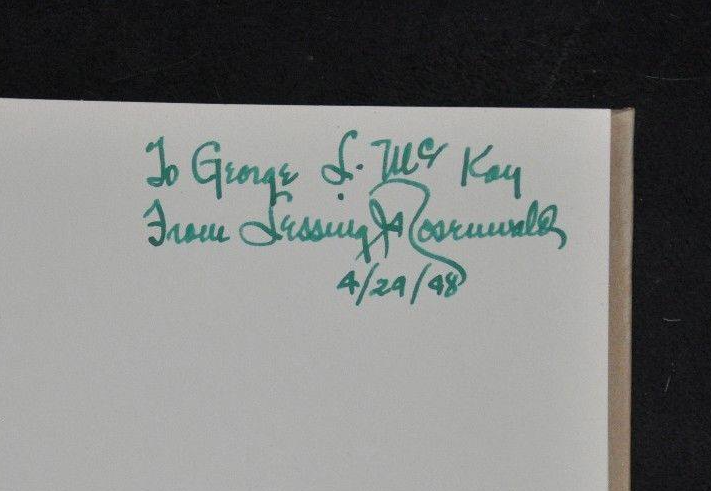
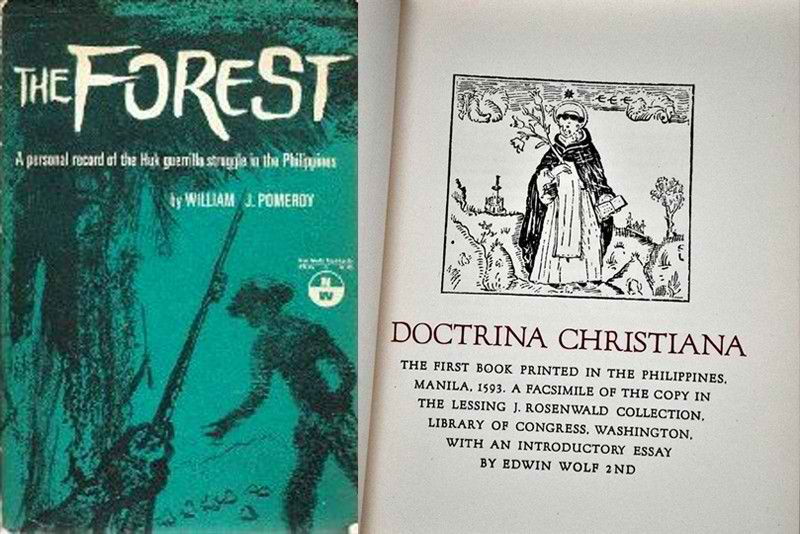
A few weeks ago, for example, I jumped on a book that turned up in Texas, a 1948 facsimile copy of the 1593 Doctrina Christiana, the very first book printed in the Philippines (a personal encounter with which I reported on here four years ago, at the Library of Congress in Washington, DC). Facsimiles are interesting but generally passed over by collectors—you can still get a facsimile of the Doctrina locally for P250—but this one had a very special value. Not only was it published by the LOC very soon after the book (the only copy known to exist) resurfaced in Paris after the war and was donated to the LOC, proof that the LOC knew exactly how rare it was; but this copy was inscribed in green ink by Lessing J. Rosenwald to George L. McKay. Rosenwald happened to be the book collector who acquired the Doctrina and donated it, along with many other rarities, to the LOC; McKay was another well-known bibliophile. So this copy shows—against a suggestion I’d heard that Rosenwald didn’t know what he was buying—that Rosenwald prized the Doctrina highly enough to gift its facsimile to his collector-friends.

Rosenwald.png

That Doctrina facsimile has joined my collection, but another outstanding book didn’t, just when I thought it would. I’d won the bidding for a first edition, with dust jacket, of William Pomeroy’s The Forest (International Publishers, 1963). This is the book that, whenever I’m asked “Which book has influenced you the most?”, I give as an answer. It was my reading back in high school of this American GI-turned-Communist guerrilla’s lyrical and moving account of his time with the Huks in the mountains of Luzon that inflamed me to join the nationalist movement. Pomeroy met and married the Filipina Celia Mariano; they were captured, imprisoned, and later led a long life of exile in the UK, where they died not too long ago in their 90s. I already had a first edition of The Forest, but this copy was inscribed by Pomeroy to their friends Bill and Ranjana Ash—another storied couple, dedicated Marxists whose lives are well worth Googling. Sadly I later got a note from the seller that he could no longer find the book in his shop, and refunded me. What a loss!

Sometimes I don’t buy the book, but take note of some very interesting details about it. For example, I came across a work on Philippine fisheries, “Bangos Culture in the Philippine Islands,” taken from an April 1929 issue of the Philippine Journal of Science. It was co-authored by Albert W. Herre and Jose Mendoza, two pioneers in the field. But the bookseller noted that “This copy is unique in that the primary author, Albert W. Herre, has crossed out the name of the second author, Jose Mendoza, on the credit line of the first page, and written alongside it, ‘This name [Jose Mendoza] was added and my paper altered after I had sent it in for publication, all without my knowledge. Herre.’ On the second page, Mr. Herre has crossed out the second paragraph (‘Description of the Bangos’) with a few pen lines (it is still very legible) and written alongside, ‘Added without my knowledge or consent. Herre.’… given that the primary author made the aforementioned annotations, it appears that he donated it to Harvard (and wanted to make sure that Harvard understood that he was the real and only author).” Are we looking at an example of professional jealousy in the sciences?

More on these discoveries next week.