Penman No. 462: Exit This Gatekeeper

Penman for May 5, 2024


INDULGE ME this bit of self-reflection, which I suppose will also speak for many writers of my generation. After much thought, I have decided that I will no longer be judging literary competitions, having just completed my last one.

My first reason is that I’m 70, a good age at which to pause and plan out the rest of my life, however long or short that may be. (The life expectancy of a Filipino male today is 72, although actuarial science seems to think that if you’ve come this far, you’ll likely hang around for another ten years.)

There are just a few things I want to devote that time to—primarily, to write my own books (not books for others, so I’m also announcing that upon completion of my current commitments, I will desist from seeking or accepting book commissions—unless I fall into grave and sudden need.) I want to travel more with Beng and Demi while we can, look after Buboy’s growth, play poker all night twice a week, and enjoy my strange hobbies. I’ll teach for as long as I can—I’m enjoying my undergraduate class right now—but will limit my participation in workshops, conferences, festivals, seminars, etc. to the few I am committed to, like the UP Writers Workshop. 

Judging competitions doesn’t seem that much work (unless you’re a judge looking at over 100 stories) and of course it’s a signal honor to be asked to help pick the best of new writing. It remains a tremendous responsibility and privilege to be thankful for. You get to go up a stage, say some nice things about literature and writers, receive a modest fee, and feel somewhat useful and relevant. That’s all well and good.

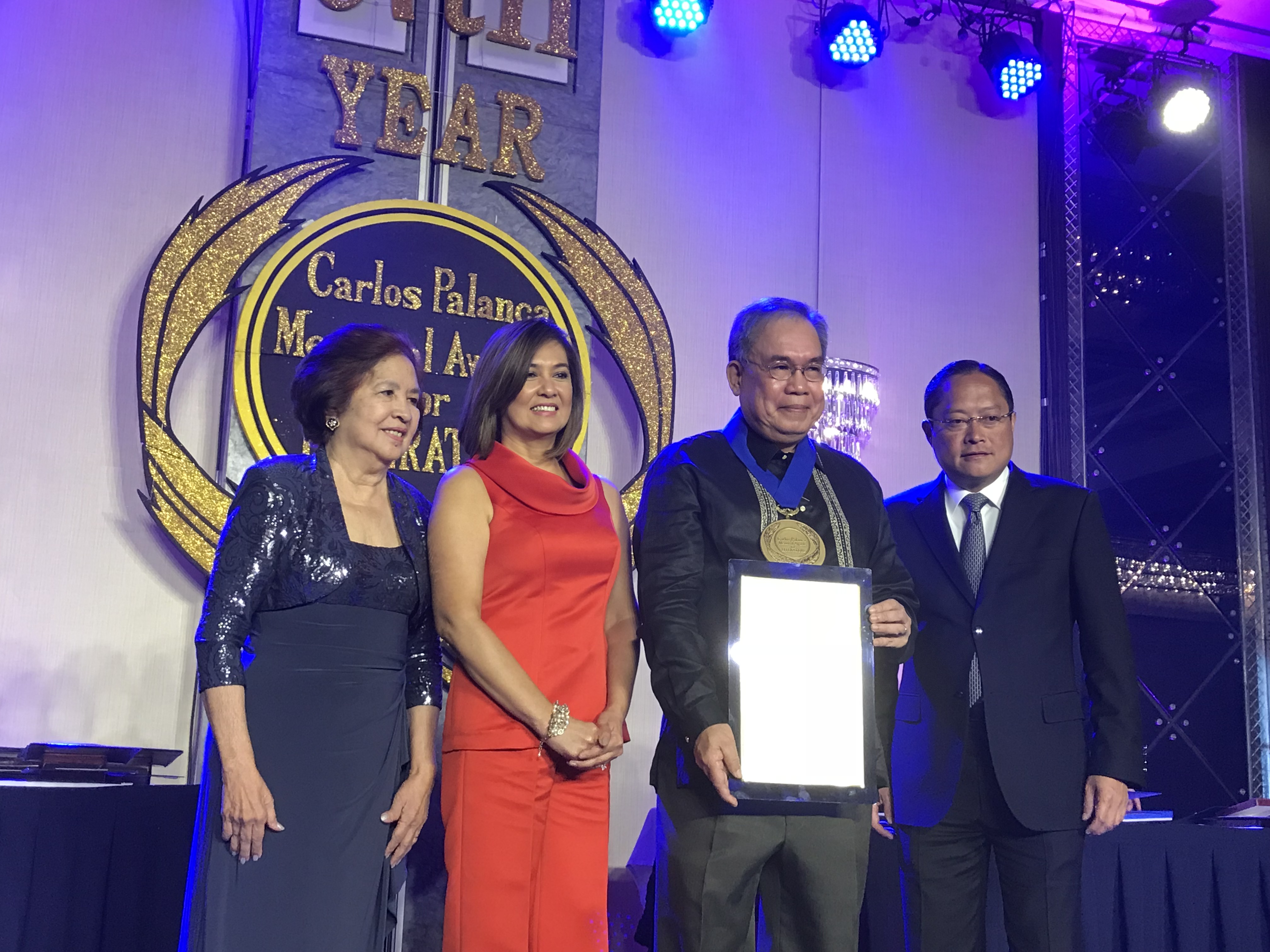
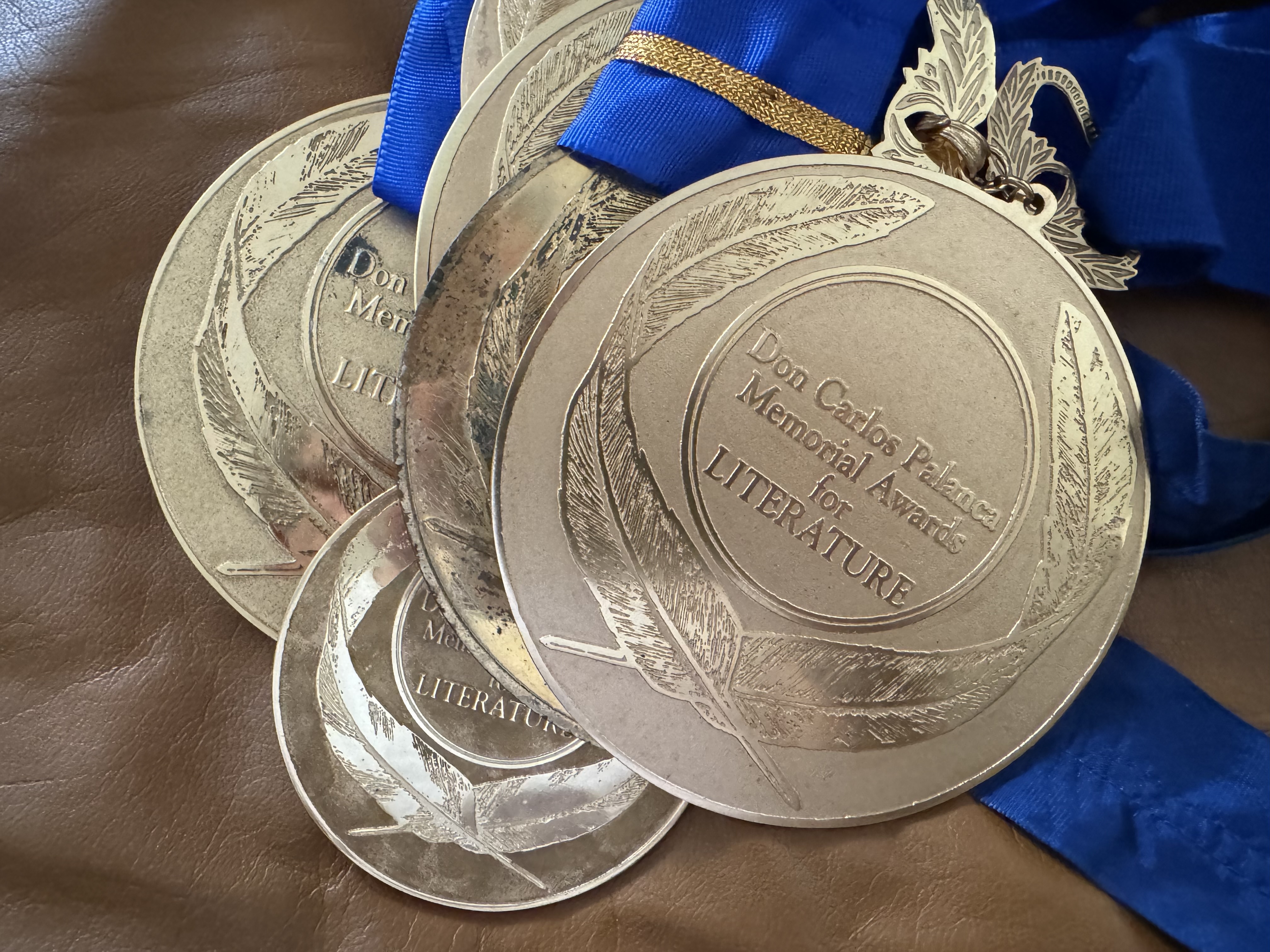
When I transitioned from being an active literary combatant (that’s how many of us felt back then, with the likes of Rene Villanueva and Ed Maranan breathing down your neck) to a judge after getting my Palanca Hall of Fame plaque in 2000—I never joined a contest after that—I felt that I had turned a corner and found a kind of inner peace. It wasn’t that I had nothing more to prove; one illusion that local literary competitions encourage in the young is that winning them is the be-all and end-all of writing, when all they are is a formal pat on the back to get you started. The true challenge for the young or beginning writer is not to win prizes but to write and publish books that will be read and appreciated by others, that hopefully will matter, that will outlive you, that for better or worse you will be remembered for and remembered by; publication is the ultimate prize, readership the ultimate validation. So I went on to write books, teach, have fun, and discover wonderful things outside of writing and literature (yes, there are such bright and shiny marvels). 

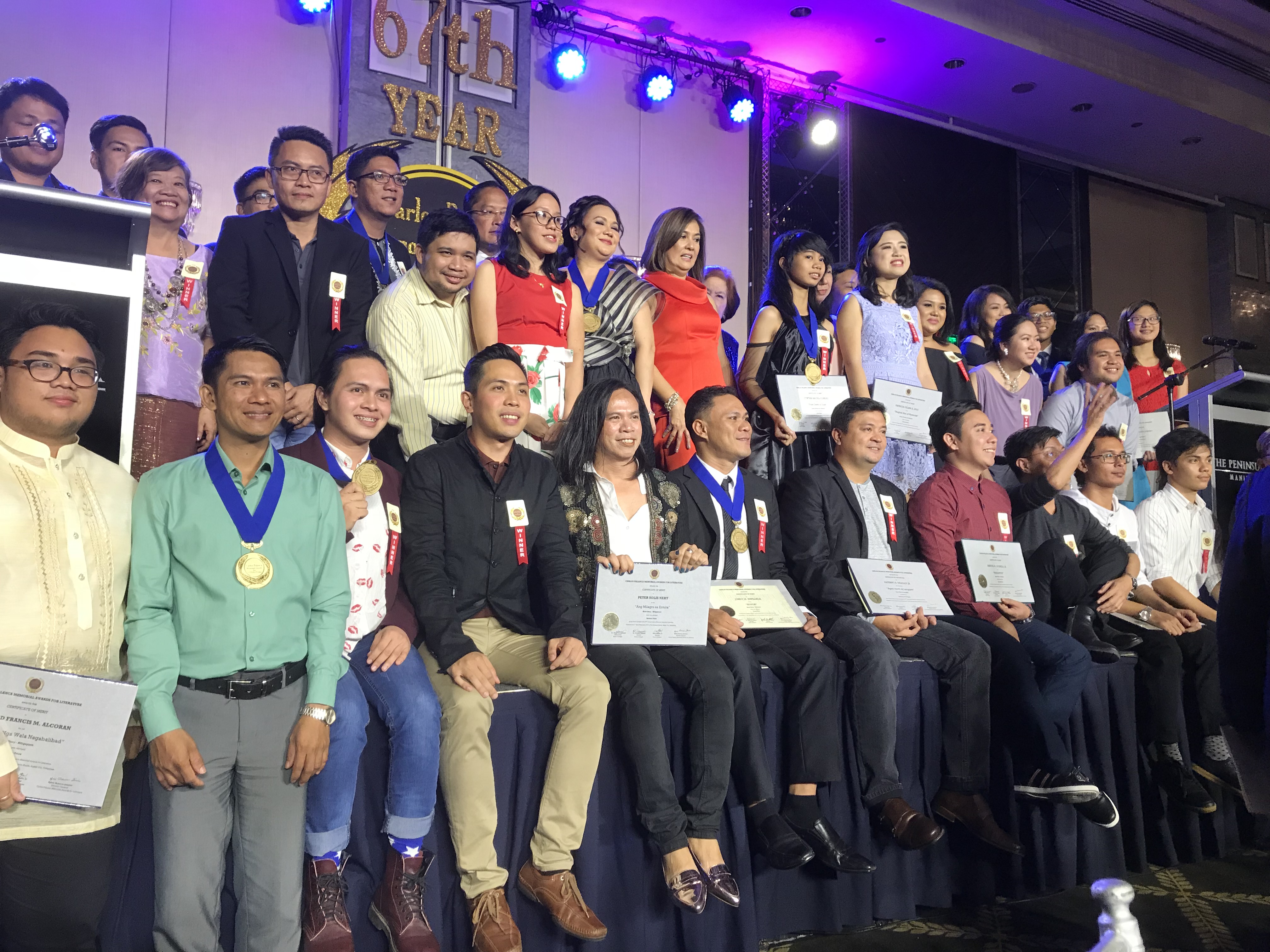
Judging competitions seemed to be a good way of keeping a foot in  the door, so I’ve been doing a lot of that, also as a kind of payback for all the people before me who took their time to recognize and reward my efforts with a prize. At some point, I realized that the foremost reason I kept joining and judging the Palancas was because I wanted to be there on Awards Night, to enjoy the company of writers I admired (the piano-playing Greg Brillantes being one of them), and to feel good about being a writer on the one night of the year that they took center stage. The great luck of Hall of Famers is that they can now attend all the Awards Nights they want without having to work for it—so I won’t.

The most important reason is that I’ve already read enough, perhaps too much, for far too long, and it’s no longer healthy for me or for those I may be judging. Our literary community certainly doesn’t lack for younger people who can do this job as well as if not better than I can.  I’m still and always delighted to see brilliant new work emerge from the pile, but it’s getting harder—more laborious, more fatiguing, and ultimately more disheartening to be asking, “ls this the best they can do? Don’t people know what a good story is anymore?” Or have I become the problem?

The word “gatekeeping” has been going around much lately, evoking the image of a surly senior (a Boomer, for sure), out of touch and out of step, insisting that his students and young writers should write like him or like Hemingway, playing favorites, and slamming the door shut on entire genres he doesn’t like or understand. That sounds a lot like me, except that I’ve never expected or driven my students to write like me; they come to my classes with their own experiences, their own material, their own talents and insights, and  the best of them have written stories that are nothing like mine, except perhaps that they’re realist, because that’s the kind of fiction I best know and teach. I’ve always been open to other forms and genres, even if I hardly write in them (I think I’ve tried everything at least once), because the world would be a terribly boring place if we all wrote about everything the same way. Think of much of the political rhetoric going around these days, no matter which flag is being waved: labels and slogans—the shorthand of groupthink—have replaced and diminished personal narrative and reasoning. (As if people will care when you die if you were “correct” all the time; they will ask if you were good and kind.) This is also why I have long resigned from anything resembling organized ideology or religion, whose avatars often seem so, so sure of themselves and of what they’re saying to the point of arrogance. 

I value the doubt and ambiguity, the constant self-questioning (what can we be capable of, despite ourselves?) that are fiction’s domain. Fiction humbles us by exposing our infirmities, but it also exalts us by offering the possibility of redemption.

In the end, what I have always looked for in a prizewinning story, aside from being exceptionally well-written (smooth and stylish when it needs to be, tough and visceral when it needs to be) is that it be moving and memorable. It should burn a hole and leave a scar in my heart, my guts, and my memory. I can enjoy clever and inventive stories as much as anyone else, but if it’s a passing amusement, like a joke, it won’t leave much behind. Some of the most memorable stories I’ve  come across weren’t even what you’d call grand in a sonorous or elaborate way. They took place in small places within relatively short periods of time, and involved ordinary people in situations that brought out their extraordinariness (by which I don’t mean some blinding heroism, but a part of them, dark or light, they didn’t even know was there).

Too many of the thousands of stories I’ve had to read over the years have been poorly written, dull, and forgettable. That’s not even a complaint, just par for the course for any kind of open literary competition here or anywhere else. People can’t be blamed for hoping and trying with their graceless prose, and I’m sure that many have nursed precious ambitions of being published and read. Not to be snarky, but the problem here really isn’t so much a lack of writing talent than of self-awareness, the kind of honesty and humility that will tell you, in your heart of hearts, that you will never be a nuclear scientist or an F-1 driver. Unfortunately, literary self-awareness can happen only when one has a sense of what truly good writing is. 

But could it possible that I myself have fallen so far behind that I can no longer recognize the new “good,” or apply the “new standards,” whatever they may be? Could my notions of “good fiction,” however liberally applied, be standing in way of some young genius’ debut?

I’ll be holding on to those notions, but now only for myself. I’m not urging my fellow seniors to do the same; we all operate on different clocks and their patience could be longer than mine. Some might say “Good riddance” and the feeling could be mutual, but I depart this task with a light and happy heart, looking forward to producing new work that will be judged by others.

Email me at jose@dalisay.ph and visit my blog at www.penmanila.ph.

Qwertyman No. 68: What We Aspire For

Qwertyman for Monday, November 20, 2023

IT WAS a humbling but also uplifting experience to attend the 65th Ramon Magsaysay Awards ceremonies last November 11 at the Metropolitan Theater, in which four new awardees—including Filipino peace negotiator Miriam Coronel-Ferrer—were honored for their contributions to humanity. Long considered Asia’s version of the Nobel Prize and certainly its most prestigious honor, the RMA has now gone to over 300 recipients from all over the world in the fields of government service, public service, community leadership, journalism, literature, and creative communication arts, peace and international understanding, and emergent leadership.

This year’s four laureates represent a wide range of endeavors.

Miriam Coronel-Ferrer (Philippines) exemplified and championed the role of women in peacemaking, leading the negotiations with the Moro Islamic Liberation Front that led to a Comprehensive Agreement on the Bangsamoro. She has since lent her skills and wisdom to peacemaking efforts in East Timor, Cambodia, Afghanistan, Kosovo, and Iraq, among other conflict zones.

Eugenio Lemos (Timor-Leste) mobilized young Timorese to adopt permaculture, a holistic system to create and manage sustainable agrosystems. His approach and methods have been adopted by Timor-Leste’s schools and local governments. Going beyond food security, Lemos emphasizes the need for “food sovereignty,” a country’s ability to produce its own food, with a focus on local, natural, and nutritious food. 

Ravi Kannan (India) set up the Cachar Cancer Hospital and Research Center in one of India’s most remote and poorest regions to bring cancer care to those who could least afford it. Dr. Kannan resolved not just to create a state-of-the-art facility, but also to make it accessible to the poor by offering free treatment, room and board, temporary employment for caregivers, and a homecare program for patients. 

Korvi Rakshand (Bangladesh) began by helping poor Bangladeshi children learn English so they could find gainful employment. His JAAGO Foundation has since expanded to provide free English-language primary and secondary education to 30,000 students in both traditional and online schools, as well as embracing other causes such as women empowerment, children’s rights, and climate change.

One thing stood out in all of these awardees—and, indeed, in those who preceded them as RM laureates. It wasn’t about them. Their backgrounds, their education, their previous honors and awards were hardly even mentioned—and when they were, it was only to suggest that Dr. Kannan could have chosen to pursue a lucrative career as an oncologist in Chennai, and Rakshand could have parlayed his law degree from the University of London into success as a barrister. 

It was all about what they did for others, the public service they performed with quiet dedication, selflessness, and humility. Rakshand would relate that when he got a phone call from RMAF President Susan Afan, his first thought was that he was being called to vet another candidate, not expecting to be told that he was the awardee.

All this made me think more deeply about how the rest of us aspire for honors, by which we almost exclusively mean personal and individual recognition. Indeed, from the grades up, we’re trained to venerate valedictorians, summa cum laudes, board topnotchers, top salesmen, beauty queens, boxing champions, singing sensations, and best actors and actresses. To be one of them is to have achieved meaning in one’s life. Our living rooms and offices have long been excuses for trophy displays, but now social media has done them better by offering a free and wide platform for self-promotion, so that not a day goes by without someone announcing some new achievement.

And why not? I suppose it’s a natural human desire to rise above the herd and be known for something, be it physical beauty, vocal prowess, athletic skill, or mathematical genius. In a world where we’ve become increasingly commodified and homogenized, self-assertion (in many cases—think Instagram—to the point of narcissism) seems mandatory, if only to say “I’m here. I’m good—no, make that, I’m great!”

So we look around at what others are doing and try to do them one better. The Internet has magnified expectations to such unrealistic extents that young people have committed suicide for reasons that people from a hardier generation would have found laughable were they not so tragic. In our quest for recognition—any recognition—we’ve fallen prey to a slew of awards, pageants, and prizes of doubtful value, even paying to play Cinderella for a day and half the night. The awards themselves have become commodified and homogenized.

To be honest, I myself have built up my own little stack of writing prizes, some of them worth more than others. But again, what is “worth” beyond oneself? Like a punch-drunk boxer with a rack of belts, all they show is that I’ve lived a life as a literary combatant, when a writer’s true prize should be the readership of his or her people, perhaps the world. In a society that gives little value to books, or is too poor to buy books, that’s an Olympian challenge. 

The Ramon Magsaysay Awards and what they stand for remind us that while service to others is often thankless and sometimes even dangerous, it’s just as legitimate an aspiration as any other, and one we don’t emphasize enough in our personality-focused culture. Our historians and sociologists will have reasons for why we seem to value kani-kaniya over the tayo, or why the African concept of ubuntu, of finding one’s meaning in community, sounds foreign to many of us. I can only guess that the ruthless demands of surviving and succeeding in a cash-driven society have encouraged us to compete rather than cooperate.

The RM Awards are, of course, also a kind of competition, but one without losers, as everyone nominated has already won in his or her own sphere, has already done good by others. The chosen laureates merely stand for their co-workers, for the ideas and values they represent, and above all for an insistently optimistic and assertive humanity in a world splintered by violence, greed, and intolerance. 

Greatness can be aspired for—I suspect the truly great don’t even think about it—but it cannot be applied for, much less paid for.

Penman No. 326: A Season of Winners

Cafe.jpgPenman for Monday, November 5, 2018


UNEXPECTEDLY, OCTOBER turned out to be a season of winners, with a series of important awards being announced involving culture and the arts.

Foremost, of course, were the National Artist Awards, eagerly anticipated by the cultural community every two years or so. Dismayed as I was by the Palace’s decision to drop Nora Aunor (and even more by the silly excuse they gave for doing so—I’m reasonably sure I can live with the agony and torment if they went nuts and named me a National Artist, which I would shyly accept), the rest of the list pretty much got a pass from the arts community, as far as I could tell.

I was especially happy to see old friends and acquaintances like Amel Bonifacio, Resil Mojares, Kidlat Tahimik, and Ryan Cayabyab on the list, people whose work I’ve known and respected for a long time. And not to take the shine off any of the winners, but I was also sad to find, once again, that my personal bets for this highest of creative honors—among them the poet Jimmy Abad and the artists Junyee and Jaime de Guzman—would have to wait for yet another round. Having been involved to some minor degree in the search process for previous NAs, I know that more visibility for the artist helps, and we’ll work on it next time.

But there was plenty of recognition to go around last month, albeit on a more local scale.

For the past six years, I’ve been privileged to serve on the Selection Committee of Quezon City’s Manuel L. Quezon Gawad Parangal for Outstanding Citizens and Institutions. It’s a task I’ve shared with former Budget Minister and City Administrator Manny Alba, former UP President Emer Roman, former QC councilor Bert Galarpe, lawyer Vicky Loanzon, and former QC Vice Mayor Connie Angeles.

There’s never any shortage of achievers from Quezon City to acknowledge in whatever field, from politics, education, and business to the arts, media, and entertainment. This year, in ceremonies last October 12, I was delighted to greet some friends among the awardees. (I assure you our friendship had nothing to do with their recognition, impeccably supported by the evidence.)

Among them was the engineer and educator Rey Vea, who belonged to the mythical first batch of the Philippine Science High School, two years ahead of me; we worked together in the UP Collegian, were arrested within a day of each other under martial law, and flew to the US in the same batch of Fulbright study grantees. Rey went on to become dean of the UP College of Engineering, administrator of the Maritime Industry Authority, and president of Mapua University.

Another outstanding QC citizen honored was the poet, editor, and screenwriter Jose “Pete” Lacaba, one of those colleagues I deeply admire as much for his craft as for his dedication to it. Like his own hero Nick Joaquin with whom he worked, Pete never drew a line between journalism and creative writing, and produced first-rate results with whatever he put his mind to. A few years older than me and a Pateros boy, Pete hung out in the same Rizal Provincial Library that I spent many an afternoon in back in the mid-1960s. We later both wrote scripts for Lino Brocka, along with Ricky Lee and Joey Reyes, and the joke among us was that Pete got all the best, long-gestating projects like Jaguar and Bayan Ko because he also wrote the slowest.

And this is as good a time as any to congratulate my fellow STAR columnist and another good friend, the writer and entrepreneur Wilson Lee Flores, whom you’ll find smiling even in the most difficult circumstances, such as when the 79-year-old Kamuning Bakery that he had almost singlehandedly revived burned down last February. The bakery itself had won the same award last year for its artisanal bread, but our committee thought that the proprietor—also a three-time Palanca laureate—deserved one on his own.

In the institutional category, my loudest cheers went to Ma Mon Luk, the iconic house of noodles I’ve patronized since I was a boy and whose owner George Ma Mon Luk is a fellow fountain pen and typewriter collector, and the Erehwon Art Center, which its founder and patron Raffy Benitez has tirelessly guided within a few short years to becoming one of the city’s true cultural oases, virtually a mini-CCP that has projected the best of Philippine art both here and overseas.

And I can’t let this review pass without mentioning the Palanca Awards for Literature, which for the first time in its 68-year-long history held its Awards Night this year in October instead of the customary September 1. Among the winners was a neurosurgeon named Ron Baticulon who had nursed a dream of writing well enough to win a Palanca, which his work “Sometimes You Can’t Save Them All” did, for Second Prize in the Essay in English category. The piece is a powerful and moving account of a young doctor’s encounters with the families of the dying, and of the humanity that asserts itself in the bleakest of situations. I’m looking forward to the release of Ron’s first book from the UP Press early next year.

To them and all the other winners from last month’s derbies, my warmest congratulations.

Baticulon.jpeg


Penman No. 268: What This Prize Should Mean to You (2)

IMG_2927.jpg

Penman for Monday, September 11, 2017


ONE OF the strangest moments of my life happened in 1993, when my first novel, “Killing Time in a Warm Place,” shared the grand prize with the late, great Tony Enriquez’s “Subanons.” The guest of honor then was none other than President Fidel V. Ramos, among whose speechwriters was none other than me.

There were four or five of us doing his speeches then, and the assignments were farmed out at random, and I can’t remember now if I accepted that Palanca Awards night job with delight or dismay. I suppose I could have swapped assignments with somebody else, but I had to think deeply about the situation. I was one of the awardees, so the young novelist in me wanted to sit back and hear my President’s sincerest thoughts about literature.

But the speechwriter in me also knew that those sincerest thoughts were just going to be written by somebody else in the room, so I figured, it might as well be me, to make sure that he would say nothing terribly wrong, and that he would say something very nice. And of course he did.

Incredibly enough, the same situation happened a year later, when I received a TOYM Award for Literature at Malacañang Palace, again from FVR. In both instances—because we ghostwriters preferred to remain spectral and worked far out of his sight—he had no idea that the hand he was shaking had also crafted his speech. In fact, it wasn’t until a few months ago, when I interviewed him for another book, that I finally introduced myself as the writer of 500 of his speeches, which remain on my hard drive. We had a good laugh.

I’ve written speeches for five Presidents and innumerable senators and CEOs, as well as the biographies of such diverse figures as Communist guerrillas, capitalist icons, and Marcos cronies. At any given time, I’m working on three or four book projects. I teach, write a weekly column, and peck away at stories, essays, poems, my third novel, and my unfinished oral history of the First Quarter Storm. And, oh, I also get to dress up and play the part of an academic bureaucrat.

I say this neither as a boast nor a lament, but simply to show that it’s all in a writing life. I’m happy and fortunate to have all of these writing jobs—although I must confess to being happier with some than others—because, despite all the challenges and compromises I have to face, this was what I signed up for.

Many other writers in this room have done the same thing, in varying degrees, both out of necessity and desire. Quite a few have approached me and said, “I want to do what you do,” but I wonder if they realize what they are asking for. I remember, early on, typing away at a commercial film script I had to complete, with tears streaming down my face, because what I really wanted to do was to join the Palancas, and I was out of time. That’s my greatest anxiety—to run out of time.

There will always be those who will scoff at what I do and who will insist that every word you write should be God’s own truth, as if that were humanly possible. God might as well smite all lawyers, copywriters, and PR professionals—and let’s throw in all politicians—with his righteous hand.

In a course I designed called Professional Writing, which I’ve been teaching for the past 20 years in UP, I begin every semester with this admonition: “There’s writing that you do for yourself, and writing that you do for others. And don’t ever get those two mixed up, or you’ll come to grief.” I also remind them that they can always say no, as I’ve done many times without regret.

If you embrace writing as a lifelong and life-sustaining profession rather than a weekend hobby, then you will not be writing every piece as if it were destined for the Palancas, although, as a professional, I do every job I accept as if it were my first, last, and only job, no matter how big or small.

But that again is exactly why we should value the Palancas. Too often, we lend our words to others. With these prizewinning pieces, we reclaim our words to ourselves, for ourselves, for whatever it was that first impelled us to write.

You remind me of that 21-year-old who, even as he had to write speeches, scripts, and stories for others, burned with the desire to write for himself and for his people at large—as this 63-year-old still does, awaiting blessed retirement 16 months hence so I can write the best of what remains in me to write.

Writing for the truth, writing for honor and glory, writing for the love of language—these are what your being here is all about, what the Palancas have existed for these past 67 years. While the generous cash awards are nothing to sneeze at—as the Foundation’s accountants will certainly attest to—the Palancas have always been about more than money. Your certificate tells you, this is how good you are; you look around you and you realize, that is how much better you can be.

This is our real reward, our hope, and our redemption. Whatever else you may have had to write or had to do, what you submit to these awards is your finest self, your truest words, your ineradicable proof of citizenship in the community of letters.

Let me quote President Ramos—well, in fact, let me quote myself: “It is both literature’s virtue and responsibility to reaffirm our fundamental humanity, and the unity of our interests and aspirations as a people. Every act of writing rehumanizes us, both writer and reader.” This is especially important in these darkening times, when megalomaniacal and murderous despotism threatens societies across the ocean, debases the truth, and cheapens human life. The best antidote to fake news is true fiction.

You and I have much to write about. You will not even need to wait until the next Palanca deadline to do what only you can do, and to say what only you can say. If you write for truth, freedom, and justice, and for the beauty and value of life itself, you will always be a first-prize winner in my book.

Penman No. 267: What This Prize Should Mean to You (Part 1)


IMG_2935.jpg

Penman for Monday, September 4, 2017


I WAS much honored to be the guest speaker last Friday at the 67th annual Carlos Palanca Memorial Awards for Literature, so I’ll share my talk with my Penman readers this week and next:

First of all, I’d like to thank the Palanca Foundation and family for this tremendous honor, which I honestly never expected to receive. For about forty years, I have been watching and listening to many very distinguished people at this podium explicating on literature and society—and you will forgive my bias if I say that the writers were usually more memorable than the politicians—but I never imagined myself to be in their exalted position.

Indeed I have been fortunate enough to join the Palanca Hall of Fame, but I am no literary genius or philosophizer. I have always introduced myself as a Swiss Army Knife of writing, a practitioner and professional who has made a living of his words. I was already working as a newspaper reporter at 18, before I won my first Palanca; I was a journalist beholden to the facts before I was liberated by fiction.

Tonight I will address myself mainly to the first-time winners in this audience, to those who entered the Rigodon Ballroom with an extra spring in their step and a sparkle in their eyes, with their parents or partners in tow.

I can tell you now that you will never forget this evening, as I have never forgotten my own introduction to this very special society of peers and comrades. It was on this day in 1975 that I won my first Palanca, a share of second prize for a short story in English. The awarding was held on the top floor of the company building in what used to be Echague—now, of course, Carlos Palanca Street—in Manila.

It was a little less opulent than this ballroom, but to that 21-year-old winning a prize the first time he joined, it might as well have been heaven, nirvana, and Camelot all rolled into one. I knew no one, and no one knew me, and I could only watch from afar as celebrated writers like Krip Yuson—who shared first prize in my category with Leo Deriada—regaled each other, likely with stories of their latest exploits in Ermita.

I still have my certificate from that ceremony: an elaborately hand-lettered work of art larger than a college diploma. Since I had dropped out in my freshman year and was working in a government office under martial law, I treasured that certificate as if it were my diploma, and had it framed. I’m told that the calligrapher who crafted those certificates has passed away, but his strokes remain indelible in my memory.

With my prize money of a couple of thousand pesos, plus some savings, I bought my first car—which tells you what kind of car it was: a canary-yellow 1963 Datsun Bluebird, battered but bright, into rehabilitating which I would throw many more years of good money after bad and not get even one day’s worth of driving, before my mechanic finally ran away with it. Years later I would get a call from the Quezon City police to inform me that they had impounded a yellow Bluebird registered in my name, and I could have it back if I paid the fee. I went over to take a look—the car’s tires were all flat, and it was riddled with bullet holes. I muttered an oath and a prayer and left it there.

So that’s what happened with my first Palanca prize, and one of these days if I turn that into a short story I might get some of my money back. But the most grievous consequence of that first victory was the fact that, for the next four years, I lost. I turned in entry after entry, and kept losing and losing. Considering who was winning—the likes of Gregorio Brillantes and F. Sionil Jose—I shouldn’t have been surprised, but I had to fight back the growing fear that my first Palanca was a joke.

In 1980 I won again, and soon hit my stride. It took 20 more years to enter the Hall of Fame, by which time I had published ten books, gone back to college, and begun another career as a teacher. I never joined the Palancas again, except to be an occasional judge, but I have come to these awarding ceremonies as often as I could, eager to witness the annual emergence of new literary talent.

I give you this overview of my long relationship with these awards to bring us to the subject proper of my brief talk this evening, “What This Prize Should Mean to You.” The quick and correct response, of course, is to say that a Palanca award will bring you honor, some fame—certainly bragging rights for your proud mama and papa—and even some money, if not for a car then for a weekend in Boracay or a new phone or laptop to replace the old one.

You will be walking on air for a couple of weeks, until the novelty wears off, the money is spent, and you return to the humdrum of teaching, call-centering, Uber-driving, or whatever it is keeps you and your family alive. You will discover that, to most people, your literary genius makes no difference and no sense. You will begin to wonder, as I did, if it was all a fleeting illusion.

Some of you will fall by the wayside, but most of you will press on, like we did, wanting this Cinderella moment to repeat itself year after year. It will not always happen, and you will learn to take your losses as well as your triumphs—those years I kept joining and losing became my real education—but if you keep at it, you will reach the point when the winning will matter less than the writing. That, I think, will be your greatest victory, the realization that these awards are but an enabler, a handmaiden of books that will be validated no longer by a panel of three judges but by a readership of thousands.

(To be continued)


Penman No. 139: Memo to the Palancas

Penman for Monday, March 9, 2015

[THIS JUST IN: Mrs. Sylvia Palanca-Quirino, director-general of the Palanca Awards, called me to announce that the implementation of the copyright rule discussed below will be suspended pending a review to be conducted by the foundation.]

THE PALANCA Awards—the country’s best known and, especially for young writers, still the worthiest literary award to go for—are entering their 65th year this year. I was happy to be reminded of this milestone by an email I recently received from a representative of the Carlos Palanca Memorial Awards for Literature Foundation, which administers the awards. The rules and entry forms, I was told, were now available at http://palancaawards.com.ph/newPalanca/entries.php.

I took a peek at that page—not because I was thinking of joining, something I haven’t done in 15 years since I was inducted into the Hall of Fame—but because I was curious to see what was going on with the Palancas, to which I and hundreds of other Filipino writers owe so much of whatever we’ve made of ourselves and of our work.

For the members of my generation—those of us who began our writing careers under martial law, when there were hardly any publishing venues and free speech was under the gravest threat—the Palancas were a lifeline, engendering the production of good new work, even though much of this would come to light only after 1986.

The Palanca Awards have also been vital to the encouragement and promotion of new writing from the regions and from young writers, for whom special categories have been added. Its biennial prize for the novel—which is up for grabs again this year—is key to the production of new work in this flagship genre, which I’ve argued is really our only way to get our writing known to publishers and audiences overseas.

For all these, the Palanca Foundation and family deserve every Filipino writer’s deep gratitude.

I should note, however, something I spotted in the rules that might be cause for concern. Pardon the long quote, but you’ll see why this should raise eyebrows:

“21. In submitting the Work(s) the contestant and parent/guardian (if applicable) (the “Contestant”) accepts and agrees to the rules of the contest (the “Rules”). In the case of a winning Work or Works, the Contestant further grants and assigns to the Sponsor the concurrent and non-exclusive right to exercise the full copyright and all other intellectual property rights over such Work(s), as well as all intellectual property rights over the Contestant’s previous Palanca Award prize–winning work(s) if any, (collectively, the “Work(s)”), and waives all moral rights over all his or her Palanca Award prize-winning Work(s) in favor of the Sponsor.

“This grant, assignment, and waiver of rights (the “Sponsor’s Rights”), may be exercised by the Sponsor to the extent permitted under existing laws applicable at the time of exercise. The Sponsor’s Rights shall extend to all forms of storage, transmission, dissemination, and communication, presently existing or subsequently created. To the extent permitted by law, the Sponsor’s Rights shall be worldwide, continuous, and may be exercised by the Sponsor for the maximum time allowed by applicable law. In furtherance of education the Sponsor reserves the right to donate copies of individual winning Works or compilations of Winning Work(s) to public and private educational institutions and public libraries.

“To promote Philippine Literature in the modern world of information technology, the Sponsor intends to make the winning entries accessible through the Internet or other electronic media, to serve as a literary archive of the contest. The website or other media to be established for this purpose are intended to be a repository of the award-winning Works, recording the history of the development of Philippine literature over the years through the Palanca Awards. In making the Work(s) thus available to the public, the Sponsor intends purely to promote literary appreciation for and public awareness of such Work(s), and not to commercially exploit the same. Contestants must indicate on the Official Entry Form whether they agree to have their Work(s) posted on the CPMA website and made available for downloading by the public for free in the event that a prize is awarded for the entry; in the absence of any indication in the entry form, it is presumed that the author has agreed to such inclusion of the Work. To encourage use for educational purposes, winning Work(s) shall be posted on the website in their entirety. Should any winning author subsequently instruct the Sponsor in writing to include or remove the Work(s) from the Internet archive, such instruction will be honored and the Work shall be included or removed from the Internet archive within a reasonable time from Sponsor’s receipt of the author’s written instruction. The exclusion of any winning Work or Works from the website shall not constitute a waiver of any of the Sponsor’s Rights.

“The prize money which may be awarded to the Contestant for the Work(s) shall constitute full payment for the Sponsor’s Rights, and shall be in lieu of any royalties or other compensation to the Contestant.”

Please correct me if I’m wrong (and I hope I am), but this this reads to me—and I wonder who else will read the rules so carefully—practically like a blanket waiver or surrender of one’s rights to the present work, including those to one’s previous winning works, as well as e-book rights—to the foundation. Unless you explicitly say no, your winning work could also be published in its entirety online and downloaded.

In this age when Filipino writers have just begun to understand the value of their work as intellectual property and to exercise those rights, this rule could be a deal-breaker for many established authors wanting to join the competition, and a rather onerous imposition on new writers dying to get a break.

Some other Palanca oldtimers like fellow Hall of Famer Krip Yuson and I have had the occasional pleasure of a private lunch with Palanca Awards director-general Sylvia Palanca-Quirino to informally review the rules and update them if necessary. Since Sylvia’s not been too well lately, we haven’t had this privilege, else I would have told her personally what I’m saying now, thinking that this over-claiming of intellectual property rights could have been a well-intentioned oversight meant to facilitate the promotion of Philippine literature.

But since the rules are out there and the competition is now officially open to all, I feel obliged—on behalf of my fellow writers—to go public with this appeal to review and moderate those rules, to make for a competition that’s freer, fairer, and more fun.

(Image from palancaawards.com)

Penman No. 59: A Boon for UP Artists

IMG_2770Penman for Monday, August 12, 2013

LAST WEDNESDAY, I had the privilege of being part of a special ceremony at the University of the Philippines in Diliman, this time for the UP Arts Productivity System or APS awards. Initiated under former UP President Emerlinda R. Roman in 2009, the APS provides substantial monetary incentives to artists within the UP System for work produced within a three-year period (or five, the first time you apply). Twenty-eight UP artists were honored, including 17 from the first batch in 2009. (A similar system had been earlier put in place for UP scientists.)

A committee of peers—themselves highly accomplished artists, including National Artists—receives and evaluates applications from Diliman and UP’s many other campuses. Points are assigned to specific works, such as books, productions, exhibitions, and major lectures; further points accrue from notable awards and distinctions, especially forms of international recognition. Within this committee, spirited discussions inevitably arise over the merits of an artist’s work. Since the award is given for new and continuing work, it isn’t a lifetime achievement award, and no matter how highly regarded an artist may be, only his or her sustained productivity will be recognized by the APS.

Not surprisingly, many questions and concerns come up in the APS. The proper and fair valuation of artistic work is one of the most difficult tasks anyone can assume, even and especially within an academic setting, which may not necessarily reflect what the market thinks say, of a painting or a commissioned biography. Academia is the bastion of theory, and an award-giving situation like this challenges and exercises every humanities professor’s notions of what is good and valuable.

The idea that art itself is of real value is, in the first place, something one can’t assume to be a general belief in our country, and even in our university. Painters have it easier in terms of establishing their worth, because people have gotten used to the spectacle of, say, a Van Gogh selling for many millions of dollars, even if they may not understand why. They can look at a painting or sculpture in their living room or in an office lobby and at least appreciate its decorative value (although modernist art will probably leave them deeply perplexed, especially when told that the piece was worth a lot of money).

The utility and practical value of a poem is far more ephemeral. Artistry in the form of a service—say, directing a play or curating an exhibit—is even harder to apprehend for many. This is why it takes another artist—or a scholar and academic—to seek out and to recognize these obscure but important triumphs of mind, spirit, and sensibility over matter.

There are awards enough in the Philippines for artistic endeavor, capped by the National Artist Award, which the Supreme Court found the good sense to rescue from pit of political patronage. Elsewhere there are the FAMAS, the Palancas, the Thirteen Artists, and any number of music-industry awards. What distinguishes the UPAPS is its recognition of artists who also teach, or teachers who also manage to produce good art despite the well-known rigors of teaching and that other great devourer of time and energy, administration.

This is particularly important in an institution like UP, which—not unlike many other Philippine universities today, for understandable reasons—seems to have reoriented itself toward more support for science, technology, and engineering. (One thing most people don’t realize is that, based on enrolment figures alone, UP Diliman is really basically an engineering school; those of us in a small minority in the humanities and the law just happen to be noisier than the typical engineer.)

I was told that the UP science complex—an impressive array of colleges and institutes geared toward establishing UP as a force to be reckoned with in regional S&T—has so far received some P3.5 billion in various forms of support and investments, chiefly from the government. Under President Alfredo E. Pascual, UP has asked Malacañang for a small fraction of that for what we might call cultural infrastructure—studios, laboratories, theaters, exhibition spaces, and equipment that our students and their teachers need to produce significant new work; so far I’ve yet to hear of a firm commitment for even this sliver of support given to S&T. (For the record, we shouldn’t be competing with S&T, but alongside S&T for our share of the national budget.)

Never mind, for now, our standing recommendation for the creation of a Cabinet-level Department of Culture to oversee national cultural policy and arts promotion. Never mind that we hardly ever hear about arts and culture in the SONA, very likely because our high officials still see culture as entertainment, as an intermission number without any material contributions to make to the national good.

Last week, where someone could do something about the lot of the Filipino artist, they did, and on behalf of the UPAPS awardees, I’d like to thank President Pascual and his administration for this initiative, and can only hope that it is picked up by other visionary academic leaders elsewhere.

Herewith, the list of UPAPS awardees—including, immodestly, yours truly (who had to publish five books in three years to make the grade!):

MUSIC and DANCE: Maria Christine M. Muyco, La Verne C. de la Peña, Jonas Baes, Josefino J. Toledo; ARCHITECTURE: Gerard Rey A. Lico, Danilo A. Silvestre; FILM: Grace J. Alfonso, Sari Raissa L. Dalena; FINE ARTS: Patrick D. Flores, Jason B. Banal, Leonilo O. Doloricon, Ruben Fortunato M. De Jesus, Ma. Eileen L. Ramirez, Reuben R. Cañete; LITERARY WORKS: Jose Y. Dalisay Jr., Ricardo M. de Ungria, Eugene Y. Evasco, Jose Neil Carmelo C. Garcia, Roland B. Tolentino, Rosario T. Yu, Layeta P. Bucoy, Victor Emmanuel Carmelo D. Nadera Jr.; RADIO, TELEVISION and RELATED MEDIA: Fernando A. Austria, Jr., Danilo A. Arao; SCHOLARLY WORK: Priscelina P. Legasto; and THEATRE: Josefina F. Estrella, Dexter M. Santos, Alexander C. Cortez.