Qwertyman No. 61: Funding Real Intelligence

Qwertyman for Monday, October 2, 2023

YOU COULD hear the gnashing of teeth from Aparri to Zamboanga when the Filipino men’s basketball team crashed out of the recent FIBA tournament with three losses, the fans’ dismay relieved only momentarily by the locals’ drubbing of arch-nemesis China. All over social media and even in the mainstream press, there was a lot of hand-wringing, with soul-piercing questions like “Is basketball really a Filipino sport?” and “How do we regain our hardcourt glory?”, followed by angry demands for certain heads to roll and fresh calls for a renewed grassroots-based sports development program.

Aside from politics—arguably the most vicious blood sport hereabouts—nothing gets us Pinoys more worked up than sports (and maybe beauty contests, another kind of sport). We know all the players and coaches, can recite the history, analyze all the moves, surveille the opposition, and scout and spot the best prospects. You would think that it was a national industry, although it all comes down to one thing: Pinoy pride, our fervent desire to matter in the world at large, if not be No. 1.

That’s all understandable, so hold that in your memory while I rattle off some other “sporting” statistics for the Philippines.

In a 2018 PISA ranking of 15-year-old students from more than 100 countries worldwide in terms of their abilities in reading, math, and science, the Philippines scored second to last in both math and science, next only to the Dominican Republic. If that sounds bad, we scored last in reading. (The Program for International Student Assessment is run by the Organization for Economic Cooperation and Development.)

Maybe they got something wrong? In 2019, the Trends in International Mathematics and Science Study or TIMMS, with covered fourth-graders from 58 countries in math and science, ranked the Philippines last. That same year, the Southeast Asia Primary Learning Metrics, checking up on fifth-graders and their proficiency in reading, writing, and math, scored the Philippines below the regional average in all three; more than 40 percent of all Filipino students tested failed to meet the minimum proficiency standard for math.

Did we hear or do I hear any gasps of dismay or demands for accountability from our government and educational leaders—or from the general public, for that matter? Of course not. The private sector has taken note, knowing they’ll be paying for these gross deficiencies down the road, but they don’t make policy, or decide the budget. Otherwise, we don’t seem to be seeing ourselves in any kind of race in global education, which just isn’t sexy or entertaining enough like singing, dancing, or basketball. We’d all be insulted if anyone called us “stupid”—and these surveys don’t use the word—so we pretend that it’s not a real problem and that we can get by on our natural smarts, like we always have. 

If we’re feeling feistier, we can even trot out the names of all the Pinoy Spelling Bee and Quiz Bee winners, chess grandmasters, Moot Court victors, World Poetry Laureates, inventors of this and that gizmo, and so on. In the meanwhile, we scratch our heads and wonder why our neighbors like the Thais and Vietnamese are surging ahead of us (“Why, we have nicer beaches! And didn’t we teach those people advanced rice technology?)

So instead of ensuring adequate funding for  programs, reforms, and resources to address these shameful scores, what do we do?

We cut the budget of the Philippine Science High School System—our flagship secondary school system, especially in math and science—from P3 billion to P2.7 billion, an 11 percent reduction. Not only the PSHS, but other agencies in our science and technology cluster found their 2024 budgets slashed as well—a 14.17 percent budget cut for the Advanced Science and Technology Institute, 18.04 percent for the Food and Nutrition Research Institute, and 83.7 percent cut for the National Research Council of the Philippines.

“We can no longer sustain our cloud-based Knowledge Hub or KHUB learning system because of this cut,” PSHS Executive Director Lilia Habacon was quoted as saying. “We developed KHUB during the pandemic, and it was being accessed by 10,000 students.” The PSHS System now comprises 16 science high schools nationwide. “Even as we’ve returned to face-to-face learning, many of our modules remain online, and the students really learn from there.” The cut will also halt the system’s infrastructure projects such as gymnasiums, dormitories and multipurpose halls in Mimaropa, Zamboanga, Soccsksargen, Calabarzon and Caraga.

The Department of Budget and Management says that the cut corresponds to “38 non-recurring and terminating locally-funded projects in FY 2023,” but as Dir. Habacon points out, there are clearly many ongoing and vital projects that need continuing funding through to at least next year. 

The DBM also took the PSHS to task for its lack of “absorptive capacity,” meaning that it couldn’t spend its allotted funds fast enough. And here’s where the irony of this whole budget business and our national priorities really gets me. (Granted, the problem goes much deeper and at more basic levels than the PSHS, but if they can do that to our premier high school, what do you think they’re doing with the less illustrious others?)

The Office of the Vice President (OVP)—under recent criticism for spending P125 million in “confidential funds” in 11 days in 2022—claimed in its defense that it did so not in 11 days, but 19. Oh, okay—is that supposed to make us feel better? Does that qualify in the DBM’s books as proof of “absorptive capacity?”

Confidential funds here, intelligence funds there in the hundreds of millions, and the recipients even feel demeaned if they’re asked to account for the money, for which their fawning friends in Congress are only too happy to give a free pass.

Meanwhile, we scrutinize every line in our budget for science education, and probably in other areas as well, and get all uptight when we spot some tiny item we can’t figure out, like some alien cockroach, and squash it with gusto, thinking we’ve done our job. When it comes to funding real intelligence, we balk.

The sad part is, we’ll get away with it, because appallingly low science, math, and reading proficiency doesn’t get people worked up as much as poor basketball tactics do. We don’t even know who our National Scientists are (there are now 42 of them), nor care what they’ve done. Fire the education coach? What for? No harm, no foul.

Penman No. 330: From Parrots to Maroons

up-maroons-86-championship.jpg

Penman for Monday, December 3, 2018


I HAD a whole other column lined up for this Monday, but that’s going to have to wait after last Wednesday’s titanic ballgame—you all know what I’m referring to, that heart-stopping semifinal do-or-die clash between the Adamson Soaring Falcons and the UP Fighting Maroons for a spot in the UAAP finals. Without a ticket to the live game at the Araneta Coliseum, I watched the nailbiter on a giant screen at the UP Theater with 2,000 other maroon-shirted fans, and screamed my head off as shrilly as the girls around me when UP sealed the 89-87 win with a shot in the closing seconds.

I can’t say that I’m a huge basketball fan—I hardly know what’s going on in the NBA or PBA—but I’m a big fan of school spirit, and have cheered for UP since my mother (BSE, 1956) indoctrinated me by playing a 78 rpm record of “UP Beloved” and “Push On, UP” every day when I was a boy. I do have to confess that I wore green and sat with DLSU last season, having reconnected with my grade-school classmates, but UP just wasn’t a serious contender then.

The victory over the Falcons sent me scurrying back to my UP history files, the last time we had been in the UAAP basketball finals having been 1986, when we emerged champions. Since then it’s been a long and frustrating story of losses and thwarted ambitions, reversed only this year by the Maroons’ Cinderella appearance in the finals which began last Saturday.

I dug into UP’s unpublished history and discovered some interesting factoids—one of the most interesting and rather unfortunate tidbits being that back in the ‘60s, as UP oldtimers may still recall, the Maroons were briefly called the Parrots, the emblems worn by the cheering squad. They were already known as the Maroons in the 1930s, when UP was part of the Big Three Basketball League (the other two being UST and NU). UP team captain and later Senator Ambrosio Padilla, who also played baseball, led the Philippine team in the 1936 Olympics and in the 1934 10th Far Eastern Championship Games, where we came out champions, beating Japan and China.

A bit of a spoilsport, UP President Jorge Bocobo pulled UP out of the Big Three, citing complaints that players had begun sporting a “star complex” and that the spectators had become too rowdy. Intramurals between UP Manila and UP Los Baños took over, as well as two annual “playdays”—one for boys, and one for girls. When the UAAP was founded in 1938, UP rejoined the big league. When we lost a game, we told ourselves (and others) that it was okay, because we were smarter anyway—a lame excuse we’ve fallen back on way too often down the decades.

But the evidence was there to show that our athletes had, indeed, as much brain as brawn. The unpublished history notes that “Alfonso Ybañez, varsity football captain of 1939, placed second in the board examinations for mining engineers in 1940. In that same year the spirit of sports enthusiasts was further lifted when Ambrosio Padilla joined the law faculty. And, while there might have been some excitement among the law freshmen at the news that he was going to teach the introductory course on family relations, his appointment was taken more as ‘an auspicious sign for their local basketball team.’”

Given our country’s crazy infatuation with basketball, few remember that UP actually won the general championship of the UAAP in the 1977-78 season, having bested all others at volleyball, track and field, baseball, football, and women’s basketball.

But UP’s 1986 basketball championship—powered by the likes of future PBA stars Benjie Paras and Ronnie Magsanoc—still glimmers in the memory of many Maroons of my generation, harking back to a golden age when we had just ousted a dictator (ironically also one of UP’s own) and were looking forward eagerly to a bright new future not only in sports but also in society itself. Neither of those expectations materialized—not so easily and not so quickly.

As I walked back to my car after the Adamson game, the cheers and chants of the crowd still ringing in my ears, I savored the extraordinary sense of solidarity that sports can bring to a community all too easily fractured by politics. Everyone needed the relief after a couple of weeks dominated by horribly bad news about misogyny and brawling among frat boys—a discussion that can’t and shouldn’t go away, but which also can’t be everything that defines a university.

After the 1986 victory, UP went wild, holding a big motorcade featuring three bands and capped the night with a bonfire. I’d have to wonder how we’ll top that in the event that the miracle continues and we rout our favored Katipunan neighbors. Raze the arboretum? Just to annoy the mighty Eagles, I think I’ll look for a parrot, dye it maroon, and train it to screech “Atin ‘to! Atin ‘to!


Penman No. 279: That Schoolboy Spirit

IMG_3628

Penman for Monday, November 27, 2017


UNTIL A couple of Saturdays ago, the last basketball shot I saw in a live full-court game was taken by the greatest of them all—Michael Jordan. This was sometime in 1989 or 1990; I was a graduate student in Milwaukee, and my friend Peter enticed me out of Shakespeare class, waving an extra ticket to the Bucks-Bulls game at the downtown arena. MJ was in town—it was literally going to be a once-in-a-lifetime chance to watch an NBA game, with Michael Jordan playing, for free. Screw Macbeth! MJ did not disappoint; with the Bulls trailing by two in the final minute, he sank a three-pointer in the final seconds, and while we were supposed to be Bucks fans, we all jumped in our seats to cheer him, screaming our heads off.

I’ve never been a huge basketball fan, although I very briefly covered the MICAA for a newspaper in the pre-PBA days and followed the NBA back when Kareem Abdul Jabbar was still Lew Alcindor. But I vicariously enjoy sport in all its varieties, from American football and baseball to boxing and badminton, as much from the game itself as from watching the players and the other watchers. There’s something about a surge going through a crowd that senses something magical about to explode on the arena or the court that lights a long-dormant fuse in me and brings me back to my boyhood, when my father took me to the Besa Boxing Arena and the Rizal Coliseum for an afternoon’s throaty mayhem.

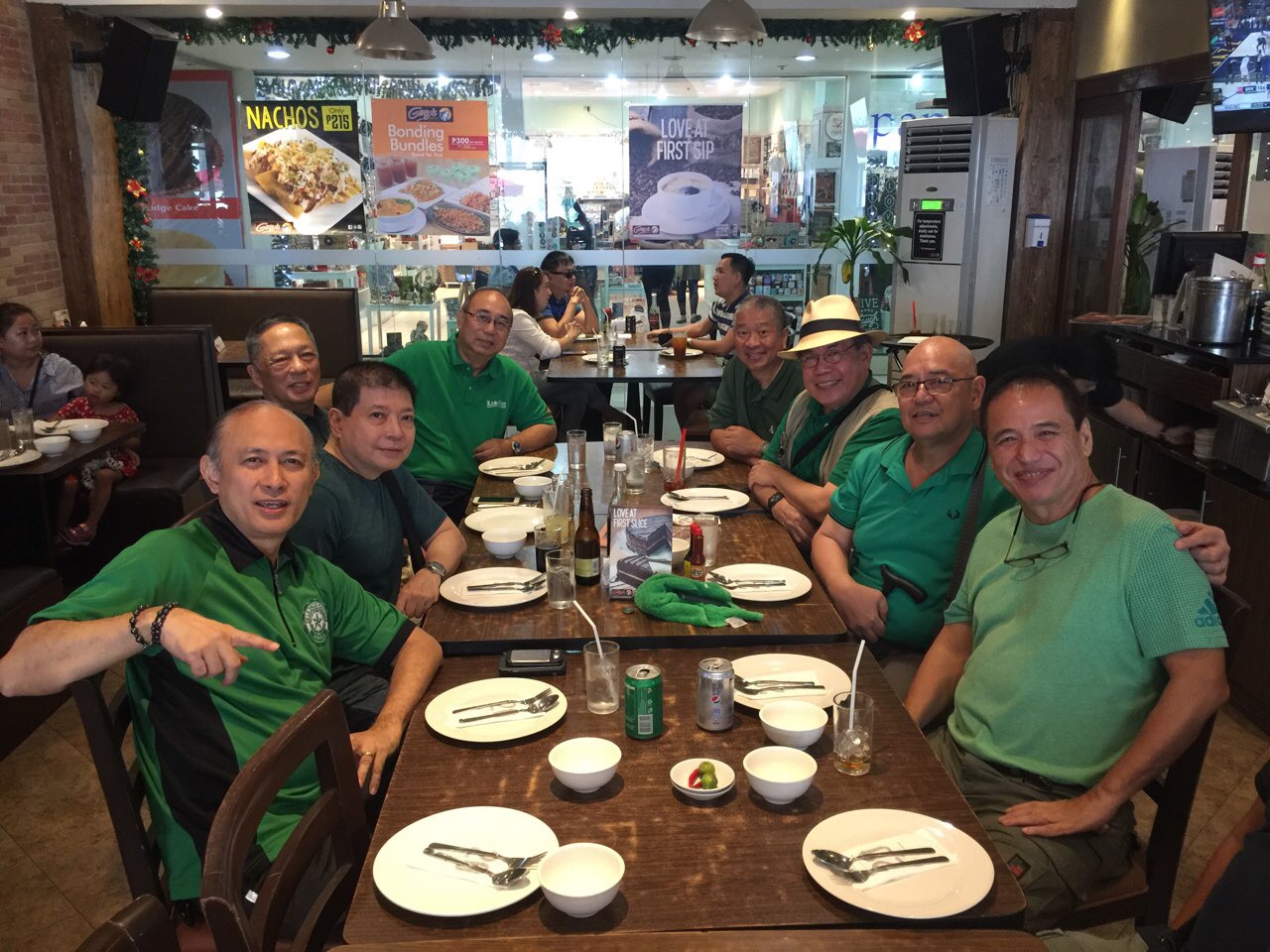
So I could hardly resist when a friend from grade school, who’s so modest I have to call him by his initials JV, invited me and the La Salle Green Hills gang to watch the La Salle-Ateneo game at the Big Dome last November 12. Ever the resourceful fellow (which explains his success in business), JV had managed to secure a certain number of tickets that enabled an impromptu reunion of some guys in our Viber group.

Of course every Pinoy barkada thinks of itself as special, but this one had a genuine claim to fame: our class was accelerated twice, saving us precious time. (And money, for those rarities—destitute La Sallites—like me.) I’ve written about my La Salle sojourn (Prep-Grade 7, 1960-66) elsewhere, the sum of which is, it’s the school I owe my preparation as a writer to, not to mention the supportive friendship of some very fine gentlemen. I went on to the Philippine Science High School, UP, and grad school in America, but I always treasured my schoolboy years in Green Hills and the love of books and language that they left me with.

How much better could it get? One minute I’m watching His Airness drop a game-winning trey, and nearly 30 years later I’m holding a golden ticket to the biggest game of the season so far. (Lest I be accused of treason to UP—which I should be cheering, after all, as a university official—I just haven’t had a chance to attend a live game yet, but was following and rooting for them all the way on the S&A channel, and I promise to come courtside next season.)

IMG_3587

First, we had to dress for the occasion, and while most of my buddies had closets full of green shirts, green socks, and presumably green underwear (JV even wore electric green sneakers), I had to reconnoiter several malls and department stores the week before the game to locate the perfect XXL polo shirt in shamrock green. We assembled four hours before gametime for a long and leisurely lunch in a nearby restaurant—for some of us, our first reunion in over 50 years, a long green-shirted line of seniors who’d last seen each other in khaki shorts, talking maintenance meds over crispy pata and cerveza negra. (Here’s one to us, guys—JV, Billy, Beyey, Dennis, Butch DG, Toffy, Mike, Conrad, and Jun!)

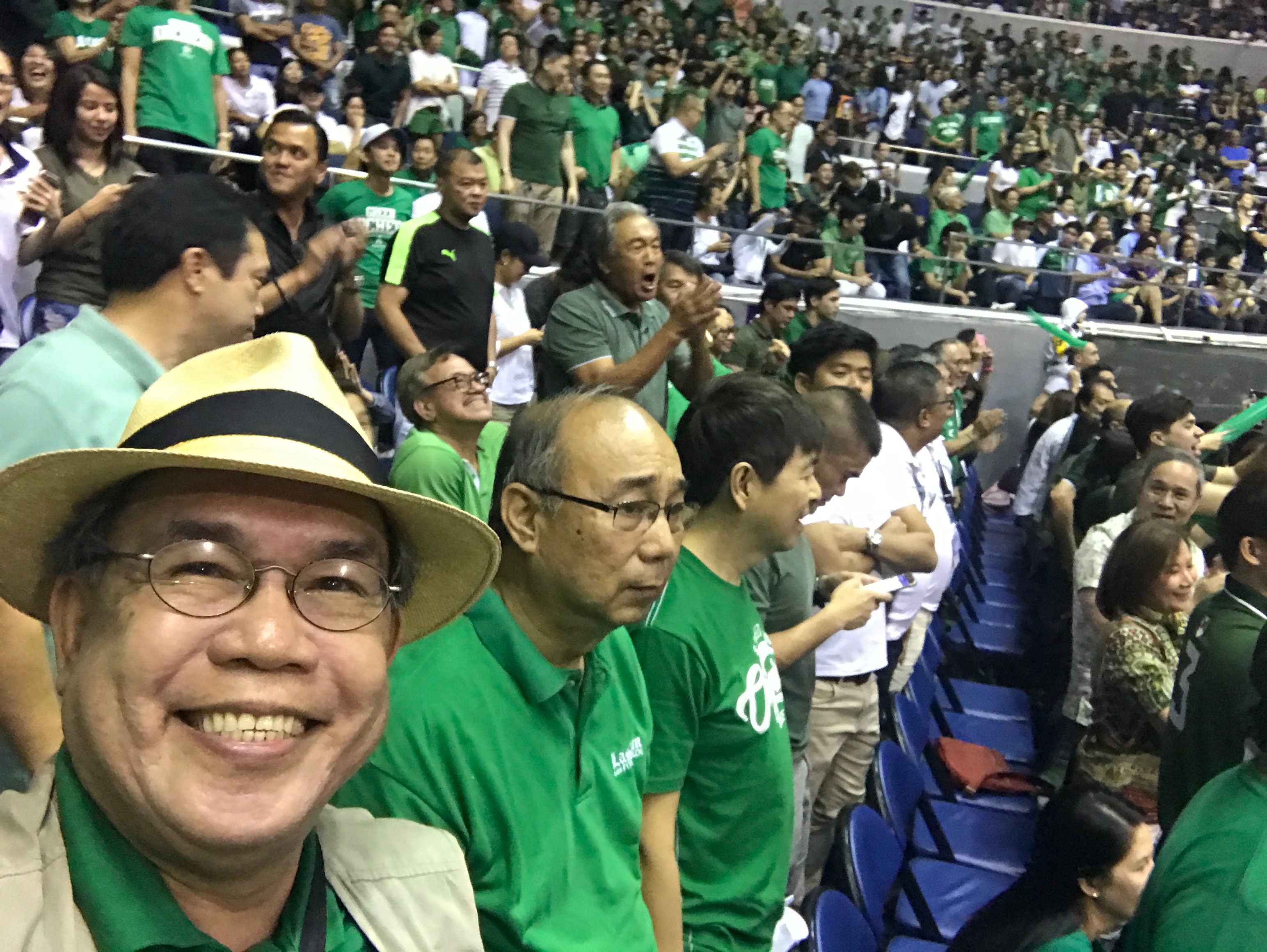
No matter how inured you might be to sports and competition, there’s no way you can escape the peculiar tingle and sizzle of a La Salle-Ateneo game, from the minute the drums unleash their tom-tom thunder from way up in the bleachers to the second the final buzzer sounds and sends half the gallery into hysteria while plunging the other half in utter despair.

It’s a rivalry that they say goes back to 1939, when La Salle beat Ateneo for the NCAA championship for the first time (27-23—sounds more like a halftime score these days). It’s come a long way since, and I don’t know who’s keeping track of the historic score, but every La Salle-Ateneo game feels like the deciding match of a best-of-three finals, going by the sheer electricity around the arena.

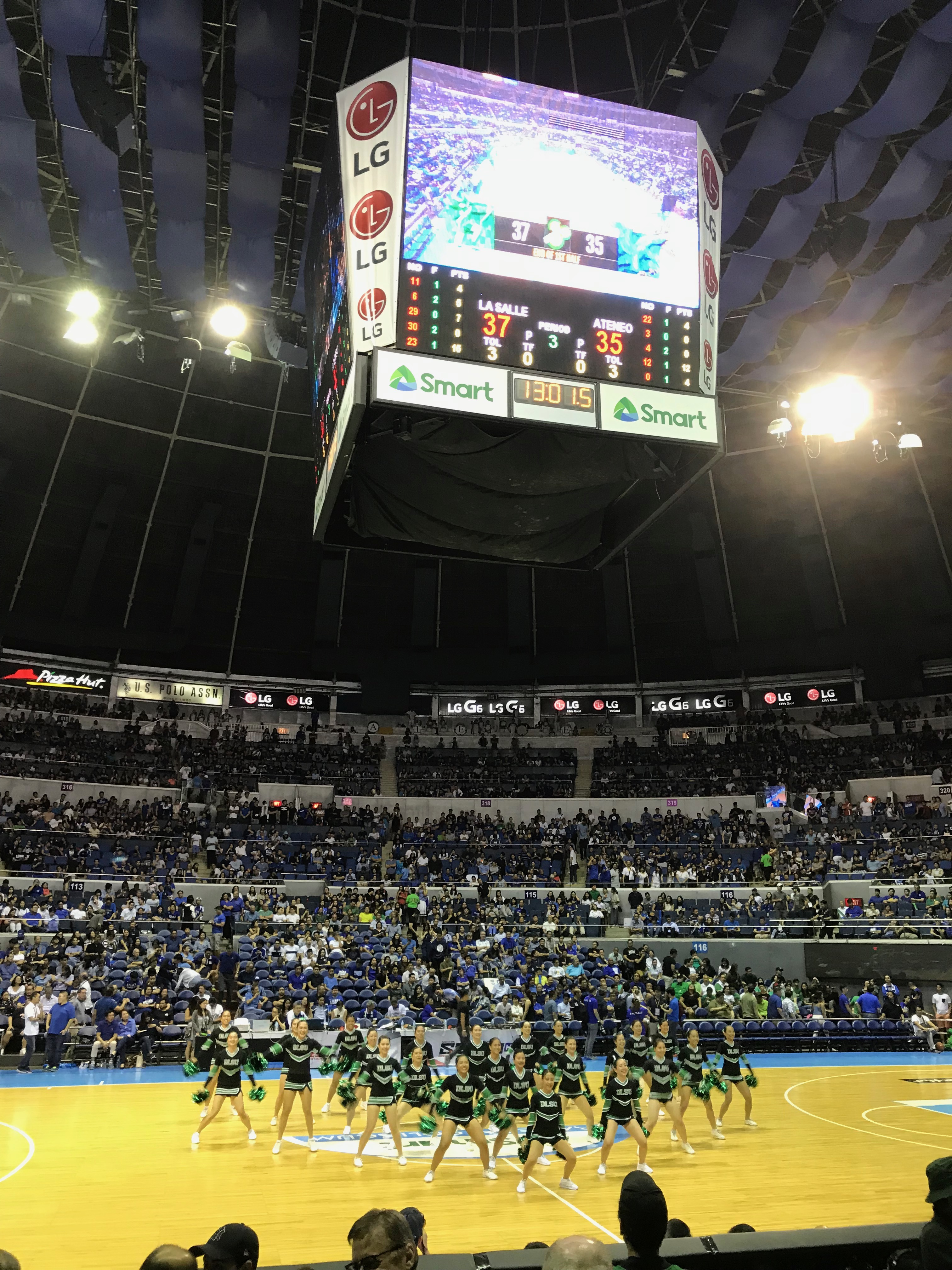
The last time I was at the Araneta Coliseum was two years ago to watch a revival concert of the Zombies; well, this was anything but a zombie crowd. Between spotting all the celebrities in the stands, appreciating the, uhm, fine art of cheerleading, and trying to catch up with new cheers and fight songs that I’d never mouthed before, it was sensory overload for a solid hour, an excursion into a culture I’d read about but had never visited.

I won’t bother you with the details of the game itself, which predictably went the cardiac route, with the Archers going down by as much as 12 in the third quarter, only to unload a 10-0 bomb in the closing minutes that led to an extremely satisfying outcome, 79-76, and just like that afternoon in Milwaukee nearly three decades gone, I found myself screaming and shaking like a broken radiator.

On the way out of the coliseum, a foot-wide grin still plastered to my face, I met a couple of blue-shirted colleagues from academia, whose baleful looks I couldn’t (and didn’t really want to) banish with my most effusive greetings.

IMG_3617