Qwertyman No. 169: Chatting with Apo Lakay

Qwertyman for Monday, October 27, 2025
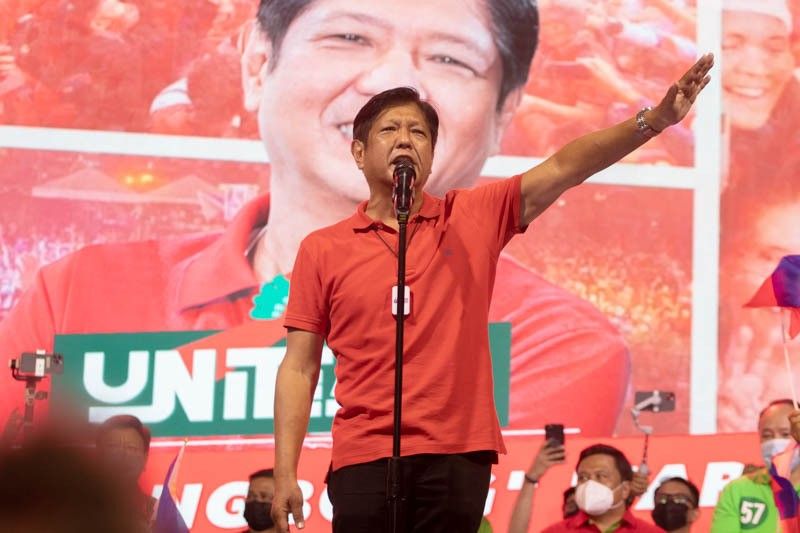
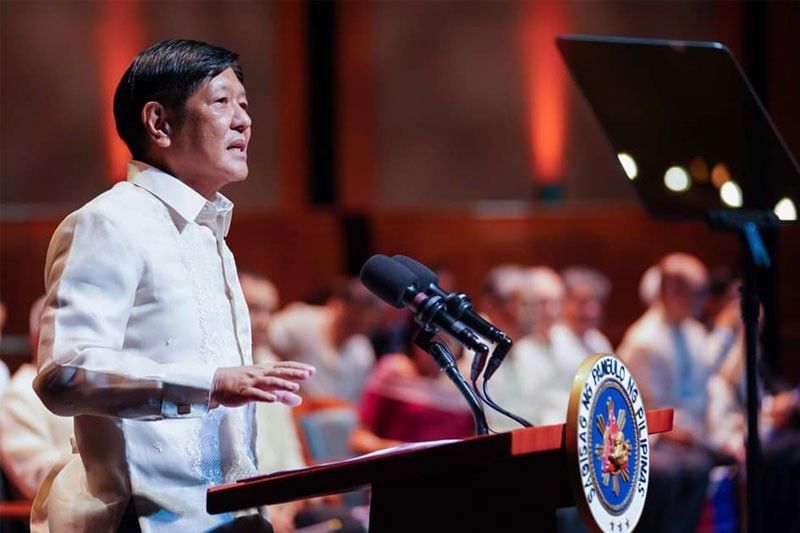
I’VE BEEN going out on a limb for the past few weeks, touting the possibility that President Bongbong Marcos—yes, the son of our martial-law dictator—might be considering doing the right thing and leaving behind his own legacy, one notably different from Apo Lakay’s. 

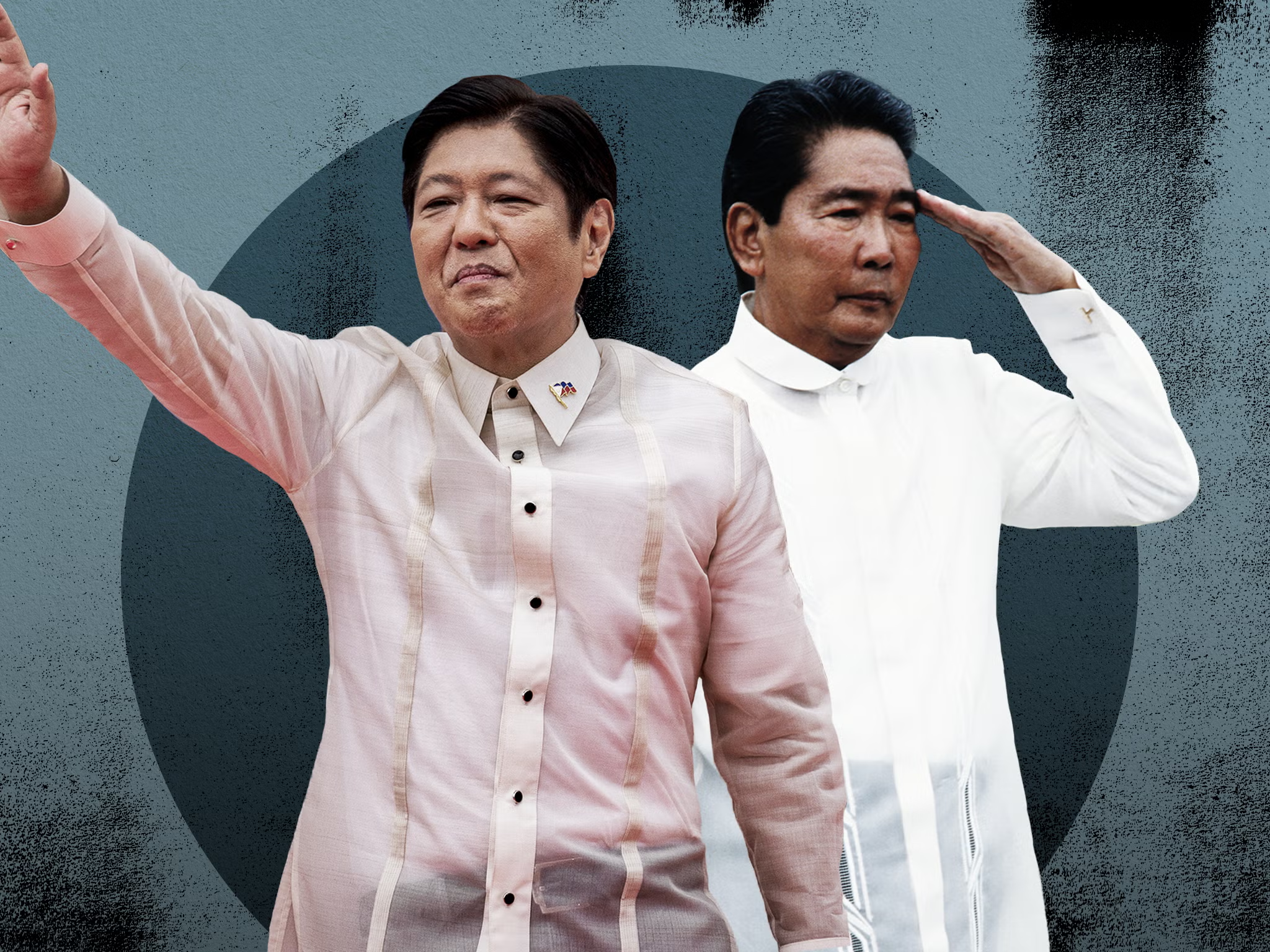
Comes now the news that his spokesperson Atty. Claire Castro—who can usually be counted on for ripostes that elevate the reasonableness of her boss—has been quoted as saying that BBM has been losing sleep conversing with his father (who, let’s not forget, passed on 36 years ago), presumably in search of some advice from the afterlife on contentious current events.

My first reaction was to wonder why their otherworldly tete-a-tete had to take so long, if father and son agreed on the same things. Could they possibly have been arguing? What about? Bank accounts? Sibling rivalry? Forks in the road? And if their encounters leave him sleepless, could BBM be that bothered by FM’s post-mortem perorations on statecraft and, well, craftiness?

This is where VP Sara Duterte enjoys the slight advantage, her father being at least alive and still capable of earthly conversation with Sara on such timely topics as “Your stepmother wants to sell the house in Davao” and “Now where did Pulong’s P51 billion in flood-control funds go?” The Hague may be almost 12,000 kilometers away from Manila, but flying there (on her own dime, she’s careful to insist) beats telepathy or telephony, and creates photo ops with the DDS faithful that nocturnal chit-chats with the departed can’t. (There’s a really nasty and cruel rumor going around, I have to note, that the VP actually wants PRRD to remain and rot away in the Netherlands until he expires—don’t ask me how—just before the May 2028 election, gifting her, like Cory Aquino did on Noynoy’s behalf in 2010, with a wave of sympathy votes. I don’t know if I should applaud or deplore the Pinoy’s political imagination, but there it is.)

Here in Germany, where I’ve just attended the 77th Frankfurt Book Fair where the Philippines was this year’s Guest of Honor and therefore the exotic insect under the microscope, the one inevitable question raised in my many reading and speaking events was “What do you think of the current political situation in your country, and of the fact that another Marcos is now leading it?”

It’s a question I’ve thought about a lot, with or without Frankfurt, and you’ve seen some elements of my answer to it right here in Qwertyman. Pitching these ideas to a foreign audience is a bit more challenging because you don’t have the time to present and explain the details of the context, and you certainly don’t want to lie. 

I’m not the Philippine ambassador, I said to them, so I can and will be frank, but if I seem to equivocate then it’s because the situation isn’t as simple as it looks. Yes, BBM is the dictator’s son and yes, I went to prison as a teenager for seven months—many stayed in far longer—under martial law. Yes, I campaigned for his presidential opponent, Leni Robredo, whom I still believe would have made a better president—and yet could.

But very recently, I noted, PBBM has been making moves that have surprised many, for their effects if not their intentions. Whatever he was thinking at the time, his public disclosure of the bigtime contractors likely tied to multibillion-peso scams that some politicians aided and profited from has shaken the country to its core. The public outrage and demand for justice has been so loud and widespread that it has gone far beyond infrastructure into a searing re-examination of corruption in every aspect and at every level of our government and society.

I brought in the Duterte factor, the continuing threat from his own Vice President and former ally, for whom BBM’s surrender of her father to the International Criminal Court could only be unforgivable. The flood-control scandal and its connection with the Dutertistas was, therefore, a bomb set off by BBM for his own political and personal survival, but one with many unintended consequences and casualties, including some of Marcos’ own soldiers, and still possibly he himself, should the stain reach into the Palace as it has been threatening to (with gleeful encouragement from the DDS).

I don’t know how well the Germans understood or accepted my reading—heck, I’m sure many Filipinos don’t—but when you put over a hundred Filipino creative writers and journalists together for a week, some points of consensus are bound to emerge over the breakfasts and endless cups of coffee. Among them: (1) 2028 can’t come soon enough; (2) BBM should double down on the kind of confidence-building measures that will shore up the rest of his presidency, like pursuing the anti-corruption campaign to the fullest, no matter what; (3) only an alliance between idealist (but sufficiently grounded) moderates and BBM’s best people (not to forget his resources) can hope to stop a Duterte restoration.

I’d tell that to my dad, who died almost 30 years ago and who, to be honest and as close as we were, I haven’t seen much of in my dreams. But like BBM and his papa, we’d likely be up all night. Having passed away while the country was still in the capable hands of “Steady Eddie,” when it seemed that Ramos’ vision of “Philippines 2000” was going to deliver us into a new millennium of political stability and economic growth, Tatay would probably crawl right back into his grave were he to be given a day off to witness what we’ve done since.

(Image from The Independentˆ)
Qwertyman No. 148: Pondering the Inconceivable

Qwertyman for Monday, June 2, 2025

IT SOUNDS like wishful thinking at the moment, but is there even a faint possibility that—in the aftermath of the midterm elections and looking ahead to the next big one down the road—President Bongbong Marcos might be willing to back a progressive candidate to take his place? And would liberal (with a small L) forces accept his help?

Just a few years ago this idea would have been totally preposterous, the relationship between the two sides being one of utter incompatibility and mutual revulsion. Marcos (more the name and what it stood for than Junior himself) was seen as the devil incarnate, while BBM would have deemed unforgivable his family’s ignominious banishment into exile in  Hawaii.

During the May 2022 election, Leni Robredo’s partisans (myself among them) made sure our people remembered the trail of blood and misery that martial law left behind, and the Marcoses’ unpaid debts to the treasury, and to the nation itself.

His election victory was met with profound disbelief and distress; we felt unmoored and stunned for a brief spell (much like the Democrats today, reeling under Trump’s relentless barrage of idiotic but effectively discombobulating executive orders). We took refuge in the certainty that this administration would quickly self-destruct from BBM’s incompetence and from its own internal contradictions—a prediction that has now partially come true, albeit with the most unexpected ramifications.

The spectacular collapse of the “Uniteam” was predictable; it had always been a marriage of convenience, seemingly forged to install BBM as a seatwarmer for VP Sara and the eventual restoration of the Dutertes in Malacañang. No one knew that better than BBM; there was talk (as there will always be, in this country of gifted storytellers) that the Dutertes weren’t even going to let him finish his term, but find a way to ease him out earlier so Sara could do a GMA and rule for longer than six years. So, went the buzz, BBM beat her to the draw by getting her impeached in the House (for good reason) and packing her father off to the Netherlands (for even better reasons).

Now comes the tricky part, which is getting Sara impeached (and struck out of the presidency for good) in the Senate—a newly reconstituted Senate that needs only nine of its 24 members to resist, and thereby keep the Dutertean dream alive. That court will convene sometime this month, with the outcome far from predetermined, but apparently leaning, at the moment, toward acquittal. Two administration senatorial bets—Imee Marcos and Camille Villar—jumped ship, making a crucial difference; the current pro-Sara tally now runs to a comfortable 11, if both Cayetanos, both Villars, and both Estrada siblings (now you see why dynasties are a bad idea?) see a longer horizon for their political futures with Sara on top. 

However, as they say, it ain’t over till it’s over, and the same opportunism that led to this tangle could just as easily turn it around within weeks or months, however long the impeachment trial is going to take. Observers note that at the last big impeachment trial—that of the late Supreme Court Justice Renato Corona—the odds were hugely in his favor at the start, but compelling evidence eventually made it not only unreasonable but politically untenable to acquit him at the end (although notably, his faithful supporter Senator BBM survived and even prospered). A strong prosecution—and, let’s admit, some backroom wooing and strong-arming—could yet land Sara in political limbo.

And that had better happen, because as BBM well knows, if the impeachment fails, his party has no candidate from within strong enough to take on the Dutertes. His apparent anointed, House Speaker Martin Romualdez, has about as much charisma and appeal as a thawed-out tamilok. Apart from the surprise victories of Bam Aquino and Kiko Pangilinan (about which more, later), the one big takeaway from the midterms was the continued strength of the Duterte forces on a national scale, never mind their isolation in Mindanao. An unverified post-election report (again, from the Bureau of Speculation) claimed that in a survey of early votes cast by the military and police, the Duterte slate scored a perfect ten. Why? Well, didn’t PRRD fatten the military, doubling their salaries and raising their retirement benefits? And aside from the mediagenic generals and admirals, who really wants to fight China in the West Philippine Sea? (Not my opinion, folks, just passing it along.)

If and when Sara wins, BBM and the Marcoses may find themselves taking another flight out in the night for parts unknown. The “bloodbath” Sara promised won’t be at the trial, but in its aftermath.

So we return to my first question: can and will BBM find it in himself to support a progressive and acceptable candidate from the middle forces, someone like Sen. Risa Hontiveros? If he insists on fielding his own man and the center-left puts up their candidate, it won’t take a political scientist to figure that as things stand, in a three-cornered fight, Sara will win. The Marcoses will be history (again) and the progressives crushed even more.

An argument can be made for the once-unthinkable. Against all expectations, BBM has done the right thing in de-Dutertizing government, (largely) stopping tokhang, and taking a firm stance for Philippine sovereignty in the WPS. On these issues, we can unite, at least for the time being. It will not be idle thinking to suspect that Bam and Kiko won not by divine miracle but with some backhanded nudge from the administration, who needed them to shore up its Senate votes (Bam, after all, was carried by the INC—as was Marcoleta, so it evens out). BBM’s Cabinet revamp shows signs of sensitivity to expectations and keenness on delivery, if only to shore up his administration for 2028.

He’ll never publicly admit it, but if BBM is truly intent on some measure of redemption for the Marcos name and on making his own mark on the presidency, this could be his historic opportunity. He will do well to support the progressives; it will be an easier and more logical switch than for the progressives to support an anointed trapo. BBM can take a free ride on the idealism of the middle forces, who are his best buffer against both Left and Right extremes.

But then again, all this comes to you sponsored by Willy Wonka’s Chocolate Factory, makers of the Everlasting Gobstopper and other fabulous confections.

Hindsight No. 19: Plot and Character

Hindsight for Monday, May 23, 2022

(Photo from philtstar.com)

WITH THE counting all but over—setting aside some issues not likely to change the outcome—it’s clear that our people have spoken, and that, by a 2-to-1 majority, they have chosen Ferdinand Marcos Jr. to lead this country for the next six years. 

It’s no huge secret that I, among many others, voted for somebody else. Of course I’m unhappy, but what I feel doesn’t really matter much in the scheme of things. Given that the life expectancy of the Filipino male is 67.26 years, I’m already on borrowed time at 68 and would be lucky to see the end of this next administration, let alone the one after that. I’ve told my mom Emy—who voted at age 94 and who shed tears of dismay and disbelief when the results rolled in—that living for six more years to vote one more time should now be her goal. Just surviving will be her best revenge.

I wonder how it is, however, for the young people who took to the streets for Leni and Kiko, believing that they would make a difference. They did, although not in the way they expected, to ride a pink wave all the way to Malacañang. They realized, as we ourselves did ages ago, that money and machinery are always heavy favorites over hope and idealism, and that issues, ideas, and the truth itself can be made to look far less important than image and message, if you can buy the right PR consultant.

They will also have learned, as has been pointed out by other commentators from both sides, that it wasn’t all disinformation—that Marcos Jr. appealed to the genuine desperation of the poor with a promise of relief, however illusory. Since most of Leni’s young supporters were visibly middle-class, first-time voters, it was a rude but necessary awakening to the realities of class politics in this country, which politicians of all kinds—none of whom have to worry about where their next litson baka is coming from—have learned to negotiate and manipulate. 

Defeat, it’s been said, can offer more lessons than victory, and while we may have metaphorically won in some significant respects—chiefly the aggregation of “middle” forces not tied to any traditional political party into a burgeoning progressive movement—there will be much to review and refine in the years ahead. This very dissociation of the Kakampinks from the old parties and their command structures, for example, was a blast of fresh air for many volunteers, but also a liability for operators used to the old ways.

Understandably there’s been much wringing of hands and gnashing of teeth in the trenches, in the desire to meld seething resistance with grudging acceptance. I see it in both young and old activists—the young, because they’re heartbroken for the first time, and the old, because they didn’t expect to find themselves facing a Marcos all over again. The bashing and taunting they’re getting online from galleries of screeching monkeys doesn’t help. 

Being one of those old fogeys, I tend to be more subdued in my reaction to Marcos Jr.’s victory, and advise my young friends to cool down, ignore the bashers, and steel themselves for a complicated and challenging future. As someone who went through and survived martial law—I was eighteen when I was arrested and imprisoned for alleged subversion (although I was never charged or tried in court, just locked up for the state’s peace of mind)—I can offer them living proof that we can survive dictators and despots, with faith, resourcefulness, and courage. My parents survived the Second World War, and many other people have gone through worse.

I’m neither predicting nor wishing that a Marcos presidency will be bound to fail. I’d hate for the country to suffer just to prove a point. Besides, whatever I think today won’t matter one bit to what will happen. Whatever Marcos does, he will do so of his own will, by his own nature, out of his own character. What that character really is will emerge in the crucible of crisis—and crisis is the only thing the future guarantees, whoever the president happens to be. Beyond and regardless of the propaganda for and against him, Mr. Marcos Jr. will have ample opportunity to display what he would not have us glimpse in a public debate, and that revelation will do more than a million tweets calling him a thief or praising his acumen.

Speaking of character, I had an interesting discussion last week with an old friend, a renowned professor of Business Administration, who brought up the possibility of “luck or destiny” to account for the Marcos victory. He added that luck was an important factor in business, and that he would flunk a student who thought otherwise. 

I disagreed; as a teacher of creative writing, I said that I wouldn’t accept “luck or destiny” as a resolution for a student story. We’d call it deus ex machina—a helping hand—which thwarts the logic of the narrative with an artificial and improbable ending. I know: it happens in real life, but not in good fiction. As Mark Twain says in one of my favorite quotations, “Of course fact is stranger than fiction. Fiction, after all, has to make sense.” 

Whether factual or fictional, stories are really less about events—the plot—than character. The plot is simply there to enable character development. Things happen for a reason: to test and reveal our character, to show ourselves and others what kind of people we really are, with dramatic clarity and inevitability.

If you’re wondering why I strayed from the May 9 election to a mini-lecture on writing, it’s because we can look at that election and its aftermath as a long and continuing narrative that will establish our character as citizens, and as leaders. The next crises—the post-pandemic economy, China’s ambitions, a crackdown on civil liberties, getting deeper in debt—will come to try us. That’s the plot. And when that happens, Bongbong will be Bongbong, and all Filipinos—31 million of them, especially—will see exactly what they bargained for.

So if you’re still smarting, just chill, recuperate, get back to something you enjoy doing, and let this drama take its course. Like my mom Emy, endure and survive. Give Marcos Jr. a chance to achieve his “destiny,” which could yet be everyone’s best education.

Hindsight No. 5: The Dropout Factor

Hindsight for Monday, February 14, 2022

(Image from thetimes.co.uk)

HOW MUCH of a factor is Ferdinand Marcos, Jr.’s being a college dropout in making people decide whether he’s worthy of being voted President or not? The anti-Marcos forces seem to think it’s a viable issue, on two counts: first, that Junior failed to complete his studies at Oxford and subsequently at Wharton, despite the extravagant resources put at his disposal; and second, that Junior and his people have repeatedly asserted that he graduated from both institutions, despite clear evidence to the contrary. 

One would think that, in a country where higher education is widely seen to be the only ticket out of poverty, Junior’s profligate ways should have turned off if not outraged large swaths of the CDE electorate that everyone now acknowledges will effectively choose our next leader.

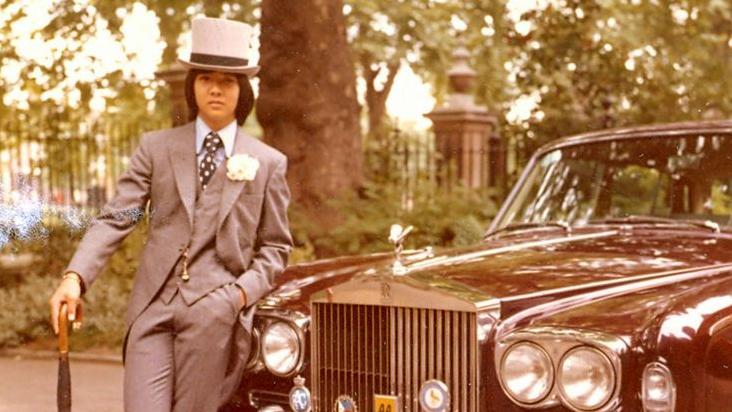
The picture of him posing as a top-hatted dandy in front of a Rolls Royce when he should have been sticking his nose into a book in the library should be sickeningly ridiculous to anyone who has had to take three sweaty and dusty jeepney rides to school. That he or his cohorts would insist that he has a BA and an MBA from the world’s top universities without proof of an actual diploma should offend anyone who failed to finish college, despite a bright mind and high grades, for lack of money—like my father did.

But sadly I suspect that for many of Junior’s supporters, the dropout factor is a non-issue, for a number of reasons. To begin with, going by the statistics, ours is a nation of dropouts. Even well before the pandemic, according to one study, the graduation rate from college was only 61%, which means that two out of every five students fell off the rails. So Junior should be in good company. 

I myself dropped out of UP in my freshman year because I was becoming increasingly more involved with student activism, and I was also itching to get a job and earn some money. Like many dropouts who managed well enough on their own, I wore my undergraduate status for many years like a badge of honor. But there came a point when I simply longed to learn in a more structured way, so I went back to school, and graduated with my AB at age 30.

To Junior’s defenders, dropping out of Oxford is understandable. “Oxford is even harder to get into than UP!” said one online. And besides, said another, he did get a special diploma, which “is already equivalent to having a degree. UK educ system is different from PH system. Between him showing certification vs emailing Oxford, I would believe him.”

As I noted in last week’s column on “Denial and Dissonance,” the politically captive mind will fashion creative explanations for everything from the “fake” landing on the moon to Donald Trump’s “stolen victory” over Joe Biden.

A Reddit thread on the topic overwhelmingly agreed that being a dropout wasn’t the problem; rather, lying about it was. “At least Erap admitted to being a dropout, and he still became President,” said one poster.

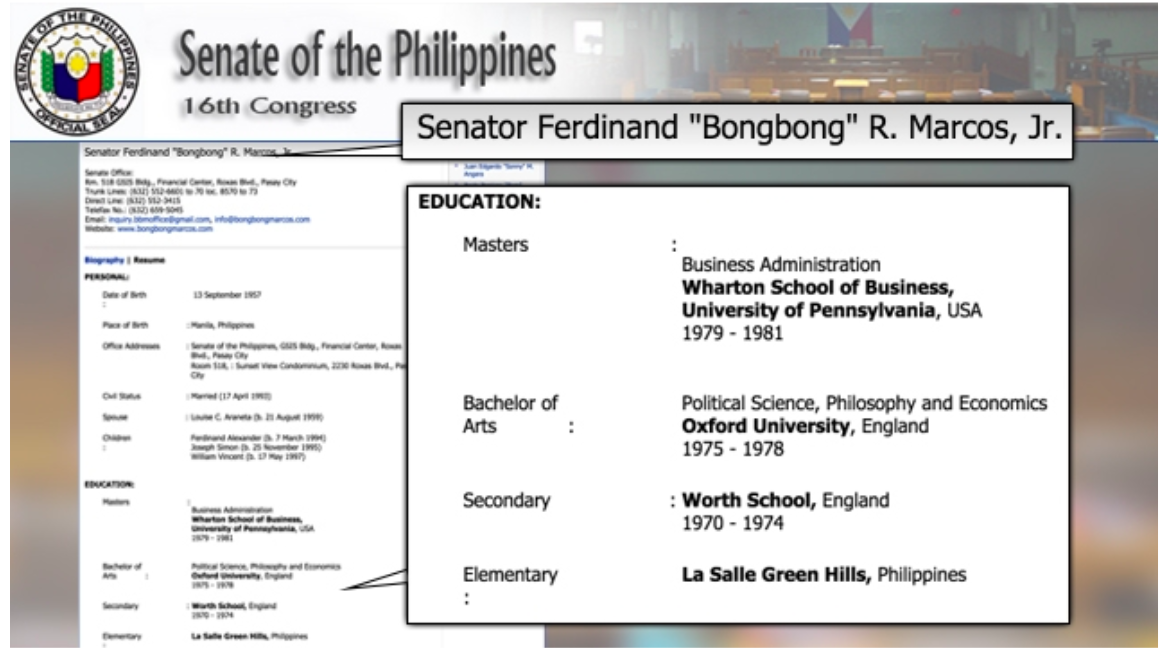
Publicly exposed, Junior back-pedaled. His official Senate resume in 2014—digitally preserved for all time on archive.org—clearly showed him claiming a master’s degree in Business Administration from Wharton and a Bachelor of Arts in Political Science, Philosophy, and Economics from Oxford. This has since been amended to “graduate coursework” for Wharton and a “special diploma” for Oxford.

(Image from rappler.com)

But there’s another side to this college-dropout issue that’s worth thinking about: what’s a diploma really worth, anyway, and what exactly have we done with ours?

We have many thousands of college graduates working well beneath their professional capabilities as domestic helpers overseas, or in jobs that require more use of their hands than their brains. So a diploma has never guaranteed success (and as Junior’s example shows, you can get very far in life without one). 

But also, since when was a college degree a measure of intellectual ability and, even more importantly, of moral probity? What has our incumbent Palace dweller done with his law degree, beyond assuring the tokhang brigade of his full protection and threatening to defy the Supreme Court? At least Ferdinand Sr. used his to cloak his every ploy with a veneer of legality. 

In terms of intellectual caliber, Marcos had probably the most illustrious Cabinet members in our history, with PhDs from the world’s foremost universities, but even they could not rein in his regime’s excesses, and some even abetted them. The good ones left early; a few tried to draw a line; others became willing accomplices to dictatorship and plunder. As idealistic and upright as they may have been or started out, Marcos suborned many of these technocrats and forever compromised the edukado in Philippine society, turning that respected figure into a minister at the foot of a despot, his wife, and their whimsy.

Our incumbent burnished anti-intellectualism into a virtue to curry favor with the crowds, and got flunkies with LLB’s to explain away his bad behavior like auditioning comedians. You listen to their tortured spiels and you ask, was this what they went to college for?

Wealth and power hold far more charm for many of us than schooling, because we see education as but a means to those ends. To be rich is to be smart and praiseworthy enough. If the rich behave imperially, impudently, irresponsibly—well, they earned it, didn’t they? We can forgive and excuse them no end; we still think like tenants thrilled to be invited into the big house for a cup of chocolate. 

We seem surprised and suspicious when a well-educated person with an honest heart claims to love and understand us, and promises to improve our lives, because we no longer recognize real goodness and ability when we see them. So we go with the devil we know, and who cares how he fared in History or Philosophy? As Ping Lacson puts it, logic was never our strong suit: “Ayaw mong manakawan, tapos, boboto ka ng magnanakaw?” I have a PhD, and I can’t figure that one out.