Qwertyman for Monday, February 9, 2026
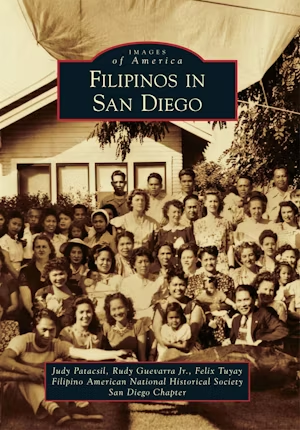
LAST WEEK, at the Executive House of the University of the Philippines where he officially resides, UP President Angelo “Jijil” Jimenez graciously hosted a delegation of about twenty Filipino-American business and community leaders from San Diego, California, led by our honorary consul there, Atty. Audie de Castro.
I was happy and proud to have helped facilitate this visit, having some close personal and professional ties myself to San Diego. Our unica hija Demi married a San Diegan, and has happily lived there with her husband Jerry for almost 20 years now. My wife Beng and I visit her nearly every year if we can afford it.
San Diego also happens to be where a dear friend of mine, Mrs. Julie Hill, lives in a lovely home in Rancho Sta. Fe. Julie stayed in the Philippines for some years many decades ago when her husband was the Ford Foundation representative here and fell in love with the country and its people, and despite having traveled and served all over the world, the Philippines retains a special place in Julie’s heart. The last time I dropped in on her a year ago, Julie (who’s approaching 90) announced that she was donating what came out to more than P20 million to help the poorest of UP students. Atty. De Castro helped to formalize that donation as our consul in San Diego, cementing our relationship.
Professionally, but through Julie’s recommendation, I also served as Pacific Leadership Fellow in 2014 at the University of California San Diego, where I had previously lectured on Philippine-American affairs. Beng, meanwhile, observed operations and state-of-the-art techniques at the Balboa Art Conservation Center.
In other words, we’ve established rather close ties to this sunny and vibrant city in Southern California, where many generations of Fil-Ams have taken root, mainly because of the US naval base there, where thousands of Filipino sailors recruited from the Philippines have served. That’s how Demi’s in-laws came to San Diego from Bicol, their children born as Americans but deeply mindful of their Filipino heritage.
Many of our visitors never saw the Philippines until they were grown up, and I think most were setting foot on the UP campus for the first time. So we gave them the warmest reception and the best orientation we could, and engaged them over lunch in a lively discussion.
One of them asked: “What is the Filipino dream?” My UP colleagues responded to that in various ways, coming from different technical and academic disciplines. I tried to give a pedestrian answer: “The Filipino dream is actually a fairly simple one: a roof over one’s head, food on the table, a good education for the children, peace and justice in our communities. We dream for our families. But like all seemingly simple things, achieving that dream is difficult and complicated.”
The visitors had earlier asked President Jimenez about UP’s role in national leadership, and beyond citing how many presidents, senators, and Supreme Court justices we’ve produced—which, to be honest, has also contributed to the ruination of our nation—Jijil emphasized the value his administration places on service to the Filipino people, which can manifest even from beyond our shores. He spoke of UP sharing its knowledge and resources with other SUCs, of UP assuming its responsibilities as the country’s national university—a concept perhaps alien to the American situation but entirely relevant to ours. (I was aware, of course, that UP has many internal issues and priorities of its own to sort out—it always has, regardless of administration.)
A more challenging discussion was one that I had on the side with two ladies who admitted that they represented two ends of the American p0litical spectrum, but had managed to remain friends despite their differences. Their question for me was, what did I personally think of what was happening in America?
No longer in UP spokesman mode, I could have answered as bluntly as possible, but I wanted to give them the more nuanced answer their friendship deserved.
I began by saying that I considered myself an exemplar of American colonial education, having gone to a private elementary school in the 1960s where I learned about “heifers” and “mackinaws” long before I ever got to see real ones, and even memorized American states and their capitals, to the dismay of my future American friends when we played Trivial Pursuit. I shed off much of the mystification as a student activist in the 1970s and took a far more critical view of the American influence over our history, economy, and politics.
But the indoctrination was so effective that I retained a fundamental affection and even admiration for many aspects of American culture and technology, and maintained a lifelong and ultimately professional interest in the US. I studied and worked for five years in the Midwestern heartland, in Michigan and Wisconsin, I taught American literature—not just in UP but in America itself, to college students who seemed surprised that I seemed to know more about their country than they did. Not just because our daughter lives there, I continue to follow American affairs keenly, starting my day with the digital editions of the New York Times and the Washington Post (the latter now sadly degraded).
What I told them was that this America was no longer the America I once thought I knew and looked up to, despite its excesses. I said I thought I understood, at least in part, where MAGA was coming from, in the neglect of the American working class and their anxieties in a rapidly changed world. At the same time, Donald Trump had ridden on those grievances to empower and aggrandize himself and the billionaire elite, trampling on the very liberties that had once defined American democracy, imposing his racist and imperialist vision of America, and endangering global peace and security. The shootings in Minnesota were profoundly shocking and depressing. I said that as much as it saddened me, with loved ones in the US, I did not plan on visiting America again until this madness had passed. If even American citizens could be dragged by masked men into vans and summarily deported to El Salvador, then I did not want to risk an encounter with the American Gestapo.
I could have added that both Americans and Filipinos, as polarized as we have become, need to find some common ground, as we share problems that cut across our differences. Bu the time was short, and we sent our guests off with a smile.
 Pinoy Penman 3.0