Penman No. 154: Teaching English to Filipinos

NEU

Penman for Monday, June 22, 2015

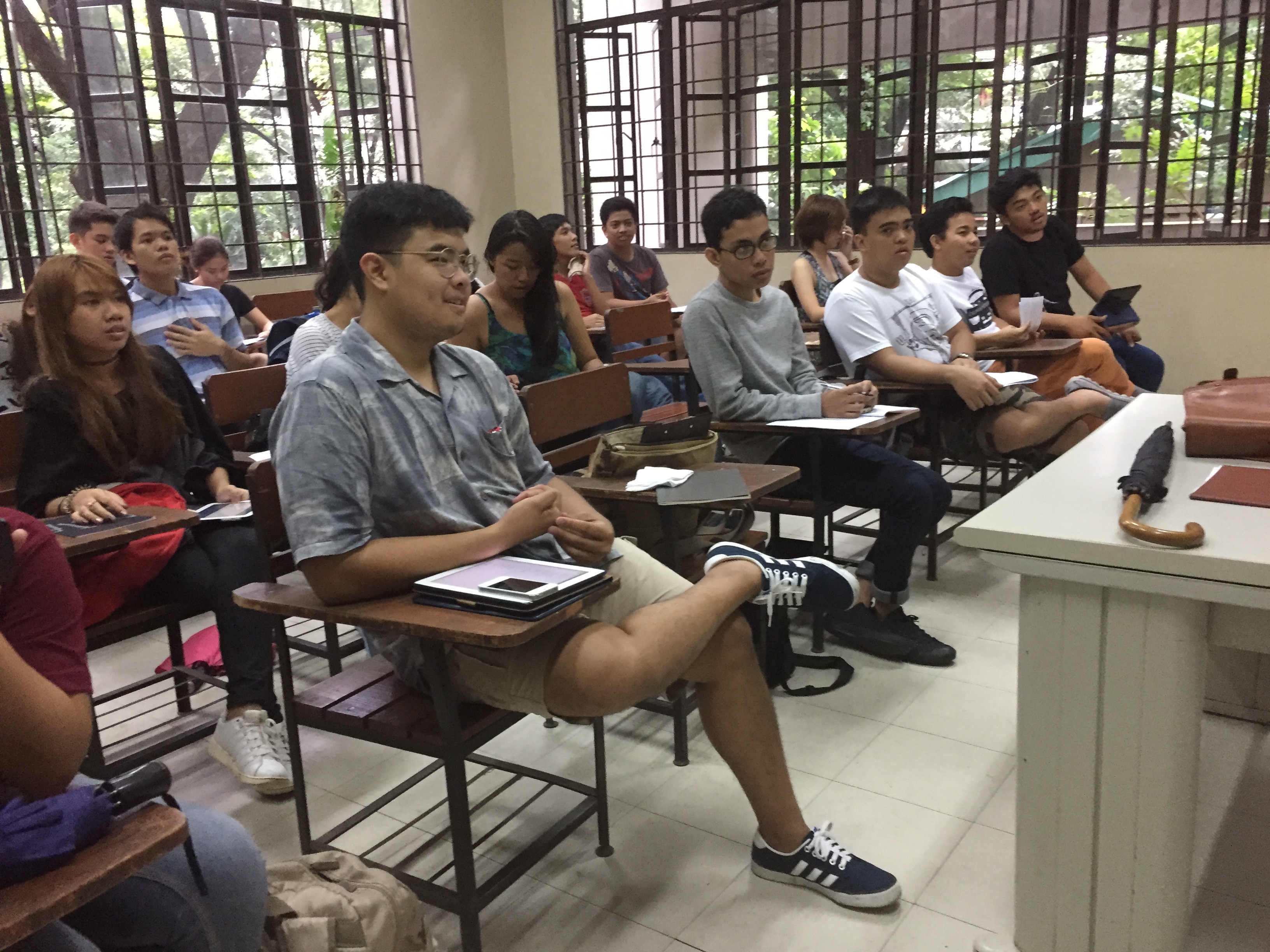
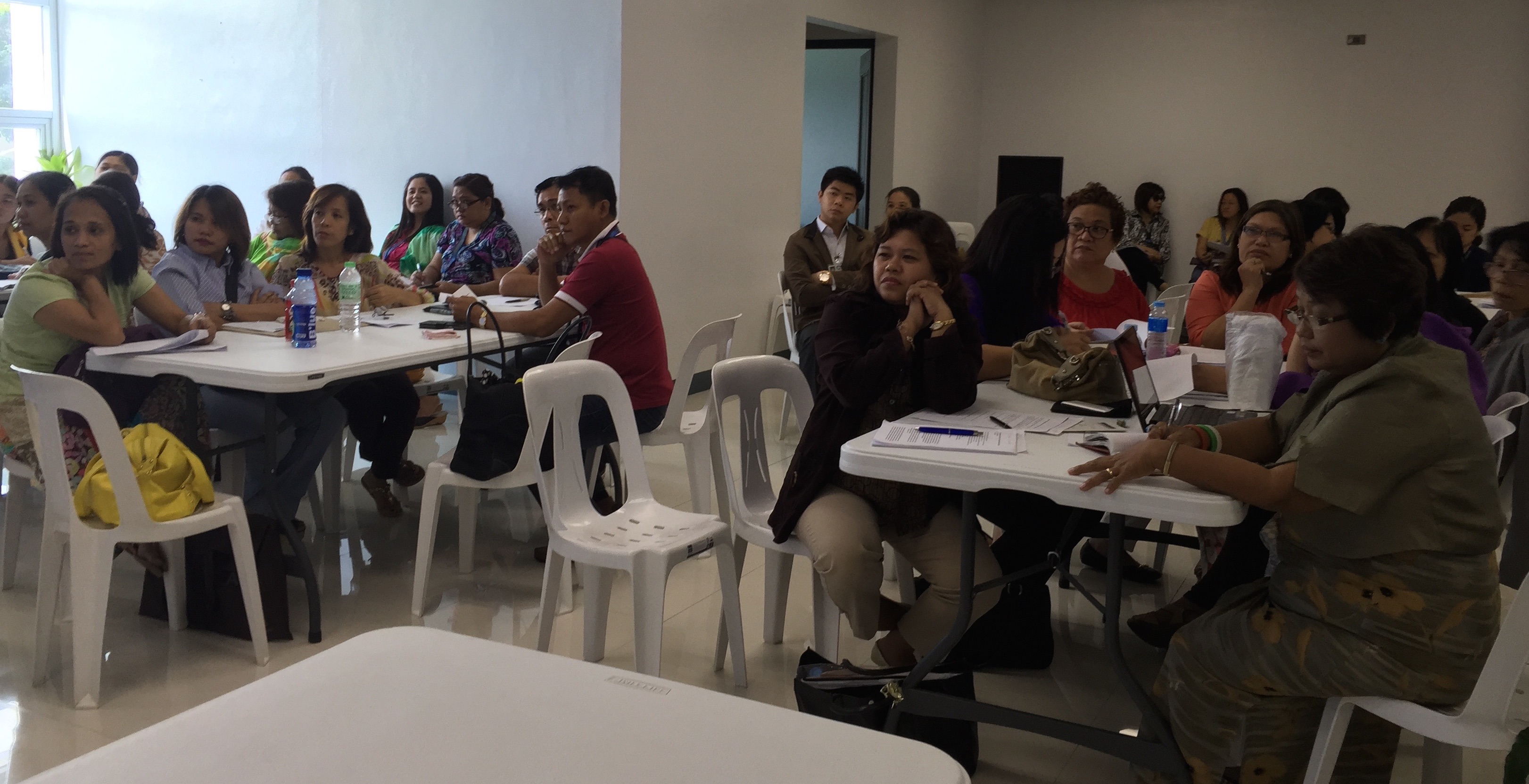
I HAD a great time last week with the English faculty of New Era University in Quezon City, who had invited me to speak at their three-day workshop on “Enhancing English Teaching Practices.” For three days, I met with a very lively group of about 30 to 40 college and high school teachers of English, talking about writing, reading, and teaching the language in today’s Filipino classroom.

I was backstopped in these discussions by the young and very sharp Ms. Cyndriel “CY” Meimban, who had taken her high school at New Era before doing an English degree with us at the University of the Philippines and then a master’s in Education at Arizona State U. CY—who also just happens to be the daughter of an old friend and fellow Fulbrighter, Dr. Adriel Meimban—took a break from her teaching duties at Northern Arizona University to help out her fellow teachers at NEU.

It was my first visit to the NEU campus near Commonwealth Avenue, which was rather ironic because we’ve lived on the UP campus just across that avenue for the past ten years. The NEU is part of the Iglesia ni Cristo complex and is run by the church, although I was pleasantly surprised to find that it’s open to all faiths. There’s a substantial Muslim population in that very area, for example, and many students from that community attend New Era.

We held our workshop in the new Professional Schools building, which housed NEU’s colleges of Law and Medicine, among others; more prominently, along Commonwealth Avenue, the College of Evangelical Ministry which Dr. Meimban (a former president of NEU) now heads trains young INC ministers, including about a hundred students from overseas—Filipino-Americans and Filipino-Europeans, among many others; I was surprised to be addressed by a young black man from South Africa in perfect Filipino. I was, in other words, in a very rich cultural and linguistic environment, in which language is used not just to express oneself or get jobs but to propagate the faith.

Otherwise, the workshop attendees voiced the same problems I’ve heard elsewhere: a clear decline in English proficiency not just among students but teachers as well; the lack of new materials in the syllabi, particularly in literature classes, as well as teaching guides for these materials; and the persistence of outdated approaches to the reading and teaching of literature and of English itself.

I began my presentation with something I always emphasize when I teach English in UP, especially in my American Literature class: we study and teach English not because we want to be Americans, British, or some other Anglophone people, but to become better Filipinos. We learn English and study other literatures in English to gain insights into and understand how these other societies operate and how certain human values and truths transcend national and social boundaries. Thereby, we should lose our unfamiliarity with and our awe of the foreign, empowering ourselves as citizens of the world.

I did a module on creative writing—focusing on fiction and nonfiction—as a way of showing teachers how writers think and work, so they can themselves become writers or at least understand what writers do and how they do it. In reading and teaching literature, I went over several poems and stories, and asked my audience to draw up a list of questions that could or should be raised about the text beyond “What’s the moral lesson?”

I emphasized the importance of considering and discussing form and technique as much as content and meaning as a way of seeing how language works, on the level of the sentence or even the word. I argued for the enjoyment of language for its own sake—in effect, for the study of literature as an exercise in pleasure as much as in education.

The problem with too many literature classes is that they’re taught as anything but literature—as philosophy, as religion, as politics—rather than as the imaginative play on words that lies at the heart of literature. When teachers march into class and declare, “Class, this is what this poem means, and believe me because I’m the absolute authority on it,” students and even teachers miss out on the fun of discovery, of teasing out sense from seeming chaos.

Inevitably, the question of a “language policy” came up. Would students benefit from the imposition of an “English-only” policy? Was it all right (or was it criminal) for a teacher of English to resort to Filipino when teaching English, or literature in English?

I went out on a limb here—and I’m sure that what I’ll say here will turn many a reader livid with consternation and disgust—but I said that, even as a former chair of the UP English Department, I’ve always been opposed to an English-only policy, because it’s silly and it simply doesn’t work.

We study English—and try to master it—because it serves us well in communication and in business, especially in a global sense, but to deliberately throttle our use of other languages (of which we have an enormous wealth) in the notion that it will somehow make us better users and speakers of English is downright stupid. I’ve yet to meet someone who now speaks and writes perfect English by having paid 5 centavos for every Filipino word he or she used. Most writers of my generation are happily bilingual or even trilingual, and we don’t get our languages or linguistic registers mixed up; what’s key is appropriateness—which language and which register is best for which occasion?

I would even argue that code-switching from English to Filipino can work in the teaching of English, and especially of literature in English, if it relaxes the non-Anglophone student and allows him or her to speak—and even to make a mistake, which should also be encouraged (and gently corrected) without too heavy a penalty. Patience and understanding, rather than force and sheer authority, have always gotten me better results in the classroom. I hope my colleagues in New Era University got a taste of that treatment, and that they enjoyed the experience.

Penman No. 118: To Teach Is to Persist

To-teach-is-to-persist-Penman-Butch-DalisayPenman for Monday, October 13, 2014


SOMEONE REMINDED me that World Teachers’ Day was celebrated earlier this month, on October 5. I forgot about it because I was—I am—overseas, on sabbatical leave until mid-2015. In our department at the University of the Philippines, we normally get just one sabbatical leave over the course of our teaching career, and typically, professors take it a few years before retirement. I’m five years away from that crossroads, so this is a good time to be away from the classroom and to recharge, which is what the sabbatical leave was originally designed for.

Wikipedia tells us that “Sabbatical (from Latin sabbaticus, from Greek sabbatikos, from Hebrew shabbat, i.e., Sabbath, literally a ‘ceasing’) is a rest from work, or a break, often lasting from two months to a year. The concept of sabbatical has a source in shmita, described several places in the Bible (Leviticus 25, for example, where there is a commandment to desist from working the fields in the seventh year). In the strict sense, therefore, a sabbatical lasts a year.”

This sabbatical, however, is shaping up to be anything but a vacation, or a rest break. I may be cool and dry in an America turning pretty with the onset of autumn, but my workload is as tropically toxic as ever, with several books to complete, columns and articles to write, faculty advising duties to perform, and sundry interests—totally and thankfully unscholarly—to pursue.

I do get a respite from the classroom, but, perhaps ironically, that’s the part of teaching I miss the most. As we celebrated World Teachers Day, I also realized that I was marking my 30th year of teaching this November, and I asked myself what three decades of teaching have taught me. After some reflection, it came down to this: to teach is to persist in the perfection of our humanity and our citizenship. That sounds awfully grand to the point of being pompous and pretentious—don’t we, after all, just grab a book, drag our feet to class, and preach bunkum for an hour to a roomful of people with the pulse rate of zombies to earn our lunch and gas money?

There are, of course, many days just like that in a teaching career, days that blur one into the other until the end of yet another semester. And at some point, it’ll get to you: your speech starts slurring and your eyes get glassy, and you can’t wait until the bell rings or the hour hand moves; you had a long rough night, the car needs new tires, the bills are piling up, your thoughts keep drifting back to Paris or Palawan, and the last thing you or your students want to talk about is disease and social order in William Carlos Williams’ “The Use of Force.”

Maybe ten years ago, I had such a day at the very start of the semester, and without realizing it, I must have been so bleary-eyed that I gave off the impression of not quite being there. To my great shock and dismay, one student later blogged about her disappointment with what she had seen; she had expected a stirring performance from her professor on Day One. It was a wake-up call, and I woke up; I promised that student that I would do my best to live up to her expectations, and I hope I did; we’re good, and she’s since gone on to a promising career in writing.

What I became acutely aware of then was that every teaching day is a performance, not unlike a show a professional actor studies and rehearses for, with the additional challenge that one simply doesn’t repeat the previous show, but keeps adding to it, improvising when possible to adapt to changes in the composition and the mood of every audience. I mutter my first lines to myself on the steps up to my classroom, ticking off the day’s main points and questions in my head; I take a deep breath, step into the door, flash a brief smile, and the day begins. And like the pro I have to be, I’ve learned to take care of myself, so I can teach well—to stay healthy, to sleep well (especially before a class day), and to think of something new to say or to bring to the next class.

So we all have our bad days, but it’s precisely on days like these when we need to remind ourselves of what a tremendous opportunity we have to make this Tuesday or Wednesday one of the most memorable in our young charges’ lives, through something we say, an idea or an experience we share, that will turn a key and open a door in their minds. Only in teaching can an ordinary, even a boring, day suddenly become indelibly special, with nothing more than thoughts and words—and the teacher’s persistence and faith in every student’s potential for transformation into someone more aware, more human, more Filipino. Perfectability? It’s more about the effort than the goal—and I’m sure that whatever we do for our students, we teachers do for ourselves as well.


SPEAKING OF teaching, my department has asked me to invite all teachers and students interested or involved in translation issues to attend the 6th Asian Translation Traditions Conference (ATT6) to be held October 23-25, 2014 at the University of the Philippines, Diliman, Quezon City.

The official flyer says that “The rationale for the ATT series is to challenge the Eurocentric emphasis of Translation Studies, which is largely due to the “unavailability of reliable data and systematic analysis of translation activities in non-European cultures” (Hung and Wakabayashi 2005). The ATT series was initiated by Professor Eva Hung of Hong Kong in 2002. A small but successful workshop was held in London that same year, followed by well-attended international conferences in India, Turkey, Hong Kong, and the United Arab Emirates. It is hoped that ATT6 will lead to theorizing on translation and developing methodologies on translation arising from the specific historical and contemporary contexts of Asia.”

Hmmm, I think that needs to be translated: this conference will explore the theory and practice of translation in an Asian context. For more details, please visit http://asiantranslation6.up.edu.ph/.

{Illustration by Igan D’Bayan of the Philippine Star.)

Penman No. 107: Small Loans for Big Dreams

WS-Butch-1Penman for Monday, July 28, 2014


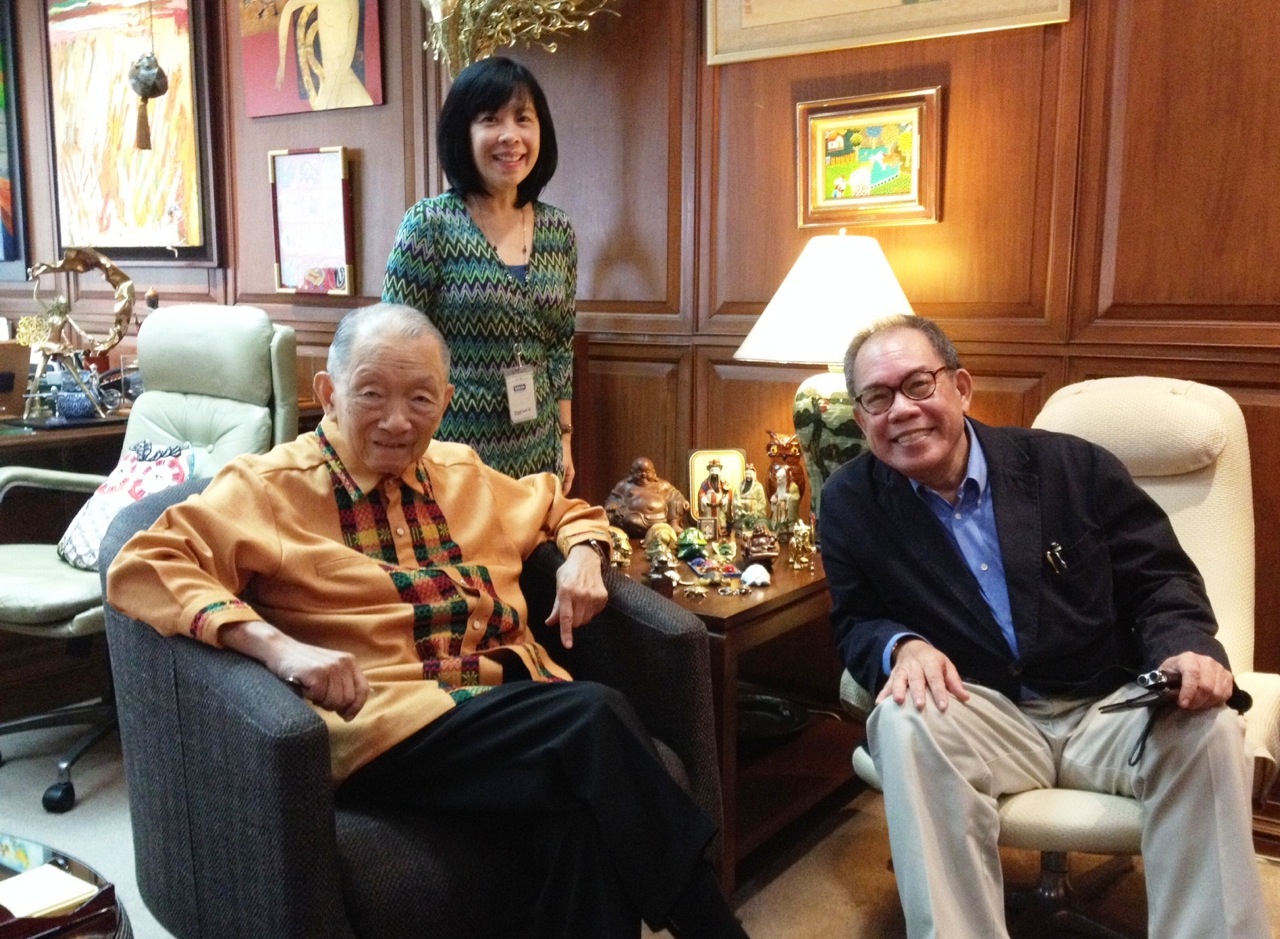
IT HAD been a few years since I last sat down for a chat with the accounting and business guru Washington SyCip, whose biography (Wash: Only a Bookkeeper, published in 2009) I had been privileged to write, so I was only too happy to oblige when our mutual friend Marlu Balmaceda asked if I could spend some time last week to shoot the breeze with Wash.

Both Wash and I had aged a bit since we started working on his book back in 2006—I more so than he, who last month turned 93. Having just gotten my senior card in January, I’ve been feeling entitled to some relaxation, but Wash SyCip was right at his desk in his old 14th floor office where I last saw him, working away, surrounded by a growing menagerie of owls, turtles, and roosters, the gifts of friends. On the wall was a Chinese painting of a dignitary, perhaps the Emperor himself, seeking the counsel of a wizened turtle. Wash caught me looking at it and told me what the turtle’s sage advice was: “Take it easy.”

As cool and dapper as he is, Wash makes it look like he’s taken it easy all his life, but I know for a fact—having chronicled that life—that it just isn’t so. No slouch could’ve put up and sustained what became the regional accounting giant SGV.

But this time, Wash wasn’t talking about himself, but about a new program for education that he and a friend began three years ago, called the Zero Dropout Education Scheme, which seeks to put and keep poor Filipino kids in school. “The country’s biggest problem remains poverty and the wide gap between the rich and the poor,” Wash says. “For me, education is key to alleviating poverty, but ironically, the poorer you are, the more children you have, so half go to school and half don’t. Those who don’t will stay illiterate, and will be resigned to poverty all their lives.”

Seeing that illiteracy still afflicted millions of Filipinos, Wash resolved to do something about it and committed US$1 million of his own money to a fund aimed at the problem. Helping him along was his friend, the Armenian-American businessman and philanthropist Paul Kazarian, who pledged to match Wash’s contribution dollar for dollar. But even with that funding, Wash was modest and realistic enough to know that he couldn’t do the job by himself. “I don’t really know the poor, and how best to reach them,” he admits. “So I got in touch with CARD-MRI, which has been a leader in Philippine microfinance, to help us out.” Radiowealth Finance Corporation has also geared its CSR program toward the Zero Dropout scheme, and committed to provide P30 million.

The Center for Agriculture and Development-Mutually Reinforcing Institutions or CARD-MRI goes all the way back to 1986 when Dr. Jaime Aristotle Alip and 14 other rural development practitioners got together to set up CARD specifically to help empower women in poor communities. In 2008, it received the Ramon Magsaysay Award for Public Service. “With over 1,400 units all over the country, CARD had a network in place we could tap for our program,” Wash says.

Initially available to CARD members, the Zero Dropout scheme offers small renewable loans ranging from P1,500 to P3,000, at a monthly interest rate of 1 percent. “Basic education may be free,” Wash acknowledges. “But families still need money for school supplies, slippers, clothes, and other expenses. That’s where we come in. We’d like to provide not just the money, but an easy way of getting it, with as little red tape as possible.”

As of March this year, the program had supported over 46,000 students through loans totaling over P160 million, out of which P130 million in principal and P6.5 million in interest has already been paid back. They expect to hit 100,000 beneficiaries by year’s end.

While most beneficiaries come from Region IV-A (the Calabarzon area), the program has expanded to the ARMM in Mindanao, where the dropout rates are the highest. Typical beneficiaries include Lucena native Lilia Fernandez, a mother of nine who works as a manicurist alongside her husband, a construction worker; her son Erick dreams of becoming an engineer.

Unlike the government’s conditional cash transfer program, which gives cash direct to poor beneficiaries, Zero Dropout is a loan program. “They repay the loan through microfinance, by increasing their income with a loan for a store, a tricycle, and so on,” adds Wash.

If you think poor borrowers can’t or won’t repay their loans, think again. CARD has made a name for itself making sure its system works, basically because it’s led by people from the very grassroots it serves. Wash tells this story: “I had CARD’s management people over for dinner at my house once, and discovered that none of them were from Makati or Manila. They were all from the rural areas, and they were mostly women, very bright women. I was very impressed with their dedication. CARD knows its clientele. It works with groups of 20 women who guarantee each other. I’ve attended meetings with these groups and I can see that our poor communities are full of people with initiative and drive.”

I came away most impressed by an incident that Wash related: “When Yolanda hit, 8,000 students under the program were affected in Leyte and other places. My first reaction was to cancel their loans, as the least we could do to help. But Dr. Alip said, Wash, no—the poor are more honest than the rich. And as reconstruction took off, the loans also began to be repaid, even if the borrowers had lost their homes.” If that’s not inspiring—in the context of billions lost to crooks and scammers—I don’t know what is.

Penman No. 38: Why I Teach Creative Writing

English Class

Penman for Monday, March 18, 2013

LAST THURSDAY, I delivered the keynote speech at a conference of creative writing teachers held at the University of the Philippines, and this was part of what I told them:

I’m going to propose an idea that will probably sound like heresy today: I teach creative writing not to promote the science or the politics of literature, but to help enlighten the mind and ennoble the spirit. These are big words, but creative writing is a big thing. It has been a big thing for a very long time, and one might even argue that it got a lot smaller when it became an academic discipline, subject to the vagaries and vicissitudes of departmental politics, and the constant and sometimes annoying need to justify its existence to those who ask, with ill-concealed derision, “Can creative writing be taught?”

Let me humor that point for a minute. No one ever asks if music can be taught, or if ballet can be taught, or if painting can be taught—and yet, in all of these artistic endeavors, a mentor-mentee relationship has been the practice if not the rule for ages. It may be that writing is a more solitary act, and indeed, until the 20th century, was something self-taught, and people like Shakespeare and Nick Joaquin wrote without the benefit of a BACW or an MFA.

But most people aren’t Shakespeare and aren’t Nick Joaquin, and we’re no longer in the 17th or even the 20th century. Genius can take care of itself; most people can’t, particularly in a time when what are seen to be the more practical necessities of life militate strongly against a young person’s decision to choose a life of art. This, I believe, is the social function of artistic education today—the preservation and promotion of art as a vital human enterprise, alongside the sciences and the professions, without which society would fail, in the absence of the self-critical mirror that the artistic imagination provides.

Those of us who teach creative writing—or music, or dance, or painting, and so on—should fight to claim our space in academia, not because we need the jobs (which of course we do), but because society needs us for its own well-being, as nurturers of our people’s imagination. Like life itself, each work of art emerges from a synthesis of method and mystery, and sometimes the happiest and most wondrous results arise from what may seem to be accident and serendipity. But as a social project, the production of art cannot be left to chance.

This is particularly significant in the context of a country and a society like ours, whose people remain in dire need of a sense of nationhood—a sense that can only be artificially defined if not distorted by politicians, but more authentically apprehended by artists. The stories, poems, essays, and plays that our students write are this generation’s understanding of who and what we are, and this has been one of the key principles of my own teaching of creative writing: to help the student find not only himself or herself, but to find himself or herself in the community of others, in the life of the nation.

Thus, this semester in my graduate fiction class, I have asked my students to write about characters decidedly unlike themselves, to explore a milieu larger than their immediate and familiar surroundings. “Write about what you know” is what we often tell them, and that’s fine for starters; but I like to push this further and to suggest, as the title of one of my books says, that the knowing is in the writing, that they will never really know their subject until they’ve written all they could about it, until they’ve stood at the edge of the unknown and made that headlong freefall into the abyss of the human condition.

In this respect, allow me to make some observations about the state of the art as I see it in our students’ work. As a writer and a teacher of creative writing, I’ve been privileged to come across the work of some of our best young writers today—in my classes, in workshops, and in literary competitions—and to note their strengths and weaknesses.

The strengths are rather obvious to me—most notably, sharp and felicitous language. It always surprises me how—at a time when it’s become customary to deplore the deterioration of the language skills of our young people—new writers keep emerging who can use English with a mastery and confidence I didn’t have at their age. I suppose that comes from an earlier and more natural affinity with English, which many Filipino writers of this post-martial law generation not only write but think and speak in—at home, at school, at work, at play.

Another hallmark of our younger writers—not only in English but in Filipino and other Philippine languages as well—is their awareness and deployment of more contemporary literary theories that have done away with the stodgy realism of old, and value freshness of approach and cleverness of idea. They write in and from the margins, employ unusual points of view, play around with their use of time, and assume a variety of voices. They cross genres, mix languages, and generally don’t seem to care or worry too much about what other people might think of their work (except for readers of their own generation), and about whom they get published by.

That’s all well and good, but let’s go to the downside of things.

The most persistent shortcoming I’ve noticed in my students’ work is their inability or unwillingness to go beyond the safe and the familiar, to push the story to the farthest limits of its dramatic possibilities. They can take risks with treatment and technique, but in terms of the human drama at the core of the piece, they fall short. In other words, they’re great at writing scenes, sketches, and setups—vignettes that define a character or a situation—but, with a few outstanding exceptions, they won’t go over the edge and take us somewhere we’ve never been. They may be technically polished and even perfect, but they are immemorable and add little to our understanding of ourselves as Filipinos. They don’t connect to a larger audience beyond the university, making what we do seem even more esoteric and irrelevant to many. We often talk in these corridors about the need to popularize science, but what about the popularization of art?

Now, I’m not making a pedestrian demand for our art to be simple and accessible, or to be held to a standard of social relevance as the measure of excellence. I firmly believe that art is intrinsically elitist, even if its aims may not be. Whether among the most common folk or the most privileged, only a few possess the sensibility and the skill to create art.

All I’m asking for is for us to encourage our students to see writing not only as a means of self-expression but as a form of engagement with the larger human community—a love letter, as it were, to the world at large, perhaps full of pain and disappointment and yet remaining open to appeal and negotiation, if not reconciliation. This, I suppose, is what I meant by “enlightenment and ennoblement”—a recognition and admission of oneself, through art, as a human being, with all of its attendant privileges and responsibilities.

That’s the challenge you and I have to pose and, ourselves, to meet: to help produce not only great art, but great art that somehow matters. By “matters”, I don’t mean that it will foment a revolution the next day or the next year, but that it will, one way or another affirm and enrich our sense of humanity and community.

The fact is that very few of our students—counting even the CW majors—will go on to become writers for life. That’s all the more reason why their brief encounters with us should be memorable ones. No matter how poorly conceived or executed, a work sincerely presented for workshop by a student still represents an act of the imagination, which deserves respectful consideration. The best students will benefit the most, taking our admonitions to heart in the same way that I can still remember what my writing teachers told me. From Mrs. Vea, my English teacher in high school: “Good writing doesn’t depend on your mood.” From Franz Arcellana: “This is good, but it needs rounding out.” From my American professor Nick Delbanco: “Don’t forget the narrative line!” What have we told our students that they will remember 40 years hence?

I have always believed that every student has at least one good story, poem, or essay in him or her—and if we draw that out of them before they move on to become lawyers, engineers, and politicians, then we shall have done our duty. If we can inspire the best of them to consider taking the same breathless gamble we took in devoting ourselves to the life of words, then we shall have gone beyond performing our teacherly duties to helping secure the future of the Filipino imagination.

Penman No. 10: Laurels for the Lyceum

Penman for Monday, August 27, 2012

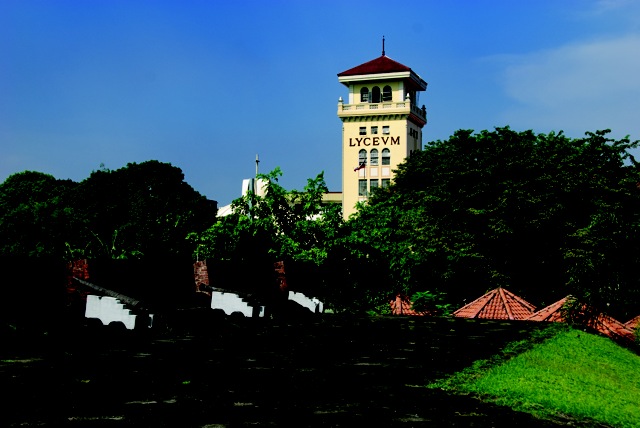
LAST JULY, a school that has done more for Philippine education and public leadership than most Filipinos realize quietly celebrated its 60th anniversary. Tucked away in a corner of old Intramuros, the Lyceum of the Philippines University—known to generations of Manileños simply as the Lyceum—may seem to outsiders to be just one of the many private colleges and universities that sprang up in the metropolis in the 20th century and managed to stagger into the 21st, dazed and confused by the challenges of globalization and the daunting economics of higher education.

Not quite. Today, the LPU is a progressive six-campus university system, with full-grown offshoots in Batangas, Laguna, and Cavite, and a law school in Makati. Its original and main campus in Manila is home to 13,500 students who are enjoying the benefit of an education anchored squarely on one foot in the classical tradition and, on the other, in new, responsive programs designed to give them an advantage in today’s economy.

I rediscovered the Lyceum in the course of writing the biography of the Lyceum’s longtime president and moving spirit, the late Sen. Sotero H. “Teroy” Laurel, the son of the school’s founder, former President Jose P. Laurel.

There’s no question that the bigger, better-known schools—UP, Ateneo, La Salle, and UST, in particular—dominate Philippine higher education and the preferences of Filipino parents and their wards. These are universities that have produced most of our presidents and heroes, big-name artists and athletes, cutting-edge scientists, business tycoons, and government leaders. They have traditionally catered to, and have also helped to form and strengthen, the Philippines’ intellectual and economic elite. And need we add that these schools, their titanic rivalries, and their alumni (both illustrious and otherwise) hog the media’s attention.

But what we don’t appreciate as much is the fact that so many more of us went to smaller schools that have also offered a good and (importantly to many) an affordable, accessible education that prepared our young people well for productive and gainful lives.

This was the vision of former President Laurel when, close to retiring from a long career in government and politics, he thought of setting up what he called “an Alexandria for the masses,” drawing its name from Aristotle’s school, the lykeion. In a book that he wrote around the same time, Laurel lamented: “How can our schools develop moral character among the young, when the schools themselves have become the centers of shocking scandals in such matters as the procurement of supplies, the selection of textbooks, or in the case of private education, the diploma mills? And where will both teachers and pupils get the inspiration for developing moral character, when they see all around them high officials who have been involved in all sorts of irregularities?

“… The truth is, the wonderful institution established by mankind, known as education, can have only one function and this is the pursuit, in the words of our Mabini, of truth, honor and justice. It can have only one sublime and overriding purpose: the recognition and dignification of the human personality.”

The “old man” Laurel, as was often called, was well positioned and prepared to assume the academic mission that his fellow Tanaueño, Mabini, had effectively bequeathed to him. He himself had a prodigious intellect, capped by a doctorate in law from Yale and honed in service with all three branches of the government—as senator, Associate Justice of the Supreme Court, and Justice Secretary—before his service as wartime president.

The Lyceum opened in July 1952 on a 1.3-hectare lot that used to be the site of the old San Juan de Dios Hospital in Intramuros, acquired for the family by Laurel’s indefatigable wife Paciencia. Teroy Laurel, who had returned from his studies in the US and who was running a law practice with his good friend and compadre Jovito “Jovy” Salonga, joined the school as his father’s executive secretary, perhaps little knowing then that the Lyceum would be the great labor and crowning glory of his own life, apart from his work in the 1971 Constitutional Convention and the Cory-era Senate.

“Jovy used to tell me that he and Teroy would go to Intramuros in the evenings to watch the construction of the school. Jovito was, I believe, the one who drew up the corporation papers, as his line was corporate law,” says Teroy’s widow Lorna.

The new Lyceum may have been a tiny school compared to its well-established neighbors, but it had one thing going for it, something that the Laurel name (the wartime charges of collaboration—eloquently disputed by Salonga, who had suffered torture under the Japanese—notwithstanding) was able to invite: prestige. As I note in my forthcoming book, “The new school had assembled the most formidable array of legal luminaries that one could put together in the Philippines at that time. These were men who would lend their names to Manila’s major streets after their time. Jose P. Laurel was the school president, the dean of the law school was Claro M. Recto, and on the Lyceum faculty were such men as Law Vice-Dean Ambrosio Padilla, Sen. Pedro Sabido, Jorge Vargas, Leon Guinto, Eusebio Lopez, Ramon Avanceña, Aguedo Agbayani, Justo Albert, Isagani Cruz, Marcos Herras, Neptali Gonzales, Roberto Concepcion, Arturo Tolentino, and Gil Puyat—men who had been or would become senators, congressmen, mayors, Cabinet secretaries, and Justices of the Supreme Court.”

Not surprisingly, the law school became one of the Lyceum’s bastions. This was accompanied by very strong programs in Journalism, Foreign Service, and Political Science, with the likes of Jose Lansang Sr., Francisco Lava, Emmanuel Yap, and Jose Ma. Sison on the faculty roster. They instructed and inspired a generation of young nationalists who included Journalism majors Satur Ocampo and Tony Zumel.

The Lyceum would go on to produce a veritable rainbow of luminaries including at least 17 ambassadors and eight Justices, three generals, three senators (Jinggoy Estrada, Ernesto Herrera, Panfilo Lacson), Speaker Sonny Belmonte, Gov. Grace Padaca and three other governors, media men Isagani Yambot, Fred Gabot, Gus Abelgas, Gerry Baja, and Deo Macalma, actor Cesar Montano, film director Joel Lamangan, Philamlife president Rodrigo de los Reyes, and education advocate Milwida Guevara, among many others.

New offerings in such areas as Hotel and Restaurant Management, Computer Science, and (in its Batangas campus) Robotics and Digital Animation and Marine Transportation keep revitalizing the traditional curriculum and assure the Lyceum’s continuing responsiveness to the times.Today, Teroy’s eldest son Bobby is on top of LPU-Manila as its president, assisted by his sister Sallie. Under the watchful eye of their mother Lorna, most of the other Laurel siblings—notably Peter, who serves as president of LPU-Batangas—are also involved in this unique family enterprise, proving themselves worthy of their father’s and grandfather’s name, and giving thousands of young Filipinos a fighting chance for a better future.