Qwertyman No. 185: A Joke for World Peace

Qwertyman for Monday, February 16, 2026

U.S. President Donald Trump places a note in the Western Wall in Jerusalem May 22. (CNS photo/Jonathan Ernst, Reuters) See TRUMP-JERUSALEM-HOLY-SEPULCHER May 22, 2017.

I JUST love it when a piece of mine about the goings-on in the US gets a rise out of some MAGA expat—and you’ll be surprised how many of them have chosen to reside here, forsaking what I would have thought would have been the sweet comforts of life in Fortress America. 

A message from a guy we’ll call “Bob” reacted to my recent column on “What I Told the Fil-Ams” by suggesting that I had imbibed too much “Cali water,” referring to that state’s trenchant liberalism. I responded by sending him a joke about an American President in the Holy Land, which I hope he appreciated. (I’ve resolved that this is how I’ll deal with my critics from now on, as long as they remain friendly enough—which to his credit Bob was—kill them with kindness, or at least with corny jokes, of which I have a barrelful. I’ll save a special section for MAGA Pinoys, who keep telling me to butt out of their business but who can’t help doling out prescriptions for their ex-countrymen to find their way to the light.)

I’ve often wondered if our world can get much worse than it already is, knowing all the while that the answer can only be yes, yes, emphatically yes. Still, it comes as a rude shock every time fresh confirmation arrives of a new Marianas Trench in human greed, crassness, and stupidity. 

All by himself, Donald J. Trump accounts for more than half of every week’s lows, and I’d like to think that I’ve become immune to further aggravation by this man, only to be roundly disabused. Last week, Trump outdid himself in crudity by putting out a meme on his social network depicting Barack and Michelle Obama as monkeys. 

When called out by even his own, usually docile partymates for the patently racist post, Trump passed it off to some unnamed “assistant” who supposedly made the mistake, which Trump claimed to have been too occupied to pay close attention to. Why the President of the United States would leave his personal account open to some junior flunky is ludicrous enough; that he would expect anyone to believe his lame excuse is beyond laughable. His spokesperson derided the ensuing protest as “fake outrage” and called for renewed attention to “the things that truly matter to the American people,” as though racism, decency, and honesty no longer mattered.

But Trump isn’t even the issue here any longer; the man is irredeemably vain, vile, and vicious. (Let’s not even mention—but heck, let’s—his offensiveness to beauty and good taste, with his insistence on gilding the White House, plastering his name all over the place, and picking Kid Rock over Bad Bunny.) Like our own Rodrigo Duterte, he has long cast his lot with Darth Vader & Co., not even pretending to be good, or to be aiming for such banalities as truth, freedom, and justice. In the words of one of his chief lieutenants, Stephen Miller, the age of “international niceties” is over; the only things that count today are “strength, force, and power,” which Trump & Co. have liberally deployed—not against global bullies like Vladimir Putin, but chiefly against the American people themselves. 

But again, let’s put the Orange Man aside for a minute. The real danger is that there are tens of millions of people who think the way he does, and who probably thought that way even before he gave Trumpism a face, a voice, and a name. These are people for whom daily doses of falsehood have become the norm, and I really couldn’t care less if they believe that Satanic Democrats drink the blood of kidnapped children, except that their weirdness creeps up to the White House and into the kind of domestic and foreign policy that makes life difficult for us 8,000 miles away, and emboldens other despots.

I’m not saying here that we don’t have our own version of Trumpers to deal with (and I’m adding this paragraph for the MAGAs who’ll remind me to stick to the local, a description I expect them to extend, in MAGA logic, to Greenland). Our DDS, in many ways, offer a parallel constituency; like many MAGA members, their grievances are rooted in historical neglect and a sense of displacement in rapidly changing times. They pinned their hopes on a man who was supposed to improve their lives—but who didn’t, distracted by a megalomaniacal drive to reshape society to his grim vision. 

This is why I haven’t given up on Digong’s faithful; there’s a valid cultural dimension to their disaffection in terms of Mindanao and Manila-centrism, but their issues can be addressed by attentive and equitable governance. The corruption issues that have gutted the country have devastated them as well. Except for the shrillest and most invested in a Sara succession, I feel that many can yet be persuaded to choose responsible leadership. 

In this respect—and this may not be shared by many, given the lows to which our own politicos have fallen, with some in need of growing a spine and others a brain or at least a heart—I feel more hopeful for the Philippines in the medium term than I do for America, and I think that’s saying a lot.

Now let’s wait for the MAGA backlash; I have lots of Trump jokes lined up to brighten their day, restore their sense of humor, and maybe help bring about world peace. 
Qwertyman No. 25: Courtesy Ca. 2023

Qwertyman for Monday, January 23, 2023

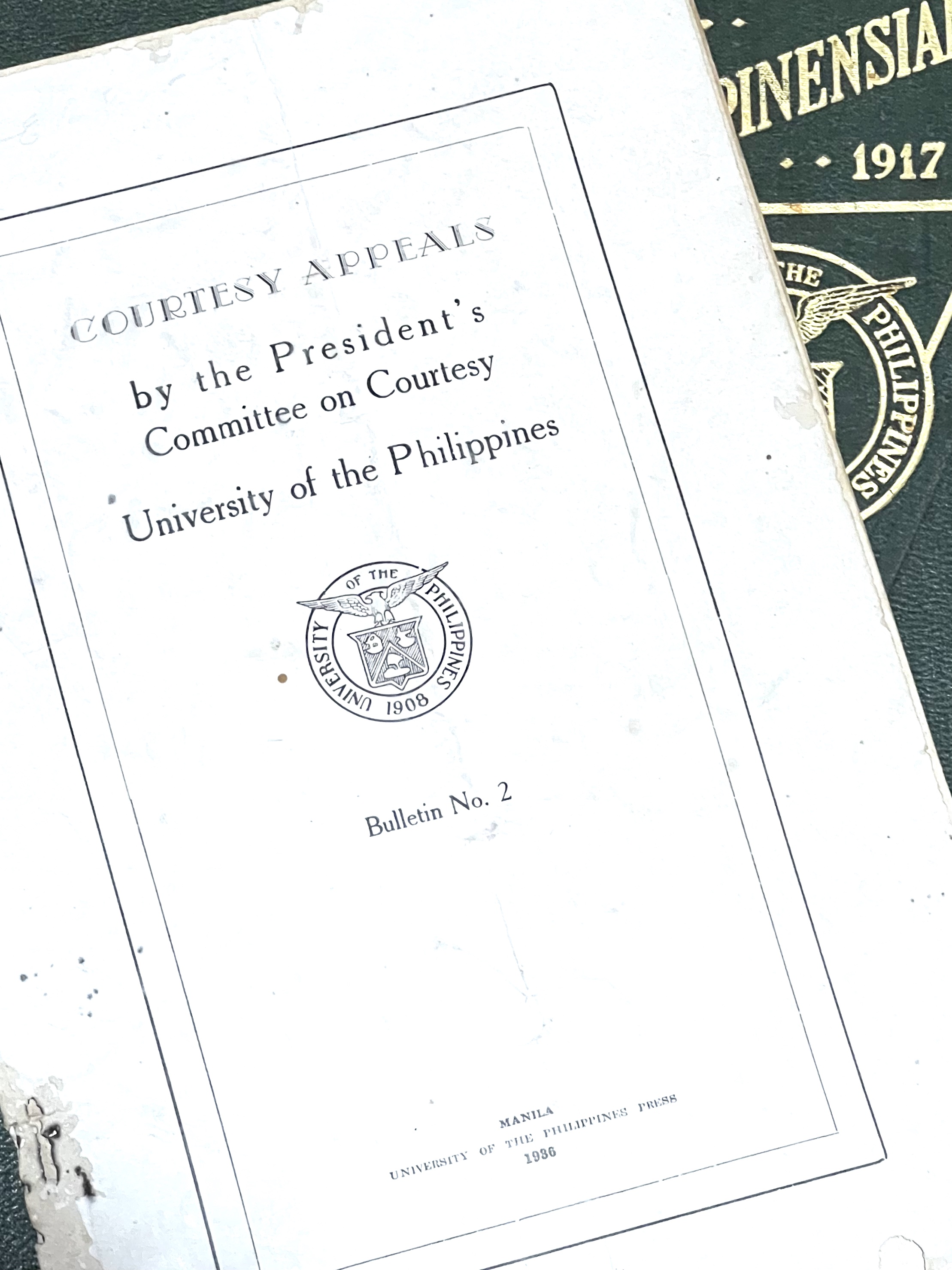
THIS TOPIC wouldn’t have occurred to me to write about if I hadn’t come across—in my meanderings online as a collector of antiquarian books and papers—a copy of a slim pamphlet published by the University of the Philippines Press in 1936, titled “Courtesy Appeals by the President’s Committee on Courtesy.” But as soon as I saw that title, I knew I had to get that pamphlet and reflect on the observance (most likely in the breach) of its prescriptions today.

To be honest, I never even heard of a “committee on courtesy” in UP. Neither, as a former student and professor, did I ever instinctively attach the word “courtesy” to UP, although I will not agree to any collective condemnation of “Iskos” and “Iskas” as boorish and uncultured. Granted, UP lore is rich with tales of what we’ll call youthful insolence toward their elders, in ways that would make even millennials cringe. (Who was that young poet who, in a writers’ workshop, supposedly stole a famous lady poet’s underwear—don’t ask me how—and strung it up a flagpole or hung it on a line, prompting her friend—another professor known for her fiery temper—to curse the laughing fellows: “I wish your mothers had aborted you!”) 

Meekness may not be one of a UP student’s strongest suits, because we teach them to assert themselves. But we also teach them to criticize or comment with style and intelligence, as when a young wit responded to a customary recitation of then President Carlos P. Romulo’s kilometric list of honorary degrees by saying, “Why, Mr. President, you have more degrees than a thermometer!” (In fairness to CPR, that fellow went on to an illustrious career accompanied by much—and some say self-generated—pomp and circumstance.)

Courtesy, of course, is not about sticking out but about staying in—behaving oneself for social acceptability and harmony, living up to someone else’s expectations by observing a strict code of do’s and don’ts. At least that’s how it was appreciated in the 1930s, when President Jorge Bocobo created the committee that came out with the prescriptions in the pamphlet. Although he served as one of UP’s most hardworking and effective presidents—someone who pushed UP students to go out and serve the masses—Bocobo was also known to be a rather prudish disciplinarian. He had been on the committee that censured Jose Garcia Villa for publishing his “obscene” and “ultramodernistic” poem “Song of Ripeness,” leading to Villa’s suspension and hastening his departure for more liberal America. He also cut down on the popular student dances that Rafael Palma allowed, and enforced the rule for student uniforms. When Guillermo Tolentino presented his design for the Oblation statue, Bocobo had one important comment: protect its modesty with a fig leaf, which was done. Not surprisingly, although again a bit too simply, he was called “the gloomy dean” by the editorialists of the time.

In 1936, when the pamphlet came out, Jorge Bocobo was almost midway through his presidency (1934-39). I learned that 8,000 copies were printed to be handed out to all students, and teachers were required to discuss its contents—all 20 pages of them—in class.

Some of its prescriptions are entirely understandable for the period:

“A young lady of social position does not go to a ball without a chaperon.”

“When a gentleman is introduced to a lady, he does not extend his hand first. It is the lady’s place to show whether she wants to shake hands or not.”

“When a lady leaves a gentleman to whom she has been introduced, she never says she is ‘glad to have met him’ or that she ‘hopes to see him again.’’

Some would be perfectly applicable today:

“Annoying the ladies by staring at them or making remarks about them as they pass cannot be countenanced.”

“Avoid being a bore by talking too much. Be a sympathetic listener.”

Some would be difficult to enforce:

“It would be nicer if gentlemen should remove their hats on entering a building.”

“Do not wear a tuxedo at daytime.”

“(Do not) thrust the individual knife into a butter dish or the individual fork into a pickle dish.”

“Bananas are peeled into a plate and taken with the fork.”

I was amused, as many of you would be, but these social commandments (yes, they were far more than “appeals,” and students and faculty were disciplined for disobeying them) invited me to wonder how we look at courtesy today or even think about it, let alone practice it. Thanks to the anonymity provided by the Internet and to a toxic political environment, rudeness if not obnoxiousness seem to have become the norm. It’s almost customary to assume that the other fellow is uninformed, hostile, stupid, or just plain wrong, and I have to confess to thinking this of many people I encounter for the first time, especially online. 

I’ve been on the receiving end of these assumptions as well. An expat American—a Trumper—once tried to convince me that I knew nothing about America, as did an expat Brit who lectured me about the monarchy like I’d never read a book (I could’ve lectured him back on Elizabethan revenge tragedy, but he could have been just a regular fellow who didn’t know anything about me, and why should he, so I desisted and let it slide).

Courtesy today clearly involves more than etiquette or protocol, more than observing antiquated codes of behavior requiring you to use this fork or that spoon. It’s more a matter of attitude toward other people, of assuming them worthy of respect and an intelligent and civil response (until they prove otherwise, as many inevitably do, especially in politics). 

Unfortunately we also too easily conflate courtesy with external manners, with opening doors for ladies (which I still do, although my wife Beng sometimes has to remind me there’s a door in front of us). On a higher order of behavior, aren’t profligacy and ostentation extreme forms of discourtesy to a people struggling to make ends meet? Do arrogance and impunity invite respect, or resentment and disdain?

What could a “Courtesy Appeals” for 2023 read like? “Do not waste the people’s hard-earned money” seems like a good place to start.

(Some factoids mentioned here come from an unpublished, unofficial history of UP. You can check them out against an official history published recently by the UP Press.)