Penman No. 464: A Fantasy Memoir

Penman for Sunday, July 7, 2024

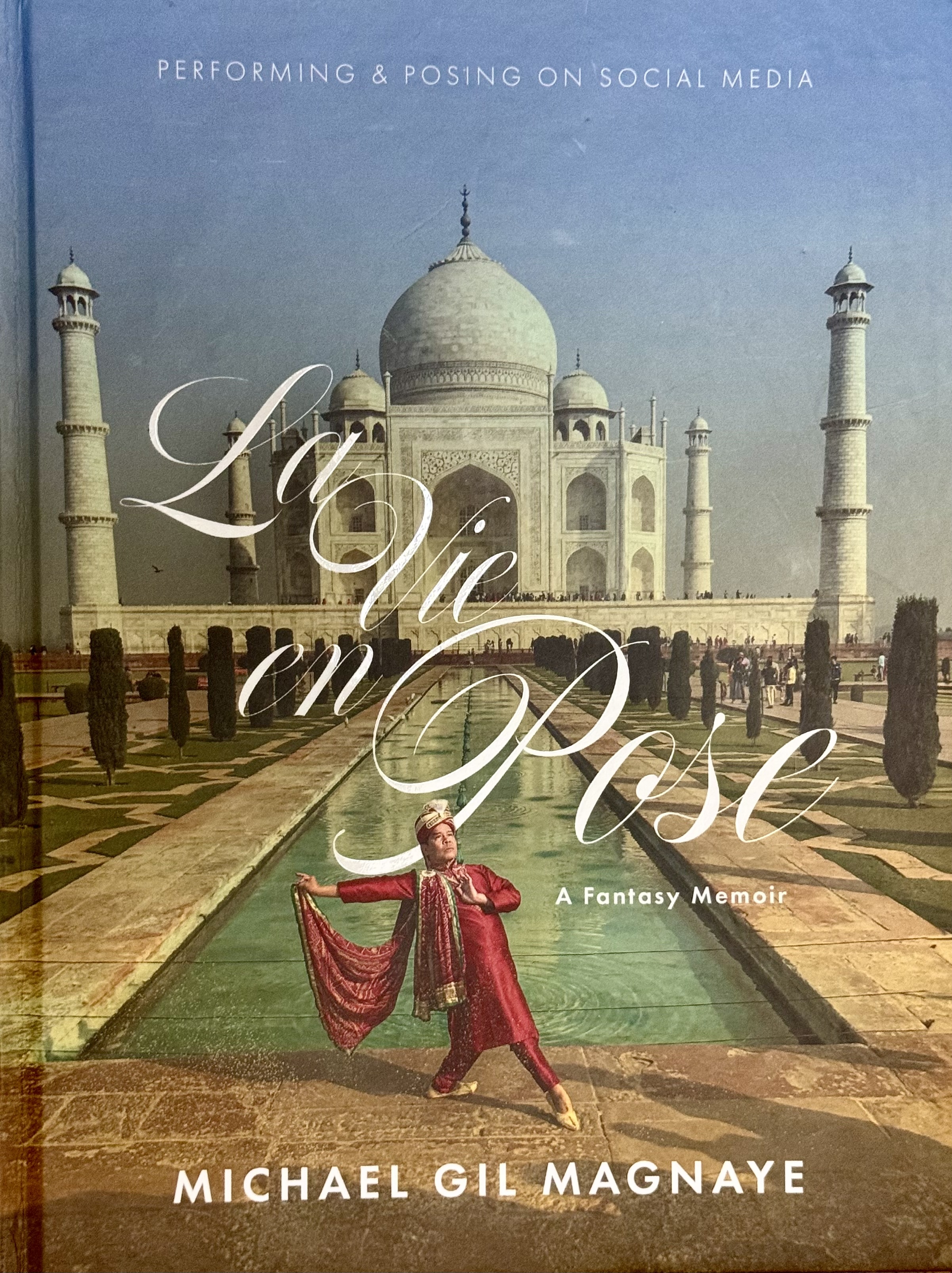
THE AUTHOR calls his book a “fantasy memoir,” and if it’s a genre you’re not familiar with, you wouldn’t be alone. Or maybe that’s just because you’re a dour and straight septuagenarian like me who doesn’t go out too much, watches true-crime shows to relax, and presses his pants and shines his shoes because, well, that’s the way it should be. I later googled the term, just to see what’s out there, and much to my surprise, it does exist—a genre defined by “imagination, escapism, and dreams,” with the stipulation that these fantasies, or products of the mind, are just as valid as memory in recreating one’s life.

Thankfully, from the cover onward, Michael Gil Magnaye’s La Vie en Pose makes it purpose clear to the most casual and non-literary of readers: to have fun—while raising some very serious questions on the side about who and what we are (or pretend to be), what poses we ourselves assume, consciously or not, in our everyday lives, and how our identities are constructed by something so simple as what we wear.

La Vie en Pose is one of those rare books one can truly call “inspired,” resulting from the kind of half-crazy “What if?” lightbulb moment that strikes you over your tenth bottle of beer at 3 in the morning. Unlike many such flashes, this one stayed with Gil, took firmer shape, and turned into a virtual obsession—a first book to be completed by his 60th birthday, not just any book, not one of dry prose between the covers, but one certain to make a personal statement for the ages.

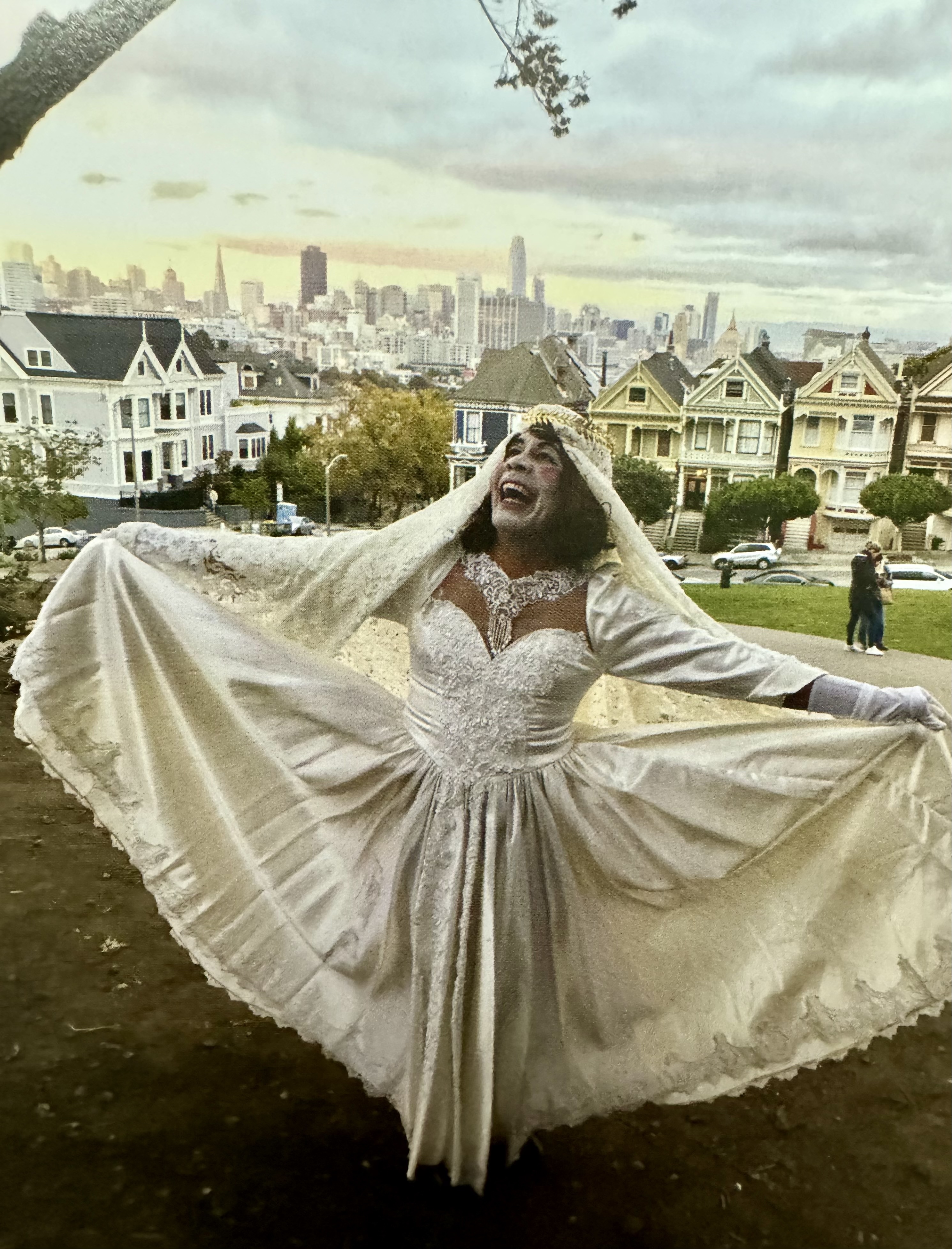
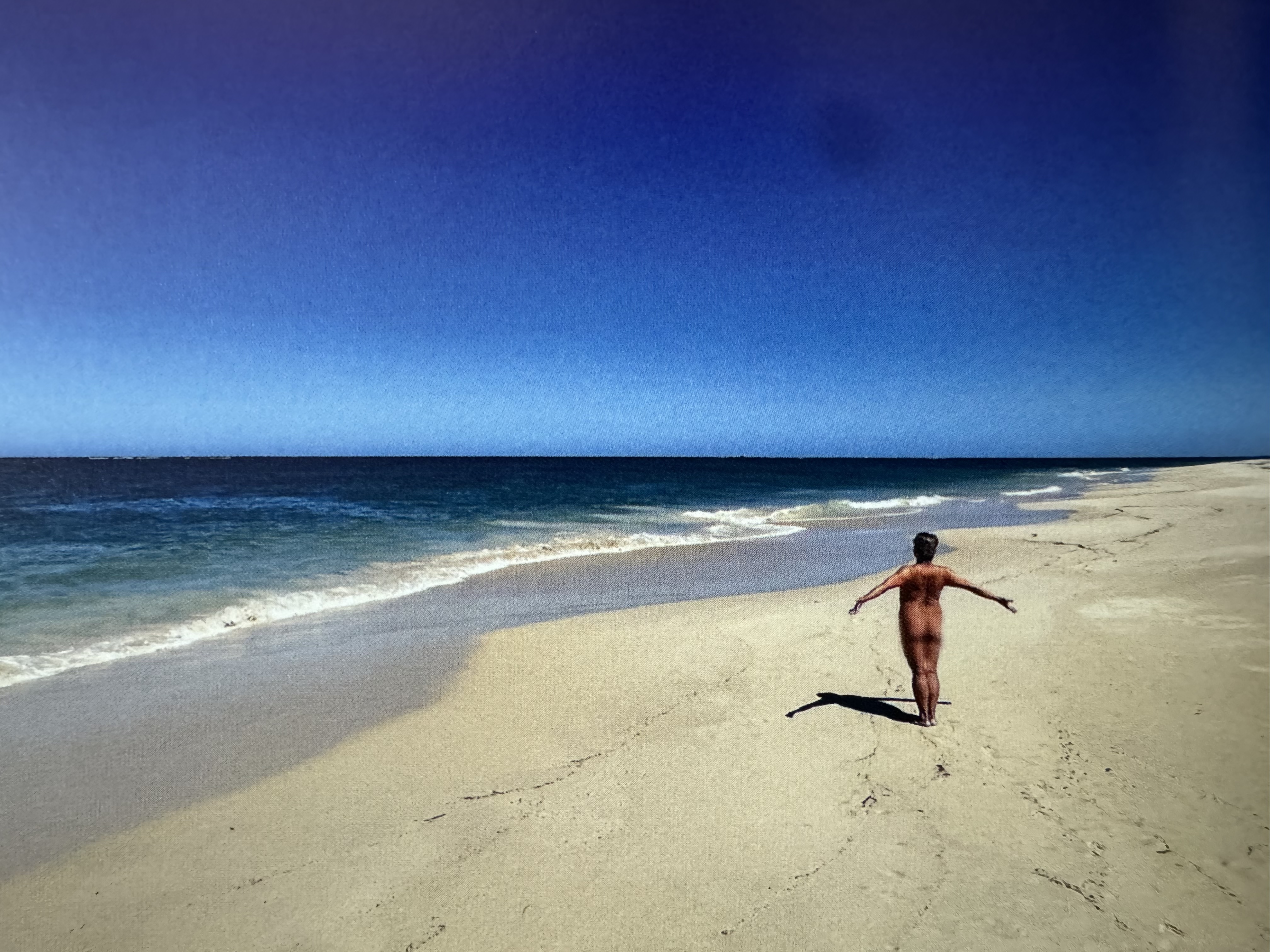
Magnaye, who works as an advisor to an international NGO, describes the book as “a fantasy memoir told in a hundred photographs of the author in costume, striking a pose around the world. Designed and photographed over a decade, these vignettes depict media celebrities, politicians, literary characters and wholly fictitious figures drawn from Magnaye’s fertile imagination. The collection offers satirical, often hilarious commentary on noteworthy personalities in pop culture, politics and history, from Game of Thrones to Bridgerton, from Jackie Onassis to Ruth Bader Ginsburg.”

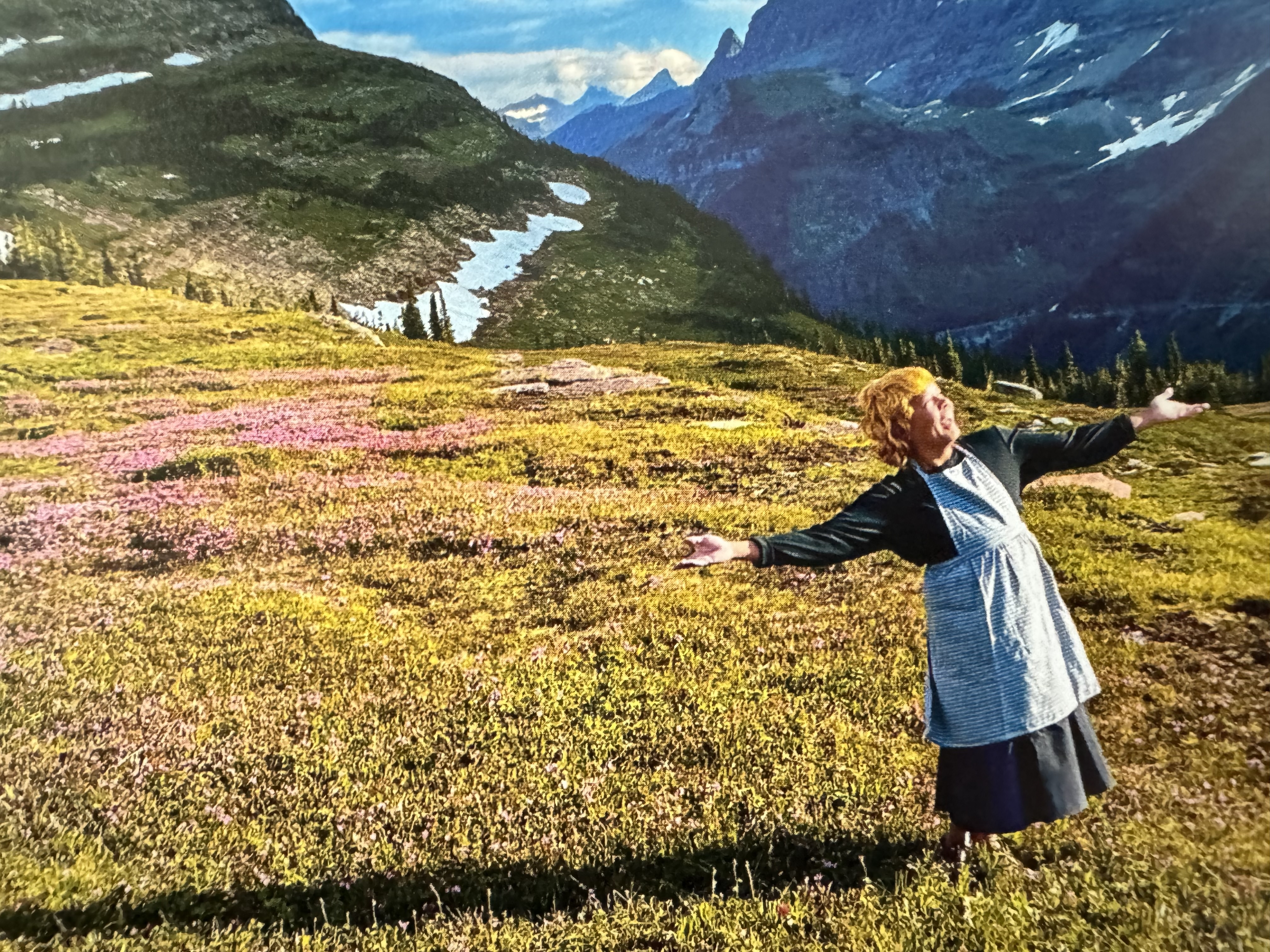
Divided into eight chapters and edited by the celebrated Fil-Am writer Marivi Soliven, the book takes Gil around the world (none of this is AI—the photography took many years and plane flights to complete), posing in various locales and contexts, often in costume, to mimic or to pay homage to familiar figures and situations. The pop-culture setups will likely elicit the most laughs and smiles—Tina Turner, Maria von Trapp, and of course Barbie all get their comeuppance—and the UP Oblation poses (thankfully just backsides) show the malayong lupain that our iskolars ng bayan have reached (Gil studied and taught Humanities in UP before going to Stanford for his master’s). The levity aside, he strikes thoughtful, almost architectural, poses against spare backdrops. He draws his husband Roy, a normally reticent software engineer, into take-offs on couples (Ari and Jackie, Ennis and Jack). The effect is both riotous and reflective, a visual essay on how pop and political culture have overwhelmed us, but also how we have appropriated and domesticated them for our own purposes, if only to say, “Hey, I can be as good that!”

The poet and queer theorist J. Neil Garcia explains it better in this note he posted online about the 30thanniversary of the landmark Ladlad anthology he co-edited with Danton Remoto: “Queer creativity is itself an integral component of the equality message, and not simply a means to an end. Since the freedom of the imagination is perhaps where all freedom begins, it is clear that giving the queer artist the power or the ability to create their own texts and art works needs to be seen as a vital objective of the equality movement, one of whose primary interests must be in securing this imaginative and/or cognitive ability above all. Hence, we need to insist on the truth that queer creativity isn’t simply a tool to promote the equality message and other activist agendas; rather, queer creativity itself is part of the agenda—is part of the equality message itself (and so, queer creativity is not just a means to an end; quite crucially, as the best evidence and enactment we have of individual and collective agency, even against the harshest of odds, it is an end, in itself).”

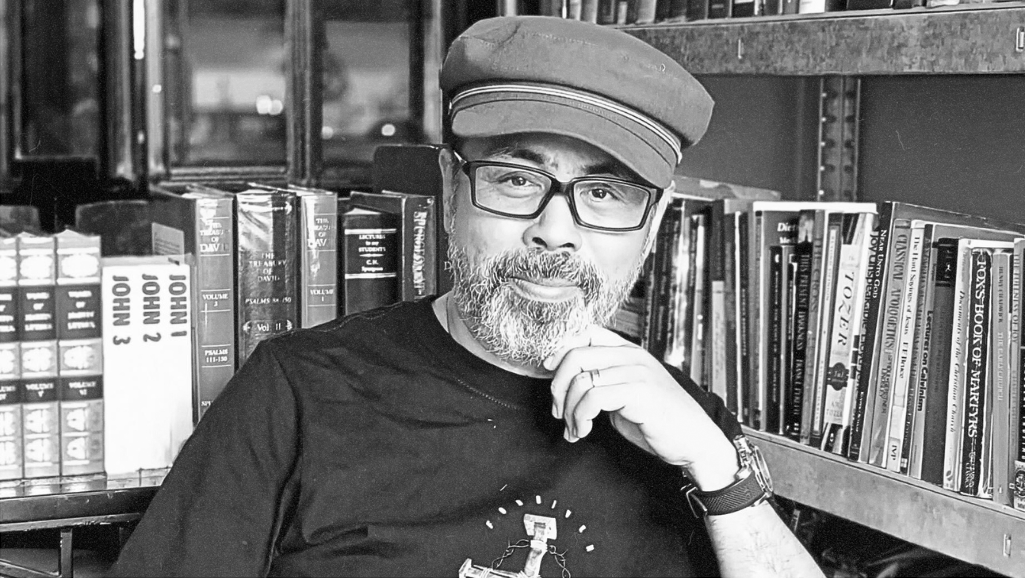
For Gil—whom I was friends with back when he still had a girlfriend and confronting his sexuality—the book is more than a personal celebration (he launched it in UP last June 23 to mark his 60th birthday); it’s also an assertion of his rights as a queer (the preferred term these days to “gay”) person—and by extension, of all other LGBTQ+ people as well—to express themselves creatively. In his introduction, he notes that “This book is born at a fraught moment in gender politics. Some states in the US have passed legislation that attacks transgender youth for their chosen wardrobe or preferred pronouns. A drag artist in the Philippines has been jailed for performing an irreverent dance interpretation of a Catholic hymn. Such adverse events would seem to suggest that cross-dressing is an act of subversion. I would argue that cross-dressing and mimicry are strategies that drag queens, drag kings, non-binary performers, and gender benders employ to resist, challenge, navigate, and extricate themselves from systems imposed by traditional constructs. And it’s a lot of fun.”

La Vie en Pose most surely is. Copies might still be available at the UP Center for Women’s and Gender Studies.

Penman No. 263: Geekdom Galore at Comic-Con 2017 (2)

IMG_2677.jpeg

Penman for Monday, August 7, 2017


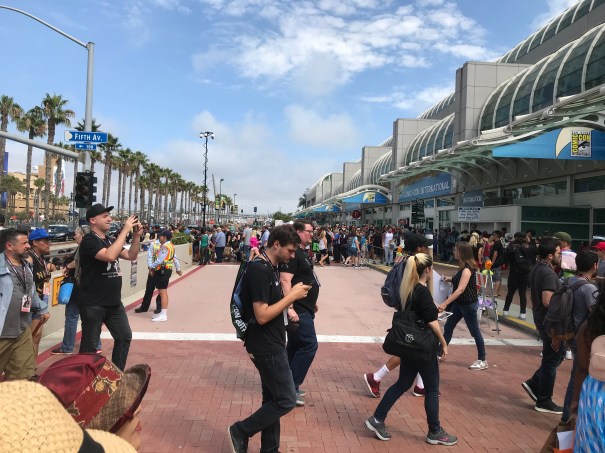
LET’S START with some stats: last month, Beng and I were two of the 35 million visitors who would have trooped to San Diego, California by the end of the year. We go there regularly for our daughter Demi, but most others would probably mention the beaches, the ships, the Mexican food, the whale-watching—and, for 130,000 people in late July, that long weekend of masked madness called Comic-Con International. Those fun-seeking fans will book all of San Diego’s 40,000 hotel rooms—many a year in advance, at room rates easily triple the normal—and on the average spend over $600 per person, injecting some $80 million in direct spending and another $70 million in multiplier effects.

Geekdom, in other words, is serious business, and there’s no stronger pitch that the spinners and purveyors of fantasy can make to their market than Comic-Con, which began in San Diego itself in the dim and dingy basement of the rundown US Grant Hotel one day in March 1970. Since then, the US Grant—where Demi works—has been refurbished into the city’s swanky grande dame, and Comic-Con, like the superheroes it glorifies, has morphed from a pimply kid to a sleek and powerful machine.

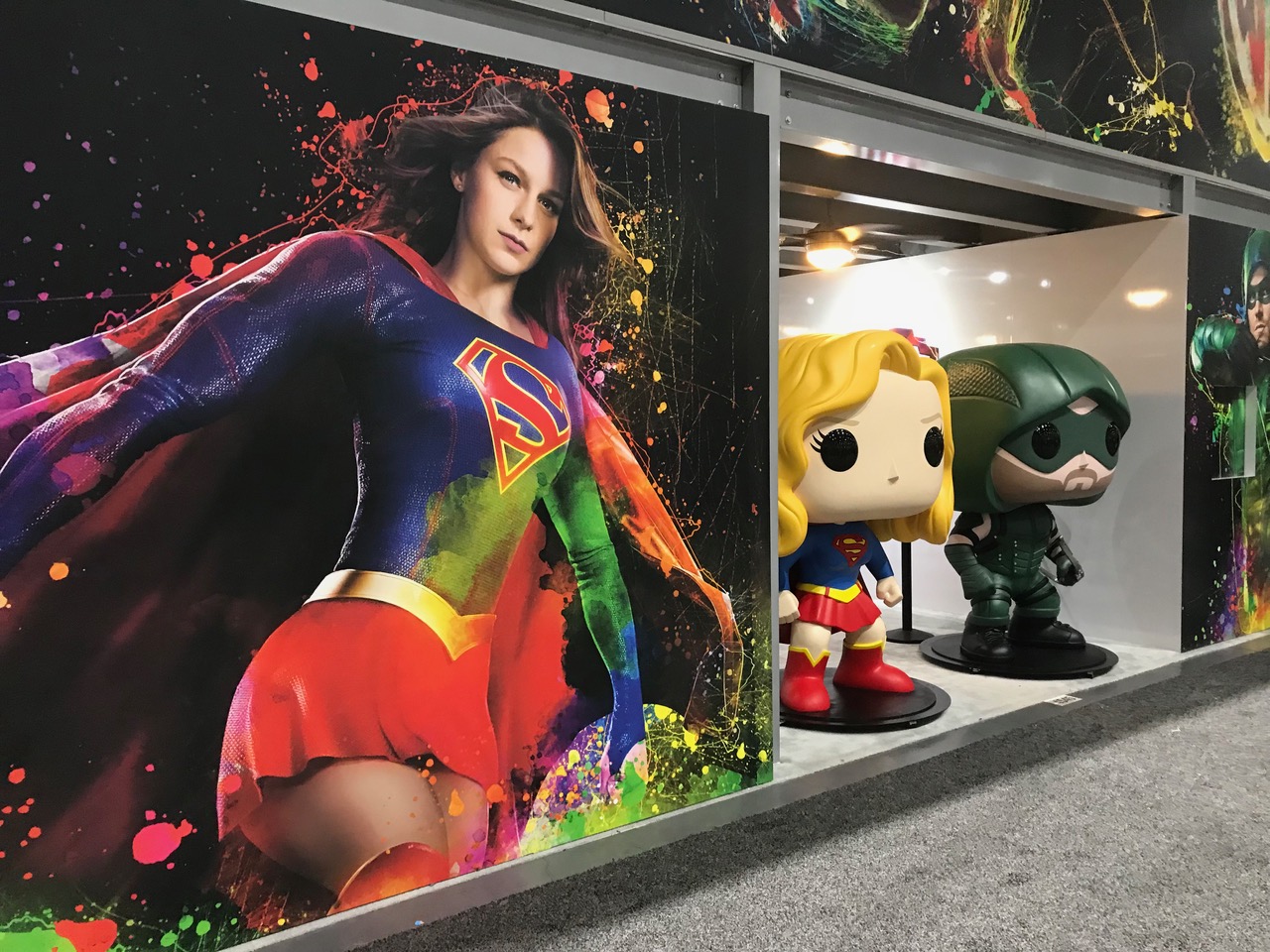
I’m sure the fans aren’t thinking much about the history when they stream through the doors of the SDCC on opening day and emerge with bags and boxes of new Funko Pop Justice League figurines, Deadpool Wooden Push Puppets, and one of this year’s exclusives, a Twin Peaks Agent Cooper Bobble Head, all yours for $14.99. The comic-book collectors could dwell on decades past, but most of Comic-Con is decidedly future-oriented, always looking around the corner for the next TV season’s plot spoilers and the next sequel’s new villain.

IMG_2653.jpg

There’s even been an urban-dictionary term coined for the phenomenon: “FOMO,” or “fear of missing out,” the hidden impulse behind the surge of the pop-culture hysteria best exemplified by Comic-Con. It’s all fun, of course, on the level of cosplay and souvenir shopping. For others, it’s also a profession and the work of a lifetime.

There were two such professionals and icons I sought out in this year’s Comic-Con: the Filipino-American artists Whilce Portacio and Alex Niño. I’d already met and interviewed Whilce in last year’s event, and subsequently at the Asia Pop Comic-Con in Manila, but it was good seeing him again in top form, signing autographs and artworks for fans in his booth in the Artists’ Alley.

Whilce actually wasn’t there yet when we arrived, as he was being interviewed by Syfy about his work, so Beng and I wandered off to observe a long queue forming for the autograph of another artist whom we frankly had never heard of before—the very young Patrick Ballesteros, another Fil-Am and San Diego native.

“We’re everywhere!” Whilce would remind me later. “Marvel, DC, Pixar, you name it, we’re there.” Whilce himself would co-found Image Comics and create Bishop for the X-Men, and he has been going back and forth to the Philippines to mentor young graphic talents such as Leinil Yu and to set up a studio that can meet the growing global demand for illustrators and animators.

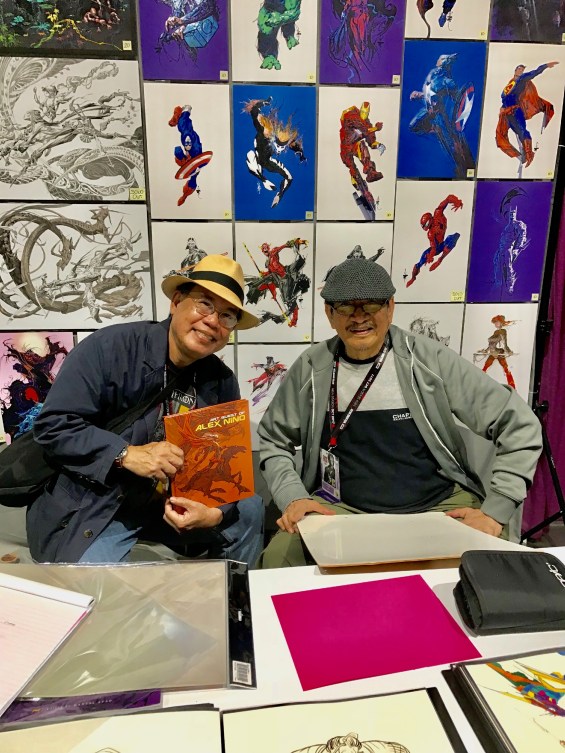
I missed Alex Niño last year—at 77, he now attends only the last couple of days of Comic-Con, leaving it to his son Jules to mind the booth—but I caught him this time at Comic-Con’s closing hour for a quick chat about his struggle to rise to the top of his profession in the US. Tony de Zuñiga blazed the trail for all of them, but Alex, Nestor Redondo, Larry Alcala, and later Whilce and his peers followed shortly after in the 1980s and 1990s.

Alex recalled a crucial moment at the beginning when, still in the Philippines, he was approached by DC to draw a comic, he came up with a carefully drawn work, only for DC to balk at his price. “I tore the pages up,” Alex said. “I preferred to do that than get short-changed.” Unknown to him, his wife Norma had painstakingly pieced and pasted the drawings together overnight, and had sent it to DC—which, understanding what had happened, paid Alex’s price. This sense of self-worth would serve Alex and his compatriots well.

He moved to the US in 1974, and I’ll leave you to check out Wikipedia for his voluminous credits since then. Time may have slowed him down a bit, but it hasn’t stopped him from working, albeit more traditionally than others. He has just finished illustrating a book on wines for Jay Ignacio. “I don’t mind technology, but I never got used to a tablet. With digital art, you can’t tell what or where the original artwork is. I still use a pen and ink, and markers. I had to evolve my own style to be different from the others. None of my five children have taken after me, but my grandson in the Philippines works in animation. I can’t retire, because I’ve yet to be satisfied by what I’ve done. I feel that my best work, my masterpiece, is still out there.”

Way to go, Alex—spoken like a true Pinoy superhero! Until next year—if we get those badges.

IMG_2662.jpg


Penman No. 55: A Foray into Fantasy

TresePenman for Monday, July 15, 2013

WE HAD an interesting discussion in my graduate Fiction Workshop class the other week about fantasy.  I’d asked my students to do an exercise—a short piece of fiction with which they could introduce themselves and their work to the rest of the class at the start of the semester—and one of them had chosen to do fantasy. It was a very well written piece, to be sure, about a child who meets an elfin spirit in a tree in their backyard, but I wanted to push the limits of our appreciation of fantasy, if we were going there at all, so I didn’t let it go at that, and raised a few questions and possibilities.

As my students and readers know, I’m a hardcore realist myself in my own fiction, operating on the notion that there are enough mysteries and wonders to be found and explored in everyday life to have to invent more. That doesn’t mean I can’t or don’t appreciate fantasy, or science fiction, which I’ve enjoyed since grade school. Like most readers, I like to be transported to other worlds and other possibilities, as a relief—or, let’s face it, an escape—from the tedium of the here and now.

That said, there are fantasies and there are fantasies, and just because a story’s a fantasy doesn’t mean that anything goes, or that the rules of credibility and plausibility can be thrown out the window. I suspect that readers of fantasy can be just as discerning and demanding as readers of realist fare; they may even be so familiar with the genre and its conventions that they will be ultrasensitive to any radical departure, good or bad, and will feel grievously shortchanged if their expectations aren’t met. Freshness of treatment and insight is key. Fantasy stories that just repeat what’s been said and done before will fail to excite the reader, who’s always demanding something new and different.

So what, to my mind, is a superior fantasy? I’m going to give an answer that will sound a little strange: it’s fantasy that’s premised on the familiar, but takes off into parts unknown, if only again to reflect back on the familiar, or what we thought we knew. In other words, fantasy is ultimately not about complete detachment from reality, but rather the defamiliarization of reality. I’m sure that more sophisticated theorists out there have made pretty much the same point (theory isn’t my strong suit, and I’d much rather reason my way through a problem), but it’s really quite simple: by taking a step back from reality and looking at it from a distance, we notice fresh things about that we would have missed up close. Fantasy provides that distance, even a certain distortion that emphasizes some previously obscure aspects of a picture or a situation over others.

Like I said, I haven’t written much fantasy—the most fanciful story I wrote, back in 1978 (when our daughter Demi was four, thinking that she would read and appreciate it when she turned 12) was a pseudo-historical tale titled “The Mirror,” set in pre-Hispanic Philippines, about the arrival of the first mirror to our shores. I had fun doing that, so I can see how liberating this kind of exercise can be for writers who feel stifled by having to deal with what’s right before them. Reality can be claustrophobic, especially when it’s dark and narrow, as it often seems to be.

But if I were to write fantasy again—and this was what I advised my young student to do—I would play with the possibility of taking off from somewhere unexpected, some place or some point that doesn’t have the word “fantasy” twinkling above it in stardusted letters.

I’m fascinated, for example, by what would happen if our authors tried to fuse freewheeling fantasy with grungy realism, employing our most familiar and even our most sordid realities as a launching pad for a journey to the surreal and the irreal. Of course, like most things in art and literature, this has been done before by many fantasists and fabulists. As I suggested earlier, the best way to lie is to begin with the seeming truth, instead of a flagrant falsehood. (One great example of this approach is the graphic story contributed by Budjette Tan and Kajo Baldisimo to our Manila Noir book—which had a very successful launch at NBS Glorietta last July 6, by the way—which begins with a series of gruesome murders on the MRT and turns into a supernatural detective story.)

The imperative of this fusion is at its most urgent in our society, ridden as it is with poverty, violence, and corruption, and yet also uplifted and ennobled by the Filipino’s deep spirituality and by our unyielding imagination. I proposed to my students that in a society such as ours, even fantasy has a social function: not necessarily as an escape, but as a means with which—even briefly—to distance ourselves from our pains and to look at them without hurting too much, so we could deal with them better upon our inevitable return. For us, the most ambitious and the most meaningful fantasy will take our stark social realities into account: you can’t set great fantasy in Tagaytay Highlands, because living there is already a fantasy for most Filipinos; you’d be jumping off a very low platform if you did that.

I threw this impromptu suggestion into the discussion: instead of locating the encounter with the duende or the benign spirit in a backyard that already seems magical (nature—trees, waterfalls, caves, and such—is very often used as an entry point to the other world), why not set it somewhere you least expect a duende to appear (a place “most hostile to romance,” as Joyce put it in “Araby”)?

Think, for example, of a suburban bank branch full of people, toward closing time. A father, a mother, and their young daughter are there, because the dad needs to withdraw some cash to make a down payment on a second-hand car they’d been saving up for. The mom chats with the girl and fixes her ribbons while the dad does his business at the counter. It’s a pleasant day, and soft music plays in the background. Suddenly masked men barge into the bank and announce a holdup. A robber scoops up the dad’s money, but he begins to say something, and gunshots fill the air. (At this point, we don’t know yet if the father has been shot, or if the guards have opened fire.) The little girl is in utter terror, shaking in the iron grip of her screaming mother. At this point, the duende appears, suspending time, and maybe even the trajectories of bullets.

Unlikely? Of course. Corny? Could be. But it’s certainly less predictable than a leafy bower, or a cloud on a hilltop.

Again, I’m a hardcore realist, but I’d be the last to say that our people don’t need fantasy. We most certainly do, especially our poorest children, who’ve been battered and savaged by the realities of life, working in the streets or in some sweatshop when they should be in school, reading books and singing songs. They need fantasy to reclaim their sense of wonder, to see beyond the rust and grime and filth of their surroundings; they can be sustained and delivered not so much by fairy godmothers as by their imagination, which always offers hope.


FROM MY friend Jane Camens, the busybody behind the Asia Pacific Writers and Translators Association (APWriters), comes this message about a call for submissions to an international anthology of flash fiction—the term in vogue for very short stories (also called “short shorts” or “sudden fiction”). Flash Fiction International, to be published by W.W. Norton of New York, is seeking stories from anywhere in the world—especially the Asia Pacific. Jane says that “the stories should be under 750 words, in English translation or original English. Previously published work (within the last 10 years or so) is preferred. But new manuscripts are also considered. Submissions may be sent by email with attachment to Robert Shapard at his email rshapard@hawaii.edu . The submissions deadline is August 15. Submission limit is three stories.” Be so advised!

(Trese image from tumblr.com)