Qwertyman No. 43: Perhaps It Takes a Fire

Qwertyman for May 29, 2023
THE WORST fire I ever witnessed was that of the Family Clinic hospital near Quiapo in Manila in 1972. I was a police reporter for the Philippines Herald, on the graveyard shift at the MPD HQ, when the three-alarm alert came in and we sped out in our jeep to the fire. Flames were billowing out of the upper floors and people were on the roof when we got there, and soon, sickest of all, I began to hear the thuds of bodies falling onto the pavement, of those who could no longer bear the heat and chose the only other terminal option. When I called the night editor to tell him what I was looking at, he had an additional assignment for me: “Count up the bodies, we need a figure.” I spent the early morning making the rounds of the nearby hospitals and their morgues, seeing up close what fire can do to a human body, the weeping of burnt flesh. I was eighteen, a college dropout eager to work; that night was worth a year in journalism school for me.

Many decades later, early in the morning of April 1, 2016, I was playing poker with some friends when I got a text message from another night owl that the UP Faculty Center was burning. Ever the skeptic, my first thought was that it was the first of what would be many April Fool’s Day jokes, but then other messages confirmed the terrible news. I dropped my cards and drove back to the campus—where I also live, by the way—behind the blare of firetrucks speeding to the scene of the fire, their loudness and haste almost superfluous in the stillness of the night. 

I arrived in time to catch the sight of my office burning—the whole first floor, our whole department, was burning. Strangely at that moment I felt no pain, no sense of loss; I didn’t flail around or throw up my hands in anguish. I suppose that was a form of shock, the way our brain throws a cold, wet blanket around us to insulate us from the heat, to keep us immobilized and therefore safe in the face of catastrophe. Unavoidably my mind began taking inventory of what was in my room—books, paintings, the best student papers of thirty-some years, twenty first-edition copies of my book Penmanship I had saved for its special paper, a computer, flotsam and jetsam from an academic life. There were many precious and irreplaceable pieces in that office, for sure, but again strangely, as soon as I remembered them, I said goodbye; I realized that I was muttering what amounted to a prayer.

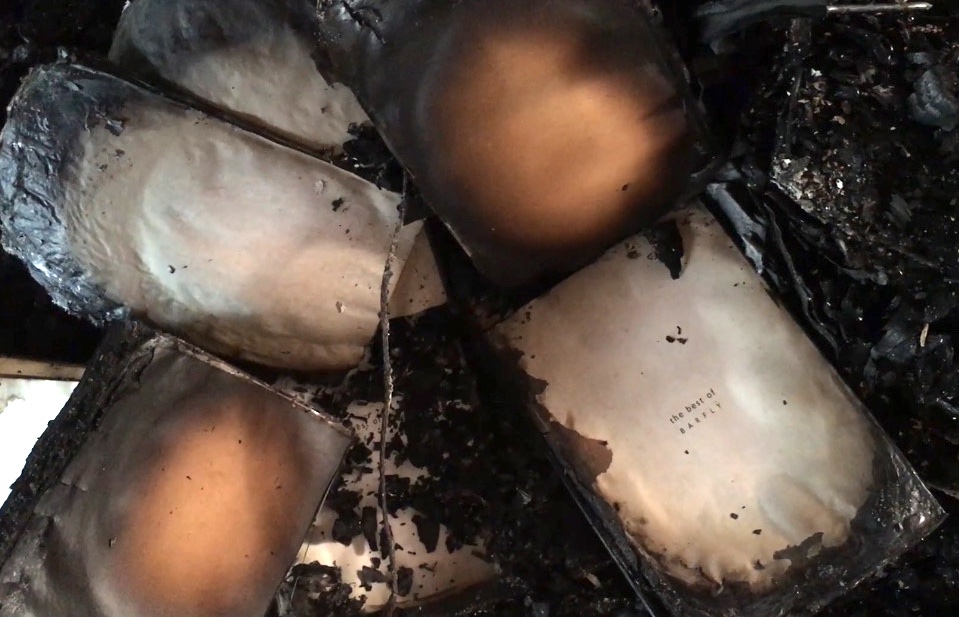
Two days later, when the smoke had cleared, I stepped into the gutted building and took a video with my phone. The embers were still steaming beneath my feet. I confirmed with my own eyes the finality of things. Everything but the shards of a ceramic cup was gone—and my book of stories, prettily charred around the pages as though for some theatrical presentation. My writer’s mind was compensating, salvaging scraps of beauty from the crushing loss. That comes to us like second nature; we want to give our grief exquisite form, hoping for meaning and consolation.
There is something about a fire, a compelling majesty, that Filipinos instinctively respond to—not necessarily to help, which is beyond most of us, but to watch and be spellbound by. Where is the child who didn’t jump out of bed and dash into the street at the shouts of “Sunog!”, followed by the festive clangor of alarms and firetrucks? Nighttime fires are especially dramatic, as the sky glows orange and the smoke curls into your nostrils. You are aware that something terrible is happening to someone, and the next morning the news will carry the grim details: a family trapped, a mother curled over her baby, a son who had just graduated the week before. We feel sorry for these victims, while being secretly relieved that we ourselves were spared. Perhaps what attracts us to fire is its anticipation of The End, with science assuring us that the sun will scorch the earth in its last embrace and religion threatening yet more heat for miscreant souls.

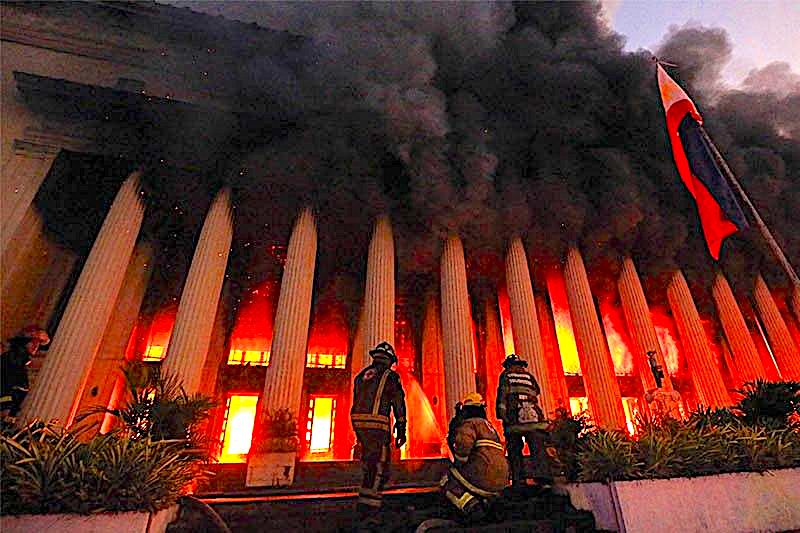
When I heard about the fire at the Manila Central Post Office building last week and began seeing the pictures coming online, I reacted with the same stunned silence, trying to absorb the enormity of it all, while morbidly, guiltily, indulging my fascination with fire. It was epic theater—the inferno raging behind and through the neoclassical columns that had withstood a war. I should have been mourning the loss of hand- and typewritten letters—rarities themselves in these days of email—and of other valuables in that building (oh, the stamp collection of the Bureau of Posts!), but my mind drew me back to my childhood, when my father was working at what was then the Department of Public Works, Transportation, and Communications, which was housed in that building.

I must have been just five or six when my dad brought me there to his mezzanine office; I recall rocking on his wooden swivel chair, and playing with the double-tipped red-blue pencils on his desk. At lunch, we crossed an inner courtyard to the cafeteria. My father was just a clerk then, but to me, he seemed like the boss of the place, and I wanted to be like him, seated behind a big table with a pen in hand (in my sixties, I would buy a similar swivel chair). 

Editorials will and should be written about the MCPO building’s loss and for its reconstruction. Explosive words like “arson,” “heritage,” “accountability,” and “negligence” will fly up in the air. For a while, like the fire itself, they will consume us, hold us in thrall, until they flicker out and we return to our daily business, our outrage expended.

Once again we find ourselves loving what is gone too late. But perhaps it takes a fire to awaken love and memory, and to teach us important albeit bitter lessons about impermanence, and thus the need to care and to give value while we can. Whether started by accident or by diabolical intent, fires remind us that we are not what we accumulate but what we regret losing, and struggle to rebuild and recover.
(MCPO photo from philstar.com)
Penman No. 195: In the Afterglow

IMG_8194.jpeg

Penman for Sunday, April 10, 2016


AS MANY of you know by now, in the early hours of April 1st, a Friday, the UP Faculty Center went up in smoke. I was playing poker at my usual haunt, the Metro Card Club in Pasig, when I got a flurry of text messages from Krip Yuson, who had just heard of the fire on Facebook. Distraught, Krip sent me pictures of the unfolding scene—flames were billowing out of the FC’s upper floors, and it was clear that nothing and no one could possibly survive such a catastrophic event. I thanked Krip for the heads-up, put my cards down, and drove off to UP to see the fire for myself.

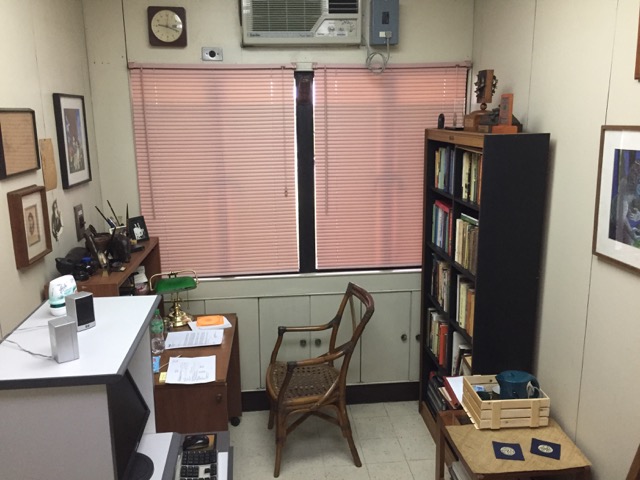
We live on campus, in a faculty bungalow on Juan Luna Street, a ten-minute walk from the FC, so UP was literally home for me. But I also held office at the FC, in the English Department, and the FC had been my official address for over 30 years since I began teaching in 1984. As I drove to Diliman I thought of my room, FC 1036, which I had had to myself since I came home from graduate school in 1991; before that, I’d shared FC 1012 with the late Angelito Santos and Ernie Bitonio, who became a lawyer and labor official.

Anyone who’s studied at UP Diliman would have gone through the FC at one point or another, and the place was rife with tales not only of intellectual and political adventure, but also of mischief of a baser, if more entertaining, nature. My favorite one, possibly apocryphal, had to do with an eminent lady professor going out on the window ledge and hanging on for dear life to spy on a neighbor whom she suspected of having an assignation with a student. Another hand-me-down scene involved two feuding scholars—one delivering a professorial chair lecture in CM Recto Hall while her nemesis handed out a vitriolic flyer at the door to anyone coming in.

It’s funny how the tragic can provoke the comic—and the professorial life certainly doesn’t lack for evidence of human frailty and folly—but it’s as good a response as any to personal loss, which was what the FC fire was really about. True, we lost a campus landmark and an academic institution. But buildings can be rebuilt—and the half-century-old FC was long overdue, anyway, for a massive renovation.

The FC’s subdivision into departments and then into individual rooms and cubicles guaranteed that each little corner would become treasured (and jealously guarded) personal space—not just mini-offices but mini-libraries and mini-galleries, showcases of both tradition and individual talent. Aside from the usual family pictures and diplomas (of which I actually saw precious few on display, perhaps in tacit admission of the silliness of flaunting one’s PhD in a boatload of them), shelves full of precious books and walls hung with choice art described the typical FC room, and each room’s state of order or chaos indelibly imprinted the tenant’s character on the visitor’s mind.

In UP, with historically low salaries and precious few incentives, a room of one’s own is an earned privilege. Professors are kings, and their offices are their castles and citadels, open to students and colleagues but impregnable to the unwelcome (except during martial law, when the military marched into the FC willy-nilly in search of Redheads). During the Diliman Commune in 1971, we’d renamed the place “Amado Guerrero Hall,” after the nom de guerre of Joma Sison, who had been an instructor with the English department.

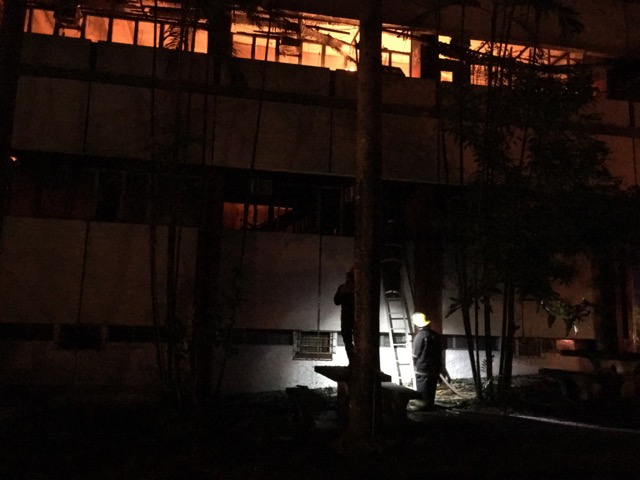
Once aflame with revolution, now it was literally on fire, and three hours after the fire began, I watched as an eerie orange glow illuminated its interior. The text messages had shown tongues of fire curling out the windows, but the blaze had mellowed down a bit when I got there. Had I arrived at its peak, I would have been too excited to feel pain, but its muted state invited contemplation, which invited melancholy. I stood outside the building facing our department, facing my corridor, and understood that very little, if anything, would survive. (And of course the scene was not without its black—or should I say its blackened—humor; I overheard an exhausted fireman asking, “Does anyone have a cigarette?” I can’t write this account without thanking the dozens of firemen from all over who battled that inferno—you all deserved a good puff afterward.)

As my fellow FC denizens would do in the coming days, I began taking stock of what I was losing even as I watched: a Joya nude (one of two that Beng had saved from her days at Fine Arts; thankfully we had given one to our daughter Demi); a large giclée print of lilies gifted to us by Jaime Zobel; two paintings we had bought from a young Jason Moss; a National Book Award trophy by Agnes Arellano in the shape of a typewriter, my favorite among all my illustrious paperweights; my TOYM trophy by Napoleon Abueva, which, meaning no disrespect, did double duty as a hat rack; two of Beng’s serene waterscapes, which I had commandeered from her exhibitions; and a drypoint portrait that I had made myself (in another life as a printmaker) of her whom I was yet courting.

There were the books: among many others, a first edition of Without Seeing the Dawn, signed by its first owner, the novelist Zoilo Galang; a signed copy of Villa Magdalena by Bienvenido Santos; more first editions of NVM Gonzalez, Nick Joaquin, and F. Sionil Jose; and a copy of Ninoy Aquino’s prison testament, which Cory Aquino had signed and gifted to me in thanks for some speeches I had happily done for her pro bono.

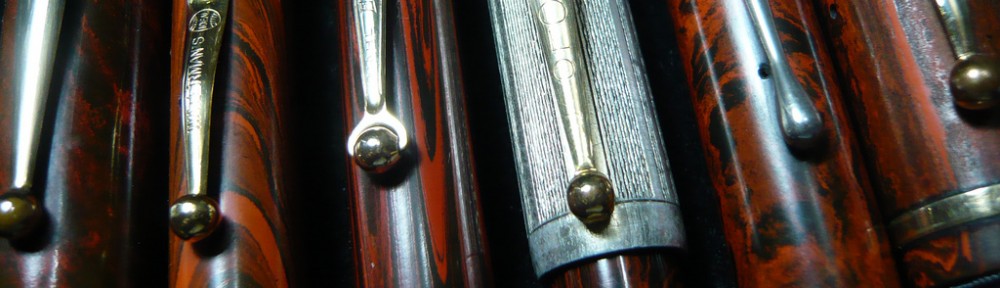
And then of course there were my own books and papers—file copies of nearly all my books, and assorted publications, including 20 copies of the first printing of Penmanship, whose special paper I treasured and therefore hoarded; and my only copy of my dissertation. Luckily I had left only one of my fountain pens in the office, a Conklin desk set from around 1925, and a handsome crystal inkwell from Barcelona. Most of these could be replaced, but not the letters of friends and students over 30 years, nor the cane chair handmade by my late father-in-law, on which I took many a siesta.

IMG_6542.jpeg

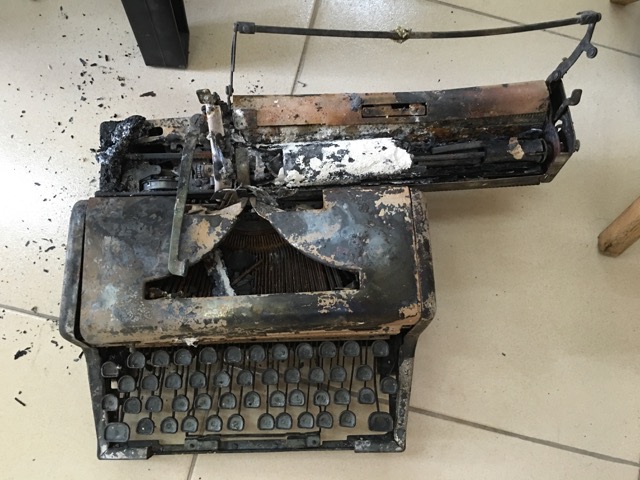
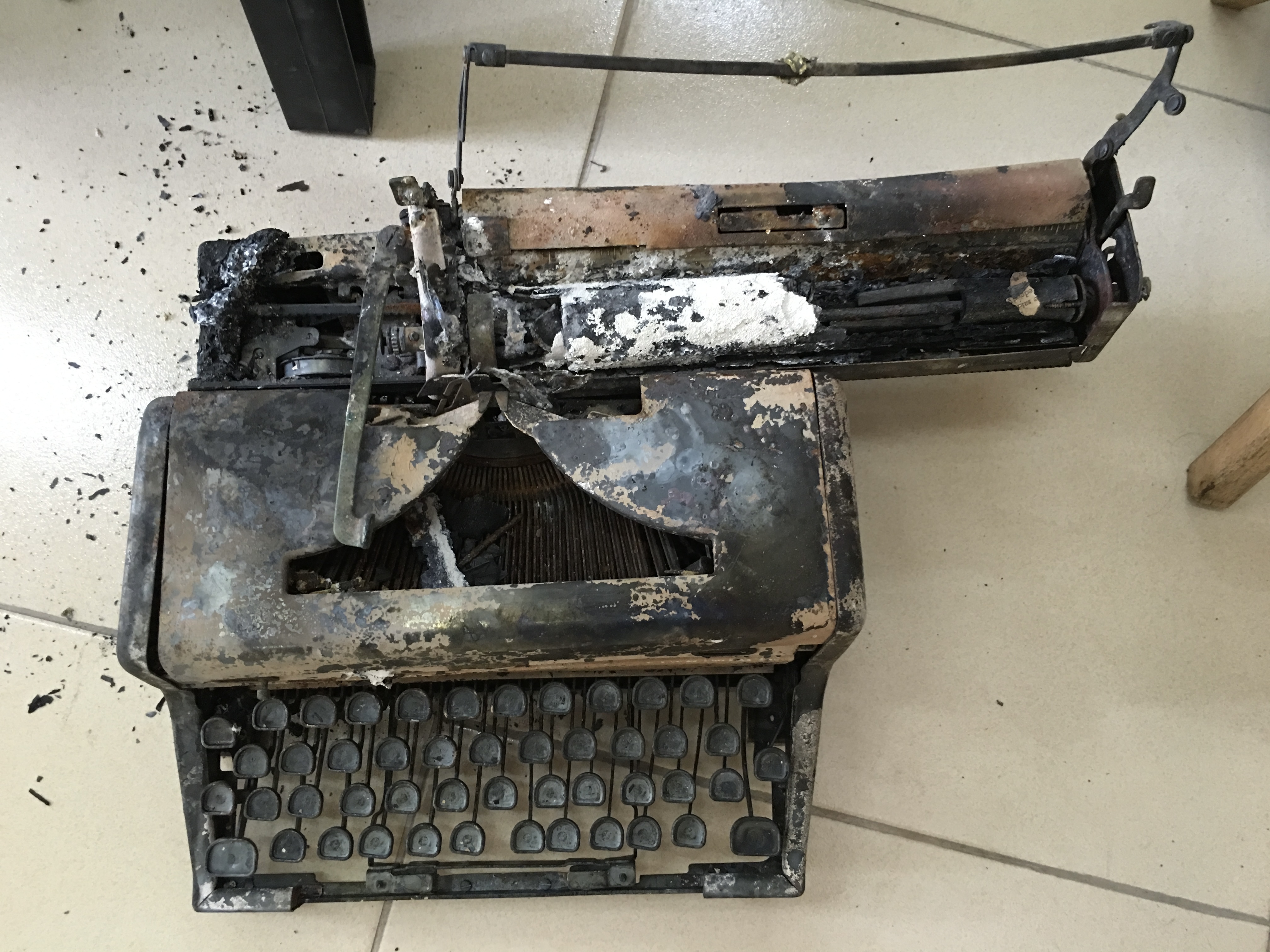
In the end, I found myself mumbling, “It’s all just things,” but of course it wasn’t. Men don’t grieve well, and over the next few days I grew increasingly sullen and irritable. Last Monday I joined a supervised foray into the burnt-out premises, just to see what we could recover. Almost everything we knew and owned had turned to mounds of char, which remained warm and smoky beneath our booted feet. From my blighted corner I picked up a ceramic mug that had lost its bottom. I also rescued a porcelain guan yin that belonged to Jing Hidalgo, and the ravaged hulk of a Royal typewriter I had given Isabel Mooney two decades earlier. We staggered out with our loot, laughing, and then the desolation hit us.

IMG_8243.jpeg

My grandmother Mamay used to sing us a lullaby which Ilonggos will recognize, about how life and sweet things will simply drift up and away in bitter smoke, and that weekend some of that life and some of that sweetness rose up into the air.

“We Pinoys are disaster-proof,” I tweeted at some point, mindful of how small our plaints seemed compared to a Yolanda. I do believe that, and we literary types have probably used up all our phoenix metaphors in the fire’s afterglow. But I’ve also always believed in proper goodbyes, so before we haul in the new furniture into the inevitable new FC, here’s mine, to ash-covered memory.

(If you want to tour the aftermath of the FC fire with me, see the video here.)