Qwertyman No. 159: No Room for Nuance

Qwertyman for Monday, August 18, 2025

LIKE MANY of his friends from the University of the Philippines and the legal profession, I was extremely saddened last week by the events surrounding and following the announcement of Senior Associate Justice Marvic Leonen of the Supreme Court’s unanimous decision in the case of Duterte v. House of Representativesthat effectively stalled the impeachment process against Vice President Sara Duterte. As someone inclined to believe in the VP’s culpability, I was of course disappointed by the decision, and dismayed that it was Justice Leonen justifying it as the ponente. 

Scores of former justices, lawyers, editorialists, and activists have since weighed in to expound on the perceived infirmities of the decision, and on the damage it has wrought on both our political and judicial institutions. Not knowing any better than these sharper minds, I can’t add anything much to those arguments, except to observe that from my layman’s point of view, it does seem that Justice Leonen went well out of his way to make impeachment more difficult even for those deserving of it.

I was saddened, but not surprised, when Marvic—both the justice and the man—was pilloried in the press and social media for his role in the matter. Insinuations floated that Leonen had been “bought” by the Dutertes in exchange for a promise of being eventually appointed Chief Justice under a Sara presidency. Other critics pointed to supposed flaws in his character, even equating him with Senate President Chiz Escudero, under whose clever management the VP’s impeachment did not push through “forthwith,” but has instead been “archived” for at least the next sixth months.

I don’t mean or need to defend Marvic, who can very well speak for himself. He was and remains a friend—we worked together in UP administration, where he served as VP for Legal Affairs and then Dean of the College of Law and I served as VP for Public Affairs—although I don’t know him nearly as well as his own compañeros in the profession. One of them, a mutual friend, came out with a stinging rebuke of the decision, while attesting—like many who know the justice and his background closely—to his personal and intellectual integrity.

I know a bit of that background, having mentioned and quoted Marvic in my recent biography of Justice Conchita Carpio Morales. He was among the four justices who dissented when, in July 2016, the Court dismissed the plunder case against former President Gloria Macapagal-Arroyo for lack of evidence. His remark then was simple but damning: “The scheme is plain except to those who refuse to see.” Earlier, as UP Law dean, Marvic had served as chief negotiator for the Philippine government in talks with the MILF, leading to a comprehensive agreement. He had also led the call asking a sitting justice to resign for alleged plagiarism; instead, the Court cleared its colleague and got back at the complainants (Carpio Morales dissented). Even before that in 2004, as a young lawyer, Leonen had argued for indigenous peoples in the La Bugal case questioning the constitutionality of the Mining Act. The Court agreed with him, only to reverse itself later.

Marvic Leonen’s performance as a lawyer, a legal academic, an advocate for the oppressed, and a justice are a matter of public record—which understandably, most Filipinos likely don’t know or care about. The question that bothered me in the aftermath of the Duterte decision was, “Should one act—widely perceived to be wrong—occlude a lifetime of good and right deeds? Are we judging the decision, or judging the man?” (The flipside of this is the sudden elevation of heels to heroes, because of one popular stance taken, as in the Senate vote.)

I asked this only because of the increasingly personal nature of the attacks against Marvic—which of course in today’s environment he had coming, even from those of us who deplore the personalistic nature of our politics. The term “cancel culture” has been often brought up in this context, a phrase more likely to be used by those on the receiving side of it. 

There are pluses to this form of public outrage, in that it can be unequivocal, if sometimes crude and over-the-top. As a way of telling public personalities that “You’re wrong” or “You suck,” there’s nothing like a torrent of posts and memes deploring or ridiculing their actions, taking minutes to form a tsunami of public opinion. In propaganda, we might call this the art of posterization, of reducing complex issues and character traits to one clear image and message, of stripping out the nuances, the “but’s” and “maybe’s,” the kind of hand-wringing I’m doing now in an effort to understand why people do what they do. 

From this perspective, and to use one of this century’s most telling cliches, at the end of the day, only the public impact of your actions count. No one needs to know or to understand your personal motivations; no one owes you the benefit of the doubt. Public opinion can sway (Shakespeare famously called it “the vagabond flag”), can be savage and cruel, but as with bees in a swarm, it’s in the nature of the hive mind to congeal and to move as one, with no room nor time for demurrers. Social media assists the formation of that hive mind exponentially, in post after repost, seeking and gaining affirmation in numbers. 

On the other hand (a phrase you hardly ever hear online), the dramatist and fictionist in me—as opposed to the propagandist—likes to individuate the caricature, to tease out the nuances of characters and situations, to explore context and subtext. That viewpoint might appreciate Marvic as a person whose own brush with impeachment made him the ideal spokesman for eleven other gray justices, serving as both lightning rod and fall guy, putting his own hard-won reputation at risk. 

Duterte v. House of Representatives wasn’t and shouldn’t have been about Justice Leonen, and not even the judiciary itself, but rather about seeking justice over the gross misdeeds attributed to a high public official. To the extent that we’re not talking about the massive and blatant corruption that prompted the impeachment in the first place so much as we’re dwelling on our disappointment with a perceived champion of the public interest, then the dark side continues to win by distraction. Methinks we should refocus on the real crooks—there’s a few more to root out in the Senate, and they were never even the good guys to begin with.

Qwertyman No. 158: Other Battles to Fight

Qwertyman for Monday, August 11, 2025

A LOT has been said this past week about the 12-0 decision of the Supreme Court on the impeachment case against Vice President Sara Duterte essentially supporting her contention that the one-year rule against bringing up new impeachment charges had been violated by the House of Representatives, and pushing back the earliest date for any resumption of such charges to February 6, 2026.

Predictably, the decision raised a storm of protest involving no less than former Justices of the Court, our top legal luminaries and lawyers’ organizations, and key media and political personalities who accused the Court of judicial overreach. On the other side were somewhat more muted voices calling for respecting the Court’s judgment—including, surprisingly or otherwise, a very sedate Sen. de la Rosa, now all flush with legal wisdom and temperance; to be fair, some of these people were hardly Duterte fans, but likely just citizens tired of all the bashing going on. (The Senate’s subsequent vote to “archive” the impeachment complaint would catch even more flak.)

However this issue is ultimately settled, one thing is clear: the Filipino public’s trust and confidence in their political institutions has hit a new low. And contrary to certain suggestions, it’s not because of journalists and gadflies like me who seem keen on tearing the house down, but because, well—it’s in the nature of the beast (or the human) for something so supposedly venerable as our Supreme Court to behave strangely in certain situations. 

The controversy stirred up by the Court in the Duterte case reminded me of a passage that I quoted in my recently published biography of retired Associate Justice and Ombudsman Conchita Carpio Morales, who has also manifested an opinion contrary to that of her current peers. The quotation comes from the former law dean and legal scholar Pacifico A. Agabin, who wrote in his book The Political Supreme Court (Quezon City: UP Press, 2012):

“The Supreme Court, like the US Supreme Court, is both an appellate and a constitutional court. Unlike most countries in Europe, we do not have a constitutional court, and so our high tribunal performs these dual functions under the Constitution. And when it decides constitutional cases, it becomes a political body, just like the executive and legislative branches. ‘Political,’ as used here, means that it acts as a legislature, according to Richard Posner, in the sense of having and exercising discretionary power as capacious as a legislature’s. According to Posner, ‘constitutional cases in the open area are aptly regarded as ‘political’ because the Constitution is about politics and because cases in the open area are not susceptible of confident evaluation on the basis of professional legal norms.’ Thus, when the court decides constitutional cases, it becomes a political organ. Like a chameleon, it changes color and assumes a different role as a political body.

“To repeat, I use the term ‘political’ here not in its partisan sense, but more in its ideological connotations. Unfortunately, there is no dividing line between the ideological and the partisan meanings, and sometimes, these blur into each other. The court itself sometimes fall into the partisan trap.

“This holds especially true in a personalistic culture like ours, where values like utang na loob and pakikisamaare embedded in the Filipino’s subconscious.”

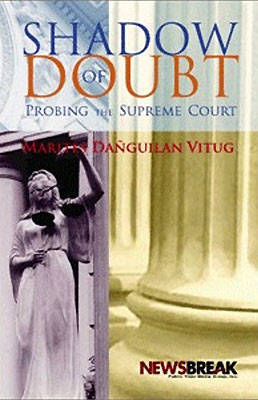
Now, that’s all still very high-minded, but another memory that’s even more disturbing comes from a book that I edited (anonymously, because I didn’t want to be saddled with a libel case—as its author inevitably was): Shadow of Doubt: Probing the Supreme Court (Newsbreak, 2010), written by my friend, the prizewinning journalist Marites Vitug. In her prologue, she recalls this incident:

“During an interview, after I asked an aspiring candidate to the Supreme Court about the unsavory realities of the appointment process, he advised me to tread carefully. The candidate, a Justice of a mid-level court, was fearful of the effects of a book that would pry into the sanctuary of the Supreme Court and ruffle the institution. 

“Over an oatmeal breakfast (mine) and coffee (his), he worried that the public may lose their confidence in the Court. He then told me the story of a staff member of a Supreme Court Justice decades ago. This man had access to confidential information and, after learning of Court decisions, immediately approached winning litigants and informed them that he could work on their cases and get favorable results. He asked for money—and, voila, delivered them the good news when the decisions were promulgated. He always had happy clients.

“The Justice I was speaking with was, at the time, working on the Court. Disturbed by the corrupt behavior of a colleague, he reported this to the Chief Justice. However, the Chief Justice took a benign, almost indifferent view. He told the young lawyer that this would soon come to an end because the erring staff member was about to leave the Court; he held a post co-terminus with that of his boss, an associate Justice. 

“It was best, the Chief Justice said, to let it pass. He feared that if the Court acted on it and the anomalies became known to the public, confidence in the ‘last bulwark of democracy’ would wane. It was paramount to keep the institution pristine in the eyes of the public, never mind if wrongdoing was gnawing the Court.

“The Justice looked back at this moment and narrated the story to impress on me how important it is to protect the institution. For him and the Chief Justice who initiated him into this misplaced patriotism, strengthening the institution meant glossing over grave offenses.”

I’m not a lawyer (something we very often hear these days, followed by some legalistic opinion), but my pedestrian sense tells me that this Court and this Senate aren’t going to dig themselves out of the hole they’ve jumped into. Pinoy officialdom never admits mistakes and apologizes, like the Japanese do; we love to brazen it out with the thickest of cheeks. 

Given that, let’s not hang our expectations on this one peg of VP Sara Duterte’s impeachment. Whether she gets impeached or not, she’ll still have to answer for the serious charges brought against her, perhaps with even more finality than her removal from office will bring. 

February 6, 2026 is less than six months away. Let the prosecutors use the time to prepare an airtight case that will secure a clear conviction, in the court of public opinion if not in the Senate tribunal—a case so compelling that it will embarrass any senator-judge who will ignore its logic (and let’s face it, there will be many), and hold him or her accountable to the people at the next election.

In the meanwhile, we have many other and far more consequential battles to fight—our bloated budget, our growing debt, the illiteracy of our youth, the hunger and homelessness of our poor. These can’t be “archived,” and the “forthwith” on these issues came and went a long time ago.

Qwertyman No. 154: Politics as Melodrama

Qwertyman for Monday, July 14, 2025

I’VE OFTEN argued that our most popular literary form isn’t lyric poetry, the short story, and certainly not the novel—it’s theater, and more specifically melodrama. Born in the West in the 18th century, melodrama weaves its spell on a suggestible audience through sensational and often ridiculous plots, exaggerated action, overblown emotion, and contrived solutions—all of which viewers happily lap up, and come back looking for more. When you think about it, it also happens to describe our politics, but more on that later.

I used to bring up melodrama when I taught playwriting and screenwriting, by way of analyzing how our Filipino sense of drama works. You don’t have to be a theater scholar or critic to observe that we Pinoys love drama, which to us really means melodrama, whether onstage, onscreen, or in real life.

Subtlety and silence have never been our strongest suit. We like to shout, to scream, to declare, to explain—and to explain some more. Take, for example, our preferred methods of murder. In Hamlet, the villainous Claudius pours poison into the king’s, his brother’s, ear. In The Seventh Seal, a knight faces Death on the chessboard. That may have been thrilling for fans of Shakespeare and Ingmar Bergman—but terribly dull and anesthetic for our kind of crowd.

No, sir, we Pinoys like our killings obvious, loud, and emphatic. Poison in the ear is for sissies. We prefer knives because they mean business, are as personal as personal can get, and they produce a lot of cinematic blood. And it’s never enough to stab someone, certainly not from behind, which would be a complete waste of dramatic possibilities. We like to announce that we’re killing someone, and to explain the reasons why: “Hudas ka, Raymundo, niyurakan mo ang karangalan ng aming angkan, kaya’t tanggapin mo ngayon ang mariing higanti ng hustisya—heto’ng sa iyo!” But of course Raymundo has to have his moment, and must raise that inevitable question: “Ano’ng ibig mong sabihin?” Whereupon our hero launches into another lengthy explanation, to which Raymundo offers an impassioned rebuttal, all to no avail, as he is stabbed repeatedly to the accompaniment of further oaths and recriminations.

I used to think that this kind of talkativeness and effusive gesturing was invented by us, until I went to graduate school and realized that it was all over the place in Restoration drama, where the likes of John Dryden had his characters indulge in copious speechifying in the name of love and honor before killing everyone onstage. I suppose a similar trend seized the French and Spanish theater, and thereby later ours, in the zarzuelasmoromoros, and komedyas that provided us with both entertainment and education. The noisiness carried over to radio, and then to our movies, which never quite shook off the “Ano’ng ibig mong sabihin?” habit. 

And this brings us to our politics, which is not only full of sound and fury, of unbridled verbosity, but of plot twists that strain credulity and yet which manage to keep the audience on the edge of their seats, either roaring in rage, applauding in delight, laughing deliriously, or weeping in sorrow, depending on their persuasions.

The Duterte Saga, our biggest ongoing drama, is now in its fourth act—the Sara impeachment—after the Uniteam victory, the fallout, and the Digong arrest and banishment. A professional scriptwriter could not have done better than giving the VP lines like Sara’s vengeful vows, as the media reported: “I have talked to a person. I said, if I get killed, go kill BBM (Marcos), (First Lady) Liza Araneta, and (Speaker) Martin Romualdez. No joke. No joke,” Duterte said in the profanity-laden briefing. “I said, do not stop until you kill them and then he said yes.” Threatened with impeachment for that statement and for corruption, she said, “I truly want a trial because I want a bloodbath.”

To the uninitiated listener, a madwoman was merely frothing at the mouth, but to the theater-goer, she’s puffing up her feathers, going larger than life, saying outrageous things to define her character and stake out her space like a Maori dancing the haka. Her adversary, PBBM, is playing cool and coy, pretending to be occupied with work and a disinterested party in Sara’s undoing. And yet he whisks off her precious papa in the night to Scheveningen, provoking even more outbursts from the DDS faithful.

Now comes the tearful part. Melodrama moves from Olympian thunder to cloying tenderness, so our next scene, naturally, has Sara’s mom Elizabeth declaring that her estranged husband has been reduced in detention to “skin and bones.” But it’s all right, she says bravely. “And how is my son, acting Mayor Baste?” the Davao City mayor-in-exile asks in a dry croak. “He’s okay, too,” Elizabeth assures him. “His vice mayor is your grandson!” So but for the absent patriarch, all’s well in Duterteland—sort of.

Melodramas love subplots, so let’s introduce one: selling the Duterte house. Common-law wife Honeylet puts up a sign announcing the place for sale (“It’s too painful to sleep there all by myself,” she claims), but son Baste reportedly has the sign removed. Not so fast, VP Sara chimes in; Honeylet could sell her half of it but not her dad’s. Besides, where would Digong live when he returns from the Hague, if Honeylet sold the house? (Cue for hopeful, uplifting music, which tapers off into a melancholic minor key.) “Perhaps he could live with Mama Elizabeth again,” Sara muses. 

Ah, such poignant moments. No one’s been stabbed yet—expect a lot of that to happen, metaphorically, if and when the Senate finds its balls and starts the impeachment trial of VP Sara. What’s theater without traitors? Sen. Migz Zubiri has already thrown down the gauntlet by declaring the trial “a witch-hunt.” But Senator Migz, ano’ng ibig mong sabihin?

Qwertyman No. 152: A Probinsyana from Paoay

Qwertyman for Monday, June 30, 2025

IT WON’T officially be out for another couple of weeks, but I’m happy to announce the publication of my latest book, the biography of one of the Philippine judiciary’s most fearless and remarkable women, former Supreme Court Justice and Ombudsman Conchita Carpio Morales. Begun during the pandemic, Neither Fear Nor Favor: The Life and Legacy of Conchita Carpio Morales (Milflores, 2025) traces the journey of a probinsyanafrom Paoay, Ilocos Norte to the country’s highest court, followed by an even more distinguished period of service as “the people’s agent” at the Office of the Ombudsman.

I’ve written a number of biographies of outstanding Filipinos before—among them the accounting titan Washington SyCip, former UP and Senate President Edgardo Angara, and the renowned economist Leonides Virata, as well as the revolutionary Lava brothers—but this was different in many ways. 

Foremostly, it was because my subject was a woman working her way up a heavily male-dominated system, constantly challenged to adhere to her fundamental values and principles in an environment of corruption, intimidation, and political accommodation.  For the men—given that they had the talent and the grit, and possibly the right connections—success was practically a given; for such women as Conchita, proving oneself worthy was often doubly difficult.

Since the Supreme Court of the Philippines was established in 1901, almost 200 justices have been appointed to that exalted bench; only 18 have been women as of 2023, and it wasn’t until 1973 that the first female justice, Cecilia Muñoz Palma, took office. After Morales was appointed to the SC by President Gloria Macapagal Arroyo in 2002, among the first cases to fall on her lap was the impeachment of no less than Chief Justice Hilario Davide, brought on by pro-Estrada congressmen who believed Davide had misused the Judiciary Development Fund. A fellow Justice approached the novice to ask her pointblank, “Chit, do you think you can handle this?” Inhibiting herself from the case would have been the prudent option, but she took it on, and wrote the decision disposing of the complaint.

She would soon be known for her fierce independence. Despite death threats—a grenade was once left outside her Muntinlupa home, along with a threatening message—she worshiped no sacred cows, spared no one from judicial scrutiny when the situation demanded. This was even much clearer when she retired from the Supreme Court and was appointed Ombudsman, in charge of investigating and prosecuting high-profile cases of graft and corruption in government. Among the cases that crossed her desk were those against PGMA, President Noynoy Aquino, former Senate President Juan Ponce Enrile, and former Vice President Jejomar Binay.

While most of a Justice’s or Ombudsman’s work is done quietly, away from public view, occasionally they come into the limelight even against their wishes because of our fraught political environment where issues often end up in court. One such case was the 2011 impeachment of Chief Justice Renato Corona, a highly significant and contentious case that centered on serious allegations of corruption and betrayal of public trust. 

Then the Ombudsman, Morales engaged a former Supreme Court colleague, Serafin Cuevas, in what came to be known as the “battle of retired justices. “I had been summoned as a hostile witness by the defense,” Conchita recalls. “I sensed that the defense wanted to embarrass and humiliate me even. They thought that my alleged opinion that Corona had millions of dollars in undeclared deposits had been based on the three complaints filed before the Office of the Ombudsman. But it was the Anti-Money Laundering Council that had furnished me with the CJ’s record of bank transactions. I had requested their assistance as reported by the media even before I was summoned to testify. The three complaints filed at the OMB never mentioned any dollar deposits. If the defense counsels had been insightful enough, they should have figured that out.” Corona was eventually impeached on a vote of 20-3.

Her confrontations with former President Rodrigo Duterte—a distant relative, through the marriage of her nephew Manases Carpio to presidential daughter Sara—were also the stuff of theater. At the 2016 wedding of Manases’ brother Waldo, the President and the Ombudsman walked down the aisle together arm in arm—he in a cream barong and she in a bottle-green gown—and appeared friendly, making small talk. The cordiality would not last long.

One year later, in October 2017, President Duterte challenged Conchita to resign as Ombudsman, claiming that she had exercised “selective justice” in asking her deputy, Arthur Carandang, to investigate his unexplained wealth. Duterte suspended Carandang, and threatened to impeach Conchita. “Resign now,” he told Morales, “at kung hindi, huhubaran kita!” The last line—which literally translates into “or else I’ll strip you naked”—was egregiously coarse, but came as no surprise to audiences familiar by this time with Duterte’s tough-guy and often misogynistic language.

Morales promptly hit back, vowing not to be intimidated. “If the President has nothing to hide, he has nothing to fear,” she coolly told a press conference.

What most people never saw was Conchita’s lighter side. The first time she went to Broadway in 1981, she watched Evita with her sister Vicky. Before watching, they had dinner at Gallagher’s, where the size of the steaks made Conchita’s eyes pop. She couldn’t finish her portion and, ever the Ilocana, wanted to have it wrapped to take home. Her sister told her not to do that, so Conchita went to the ladies’ room, got some tissue paper, and wrapped the steak. The following day, they went to Washington, where they went to dinner and had shrimp cocktail. Conchita then took out the previous day’s steak to the shock of Vicky, who said, “Don’t bring that out. Don’t embarrass me!” The steak ended up in the wastebasket. 

Lawyer Ephyro Amatong and others who trained with her were privy to Conchita’s moods and modes. “When she was in her ‘Justice’ mode, she was very strict, very sharp, very hard to read, with an incredible poker face. I knew lawyers like the co-head of litigation at a big firm who thought that she was scary,” Eph says. “But while she could be reserved, she could also be very charming and accommodating. She had a great sense of humor. I remember when she had to attend an en banc meeting or when she had a ponencia for deliberation, just before she went out the door, she might be laughing or making jokes about the grilling she might get, or mention what she was wearing and how fashionable she was. But once the door opened and once she stepped out, her ‘Justice’ face came on, ready for battle.”

You can read more about this feisty Filipina, the Ramon Magsaysay awardee for public service in 2016, in the book. Neither Fear Nor Favor: The Life and Legacy of Conchita Carpio Morales will be available on Shopee and Lazada or from milflorespublishing.com very soon.

Qwertyman No. 148: Pondering the Inconceivable

Qwertyman for Monday, June 2, 2025

IT SOUNDS like wishful thinking at the moment, but is there even a faint possibility that—in the aftermath of the midterm elections and looking ahead to the next big one down the road—President Bongbong Marcos might be willing to back a progressive candidate to take his place? And would liberal (with a small L) forces accept his help?

Just a few years ago this idea would have been totally preposterous, the relationship between the two sides being one of utter incompatibility and mutual revulsion. Marcos (more the name and what it stood for than Junior himself) was seen as the devil incarnate, while BBM would have deemed unforgivable his family’s ignominious banishment into exile in  Hawaii.

During the May 2022 election, Leni Robredo’s partisans (myself among them) made sure our people remembered the trail of blood and misery that martial law left behind, and the Marcoses’ unpaid debts to the treasury, and to the nation itself.

His election victory was met with profound disbelief and distress; we felt unmoored and stunned for a brief spell (much like the Democrats today, reeling under Trump’s relentless barrage of idiotic but effectively discombobulating executive orders). We took refuge in the certainty that this administration would quickly self-destruct from BBM’s incompetence and from its own internal contradictions—a prediction that has now partially come true, albeit with the most unexpected ramifications.

The spectacular collapse of the “Uniteam” was predictable; it had always been a marriage of convenience, seemingly forged to install BBM as a seatwarmer for VP Sara and the eventual restoration of the Dutertes in Malacañang. No one knew that better than BBM; there was talk (as there will always be, in this country of gifted storytellers) that the Dutertes weren’t even going to let him finish his term, but find a way to ease him out earlier so Sara could do a GMA and rule for longer than six years. So, went the buzz, BBM beat her to the draw by getting her impeached in the House (for good reason) and packing her father off to the Netherlands (for even better reasons).

Now comes the tricky part, which is getting Sara impeached (and struck out of the presidency for good) in the Senate—a newly reconstituted Senate that needs only nine of its 24 members to resist, and thereby keep the Dutertean dream alive. That court will convene sometime this month, with the outcome far from predetermined, but apparently leaning, at the moment, toward acquittal. Two administration senatorial bets—Imee Marcos and Camille Villar—jumped ship, making a crucial difference; the current pro-Sara tally now runs to a comfortable 11, if both Cayetanos, both Villars, and both Estrada siblings (now you see why dynasties are a bad idea?) see a longer horizon for their political futures with Sara on top. 

However, as they say, it ain’t over till it’s over, and the same opportunism that led to this tangle could just as easily turn it around within weeks or months, however long the impeachment trial is going to take. Observers note that at the last big impeachment trial—that of the late Supreme Court Justice Renato Corona—the odds were hugely in his favor at the start, but compelling evidence eventually made it not only unreasonable but politically untenable to acquit him at the end (although notably, his faithful supporter Senator BBM survived and even prospered). A strong prosecution—and, let’s admit, some backroom wooing and strong-arming—could yet land Sara in political limbo.

And that had better happen, because as BBM well knows, if the impeachment fails, his party has no candidate from within strong enough to take on the Dutertes. His apparent anointed, House Speaker Martin Romualdez, has about as much charisma and appeal as a thawed-out tamilok. Apart from the surprise victories of Bam Aquino and Kiko Pangilinan (about which more, later), the one big takeaway from the midterms was the continued strength of the Duterte forces on a national scale, never mind their isolation in Mindanao. An unverified post-election report (again, from the Bureau of Speculation) claimed that in a survey of early votes cast by the military and police, the Duterte slate scored a perfect ten. Why? Well, didn’t PRRD fatten the military, doubling their salaries and raising their retirement benefits? And aside from the mediagenic generals and admirals, who really wants to fight China in the West Philippine Sea? (Not my opinion, folks, just passing it along.)

If and when Sara wins, BBM and the Marcoses may find themselves taking another flight out in the night for parts unknown. The “bloodbath” Sara promised won’t be at the trial, but in its aftermath.

So we return to my first question: can and will BBM find it in himself to support a progressive and acceptable candidate from the middle forces, someone like Sen. Risa Hontiveros? If he insists on fielding his own man and the center-left puts up their candidate, it won’t take a political scientist to figure that as things stand, in a three-cornered fight, Sara will win. The Marcoses will be history (again) and the progressives crushed even more.

An argument can be made for the once-unthinkable. Against all expectations, BBM has done the right thing in de-Dutertizing government, (largely) stopping tokhang, and taking a firm stance for Philippine sovereignty in the WPS. On these issues, we can unite, at least for the time being. It will not be idle thinking to suspect that Bam and Kiko won not by divine miracle but with some backhanded nudge from the administration, who needed them to shore up its Senate votes (Bam, after all, was carried by the INC—as was Marcoleta, so it evens out). BBM’s Cabinet revamp shows signs of sensitivity to expectations and keenness on delivery, if only to shore up his administration for 2028.

He’ll never publicly admit it, but if BBM is truly intent on some measure of redemption for the Marcos name and on making his own mark on the presidency, this could be his historic opportunity. He will do well to support the progressives; it will be an easier and more logical switch than for the progressives to support an anointed trapo. BBM can take a free ride on the idealism of the middle forces, who are his best buffer against both Left and Right extremes.

But then again, all this comes to you sponsored by Willy Wonka’s Chocolate Factory, makers of the Everlasting Gobstopper and other fabulous confections.