Qwertyman No. 97: The City That Works

Qwertyman for Monday, June 10, 2024
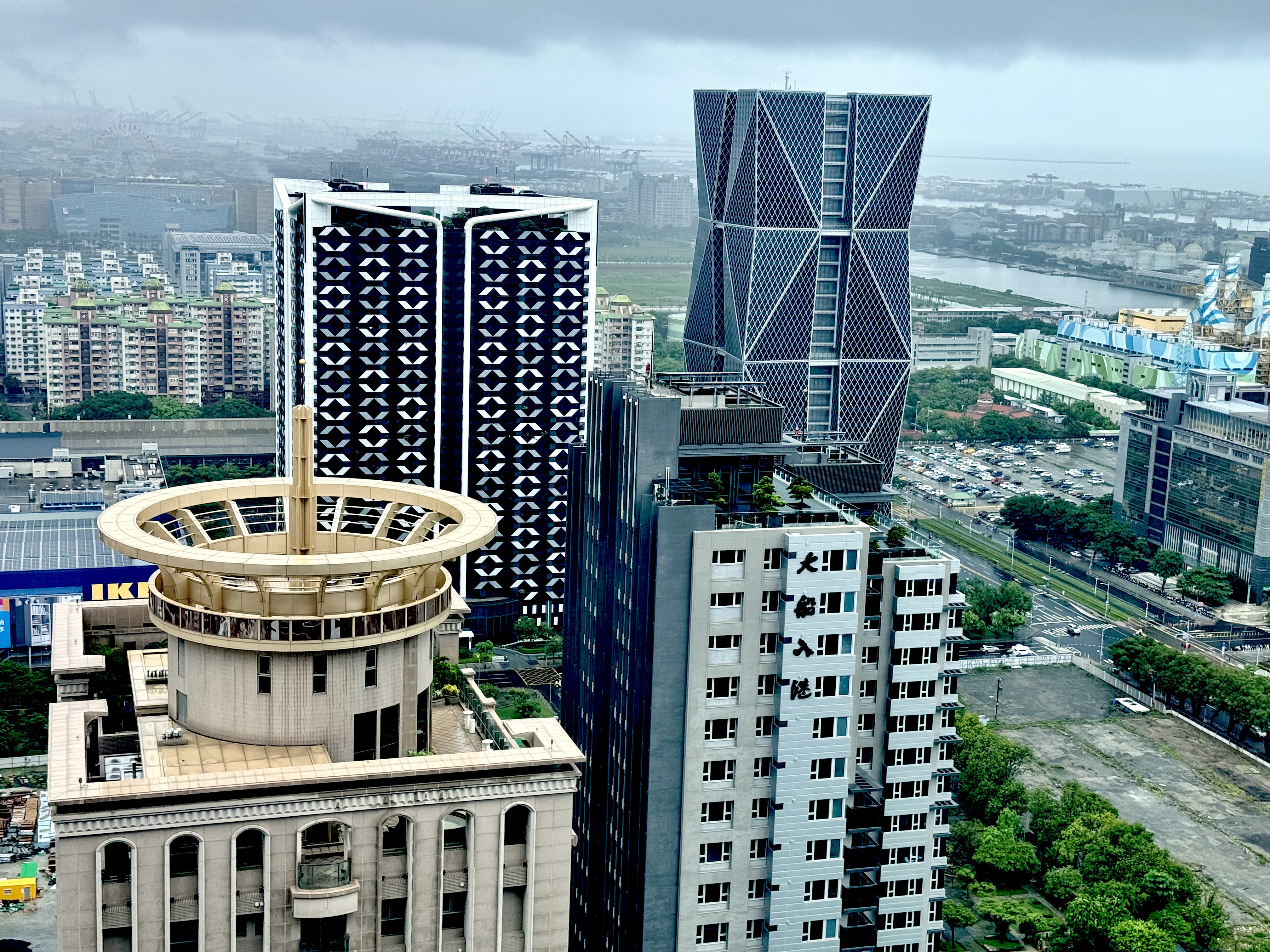
I WAS back last week in the city of Kaohsiung in Taiwan with a group of writers from the University of the Philippines Institute of Creative Writing, at the invitation of Dr. Eing Ming Wu of the Edu-Connect Southeast Asia Association, an education NGO seeking to establish stronger ties between Taiwanese universities and their counterparts south of Taiwan. We were there to meet with our literary and academic counterparts, but also to acquaint ourselves with contemporary Taiwanese society and culture. What we found along the way was a city and a government that works—a model we have much to learn from.

It was my second time in Kaohsiung and my sixth in Taiwan since my first visit in 2010, but those earlier sorties were either for tourism or for attending meetings and conferences, so we never really got to immerse ourselves in the place and its people. This time, Dr. Wu made sure that we went beyond casual handshakes and pleasantries with city and university officials to engage our hosts in in-depth conversations.

The first thing that usually strikes visitors about Taiwan is how modern it looks, especially when flying in through Taipei—the High Speed Rail (HSR), the wide roads, the skyscrapers (think Taipei 101, once the world’s tallest), the late-model cars. For quick comparisons, consider this: Taiwan’s population, at 24 million, is about a fifth of ours; in terms of land area, we are almost ten times larger; its nominal per capita GDP, however, is almost ten times larger than ours at US$35,000. Not surprisingly, Taiwan now ranks around 20th in the world in terms of its economic power.
That power came out of decades of dramatic transformation from an agricultural to a highly industrialized economy, starting with massive land reform and the adoption of policies that spurred export-driven growth. Industrialization itself went through key phases from the production of small, labor-intensive goods to heavy industry, electronics, software, and now AR/VR and AI tools and applications.

At a briefing at the Linhai Industrial Park by Dr. Paul Chung, a US-trained engineer who was one of the architects of this economic miracle, we learned how Taiwan built up the right environment for economic growth through such strategies as the creation of industrial parks (there are now 67 of them covering more than 32,000 hectares, with 13,000 companies employing 730,000 people and generating annual revenues of more than US$260 billion—almost eight times what all our OFWs contribute to the economy). The Taiwanese government has also implemented a one-stop-shop approach to investments, bringing together the approvals of many ministries and local governments under one roof.

Consistently, in modern times, the private sector has led the way forward, with the government acting as facilitator. This was much in evidence in Kaohsiung, Taiwan’s southern industrial hub that was, until relatively recently, a virtual cesspool, the prime exemplar of industrialization gone amuck. A strategic seaport, Kaohsiung grew out of the need to export Taiwanese sugar during the Japanese occupation (1895-1945); the sugar industry gave rise to railways that went far up north to Keelung and became the backbone of the country’s transport system. After the war, the Kuomintang who displaced the Japanese did little to improve things until a visionary mayor undertook reforms that cleaned up the place. Industry also achieved important synergies by adopting policies toward carbon neutrality and reducing waste—for example, one company’s blast furnace slag is being used to pave roads, and harmful carbon monoxide emissions have been rerouted as inputs to chemical companies.

Kaohsiung today is a city of 2.8 million people, a showcase of how runaway industrialization and urban blight can be reversed through good governance and political will. “People need responsible, responsive, and accountable government,” says Dr. Wu, a public-administration expert who worked for 15 years with five Kaohsiung mayors and who now serves as a visiting professor at UP’s National College of Public Administration and Governance (NCPAG). 

A longtime visitor to the Philippines, Dr. Wu has made it his personal mission to promote Philippine-Taiwanese people-to-people relations—a concept he calls “taiwanihan”—in the conviction that the two countries have much to learn from each other and form a natural geographical, economic, and cultural partnership. “We are each other’s closest neighbor,” Wu says. “Taipei is 96 minutes away by train from Kaohsiung, but Kaohsiung is only 90 minutes away by air from the Philippines.” 

Wu and his colleagues at NCPAG have been exploring the possibilities of developing a corridor of cooperation between Southern Taiwan and Northern Philippines, given their proximity. “We have the technology, you have the resources like biomass,” he adds, pointing out as well that taiwanihan doesn’t just mean a one-way relationship, but that the Philippines can also assist Taiwan with its growing needs, such as engineering talent and manpower. Some 8,000 Filipinos now work in Taiwanese factories, but Taiwan’s demand for highly skilled workers will only get higher as it moves into the next phase of its development, which will be heavily dependent on AI.

Artificial intelligence already takes care of many of Kaohsiung’s more mundane needs such as remote traffic monitoring and even the paid parking of vehicles, which has been outsourced by the government to a private entity. “We buy services, not things,” explains Dr. Wu. “The government provides the land for the parking, the private sector supplies the technology and the hardware. This is our version of public-private partnership: the government listens to the private sector, which can use the city as its lab.” 

E-governance and decentralization led us to an unusual sight: we visited City Hall on a weekday and saw very few people in the lobby, unlike its Philippine counterparts. That doesn’t mean that government is distant from the citizens, as a “1999” complaints center receives and fields calls online or in person, employing the disabled to man its booths. 

And even as AI has taken the forefront, it was abundantly clear that human intelligence and human priorities remained important. Good community governance, for one thing, was key to clean and peaceful neighborhoods (their village officials are appointed rather than elected, eliminating vote-buying). Their libraries alone show how and why the Taiwanese are succeeding: they not only have hundreds of thousands of books available to their citizens, but they have innovations such as the “Adopt-a-Book” program by which you borrow a book just based on a previous reader’s recommendation, and books in both Braille and regular text, so that sighted readers can read along with the blind and enjoy a story together. A city that goes that far to meet its people’s needs can’t fail.

Penman No. 332: Southern Surprises

IMG_8556.jpeg

Penman for Monday, December 17, 2018


MY RECENT forays to southern Taiwan—the first to Tainan, and the second to Kaohsiung—reminded me that while we Pinoys love to chuckle and even snicker at how the Chinese (among others) mangle English, the economic and technological leaps they’ve made (using their own language, let’s not forget) are no laughing matter, unless you’re a Chinese entrepreneur or engineer on his or her way to the bank.

This occurred to me as I was flipping through the local travel and leisure magazines in my hotel room in Tainan between sessions of the academic conference I was attending. Typical of the prose was this advertisement for a resort on the island: “Join the exclusive equestrian sports of the aristocrats, so that parents can easily experience the price of the people, the wonderful and rich itinerary, you can easily lick the children without going far! Let you play and don’t want to go home anymore.”

I could imagine some snooty Filipinos, more English than the English, rolling on the floor and thinking that people who write that way can’t possibly go anywhere, but I would’ve liked to bring those people to the exhibits downstairs showcasing Taiwan’s state-of-the-art research in biomedical engineering, solar power, and materials science, including an interesting project aimed at improving your basketball skills through “a virtual reality basketball tactic training system.”

I don’t know how close that project will bring Taiwan to a world basketball championship, but I could see, from the presentations I was listening to, that they were going all out to become world-class champions in research and development. Our host, the National Cheng Kung University, had almost US$145 million to spend on R&D in 2017, mostly from the government. (That’s about half of the University of the Philippines’ budget for everything.)

Thankfully, we did have a break from all the S&T reports on the last day of our Tainan conference, and we were given a choice of tours between visiting a museum or an aquaculture farm. Now, I love fish as much as you do—it’s often the first thing I eat in the morning—but I wanted to have a closer look at Taiwan’s culture and history, so I hopped on the museum bus. What we saw was, well, anything but Taiwanese—unless you take the act of presenting the thing itself as an expression of Taiwan’s place in the world today.

Our destination was the Chimei Museum, named after the company that’s now the world’s largest maker of ABS resin, which goes into the making of popular plastics such as computer keyboards, auto body parts, and bicycle helmets.

The Chimei Museum is an imposing if rather odd homage to Western art and artisanship. Located on the outskirts of Tainan, it was built in 1992 by the billionaire industrialist Shi Wen-long. Now 90, Shi never got a college degree. But he’s also a passionate amateur violinist who’s played with Yo-yo Ma. That, plus his personal fortune, has allowed him to put together a stunning collection of vintage musical instruments—including priceless violins by Stradivari, Guarneri, and Amati—that are now on display at the museum, in an exhibition that recreates the workshop of a master luthier or violin maker.

The Chimei’s other showstopper—aside from the Rodin gallery and some masterpieces of French realism—is its exhibit of ancient arms and armor, from the time of the Greek hoplites and medieval knights to the Japanese samurai and English crossbowmen. I have to admit to a boy’s fascination with weaponry, and having visited many of the world’s best museums, I’d have to say that the Chimei’s collection was comprehensively fearsome. These were the real things, folks, not cheap or 3-D printed replicas.

Indeed, there’s hardly anything Chinese in the design of the Chimei or in its exhibits. The large, neoclassical, Corinthian-columned museum—set off from the street by a long walkway flanked by tall statues of the Greek gods and goddesses—could have stood anywhere in Europe or the US, and comes off as a statement, as if to say, “We could have given you the chinoiserie you expect, but we chose to acquire and to present the best of the West.”

IRide.png

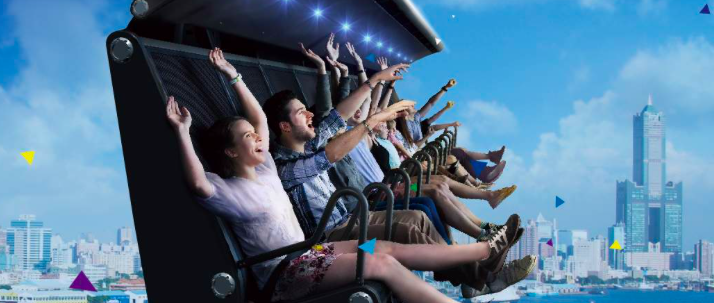
And I can’t let this column end without mentioning the other surprise I came across in southern Taiwan, in the port city of Kaohsiung, where I also attended a conference on distance education. Our host, Dr. Eing-Ming Wu, made use of a free afternoon to introduce us to the city in a most unconventional way—by giving us tickets to take the I-Ride, Kaohsiung’s so-called “flying theater”—kind of like a rollercoaster in an Imax—powered by the homegrown Brogent Group’s 3D technology, which it has exported to Hollywood and other amusement capitals worldwide. If I needed to be impressed by Taiwan’s engineers, this was the best way to do it, screaming my head off, feet dangling in the air, as we swooped over a Buddhist temple then plunged into the ocean.

While travel to Taiwan remains visa-free for Pinoys, I’m definitely returning as a tourist to Kaohsiung with my wife Beng, if only to have her  experience the exhilaration of the I-Ride and maybe take her on a cruise on the Love River, feasting on the sweet giant atisuntil our eyes bulge. As they say, in Taiwan, “you can easily lick the children without going far”—whatever that means, it sounds like fun!


Penman No. 331: Opening up to Taiwan


IMG_8621.jpegPenman for Monday, December 10, 2018


AS IT happened, I was in Taiwan twice last month to represent the University of the Philippines in two conferences that underscored the vitality of our academic partnerships with our Taiwanese counterparts—and the importance they accord to improving relations with Philippine universities.

Over the past decade, the Philippines has been sending scores of graduate students to various universities in Taiwan for their masteral and doctoral degrees, mainly in the sciences, where Taiwan has a lot to offer the world, given its cutting-edge technologies and laboratories. This also plays into one of the island’s growing predicaments—a demographic dip that has encouraged its policymakers to draw students for its universities from around the region, embodied in its so-called “New Southbound Policy” of promoting relations with South and Southeast Asia and Australasia.

Southern Taiwan has been especially aggressive in opening and developing academic relations with Philippine universities, banking on its geographical and cultural proximity to us. (It always amazes me how closely their aboriginal costumes and folkways resemble ours.)

The first conference I attended was the Presidents’ Forum of the South and Southeast Asian and Taiwan Universities (SATU), a consortium organized 15 years ago and since led by the National Cheng Kung University based in Tainan. This year’s meeting was devoted to strengthening linkages between universities and industries, with experts from Thailand (medical sciences) and India (engineering) supporting their Taiwanese counterparts in providing models for cooperation. SATU universities match experts who then work collaboratively on projects ranging from robotics and wind tunnels to dengue and stem cell research.

The second and larger conference was held in the port city of Kaohsiung, even farther south (both Tainan and Kaohsiung are easily reachable from Taipei by high-speed train). This was the 3rdInternational Conference on Open and Distance e-Learning (ICODeL) with the theme “Technology-Enhanced and Inclusive Education in the Digital Age,” and while it took place in Taiwan, it was actually organized and run by the UP Open University (UPOU), with support from the Commission on Higher Education (CHED), the Manila Economic and Cultural Office (MECO), the National University of Kaohsiung, the Open University of Kaohsiung, the Southern Taiwan Universities Alliance, and Taiwan’s Edu-Connect Southeast Asia network, among others.

This is as good a time as any to highlight the work of UPOU, one of UP’s eight constituent universities—one that happens to have the smallest physical footprint (it occupies a small lot in Los Baños, Laguna) but the largest global reach, because of its online presence. Founded almost 25 years ago to democratize access to quality higher education through distance education, UPOU came fully online in 2007, with 25% of its enrollees spread out over 70 countries. It offers three undergraduate, about 30 graduate diploma and masteral, and three doctoral degree programs, from which it has produced close to 3,000 graduates, mostly from its Multimedia Studies and Education programs.

All of this happened, former UPOU Chancellor Grace “Gigi” Javier Alfonso told me, without compromising UP’s high educational standards. “Applicants to our undergraduate degree programs still have to pass the UPCAT,” she said.

There’s a persistent impression out there that open universities and distance education offer cheaper but also lower-quality education and easier-to-pass courses, but UPOU has been working hard to prove this stigmatization wrong. “We offer the same quality of education as any other UP CU,” said current Chancellor Melinda Bandelaria, who also presides over the Asian Association of Open Universities (AAOU). “What open universities like UPOU provide is a chance for working professionals, housewives, entertainers, and OFWs to acquire a college or graduate education at their own pace, wherever they may be in the world. It’s not a replacement for, but an alternative to, traditional residential colleges.”

Many of UPOU’s students are OFWs working on their degrees, which will boost their skills and employability where they are and when they come home. One of the highlights of ICODeL was the inauguration of a Philippines Learning Commons in Kaohsiung where UPOU students could access their materials online. Much of the instruction of UPOU and other open universities is done through Massive Open Online Courses or MOOCs, which have become increasingly popular in the global academic landscape. UPOU now has more than 70 MOOcs on its roster, with 3 MOOCs typically covering a 3-unit course. It typically takes three years to finish a master’s degree with UPOU.

Mandated by RA 10650 or the Open Distance Learning Act to assist CHED and TESDA, UPOU had engaged industry experts help it in designing Open Educational Resources  or OERs which are free to use by teachers and students; UPOU then develops MOOCs using these OERs. “When industries work with universities, they create a powerful engine for economic growth and innovation,” said Dr. Bandelaria.

The point of bringing ICODeL to Kaohsiung was also to match UPOU and the many Philippine SUC officials who attended the conference with their Taiwanese counterparts. The chief matchmaker was Edu-Connect’s indefatigable Executive Director, Dr. Eing-Ming Wu, a political scientist and Chair Professor at Shu-Te University who has been one of the most energetic promoters of the Philippines abroad that I’ve ever met.

With these connections in place, Philippine educators may not have to look much farther than our closest northern neighbor for vital help in raising their educational standards.