Qwertyman No. 142: A Long Learning Process

Qwertyman for Monday, April 21, 2025

I RECENTLY came across a thread on social media urging Filipinos to boycott the midterm elections next month on the expectation that they will be tainted with fraud, as the 2022 elections were believed or alleged to have been by many.

When I looked it up, as early as last October when certificates of candidacy were still being filed, a retired OFW named Ronnie Amorsolo had already protested the elections, telling aspirants to not even run and calling the May 2025 polls a waste of time, energy, and money as they were already rigged. Political dynasties were making sure they would stay in power, he said, with the connivance of the Comelec and Miru Systems, the contractor for this year’s automated vote counting.

I can understand the extreme frustration of our countrymen like Ronnie who feel that the current electoral system is hopeless and that our democracy itself is a fraud given the seemingly unbreakable grip of dynastic families on our political leadership. But I disagree with his cynicism and with his call for a boycott. I think abstention will simply play into the hands of those dynasties and be written off as a virtual surrender.

To put it another way: if Leni Robredo herself believed in the futility of seeking change through elections, then why is she running for mayor of Naga? Granted, it’s friendly territory for the Robredos, but she could have symbolically stayed away to make a point. (There are, of course, those who fault even Leni for not protesting her presidential loss loudly enough and for wishing her opponent well, but I for one admire her for her graciousness and sobriety. I suspect she must have known that whether or whatever fraud may have occurred, much more work needed to be done to move Filipinos toward the light.)

As a longtime educator, I believe in learning—sometimes, the hard way. What’s happening in America now is what tens of millions of Americans didn’t realize they had voted for—but they did, and now they’re reaping the dire results; we’ll see in the US midterms next year if they’ve learned anything (and the Democrats as well, about their messaging). I’ve always thought that it will take at least two more generations before we Pinoys start looking for real merit in our leaders like the Singaporeans (whose inclination to self-censor I have always scoffed at, but for whom governance has become a learnable science). 

In the meanwhile we will keep making mistakes and keep paying the price—until we learn from those mistakes. Experience, they say, is the best teacher, but to learn from experience, you still need someone in the room to make sense of what just happened and what’s likely to happen again, if we don’t choose wisely. That’s what a good opposition should do—tilt against windmills and prepare to lose if they must, but give voters clear choices and alternatives. And the opposition itself has much to learn in terms of communicating with the seemingly unreachable. I don’t think it’s true that the only language the poor understand at the polls is money; a moving narrative of hope could work miracles.

In a very recent study titled “Elections Under Autocracy: The Opposition’s Dilemma—Compete or Boycott,” law professors Samuel Issacharoff and Sergio Verdugo point out that “Even in extreme authoritarian situations, opposition leaders should develop a pragmatic and strategic assessment of the political landscape. In many cases, the opposition should opt for participation while simultaneously exposing and denouncing the regime’s electoral abuses. Participation does not necessarily imply endorsing the legitimacy of a rigged system—despite the risk of elections strengthening the regime in the end—but instead serves as a means to challenge the regime, mobilize supporters, maintain political visibility and denounce abuses to both the domestic and international communities. By engaging in the process, opposition forces can highlight institutional flaws, document electoral manipulation, and create pressure for reform, even in the face of near-certain defeat. While acknowledging that outright victory is unlikely, there are there are compelling reasons for opposition forces to contest elections in authoritarian settings to be considered.” 

Remember 1985? If we had boycotted the snap elections then—and what a brazen act of larceny those elections turned out to be—would February 1986 have happened? It wasn’t just the plight of the military rebels that brought us out on EDSA; it was our outrage—and yes, maybe we just don’t have enough of that today, but push us some more, and it could happen again.

At this point, let me borrow some thoughts from a group called the Global Transparency and Transformation Advocates Network (GTTAN), which recently put out a statement in response to the calls for a boycott of the May elections: 

“While GTTAN understands that the boycott aims to express dissatisfaction with the electoral system and pressure authorities for reform, the reality is that with only three months remaining, any significant changes are highly unlikely.

“The COMELEC and the current administration have demonstrated little interest in implementing reforms, making boycott rallies an ineffective protest strategy.

“Furthermore, refusing to participate will not prevent the election from taking place. 

“Instead, it may lead to a sweeping victory for the administration’s candidates, as their supporters will still cast their votes.

“An outright boycott risks further weakening opposition to the government.

“For these reasons, GTTAN firmly opposes the call to boycott the elections. Instead, GTTAN advocates a strategic approach that includes: 

  1. Deploying poll watchers to oversee the voting process, including vote counting, recording, and reporting at each precinct; 
  1. Collaborating with and supporting organizations including political parties that are actively working for electoral integrity; 
  1. Advocating for citizens’ rights to review the automated election system, ensuring it meets transparency and auditability standards;
  1. Pushing COMELEC to maintain election records for a minimum of 10 years after each election and to make such records available for inspection by the public upon request; and  
  1. Educating voters on proper voting procedures and raising awareness to prevent election fraud. 

I couldn’t have put it better: engagement, not withdrawal, remains the activist’s bravest and toughest option. Whether those twelve names you write down win or not—or even get counted or not—you’ve already won your own battle against despair.

(Image from philtstar.com)

Qwertyman No. 42: Life Lessons for the College Student

Qwertyman for May 22, 2023

TWO YEARS ago, well before I began writing this column, I was asked to share some thoughts with fellow teachers of General Education—that special recipe of college courses in various disciplines meant to give incoming students a basic but challenging introduction to the issues of life and society. Instead of giving a lecture, I decided to come up with a list of 12 “life lessons” that I thought every undergrad should learn, one way or another, over their four years in college. I’d like to share them here as well, with further notes from me in parentheses, to reach a larger audience—and yes, even well beyond college. Here goes:

1. You don’t have to understand everything right away. In any case, you can’t. Some things in life will forever remain mysteries—some of them wonderful, some of them perplexing. Staying curious is what matters to the lifelong learner. (Aside from being usually obnoxious and insufferably arrogant, know-it-alls never learn that they can’t possibly know everything.)

2. Engagement helps—and by engagement, I mean investing yourself, putting in your time, effort, and maybe even money behind some belief or idea or activity that means something to you. Sometimes engagement is the best way of knowing, learning, and finally understanding. (Talk is cheap; get off your butt and actually do something. Remember the “community pantry”? That was because somebody took charge of an idea and put it into action.)

3. Not everything has to have practical value—at least not yet, or maybe ever. Value can mean more than utility or money. Delight and discovery are their own rewards. (All art involves finding beauty in the abstract; even sport is the quest of abstract perfection. Of course both art and sport have ironically become big business, and their best practitioners deserve every reward, but just as ironically, their greatest feats are driven by love and passion, not money.)

4. You are not the center of the universe. Not everything has to do with you. However, every connection you can make to the world around you leaves a mark that you were here—and that, in your own way, you mattered. (Know the difference between history and Instagram.)

5. Learn to see time in years and centuries, not seconds or hours. If you want to foretell the future, look back to the past. We may seem to be headed for the future, but in fact we will all inevitably be part of the past. How will you want to be remembered? (Repeat: Know the difference between history and Instagram.)

6. Intelligence, cleverness, knowledge, and wisdom are very different things. Knowledge without values is worthless and even dangerous. The middling student who has a sense of good and bad and right and wrong is worthier than the summa cum laude who doesn’t. (The people who have methodically impoverished and destroyed this country are no idiots; they are experts at what they do, or can hire whatever expertise they need.)

7. The first thought that comes to your mind may not be the best one. Pause and think before you speak or write, especially in these days of Facebook and Twitter. Speech but also silence can require courage and good judgment. (Live and write as if there were no “delete” or “unsend” buttons at your fingertips.)

8. Learn to love something larger than yourself, your family, and your prized possessions. “Nation,” “freedom,” “justice,” and “equality” are very attractive ideas, but you have to learn to bring these big words down to earth, in concrete forms, actions, and decisions. Can you accept that you are your housekeeper’s equal as a human being? (Good citizenship is always personal. Bad leadership is no excuse; be the example to your family, friends, and community.)

9. Be prepared to take risks and to make mistakes—and even to fail. You can learn more from failure than from over-performance. Everybody—even the very best of us—will fail sometime, and it will be good to believe that we are all entitled to at least one big mistake in our lives. (Being humbled by failure is always a good starting point; as we like to say in Diliman, you have nowhere to go but up!)

10. Be prepared to change your mind. As you grow and learn, some things will become more simple, and others more complex. You are not a fixed entity; you are changing all the time, and you can change faster than the world around you. (In my twenties, I thought I had the world all figured out in black and white, and would have been prepared to die for my causes. I’m glad I didn’t—I needed more time to learn that the world is mostly shades of gray, and that “compromise” is not necessarily a bad word.)

11. Technology can be deceptive. It can lead us to believe that the world is changing very fast and for the better. That may be true for some of us and for the way we live. But for many others left behind, the world is no better than it was a hundred years ago. (Technology, even artificial intelligence, is amoral. It’s only as good as the person who uses it, and his or her intentions.)

12. Competition is good, but cooperation is often better—and necessary. Poems are written by solitary genius, but bridges, cathedrals, and nations are built by many minds and hands. The best way to deal with loneliness is to find meaning in the many—to learn from and to contribute to the experience of others. (And I’m not talking here just about networking online; indeed nothing has made us lonelier in this century than the Internet. Share a cup of coffee, and learn to listen—their causes could be more urgent than yours, and you might even have the answer.)

Penman No. 366: A Little Learning

harlan-ellison-dead.jpg

Penman for Monday, August 12, 2019


I KNOW and can appreciate the effort (and maybe even the talent) that it takes to add two or three little letters to your name, which are supposed to suddenly make you look ten times more learned than you were before. For the record, I picked up my PhD in English back in 1991 when I was 37, a few years after I got my MFA (or Master of Fine Arts in Creative Writing).

Why am I parading these academic credentials? Because it’s something I hardly ever do, or need to do—except when… but I’ll get to that in a minute. Let me just say, before anyone gets the wrong idea, that among the real, practicing writers I know (even those with PhDs), a PhD is worth about as much as a flyleaf or an empty page in a book. You can get a PhD in English or Literature or Creative Writing after a lot of patient study and writing a ton of intelligent-sounding papers, but the degree won’t guarantee that you can or will write an outstanding novel or book of poems.

Some of us spend an extra five to six years after the master’s anyway to go after the PhD, basically because nearly every university today requires it if you plan on teaching in college as a career besides writing, and because, well, some of us just want to study and write some more under pressure. You could call it the love of learning, which has become strangely irrelevant to many people in this age of tunnel-vision efficiency. At least that’s how I remember my own time in graduate school in Michigan and Wisconsin, when I would madly read two books in one day, exhilarated more by the obscure and bloody excesses of Elizabethan revenge tragedy than by any kind of practical expectation.

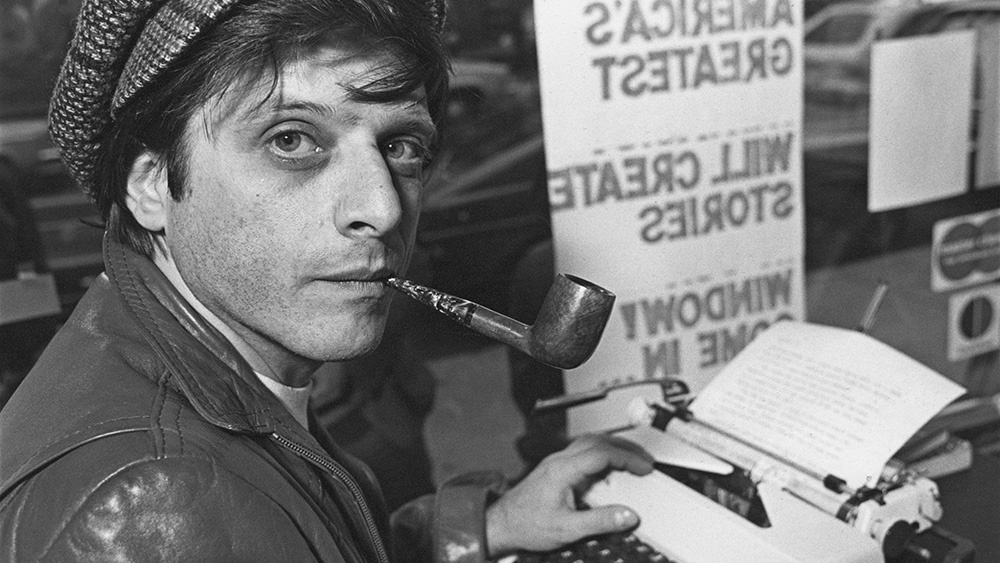
I recalled those heady moments when, a few weeks ago, I stumbled on a post in a forum I belong to, one devoted to collecting vintage typewriters, from a fellow we’ll call Dickie. Dickie shared an interesting note about his icon—the famously abrasive science fiction writer Harlan Ellison (1934-2018; that’s him in the pic, c/o Variety)—who used typewriters well into the age of laptops, and who supposedly asserted, as some typewriter folk are wont to do, that using computers to write was BS, because computers produced bad, lazy writing. Dickie presented himself as a writer—a claim I’m happy to accept and respect, until proven otherwise—and took Ellison’s word as proof positive that, well, people like him who used typewriters were therefore better writers than the rest of mankind (I’m using a bit of hyperbole here, but you get the point).

Maybe I should’ve known better, but I submitted a gentle rejoinder to say that, with all due respect to Mr. Ellison, that was BS, too—good writers adjust to the tools at hand, and I was willing to bet the house that 99% of all the best novels of the past 20 years, going by anyone’s list, were written on computers. I myself had gone through the whole gamut from handwritten manuscripts to typescripts to computer printouts, and while each technique had its advantages, nothing allowed revision—so essential to good writing—as easily as the computer. Tut, tut, Dickie messaged back: I had better rethink what I just said, because “I’m better educated about literature than you.”

That was kinder than what he told another forum member who queried him about the precarious quality of his own prose, which he promptly withdrew from public viewing, remarking instead on his critic’s mammaries. Still, it set off a little explosion in my head—not because it couldn’t possibly be true (I’d be the first to say that I know zilch about literary theory, for example, which went in one ear and out the other, and that I’ll take Maugham over Murakami anytime), but because he could make statements like that with absolutely no idea whom he was talking to. I was on the forum using a pseudonym (to avoid having to deal with “friends”), and even if I had used my real name, I doubt that it would have rung a bell in his insular brain. I could’ve been TS Eliot, Chinua Achebe, or Susan Sontag, and he would’ve said the same thing.

Again, I have an extremely modest estimate of my own erudition, and I’m not given to flame wars, but in this case I just had to let fly a salvo of demurrers to put a presumptuous, uhm, Dickie in his place: “If,” I said, “you took your PhD in Literature before 1991, published more than 35 books, and taught literature and creative writing for more than 35 years, then indeed, sir, you are very likely better educated about literature than I am. Back to typewriters, shall we?” After a pregnant pause, he huffed: “English is NOT my second language.” I imagined a worm retreating into its burrow, but before it could vanish completely, I posted: “Ah, yes, it’s only my second language—but there’s a third, and a fourth.”

I was tempted to ask, “Pray tell, and please correct this second-language learner if he’s wrong, but would ‘puerile asininity’ best describe your attitude?” But I let it go at that—the moderators kicked him off the forum shortly afterward, for more egregious misbehavior.

Once, as an exchange professor in an American liberal-arts college, I attended a welcome party where a kind-looking lady walked up to the obvious foreigner to make him feel at home. “So what are you teaching?” she asked sweetly. “The American Short Story,” I said. Her eyes widened in utter disbelief. I smiled and excused myself.

It really doesn’t mean much, but maybe I should trot out that PhD more often.