Penman No. 464: A Fantasy Memoir

Penman for Sunday, July 7, 2024
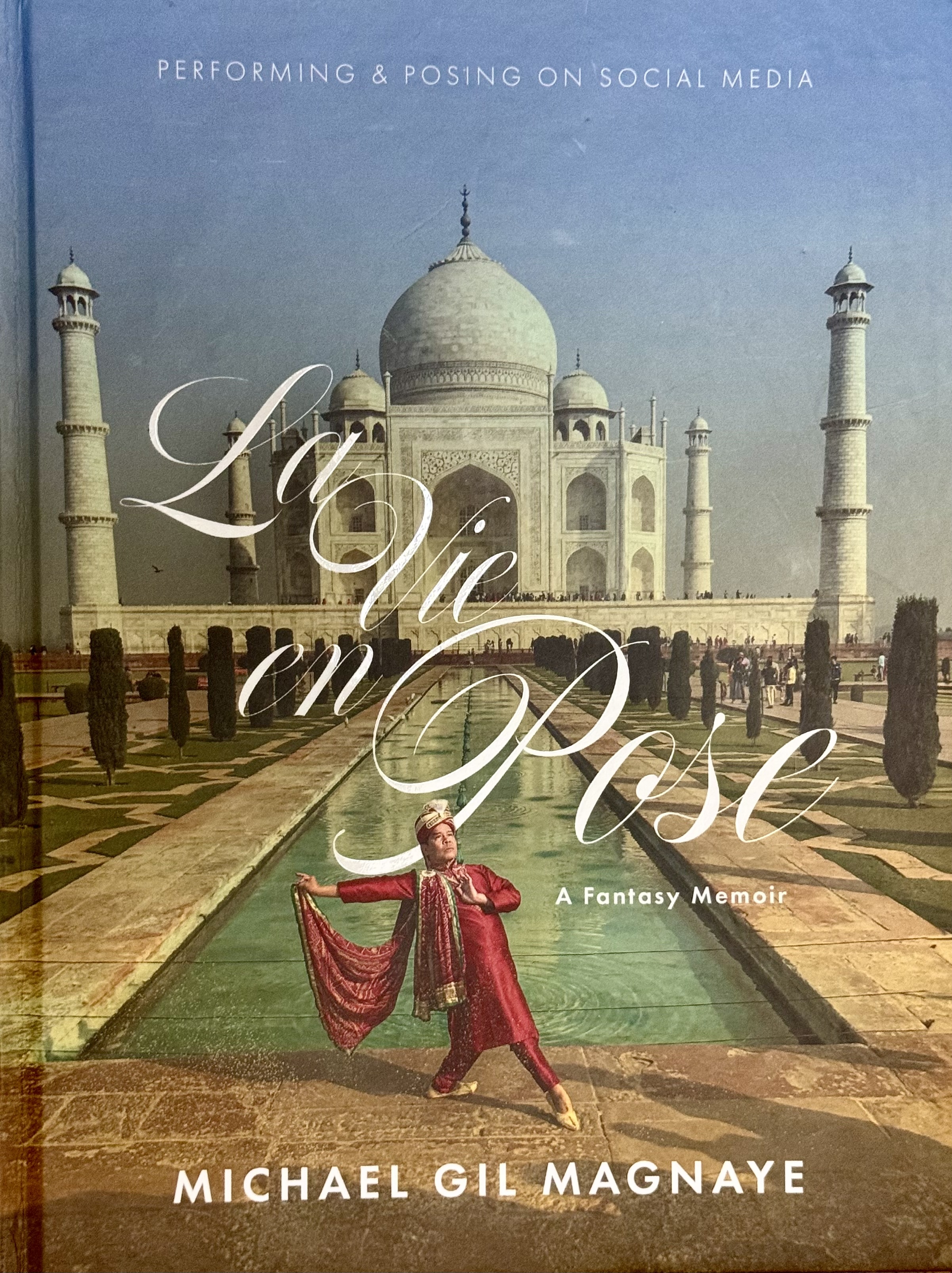
THE AUTHOR calls his book a “fantasy memoir,” and if it’s a genre you’re not familiar with, you wouldn’t be alone. Or maybe that’s just because you’re a dour and straight septuagenarian like me who doesn’t go out too much, watches true-crime shows to relax, and presses his pants and shines his shoes because, well, that’s the way it should be. I later googled the term, just to see what’s out there, and much to my surprise, it does exist—a genre defined by “imagination, escapism, and dreams,” with the stipulation that these fantasies, or products of the mind, are just as valid as memory in recreating one’s life.

Thankfully, from the cover onward, Michael Gil Magnaye’s La Vie en Pose makes it purpose clear to the most casual and non-literary of readers: to have fun—while raising some very serious questions on the side about who and what we are (or pretend to be), what poses we ourselves assume, consciously or not, in our everyday lives, and how our identities are constructed by something so simple as what we wear.

La Vie en Pose is one of those rare books one can truly call “inspired,” resulting from the kind of half-crazy “What if?” lightbulb moment that strikes you over your tenth bottle of beer at 3 in the morning. Unlike many such flashes, this one stayed with Gil, took firmer shape, and turned into a virtual obsession—a first book to be completed by his 60th birthday, not just any book, not one of dry prose between the covers, but one certain to make a personal statement for the ages.

Magnaye, who works as an advisor to an international NGO, describes the book as “a fantasy memoir told in a hundred photographs of the author in costume, striking a pose around the world. Designed and photographed over a decade, these vignettes depict media celebrities, politicians, literary characters and wholly fictitious figures drawn from Magnaye’s fertile imagination. The collection offers satirical, often hilarious commentary on noteworthy personalities in pop culture, politics and history, from Game of Thrones to Bridgerton, from Jackie Onassis to Ruth Bader Ginsburg.”
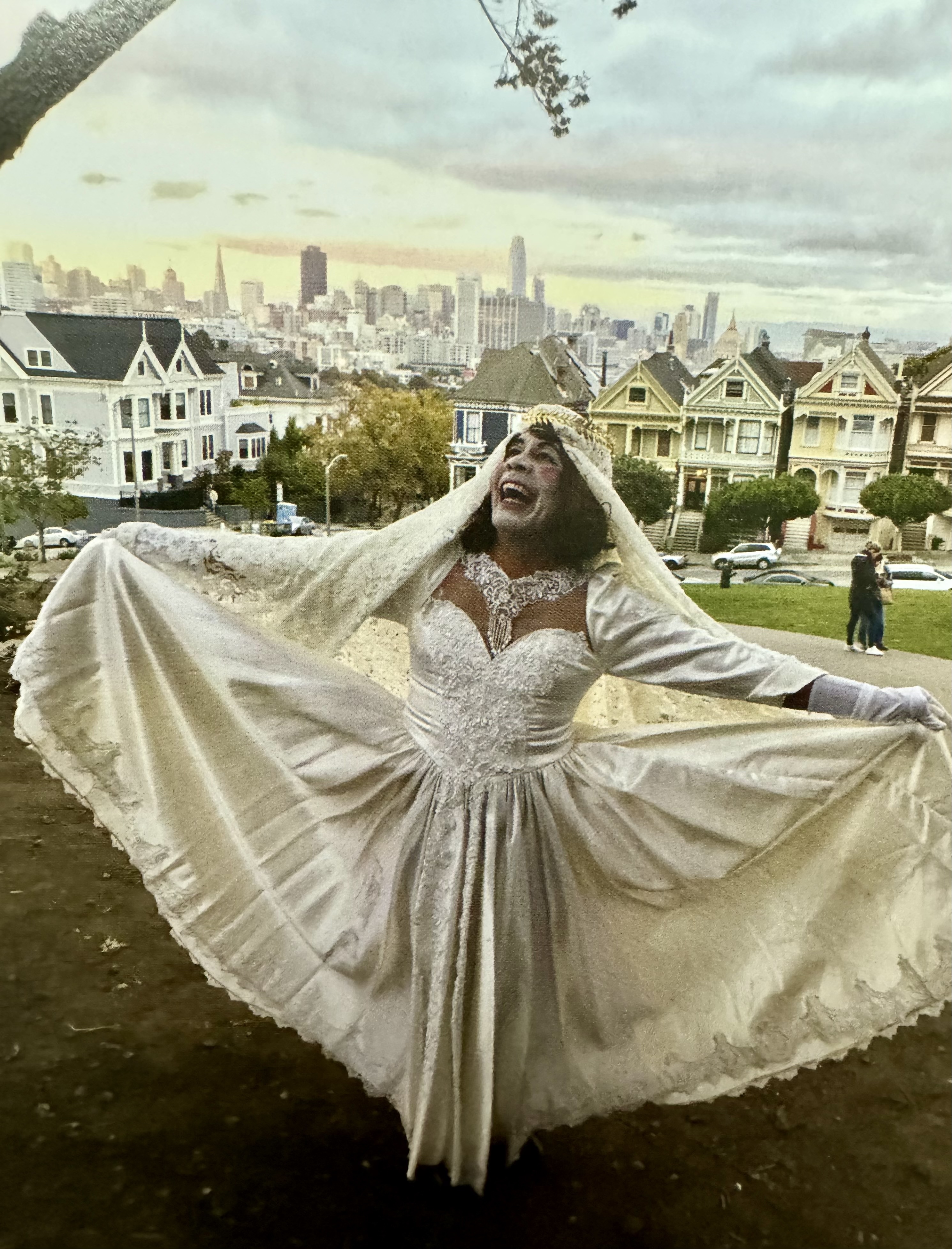
Divided into eight chapters and edited by the celebrated Fil-Am writer Marivi Soliven, the book takes Gil around the world (none of this is AI—the photography took many years and plane flights to complete), posing in various locales and contexts, often in costume, to mimic or to pay homage to familiar figures and situations. The pop-culture setups will likely elicit the most laughs and smiles—Tina Turner, Maria von Trapp, and of course Barbie all get their comeuppance—and the UP Oblation poses (thankfully just backsides) show the malayong lupain that our iskolars ng bayan have reached (Gil studied and taught Humanities in UP before going to Stanford for his master’s). The levity aside, he strikes thoughtful, almost architectural, poses against spare backdrops. He draws his husband Roy, a normally reticent software engineer, into take-offs on couples (Ari and Jackie, Ennis and Jack). The effect is both riotous and reflective, a visual essay on how pop and political culture have overwhelmed us, but also how we have appropriated and domesticated them for our own purposes, if only to say, “Hey, I can be as good that!”
The poet and queer theorist J. Neil Garcia explains it better in this note he posted online about the 30thanniversary of the landmark Ladlad anthology he co-edited with Danton Remoto: “Queer creativity is itself an integral component of the equality message, and not simply a means to an end. Since the freedom of the imagination is perhaps where all freedom begins, it is clear that giving the queer artist the power or the ability to create their own texts and art works needs to be seen as a vital objective of the equality movement, one of whose primary interests must be in securing this imaginative and/or cognitive ability above all. Hence, we need to insist on the truth that queer creativity isn’t simply a tool to promote the equality message and other activist agendas; rather, queer creativity itself is part of the agenda—is part of the equality message itself (and so, queer creativity is not just a means to an end; quite crucially, as the best evidence and enactment we have of individual and collective agency, even against the harshest of odds, it is an end, in itself).”

For Gil—whom I was friends with back when he still had a girlfriend and confronting his sexuality—the book is more than a personal celebration (he launched it in UP last June 23 to mark his 60th birthday); it’s also an assertion of his rights as a queer (the preferred term these days to “gay”) person—and by extension, of all other LGBTQ+ people as well—to express themselves creatively. In his introduction, he notes that “This book is born at a fraught moment in gender politics. Some states in the US have passed legislation that attacks transgender youth for their chosen wardrobe or preferred pronouns. A drag artist in the Philippines has been jailed for performing an irreverent dance interpretation of a Catholic hymn. Such adverse events would seem to suggest that cross-dressing is an act of subversion. I would argue that cross-dressing and mimicry are strategies that drag queens, drag kings, non-binary performers, and gender benders employ to resist, challenge, navigate, and extricate themselves from systems imposed by traditional constructs. And it’s a lot of fun.”

La Vie en Pose most surely is. Copies might still be available at the UP Center for Women’s and Gender Studies.

Penman No. 174: What Women Remember

4510563825_5f753e970a

Penman for Monday, 16 November 2015


I WAS very pleased and much relieved—and, as one of the convenors—immensely proud for the Philippines to have successfully hosted this year’s conference of the Asia Pacific Writers and Translators (APWT) late last month in Manila.

Among the highlights of the conference was a keynote talk given on the last day by none other than one of our foremost fictionists and critics, Dr. Cristina “Jing” Pantoja-Hidalgo, now the Director of UST’s Center for Creative Writing and Literary Studies, who spoke on a subject even her fellow Filipino writers like me know very little about or pay only minor attention to—the journals, memoirs, and autobiographies of Filipino women. I found her lecture (titled “The Subversive Memory: Women Tell What Happened”) so informative that I asked her permission to excerpt parts of it to share with my readers, so here:

Several generations are represented in the seven women who are the subject of my new book, which I called To Remember to Remember…. t today is referred to as multi- er, is available at the UST Publshing Housee so informative that I asked her permission to exce

The oldest, Paz Policarpio-Mendez, was born in a small town in the province of Nueva Ecija in 1903, and was among the first children to enter the American public school system, and one of the first women to go all the way to college in UP. But, to get there and to stay there, she had to fight her father – who did not hesitate to beat her when he objected to her behavior or her opinions. Always painfully aware of her father’s preference for his sons, she strove to win honors in school, to merit his approval. But he never gave it. Later, she married a journalist who eventually became a diplomat, and finally the Secretary of Foreign Affairs. But Paz went right on studying and teaching, while raising a family, and attending to the duties of a diplomat’s lady.

The youngest, Rica Bolipata-Santos, was born in Manila, and educated entirely in Catholic schools, until she decided to get a PhD in Creative Writing in UP. She is sister to the three famous Bolipata brothers, musical child prodigies. This doomed her to play second fiddle to them, to grow up feeling unimportant, untalented, even ugly. Kept back from developing her own musical talent (she could sing!), not deliberately or maliciously, but through neglect, she found her voice in writing and in teaching. Now she is also an academic administrator. But the biggest trial in her life has been her special child, and her memoir is the story of her struggle to cope with anger, sorrow, sometimes despair.

In between there is Solita Camara-Besa, a woman who describes herself as a battered child – this abuse by her father did not let up even after she was married, until her husband, demanded that she choose between himself and her parents. For all this, she became one of the country’s first women doctors—though again, she experienced appalling gender discrimination in the UP College of Medicine, of all places—and was part of the heroic little band of UP faculty members who kept UP and its teaching hospital, the Philippine General Hospital – running throughout World War II.

The remaining four writers who are part of the book took for granted their right to an education and to careers of their own. But they had their own battles to fight. For Gilda Cordero-Fernando (b. 1930), maker of baby bags, keeper of antique shop, fashion designer, publisher, and one of the country’s finest writers of fiction and nonfiction, the battle was against her mother and the convent school education that she felt trapped in; against her husband who resented her writing, her writer friends, and the many worlds that her numerous gifts opened up to her, but kept a mistress for most of their life together; and against conventional ideas about what constitutes accomplishment and success.

For the prize-winning poet and academic, Merlie Alunan (b. 1943), it was the battle to hold it all together when she became a single parent, seeing herself and her children through school, teaching in college, holding workshops for struggling young writers, and picking up poetry awards along the way.

Jennifer Ortuoste (b. 1968) trained as an apprentice racehorse jockey, married a professional jockey and raised her babies in the Santa Ana Racetrack. Hers is the story of a battered wife; and the story of the collapse of her marriage is told against the backdrop of the demise of the racetrack that she loved. When her marriage fell apart, she picked herself up, became a journalist, got an M.A., and is now writing prizewinning fiction and nonfiction.

Criselda Yabes (b. 1964) chose a profession, which until the generation before hers was not considered quite respectable for women—journalism. The most independent, unconventional and alienated of the seven, her story is focused on 16 months of her life, the period after she had been abandoned by her lover of seven years. And, to keep a hold on sanity, she went to Europe, first on a scholarship, then as a war correspondent in different countries, until, in a borrowed apartment in Athens, she began to write about the year she had just lived through, and so found her way home.

In life, these women broke from the mold. They would not settle for what was expected of and from them as women. They wanted different things. In writing their memoirs, they, again, transgressed. For in the Philippines, family matters are kept private, particularly matters which will make the family lose face; one’s personal memoirs inevitably include other members of the family. They may not have been flaming radicals, marching down streets, waving banners and chanting slogans, or being hauled off to jail, being tortured and even killed, as some of their sisters were. But, in their own quiet way, they were rebels….

I read the memoirs of the three older writers as variations on a theme, the theme being the education of the modern Filipino woman, and her transformation, from sheltered schoolgirl into formidable, professional woman without relinquishing the role of wife and mother. I do not claim for this narrative that it applies to all modern Filipino women, nor even all modern Filipino women of the middle class (to which all three belong). But I do believe that it is a pattern that many Filipinas aspire to, and can therefore identify with. And I suggest that in telling their own life stories, these writers are creating a different myth, to replace the older narratives about the Filipina and her role in society….

These are the narratives that we, the next generation of Filipino women writers inherited. Most of our mothers had college degrees and careers. After they married, those who lived in extended families, or could afford reliable yayas went on working, and became quite expert at juggling their several roles, what today is referred to as multitasking, and they trained their daughters to do the same.

The memoirs of the younger writers are, in a sense, their response to these narratives. I take them as signposts. They mark the latest paths taken by Filipinas and what they reveal is the distance they have travelled, but not a change of direction. Those pioneers, some of them already so bold for their time, but working in relative obscurity, had pointed the way….

What these women have done is take the personal narrative—either the full-length autobiography or the memoir—and use it to open doors previously kept firmly locked, and to explore their own thoughts and feelings about the monsters lurking in its shadowy corners. This they have done in language both precise and elegant. Thus have they contributed to the story of their country, and the place in it of Filipino women.

(Jing Hidalgo’s new book, To Remember to Remember, is available at the UST Publishing House for P400.)