Qwertyman No. 179: Omitting Flowers

Qwertyman for Monday, January 5, 2026
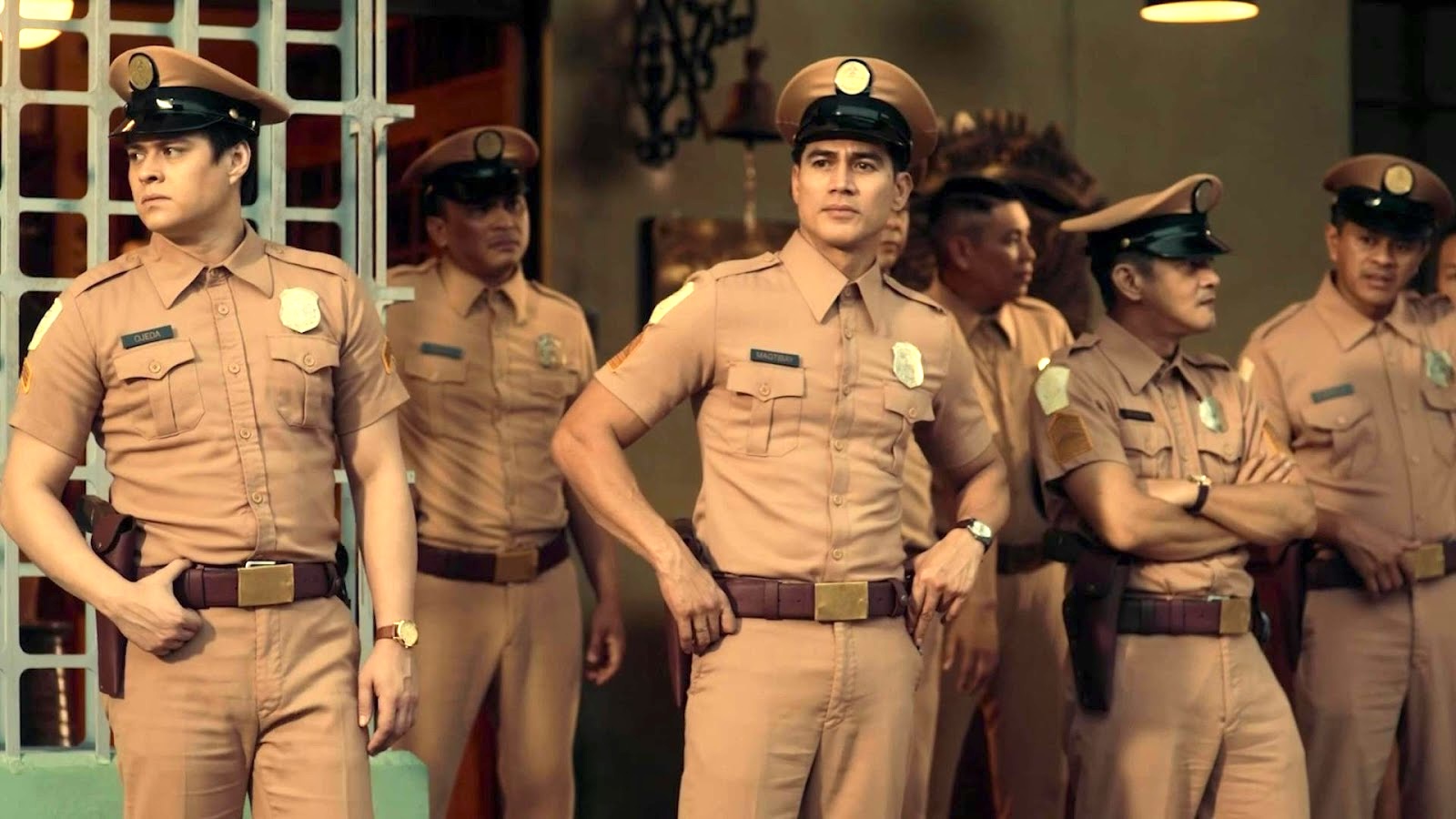
THIS COMES a bit too late to affect the box office in any way (and it’s not as if anything I write sends people scurrying anywhere), but my wife Beng and I just saw “Manila’s Finest,” and we left much impressed and hopeful for Philippine cinema.

We were out of town for most of the Christmas holidays so we unfortunately got to see only this one film among all of the Metro Manila Film Festival entries. We’d heard good things about the other entries as well, and the fact that “Manila’s Finest” ended up in only third place for Best Picture tells me that we probably missed out on what seems to be a bumper crop. But this isn’t about the MMFF, and I won’t even call it a formal review. It’s more of an emotional reaction to a period and a milieu I happen to have some familiarity with.

“Manila’s Finest” is set in a precinct of the Manila Police from 1969 to 1972, a time of great social and political turmoil. It revolves around the character of Lt. Homer Magtibay (very capably played by Piolo Pascual), a policeman who, despite his flaws, holds on to an old-fashioned sense of duty just when the police service is becoming more politicized in preparation for martial law. He has his hands full with a gang war, only to realize that an even deadlier kind of factionalism is emerging within the force itself, with the rising power of the Philippine Constabulary’s Metropolitan Command, or Metrocom. He also has to deal with trouble at home, as his daughter has become a student activist, the kind that he and his fellow cops have to face with truncheons at the rallies. It dawns on him that it isn’t petty crooks creating chaos in the streets, but the government itself, setting the stage for a crackdown. The movie ends, rather abruptly, on a dire note of warning, hinting at darker times ahead.

The film appealed to me on many levels—the political, the aesthetic, the narrative—but most strongly at the personal, because of the memories it inadvertently brought up. To begin with, my late father Jose Sr. was a cop—or almost. A law student who never finished (like the movie’s Homer), he joined the police academy, in the same batch that produced the future MPD chief James Barbers. The very first picture in my photo album is that of him in police uniform, at parade rest. He never joined the force, perhaps because he married, but he did become an agent for the Motor Vehicles Office, and I remember how impressed I was by his silvery badge when he flashed his wallet open on the jeepney rides we took. That was the kind of thrall in which lawmen at the time were held, or at least I so imagined; they kept the world safe and peaceful, and held evil at bay. (I was too young to understand that my dad’s MVO badge got us free rides.)

I became an activist in college and joined many rallies and street marches; this changed my view of the police, who became fascist pigs, the enforcers of laws for the rich and powerful. During the Diliman Commune of 1971, I held a kwitis that I was supposed to fire if I saw cops approaching on the perimeter of UP’s Area 14. And then something happened that would reverse my perspective: I dropped out of school to find a job. At age eighteen, I finagled my way into becoming a reporter for the Philippines Herald, with zero units in Journalism but with loads of pluck and some writing talent. Seeing what they were dealing with, my editors led by Oskee Villadolid and Joe Pavia decided to give me a crash course in journalism by designating me as General Assignments reporter and making me do the rounds of the beats: police, education, sports, and so on.

Of course, the police beat turned out to be the most challenging and instructive. I was stationed at MPD headquarters on UN Avenue, and put on the graveyard shift that ra through midnight until the morning. When nothing much was going on, we played ping-pong and waited for the fire alarm bell to ring (we ran out only for major fires, like the Family Clinic fire where my job was to count the dead). I kept a little black book of phone numbers where I could ring up hospitals to ask if any major accidents had come in. I learned of a restaurant near the Luneta where killers could be hired for not too much. Being a snot-nosed newbie, I trailed veterans like Ruther Batuigas to avoid being kuryented or bum-steered. I covered murders and suicides, visited the city morgue at three in the morning, and joined cops on their drives along Ermita, checking on vagrants, just like in the movie. It was all heady stuff for an eighteen-year-old.

But what proved to be most stressful was covering demonstrations, now that I was looking at them from the other side of the barricades, parked in a Herald jeep with a driver and photographer. Despite my job, my sympathies strongly remained with the activists, and I dreaded watching the police donning their riot gear and preparing for certain trouble. These being the days long before cellphones and pagers, there was no way I could warn my comrades about what I thought to be snipers or provocateurs or just agents taking their pictures from the rooftop of the Shellborne Hotel near the US Embassy. When the tear gas canisters began flying all I could do myself was duck and run, and I remember visiting some wounded marchers in the ER later. After I covered the funeral of a rebel killed in combat, praising him effusively and playing up the drama, an editor cleaned up my prose and gave me a very dry lesson in reportage: “Omit flowers.”

That’s the kind of treatment director Raymond Red gives his material in “Manila’s Finest.” Nothing is romanticized, no hero left unsullied, except perhaps for the young activists whose further awakening yet lies ahead of them. This well-crafted and well-acted film deserves all its plaudits; the mature Piolo Pascual is outstanding, as is the period production design (except again perhaps for everyone’s new-looking uniform, the bane of period movies, and a few questionable references time-wise—“barangay,” “the New Society,” and Pierre Cardin-style barongs all came after 1972, if memory serves me right). Most of all, “Manila’s Finest” deserves and indeed demands a sequel, into the time of tokhang, when the moral choices facing the police became even starker. But as it is, at least for me, “Manila’s Finest” may indeed have been the finest of its kind this year.

(Image from walphs.com)
Penman No. 335: Senior Moments

Rainbow's_Suns_poster.jpg

Penman for Monday, January 7, 2019


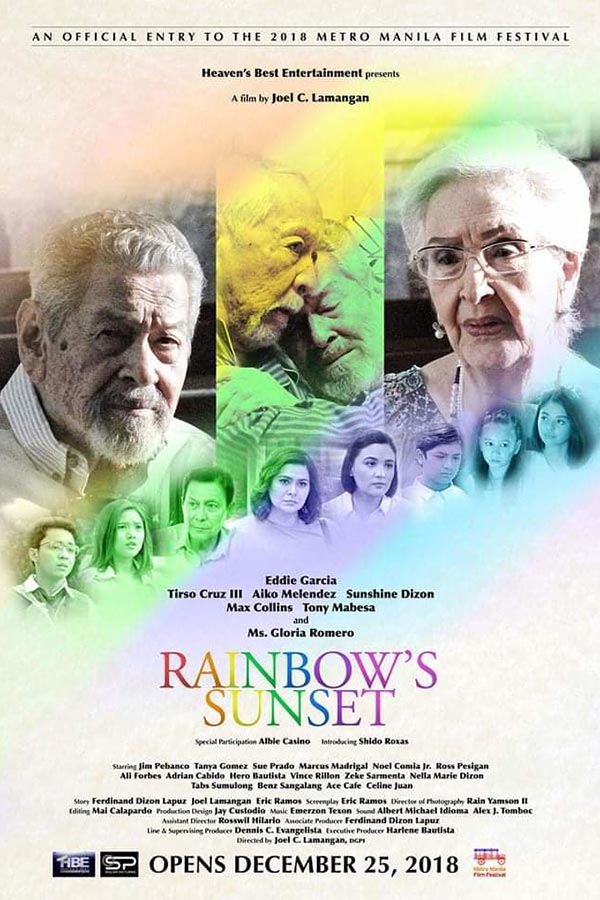
BEFORE ANYTHING else, I’d like to put in a word of praise for the only movie that my wife Beng and I really wanted to see among the entries to the recent Metro Manila Film Festival, Joel Lamangan’s Rainbow’s Sunset, a film about two gay old men on the brink of death and of the family around them. I’ve often said that in our youth- and gimmick-centered culture, we don’t have enough movies (or books and songs, for that matter) about old people, and not enough intelligent movies, either.

 Rainbow’s Sunset satisfies both criteria, offering a sensitive, often comic, in-your-face portrayal of the undiminished decades-old love between two men—and of the woman who loves them both—without losing sight of the very real complications it creates for others, no matter how sympathetically inclined. It’s a project that could very easily have given in to caricature and condescension, but it doesn’t. The acting performances are solid and engaging, both individually and as an ensemble. Aside from the lead actors Eddie Garcia and Tony Mabesa, of course, Gloria Romero and the three children—Tirso Cruz, Aiko Melendez, and Sunshine Dizon—are a delight to watch.

It’s far from a perfect movie—I find the title a bit strained (I get it, I get it) and there are a few off-key notes in the drama—but the minor flaws shouldn’t take much away from its overarching achievement. It will probably be gone from the mainstream theaters by the time this comes out, but it deserves more than passing notice, and I hope it leads to more good movies about seniors, who should know a thing or two about love and life.

WahlDeco.jpg

SPEAKING OF seniors, I started the New Year in the best and the worst possible way: by buying an old pen, I suppose as a late Christmas or early birthday gift to myself, but whatever the excuse, I’m happy, because it was one of the last of what we collectors call our “grail” pens (as in “Holy Grail”), something I had been dreaming about for, oh, thirty years.

I woke up early on January 1, and like most of us do, I picked up my phone to scan my messages—nothing too interesting there beyond the predictable plethora of New Year greetings. And then, unlike most of us, my digits drifted off to the fountain pen sites, just to see what people could be possibly up to. There is such a thing as a global fountain-pen community (just as there’s an antique typewriter community, a wristwatch community, a Japan-surplus community, and an Apple community—and yes, I belong to all of those, too), and it’s become my virtual hangout online.

Unlike real friends, with whom you have to chug beers and trade miserable stories that inevitably involve retirement options, Metformin, and political sleaze, these thing-centered, Web-based communities offer mostly good cheer and kind intentions. Sure, we get our share of jerks and trolls, but they’re pretty easy to weed out with a few keystrokes. These sites are the best distraction I can find from the front-page news (let’s not get started on that, shall we?), and they offer something often lost in today’s Twitter-driven dystopia: a sense of wonder and discovery, and for an aging romantic like me, an enchantment with things past. I know that we keep bemoaning how consumerism has turned us into heartless, mindless brutes, but you’ll be surprised how people can be their nicest, most civil, and most helpful selves when talking about flexing vintage Waterman nibs, locating the tension lever on an Olivetti Lettera 22, and using Stage Light in Portrait Mode on an iPhone X.

But all that’s a long excuse for treating myself in my creeping old age—I’ll hit 65 and retire in two weeks—with a new old pen. “Senior moments” are supposed to be about forgetting things, but they should also be about remembering things, chiefly that life is short and keeps getting shorter, which means that any treats you deserve or expect had better come sooner rather than later.

The fountain pen I grabbed when I saw it was a (hold your breath) Wahl-Eversharp Personal Point Gold Seal Deco Band Oversize in woodgrain ebonite with a factory 14K stub nib—meaning a large, fancy, impressive-looking pen with gold trim, great for loopy signatures and maybe for stabbing malevolent strangers in the dark (but with a stub or flat nib, it won’t do much damage). A 25-peso ballpoint will probably write better for most people, but with all due respect to most people, I’m a bit odd in some ways.

In its time, the W-E Deco Band was among the classiest of them all, alongside the Parker Duofold Senior and the Waterman Patrician—think Duesenbergs, Auburns, and Bugattis in terms of 1920s cars. This pen I got survived wars (and worse, people with clumsy hands), and given a few weeks, it will make its way from Pennsylvania to California and then to me. It won’t write a novel—maybe it’ll sign a few greeting cards—but even just sitting in my pocket, it will make a boy from Romblon feel like the Great Gatsby, for once in his Nick-Carrawayish life.


Penman No. 233: A Ray of Filmic Sunshine

Sunday_Beauty_Queen_poster.jpg

Penman for Monday, January 9, 2017

AS SOMEONE who wrote about 25 full-length screenplays for various film projects and directors in another life between the late 1970s and early 2000s, I really should be more interested in the remarkable developments that have taken place since in local cinema, especially on the indie scene.

But I have to confess, with some guilt and shame, that I haven’t kept up with what our younger, post-Brocka and post-Bernal directors have produced, except for the occasional viewing of a Brillante Mendoza or a Lav Diaz film, or outstanding documentaries such as last year’s Curiosity, Adventure and Love and An Open Door: Jewish Rescue in the Philippines. There are some personal reasons for this estrangement (not worth getting into at this time), but I do realize that I’ve missed out on a lot of good material while bingeing unpatriotically on Hollywood and Netflix.

I must say that the Metro Manila Film Festival and its seemingly bottomless decline from its glory days ages ago to the inevitable iteration of Enteng Kabisote contributed to my dismay. This most recent MMFF, however, seemed open to letting a ray of filmic sunshine through, with new criteria and a new selection process that put a premium on quality over commercialism. When I saw the list of the people involved and when I noted that their final selections were fresh titles by new directors, my expectations rose and I told Beng, after Christmas, “Let’s go see a movie!”

We’ve managed to see only two MMFF films as of this writing, but in both instances, our hopes were well rewarded.

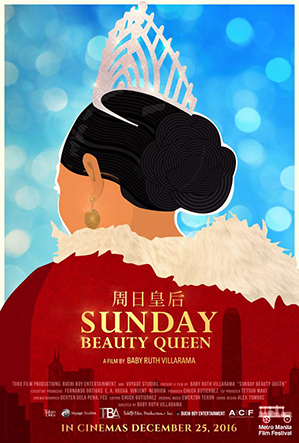
Sunday Beauty Queen, which eventually won the Best Picture Award, documents the labors of Hong Kong’s OFW community in putting together a beauty pageant to ease the pangs of loneliness and the drudgery of their work. Directed by Baby Ruth Villarama, the film tracks pageant organizer Leo Selomenio—herself a longtime domestic helper—and the lives and stories of several key participants, all of them hardworking DHs. These girls, clearly, are no Gemma Cruzes or Pia Wurtzbachs, but even those of us who may scoff at the predictable inanities of beauty pageants will appreciate how the idea of “beauty” itself has been turned inward by this film, whose insistent positivity prompted me to tweet, as I stepped out of a cinema, that it was a “beautiful film about truly beautiful people.”

It wasn’t lost on me that I myself had written a novel, Soledad’s Sister, about OFWs, set briefly in Hong Kong, and had more than once observed our compatriots’ festive Sunday gatherings in Statue Square. Novels like mine tend to be morose reflections on human suffering, but there’s nothing like a well-crafted and even-handed documentary to bring out the verve and the tenacity that must accompany and cushion all that sorrow, and Sunday Beauty Queen draws on Pinay resilience in spades. The ultimate crown its subjects wear—and they are all winners—is that of dignity. Bravo, brava!

The other movie we chose to see was Ang Babae sa Septic Tank 2, with the irrepressible and hugely talented Eugene Domingo reprising her title role. We hadn’t seen the original movie from 2011 (and are now sorry we didn’t), but had no trouble wading into the premises of this sequel, which has Eugene playing herself as a comebacking star and tormenting her director (Kean Cipriano) with her “suggestions” for “improving” the script. It’s a riotously satirical project through and through, well-acted by its ensemble and well-scripted by the unfailingly sharp Chris Martinez, intelligent without being pretentious.

I may have chuckled more appreciatively than others in the audience, having gone through many of the absurd situations and propositions Eugene’s character raises in the film with her director-scriptwriter. I know I said at the start of this piece that I didn’t want to talk too much about how and why I got fed up with working in the film industry, but I feel like I should share at least one incident, from around 20 years ago, that’ll help explain why I moved from writing film scripts to writing novels and biographies.

Let’s set our scene in the offices of a big film studio, somewhere in Quezon City. I’ve been called to an urgent meeting by the producer because the movie we’re shooting (yes, we’re actually in the shooting stage) needs a new ending. Why? Because the studio’s Big Boss, who keeps track of the bottom line, doesn’t want our hero to die, like we’d originally planned; dead heroes bomb at the box office. So now we have to figure out a new extro, and the producers’ friends and alalays are all generously available and willing to help us think the ending through.

“So Gabby doesn’t die at sea when his banca is run over by a big ship,” one of them suggests, “but of course Sharon doesn’t know that, and in despair, she accepts Eric’s offer of marriage. But on the way to the wedding, she asks the car to stop by the beach, where she and Gabby used to promenade. She’s in her wedding gown, and she walks on the beach thinking about Gabby, until she reaches the tree they used to stand under. So she does some muni-muni, remembering their happy days….” At this point, another alalay interjects: “Ay, you know what, it will be so kilig if she looks up at the tree, and she’ll see the face of Gabby shimmering on every leaf!” I take a huge gulp of water to drown the welling acid in my gut.

“She makes a speech and tells the absent Gabby how much she truly loves him,” the original contributor ventures breathlessly, “and then she walks away… to her marriage and her life with Eric…. But it doesn’t end there! Because… because when she drives away, we see that there’s movement from behind the tree—it’s Gabby! He’s alive!”

There’s clapping and cheering all around the table, until somebody has the temerity to ask, “But why doesn’t he show himself to her?” It’s a question met with profound disdain. “Because—don’t you see?—Gabby is now in crutches, he lost one of his legs in the boating accident, and he loves Sharon too much to make her share her life with a cripple! So, nobly, he lets her go, as the theme song plays to the closing credits…..”

Appreciative sighs greet the revelation, as some of my water sputters onto the table.

Thankfully my director and I found a way to weasel out of that inspired conclusion, and the movie was shot and finished. I collected my paycheck, and resolved to do my best to write just stories, novels, nonfiction, and columns from that moment on.