Qwertyman No. 106: For Our National Peace of Mind

Qwertyman for Monday, August 12, 2024

FOR A country starved for heroes, Carlos Yulo’s double-gold performance at the Olympics provided a sumptuous feast—a bacchanalian one, to use probably the newest and most notorious word in many people’s vocabulary. In one YouTube replay after another, we marveled at his seemingly magical flips and tumbles, and our eyes welled with tears when the Philippine anthem played over the stadium’s loudspeakers.

The euphoria effectively drowned out the previous week’s near-manic howls over the controversial Dionysian tableau of the opening ceremonies and the chorus proclaiming Paris as the most evil and corrupt city on the planet. Suddenly Paris acquired a golden halo; Yulo was beatified on social media as the exemplar of perseverance and tough-mindedness, and rightly so. His feat—sterling victories achieved despite overwhelming odds—was unprecedented and not likely to be equaled by another non-hyphenated Pinoy anytime soon.

But no sooner had Filipinos united in that moment of jubilation than they, almost by instinct, found cause to divide once again, this time over one’s choice of villainess in poor Caloy’s life: the bitter mother or the sexy girlfriend, behind either one of whom platoons of supporters rallied. Team Nanay exalted motherhood and filial piety above all else; Team GF cheered for the pursuit of happiness. Who will get to the podium remains to be seen.

I’m sure Caloy Yulo isn’t alone in his predicament. An assiduous journalist just has to comb through the life stories of all the 400+ gold medalists in the Paris Olympics to discover that 87.93 percent of them have problems with mothers, fathers, girlfriends, boyfriends, siblings, in-laws, best friends, neighbors, and pets. (For these, I would look most closely into places like Uzbekistan, Uganda, and, yes, Italy, where families seem to be big and noisy.) Statistically speaking, there has to be a champion shotputter or a synchronized swimmer somewhere whose miserable mama hates his shapely squeeze. (I’ve even heard someone posit over breakfast coffee that maybe EJ Obiena needed a mother/girlfriend problem to clear the bar at 6.0 meters.)

The big difference is that no one goes to town with family dramas quite like us Pinoys, especially Pinoys with social-media accounts normally given to showing off what they just ate or their OOTD. To show, at least once in a while, that there’s actually a thinking and feeling person behind the avatar (and online, feeling equals thinking), we post a strong opinion—never mind that it’s the millionth repost of someone else’s meme. We find it important—nay, obligatory—to take sides on vital issues (that do not include PISA scores, ICC probes, or jeepney modernization). We have to decide if the mother or the girlfriend is at fault; our national peace of mind depends on it. Never mind what Caloy Yulo himself thinks—this is bigger than him (like most things are).

And this is just the beginning, although it’s inextricably tied in with the next big question that 115 million Filipinos have to grapple with: what should Caloy do with all his money? (I don’t even want to think about whether he should go into showbiz or politics next—my friend Ige Ramos’ post on those prospects was probably the sanest of the past week, and one Caloy would do well to heed.)

In addition to all the lifetime supplies of ramen, litson manok, and colonoscopies that come with being a Pinoy Olympic laureate, will it be too much to offer Caloy Yulo a lifetime supply of peace? It costs nothing but our willful silence.

Seriously now, silence is a virtue, and withholding opinion can be as valuable and as helpful as giving one. It doesn’t mean you’re dumb or uncaring. On the contrary, it might mean that you know enough to understand that staying out of the fray and keeping your thoughts to yourself is the more sensible if not kinder option. But we Pinoys, the reigning world usisero and pakialamero champions, have never been known for excessive self-restraint, which manifests only when the neighbor’s wife is being beaten senseless by her husband (“Wala tayong kinalaman diyan”) or when witnesses are called to testify to their boss’ or their congressman’s misdeeds.

Sadly, social media has empowered everyone from nitwits to geniuses (and of course, everyone thinks of himself or herself as a genius, especially the nitwit) to hold forth on every conceivable subject, even and especially if the issue at hand is none of one’s bloody business. 

I say that with the ironic awareness that we opinion writers do pretty much the same thing, with some sort of official license; we even get paid for it. Indeed we may even be the ultimate pakialamero, poking our noses into all manner of secrets and scandals, particularly the government variety (or maybe not me, because I don’t hobnob with politicians or their secretaries, and so am useless when it comes to the saucy stuff). But the difference is that having to write 1,000 words instead of a ten-word tweet, we actually have to stop to think about how we feel, to contextualize, and perhaps even to decide that we have nothing truly important or useful or even amusing to say about the matter, and so should move on to something else.

At least Caloy can rest assured that given the nature of the beast, this tempest will blow over soon. (Is anyone still posting about the Last Supper? That’s so last-week!) And before too long, he can rightfully enjoy the pommel horse in his P32-million condo. Wait—it does have a pommel horse, right? If not, it should! What do you think?

(Photo from rappler.com)
Penman No. 384: Seeing the “We”

Kids.png

Penman for Monday, March 30, 2020


MORE THAN a year ago, on September 3, 2019, I wrote a column-piece titled “Meaning in the many,” in which I thought aloud about why so many young and often bright people were committing suicide or exhibiting a troubling emotional fragility. Was it, I surmised, a generational thing? Were we oldies somehow made of sterner stuff, or was that just an illusion haloed by time?

Whatever, I proposed that the answer to our individual predicaments could often be found in those of others, remembering that “We sought out kindred spirits and sang songs together, finding solace in community and in the sobering realization that many others had it worse. We found relief from our personal troubles by relieving the greater needs of others.”

I don’t pretend or expect to have too many readers, but now and then I post something that goes viral and gets hundreds if not thousands of likes on Twitter (where a version of this column appears a day or so later). That column on “Meaning in the many” got absolutely zero. I wanted to believe it was some kind of digital glitch, that people were getting a blank page instead of seeing what I wrote, but soon the cold reality set in that I had failed to communicate, in which case it was of course my fault.

So let me try again and see if I can get through in this time of Covid-19, which has been with us Pinoys for just about a month but which already feels like a year for many, long enough to spawn a torrent of memes and new buzzwords and phrases like “social distancing” and “shelter in place.” People are drowning in theories and prescriptions, rumors and rants, or otherwise occupied—somewhere between astonishment and anger—by prayers and eulogies.

It’s almost become a cliché to note the irony that at a time when we most need a sense of community (one commentator called it “seeing the ‘we’”), our best defense against disease is isolation and distance. Those of us lucky to have Internet access have formed communities online, through Viber and Messenger, passing on the latest tidbit with breathless anxiety, as if to say, “I’m still alive!” The patently fake news and repetitiveness aside, much of this traffic has been well-meant and benign—pleas for help and donations (almost instantly answered), jokes (not always funny, but better than news of another death), and coping strategies (everything from menus and exercise regimens to reading lists and Netflix favorites). They are, of course, the preoccupations of the living, and if there’s a certain bourgeois banality to them, it’s probably because they’re our most honest attempts at recovering a middle-class normalcy that has suddenly acquired meaning and value—even chores that we took for granted, if not disliked, like driving to work or doing the groceries.

Long.png

But now and then some messages have disturbed and saddened me deeply, almost as badly as the news of friends lost (three of them, at latest count), things which reminded me that long before this enforced lockdown, we had already, in a broader sense, quarantined ourselves and practiced social distancing, class-wise.

Topmost was that alarm sounded by a post—subsequently shown to be fake—claiming that scruffy gangs were threatening to loot a grocery and plunder rich folks’ homes. I have to confess that at first blush it scared me, because I thought it was true; it probably was, because people were going hungry, and when they got hungry, well, they….

And then I remembered how, in the early 1970s, another period of crisis—before I got a real job and wore a tie and went back to school to pick up a diploma and order a box of embossed business cards—my family and I were living in a hovel whose rusty GI roof was held down by a tire. My father had to work far away, my mother was a clerk, my siblings were in school, I was newly married, and we had very little but each other (and a pig that we kept in the bathroom, being fattened for the future). And sometimes there was so little food that Beng once had to sell her nicest clothes to tide us over. One Christmas, the best gift we could bring home was a set of new, cheap plastic plates to replace the cracked ones we were using. We were hard up, but if we were desperate, we tried hard not to show it.

Remembering that, I posted a message: “While all these scenarios are possible, I seriously doubt that these recent posts about the poor plotting to storm groceries and gated subdivisions are based on fact. They seem purposely crafted to sow fear and disunity, appealing to our worst instincts and characterizing the poor as a mindless mob, at a time when compassion and rational thinking are most needed. I frankly don’t know who would benefit from this kind of campaign, and I don’t mean for people not to be careful about their safety, but putting up more barriers, physical and otherwise, between people in common distress seems to me not only un-Christian but ultimately counterproductive.”

I know, that sounds more like the editorials I used to write for another paper. I should’ve just told my story, but I didn’t, because any suffering in the past almost sounds like gloating against the very real and urgent claims of the present. It was, I guess, a reminder to myself (and to our younger family members who never went through all that) that there are things worse than Covid, things worse than quarantine, like the loss of memory, and of our connections to one another beyond the physical and the digital.

Penman No. 355: Loverly London (1)

IMG_0319.jpeg

Penman for Monday, May 27, 2019


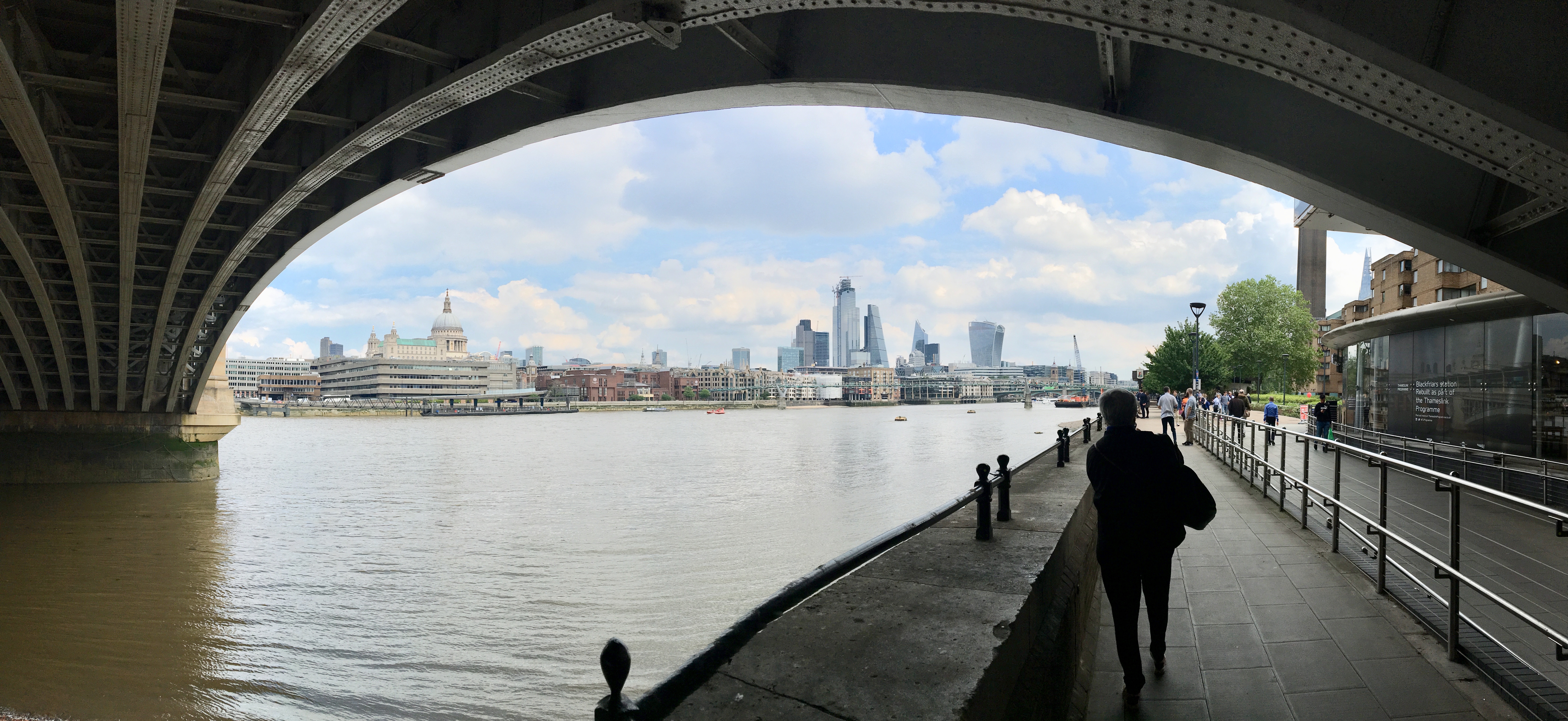
I FIRST visited London 25 years ago, on my way to Scotland to take up residence at Hawthornden Castle on the fellowship that led to Penmanship and Other Stories. Since then I’ve been back a few times—very often in 1999-2000, when again I was a writing fellow at Norwich. It’s easily my favorite city in the world to visit, given its cultural vitality and the accessibility of the things that matter most to me—museums, galleries, and flea markets—and for the past two decades, Beng and I had been dreaming of returning to London to step back into our old haunts.

That finally came true on the heels of our recent Scotland trip with our daughter Demi and her husband Jerry; they flew back to home and work in California, so Beng and I had a full week to ourselves, and wisely we decided to just spend almost all of that time in London, except for an overnighter in nearby Chelmsford and Norwich. As with 20 years ago, we did everything by train and by Oyster card (“contactless” is a new English word you’ll learn quickly just out of Heathrow). There’s nothing like a train ride into the English countryside and its undulating greens awakened now and then by brilliant yellow swathes of rapeseed to make one understand Wordsworth and Romanticism, in the same way that Glasgow’s sooty masonry and steel sinews recall a darker, Dickensian industrial past.

9101e10824ce12963ec78a189abcd3c22e091785.jpg

Speaking of Dickens, and like many Pinoys my age, my first impression of London was shaped by Broadway’s and Hollywood’s renditions of its Victorian upside and downside, in such confections as “Oliver Twist” and “Mary Poppins” (from which the screech of my schoolboy crush, Julie Andrews, still resonates, appealing for “a room somewhere, far a-wigh from the cold night air…. Awww, wouldn’t it be loverly?”).

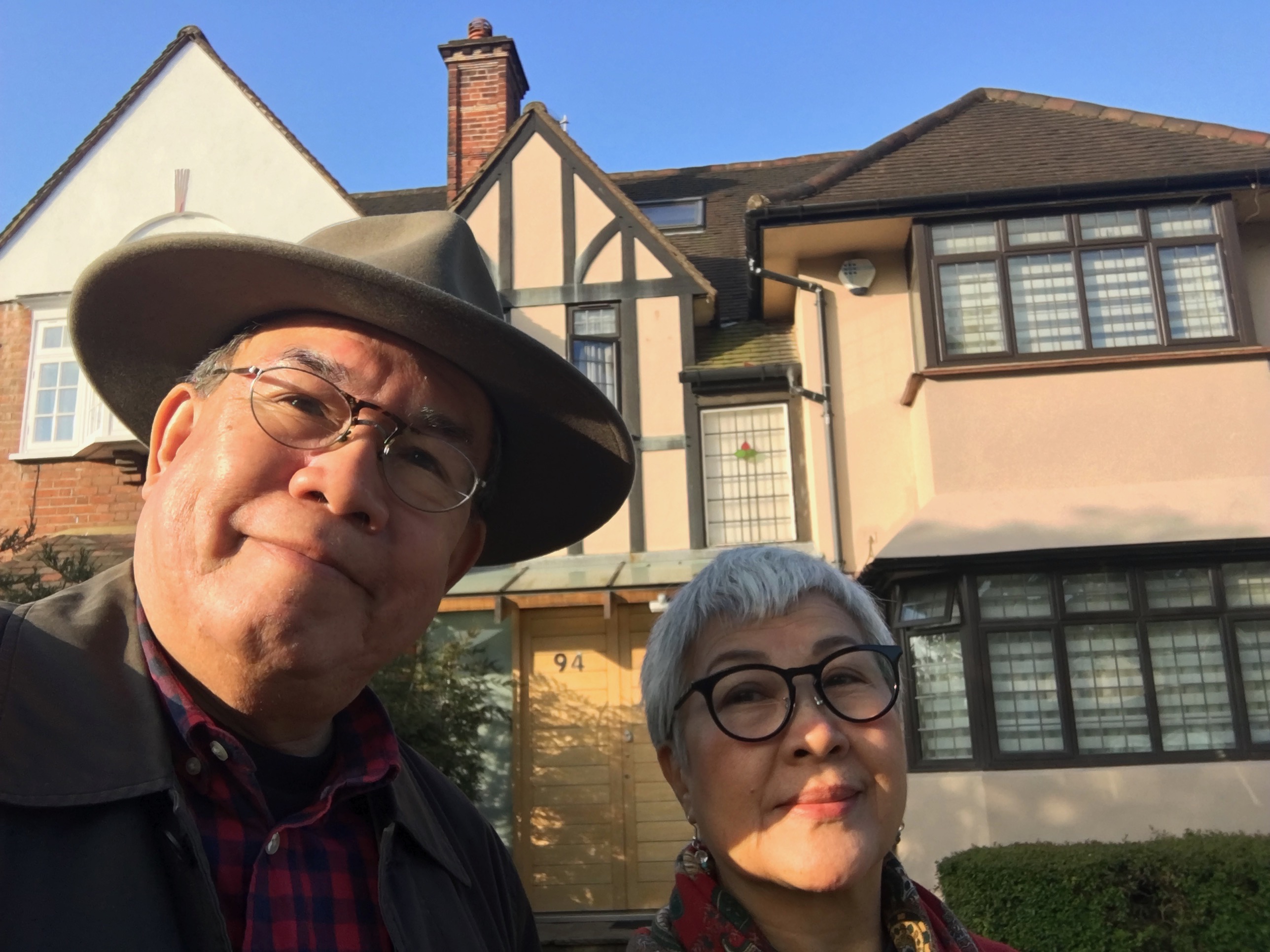
Well, thanks to Booking.com, Beng and I found ourselves a loverly, affordable room in a large house in the northwestern London suburb of Golders Green—a neat and quiet, multicultural neighborhood on the Tube’s Northern Line, historically Jewish but with many Turkish, Iranian, and Japanese restaurants and groceries lining the streets. And, of course, there were Filipinos everywhere, not tourists like us (you’ll find them at Harrods) but off-duty caregivers and housekeepers enjoying time together at the local KFC.

IMG_0329.jpeg

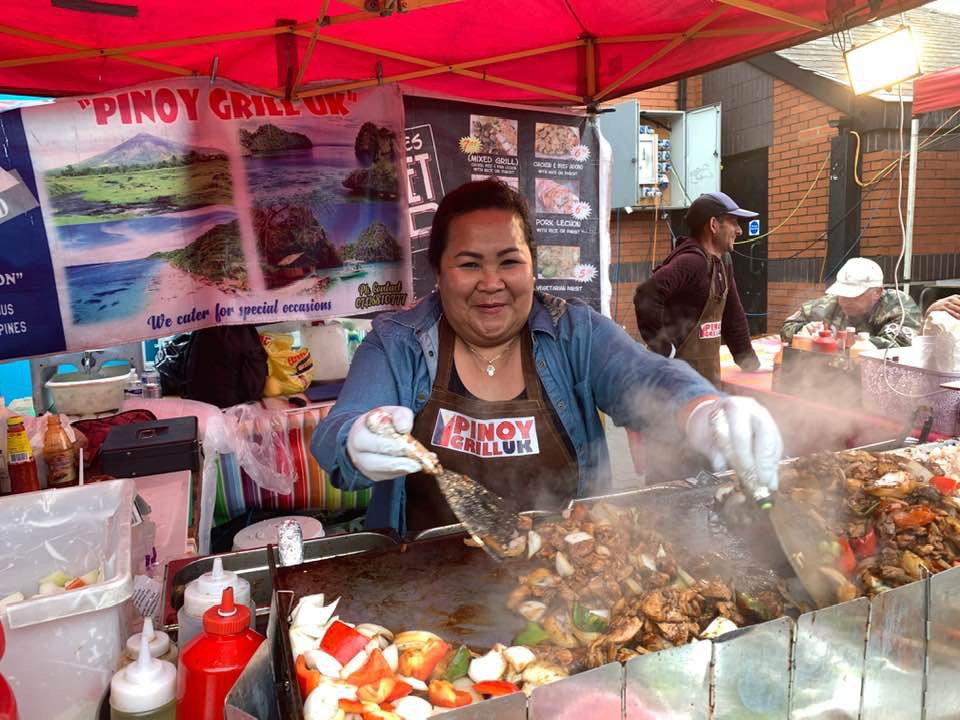
That’s where we met someone we’ll call Thelma, who has worked for the same Jewish employer for the past ten years. It just so happened that she and Beng had some mutual friends from Iloilo, where Thelma went to college. “I’m treated very well here,” Thelma said. “Every year I get a paid vacation to go home.” We spotted another unmistakably Pinay girl at the streetcorner selling suman, which we had for our next breakfast. And at the end of a long Sunday walk down Portobello Road, in a cluster of street-food stalls offering everything from vegan paella to Jamaican patties, we found Eva Caparanga’s Pinoy Grill UK, which instantly answered the question we had been asking all day, “What are we having for dinner tonight?” As she heaped our chicken adobo into a large takeout cup, Eva told us that she had been in the UK for more than 30 years, and was still working in health care, but that for the past three years she had used her days off to run her stall at the far end of the popular Portobello Market. “People ask me why I do this, and I tell them it’s so I can help family back home in Bicol. And again they ask me why I do that, and I say, well, that’s just how we Filipinos are!”

IMG_0618.JPG

The story of Filipinos in the UK and London is a long and colorful one, and I can’t count the many times they came to my succor during my tenure at Norwich and my weekend sorties to London years ago. When my feet acquired a horrible infection in Norwich, I ran to the National Health Service, only to find it staffed by kindly Pinoy nurses who got me back to walking in no time. In London, my host was the late, beloved Ed Maranan, who had ushered at the National Theatre and could sneak me into plays for free; in return, I made sure to wash the dishes at his flat on Goldhawk Road. The writer Jun Terra also brought me around once to marvel at the late Dr. Teyet Pascual’s art pieces in his Chelsea apartment.

This time, Beng and I were resolved to stay close to ground level, having neither the budget nor the inclination to splurge on the timelesss luxury that puts British-made things—whether they be suits, shoes, bags, or fountain pens—in a class all by themselves. This time, we said, we would go straight for the two things that we enjoy most in our sorties to foreign cities: flea markets and museums.

More on these next week.

IMG_0269.jpeg

Penman No.205: Sojourn in Seoul (2)

IMG_8666.jpg

Penman for Monday, June 27, 2016


HAVING PLANNED our trip to Seoul months in advance, I made a point of touching base with some local contacts for possible meetings—something I usually don’t do, wary of disturbing people with my unseasonable presence. But with a week to kill in one city and with some longstanding connections in place, I thought it would be even more ill-mannered if I didn’t at least tell them that I was going to be in town.

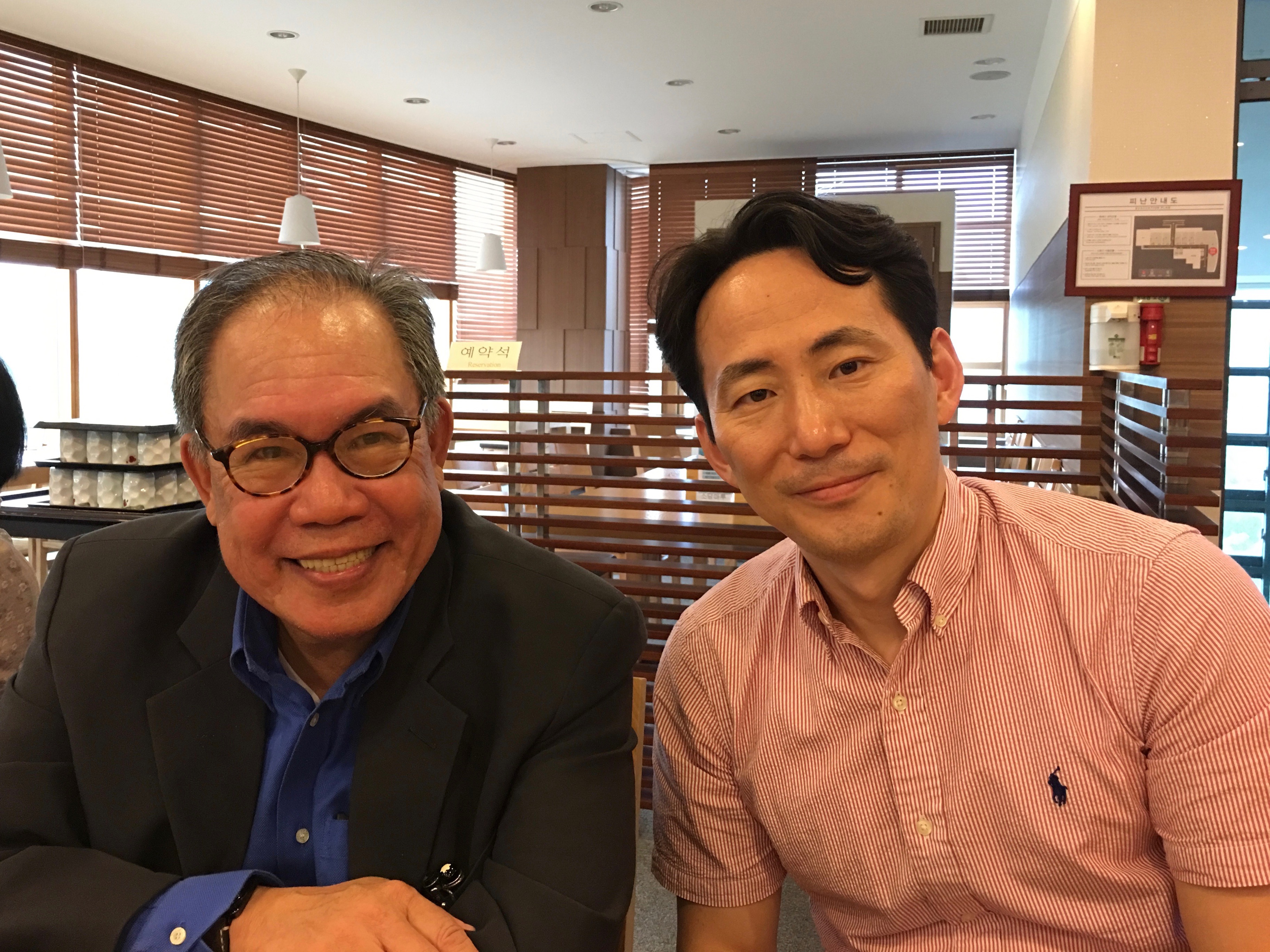
One of those connections was Dr. Sukjoo Sohn, who teaches English at Dong-a University in Busan, Korea’s big industrial center four hours by train from Seoul. Sukjoo—a specialist in world literature—happens to be married to Catherine Rose Torres, one of our bright new young fictionists who now serves as First Secretary and Consul at our embassy in Berlin. I’d first met Catherine in 2011 when I attended the Singapore Writers Festival and she was with our embassy there, and I was later very happy to write a blurb for her first book, Mariposa Gang and Other Stories (UST, 2015).

It’s really these personal connections that make for global literary networking, the value of which I can’t overemphasize. In 2014, Sukjoo translated one of my stories for publication in Global World Literature, which is put out by some of Korea’s foremost literary scholars and critics in that area. Through Sukjoo, I was also able to contribute an article to the Korea-based journal Asia, in which I wrote about some of our most gifted and exciting younger writers. As a result of that article, one of our best young non-fictionists, Sandra Nicole Roldan, will be visiting Seoul this week to attend the 2016 Asia Literature Creative Workshop.

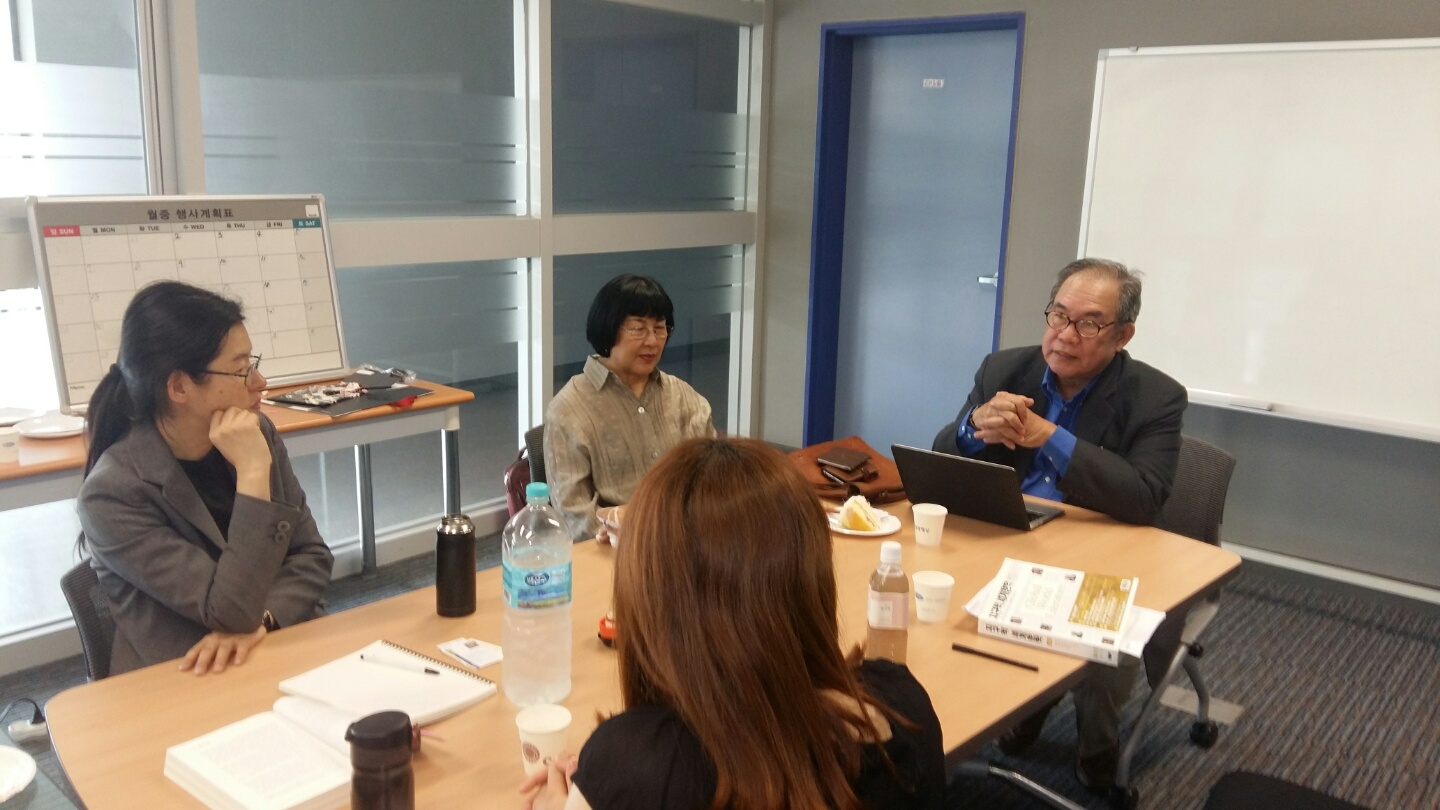
And so our connections continue and deepen. When they learned that I was visiting Korea, Sukjoo’s organization invited me to a special meeting, so I could tell them more about Philippine literature. That gathering took place at Seoul National University toward the end of our visit, and a very fruitful and engaging encounter it turned out to be. Perhaps I shouldn’t have been surprised, but their very first question had nothing to do with lyric poetry: “What do you think of your new President, Rodrigo Duterte?”

It will take more than this column to share my answer with you, but suffice it to say for now that we talked about our colonial history, our Catholic predisposition to suffering, the two Joses (not me) by which our literature is best known overseas, class as the key divisor in our literature and society, Korea’s and the Philippines’ shared experience of dictatorship, and the irony of having to deal with a resurgent Park and a resurgent Marcos, and our younger writers’ affinity with Gaiman, Murakami, and Wattpad.

We discussed my translated story, “In the Garden,” which I’d written in the 1980s about militarization in the countryside and the moral duty of a teacher caught in the crossfire. While the topics were unavoidably contentious, our meeting itself was thoroughly pleasant and mutually informative, capped by dinner, shop talk, and, yes, chatter about Lee Min-ho.

meeting 2.jpg

The second highlight of our visit—away from the malls and the flea markets—was a meeting with the Filipino community in Seoul, which had also been pre-arranged by Catherine through her Seoul colleague, the very capable Third Secretary and Vice Consul Ella Mitra.

It was a Sunday—our last full day in Korea—and much to our surprise, the embassy was open and bustling with people, with a wedding taking place right in Ella’s office. (“We can officiate at weddings,” Ella told us, “as long as the two parties are both Filipino citizens. We’re open on Sundays because that’s when most of the community can come.”) There were over 40,000 Filipinos in Korea, Ella informed me, many employed as factory workers in jobs that the locals themselves prefer not to do.

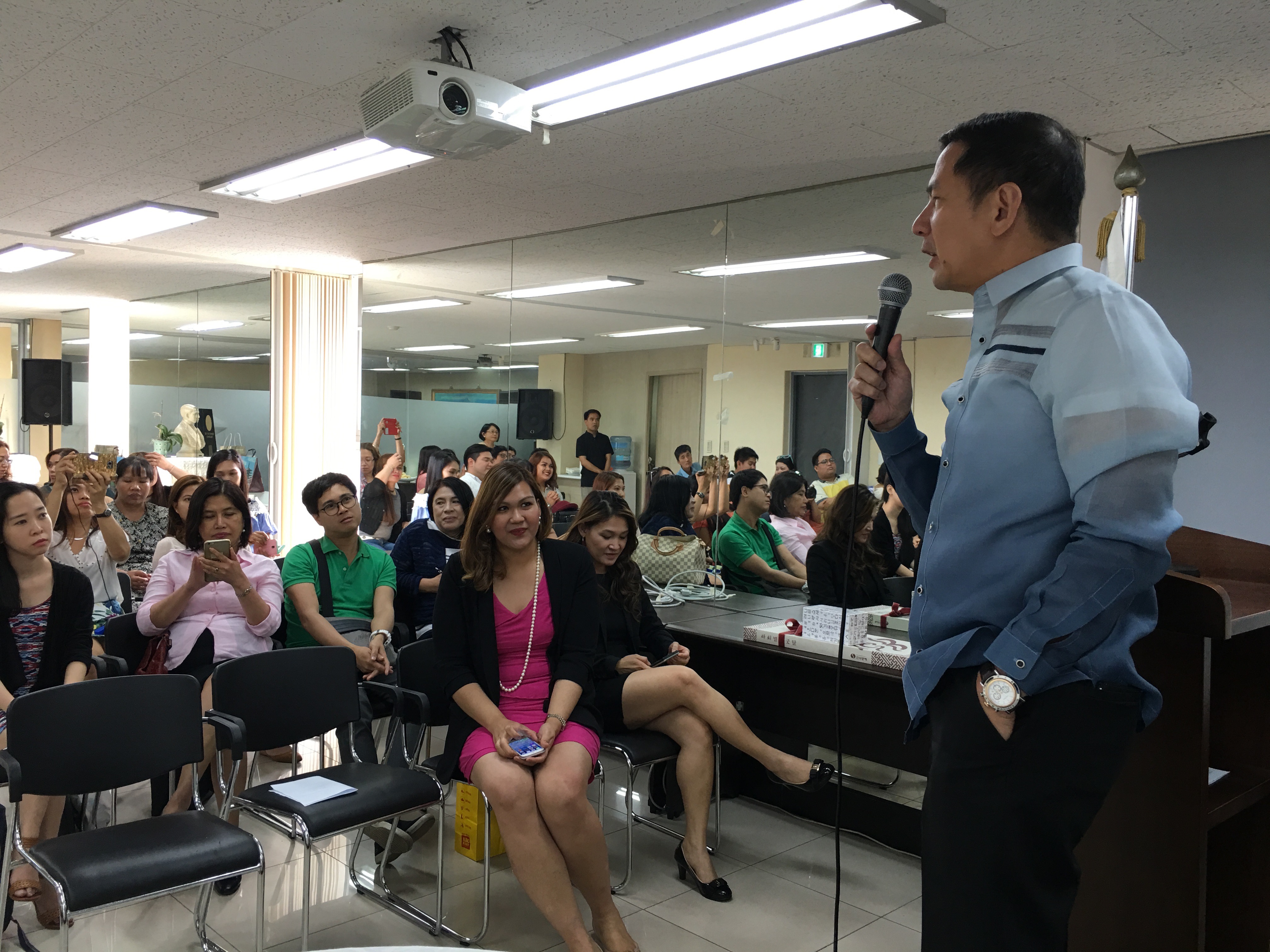
I’d been asked by the embassy to give a reading for the community—something I love to do whenever I’m abroad, as it puts me in touch with ordinary Filipinos striving to do their best in often very challenging circumstances. The Filipino, I like to say whenever the opportunity arises, is the modern-day Ulysses, roaming recklessly to the farthest reaches of the globe, but imbued with an unfailing sense of home. Now here they were, a crowd that filled the room beyond our most generous expectations—professionals, teachers, graduate students, Filipino-Korean couples, even the Ambassador himself, the dapper and articulate Raul Hernandez.

IMG_8681.jpg

The embassy had calendared my reading as its second Sentro Rizal activity, and with June 12 coming up, it seemed a good time to remind ourselves of the things that both divided and united us, and of the need to hang together as Filipinos, at a time and in a region of revived nationalisms. Even so I chose to do a very light reading, one that made fun of my own social ineptitude in cross-cultural situations, and thankfully it went over well with the audience. More than the reading, it was the ensuing Q&A and freewheeling chat over pancit and puto that proved most gratifying. I could sense the community’s strength of spirit, its determination to master a new cultural terrain.

I was especially happy to see a former student, Tech Apognol, now doing an MA in International Relations and speaking Korean. She’s hardly alone; the association of Filipino grad students in Korea now numbers 500, I was told, and there were plenty of masteral and doctoral scholarships for those inclined. “We can take classes in English,” one student named Eve told me.

Another grad student named RJ solved a mystery that had been bugging me for 40 years. Back then, I told him, I was a young writer employed by the National Economic and Development Authority, and one of my tasks was to help edit the Five-Year Development Plan, which was thicker than an encyclopedia because of its bloated prose. On the other hand, I recalled, the South Korean development plan that I used as a reference was no bigger and fatter than a paperback novel—and look, I told RJ, where Korea was now. “Ah, that’s easy,” RJ said. “It’s because the Koreans value brevity, and memos are expected to be no more than a page. The higher up the ladder papers go, the more concise they’re expected to be.”

The shopping was fun—just the flea markets for us, please, not the high-end shops—and the streetcorner food delicious, but it was, ultimately, our encounters with the people that added the most value to our visit. Kamsahamnida, Sukjoo, Cathy, Ella, and Tech for these memorable exchanges.

Penman No. 17: Another October, Another Michigan

Penman for Monday, October 22, 2012

LIKE I mentioned last week, I’m in the US to visit family and to participate at the International Conference on the Philippines (Icophil), which is taking place Oct. 28-30 at Michigan State University in East Lansing, Michigan.

Dealing with all aspects of Philippine Studies, Icophil happens every four years, and it’s been held around the world—mainly in the US and the Philippines, but also in Australia and the Netherlands; the upcoming conference in Michigan will be the ninth. Icophil’s international reach reflects not only the global Filipino diaspora, but also the growing interest and engagement of non-Filipino scholars in Philippine affairs. While most participants still come from the Philippines, a significant number of speakers and panelists come from foreign universities.

Icophil also provides scholars an opportunity to assess the state of Philippine Studies around the world, in a roundtable organized by Prof. Belinda Aquino of the University of Hawaii at Manoa, who is Icophil’s founding chair. Convenors for this year’s conference are the eminent scholars Dr. Roger Bresnahan of MSU and Dr. Bernardita Churchill of UP.

Aside from us Filipinos, this meeting will bring together Filipinists from the US, Japan, Singapore, Thailand, Australia, France, Russia, Spain, and the Netherlands. By institutional affiliation, the confirmed Filipino participants will include Jose Buenconsejo, Marilyn Canta, and myself (UP Diliman)); Filomeno Aguilar, Jr., Czarina Saloma-Akpedonu, and Lisandro Claudio (Ateneo de Manila); Paul Dumol and Clement Camposano (University of Asia and the Pacific); Raymundo Rovillos (UP Baguio); Teresita Ang See (KAISA); Nick Deocampo (Center for New Cinema);  Genevieve L. Asenjo (DLSU); Hope Sabanpan-Yu (University of San Carlos), Kristian Cordero (Ateneo de Naga); and Prisciliano Bauzon (University of Southern Mindanao).

Icophil 2012’s keynote speaker will be an international expert on climate change, Dr. Rodel Lasco, Senior Scientist and Philippine Program Coordinator of the World Agro-Forestry Centre (ICRAF) and Affiliate Professor, UPLB School of Environmental Science and Management. A recipient of the Outstanding Young Scientist Award in 1997, Dr. Lasco has been a member of the Intergovernmental Panel on Climate Change since 1999. In 2009, he was elected to the National Academy of Science and Technology of the Philippines.

Trailers for two new and interesting documentaries will be shown: one by MSU Prof. Geri Alumit-Zeldes on the two Filipino nurses who were wrongly convicted for murdering their patients in Ann Arbor, Mich. in the mid-1970s, and another, by filmmaker Sonny Izon, about the “Manilaners”—Jewish refugees from the Nazi Holocaust who found refuge in Manila through the intercession of President Manuel Quezon. Filmmaker Nick Deocampo will also be showing a documentary on American influences on Philippine cinema.

The panel discussions cover a predictably broad range of topics, from indigenous peoples, the Pinoy diaspora, and peace-building to economic relations, modernization, and popular culture (one of my early favorites on the program: “Automats, Supper Clubs, Drive-ins, and Quarantined Carinderias: The Contradictions of Restaurant Culture in Post-War Manila” by Peter Keppy of the Netherlands Institute for War Documentation).

I expect to be ruffling a few academic feathers with my chosen topic, which just happens to be one of my recent areas of expertise: “The Commissioned Biography: Confessions of a Hired Gun.” I’ll be speaking less as an academic than a professional writer, and I’ll try to keep it light, but I’ll be dealing with some serious ethical and academic questions raised by the practice of biographical writing from a sympathetic point of view, as opposed to the independent and critical stance expected of the unpaid scholar. Aside from payment for the writer and PR for the subject, can there be anything to be gained from the commissioned biographies that have appeared in recent years on Philippine shelves? Can they be of any service to the academic historian, political scientist, and litterateur? My provisional answer is yes, but I’m going to have to prove my case.

I tacked on the official part of this trip to my annual vacation so it’s not costing UP anything, but I have another personal reason for going to Icophil. I’m a proud graduate of Michigan State’s archrival, the University of Michigan (MFA ’88), but it was MSU (the “other” Michigan) and East Lansing that hosted me for more than two months on my first visit to the US (and my first trip abroad) in 1980. I’d never been away from my home and family for so long, and it was here that my 30-year-plus relationship with America took off. I would even write about that first autumn—about a foray into the yellow forest in my backyard called Sanford Woods—in my first novel, Killing Time in a Warm Place (1992):

“Sandbar, Sandfar, Sanford. Sanford Woods. In the shock of autumn, the first of my life, I took a walk in Sanford Woods with Estoy. Estoy himself had arrived in the United States just the previous year to take a Ph.D. in Development Economics on a fellowship, and I took the train up to Michigan the first chance I got to leave the conference in New York. I had never stepped into a forest of red and gold before, and for the first few minutes I trod carefully on the layered ground, as though disturbing it would hurtle me back in a swirl of pretty leaves to prison camp. We let ourselves be taken in and covered by that new season: we watched the squirrels shimmy up the trunks, and, coming into a patch of pure, delirious yellow, I persuaded Estoy to pose for a snapshot he could send home to his wife Marie. He stood stiffly against the color, hands in his jacket pockets, and he muttered an oath about the cold, but his grin was true. On the way back we observed how fat the squirrels were. In Manila, Estoy said, they’d be roasting on a spit, if they ever got that big. I said that there probably was a law preventing people from doing that in this country.”

That fellow “Estoy” was based on a real character, a friend who passed away a few years ago, whose life was marked by both blinding brilliance and consuming darkness. I barely told his story in the novel, and it will be a moving experience for me to retrace our steps into those woods, in another October more than three decades after.

More comic is the memory of my first kitchen disasters in that new country: of how I walked miles to the nearest Asian food store, craving food from home, and then eagerly frying a panful of dilis in my dorm room, only to have people hammering on my door, asking where that awful smell was coming from; and of stashing bottles of Coke in the freezer and forgetting about them, to be greeted by a ragged waterfall of black ice upon opening the fridge.

I’ll have a thing or two to say in East Lansing, but I’m really looking forward to more private conversations with the squirrels and sugar maples of Sanford Woods.


Flashback No. 4: What Fil-Ams Can Do

This being the Fourth of July, and my daughter Demi having taken her oath as an American citizen a couple of weeks ago, I thought I’d repost this piece I wrote for the now-defunct San Francisco-based magazine Filipinas a few years ago.

Manileño for January 2007

I HAD a very pleasant and engaging semester as a visiting professor at St. Norbert College in De Pere, Wisconsin, last fall, a welcome break from my teaching duties at the University of the Philippines, where I should be back in harness by the time you read this. Not only did my stint at SNC allow me to introduce the Philippines to about 50 of my own students, only three of whom were Filipino-Americans; I was also able to speak before several groups of students and compatriots in other schools—the University of Michigan, the University of California at San Diego, and Marian College in Fond du Lac, Wisconsin.

With UCSD having one of the biggest Asian-American student populations among US universities, my encounter with the students there after my formal talk proved the longest and most challenging. Here, a student raised a question that I would hear in other places: what was the best thing Filipino-Americans could do for Filipinos and the Philippines?

I’m sure that it’s a question that occupies Filipino-Americans all the time, and for which there are any number of answers, some easier and more obvious than others.

When a supertyphoon hits the Philippines and ravages the land, then relief goods are always welcome; when poor Filipino boys and girls can’t go to school despite their talents, their lives can be changed by scholarships from Fil-Ams who also worked their way up the educational and economic ladder. Many US-based doctors make regular pilgrimages home on medical missions to poor communities. Some Philippine schools receive loads of used books and computers from their alumni in America.

All of these efforts are noble and much appreciated, for sure. A few of them may have been undertaken more to burnish the image of the donor than to uplift the lot of the receiver, but in the end, it doesn’t matter: some public or private good has been done.

At the same time, such humanitarian projects are basically defined by a relationship of dependency, with America as the perennial giver and the Philippines as perpetual receiver. It’s a relationship that, like I told the students in San Diego, can sometimes grate on both sides, with Fil-Ams feeling like the only thing they’re useful for is another donation to another needy cause, and Filipinos feeling like they’re seen as little more than mendicants.

It gets worse when—dependency or not, and whether out of frustration, bossiness, or a genuine concern—some Filipino-Americans dispense quick and easy prescriptions for the cure of Philippine maladies as though nobody back home had the brains or the guts to come up with such ideas on their own.

One such bromide Pinoys often hear is, “Why don’t you just unite behind the President and stop bickering with one another?” Sounds good, but it makes me wonder why more than two million Filipino-Americans can’t get together under, say, just one dozen regional associations and one alumni association for each major university or college, and elect a congressman or US senator among themselves.

The fact is that the best and worst of our culture manifest themselves on both sides of the ocean. Our generosity, our sense of self-sacrifice for the good of the family, our commitment to education, and our industry and resourcefulness have helped us back home as much as they have gained our compatriots a firm footing in American society. On the other hand, the same sorry habits of inggitan, intrigahan, and siraan have fragmented Filipinos in Manila and Manhattan, in Cebu and Chicago, in Davao and Detroit (I’m using these cities metaphorically, but I’m sure you can supply the damning details). One of the worst examples I heard of recently had to do with the visit some years ago of a Philippine president to a Midwestern city—only to find two competing Fil-Am organizations holding two separate programs in two hotels facing each other across the street.

So what did I tell the bright and idealistic Fil-Am students who asked me what I thought they could best do for the Philippines?

Be good Americans, I said—whatever that may mean to each of them. Get engaged in America’s political processes, and make a difference in your own sphere of action. Vote not just for fellow Filipino-Americans—although a few more such voices in high places could help the community as a whole—but for political leaders who will make responsible decisions that will benefit peoples everywhere, including Filipinos.

As the world’s only remaining superpower, America needs all the critical intelligence (and I don’t mean military intelligence) it can muster, and Filipino-Americans can make themselves heard on both domestic and foreign-policy issues, instead of simply going with the flow and making themselves as inconspicuous as possible.

And what’s our claim to being in a unique position to tell Americans and American leaders something they don’t know? Well, we lived with America for half a century. As I often tell my American friends, we were their first Vietnam; and yet we also view America with much greater affection—some would say unreasonably so—than they can ever expect from Afghanistan or Iraq.

Overseas charity is good for the soul and is always welcome; but as they say, it begins at home, as does good global citizenship.