Penman No. 42: The Memoir as Mediated Memory

LarsonPenman for Monday, April 15, 2013

AMONG THE most interesting topics that came up in the recent UP National Writers Workshop in Baguio was that of writing the memoir. More and more people—and not necessarily celebrities or historical figures—have been writing their memoirs lately, and it could even be argued that many blog entries are, effectively, memoirs, although the quality of the prose and of the sensibility behind it might vary widely. No matter, for now: what’s important is that we’ve put a considerable value on what people say they remember, so it’s as good a time as any to look at memoir-writing with a critical eye, as we did in Baguio.

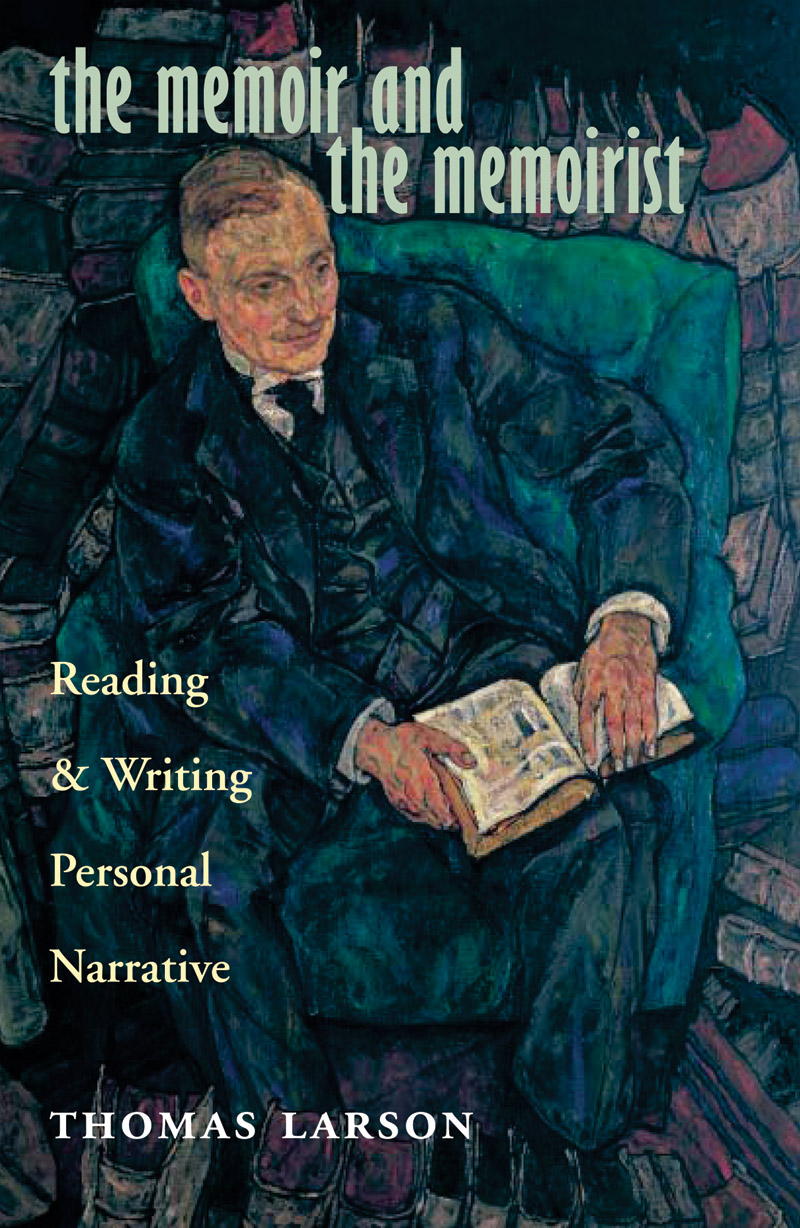
Having been assigned to lead that discussion, I drew on a book that I’ve had my students in creative nonfiction read before they mine their own lives for material with which to complete the course. Written by Thomas Larson, the book is titled The Memoir and the Memoirist: Reading and Writing Personal Narrative, and it was published in 2007 in the US by the Swallow Press of the University of Ohio. It was my wife Beng who found the book for me during one of our visits to San Diego, and I’m very happy that she did. I rarely read books from cover to cover in a few sittings, but this was one of those exceptions. I found myself nodding and putting check marks on the margins here and there, so cogently did Larson raise his points.

So rather than dilute Larson’s wisdom with too much of my own commentary, and since this isn’t a full-scale lecture on the memoir, I’m going to quote extensively from his book by way of raising issues that the potential memoirists among my readers can consider.

Let me just take off from what I said last week about the writing of historical fiction—about how the past speaks to the present, and how, beyond nostalgia, history is of value to the writer as material with which to explore why we are who and what we are today. Memoir writing, when you come right down to it, poses the same challenges and opportunities as historical fiction, except that it really happened, and it happened to you.

But in the memoir, Larson suggests, the past in a vital sense did not just happen; it continues to happen. In other words, the past is never over, and it is the memoirist’s job to be aware of and to remark on the happening.

Quote: “You need to emphasize that which captivates you in the present…. The past drama is not the only drama. The present drama of recollection is equally alive, equally in and of the story. [The memoirist finds] that as she remembers she is being emotionally altered by what she remembers.”

Memoir is different from autobiography, Larson says, in that it deals with small, intimate, ambiguous portions of a life rather than a coherent whole. The memoirist’s stance is one of self-doubt rather than the biographer’s certitude.

Quote: “The Encyclopedia Britannica describes the old plural form, ‘memoirs’, as that which emphasizes ‘what is remembered rather than who is remembering.’ If we invert this, we can call a book that emphasizes the who over the what—the shown over the summed, the found over the known, the recent over the historical, the emotional over the reasoned—a memoir…. It cannot be the record of the past as autobiography tries to be. Memoir is a record, a chamber-sized scoring of one part of the past.”

Larson says that indeed, the true subject of memoir is not the past but the mutable self.

Quote: “[In] the construction of a relative self in the memoir… the person who is writing the memoir now is inseparable from the person the writer who is remembering them. The goal is to disclose what the writer is discovering about these persons…. What the memoirist does is connect the past self to—and within—the present writer as the means of getting at the truth of his identity.”

In revisiting the past, Larson refers to what Virginia Woolf calls “moments of being,” those events, instances, and decisions that define the self. The memoirist actively seeks out these moments, and explores and amplifies them until they acquire a kind of resonance.

Quote: “The exceptional moments are ‘moments of being.’ They are physically overwhelming and, over time, represent a legendary quality about the self.”

Context is vital to the definition of this self.

Quote: “The memoir’s prime stylistic distinction is a give-and-take between narration and analysis, one that directs the memoirist to both show and tell…. In memoir, how we have lived with ourselves teeter-totters with how we have lived with others—not only people, but cultures, ideas, politics, religions, history and more.”

The memoir is therefore more than raw memory, but is rather memory mediated and processed by a host of factors, including one’s position and interests in the present.

There will, of course, be times when the memoirist seems unsure of exactly what happened—and that uncertainty is part of the game. The best memoirists, Larson says, don’t deliberately invent events (as in that infamous case of James Frey); they don’t have to.

Quote: “In the memoir, the truth and the figuring out the truth abide. The best way to deal with the tension between fact and memory, as one uncovers the tension in the course of one’s writing, is to admit to the tension—not to cover it up…. What we learn in memoir writing is that memory has far more of its own agency than we thought, that the very act of remembering may alter what did occur…. This layered simultaneity… is the prime relational dynamic between the memoir and the memoirist: the remembering self and the remembered self.”

And finally, there’s no escape from chronology, says Larson. The whole point of memoir is that one thing will lead to another, and that what we’re trying to palpate from these flows of memory is the underlying plot of our lives—even if, or perhaps because, we don’t know what will happen next. The memoir is itself a story, but is also part of a longer story yet to be fully grasped and told.

Quote: “Be it abuse, death, grief, a fall off a horse or the rise to the presidency, a memoir is, as tale and discovery, always consequential, even if one tries narratively to evade or delay the consequence…. Memoir is reminding us that its largely essayistic direction allows readers and writers not to know ahead of time what will be said. And to preserve that not-knowing, that tentativeness, is vital to the memoir’s story.”

Penman No. 41: Writing Historical Fiction

Deed of SalePenman for Monday, April 8, 2013

AS I write this, we’re up in Baguio with this year’s crop of 12 fellows attending the 52nd UP National Writers Workshop, and we’re discussing the works-in-progress presented by the fellows, who are all practicing and accomplished creative writers with at least one published book to their name. We’re calling them mid-career writers, but their ages range widely from the mid-20s to seniorhood.

In our youth-oriented culture, we often forget how maturity can have its advantages, and how the literary imagination can improve with age. I was reminded of this when we took up the works of two of this year’s older fellows, Thomas David Chavez and Anna Marie Harper, both of whom happened to be working on historical novels.

Writing the novel is difficult enough, but the writing of historical fiction poses some special challenges, which probably explains why not too many writers essay the medium.

History deals with the past, but whenever we present it today—whether as fact or fiction—it inevitably also deals with the present, and by projection, with the future. In other words, the past is truly important to us—beyond its curiosity value—insofar as it informs the present, and provides clues as to what the future might be.

The “historical” part of the term “historical fiction” apparently requires close attention to factual detail, which means exhaustive research of an almost academic nature, to make certain that one is taking off from solid ground. Just how solid that ground is will of course be debatable and may even be the subject of the fiction itself—“What really happened?”—but no matter what departures from fact are taken, a certain familiarity with the past (perhaps a fictive or imagined familiarity) is assumed.

Indeed the basic proposition of historical fiction can be summed up thus: “We think we know the past, but we don’t.” A more severe formulation might be: “We don’t know the past at all.”

The fictionist’s conceit lies in his or her suggestion that fiction, rather than even more thorough or more scholarly research, can remedy this lack of understanding. It’s the same conceit we carry over to contemporary fiction, which is our response, our proposed alternative, to CNN, to the White House or the Malacañang Press Secretary, to the Departments of History and Political Science. The fictionist’s reason for being draws from one of my favorite quotations, this one from Mark Twain, a man who knew how to spin a fanciful yarn while being engaged in the most significant political debates of his time. In so many words, Twain said: “Of course fact is stranger than fiction; fiction, after all, has to make sense.”

The sense-making of fiction relies, in turn, on dramatic plausibility—or, to put it in Aristotelian terms, on probability and necessity, in the logic of the human heart and mind. (To Aristotle, tragedy—which you can take to be literature itself—was superior to history, because history merely dealt with what happened, while tragedy concerned itself with what could happen). What makes fiction interesting is that this logic of the human heart and mind can often be bewilderingly illogical, although it will, at some point, acquire a frightening inevitability.  I’ve often told my students that characters become truly interesting if and when they go out of character, and these turning points are what we wait for, both in history and fiction.

It is, therefore, the burden of the historical fictionist to offer more than both ordinary historians and ordinary fictionists can offer. The past has to be more than setting or décor, the pitfall of bad historical fiction; and the fiction will require more than an embellishment of known fact. Historical fiction is not fictionalized history; it is not creative nonfiction. It is a fictionist’s creative use of the past as material with which to make sense of the present, of how we came to be what we are, of how we will likely be tomorrow.

Dave Chavez’s novel is set in the American Occupation, told from the point of view of the Filipino butler and cook of an American officer who heads the health service in a time of war and cholera. It goes a bit farther back to 1874, when a boatload of Japanese lepers arrives in Manila Bay from Nagsaki under the command of a Captain Kurosawa:

“Only in the last minute was Kurosawa informed of the nature of his gruesome mission, although two weeks before setting sail, he was told to recruit an able-bodied crew of 14 ocean-tested men, then to stock up on supplies treble that number, and finally, to organize a guild of petty merchants who could assemble on such short notice a credible cargo for trade in Manila. Given the time constraint, the captain orchestrated a passable, if rough and ready nine tons of merchandise. Kurosawa inspected and oversaw for himself the weighing of the bales of Kyushu silk, wax-sealed jars of Shikoku soy sauce and crates of Western-style gleaming steel cutlery from the foundries of Fukuoka.

“Of course, there were special items that were not for sale or barter, but were primed spotless and sheening just the same under orders of the Overlord. In there were intricately- packaged gifts of dolls, fans of gilt brocade paper, ukiyo-e scrolls, pictures of the fleeting world depicting the pillow tales of cloistered Genroku noblewomen, some fancy paper from the presses of Nagoya, and finely-wrought cotton yukatas from the prefecture of Nara. These were presents for Manila’s notables, including Governor-General José Malacampo Monje, the Spanish and mestizo nobles of Intramuros and Ermita, the regidor of the port, and finally the Archbishop of Manila, Gregorio Melitón Martinez Santa Cruz.”

Bambi Harper’s second novel will be a prequel to her first one, Agueda, published last year. While Agueda charted a woman’s and her society’s progress from the late 19th to the early 20th century, The Shadow on the Sundials starts with the British Occupation of 1762, and introduces a colorful cast of characters that includes a visionary beata, a dashing Spanish rake, a native servant girl, and a dwarf. Harper draws the curtains on our bygone days thus:

“The entire upper floor of the house that overlooked the narrow provincial road formed a giant screen with its window panes of capiz shells, while below the sills were ventanillas where as a child Tita dangled her chubby legs through the spaces between the carved balusters. The house stood on the corner beside an old stone bridge and massive doors opened into a saguan where granite steps led to the caida, an anti-sala overlooking a garden of fruit trees. The lower classes waited here to be summoned into the august presence of the owner—even poor relations of Doña Titik unless they were in the kitchen eating with the help. The lucky visitor who was invited into the inner sanctum of the sala meant you were either a friar, a foreigner, rich, or all of the above. No expense had been spared in the décor of the living room that revealed ceilings painted with garlands held up by rose-cheeked cherubs. Trompe l’oeil of receding colonnades on the walls created an illusion of expanding space. No carpets hid the glory of the wide narra floor planks that were rubbed daily with a coconut husk and banana leaves to a mirror finish.”

I look forward to the completion of both projects—indeed, of more novels that draw on our tremendously rich history to examine the emergence of our nationhood.

I’D LIKE to acknowledge and express my appreciation for a message from reader Nikko Salvador, who wrote in to say—in response to my GenSan piece last week—that a museum can indeed be found at his school, the Notre Dame of Dadiangas University, and that a few steps away stands a thorny dadiangas plant. I’ll make sure to visit these spots the next time I fly down to GenSan.

Penman No. 31: The (Ink and) Paper Chase

Oxblood

Penman for Monday, January 28, 2013

ONE THING that fountain pen fanciers rather quickly realize is that their obsession (read: expenses) won’t end at buying another Parker, another Sheaffer, or another Pelikan. You can have bread without butter, or even without coffee on the side; but you can’t write without ink and paper, so that anyone who habitually buys and collects pens soon metamorphoses—even without meaning to—into an ink and paper hoarder as well.

Indeed, inks and papers have become collectibles on their own, and not necessarily together. I have friends who couldn’t care less about pens, but for whom the sheer texture and even the faint aroma of paper can trigger paroxysms of pleasure. These are the people who seek and haunt stationery and art-supply shops, pawing through exotic papers from Thailand, Japan, and Italy, paper that might not even end up being lettered on but pressed into some other service. (And while we’re on this subject, please, please never say “stationary” to refer to writing paper; it’s “stationery” with an E, referring to “stationers”—the people who, in medieval times, sold books in fixed places, as opposed to peddlers who went around with their wares.)

My wife Beng, a watercolor painter and professional art restorer, has one such mecca on 3rd Avenue in New York City, on the second floor of which, up a steep flight of stairs, can be found an astounding array of the world’s finest art papers. But when she visits, Beng’s not looking for paper to paint on; instead, she wants a delicate, silk-like paper made in Thailand that she can use to lay over and stabilize patches of paintings where the paint has begun to flake off.

Forty years ago, when I worked briefly as a printmaker (another of the many hats I’ve worn—and I still wear them now, the real ones!), I too rhapsodized over art paper—the thicker and creamier the better—and on good days or for special jobs, I’d splurge on Strathmore paper, whose texture somehow made any print I designed, however poorly, look rich.

Indeed, it seemed rich of me to get so picky about my papers when, just a few years earlier in my mid-teens, the only paper I knew and cared about was bond paper (the kopong bond we bought at the corner store for 5 centavos a sheet), ruled pad paper for school, and yellow legal pad paper. For special purposes, there was oslo paper and onion skin, and maybe when we got moony we bought some fancy stationery at the bookstore (mine had a picture of the Beatles on every sheet) to write the crush of the moment on (yes, all I’ve ever had in my meager arsenal all my life has been words, words, words).

I still look for good paper these days, but it’s no longer to woo the wenches with (better not, says Beng) nor to pen my next novel on, but simply to test my nibs and inks, like a driver might look for a pristine stretch of track on which to lay some nasty rubber.

And what’s to like and not like about paper? While many kinds of paper—especially the smooth ones—may all look the same from the top, on the microscopic level, they could vary a lot, in terms of the makeup of the fibers and how closely they’re packed together. That means that when the ink flows out of the pen’s nib and gets onto the paper, it will either hold together and more or less stay in one place, or spread out like mad through spaces in the fibers and saturate the paper in such a way that the ink will bleed through, or be visible from, the back side of the sheet.

This latter process is called “feathering” and “bleeding.” You’ll know that your paper feathers when the line you write quickly becomes thicker and fuzzier, sometimes to the point that the letters become hard to read; bleeding or bleed-through, on the other hand, is obvious when you turn the page over and can see the ink. Feathering, I think, is worse than bleed-through; at least you can write on just one side of the paper and still have something crisp and clear, but paper that feathers horribly will leave you with one big blur.

As a general rule, cheap paper—thin, with loose wood-pulp fibers—will feather and bleed. More expensive papers, such as those that use linen, will tend to be thicker and more compact, and therefore offer a more pleasant writing experience. A simple pad or notebook could cost many hundreds of pesos, especially if they sport leather covers and other accoutrements.

In our pen club, the Fountain Pen Network-Philippines, members are forever on the hunt for good but affordable writing paper, even as we may indulge ourselves in the occasional pad of proven performers like Clairefontaine and Rhodia, available in some local bookstores. One sad and surprising discovery that fountain-pen users make early enough is that the iconic Moleskine notebook—whose design I love and have offered whole essays to—isn’t fountain-pen-friendly at all, showing awful feathering and bleeding.

Thankfully, many alternatives to (and copies of) Moleskine now exist, some dearer and others cheaper. A recent experience of mine seems to prove a point. Feeling more expansive than usual on my birthday, I went to the bookstore and spotted a very handsome-looking, leather-bound Jadeco notebook with what appeared to be excellent paper; the tag price of nearly a thousand pesos made me gulp, but what the heck (as I often rationalize these days), at 59 I can excuse anything. I picked it up, paid for it out of my birthday budget, and soon confirmed my expectation that the paper would hold up well to runny fountain-pen ink. The following day, on another sortie to National Book Store, I saw a small spiral notebook (that’s all it says on the kraft-paper cover: “Notebook”) that cost all of P28; on a whim, I bought that, too, and discovered to my chagrin that it performed almost just as well as the Jadeco. I would later learn from friends that some good compromises can be found in the middle of these extremes; I found another one myself a week later, at Fully Booked, under the brand-name Schützen—a regular-sized spiral notebook for P285 that didn’t feather and bled just minimally.

This brings us to inks, which really deserve another column-piece on their own (which I’ll do some other time). Let’s just say for now that inks can even be more bewildering and exhilarating than paper, given the seemingly infinite range of colors and hues you can produce from a mixture of water and pigment. Some inks are also thicker and more saturated than others; some are permanent, and others washable. Some specialty inks, like De Atramentis, can even carry the scents of fruits, flowers, and wines.

I’m not a very adventurous person ink-wise, and for the longest time wrote only with black, blue-black and brown inks; green, bright blue, purple, and red (not to mention yellow and orange) were simply out of character for me. They still are, but I’ve since nudged my range a bit to include Diamine Oxblood (a robust maroon) and Rohrer & Klingner Sepia (a greenish gray reminiscent of old manuscripts) in my small stable. I’m still on the hunt for the perfect blue-black, alternating between the Parker, Pelikan, Montblanc, and Lamy versions. Most days, I just liberally mix things up, turning my desktop into Inkspot City. (Better than alchemy, drop in at Scribe Writing Essentials in Eastwood Mall for a plethora of inks such as J. Herbin, not to mention many fine pens.)

Do take note that the final appearance of your ink will depend not just on chemistry, but on the paper quality, and also on the pen and the nib you use—a wider nib like a stub will deliver a thicker line that shades beautifully as it moves along; that’s what sends pen pushers into seventh heaven.

And what do I write with these exquisite implements? Aside from the occasional signature, absolutely nothing meaningful. I’ve come to realize and to accept that this is how I relax and make myself feel good: by taking hold of a pen worth what someone else more practical might have paid for a fridge or a flat-screen TV, and doing nothing more with it than doodling for hours on premium paper. I liken it to driving around on a lazy weekend to nowhere in particular, just enjoying the scenery and the sweet hum of a perfectly tuned engine. Such are one’s pleasures on the doorstep of one’s dotage.

Penman No. 26: New Novelist in Town

OFW AwardPenman for Monday, Dec. 23, 2012

IT’S ALWAYS a pleasure to welcome a new novelist into our ranks, and today will be one of those happy days when we acknowledge the arrival—literally and figuratively—of a new talent in our midst, Dr. Almira Astudillo Gilles, or just Almi to her friends.

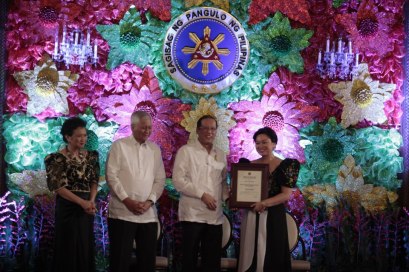
Almi flew in from Chicago as one of 29 recipients of the 2012 Presidential Awards for Filipino Individuals and Organizations Overseas, which were given out last December 5 by President Aquino at Malacañang. I had met her at the ICOPHIL conference in Michigan last September, although she had introduced herself to me by email earlier, as a fellow Filipino eager to make contact with other writers in the US and the Philippines.

Last December 9, Almi also launched her first novel, The Fires Beneath: Tales of Gold (San Francisco: Philippine American Writers and Artists, Inc., 2012), at the Ayala Museum. The novel deals with how a poor man’s discovery of ancient gold in the Philippine South changes him, his family, and his community. I haven’t finished reading the book, but I’ve been much impressed by her sharpness of eye and precision of language.

Writing about Quiapo and Binondo, for example, Gilles observes that “In Quiapo, the Golden Mosque is flanked by the Church of the Black Nazarene while the Binondo Chinese worship at Our Lady of China. On the sidewalks surrounding both places, vendors set up storefronts assembled from canvas, corrugated metal, or pieces of plywood, displaying items promising an easier spiritual journey. ‘Bypass purgatory,’ the vendors hawk. ‘Take one step closer to paradise… at a fraction of retail.’ Most believe, all pray. Both acts of nature and man cause great suffering. Metropolitan Manila lies beneath sea level and all it takes is one bad rainy season to show the inadequacy of the government’s flood control system. But the people take this all in stride. They buy both prayer beads and rubber boots.”

Since she was busy enjoying a well-deserved Christmas break with her family in the Philippines, I asked Almi to respond to a few questions I sent her by email, to map out the unlikely course she took to becoming a novelist from a professional background in the social sciences.

BD: Tell me something about yourself and your background.

AAG: I spent a few childhood years in Frankfurt, Germany where my father was assigned by the World Bank. Hence, English was the first language I learned formally. I was in premed psychology at UP Diliman and switched to AB psychology in my third year because I never intended to be a doctor and the subjects were getting harder. I graduated cum laude, and went to work for Sycip, Gorres, and Velayo (management consulting). After two years, I left for graduate school in the US, where I eventually finished a doctorate in social science, a master’s in political science, and a master’s in labor and industrial relations, all from Michigan State U. I also met my husband there, a doctoral student in economics, and got married there, on campus. My husband works in the telecommunications industry. I have a 22-year-old-son who works for Facebook and a 17-year-old daughter who’s starting college next year. I have a brother in Vancouver, Canada, and a brother and sister in the Philippines. My parents live in Manila.

BD: What started you writing?

AAG: I started writing poetry when I was about seven years old, and as I grew older I also started writing essays which were often published in the school newspaper. After graduate school, I joined the management faculty at De Paul University as adjunct professor, and taught at other area universities as well. At the same time, I had young children and my husband was traveling frequently. None of my childcare arrangements were satisfactory. After I grew dizzy and almost fainted in one of my classes (a night class for graduate MBAs), I went to see a doctor the next day and was diagnosed with hypertension, which apparently had been going on for quite a while. I then decided to quit teaching (I was teaching at campuses all over the Chicago area and would often get home around 11 at night) and try my hand at writing. My children’s book, Willie Wins, was published soon after, and I was hooked on writing. I started out writing for children since I had young ones of my own, and have published poetry, essays, short stories (one of which won a national award in the US), and plays for community theater. Now that my children are older, I thought I’d try something more adult, hence this novel.

BD: Where did the idea for this novel come from?

AAG: My friend’s sister was curator of the gold exhibit at the Ayala Museum, and she suggested I write a novel based on the discovery of the Surigao treasures. It took me about three years to finish, but I was working on other projects as well. I was fortunate that a video series of this story already existed, and I used that as reference.

I wanted the novel to reflect the tug between secularism and religiosity, and tried to delineate this struggle through my main characters (the gold discoverer and his family). Since I consider myself as a writer of the diaspora, I was careful to maintain a high level of authenticity about the Filipino experience (especially since the setting is the Philippines), while trying to appeal to American readers as well. Several chapters were workshopped at a master novel writing class led by a Northwestern University professor, and they were all white (no writer of color). While they liked the voice and style, they defined it as magical realism—a sad commentary on their knowledge of other cultures since the characters, setting, scenes were typical of a Filipino lifestyle. Some were also uncomfortable with my sentence construction (I tried to mimic the rhythms of Tagalog) but generally they liked the novel very much. In a writing workshop organization to which I belong, I’m the only Filipino writer (of English), and the only Filipino writer I know of actively publishing in the Midwest, so I feel I have to work extra hard to publicize my work and get the American readership to be more open to Filipino writing in English.

BD: What did your presidential award mean to you, and where do you go from here?

AAG: I write full time, but I guess you can say that days are filled with a lot of community organizing in addition to my writing projects. I’m very active in the Filipino American community in Chicago, and have a good working relationship with the Field Museum of Natural History. I try to promote Filipino culture whenever I can and am also invited by many schools to talk to students about multicultural writing. I’ve spoken at institutions and conferences all throughout the US, most notably at the Smithsonian Institution in Washington DC.

I’m humbled by the achievements of all the awardees—they are really exceptional people who have given so much back to the Philippines. I’m grateful that my writing has been recognized (Willie Wins is the most widely circulated Filipino American children’s book in the US, available in many schools and libraries, and is on the reading list of most multicultural publications), but I feel that a presidential awardee is obligated to continue to serve. My other passion is conservation and the environment (as president of the UP alumni group in Chicago, we raised funds for a marine study in UP Visayas), and I’m always trying to push both literacy and conservation. I’m encouraged by the feedback I get about my efforts because many have told me that I have motivated them to either write or start doing something to save the environment. I try to use the award to open doors so that I might do more, and the awards have been very effective in helping me to connect to others whom I might recruit for my cause.

AND SPEAKING of new novels, I’m awaiting an early copy of Marivi Soliven Blanco’s The Mango Bride, a comic romp through contemporary Filipino relationships, which will be released by Penguin in the US this coming April. Like Almi, the San Diego-based Marivi started out writing stories for children. Their examples should encourage more Filipinos, especially women, to make their mark in global publishing.

Penman No. 7: Creative Writing in Hong Kong

Penman for Monday, August 6, 2012

I WAS honored a couple of weeks ago to be invited to visit the City University of Hong Kong to conduct a workshop for their graduate writing students and to give a reading before a gathering of some of Hong Kong’s brightest writing talents, students and teachers alike.

I’d been to CityU before—two years ago, I attended a literary conference there, then stayed on for the Hong Kong Literary Festival. Established only in 1984, CityU (I kept calling it CUHK, until I realized that these initials were already in use by the Chinese University of Hong Kong) has distinguished itself as one of Hong Kong’s most dynamic and modern campuses, oriented toward the world and the future. Aside from the more traditional disciplines, for example, it has a School of Creative Media which teaches everything from Animation to Computational Art and a newly opened School of Energy and Environment where students can specialize in Climate Science and Energy Technology, among others.

The focus on business and technology is hardly surprising in a place like Hong Kong. What struck me was its apparent bid to become a cultural leader in the region as well—and not just in things Chinese, but in areas dominated and nearly monopolized by Western centers of learning.

A case in point was the CityU program that brought me over—Asia’s first and, so far, only low-residency Master of Fine Arts in Creative Writing (MFA) program. Only in its third year, the program has already attracted many first-rate students and teachers from around Asia and much farther beyond.

At the program’s helm is Xu Xi, a gifted fictionist and essayist who’s the living example of hybridity—she’s Indonesian Chinese, was raised in Hong Kong, and took her MFA at the University of Massachusetts-Amherst. She teaches at Vermont College, but has taken time out to direct the writing program at CityU. Though she’s now an American citizen, Hong Kong is in Xu Xi’s blood and imagination, permeating her fiction. She’s become one of the prime movers of creative writing in the region; we were fellow finalists for the inaugural Man Asian Literary Prize in 2007, and she came over as a panelist at the Dumaguete Writers Workshop two years ago.

In setting up their program, Xu Xi and CityU were deftly capitalizing on Hong Kong’s strategic position as an entrepot attracting people from all over the world, with its large expat community and a new generation of Chinese students writing in English. CityU’s English department was built up and strengthened by the likes of language and literature expert Kingsley Bolton (who gave a wonderful lecture on how the Chinese learned and used English, when I was there) who, a few years ago, co-edited a book with Ma. Lourdes Bautista on Philippine English.

The MFA, of course, remains the global standard for advanced studies in creative writing. (In a radio interview, my fellow Distinguished Visiting Writer, the English novelist Jill Dawson, and I were asked the perennial question: “If Charles Dickens didn’t need an MFA to write his novels, why should anyone?” We answered just as predictably: “You don’t need the MFA to write a novel, but it helps you to focus on writing your novel in an age full of distractions, which Dickens didn’t have to deal with. Besides, if painting and music can be taught and learned, so can writing.”)

There are hundreds of MFA and MA Creative Writing programs around the world today—the MFA tends to be longer and more intensive, and is considered a terminal degree—causing us teachers of writing to ask in wonder and consternation: “Why do so many people want to be writers?” The MFA’s low-residency version has been a recent innovation, with Xu Xi’s Vermont College among the pioneers; there are now around 50 such programs in the US, but only CityU offers one with a distinctly Asian orientation.

Under such programs, students sign up for one-on-one distance mentoring with the program’s international teaching staff, recruited from among the world’s best writers (including our very own New York-based poet Luis Francia). Once a year, for about ten days during the Hong Kong summer, everyone gets together on the CityU campus in Kowloon Tong for a series of intensive day-long workshops with the majority of the faculty in attendance. Students are required to produce a creative thesis, a substantial body of work, and the program should be doable in two years. (Two Filipinos—Karla Delgado and Sheree Chua—are in the program; I also met students from the US, the UK, Australia, and, of course, Hong Kong and China.)

There are pluses and minuses to this kind of arrangement, but it’s clearly a boon to those who may otherwise be too busy or just don’t have the option of attending classes and workshops physically in a university, especially a foreign one. It’s less expensive than a traditional campus-based MFA—certainly less than a US or a UK degree—given that one needs to fly in to Hong Kong only occasionally. But Hong Kong being what it is, it’s by no means cheap, especially for Filipinos used to paying UP tuition fees. The costs aside, the international character of the program in terms of both its students and faculty is its strongest aspect, privileging, for once, an Asian sensibility over the usual Anglo-American bias in creative writing in English.

This was something we could’ve done at the University of the Philippines—we’ve had a 30-year lead over everyone else in the region, after all, in offering degrees in Creative Writing—but sadly we just don’t have the funds and the flexibility to attract the kind of international teaching staff you need for a program of this scale and orientation.

But thinking in terms of the region, CityU’s MFA program is a boost for Asian writing and teaching as a whole, the beginning of the reversal of a century-old paradigm where we learned to write in English only in and from the West.