Penman No. 35: Return to Radio

Radio

Penman for Monday, February 25, 2013 

I ACCEPTED an unusual invitation for an interview a couple of weeks ago—unusual because of the medium involved, which was radio, specifically DZUP, the on-campus station of the University of the Philippines. DZUP station manager Rose Feliciano asked me to guest on her noontime show so I could talk about the UP Institute of Creative Writing and its flagship programs, and I was happy to oblige—not only because, as UPICW Director, it’s my job to promote the institute, but also because I’ve always had a warm spot for radio, and remain a fan of the medium.

For Filipinos weaned on the Internet, radio must seem like a blast from the past, and, in a very real sense, it is. We’re told that the first local radio stations came on the air in June 1922, so we’re just nine years away from celebrating radio’s centennial in the Philippines. While there’s some dispute as to who really invented radio, no one disagrees with the fact that Guglielmo Marconi made the first successful radio transmission in 1895—when our revolucionarios were just plotting their moves against Spain—and received a British patent for it the year after.

Of course a century’s just a drop in the bucket of human history, but in terms of technology, it’s virtually an eternity. The idea of an invention remaining just as useful after a hundred years boggles the mind, in an age when, say, the floppy disk gave way to the CD, which then gave way to the DVD and then the USB drive, all within the span of a few years. And of course radio today is a far cry from the rasp across the ether that it was at its inception (you can hear a pin drop and bounce off the floor on FM), but the basic idea remains the same—a message is electronically transmitted and received, completing the cycle of communication.

I belong to that generation of Pinoys for whom radio, and not even TV, was our main source of information and entertainment while we were growing up. I remember listening to radio soaps such as “Eddie, Junior Detective” “Erlinda ng Bataan,” and “Gabi ng Lagim.” This last program, a horror show, would go into a TV version (on MBC, Channel 11, if I remember right), but there was nothing like being in your room and quaking all by your lonesome at every creak of the door or every drag of the chain, all these creepy sounds magnified by your fervid imagination.

And that was the magic of radio, especially in the pre-visual age. TV and film may look busier, but they’re actually more passive, in that they require little more of the viewer than for him or her to sit back and be flooded by images and sounds. Radio reaches deep into your brain and forces you to supply the missing image. (When I was very small, I was convinced that there were little people inside the big wooden box that ruled the living room, and was perplexed when I managed to peek into the back of the cabinet and could find nothing but glass tubes.)

One British commentator explains the continuing relevance of radio this way: “Radio is at once intimate and universal, capable of keeping you company like a proper pal and able to impart the gravest of news with a little respect rather than the hubris of its flash-git brother, TV. And it’s also brilliant at being (a) bridge builder…. I remember sitting at traffic lights as one of my British radio heroes, Chris Evans, cracked a joke on his breakfast show a decade or so ago; I turned left and right to see a plasterer in his pick-up truck cracking up and a suit in a Jag grinning at the same moment at the same joke, right there, live—and it was moving. It was like an advert for something but it rang true.

“The thing is this: radio does what we do, it sounds like we sound…. Radio’s better at being really well-behaved. It doesn’t need to be lit, over-orchestrated or faked. Radio requires a bit of description, it’s got an artistic bent; radio’s beauty is that it’s a bit abstract—it’s painting pictures, while TV’s just taking photos. Radio is also the secret to younger-looking skin because no-one can see you.”

But who listens to radio these days? I know I do—I tune in to the news the minute the car rolls out of the driveway, if only to check out the traffic situation, although of course I get to listen to the commentary (admittedly often insipid) as well. At night, on our way home from a movie and dinner, Beng and I gorge on the free medical and legal advice on radio for dessert.

Like that Brit said, radio comes across to us like an old friend—sometimes funny, sometimes silly, sometimes even truly useful and irresistible, such as during impeachment trials, disastrous floods, and post-election vote counts. And I know we’re hardly alone—it’s a safe bet to say that in an archipelago like the Philippines, radio remains the best and the cheapest bridge across the islands, shaping the tastes and opinions of millions of our countrymen, particularly the working poor who have to leave for work on jeepneys and buses at five or six in the morning.

I do wonder if my teenage and twenty-something students still listen to radio; I suspect they don’t, preferring to retreat into the individualized, hermetic cubicles of their iPods rather than engage in the community-building enterprise that’s radio. Perhaps I should worry, but I don’t. DZUP just marked its 55th anniversary, and I have little doubt that some version of it will live to be a hundred. In the same way that print survives and continues to be needed in this era of electronic and digital media, radio will continue to find its audience, for as long as the human voice appeals to the human ear and to our dreaming brain.

(Photo from dreamstime.com) 


Penman No. 34: The Loneliness of the Long-Distance Writer

Foundation U

Penman for Monday, February 18, 2013

ONE OF the good things about holding the annual Taboan Philippine Writers Festival around the country and outside of Manila is the opportunity it provides to introduce us to writers whom we might otherwise have never known or heard about. Earlier this month, more than 40 writers from all over the archipelago gathered in Dumaguete, many of them meeting one another for the first time.

As I’ve noted on other occasions, writing is one of the loneliest professions; you’ll realize that when you’re working on a novel or a column like this one at 3 in the morning and all you have for company is the blinking cursor. Last week I wrote about the cliquism or the clannishness that our writing community has been accused of—not without reason. The truth is, like it or not, our best friends are often fellow writers, whom we count on for personal and professional support, since there’s hardly anyone or anything else out there to fall back on.

I think that’s entirely human—and, in our case, also entirely social, given how (despite this talk of a literary “elite”), we as a community are marginalized in the national mainstream. We may argue among ourselves, but on the whole, no one out there really gives a hoot about us and what we do, whether we’re Ramon Magsaysay awardees or some indie upstart trying to publish his or her first novel. So we close ranks, and find comfort in each other’s misery.

A big writers’ festival like Taboan goes a long way toward diminishing the writer’s loneliness, especially that of the writer working from the country’s geographical and political fringe—he or she can be lonely, yes, but certainly not alone.

Sometimes those connections to other writers cut across not space, but time. I was especially glad to have come to Dumaguete because of one session that—against all my expectations, for a Saturday morning that I would was itching to spend on the beach or on an airy hilltop—proved to be one of the most uplifting I’d attended in ages. It was uplifting not because the subject was a happy one—it was a gifted poet who, some suggested, may have killed himself at the age of 38—but because I discovered another Filipino writer whose luminous talent outlived him, not only in his books but in the inspiration that he provided others.

The writer in question was Artemio Tadena (1939-1977), and the session was held in Dumaguete’s small but picturesque Foundation University, Tadena’s alma mater. To be perfectly honest, not knowing Tadena or his work, we attended the session more out of a sense of duty than anything, but were rewarded by a brilliant discussion of a poet’s life and influence.

It was Myrna Peña Reyes, herself a fine poet and a friend of the late Artemio, who keynoted the session with a brief but moving account of Tadena’s life and work. Let me quote from that keynote:

“A high achiever with many talents, at 15, he won First Place for his water color painting representing the Philippines in an international UNICEF Contest that had gone around the world for judging.  In high school at the East Visayas School of Arts and Trade (now NORSU), he won First Place in declamation and oratorical contests, and he edited the school paper.

“At Foundation University where he earned an A.B. and a Law degree, he was English professor and English Department Head, as well as Head of the Office of Publications and Research at the time of his untimely death in 1977, the same year he also passed the Bar.  He had received the Most Outstanding Alumnus Award from Foundation in 1975.

“When we were already teaching at our respective schools, he at Foundation and I at Silliman, he would come over sometimes to the campus to look up people and to talk.  He did most of the talking, and I was a good listener.  It was always about writing and writers.  He admired Yeats and Hopkins and read Rilke and Pound and American poets like Robert Lowell and James Dickey, many others.  He favored Carlos Angeles and Edith Tiempo, among Filipino poets.

“He was a voracious reader, very well informed, and used a lot of what he gleaned from his readings in his poems.  For example, I know he didn’t speak French or Italian, but he used them in a poem or two.

“I recall borrowing books from the Library and seeing his written comments—in ink—on some pages.  He made copious marginal notes, quarreled with assertions in the book, approved of some, and left his comments as a permanent part of the book.  I recognized his distinctively beautiful cursive handwriting that he was most vain about.

“He published in national magazines and the Sands and Coral, and when the Silliman Writers Workshop was going on in the summer, he would come around to meet the writers and to go out drinking with some of the guys. Twice, he was an official Writing Fellow at the Workshop.  He was also a Fellow at the U.P. Writers Workshop held in Cebu in 1971.”

Tadena was a prodigious poet, publishing five collections of his poetry within seven years between 1968 and 1974. He won several Palanca Awards, including First Prize in 1974 for his last collection, Identities.

Sadly, hardly any of his books have survived, and although I had heard his name mentioned before, I had never really come across his work until that morning session in Foundation University. Aside from Myrna’s informative keynote, we also heard some very sharp commentary on Tadena’a poetry from two of his friends and former colleagues, the accomplished poets Cesar Ruiz Aquino and Francis Macansantos (incidentally, the same two fellows who took me in hand in the 1981 Silliman Workshop and infected me for life with their passion for poetry), who both acknowledged the older Tadena’s influence on their own work. Theirs were not fawning accolades, but sincere if sometimes critical evaluations of the craft of a poet imbued with a sense of the dramatic.

Artemio Tadena died of an asthma attack—some suggest he refused to take his medicine, although no one seems to have proof of that—in 1977, soon after he had passed the bar and while he was preparing for his first court appearance. One can only imagine what other wonders this southern light would have produced had he lived on.

I’ll close with another quotation from Myrna Peña Reyes’ keynote, describing the man’s poetry and providing a stirring example of it:

“From the poems, one senses a poet who thoroughly revels in the sound and flow of words.  In fact, one could say that he is literally drunk with words, sometimes, one feels, to excess, but the reader always feels he is reading poetry.  The same lyrical, eloquent, graceful facility and ease of expression that so impressed us in college mark the poems.  Many are moving, sharing wisdom of our human condition.

“In his writing style, Tadena was not an experimentalist.  Although his poems are complex, they are accessible.  His early models may have been the traditional British and Irish poets whose forms he borrowed (especially the sonnet), but his sensibility is modern, his style, his own.

“He is not a minimalist whose language is lean and spare, whose lines are short.  Although he has poems of regular line length, many of his poems’ lines are often long, dense, textured; his sentences compound and complex, often overflowing with clauses.  He uses the colon, semi-colon, and the dash unsparingly. For example, here is an excerpt from an early poem about a man and a woman in a tryst at a hotel, feeling very nervous about being seen:

“Although invisible eyes will always / Follow them wherever they go:  now, in noon’s bronze /Shifting for them into a haze

“Of gold where at first, enraptured / They gaze at each other; then suddenly look askance / To save nothing of this but the shared

“Absolution of each / Other’s need, each other’s fears—and what / Remorse can reach,

“And fortify, faithfully observed at first, and then / At first sight of each other woe- / fully abandoned.  Ears are clocks and / So is blood…” (In a Haze of Gold: The Other She)”

It may well be that there’s nothing lonelier than writing a poem, but nothing also assuages loneliness better than a poem.


Penman No. 33: At the Literary Table

Dumaguete

Penman for Monday, February 11, 2013

I’M HERE in Dumaguete City for Taboan, otherwise known as the Fifth Philippine Literary Festival, an annual gathering of writers from all over the archipelago, and even a few parts beyond. Dumaguete, of course, is inextricably linked with Philippine literary history as the home of the first and longest-running writers’ workshop in the country—the Silliman Writers Workshop, based in Silliman University—which explains its proud and rightful claim to be the “City of Literature.”

Scores of the country’s finest writers, especially in English, have passed through Silliman’s portals (in Silliman’s case, these are real portals, as iconic and as symbolic as the Oblation is to the University of the Philippines), thanks largely to Edith and Edilberto Tiempo, who started the workshop in 1962 after their return from the United States. I myself might not have thought of going back to school after having dropped out for ten years and of taking up fiction seriously after laboring as a playwright if it hadn’t been for the Silliman workshop, which I attended in 1981.

So holding Taboan in Dumaguete was in many ways a logical homecoming, and the fact that festival director Dr. Christine Godinez-Ortega (who now teaches at MSU-Iligan) is a Silliman alumna helped things along immensely. The university administration and the city government were very supportive, and the festival began on an appropriately celebratory note with a parade around the city on Thursday morning, led by National Artist Bienvenido Lumbera.

But it was the keynote address delivered shortly after by the Cebuano scholar and writer Dr. Resil Mojares that best reminded me why it’s important for Filipino writers and academics to go out of Manila and listen to what the rest of the nation has to say if writers are to help in achieving that sense of nationhood that’s eluded us for ages. Resil—whose level-headed scholarship and clarity of thought I’ve always admired—spoke on “The Visayas in the National Imagination” (there was some confusion about the topic, but in the end it didn’t matter).

He spoke of how complicated the writer-nation relationship can be: “A writer’s relationship to his or her country cannot be one of blind faith or easy self-love. I think there is much in what the Peruvian novelist Mario Vargas Llosa says about his relationship to his native Peru that we can recognize as our own. ‘For me,’ Llosa says, ‘Peru is a kind of incurable illness and my relationship to it is intense, harsh, and full of the violence of passion… [a relationship] more adulterous than conjugal… full of suspicion, passion, and rages.’ Yet, for all these, Llosa confesses to a ‘profound solidarity’ with the country. He says: ‘Although I have sometimes hated Peru, this hatred, in the words of the poet Cesar Vallejo, has always been steeped in tenderness.”

That relationship can get even more difficult when the writer feels like a stranger or second-class citizen in his or her own country, as a writer working outside the national center might be made to feel. This dichotomy between the “national” and “local” (or “regional”) writer has been a longstanding point of concern and conflict in Philippine literature for which there have been no easy answers. Dr. Mojares couldn’t have illustrated the problem more clearly than in this excerpt from his keynote:

“Perhaps we have to bow to the historical fact that it is where power is accumulated and concentrated that the ‘nation’ is most effectively imagined. It is where the ‘local’ ascends to the level of ‘national.’

“The literary situation today is that writers and works have to be recognized in Manila for them to acquire the status of ‘national.’ The center exercises the power to canonize and consecrate. A Cebuano writer who publishes in a ‘vernacular’ magazine with a circulation of 30,000 is merely a ‘local’ writer, while one who publishes a book of English poetry in Manila with a print run of 750 copies is ‘national.’ So effective is Manila’s consecrating power that a writer may start out in Dumaguete or Davao but Manila is where he hopes to ‘arrive.’ Dumaguete may be the ‘city of literature’ but it is not its capital.

“Some years ago, the poet-and-critic Virgilio (Rio) Almario asked me—with a hint of mischief and challenge—‘Where’s the new Cebuano poetry?’ I did not have a ready answer but assured him that there was a great deal of fresh, exciting work being done by young Cebuano poets. But Rio’s question did tell me that much of today’s Cebuano-language poetry—that circulates in manuscripts, poetry readings, small local publications, and Internet blogs—remains largely invisible outside of Cebu and Cebuanos, and that we (Cebuanos) have been remiss in defining and projecting to a wider audience what in this poetry is distinct, different, and deserving of ‘national’ attention. Yet, the encounter with Rio did remind me that indeed one has to be consecrated by readers and critics like Rio for one to acquire the status of ‘national.’ I say this without malice. Rio is a friend. But such is the politics of recognition.”

The discussion got even more lively in the plenary session following Resil’s talk, which was devoted to the topic of “Your Place at the Writers’ Table,” around the idea that while a national literature should ideally be inclusive, many writers still felt left out—not just because of the cultural and political distance between the center and the margins, but also because of the generational divide, and perhaps even of sheer snobbery on the part of “established” writers unwilling to yield ground to younger, fresher talent.

I’d meant to keep quiet and let others do the talking, but was prodded for my opinion on this “insider/outsider” argument, which I understand had been a hot topic online. Not being on Facebook, I caught on to it late, and composed a response that I circulated privately, from which I’ll quote:

Small as it is, Philippine literary society is indeed ruled in a way by cliques, barkadas, orthodoxies, and prescriptions. In some cases, these institutions and conventions may have made it difficult for new, alternative, and dissident voices to emerge and be heard.

I myself will indefensibly admit to being part of this ruling elite—I suppose by default, being the director of an institute of creative writing, a professor of literature, and a member of an NCCA committee that gives out grants. I’ve done well by the system (Silliman workshop, CW degree and MFA, Palancas, etc.) and the system, I think, has also done well by me.

But all this doesn’t mean that my mind is closed to new ideas or that I will shoot them down when I get the chance. Within the system, I have voted and even argued for writers and kinds of writing I personally don’t prefer, because I remain aware of what’s at stake, which is much larger than what I like. I have voted down my friends, denied them grants, and brought in people left out in the usual pollings , again because—as an old-time, squishy, hand-wringing liberal—I believe in fair play, imperfect as any cultural or political regime will always be.

By and large, the system works, if getting ahead the usual way is all you want: join a workshop, write like your mentors, win a few prizes, publish a book or two. But I keep reminding my students that this isn’t the only way to writing fulfillment and happiness, and that they’re free to choose other paths and listen to other gurus—but also, and again, that the alternatives won’t be easy. We all make our own choices—but we should do so with full self-awareness, mindful of the costs and benefits to ourselves and to society.

How important is writing to you? Whom or what do you write for? What do you expect to get out of writing? How do you want to be seen or remembered by others through your writing? I’ve answered all these questions for myself—the bottom line is that writing is my livelihood and profession; I’m less a romantic than a realist—but I can’t hazard an answer for others. As a member of the barkada, the best I can do is to enlarge the table and to bring others to it—if they even want to be there, in the first place; if they don’t, well, perhaps they shouldn’t mind too much if we dine in peace and enjoy each other’s company—and maybe even manage to write a good book or two on the side.

Penman No. 32: Ten Tips for the eBay Newbie

ebayPenman for Monday, February 4, 2013

BEEN LOOKING for a DVD copy of the 1973 Hollywood musical Lost Horizon, a 1954 Omega Seamaster, a pair of Johnny Depp’s Moscot Lemtosh shades, an 11200-mAh power bank for your iPhone, or a 1988 Stipula Baracca limited-edition fountain pen? Well, I have—and I found them all, not in my neighborhood mall or ukay-ukay, but in that largest of global marketplaces, eBay.

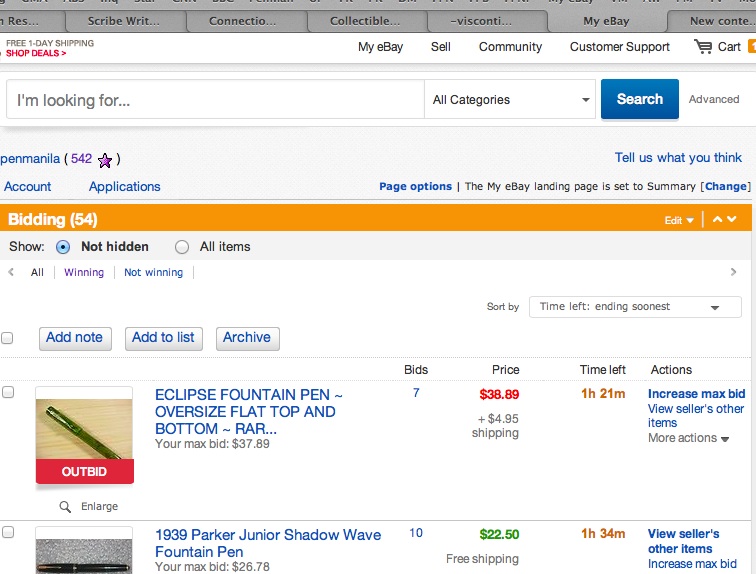
I’ve been buying and occasionally selling on eBay almost from the very beginning, since December 1997, and now have a feedback of 520+ (thankfully 100 percent positive). In all those hundreds of transactions, I’ve had maybe three or four bum cases of sellers not delivering, or sending me bad stuff. All of those cases were sorted out and I was refunded, so I do believe eBay to be a generally safe place to shop, with lots of wonderful bargains to be had, but as with any marketplace physical or digital, it can be tricky for the unwary.

I thought of writing up this brief guide to shopping on eBay because, thanks to my recent articles featuring fountain pens, papers, and inks, I’ve been deluged with inquiries about where to find these items and for how much. In particular, vintage and premium pens seem to be in great demand—pens like the Montblanc 149 and 146, the Parker Duofold, Parker Vacumatic, and Parker 75, and 1920s Waterman pens with flexible nibs.

I’ve sold quite a few of these pens myself, having made a pledge (a pitifully weak one) to trim down my collection of about 200 pens by half. My recent acquisitions have tended to be more expensive, so to help assuage my wallet and my conscience, I’ve had to dispose some of my loot, if only to make room for more. That means that I have to find a steady and reliable source for pens both to resell and to keep, and that can only be eBay—where, at any given moment, there will be about 40,000 pens of all kinds to compete for my attention and my credit card.

So I’ve been telling my pen-seeking friends that they could save themselves a chunk of change by bypassing me and going straight to the source—where a slightly used Montblanc 149 (which sells new on Amazon for $810) might go for around $400. But I’ve also warned them that it’s going to be a slippery slope, fraught with dangers and risks—not to mention the biggest risk of all, which is to get infected with eBay shopaholia.

Even if you care nothing about pens, there are literally a million more things to be found on eBay.com and on its local site, eBay.ph—everything from a mummified monkey’s paw (which you can buy without bidding for $13.00) and an 1864 autograph of Abraham Lincoln (bidding starts at $4,995.00) to a 2012 Lamborghini Aventador (yours for $469,991.00). Very likely, they’ll be things you don’t need but will soon want—and want badly, so mind the following tips if you plan on shopping on eBay without risking your children’s inheritance or your marriage. I’m going to use pens to illustrate my points, but these tips can apply as well to cameras, shoes, bags, bikes, or whatever floats your boat.

1. Know what you’re looking for—know the product and its current market value. Do some research beforehand and establish what possible issues there might be with the item. For example, if you’re looking for a Montblanc, understand that vintage celluloid ones in good shape could command more than new ones in “precious resin”—but also that the 149 and 146 are the most faked pens in the world (along with the Parker Sonnet); eBay actually has a guide to determining fake MBs (which means, know your way around eBay as well). EBay’s “completed listings” is a great way to determine market value—look for the median price (discard lowest and highest prices) for a better sense of what you can expect to pay. Check other websites (Amazon, BestBuy, etc.) as well, because their special deals and offers could undercut eBay. I do most of my gadget shopping, for example, on dealmac.com.

2. Condition, condition, condition. In your enthusiasm for an item, you might forget to probe its condition. Read the description very well and look out for any flaws. Especially scrutinize all the pictures. (This also allows me to spot special features that others might miss—a broad stub on a nib, for example). I think I know pens well enough that I can tell make, model, year, and approximate value for most major brands on sight, but every pen is still unique once it’s up for sale. Keep an eye out for cracks, glue, broken tines, mismatched caps and barrels, discoloration, etc.

3. Set up a PayPal account. It will make your life a whole lot easier on the Internet, since PayPal has become a global standard for electronic payments. I’ve tied my PayPal to a specific bank account I use only for eBay transactions. Is it safe? Of course you’ll hear a horror story here and there, but in my own experience, eBay and PayPal have served me very well, settling questions and disputes and sending refunds very quickly in the rare cases of non-delivery I’ve encountered.

4. Keep looking. Since I now buy and sell pens, I check out eBay many times a day—I have it on my phone—and have set up search terms for my favorite items, like Parker Vacumatics. This enables me to find what I like quickly, in a marketplace where millions of items are up for sale at any given moment. Some of my best bargains have come when buyers in the US—my chief competitors—are literally asleep. I also check out ebay.uk and ebay.ca (the UK and Canada) and have found some of my best bargains there. The first thing I check is “newly listed”, further narrowed down to “buy it now”—this way I can catch the real bargains before anyone else does. Then I check “ending soonest.” You can also refine your searches, for example by looking just for “149” under “Montblanc” under “fountain pens.”

5. Check the seller’s feedback. I’d be wary of a seller with less than 95% positive feedback. He or she may not be a cheat, but has a poor service record (delayed mailings, no response, etc.)

6. Establish your bidding threshold early on. Don’t get caught in a bidding war with another bidder. These days, since I could be bidding on 20 items at any given moment (expecting to win maybe two or three), I just bid my maximum and forget about it until the last two minutes, which are really all that matters on eBay. Some people use sniping programs that let the computer make a last-second automated bid for them; I should, but have been too lazy to set one up, and I rather like the excitement of making the last-minute bid myself.

7. Figure out and factor in your shipping options. Since most of my purchases are made in the US, I use a US shipping address (my sister’s in Virginia) and aggregate my purchases there. When I’ve gathered a boxful, I ask my sister to ship them to Johnny Air Cargo in NYC, which forwards them to me in Manila a week later. I’m sure many of you have US relatives who can do this for you (just make sure that they’re willing—be very nice to them at Christmas). I’ve educated my sister on pens so she’ll know how to check out a pen when it arrives and how to handle and package them properly; and yes, I’ve given her a nice pen or two.

8. Pay promptly, and leave feedback. You’ll see how your own feedback will improve once you become a good eBay netizen.

9. If and when you encounter a problem, report it to eBay. They have mechanisms for dealing with problems like getting a defective item (unless it was so described) or not receiving an item you paid for at all. Take note that there’s a time window (45 days, I believe) within which complaints can be filed.

10. Don’t lose hope. I’ve lost out on bids for items that I’d coveted for years, but then found another one a week later, for cheaper. If you can’t find it on eBay, it probably doesn’t exist, or is illegal to own. For me, it’s fountain pen paradise, and another reason to wake up in the morning for.

Penman No. 31: The (Ink and) Paper Chase

Oxblood

Penman for Monday, January 28, 2013

ONE THING that fountain pen fanciers rather quickly realize is that their obsession (read: expenses) won’t end at buying another Parker, another Sheaffer, or another Pelikan. You can have bread without butter, or even without coffee on the side; but you can’t write without ink and paper, so that anyone who habitually buys and collects pens soon metamorphoses—even without meaning to—into an ink and paper hoarder as well.

Indeed, inks and papers have become collectibles on their own, and not necessarily together. I have friends who couldn’t care less about pens, but for whom the sheer texture and even the faint aroma of paper can trigger paroxysms of pleasure. These are the people who seek and haunt stationery and art-supply shops, pawing through exotic papers from Thailand, Japan, and Italy, paper that might not even end up being lettered on but pressed into some other service. (And while we’re on this subject, please, please never say “stationary” to refer to writing paper; it’s “stationery” with an E, referring to “stationers”—the people who, in medieval times, sold books in fixed places, as opposed to peddlers who went around with their wares.)

My wife Beng, a watercolor painter and professional art restorer, has one such mecca on 3rd Avenue in New York City, on the second floor of which, up a steep flight of stairs, can be found an astounding array of the world’s finest art papers. But when she visits, Beng’s not looking for paper to paint on; instead, she wants a delicate, silk-like paper made in Thailand that she can use to lay over and stabilize patches of paintings where the paint has begun to flake off.

Forty years ago, when I worked briefly as a printmaker (another of the many hats I’ve worn—and I still wear them now, the real ones!), I too rhapsodized over art paper—the thicker and creamier the better—and on good days or for special jobs, I’d splurge on Strathmore paper, whose texture somehow made any print I designed, however poorly, look rich.

Indeed, it seemed rich of me to get so picky about my papers when, just a few years earlier in my mid-teens, the only paper I knew and cared about was bond paper (the kopong bond we bought at the corner store for 5 centavos a sheet), ruled pad paper for school, and yellow legal pad paper. For special purposes, there was oslo paper and onion skin, and maybe when we got moony we bought some fancy stationery at the bookstore (mine had a picture of the Beatles on every sheet) to write the crush of the moment on (yes, all I’ve ever had in my meager arsenal all my life has been words, words, words).

I still look for good paper these days, but it’s no longer to woo the wenches with (better not, says Beng) nor to pen my next novel on, but simply to test my nibs and inks, like a driver might look for a pristine stretch of track on which to lay some nasty rubber.

And what’s to like and not like about paper? While many kinds of paper—especially the smooth ones—may all look the same from the top, on the microscopic level, they could vary a lot, in terms of the makeup of the fibers and how closely they’re packed together. That means that when the ink flows out of the pen’s nib and gets onto the paper, it will either hold together and more or less stay in one place, or spread out like mad through spaces in the fibers and saturate the paper in such a way that the ink will bleed through, or be visible from, the back side of the sheet.

This latter process is called “feathering” and “bleeding.” You’ll know that your paper feathers when the line you write quickly becomes thicker and fuzzier, sometimes to the point that the letters become hard to read; bleeding or bleed-through, on the other hand, is obvious when you turn the page over and can see the ink. Feathering, I think, is worse than bleed-through; at least you can write on just one side of the paper and still have something crisp and clear, but paper that feathers horribly will leave you with one big blur.

As a general rule, cheap paper—thin, with loose wood-pulp fibers—will feather and bleed. More expensive papers, such as those that use linen, will tend to be thicker and more compact, and therefore offer a more pleasant writing experience. A simple pad or notebook could cost many hundreds of pesos, especially if they sport leather covers and other accoutrements.

In our pen club, the Fountain Pen Network-Philippines, members are forever on the hunt for good but affordable writing paper, even as we may indulge ourselves in the occasional pad of proven performers like Clairefontaine and Rhodia, available in some local bookstores. One sad and surprising discovery that fountain-pen users make early enough is that the iconic Moleskine notebook—whose design I love and have offered whole essays to—isn’t fountain-pen-friendly at all, showing awful feathering and bleeding.

Thankfully, many alternatives to (and copies of) Moleskine now exist, some dearer and others cheaper. A recent experience of mine seems to prove a point. Feeling more expansive than usual on my birthday, I went to the bookstore and spotted a very handsome-looking, leather-bound Jadeco notebook with what appeared to be excellent paper; the tag price of nearly a thousand pesos made me gulp, but what the heck (as I often rationalize these days), at 59 I can excuse anything. I picked it up, paid for it out of my birthday budget, and soon confirmed my expectation that the paper would hold up well to runny fountain-pen ink. The following day, on another sortie to National Book Store, I saw a small spiral notebook (that’s all it says on the kraft-paper cover: “Notebook”) that cost all of P28; on a whim, I bought that, too, and discovered to my chagrin that it performed almost just as well as the Jadeco. I would later learn from friends that some good compromises can be found in the middle of these extremes; I found another one myself a week later, at Fully Booked, under the brand-name Schützen—a regular-sized spiral notebook for P285 that didn’t feather and bled just minimally.

This brings us to inks, which really deserve another column-piece on their own (which I’ll do some other time). Let’s just say for now that inks can even be more bewildering and exhilarating than paper, given the seemingly infinite range of colors and hues you can produce from a mixture of water and pigment. Some inks are also thicker and more saturated than others; some are permanent, and others washable. Some specialty inks, like De Atramentis, can even carry the scents of fruits, flowers, and wines.

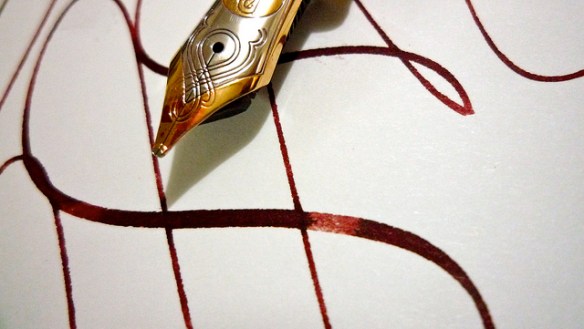
I’m not a very adventurous person ink-wise, and for the longest time wrote only with black, blue-black and brown inks; green, bright blue, purple, and red (not to mention yellow and orange) were simply out of character for me. They still are, but I’ve since nudged my range a bit to include Diamine Oxblood (a robust maroon) and Rohrer & Klingner Sepia (a greenish gray reminiscent of old manuscripts) in my small stable. I’m still on the hunt for the perfect blue-black, alternating between the Parker, Pelikan, Montblanc, and Lamy versions. Most days, I just liberally mix things up, turning my desktop into Inkspot City. (Better than alchemy, drop in at Scribe Writing Essentials in Eastwood Mall for a plethora of inks such as J. Herbin, not to mention many fine pens.)

Do take note that the final appearance of your ink will depend not just on chemistry, but on the paper quality, and also on the pen and the nib you use—a wider nib like a stub will deliver a thicker line that shades beautifully as it moves along; that’s what sends pen pushers into seventh heaven.

And what do I write with these exquisite implements? Aside from the occasional signature, absolutely nothing meaningful. I’ve come to realize and to accept that this is how I relax and make myself feel good: by taking hold of a pen worth what someone else more practical might have paid for a fridge or a flat-screen TV, and doing nothing more with it than doodling for hours on premium paper. I liken it to driving around on a lazy weekend to nowhere in particular, just enjoying the scenery and the sweet hum of a perfectly tuned engine. Such are one’s pleasures on the doorstep of one’s dotage.

Penman No. 30: Music to Lose Weight by

Penman for Monday, Jan. 21, 2013

AS I’VE been reporting lately, I’ve lost quite a bit of weight since my doctor ordered me six months ago to take brisk walks and go on a sensible diet to fight the onset of Type-2 diabetes. I seem to have hit the wall at a weight loss of 45 pounds, but I guess I should be happy where I am, in the low 170s. With my blood sugar in the 100 range and my blood pressure steady at around 110/80, I’m a whole lot better off than where I was a year ago—and, I suspect, than many men my age.

But this isn’t about cholesterol, triglycerides, and all that; rather, it’s about another unexpected side benefit to all this huffing and puffing. Because I take 30-minute to one-hour walks around the UP Academic Oval several times a week, I’ve rediscovered all the music I’d stored away in my iTunes. I have about 2,000 songs all in all—apparently not much by the standards of today’s kids, some of whom I’ve seen to profess having 10,000 songs in their playlists (of which, I’m pretty sure, 9,900 will sound all the same to me).

As you can imagine, most of my music is made up of what seniors know as “standards”—vintage pieces from the likes of Doris Day and Bing Crosby that can put a 20-something to sleep in 30 seconds, the kind of music you’ll hear on FM radio at 2 pm. Of course I have the complete Beatles collection (and could probably sing 80 percent of it from memory), a boatload of Broadway, Sinatra from here to eternity, Michel Legrand in both English and French, opera like I knew Italian, enough bossa nova to make me wish I knew Portuguese, and instrumentals from the likes of Jackie Gleason (yes, he was also a bandleader). Henry “Pink Panther” Mancini, and Toots Thielemans, who can make a harmonica sound like a love letter with your address on the envelope.

I do have quite a few new songs—but “new” to me usually means something 20 or 30 years old. Instead of Linkin Park, I have Led Zeppelin; instead of the Eraserheads, I have Heber Bartolome and Banyuhay. OK, I have a couple of songs by Journey (what else but “Open Arms” and “Faithfully”) and one by INXS (“Afterglow”) but no Nirvana, no hip-hop, nothing to disturb my hard-won equanimity or my illusion that the world is anything but an ordered whole.

It’s that old-guy sense of order and purpose that drives my left foot in front of the right and the right in front of the left, for 2.2 kilometers around the oval until I reach the Oblation and then do it all over again. I have to believe that all of this exertion will actually mean or bring something good, and for that I need emphatically optimistic music.

Broadway, I find, best puts me in this mood. If anything—from Carousel to Les Miserables—Broadway’s been built on selling the power of love and the indomitability of the human spirit, so you could whistle a happy tune and never walk alone and look to the rainbow and be sure that the sun will come out tomorrow. I might start with something light like “Dites Moi” from South Pacific or “Question Me an Answer” from Lost Horizon, progress to something more dramatic like “We Kiss in A Shadow” from The King and I or “If Ever I Would Leave You” from Camelot, and then push myself for another turn around the oval with something truly rousing like “On the Street Where You Live” from My Fair Lady or “There Is Nothing Like a Dame” from South Pacific. I’m singing all of these in my head, but being deaf to the world with my noise-canceling earphones on (not the smartest idea on the open road), I’m sure—from the strange looks I get from people I pass by—that I’m making noises I’m not hearing.

Next to Broadway, my two favorite genres are Latin music and OPM. I don’t really speak anything more than schoolboy Spanish (thank God for the old Spanish Law, which of course all of us detested in our time), but whenever I listen to someone like Luis Miguel, I find myself feeling foolishly sorry that we kicked those Spaniards out. I have eight versions of “Sabor a Mi” in my iTunes, and savor both Andrea Bocelli’s and Ennio Morricone’s versions of “Amapola” (which Morricone used for the soundtrack of Once Upon a Time in America). Speaking of Morricone, how could anyone resist “Gabriel’s Oboe” from The Mission, especially when it’s Yo Yo Ma doing the honors? And speaking of Yo Yo Ma, how much sweeter can a cello get than on “Doce de Coco” from his Brazilian album?

Ah, Brasil, where hearts were entertaining June, and we stood beneath an amber moon…. I’ve told my wife June (also known as Beng) that when I croak, the kind of music I’ll want at my wake will be that of Antonio Carlos Jobim, especially “Desafinado.” There’s something in the gentle insistence of the bossa nova that speaks to my own temperament. And here I have to bring up one of my favorite divas (aside from the inimitable Barbra and our own Sharon—yes, I’m an unabashed Sharonian)—the Japanese-Brazilian chanteuse Lisa Ono, whose “Pretty World” never fails to add some lift to my shoes.

For something more soulful I’d turn to Laura Fygi’s “Abrazame”—and it may be an odd way of looking at these ladies, but if Laura Fygi and Lisa Ono’s voices were like ink, Laura’s would shade to purple and Lisa’s to green. To top off my Latin section, no single album gets more airplay in the car or in my earphones than the soundtrack of Woman on Top, which has an upbeat vibe you can listen to all the way to Baguio. (I was playing it in the car once while driving around Pampanga, and everyone with me wanted a copy.)

And did I say OPM? Much as I may appreciate exotic melodies like “Dein ist mein ganzes herz” or “Les moulins de mon coeur,” they can’t get me going like Sharon’s “I-Swing Mo Ako” or “Bituing Walang Ningning.” When I’m rounding that long bend around the Sunken Garden and am tempted to linger under the acacias for a lick of sweet sorbetes, I strengthen my resolve by drawing on “Sana’y Wala Nang Wakas”: “Kahit na ilang tinik ay kaya kong tapakan, kung iyan ang paraan upang landas mo’y masundan… Kahit ilang dagat ang dapat tawirin, higit pa riyan ang aking gagawin!

And that—plus a lot of kangkong and hasa-hasa in sour broth—was how I lost 45 pounds in six months.

Penman No. 29: Some Things Meant to Be

Penman for Monday, January 14, 2013 

MY LATE father Jose Sr.—Joe to his friends—would have turned 90 this coming Saturday. An incorrigible chain smoker, he died of an aneurysm in 1996, and there’s hardly been a day since when I haven’t thought about him. Whenever I travel, which is fairly often, I find myself talking to my dad to tell him, “Tatay, I wish you’d seen this, and this, and that.” He was a simple man whose feet never left his country nor, pretty much, his home; his joys were in the kitchen and in the garden, and his favorite pastime was doing crossword puzzles.

Indeed, in his own way, he was a man of words, a gifted writer who—like I would do, myself—ghost-wrote speeches for far more powerful but much less articulate men. As modest as our circumstances were, there were always books and magazines at home, and even before I could read or write, my father fired up my imagination by reading stories to me at bedtime. In brief, I would not have become a writer had it not been for him.

Nor, speaking of my quaint obsessions, a fountain pen collector. In his last days my father wrote with a cheap plastic Bic ballpen—the kind you can now buy by the box and forget or throw away after a few uses—but in his prime he had some Sheaffers and Parkers that he would load up with blue-black ink, whose ability to bloom into a dark-hearted rainbow on a wet napkin brought me endless fascination. Regretfully none of his fountain pens have survived—which is probably why, as with most enterprises driven by some deep longing, I keep amassing pens, as if they would somehow bring my father back.

Now, begging your indulgence, here’s where this memory detours into the story of a pen and of a box.

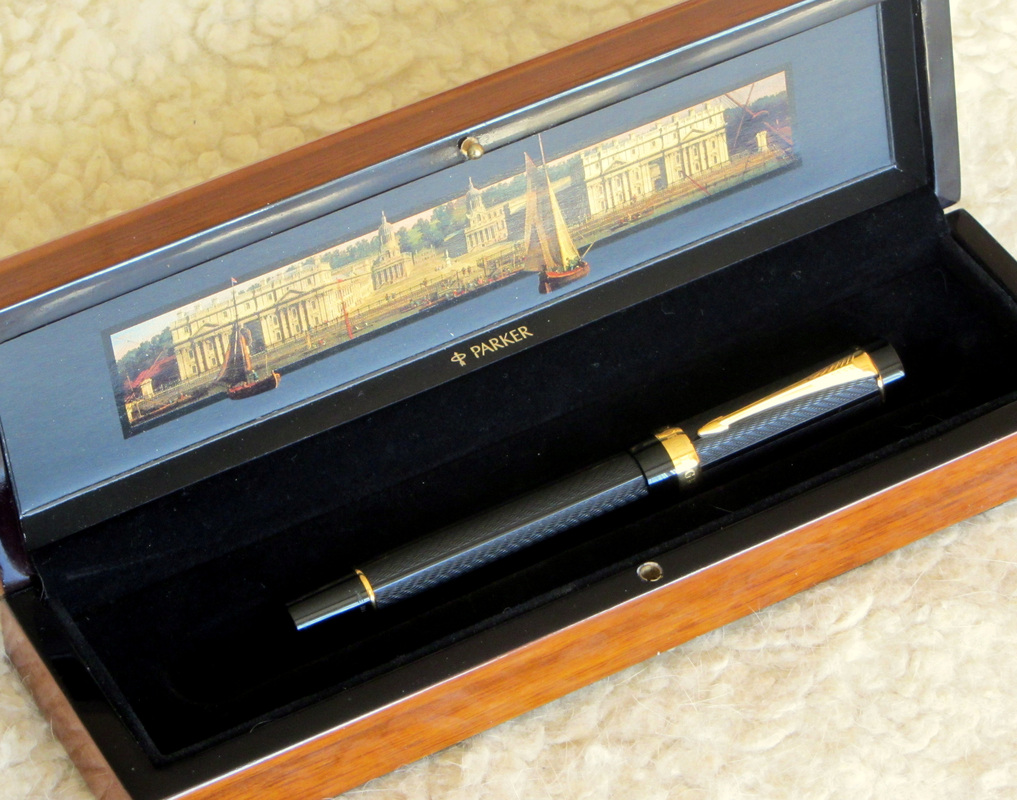
A few weeks ago, after months of eager questing, I acquired what collectors call a “grail” pen—an object of acute desire, usually for reasons of great beauty, scarcity, or some sentimental connection. In this case, it was purely a matter of esthetics and collectability: the Parker Duofold Greenwich Centennial would simply be a big, black, overpriced pen to most sensible people, but to me it was the noblest of the modern Duofolds, a reincarnation of a classic 1920s line that established the Parker name for the rest of the century. Made specifically to commemorate the Royal Observatory in Greenwich, England—which Beng and I visited around the time the pen was made in 1999—the pen was a special edition with a limited run, and had become rather hard to find.

When I found one on eBay at a price I could afford, I was ecstatic, filling my posts about the find with smileys and dancing bunnies. It was near-mint, the chevrons incised into its black cap and barrel deep and lustrous, its gold fittings rich and warm. Its regal nib was a joy to write with. I couldn’t have asked for more—or perhaps I could, as it came to me without its presentation box. Pens of this caliber always came in pretty wooden boxes in themselves worthy of collection, and indeed, in one discussion of the Greenwich in a forum I frequented, another collector had reported seeing “a small but fancy box with what appeared to be a European cityscape picture on the inside of the box cover.” I wasn’t sure why, but that description sounded oddly familiar to me then.

When the pen arrived from the US I put it to happy use, doodling away, writing loopy notes to no one. The Greenwich was truly an impressive pen and it sat haughtily in my pocket, but now and then I would be besieged by the collector’s constant fear of losing or dropping a valuable pen, and I would begin wishing that I had its box to put it to bed in, before I scored the exquisite chasing on the pen or, worse, let it slide out of my attention in one of my poker binges. But then of course, I didn’t have its box, and I couldn’t bear to stick it in anything beneath its stature.

And then, a few nights ago, something strange happened. As I was idly surfing away to more pleasant distractions (meaning, more pen-related Websites) in the middle of finishing the draft of another commissioned piece, I stumbled on a picture of the Greenwich in its original wooden box. And at that instant, the familiarity of the box and of its pictured scene overcame me, as I realized that, of course, I’d had that box somewhere in the house, somewhere in the very room I was in. Years ago, I had found the varnished receptacle in a thrift store in America, and had been taken by its plaintive beauty—plaintive because it was clearly a box for some majestic Parker pen (the Parker name was proudly emblazoned on it), but it was empty, and I had no idea then what model its proper occupant might have been.

I bought the box for a couple of dollars, and brought it home with me to the Philippines, where I decided that it would house the most precious pen in my collection—my dad’s battered Bic ballpen, the last thing he wrote with before he died. So I was certain I had it somewhere, and I began ransacking my den, pawing through shelves of empty pen and ink boxes (you can imagine what a collector’s nest looks like). Sure enough, there it lay behind a stack of ink bottles, the box that opened to a “European scene”—a cluster of neoclassical buildings foregrounded by a sailboat on the water. (I would later discover that it was a depiction of the Royal Naval College at Greenwich, seen from the north bank of the Thames.)

It was the box that had been designed for—and only for—the rarefied Parker Duofold Greenwich Centennial, and by some stroke of what the poets called serendipity, I had found the box years before I found the pen. I took my father’s crystal Bic in my hand and smiled, thinking, “Tatay, what strings did you pull to make this happen?”

So I put the Parker where it was meant to rest, and now I had to find new and no less suitable quarters for the Bic. Fortunately, on the same shelf was an old Japanese box, gleaming in black lacquer, that I had found in another discount store on Avenida Rizal, and which would originally have carried chopsticks. I didn’t think Tatay would have minded the switch, being an excellent cook.

And finally, I resolved that, in honor of Jose Quinton Dalisay, Sr., the Greenwich pen would henceforth use nothing but blue-black ink, a choice its golden nib seems perfectly content with. My other pens can gorge on Diamine Oxblood and other fancier concoctions, but I had been soundly persuaded that some things are just meant to be. (And here’s to a happy 90th, Tatay!)

Penman No. 28: Traveling with Pens

Vacumatic

Penman for Monday, January 7, 2012 

IT’S THE day before New Year, and I’m on my way to Kuala Lumpur with Beng for the last jaunt of the old year and the first of the new one. In my shirt pocket is a 1999 Parker Duofold Greenwich Centennial, a big black pen I’ve had for just a few days and which I’m putting through its paces; in my bag is a leather two-cigar case that’s transporting not Cohibas but two more Parkers—another Duofold, an orange International from around 2008, and a Vacumatic Oversize that goes all the way back to 1938.

I don’t even know why I travel with fountain pens. Lord knows how many valuable ones I’ve lost on the bus or in some stranger’s car, where it’s probably moldering under the back seat alongside an ossified wad of gum. (Probably the most valuable pen I lost, I didn’t even see. Twenty years ago, my grad-school friend Joe mailed me a pen in a box along with a book—I grabbed the book and threw away the box. “How was the pen?” asked Joe when I thanked him for the book. “What pen?” I asked. “The silver-filigree vintage Waterman that I tucked away in a corner of the box. It was meant to be a surprise,” Joe said. This was a couple of days after the box had gone to the dumpster in Milwaukee.)

It’s not like I write novels on the road, or write anything substantial, period, with my fountain pens. I have a thick pad of gorgeously creamy Clairefontaine paper at home, and all I ever write on it is “This is a Parker Duofold from 1931” or “This is a Bexley with a broad nib that I stubbed” or “This Waterman 52 flexes oh so nicely” and pages and pages of figure 8s. If I ever become truly famous, I suppose that pad of doodles and scribbles will be worth something to someone, but they’ll be disappointed if they’re expecting to find the first line of a new novel or some deep dark secret in it.

I keep that pad on my desk for whenever I get a new pen—maybe two or three times a month—for its ritual initiation: I’d write “This is a Pelikan M600 in tortoise” and see how the nib performs. I like my nibs broad, wet, and stubby, and if they aren’t any of these three (I do keep a few fines and mediums unmodified), I work on them with very fine 2500-grit sandpaper, finishing off the job with an 85-peso nail buffer from a Korean cosmetics shop (it always raises eyebrows when I walk into one of these mall shops and get three nail buffers all at once).

It takes care and patience, but there’s a lot you can do to improve the flow of ink in new pens, whose nibs will sometimes be “hard” writers requiring just a bit of tweaking to perform optimally. Beyond the flow, modifying the nibs themselves requires special knowledge and more than a dash of daring; I can stub or flatten nibs and make them write more smoothly, but it takes the skills and workbench of someone like my friend JP Reinoso to turn them into crisp cursive italics. For even more difficult jobs like straightening bent tines or adding iridium or tipping material to old nibs, we go to the best of the world’s so-called “nibmeisters”—people like John Mottishaw, Greg Minuskin, Mike Masuyama, and the now-retired Richard Binder.

But where was I? Oh, traveling with fountain pens. As I was saying, it’s something no one really needs to do these days. In fact, I also bring along a ballpoint or a rollerball pen for the inevitable task of filling out immigration and customs forms, especially those that require duplicate copies. (It was the necessity of the carbon copy, back in the ‘40s, that would eventually spell the death of the age of soft-nibbed fountain pens and the start of the world’s love affair with the ballpen or the “biro” as it was first called, after its inventor Laszlo Biro.)

A vintage fountain pen in your pocket might even spell fashion disaster inflight. Today’s air cabins are properly pressurized, and I should say that I’ve yet to have a pen burp on me airside and cause an inky bloom on my shirtfront, but there’s enough anecdotal evidence out there to suggest that not all pens or filling systems may be so well behaved. Conventional pen wisdom says that you fly with your pen either completely empty or completely filled.

Being a gambler, I travel with fully loaded pens. I might write a line or two with them on the road in my Moleskine notebook, but again it’s not the writing I carry them with me for—for that menial task, I have the trusty MacBook Air that I’m typing this piece on, in seat 7-D of our AirAsia flight. So what is it that I need to bring three pens for to an exotic destination like KL—where, ironically, I’m going to be picking up five more pens for friends from PenGallery (www.pengallery.com), one of Asia’s and the world’s best pen shops?

I suppose my pens are like the kids or pets I never had—and I know, I know, sometimes kids are better left at home, but you still want to know that they’re safe and that they’re where they’re supposed to be, and what better place can they be but right with you? I can’t possibly bring all of my dozens of pens along—I keep about nine or ten of them in the daily rotation—so I choose favorites for the week, and perhaps go for a mix of old and new, of ink colors (my staples being blue-black, which reminds me of my father’s writing, and oxblood, which lives up to its sanguinary promise), and of nib sizes (a fine or a medium for note-taking, a broad stub for signatures). A pen’s pleasures are both visual and tactile—the smooth curl of a line or a letter on the page, the feel of a precisely tuned instrument at your fingertips. Knowing that these pleasures are literally within reach, wherever I may be, gives comfort.

I like my modern Duofolds (a reprise of a classic design from the 1920s) because of their heft and balance, but I’ve taken the burgundy 1938 Vacumatic out of its 18-year storage and put it in my cup of daily writers after convincing myself that if I had a pen this precious but never used it, then I would have foregone one of life’s rarest privileges. (Yes, this is the very pen I found in Edinburgh in 1994 and which provoked the writing of the short story “Penmanship,” a desperate attempt to justify the impulse buy of the pen and to recover its cost.)

As you can see, I’m something of a Parker partisan, although I like and collect all kinds of pens, including the relatively inexpensive but ever-reliable TWSBI and Lamy. I have nothing against Montblancs—I have quite a few of them and treasure one of my 149s for its ability to write a sharp wet line even after weeks of being left unattended—but I remind my corporate and lawyer friends that there are other fine pens out there without a white star on the cap, such as Pelikans and Sheaffers, and they don’t all come with five-figure price tags. (Try Scribe Writing Essentials at Eastwood Mall and the pen counters at National Book Store for more options, or join our pen club at http://groups.yahoo.com/group/fpn-p/ for more information and great company.)

Speaking of vintage pens, I found a couple of noteworthy ones just before Christmas in an antiques shop in Quezon City. I had taken Beng out to lunch at a Japanese restaurant and right beside it was Siglo, which we hadn’t visited in ages. There under glass were two pens that had been waiting all that time for me: a 1920s Waterman safety pen inscribed “Conchita”, and a 1947 Parker 51 once owned by a “Julian T. Navarro.” Some pen collectors don’t like these personalizations, but I’ve never minded them, taking them as provenance and proof that these once were more than objects for someone’s collection.

Vintage pens

Like I told another collector-friend, I see myself much less as an owner than a caretaker of things that will pass on and give delight to someone else, and hopefully revive some tender memory of me. I have no way of knowing who “Conchita” was, but thanks to the wonders of Google, I was able to locate the obituary of Julian T. Navarro, who was born in the Philippines in 1907 and who died in California in 2003. He had been a war veteran, and then a contractor, and would have been 40 when he got the Parker in 1947—a man just approaching his peak at the end of a devastating war. I can just imagine him writing with that Parker, its now heavily tarnished gold cap gleaming in his hand. What hope and optimism would have flowed out of that pen.

I suppose that’s why I bring these babies home, and carry them around with me wherever I go.

KRIP YUSON already wrote the literary tributes I would’ve offered for the late Emy Arcellana and Jerry Araos, so let me just add my fervent sympathies to the families of these dear departed friends. Their lives enriched and brightened ours, and they will be much missed. Beng had visited Jerry just a week or two before the end, and he had told her, “I want to go home.” And so he did.