Qwertyman No. 156: That Bam-Kiko Thing

Qwertyman for Monday, July 28, 2025

RETURNING SENATORS Bam Aquino and Kiko Pangilinan have been getting roasted online for joining the majority bloc in the incoming Senate, thereby securing important committee chairmanships under the highly unpopular but tough-to-unseat Senate President Chiz Escudero. Despite sympathetic reactions from such opposition stalwarts as former VP and now Naga Mayor Leni Robredo and Sen. Risa Hontiveros, the two have been roundly scored for their decision.

Typical of the outcry was this much circulated post by a friend I deeply admire, the penal and judicial reformer Raymund Narag, who lamented that “They will join the majority. The same majority that excuses corruption as politics, power as protection, and self-interest as national interest. But what they forget is that we voted for them not to play the game. They forget that it was not just about committees, or positions, or so-called influence. It was about principle. We mourn the death of idealism in Philippine politics. But it’s a slow death. Not by assassination, not by defeat, but by compromise. And the executioners are the very people who once called themselves idealists.”

It’s a heavy to charge to lay at the feet of these two men—turncoatism, betrayal, the surrender of idealism, latent hypocrisy—and I can see where the disappointment and dismay are coming from. But with all due respect to my friend Raymund and to those who share his sentiments, I don’t see these dire reversals at all in the choices that Bam and Kiko made, but possibly an interesting and potentially significant maturing of our political culture, especially within the opposition.

It’s true that the Bam-Kiko decision came as a surprise, and that things would have been much clearer, the battle lines much more cleanly drawn, had they sat with Sen. Risa Hontiveros in a true and unflinching albeit tiny minority, duking it out with the majority at every turn, exposing wrongdoing right and left, and remaining unblemished by compromise to the end of their term. We could have remembered them for their impassioned speeches in defense of democracy and justice, tilting against the windmills of the Marcos-Duterte regime.

But I don’t think that’s all or what we elected these two senators for—or was it? As far as I can tell, we voted for them to get things done—the good, the right, and the best things—where they mattered, in their areas of expertise: Bam in education, and Kiko in agriculture. Granted, it may have been secondary to sending a message upstairs that these were the good guys, infinitely much better than the trapos being foisted on us by both the Marcos and Duterte factions, but it was their track record that gilded their credentials.

In case we’ve forgotten or weren’t listening too closely when they were campaigning, Bam Aquino authored 51 laws, including the Universal Access to Quality Tertiary Education Act, the Go Negosyo Act, and the Microfinance NGOs Act. He was also behind the Masustansyang Pagkain para sa Batang Pilipino Act and the No Shortchanging Act of 2016. Kiko Pangilinan, an even more seasoned lawmaker, produced over 150 laws, including the Sagip Saka Act, the Coconut Farmers and Industry Trust Fund Act, and the 105-Day Expanded Maternity Leave Law.

Their acceptance of the agriculture and education chairmanships should help ensure and strengthen their ability to pursue these progressive initiatives further—regardless of how they think about and vote on other issues of national consequence, such as the impeachment of VP Sara Duterte, the national budget, our foreign policy, and constitutional change. 

We have yet to see—as their critics already seem to have foretold—if they will cherish their chairmanships to the extent of abandoning their fundamental principles. Instead I foresee the greater likelihood of the reverse happening: of Bam and Kiko relinquishing their posts should their stay there prove morally untenable. If they were to perform well in their Senate positions, and they were then stripped of their chairmanships for their independent stances, then that still would be more emphatic than if they had never assumed the responsibilities that are also their entitlements, according to their competencies.

But in and of itself, joining the majority bloc—never a firm nor a politically or philosophically cohesive entity in our system of what Shakespeare called “vagabond flags”—should be less of a deal or an issue than it is being made out to be. This “majority,” in any case, seems such a ragtag band that it is almost certain to collapse before the end of the present term.

It probably says more about us as an electorate than about Bam and Kiko when we cast their decision as a “betrayal” of what they were presumably voted for. I’m no political scientist so the experts can explain this better than I can, but it seems to me that we’ve become used to seeing our legislature as a forced marriage of fundamentally incompatible forces—the ruling party (powerful but unintelligent, corrupt, opportunist, cynical, good-for-nothing) and the opposition (weak but progressive, smart, morally upright, idealistic, courageous, media-savvy, and effective). We see the Senate as an arena, a battleground (and often a circus), rather than an office where people are supposed to work, and work together (never mind that some of them are lazy and stupid), achieving results through compromise.

Bam and Kiko just need to prove themselves once more at their jobs and serve the Filipino to the best of their ability, so that when 2028 comes—and whatever their plans may be for that next milestone—they can have a good answer to the basic question that our voters have every right to ask: “So what have you done for me?” It’s a question that the elevated rhetoric of the progressive opposition has sadly often ignored and dearly paid for, almost as if it were beneath consideration. Bam and Kiko need a platform from which to connect corruption to the price of rice, to persistent flooding, to the failure of Filipino children to read at Grade 3. 

Of course, it can be said that that’s exactly what Risa Hontiveros has been doing all by her lonesome—without the benefit of patronage, and with just the chairmanship of the Senate Committee on Women, Children, Family Relations and Gender Equality to her name. She sponsored the passage of the Expanded Solo Parents Welfare Act, the Safe Spaces Act which protects Filipinos, especially women, from gender-based harassment in public spaces, and the Anti-Online Sexual Abuse or Exploitation of Children Law.

Taking another tack but manifesting the same tenacity, Sen. Loren Legarda has survived through many administrations in all kinds of political weather, drawing criticism for that ability, but has remained steadfast in her commitment to protecting the environment, mitigating climate change, and promoting Philippine arts and culture like no other senator nor President for that matter has. 

But for what they’ve already done and could yet do, I think Bam and Kiko deserve our trust. Let’s cut them some slack and give them a chance. We pinklawans aren’t the only voters they’re answerable to.

(Photo from rappler.com)
Qwertyman No. 155: Deflections and Reflections

Qwertyman for Monday, July 21, 2025

FAR BE it from me to serve as an apologist for the Marcoses, who can easily hire half of Makati and Ortigas, not to mention Madison Avenue, to front for them. 

But speaking as a curious citizen, I’ve been wondering about the recent rash of posts online drawing attention to the unfortunate death in the United States of a member of the Tantoco clan, reportedly from a drug overdose. 

The peg was that the ongoing investigation into the disappearance and presumed murder of 110 sabungeros—which reached a climax with the explosive revelations of a whistleblower and the retrieval of possible bones from Taal Lake—was a massive ploy to deflect attention from the real issue, which was First Lady Liza Araneta Marcos‘ rumored involvement in the Tantoco case. 

That death happened in March. Contrary to allegations that it was swept under the rug, or that a media blackout was imposed by the Palace, Rappler has noted on its website that “Mainstream media outlets have reported earlier on the death of the Rustan executive, who died on March 9 at the age of 44. Examples of these news items include a March 9 Manila Bulletin article, a March 10 Philstar.com article, a March 10 GMA News Online article, a March 10 Manila Times article, a March 11 Rappler article, a March 11 ABS-CBN News article, and a March 12 Daily Tribune article.” 

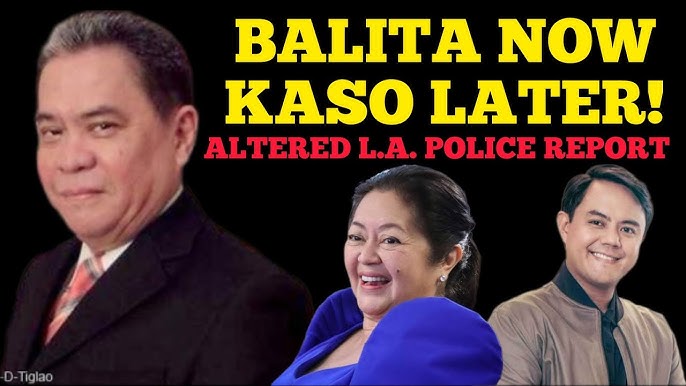
So why the sudden buzz? Because a newspaper columnist known to be a Duterte trumpet very recently came out with an “exposé” claiming that, according to a report supposedly released by the Beverly Hills Police Department, First Lady Liza was among those interviewed by the police after Paolo Tantoco’s death. The BHPD subsequently declared the report to have been tampered with, pointing out that the portion implicating the First Lady had been tacked on.

But the “exposé” was touted as big news in DDS-land, proof of the veracity of which was the rattled haste with which the administration (1) trotted out a “whistleblower” in the lost sabungeros case, followed by divers dramatically fishing out sacks of bones (with the Atong Ang-Gretchen Barretto angle as a saucy aside); and (2) exhumed the long-dead issue of Defense Secretary Gilberto Teodoro’s Maltese passport, which he had long surrendered. A timeline put out on YouTube by a Duterte publicist “proved” that after every iteration of the “Tantoco-FL” case, a “diversion” engineered by Malacañang immediately ensued, starting with the death itself, followed by the sensational arrest of Rodrigo Duterte and his quick deportation to the Hague for trial by the ICC.

In short, a lot of labor has gone into this conspiracy theory which would have us believe that PRRD was whisked off to the Netherlands, that the lost cockfighters were suddenly found, and that Gibo Teodoro’s loyalties are questionable—just to deflect attention from the real and the most important story (since shown to be fake) that the First Lady was somehow involved in the death of a prominent Filipino family scion. It would be the cover-up of the (21st) century for Pinoys, if true—and a mountain of poop to swallow, which many of the DDS faithful apparently have no difficulty ingesting. And not just them, either—I’ve heard the “Cover-up! Cover-up!” line being echoed by some of my liberal friends.

My own pedestrian take is, so what if FL were somehow involved in the Tantoco case, nefariously or otherwise? So what if Malacañang panicked and sought to quash the news by thinking of gimmicks to overshadow it? Rodrigo Duterte still needed to be shipped off to the Hague to face justice, and he was. The missing sabungeros, more than a hundred of them, still need to be found, and they may have been. If good results come out of shady decisions, I’m thankful they did.

But let me try on that same conspiratorial hat that seems so fetching on DDS heads. It’s a loose fit on mine, but reflecting on these matters like a true conspiracist, where do you suppose all these feeds are coming from, and why? Who stands to benefit from all this disinformation, and has the wherewithal to support a network of trolls, columnists, and “political analysts” all trying to divert public attention from what should be the biggest political story of the moment—VP Sara’s impending impeachment case—to some fake cover-up? 

The Dutertes stand to benefit, of course, but the impish fictionist in me says the hand of a larger patron can’t be discounted—particularly when you factor in the Gibo subplot, which concerns a possible presidential candidate who has been very vocal in his criticism of a northern bully. (The operatives peddling the “distraction” story, not incidentally, are the same people who keep reminding us that we asked to be bullied by filing that frivolous and unfriendly suit laying claim to our own territory.)

But of course I could be overthinking, which then again becomes any aspiring and self-respecting conspiracy theorist. I’ll get the hang of it, one of these days. 

 Maybe I’ll begin with the “traitorous” tandem of Bam and Kiko—as they’re now being made out to be even by some of their staunchest supporters—signing up with the Senate majority to worm their way into DDS hearts, so maybe one of them could be Sara’s running mate in 2028 under a broad anti-Marcos alliance. Wild? Can anything run too wild in the Pinoy’s fevered political imagination?

(Image from YouTube)

Qwertyman No. 154: Politics as Melodrama

Qwertyman for Monday, July 14, 2025

I’VE OFTEN argued that our most popular literary form isn’t lyric poetry, the short story, and certainly not the novel—it’s theater, and more specifically melodrama. Born in the West in the 18th century, melodrama weaves its spell on a suggestible audience through sensational and often ridiculous plots, exaggerated action, overblown emotion, and contrived solutions—all of which viewers happily lap up, and come back looking for more. When you think about it, it also happens to describe our politics, but more on that later.

I used to bring up melodrama when I taught playwriting and screenwriting, by way of analyzing how our Filipino sense of drama works. You don’t have to be a theater scholar or critic to observe that we Pinoys love drama, which to us really means melodrama, whether onstage, onscreen, or in real life.

Subtlety and silence have never been our strongest suit. We like to shout, to scream, to declare, to explain—and to explain some more. Take, for example, our preferred methods of murder. In Hamlet, the villainous Claudius pours poison into the king’s, his brother’s, ear. In The Seventh Seal, a knight faces Death on the chessboard. That may have been thrilling for fans of Shakespeare and Ingmar Bergman—but terribly dull and anesthetic for our kind of crowd.

No, sir, we Pinoys like our killings obvious, loud, and emphatic. Poison in the ear is for sissies. We prefer knives because they mean business, are as personal as personal can get, and they produce a lot of cinematic blood. And it’s never enough to stab someone, certainly not from behind, which would be a complete waste of dramatic possibilities. We like to announce that we’re killing someone, and to explain the reasons why: “Hudas ka, Raymundo, niyurakan mo ang karangalan ng aming angkan, kaya’t tanggapin mo ngayon ang mariing higanti ng hustisya—heto’ng sa iyo!” But of course Raymundo has to have his moment, and must raise that inevitable question: “Ano’ng ibig mong sabihin?” Whereupon our hero launches into another lengthy explanation, to which Raymundo offers an impassioned rebuttal, all to no avail, as he is stabbed repeatedly to the accompaniment of further oaths and recriminations.

I used to think that this kind of talkativeness and effusive gesturing was invented by us, until I went to graduate school and realized that it was all over the place in Restoration drama, where the likes of John Dryden had his characters indulge in copious speechifying in the name of love and honor before killing everyone onstage. I suppose a similar trend seized the French and Spanish theater, and thereby later ours, in the zarzuelasmoromoros, and komedyas that provided us with both entertainment and education. The noisiness carried over to radio, and then to our movies, which never quite shook off the “Ano’ng ibig mong sabihin?” habit. 

And this brings us to our politics, which is not only full of sound and fury, of unbridled verbosity, but of plot twists that strain credulity and yet which manage to keep the audience on the edge of their seats, either roaring in rage, applauding in delight, laughing deliriously, or weeping in sorrow, depending on their persuasions.

The Duterte Saga, our biggest ongoing drama, is now in its fourth act—the Sara impeachment—after the Uniteam victory, the fallout, and the Digong arrest and banishment. A professional scriptwriter could not have done better than giving the VP lines like Sara’s vengeful vows, as the media reported: “I have talked to a person. I said, if I get killed, go kill BBM (Marcos), (First Lady) Liza Araneta, and (Speaker) Martin Romualdez. No joke. No joke,” Duterte said in the profanity-laden briefing. “I said, do not stop until you kill them and then he said yes.” Threatened with impeachment for that statement and for corruption, she said, “I truly want a trial because I want a bloodbath.”

To the uninitiated listener, a madwoman was merely frothing at the mouth, but to the theater-goer, she’s puffing up her feathers, going larger than life, saying outrageous things to define her character and stake out her space like a Maori dancing the haka. Her adversary, PBBM, is playing cool and coy, pretending to be occupied with work and a disinterested party in Sara’s undoing. And yet he whisks off her precious papa in the night to Scheveningen, provoking even more outbursts from the DDS faithful.

Now comes the tearful part. Melodrama moves from Olympian thunder to cloying tenderness, so our next scene, naturally, has Sara’s mom Elizabeth declaring that her estranged husband has been reduced in detention to “skin and bones.” But it’s all right, she says bravely. “And how is my son, acting Mayor Baste?” the Davao City mayor-in-exile asks in a dry croak. “He’s okay, too,” Elizabeth assures him. “His vice mayor is your grandson!” So but for the absent patriarch, all’s well in Duterteland—sort of.

Melodramas love subplots, so let’s introduce one: selling the Duterte house. Common-law wife Honeylet puts up a sign announcing the place for sale (“It’s too painful to sleep there all by myself,” she claims), but son Baste reportedly has the sign removed. Not so fast, VP Sara chimes in; Honeylet could sell her half of it but not her dad’s. Besides, where would Digong live when he returns from the Hague, if Honeylet sold the house? (Cue for hopeful, uplifting music, which tapers off into a melancholic minor key.) “Perhaps he could live with Mama Elizabeth again,” Sara muses. 

Ah, such poignant moments. No one’s been stabbed yet—expect a lot of that to happen, metaphorically, if and when the Senate finds its balls and starts the impeachment trial of VP Sara. What’s theater without traitors? Sen. Migz Zubiri has already thrown down the gauntlet by declaring the trial “a witch-hunt.” But Senator Migz, ano’ng ibig mong sabihin?

Penman No. 475: True Confessions

Penman for Sunday, July 13, 2025

AS A collector (make that a scavenger) of old books, manuscripts, and what the market generally calls “ephemera,” I inevitably come across material neither written by nor meant for kings and presidents, but rather pedestrians like myself with things to say, perhaps secrets to whisper, likely to no one but to God and posterity.

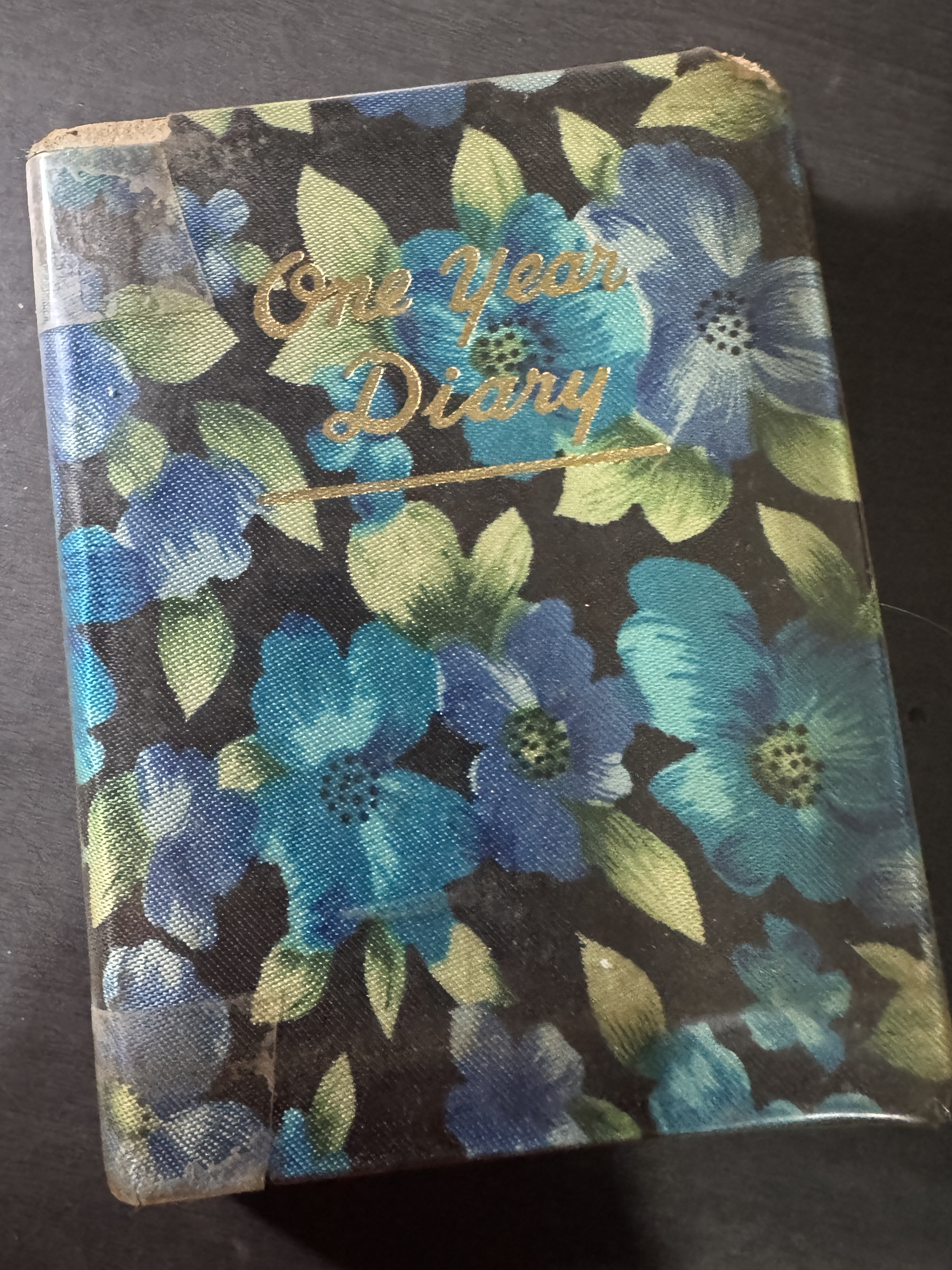
I’m talking about diaries and journals, which people of my generation used to do (and millennials are back to doing). Worse than a pack rat, I hoard other people’s memories, some in diaries that would make people turn in their graves to know I had. I come across these often as discards or stray items among people selling and buying old books, but I find them equally if not even more fascinating than published (and therefore sanitized) material.

Back then, before computers and digital journals, New Year began with the purchase of a new diary, its pristine pages waiting to be filled with birthdays, appointments, expenses—and more interestingly, interjections of love, pain, joy, and grief, life’s highest and lowest moments. 

I myself kept diaries at one time, although the entries tended to peter out around March or April, when fatigue got the better of my enthusiasm. My most interesting one has to be my martial-law diary, which I rather presumptuously began as soon as I was thrown in prison at Fort Bonifacio; I say “presumptuously” because, at seventeen, I entertained the precious thought that somehow, someday, my juvenile musings would be worth something to someone other than my mother (I had yet to find a wife then). 

When the Italian Marxist Antonio Gramsci languished in a Fascist jail in the late 1920s, presumably between a meager breakfast and gazing out into the starless night, he penned lines like “The old world is dying, and the new world struggles to be born: now is the time of monsters.” He developed his theory of hegemony and held forth on the role of intellectuals in social change, published in his seminal Prison Notebooks.

My own teenage memoirs have survived, but instead of writing about the dominance of the ruling class or about harrowing details of torture and misery—which did happen to others—I chronicled the visits of the pretty young psychologists assigned by the military to interview us; of course we assumed they were spies, but that didn’t stop us from chatting with (more like staring at) them across a table that felt much too wide.

Indeed, for most of us more interested in the personal than the political (although arguably one will always be the other), the value of diaries lies in their true confessions, in their promise of intimacy and insight—along with, let’s admit it, the wicked thrill of voyeurism.

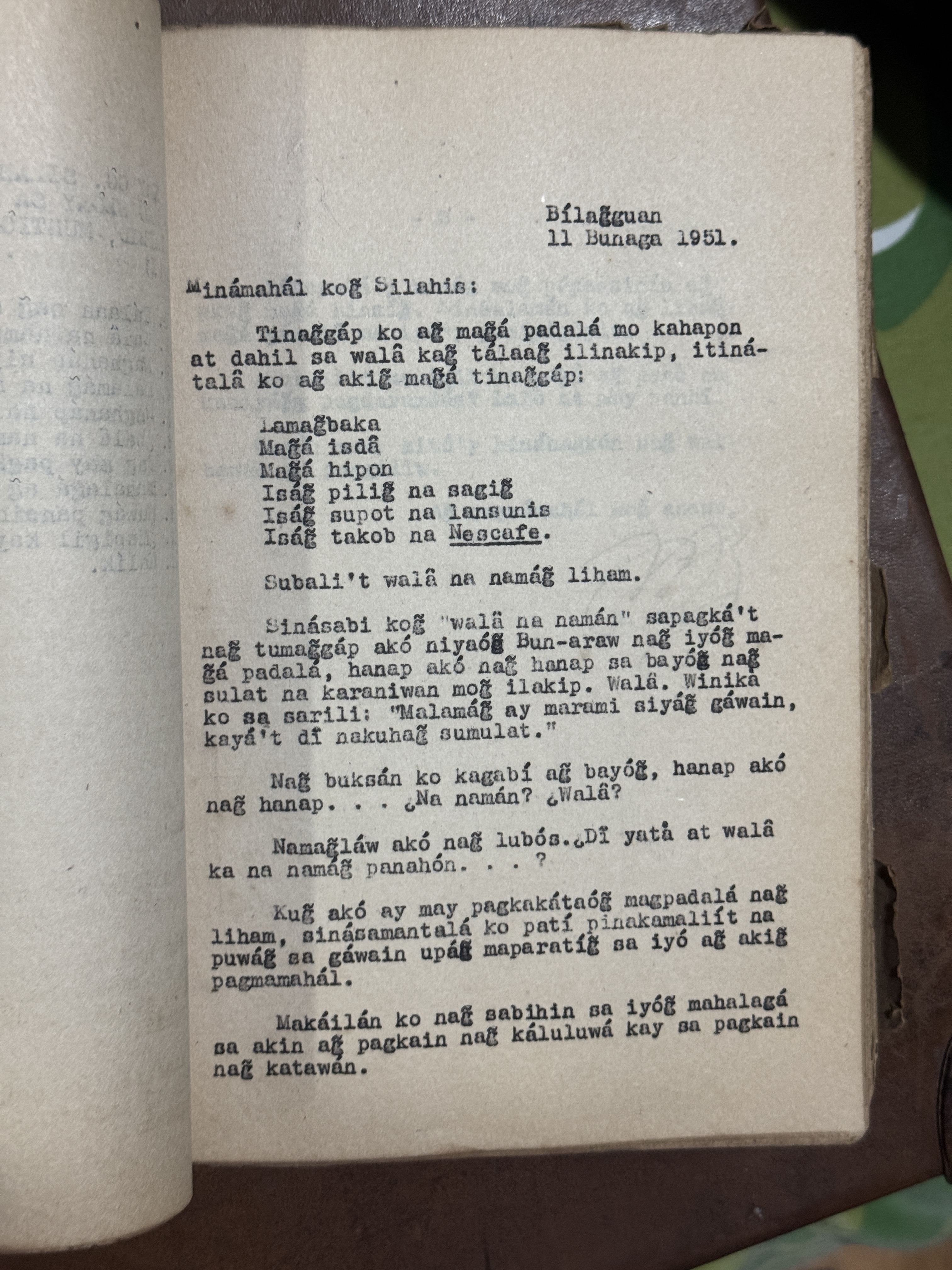
Among the most poignant of my inadvertent discoveries has been the diary—really more a scrapbook—of a once-famous and gifted writer (whose name I’ll leave out for now as he still has family around) who was imprisoned after the War for his stridently pro-Japanese sentiments and actions. In three languages, both typewritten and handwritten, he acknowledges receipt of his beloved’s supplemental rations—beef, fish, fruits, and coffee—but no letter yet again. “Nang buksan ko kagabi ang bayong, hanap ako nang hanap…. Na naman? Wala? Namanglaw ako nang lubos. Di yata at wala ka na naming panahon.” How many times do I have to tell you, he goes on to lament, that even for important to me than sustenance for my body is sustenance for my spirit?

I once came across a whole sheaf of journals in a ditch in front of our house, which I was inspecting because it had gotten clogged with what turned out to be a plastic bag full of papers. It had been carelessly thrown there by the home’s previous occupants or whoever cleaned it out—we had just moved in. They turned out to be the personal papers of a renowned UP professor, and as guilty as I felt about peeking into her life, I read a few pages, in which she confessed her admiration for a certain man (she lived and died a spinster)—only to remind herself, with what I could almost hear was a deep sigh of regret, that she considered herself wedded to God. I read no further, and decided to turn the papers over to a friend, a former and beloved student of hers who was the closest thing to a son.

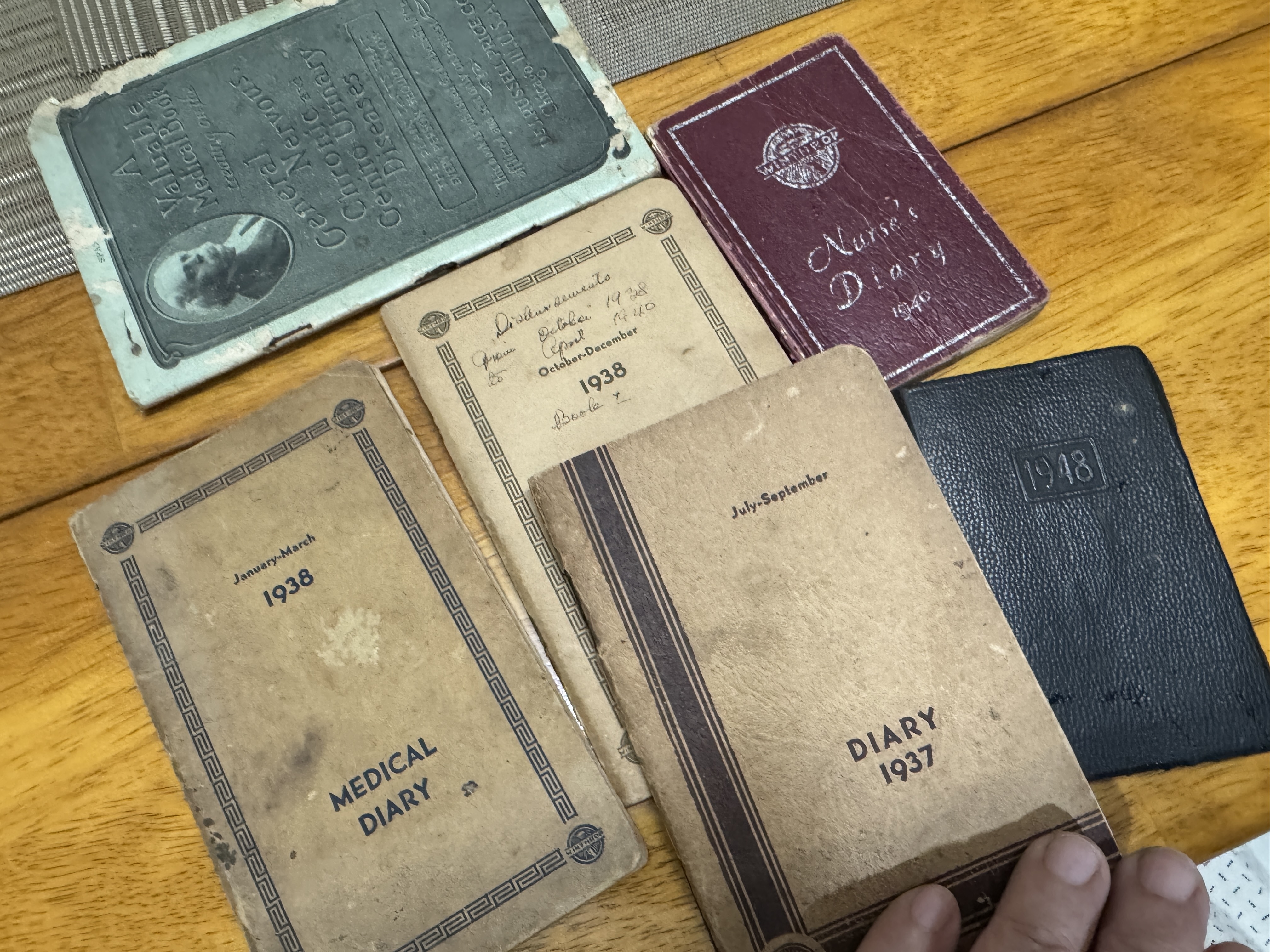
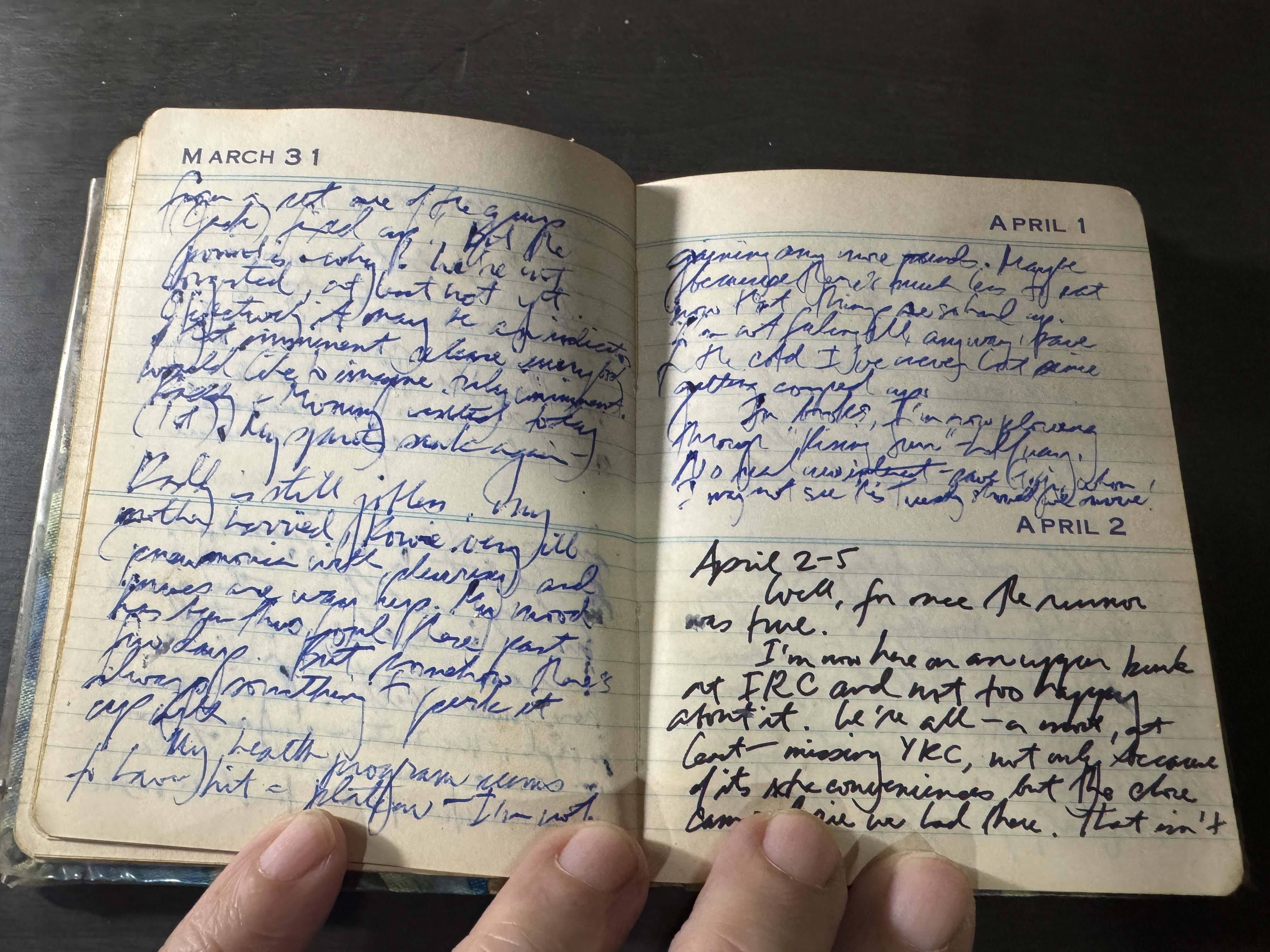
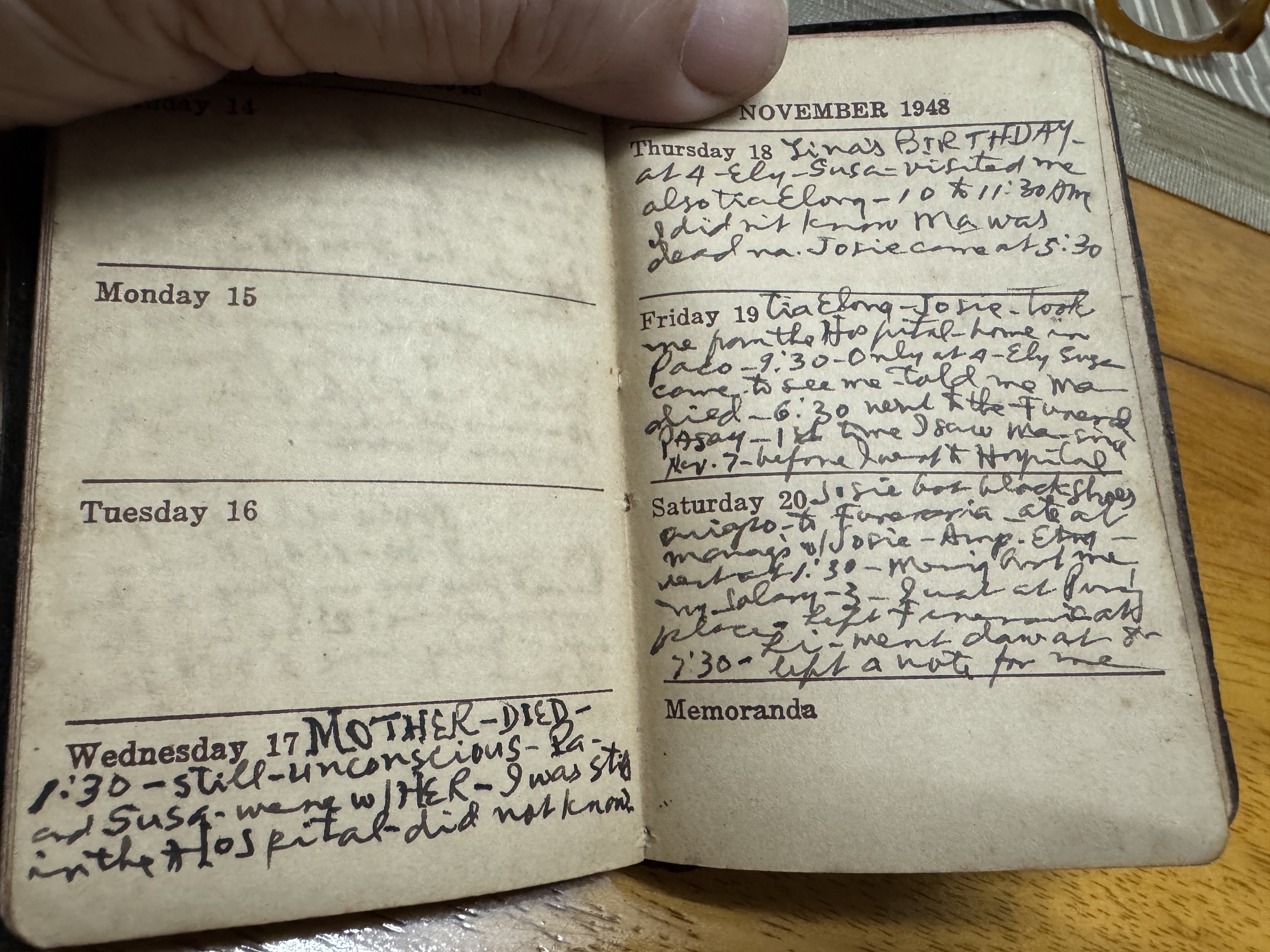
Most recently, some diaries from the late 1930s and 1940s came to me along with a medical book, and they contain nothing so revelatory, but the details of everyday life a,re always engrossing. They obviously belonged to a doctor—perhaps more than one—and while they contain medical marginalia they also carry legal notes, so the owner must have been studying to be a medico-legal person. Rather moving is the narrative in one diary of bringing a very sick mother to the hospital; I flipped a few pages and the inevitable entry appeared: “Mother died.” And there lay the stark helplessness of a doctor who could not save his own mother.

For many years now, the writer and presidential historian Manolo Quezon has been on top of an important enterprise called the Philippine Diary Project, a digitized compilation of diaries and memoirs from such notables as Jose Rizal, Ferdinand E. Marcos, Dean Worcester, and Emilio Aguinaldo all the way to the murdered activist Ericson Acosta (clearly more women need to be added to the roster).

“To me there are two holy grails,” Manolo told me. “The first is the diary of Gregorio H. Del Pilar. The diary of the American officer who led the expedition that killed him, Frederick Funston, exists but has yet to be transcribed. It was he, by all accounts, who pocketed del Pilar’s pocket diary; perhaps his papers will reveal them after a thorough search. The other is the diary of Benigno S. Aquino, Sr. The late Benito Legarda, Jr. told me that it was shown to him by one of the sisters of Ninoy, and that, in Spanish, it began, “I have been summoned to a meeting in Malacañan by the commanding general of the Japanese Military Administration…” The thing is, the last sister who had it, lost her memory and her children have not found the diary since.”

He adds that “A large portion of the Marcos diary is missing and anecdotally is said to be in the possession of a former member of his administration. For me though, what I’m seeking are diaries by Filipinos. Our own voices are woefully underrepresented. I think many were lost in Ondoy, many others have been thrown away, still more exist, but families are afraid people will take offense and so prefer to keep them secret.”

What I find from my own small collection is that whether they wrote in English or Tagalog, or used fountain pens or typewriters, our forebears recorded the smallest details such as “Auto repair 15.00” and “Won jai-alai 5-3 event.” Today we do all that with digital ink. I wonder what some digital pack rat will be remarking about us 50 years hence.

Qwertyman No. 153: Our Literary Fathers

Qwertyman for Monday, July 7, 2025

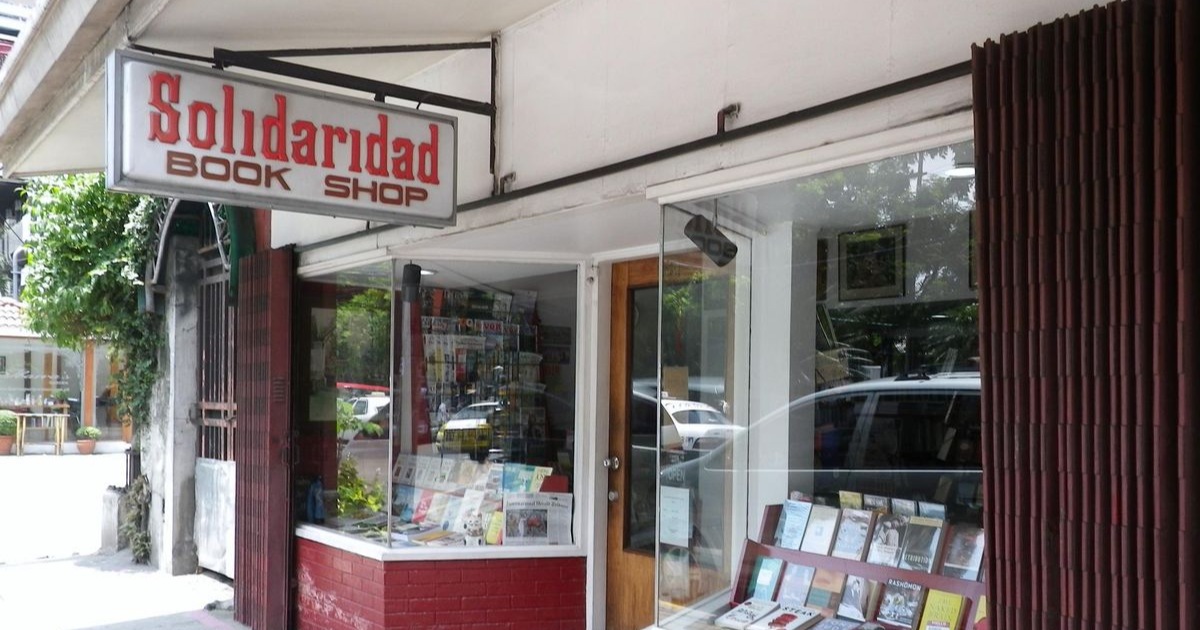
THE RECENT announcement of the impending sale of the Solidaridad bookshop in Ermita owned and run by the family of the late National Artist F. Sionil Jose understandably triggered a wave of nostalgia for the place, the old man, his dear wife Tessie, and for a bygone era when people strolled into book stores over their lunch break or after work to browse and pick up an Updike, a Le Guin, or a Garcia Marquez—and, of course, a Sionil Jose, and get it signed by the man himself if he was luckily around. Five decades ago, as a writer for the National Economic and Development Authority just a couple of blocks away on the same street, that browser would have been me, for whom Solidaridad and the equally legendary Erehwon nearby were a godsend, an unlisted perk. 

Indeed Solidaridad and FSJ (or Manong Frankie, as we his juniors called him) were inseparably conjoined in the public’s imagination of a man who was not only our most productive and best-known novelist but also an indefatigable purveyor of great literature and critical if occasionally controversial thinking, through his journal Solidarity and his long-running column “Hindsight,” this very space I was honored to have inherited.

Like many others—even those with whom he had quarreled fiercely—I was deeply saddened when Manong Frankie passed away three years ago. It was particularly bittersweet for me because we had become quite close in his last years, after having been somewhat estranged for the longest time. 

He had taken me under his wing on a writers’ conference in Bali in 1983, in a group of young, aspiring writers finding their way in a broadening literary world. But shortly after, in an interview with National Public Radio in America where I had gone to study, I offered my rather injudicious opinion of his prose—not mine alone—which he must have gotten wind of and found disparaging, because he gave me the cold shoulder afterwards. Like other younger writers, I would bristle at his hectoring moods—which I would better understand as I myself got older—during which he lamented the seeming alienation of the Filipino writer from his or her own social and political reality. 

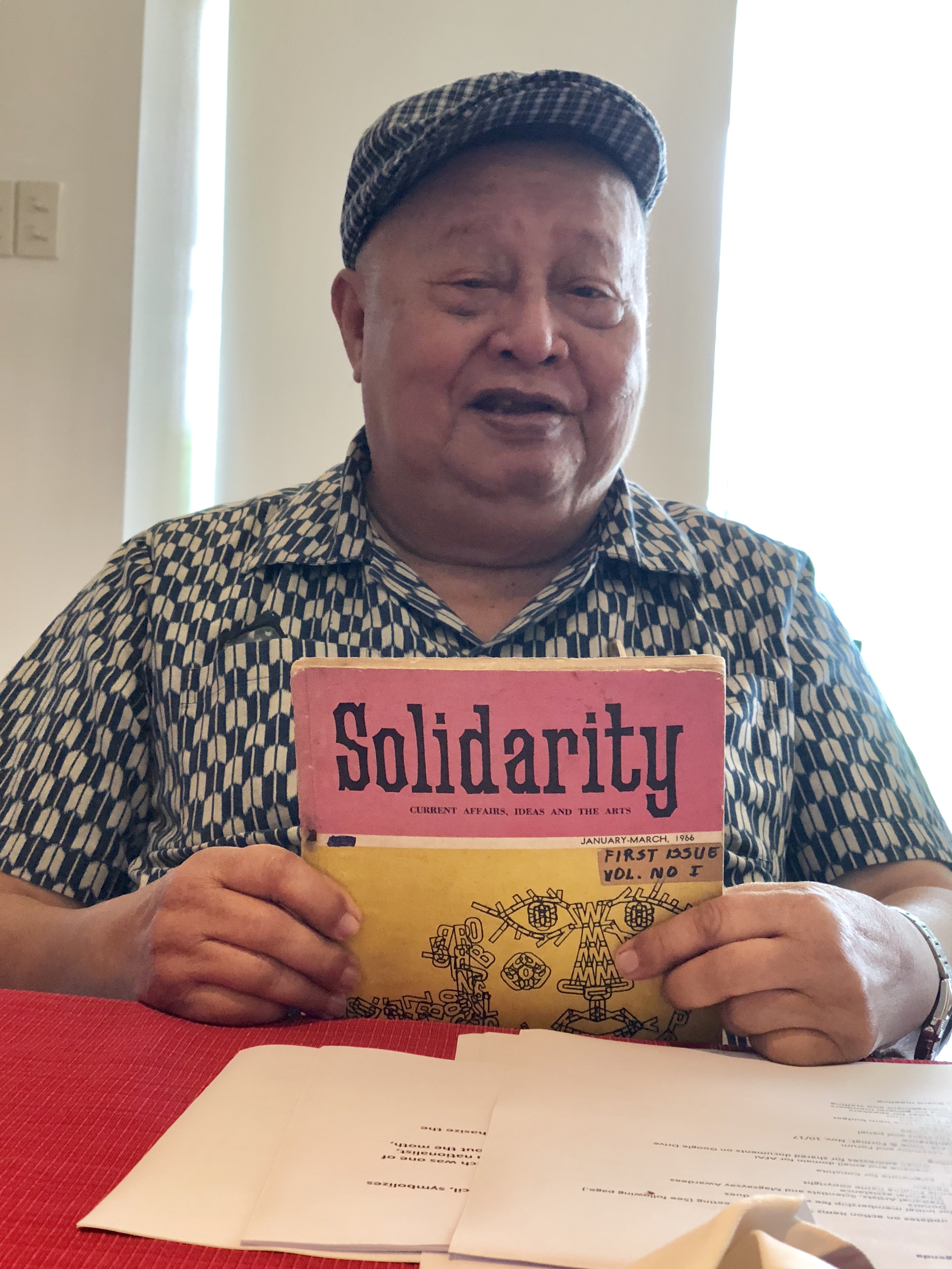
It was a concern we happened to share, and he began to know and appreciate me as someone who eschewed academic snobbery as much as he did, having transitioned to fiction from a background in journalism rather than the writers’ workshop system that he was deeply dubious of. In other words, we had more in common than each of us thought, and our work in the Akademyang Filipino brought us closer together. At one time I gifted him with the very first issue of Solidarity—Vol. I, No. 1—which I had found, and which he had not seen for ages; he was happy. After my speech at the Palancas in 2017, he came up to shake my hand.

Ironically, this happened at a time when FSJ, ever strongly opinionated, turned off many of his readers with his pro-Duterte sentiments, his putdowns of Nobel prizewinner Maria Ressa and others he thought undeserving of their fame, and his acerbic loathing of certain families he considered oligarchs despite their long having been supplanted by new and far more ravenous overlords. I did not share these views, and he knew that, but I think we had quietly decided that our friendship was more important than our politics. Shortly before he died, he sent me a brief letter that will be a cherished secret to keep until I myself pass on.

I didn’t learn writing from Manong Frankie; rather, I observed and admired his persistence and perseverance, literally writing to the last on what turned out to be his deathbed. I enjoyed his stories more than his novels, but in the end my own preferences don’t matter. He left a sprawling, robust, and indelible body of work that for many readers here and overseas will define Philippine literature in English for the latter 20th century. He led what our mutual friend the novelist Charlson Ong called “a well-managed life,” building a legacy partly through Solidaridad, Solidarity, and Philippine PEN which he led for a long time, apart of course from his work, and making sure he was heard when he spoke. 

His passing reminded me of the other members of his generation—his seniors and juniors by a decade or so—whom my generation in turn looked up to and at the same time, in that perpetual cycle of revolt and renewal, sought to depose. Nick Joaquin we adored as much for his prose as for his prodigious drinking (and seriously, for putting as much of his heart and craft into his journalism as into his fiction). NVM Gonzalez, who happened to have been born in Romblon (and not in Mindoro as many think) several kilometers away and forty years ahead of me, had that common touch many citified writers lost. Edilberto Tiempo I owe for urging me to return to school and devote my life to studying and writing rather than to bureaucratic servitude. 

Bienvenido Santos, twinkly-eyed and gently smiling, was my favorite of them all in terms of the quietude but also the emotional resonance of his stories, so graceful and yet so powerful. If I were to think of a literary father, it would have been Franz Arcellana, whose work may have been so vastly different from mine and yet, as my mentor in school, was the one I sought to please, slipping my story drafts under his office door and praying for his approval. Gregorio Brillantes, the youngest of them and perhaps more properly belonging to the next generation along with Gemino Abad, has been my writing hero for his superlative technique and unfailing sense of character. All these men (and women as well, for whom a separate story should be told) have taught me and my peers much, not just about the craft of writing but just as importantly the writing life, this vocation of books and words we have ddevote ourselves to for the bliss and yet also often the anguish of finding meaning in life through language.

Manong Frankie has passed on and soon so will his fabled bookshop, but his words, as well as ours, now have a life of their own.