Penman No. 444: A San Diego Sojourn

Penman for Sunday, November 6, 2022
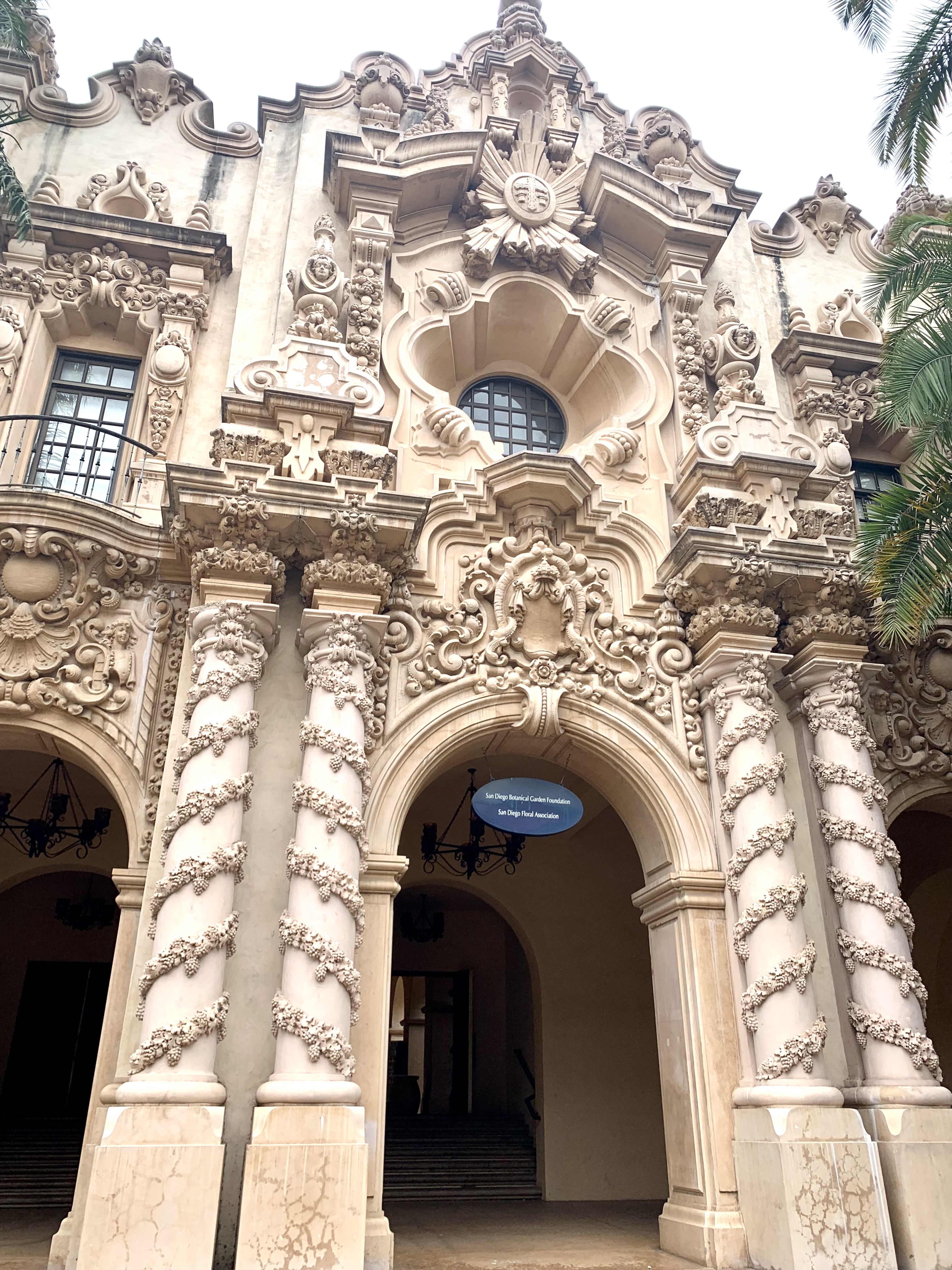
A FEW weeks ago, for the first time since the pandemic, my wife Beng and I took a plane out of the country, and I can’t tell you how liberating that felt after three years of being landbound. I’d had few complaints about the long lockdowns, because I’m used to working and writing in isolation, and have become much less sociable as I age. But I did miss the travel, the foreign air, the view from the other side of the ocean. 

Just before the pandemic hit, Beng and I had spent my first year in retirement (and a good chunk of my retirement kitty) gallivanting around seven countries, against the advice of family and friends who thought that we were overdoing it; perhaps we were, but now we know that the world we saw then will never be the same again, and that we ourselves—in or approaching our seventies—will never be able to do that again. And so it was with a huge sigh of relief that we boarded our flight to San Diego, where our daughter Demi has been living with her husband Jerry for the past 15 years. We’d visited San Diego often before, but probably not with this much anticipation, having been away for years. 

Sitting on the Mexican border, San Diego isn’t the first place most Filipinos would choose when they think of visiting America, unless, like us, they have personal reasons to go there. Los Angeles and San Francisco seem to be more exciting places, have large Fil-Am communities, and have long been the ports of entry for Pinoys landing on the West Coast. (Our Japan Airlines flight was that rare straight flight via Tokyo to San Diego.) But San Diego has its own charm and its own attractions, most notably Balboa Park, the San Diego Zoo, and Comic-Con, that annual extravaganza of pop culture that draws about 150,000 fans from around the galaxy. (Much to my young students’ chagrin, I’ve been to Comic-Con twice, happily ignorant of much of what I was looking at.) 

And whether you’ve lived there for decades or are just passing through, San Diego will always give you a taste of home, with dozens of Pinoy foods stores and restaurants, especially in National City and Chula Vista where you can shop at Seafood City for daing na bangus and Chocnut and at Goldilocks for your party cake while dropping packages off at LBC—or you can run to Mira Mesa for your Jollibee fix. (For me, an American sojourn would be incomplete without a trip to Arby’s and Red Lobster.)

Inevitably San Diego also has its own spotted history of East-West relations, in which Filipinos have figured; the better part of that history was celebrated last month as Filipino-American Heritage Month in the city. The worst part remains in the archives, in the memories of early immigrants such as Emeterio Reyes, who recalls that “I asked the driver if he could take me to a Catholic church. As soon as we got there, I told him to wait for me because I had a funny feeling I might not be welcome at this church. As I entered the door, a priest approached me and told me that the church was only for white people. That moment, I wanted to cry and die!” 

When Sebastian Vizcaino sailed into what he would name San Diego Bay on November 10, 1602, he found that he had “arrived at a port which must be the best to be found in all the South Sea, for, besides being protected on all sides and having good anchorage, it is in latitude 33½o. It has very good wood and water, many fish of all kinds, many of which we caught with seine and hooks. On the land there is much game, such as rabbits, hares, deer, very large quail, royal ducks, thrushes, and many other birds. On the 12th of the said month, which was the day of the glorious San Diego, the general, admiral, religious, captains, ensigns, and almost all the men went ashore. A hut was built and mass was said in celebration of the feast of Señor San Diego.”

As a major port facing the Pacific, San Diego has long been home to the US Navy’s Pacific Fleet, its base harboring over 50 ships. The naval presence defines much of San Diego’s character, and provides a good part of the reason why about 200,000 Filipino-Americans live there today. Since early in the American occupation, Filipinos have signed up with the US Navy as their passport to what they hoped would be a better life and to a bit of adventure. 

I just learned, for example, that the first Filipino to have joined the US Navy, back in 1903, was a seminarian in Manila named Potenciano Parel who snuck out of his vows to be a sailor, but not having the right papers, he used those of a friend and assumed his identity, Tomas Dolopo; the Dolopos continue to be San Diegans. Demi’s late father-in-law, Ric Ricario, joined in 1957; his eldest son, Ray, followed him into the Navy; Ray’s brother Jerry met and married Demi. And so we find ourselves now tied by blood to that long tradition, as did many thousands of others before us.

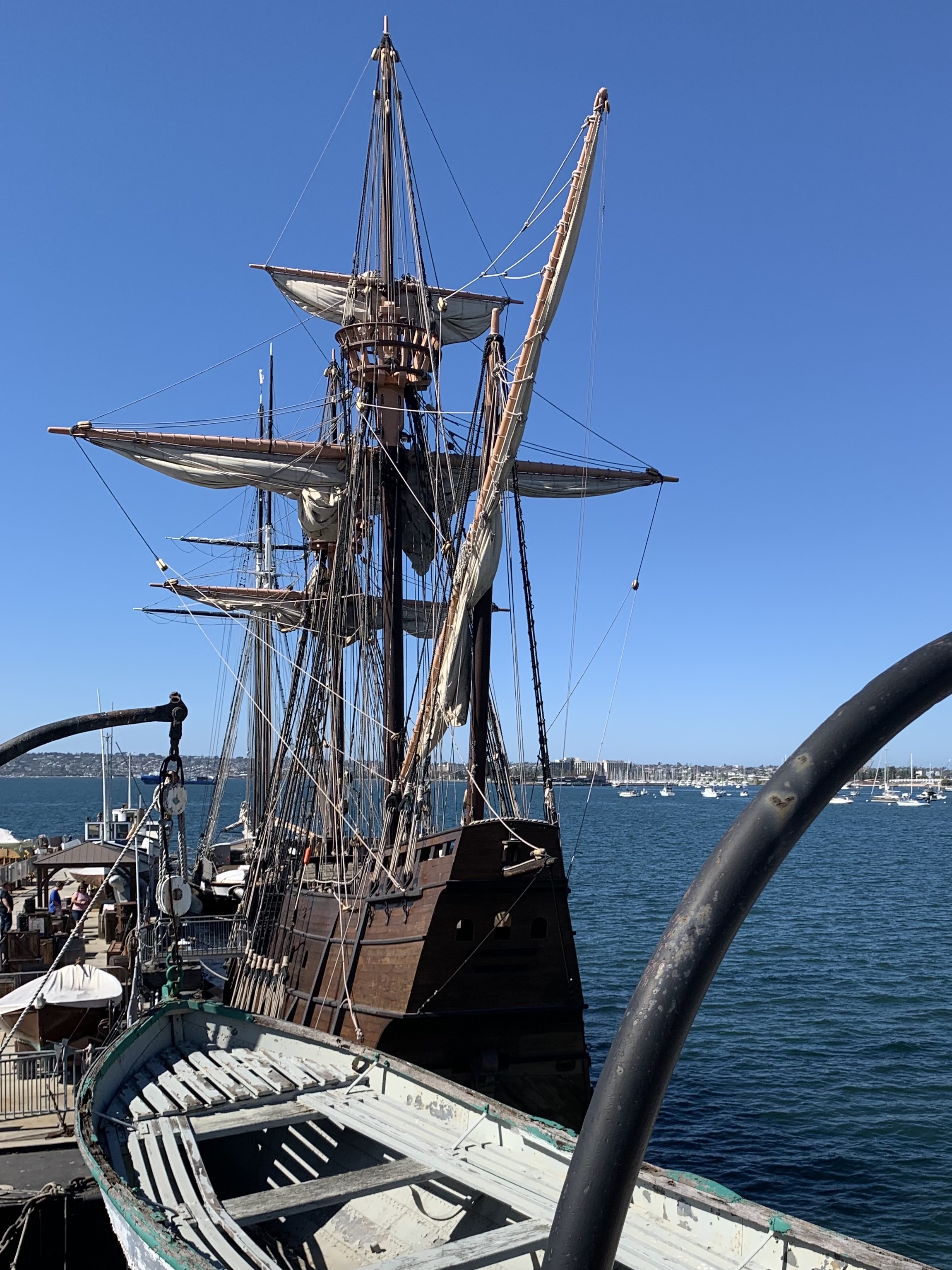
Despite having visited San Diego many times before, and having enjoyed its more popular attractions, we felt more acutely aware of history this time around. We finally stepped into the city’s Maritime Museum, a complex of many ships from various centuries that allows visitors a hands-on experience at traveling the world on water. The ships on display range from a full-size and fully functional replica of a Spanish galleon ca. 1542, the San Salvador, to the world’s oldest sailing ship, the grand, mid-1800s Star of India, to a ca. 1970s submarine that still holds the record for the deepest dive, the USS Dolphin. For just $15 for seniors and just slightly more for others, you can hop from one ship to another, and imagine what it was like to cross a tempestuous ocean with only the stars to light the way and nothing to eat but stale bread and salted pork. 
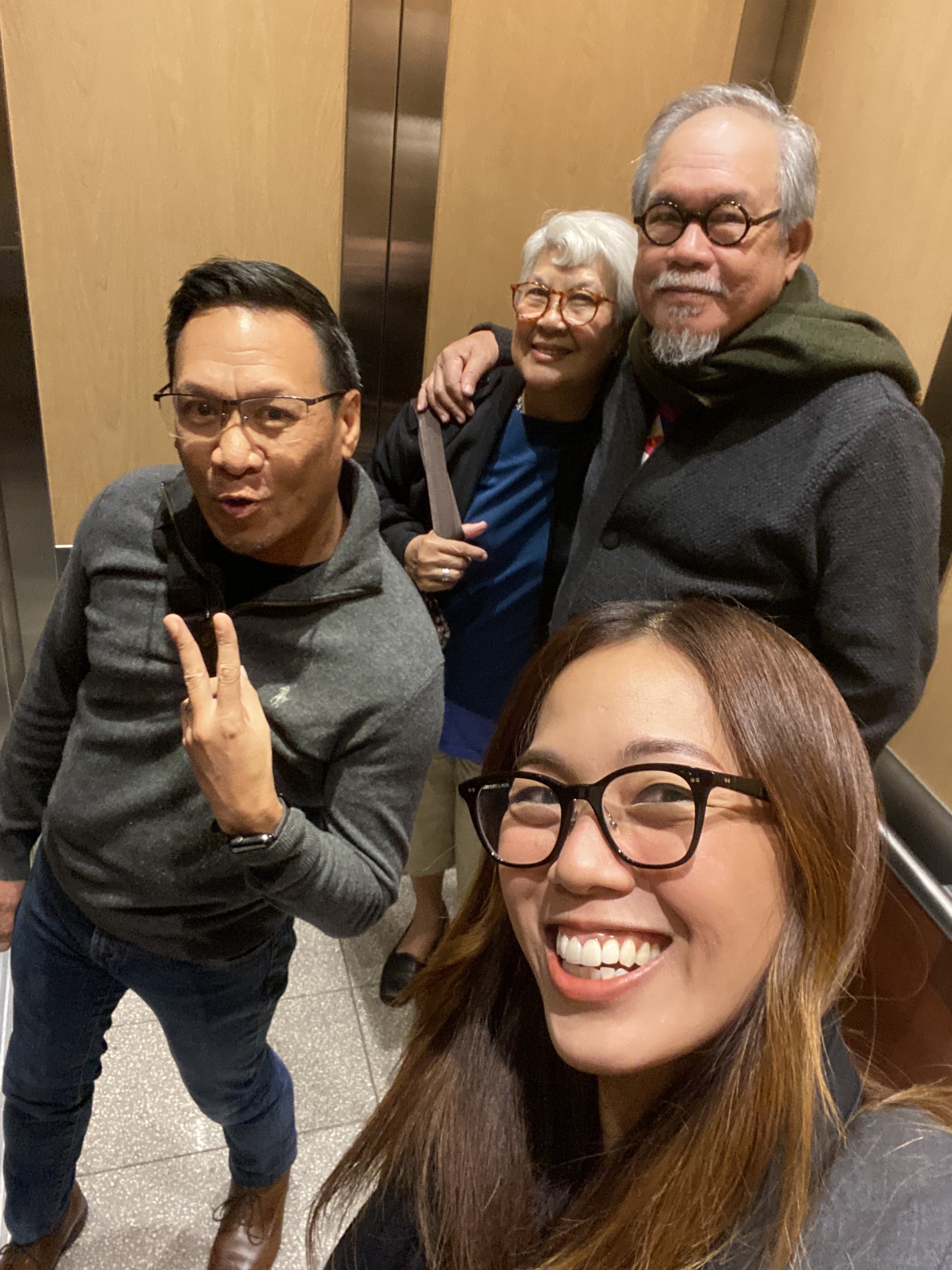
We enjoyed history of another kind by having dinner with our in-laws in a National City dive that our son-in-law Jerry chose for its unique ambience, which you can either call seedy or loaded with character. (There was a famous sailor’s bar in the area called the Trophy Lounge, Jerry told us, that used to be run by ladies from Olongapo…. But that’s another story, and San Diego has books of them, yet to be told.) La Maze is the kind of leatherbound ‘50s restaurant that the Rat Pack and other Hollywood celebrities frequented when in San Diego, and you can still order the same great steaks they had. A local band played dance music, and to the tune of “Solamente Una Vez,” I took the pretty silver-haired fox next to me to the floor and slow-dragged the night away. 

Penman No. 443: A Hairy Experiment

Penman for Sunday, October 2, 2022

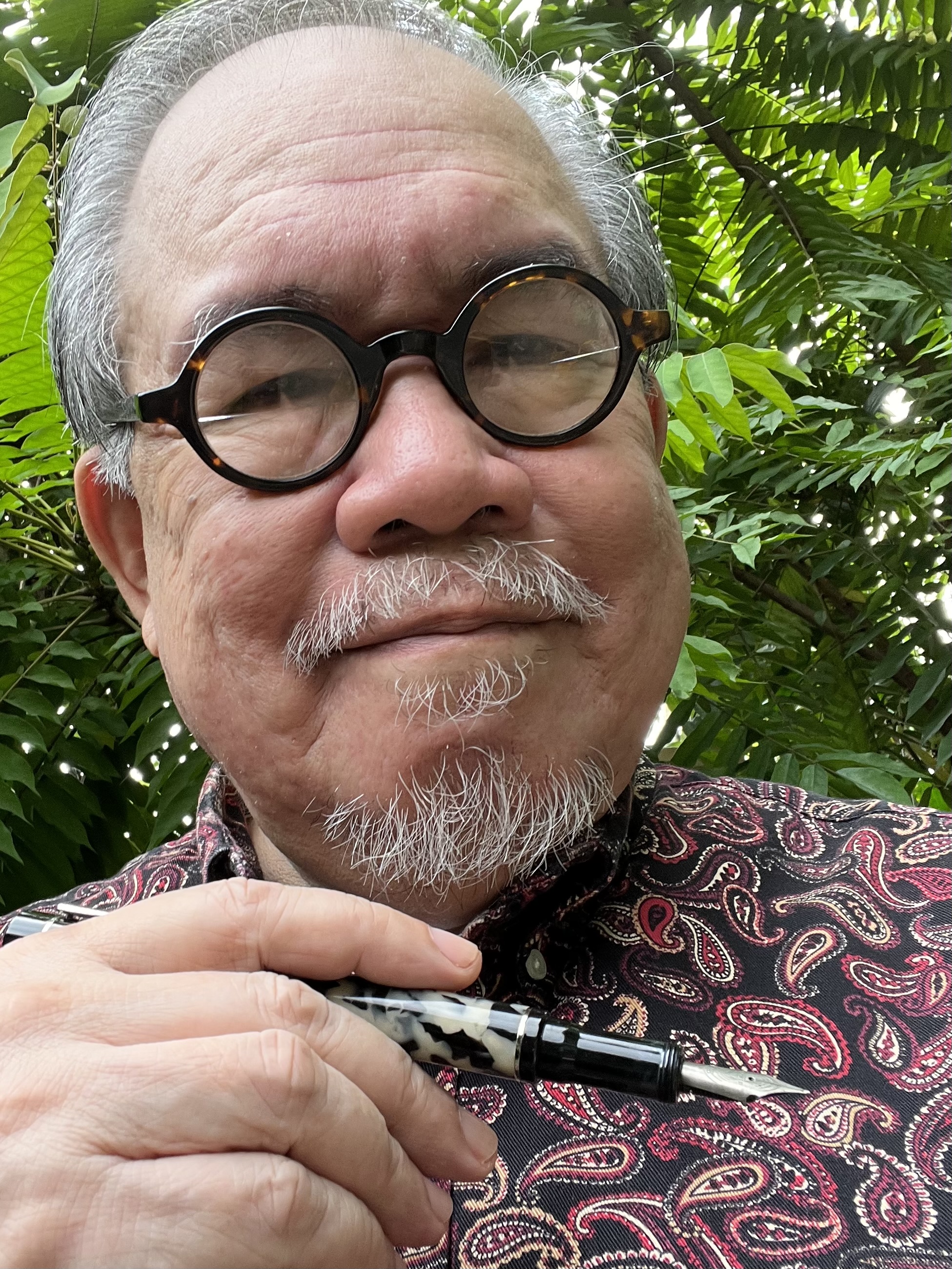
FOR THE first time in my 68 years, I tried something new these past two months: grow a mustache and a beard. It began when Beng caught Covid—thankfully the rather benign Omicron variety—and I followed suit, which required us to self-isolate for at least a week. Either out of laziness or perhaps to give some purpose to my enforced enclosure, I didn’t shave until I woke up one morning to find some whiskers germinating on my upper lip and chin, and decided to wait some more. 

No one in my family has ever sported facial hair, for good reason—our forefathers must have been chasing wild goats in the forest when they handed out genes for abundant hair. They got home just in time to catch some scraps, which was why my two brothers and I enjoyed luxuriant mops on our tops in our younger days, only to lose much of it to male-pattern baldness in our senior years. We grow hairy chests and bristly forearms only in our deepest sleep—in other words, we morph into Tom Selleck (or maybe Chewbacca)—and wake up to the pathetic reality of a pimple forming right where a respectable thicket’s supposed to be.

Much to my surprise, a perceptible fuzz did grow around my mouth, and for a minute back there I entertained the possibility of doing a Hemingway (for which I already have the girth), until I had to accept the fact that the Lord was already being exceedingly generous in making me feel like Johnny Depp for a day (hey, we even have the same initials). 

It was nothing to crow about (a Facebook friend admitted to shaving off his incipient mustache when someone remarked that “I have more hair around my anus”), but I was happy. I looked different, and—okay—I felt just a bit different, maybe a tad more writerly, as if anything coming out of my mouth was going to sound like godly wisdom. It was comforting to know that while I’m never going to grow a mohawk on top, I can still go bald and whiskered, Yoda-like. Additionally, I thought that Beng would be tickled and thrilled to be kissed by a new man in her life (tickled, yes, thrilled, no).

All this has led me to explore the history of the mustache (“moustache” is its British version). The BBC’s “The Moustache: A Hairy History” gives a fascinating account of the ups and downs of facial hair (and even a new word: “pogonotrophy,” the art of its cultivation). The highlights include Peter the Great’s “beard tax,” which led to shaved chins and flowery mustaches; Lord Byron’s preference for the pencil-thin trim; the association of bushy beards with bacteria, and the subsequent falling out of fashion of the hirsute look (also, World War I gas masks didn’t work with grizzly faces); the resurgence of the handlebar mustache (strictly no beards) postwar; and the now-popular “Movember” charity event in November, for which men grow mustaches to raise awareness of men’s health issues (a most noble excuse, to my mind).

Since Samson established the link between hair and testosterone, mustaches and beards have also implied more masculinity, about which The Gentleman’s Journal has an interesting story. When the British colonized India, the native men—who brandished their mustaches like scimitars—looked down on their clean-shaven sahibs as wimps, forcing the white masters to grow their own, and bringing the fashion back to England with them. (The e-zine also offered up this etymology: “‘Mastax’, a Greek word, was stolen by the Scottish and turned into ‘Mystax’, with both meaning ‘jaws, mouth or lips’. The Medieval Greeks took the word back, and that ‘Moustakion’ grew out into the Italian ‘Mostaccio’ — before the French combed it into submission, giving us ‘Moustache’ around 1580, with a final definition of: ‘The hair that grows on the upper lip of men’.”)

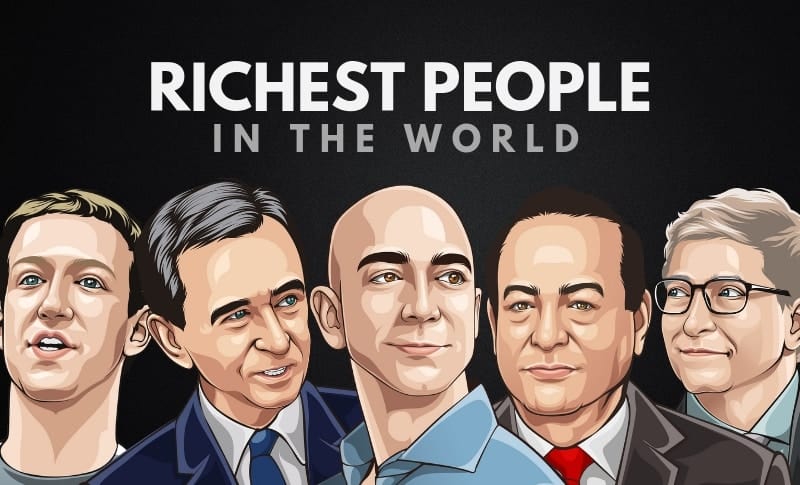
The history of beards seems just as complicated; at one point, says Beardpilot, you could pay off a debt with your beard. Ancient societies punished erring men by cutting off their beards. In the Middle Ages, touching someone else’s beard could be cause for a duel. Before Peter the Great, Henry VIII and Elizabeth I also taxed beards. Of course, wherever you went, hair on your face meant virility and wisdom. What it did not guarantee was money, if one recent survey is to be believed, claiming that “Ninety-eight percent of the men on the Forbes 100 list of the world’s richest individuals are clean-shaven.”

Me, I’d rather be wise than virile at 68 (and should I say wealthy rather than wise?), but I’m just trying to get used to feeling something furry and sometimes wet beneath my nose, especially when I’m slurping soup or sneezing. I’ve learned to trim what passes for a mustache where I can touch it with my tongue, and to snip off vagabond whiskers from my scraggly beard. Beng seems indifferent to my experiment, in fair exchange for me not saying anything untoward about her pixie cut (I miss her bangs). I told our apu-apuhan Buboy that his Tatay Butch was going to be a pirate, but he appears unimpressed; I’m not menacing enough, needing to put more growl into my act. I hope Demi agrees that the bearded-guru effect makes her dad look smarter than he is.

One of these days I’m sure I’ll say that I’ve had enough, and reach for a razor—but not just yet. I’m just getting the hang of pogonotrophy, and while I guess I’m never going to be as shaggy as a Wookiee, I’d like to have fun playing Johnny Depp just a little bit longer, before the dementia gets real.

Qwertyman No. 8: The Secret

(Photo from dreamstime.com)

Qwertyman for Monday, September 26, 2022

“LOLO, LOLO, was martial law really bad? We took it up in class today!”

“Bad? Said who?”

“Our teacher, Ms. Landicho. She said that awful things happened back then that people have forgotten about.”

“How old is this—Ms. Landicho?”

“Oh, maybe in her thirties? She’s just about to be married—to Mr. Arnaldo, our Physics teacher! We’d been teasing her about it for months!”

“In her thirties? Then how would she know what the heck happened under martial law? She wasn’t even born then.”

“Were you around then, Lolo?”

“Of course I was. I’m seventy-three now, so fifty years ago I was a young man. I had just left my first job because my boss was a tyrant! So I moved to another bank and that’s where I met your Lola Auring, whom I would marry two years later. If I hadn’t made that move, you wouldn’t be here!”

“Was that the bank you now own?”

“The bank we own, hijo! That’s why I want you to go to Wharton after college. I’ll be there for your graduation, and then I’ll give you the keys to that Mercedes G you’ve always wanted—”

“Really, Lolo? But that’s at least ten years away! Golly, a Mercedes G….”

“I remember, my first car was a used and beat-up Datsun Bluebird that your Lola Auring wouldn’t even step into until I got it fixed, because the door kept opening on her side, hahaha! I spent half-a-month’s salary just replacing that door. Oh, the things we went through….”

“Ms. Landicho said her lolo died under martial law….”

“So? So did a lot of people. People die all the time—of heart attacks, diabetes, even slipping in the bathroom can kill you, like my friend Pepito—”

“She said her lolo was arrested by the soldiers, and then they tortured him and dumped his body under the mango trees in Cavite.”

“Well—he must have done something to deserve that. You go against the government, what do you expect? There was a war with the communists going on. War is ugly, wherever you go. Was that was your teacher said about martial law being bad? Did she also say how many crimes and strikes were averted, how clean, peaceful, and orderly everything was, with people following the law?”

“She said her lolo did nothing wrong—”

“Of course she’d say that. Nobody’s lolo does anything wrong—right, hijo? Haha.”

“Yes, Lolo!”

“I did all the right things. I stayed out of trouble, focused on getting my life and my future together, on raising my family and raising my income. And then I went into business for myself, so nobody could boss me around. I showed everyone what I was capable of. I didn’t care about what everybody else was doing. You listen well, hijo. In this world, you take care of yourself first, and then your family next. If you can’t take care of yourself, you can’t take care of your family.”

“You’ve always taken good care of us, Lolo. Papa always tells me, if not for you, I’d be taking the bus or the jeep to a public school—”

“Like I had to, at your age! We were poor as rats and sometimes I went to school with nothing but gas in my stomach. I made sure your papa never went through that. That’s why I had to succeed.”

“Mama also says that if not for the President, you wouldn’t have succeeded. She says that you worked for people who worked for the President—”

“Is that what she said? I have to talk to your mother one of these days. There’s a lot that woman will never understand. There’s a lot that women will never understand. What you have to do to keep yourself and your family afloat. Instead of gratitude, you get questions, questions, questions—”

“What did you do for the President, Lolo? I want to know! Was it a big job, a secret mission, something nobody else could do?”

“Well, I guess you could say, all of the above! Remember, I was still a very young man. But I realized—and my bosses did, too—that I was very good with numbers. And secrets! They could trust me with their lives. But shhhhhh, don’t tell anyone!”

“Like what kind of secrets, Lolo?”

“If I told you, then it wouldn’t be a secret anymore, would it?”

“Awww, Lolo, I promise not to tell anyone! You can trust me—like they trusted you!”

“Well…. All right. Since it’s been a long time and since the President himself is gone, I suppose I can share a secret with you—but just one secret, okay? And this will remain a secret between the two of us—never tell your mama or papa.”

“Okay! Cross my heart and hope to die! What’s the secret, Lolo?”

“I… took… care… of… the… President’s… money. There was a lot of it. I had to collect it and send it safely abroad.”

“Why you? Did you carry it in a bag? Couldn’t the Air Force or the Navy do that?”

“Hahaha, it’s not that simple, hijo, a 747 wouldn’t have been enough to carry everything! He had to keep it abroad because—there were bad people here who were after it. So I was sent on secret missions to make sure everything was okay…. I went to Hong Kong, to the United States, to Switzerland. I loved Switzerland most of all—oh, to be in my thirties again and to watch the fountain at Lake Geneva at sunset. Le Jet d’Eau est tres beau!”

“So that’s where you learned French!”

Juste un peu, mon garçon! If she were still here, I would have loved to take your Lola Auring there again. You must go to Geneva—after Wharton!”

“Lolo—Ms. Landicho said—she said the President stole a lot of money—”

“Wha—I pay so much for that school and they tell you this? Your teacher keeps saying things she knows nothing about! I was there! I saw no stealing! And let me tell you something—even if I did, presuming I did, it was none of my business. Making money was his business, keeping it safe was mine. That’s called compartmentalization. Remember that word—compartmentalization! You put everything in its box, just worry about the things you should worry about, and you’ll be all right. Understood? Comprenez vous?”

“Yes, Lolo…. So I’ll put the lolo I know in one box, and then my secret lolo in another box….”

“They’re one and the same person.”

“That, Lolo, will be my secret.”

Hindsight No. 20: Mindfulness and Memory

Hindsight for May 30, 2022

(Photo from toolshero.com)

WHEN I I unexpectedly slipped into a black pool of anxiety and depression a couple of years ago—another unwitting casualty of the pandemic—I learned a new word from my psychiatrist: “mindfulness,” defined as “the basic human ability to be fully present, aware of where we are and what we’re doing, and not overly reactive or overwhelmed by what’s going on around us.” 

It’s a therapeutic technique to keep your mind from straying into dark forests and crevices, focusing instead on the pen in your hand or the chunk of melon you’re about to swallow. Accompanied by meditation and measured breathing, it slows and calms you down just long enough for you to understand that you’re alive, you’re safe, and you will be well. It puts you back in control of your runaway thoughts and emotions, giving you back the composure you need to face your problems for the day.

It works. Of course I still take my nightly dose of sertraline (your doctor might prescribe something else; don’t take my word for it), but even just the awareness that you can, on your own, stake out a little zone of peace and quiet around yourself is liberating. Paradoxically, it allows you to deal with the stress of the moment by putting you in the moment. It’s the anticipation of terrible things about to happen—especially bad for imaginative minds—that brings on the fear and anxiety. Mindfulness snaps you back from that bungee jump to despair.

I thought about this last week as I encountered many friends online still in shock and grief over their electoral loss, brimming with agitation over what political atrocities could be forthcoming, and eager to begin the campaign for 2028 pronto. The trolls are gleefully feeding this anguish: one prayed that VP Leni’s plane would crash, another declared all Kakampinks “enemies of the state” who deserve to be hunted down, and yet another—despite doing it herself—faulted the Robredos for the crime of taking graduation pictures. 

When I realize that this is the world we now live in, roiling with nastiness, idiocy, and barbarity, I feel like reaching for something stronger than Zoloft to ward off the bad vibes (I also have a prescription for Xanor, but haven’t touched it for a year). But then I remember the old Jedi mindfulness trick, take a few deep abdominal breaths, think about places the ogres can’t reach, and soon enough I’m functional again, capable of absorbing the absurdities and ironies of the hour.

One more thing about mindfulness: it works well with daydreaming of the positive and wishful kind. The writer Sam Brinson quotes the psychologist Scott Barry Kaufman: “A wandering mind is more creative, better at future planning and goal-driven thought, and helps with memory consolidation.” Kaufman argues for a balance between focusing your thoughts and letting them stray, which is relaxing, and a relaxed mind is better at making creative connections.

I don’t know if you could call it daydreaming, but lately my mind has drifted back to my own “golden era”—a time when things felt good and I felt good, when the country was in a bouncy mood and seemed to be going in the right direction: the mid- to late 1990s, the FVR years. We had a lot of problems—a rash of brownouts among them—but you could sniff the optimism in the air. (Full disclosure: I was one of FVR’s speechwriters, so it’s possible that I drank the Kool-Aid and fell for my own prose.) 

Beng and I got ourselves a decidedly downscale apartment close to West Avenue where huge rats scurried overhead at night, and we bought our food from the talipapa down the street. Having brought up that memory, I realize that we like thinking and talking about the past mainly for the fact that it’s over, it already happened, which means that whatever it was, we survived, presumably for the better. I’m sure it wasn’t as rosy as I now make it out to be, and that I’m blocking out the less pleasant parts. But that’s the way the memory works, the way it protects us from pain and provides us with some sense of certainty, some clear point of reference, in these nebulous times.

Just recalling how it was ten, eleven years ago fills me with a combination of wistfulness and regret. It was a time when despots around the world—Egypt’s Mubarak, Libya’s Khaddafi, North Korea’s Kim Jong Il—were being toppled or dying; Donald Trump’s presidential ambitions were still something of a joke; China was being rocked by pro-democracy protests; and a new platform called Friendster made waves on the Internet, where there were still pockets of innocence and honesty to be found.

It was a time when people and politics still retained a modicum of civility and intelligence, when the truth was nothing but the truth, when human rights were not to be cursed or spat upon, when bad leaders got their due, and when God seemed to be awake most of the time, sending a bolt of lightning here and a swath of sunshine there. It was the world before Covid, when all our friends and loved ones were still alive and laughing over their beer and sisig, when face masks were for the sick, when people danced and even kissed and made love without fear. The future sounded like it would be a wonderful place; technology and human genius would make sure of it.

When I woke up last week to the news that 19 schoolchildren and two teachers had been massacred in Texas, I tried to imagine what a mother there must have felt, how she would have given her own life to turn back the clock just one day. I was only beginning to be inured to the savagery in Ukraine, and now I saw that it was always possible for evil to become even crueller. For a minute, the aches left by May 9 felt dull and trivial.

There are things that Zoloft will not banish, but I know that mindfulness and the memory of a saner past can give me the cool head and steady heart that I will need for the long fight. Bring it on; we will survive, if not prevail.

Hindsight No. 17: The True Winner

Hindsight for Monday, May 9, 2022

(Photo from lumina.com.ph)

I HAD another column all lined up for today—Monday, the 9th of May, arguably the most important Monday of this year if not the next six years. But I’d forgotten that the ban on electioneering, which started yesterday, won’t end until midnight tonight, so I’ll shelve that piece for another time—with major revisions likely, depending on the outcome of today’s vote.

Maybe it’s just as well that that happened. It forced me to pause and simmer down for a while, just when emotions and tempers were rising to a boiling point and nothing else seemed to matter but politics and the colors of our T-shirts.

I’m sure I’ll be speaking for many of us—and even across the political divide—when I recall that just a year ago, we all led what seemed to be normal lives, or at least as normal as lives could get under a crippling pandemic. We were in deathly fear of a virus we couldn’t see, of getting infected by some pasaway neighbor or relative, and of dying by our lonesome in a strange hospital ward with a tube stuck down our throat. Our chief concern was survival—as individuals, as families, as communities. We walked around like inter-galactic travelers in face shields and face masks, soaked in 70-percent alcohol, hands raw from constant washing. We felt lucky to be alive, never mind that the cinemas were closed, restaurant food was takeout-only, and we all became talking heads in little Zoom boxes. Today we can afford to chuckle a bit at the memory of those days, even if we know—or have to be reminded—that those days are far from over. 

But just as the influx of vaccines brought a steep drop in Covid rates, another contagion appeared on the horizon—election fever. Its symptoms included not only indifference to other diseases like Covid, manifest in the sudden and universal disregard for “social distancing.” They also showed in an increased propensity for loudness and even bellicosity in public discourse—especially online, where sticks and stones came free by the ton. The emergence of candidates and choices meant the emergence, as well, of our long-cherished biases and preferences. 

Our candidate defined who we were, and because of that, we took everything personally, responding to every swipe and gibe as though not only civilization itself were under attack, but also our gut, the precious and tender core of our very being. We felt hot under the collar every time our champion was maligned, and often returned the gesture with equal vehemence, thankfully with a dash of Pinoy humor. Whichever side we were on, we believed that nothing less than the nation’s survival was at stake, something larger than ourselves. We could survive Covid, but the loss of one’s candidate seemed like an even graver existential threat. 

Many years from now, the drama of this election will be remembered for its intensity and divisiveness, for the rancorous fervor with which many partisans fought for their beliefs, or for their scripted spiels. Some operators showed us just how low and how nasty a campaign could go, with the leanest of morals and the fattest of budgets. Never has so much been spent on promoting falsehood and obscuring the truth. Never was the public’s intelligence valued less by candidates expecting to coast to victory without having to be asked difficult questions and to account for their liabilities. Never did surveys, scientific and otherwise, seem so opaque and perplexing, like hazy oracles supposed to convey some prophetic message. 

But it will also be remembered for its creativity, its outbursts of spicy wit, its spontaneity of generosity and the communal spirit. Never have we witnessed a campaign so heavily reliant on the kindness of strangers, who ceased to be strangers in an instant of mutual recognition. Never have we seen crowds so huge—wait, yes, we have seen multitudes mourning a martyr’s death, or forming a human tidal wave to sweep a dictatorship away—but not hundreds of thousands massed for the sheer joy of congregating for the good. Never have rallies—once gatherings devoted singularly to the expression of popular anger and dismay—been so uplifting and flush with hope, like a cathedral without a roof raising its prayers to the sky.

And whatever happens today and in the weeks and months to follow, those rival strains will remain in the air—the noxious fumes of the devil’s workshop and the cool and cleansing breezes coming down summits too high for us to see. I think we will realize and understand that this election, as titanic a clash of values as it was, is but another episode in the larger and longer story of our continuing quest for nationhood, another tentative answer to the question of who and what it is we want to be. That story and the conflict at its heart will go on for generations more, and every six years our people will have a chance to choose between right and wrong, between redemption and damnation, between wisdom and ignorance.

Those of us who feel that they chose rightly today have no cause to regret their action, regardless of the outcome. You voted not just for your candidate, but for the best Filipino in you, which can never be a loss; you have passed the test of faith in the good and just. It may take longer for others to reach that point of peace with oneself. The results might suggest that there are more of them right now than you—which only means that there is more patient work to do, and also more time to do it, beyond the frenzied crush of the past few weeks.

On a personal note, today my mother Emy turns 94. She is eager to cast her vote, knowing that it could be the last time she will choose a president to lead our people. She cares about who will win, for our sake. More importantly, she cares about choosing wisely, for the sake of her soul. She knows something many of us have forgotten in the flood of surveys and fake news: that the only true winner in these elections is the one who can show God his or her ballot with honest pride and joy.

Penman No. 438: The Girl from Guinbirayan

Penman for Sunday, May 8, 2022

THIS MOTHER’S Day is historic enough for happening on the eve of what’s certain to be the most important election we will be holding in generations. For my mother Emy, she won’t only be trooping to the polling station, with her three-footed cane in hand and her caregiver Jaja at her elbow; she’ll be celebrating her 94thbirthday as well, by casting her vote for the president she will be following on the news for the last six years of her first century. 

She’s hard of hearing and her eyesight is failing, and she might forget where she last left her glasses, but don’t make the mistake of calling her “senile” or some such word suggesting a softness in the brain. She’s up to date on the news, and will even call our attention to what this tinpot politician said and what happened yesterday in Ukraine; her opinions can be sharp and scathing, especially when it comes to Vladimir Putin and his fellow despots, and immodest fashions.

But everything else about her is grandmotherly in the usual way we know—white-haired, with streaks of the original black, freckled with age spots, slow-footed, and happy to be with little children. Her four-year-old great-granddaughter Ollie’s visits are the highlights of her weeks. Even our five-year-old apu-apuhan Buboy, our housekeeper’s son and my sidekick, feels relaxed enough with her to play with the soft folds of skin under her arm, with neither of them noticing. Our daughter Demi’s Facetime calls from California are sure to make her Chinese eyes disappear in a crinkled smile. Demi, the first grandchild and the one who grew up with her, has inherited her UP class ring.

thumbnail

This was the mother who raised the five of us on her meager salary, with my father’s earnest but inconstant contributions. Born bright but poor, he never finished college. The daughter of a merchant with some landholdings, she did—at the University of the Philippines at that, far away from the coconuts and carabaos of Guinbirayan in Romblon, the only one in their brood of twelve to do so. The youngest girl, she grew up her father’s favorite, accompanying him on his trips to the big city (he had a sailboat that capsized in a storm). She could ride a horse, and thought nothing of venturing into Kalatong, the enchanted mountain near her village, where fair-haired people were said to have been seen in chariots, where the rocks glittered, and where the unsuspecting vanished. Even without the fairies, she had a magical childhood, waiting in the afternoons at the water’s edge for the fishing boats to come in with their catch, teeming and leaping in silver arcs, or peering at the fat snakes sleeping on top of the tall rice bins. 

(Kalatong, left)

One day, she recalls, she was walking in Manila when she saw a sign saying that the UP High School was accepting students; so she walked in, applied, and was accepted, graduating the year before UP moved to Diliman, where she studied to be a teacher. But her college graduation would be delayed, because in the meanwhile, she had met and married my father Joe—the smartest guy in town, tall and deep-voiced. I think they met at the pier, waiting for other loved ones (Joe had a girlfriend then, whom I would meet much later, a pretty woman with sad eyes). 

One of my earliest pictures is that of me as a two-year-old, tugging unhappily at a stalk of grass outside the school where my mother was teaching. I must have been wondering why I had to share her attention with other children. Soon there would be other children right at home—my siblings Jess, Rowie, Elaine, and Joey, all born two years apart in Manila, to where we had moved. For a while, life was good; I went to a private boys’ school and learned English. My mother played “UP Beloved” and its flipside “Push On, UP” endlessly, to make sure I would go there and get a UP diploma myself (it took me 14 years, but it worked). 

And then my father lost his job, and the long hard years came. We must have moved around Manila a dozen times in three decades, with the household items on the moving truck getting older and fewer. Emy took a minimum-wage job as a postal clerk, and later as an employee at the Manila CFI and the Sandiganbayan. Plaintiffs and defendants would leave envelopes on her table, which she invariably returned, despite our constant need. When I dropped out of college to become an activist, it must have pained her deeply, but she and Joe supported me, even when I went to martial-law prison. When I married Beng, we shared what was basically a lean-to in Tandang Sora with my parents, my siblings, and a pig in the bathroom—and later, Demi, whom Beng was horrified to discover one morning, beset by a swarm of bedbugs. We were still hard up but happy. Joe had to work in Romblon, writing speeches for the governor; Beng and I found jobs, and one Christmas we gifted Emy with a new set of cheap plastic dinner plates to replace the ones that had warped or been scarred by cigarette burns, and I think she wept for joy, as did we.

Things got a bit better, and we moved to San Mateo, in two small but adjacent subdivision houses. And then my father—whom I had hero-worshipped despite his troubles—died from smoking, and for a while it seemed Emy would follow suit, coughing up blood from late-stage tuberculosis. Miraculously, thanks to care and medication, she survived, and soon discovered that she liked to travel—to America, where my sister Elaine lived, and where Emy even got a green card, to Europe, around Asia, and wherever her feet could take her. She was aging well.

One day I was surprised to find a thin book of poetry from the 1950s titled Diliman Echoes, a compilation of poems written by students—one of which was by “Emilia A. Yap,” a poem on “My Nipa Hut.” My mother was a poet, and I didn’t even know. I felt incredibly proud, but she just smiled at my discovery.

Today she occupies herself playing word games and puzzles on her iPad and iPhone, watching K-dramas on Netflix, following the news and hearing Mass on TV, and walking around the yard in the morning sun. Over meals, she tells us stories about the Guinbirayan of her youth; I had her write her memoirs in a notebook, so others can hear those stories.

When I think I’ve lost something and start yapping about where it could be, she’ll tell me, in that way only mothers know, “Look with your eyes, not with your mouth.” Even at 68, I will always be her boy, her first-born, her “Toto.” In a plastic bag, she’s left her instructions for the inevitable: no tubes down her throat, her funeral policy, what she’ll be wearing, and so on. She returned her green card after her last flight home. “I want to die here,” she tells us. I want to imagine that when that happens, she will dissolve into a cloud of gold dust, and join the fairies of Kalatong.

Penman No. 435: A Dying Swan at Midnight

Penman for Sunday, February 6, 2022

YOU’VE BEEN reading about some of my book-buying adventures and the most unlikely places I’ve found some of my most valuable books—like a 1551 book of English essays under a lamppost in Cubao, a signed first edition of Carlos Bulosan’s America Is in the Heart at Jollibee on Commonwealth Avenue, and an 1868 two-volume facsimile of Don Quixote at a McDonald’s on that same road.

Now here’s an incredible story that happened to me one night a couple of weeks ago—very late that night, just as I was about to go to bed. Beng had just finished another episode of another interminable K-drama, and I was too sleepy to switch to my own program (typically some violent crime show, which gives me a good night’s sleep). And then as I always do, I checked my messages on my laptop before moving from the La-Z-Boy to the bed, and I saw something that instantly woke me up again.

Let’s backtrack a few days earlier to another idle moment when I was poking around the usual FB sites for garage-sale and Japan-surplus flotsam and jetsam—the “antique” Coke trays (probably China-made), the Ambassador furniture sets, the bobblehead figurines, the wooden fruit bowls, etc. And then I came across a rack of paintings being sold for just P1,000 each—most of them quite awful and not even worth the price, even to a bottom-feeder like me.

But then I spotted a painting that had rather intriguing lines and colors, one that was clearly different in theme and treatment from the nipa huts and carabaos that populated the other canvases. 

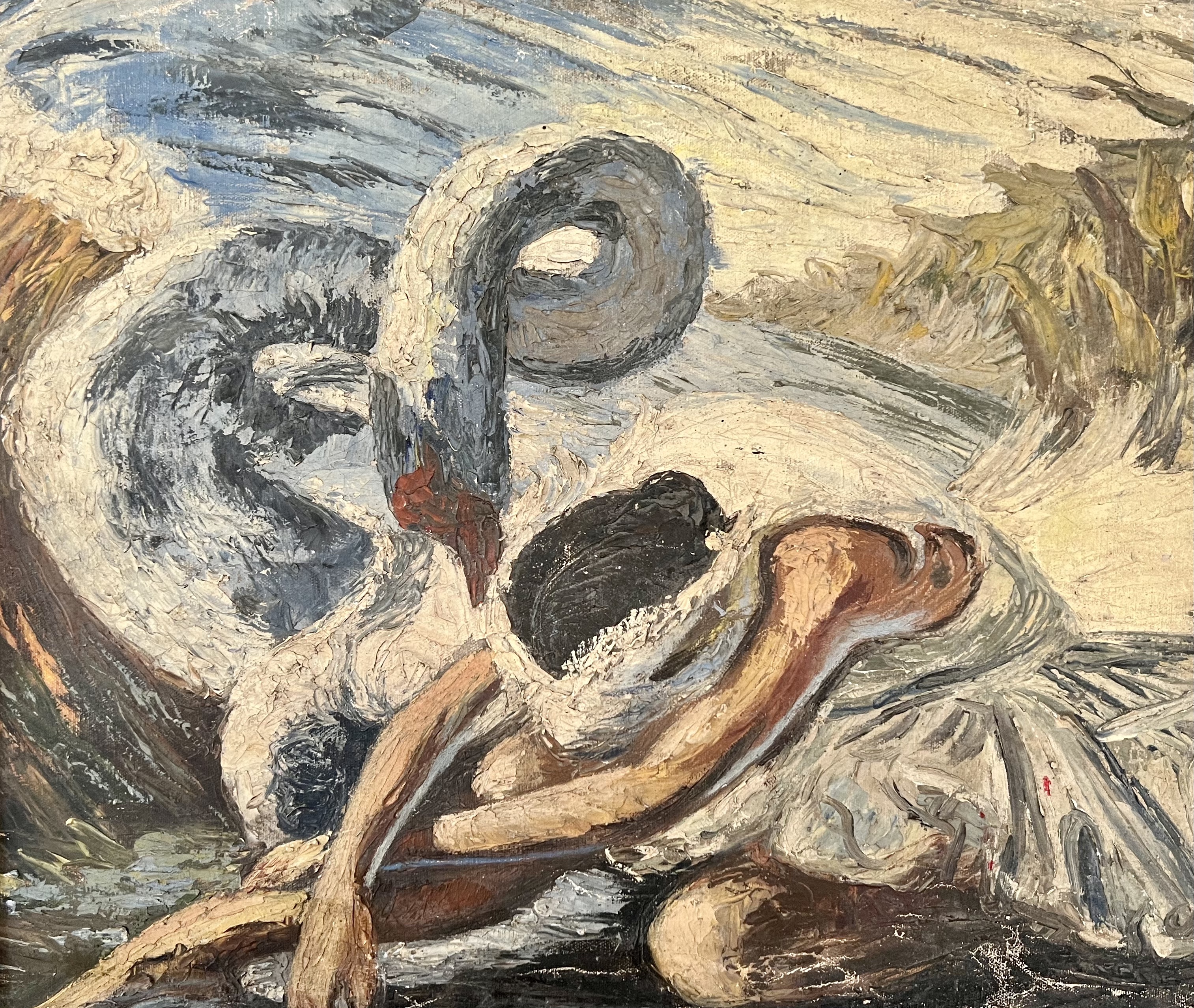
In the foreground was a young woman in a white dress—a dancer immediately came to my mind—set against what first seemed to me a backdrop of the sea, a huge curling wave threatening to envelop her. But there was another element, aside from the strange shape of the “water”, that didn’t make sense: an orange something near the woman’s face.

And then it all snapped into place: the background figure was a swan with one wing outstretched and the other practically smothering the woman, and the orange thing was its beak. What sprang to my mind was Leda and the Swan, the old Greek myth that has been one of art and literature’s most reinterpreted and most referenced stories (where Zeus, in the guise of a swan, rapes or seduces Leda, and has two children by her). 

This could not have been done by a naif painter; it took some education and sophistication to take on a subject like that, and to represent it with both grace and power. This painting could not have been a recent work; its strokes and colors belonged to another age. It felt old, in a good way. I thought that it had to be decades old, possibly even pre-war.

I immediately messaged the seller to reserve the painting for me. For P1,000, it was a no-brainer. Usually the seller would respond within minutes, and we would do the GCash and Lalamove song-and-dance within the hour. But the day passed with no response. I messaged him again that night, and next morning I still heard nothing back. Another day passed; I had saved the picture of the painting on my phone and returned to it now and then, stewing inside, increasingly annoyed by the seller’s silence.

And then I got the message: did I want it? Of course, I messaged back quickly. It will cost you P1,000, he said. Sure, I said, give me your GCash number. I hope you can book it for pickup now, he said, because I’m leaving very early tomorrow morning—unless you want to get it in the afternoon. No, no, I said—I’ll book it right now. It was 11:30 pm, and Beng was sound asleep. 

And so it happened that just past midnight, a Lalamove rider roared up to my gate to deliver the painting, which I examined immediately. It had been very badly framed, with ragged edges of the painted canvas hanging over the back. Since the edges had been pulled over, I could find no signature. Still it was every bit as powerful as I had thought it to be, the colors laid on in a thick impasto. 

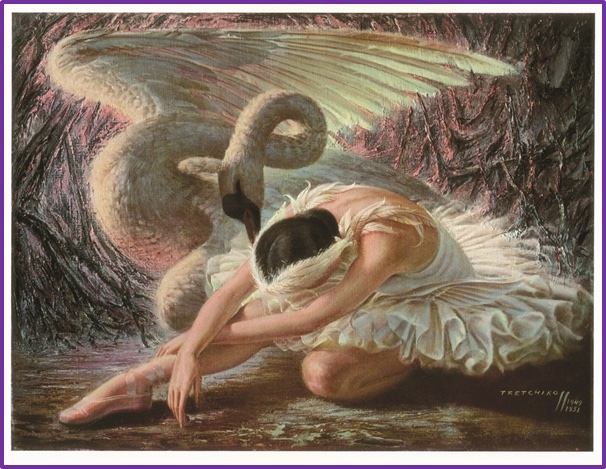
So the mystery was, who painted it, and when? I posted it on FB the next morning, and immediately the writers and artists in my group identified it with Leda and the Swan. I felt vindicated. And then my Toronto-based friend, the poet Patty Rivera (whose husband Joe also paints), posted a link to a story from South Africa, where a painting by a Russian-born artist named Vladimir Tretchikoff was up for auction. It was titled “The Dying Swan,” from the ballet by Mikhail Fokine; Tretchikoff had even persuaded the great ballerina Alicia Markova to pose for him in 1949, when he began the work (one of two he gave that title).

So my midnight acquisition was a copy done by a local painter in the 1950s, possibly by an amateur or even a student. Was I disappointed? How could I be, especially for the price I paid? Tretchikoff’s original was clearly much finer and more radiant; but my rougher copy, in Patty’s words, showed more “torment and despair.” When Beng restores this and we have it reframed, it will have its own life and energy, and the swan will die, over and over again, which means it never will.

Penman No. 433: Finally, Facebook

Penman for January 16, 2022

My Lifestyle column in the Philippine STAR, “Penman,” has now been moved to every other Sunday, to avoid the awkwardness (and extravagance) of having two of my columns appear in the paper on Mondays. My takeover of F. Sionil Jose’s “Hindsight” on the Op-Ed page debuts tomorrow.

I WAS sixteen years late to the party, but I finally gave in and opened a Facebook account last June under my name, initially just for family. A few weeks ago I began accepting “friends,” of which I now have about 600, and I don’t intend to add too many more, although time and tolerance could change that reticence as well.

I resisted joining Facebook all those years for all the reasons some of my real-life friends remain staunch holdouts. Foremostly, it seemed to diminish and commodify the idea of friendship, replacing what should have been forged over conversation, coffee, and even conflict with a few keystrokes. Even now, looking at the roster of my newfound “friends,” I know—and do not really regret—that less than half of them are people I have actually broken bread or raised a toast with.

Honest to God, not being a politician, I don’t need 5,000 friends; I wouldn’t even know what to do with 1,000 of them. If they all pledged to buy my next book, then maybe I’d reconsider and lower the bar by a foot or two, in the cause of promoting literacy and my Fountain Pen Rescue Fund.

And then of course Facebook is a total timesuck, defined by the Urban Dictionary as “the void that gets created by engaging in an activity that seems like it will be short but ends up taking up huge amounts of time.” It’s just not human not to read and then not to respond to comments on your posts, and then not to read the posts of others and not to react to them.

Every “tag” might as well be a distress call; somewhere out there you’re being praised or reviled, and you just have to pause that report you’re drafting for the Board of Regents or that article you’re refereeing for the Journal of Linguistics to see what Cookie has been saying about that encounter in Boracay or Chef Dodo’s opinion of your dinuguan recipe.

As it is, even deciding who gets to be your Facebook “friend” or not raises all kinds of vexing and time-consuming moral dilemmas. I don’t know how others do it, but I review nearly every request I receive, going through that person’s profile—and not just our common “friends”—to see who and what’s behind the name. My rule of thumb is, if I really know you—and like you—then you’re in; if I know you by reputation, I might even feel honored, and click “confirm.” If I’ve never met or heard about you at all—which isn’t your fault or any fault for that matter—then I evaluate your application for virtual “friendship” using my shamelessly subjective criteria.

First, I check to see if you’re a real person, or that you are who you say you are. Early on in this “friendship” game, I received a slew of requests from impossibly pretty and shapely ladies, which made me wonder why I had waited sixteen years to enter paradise. (They all seemed to have one or two common “friends” with me, always the same persons, so I know who’s been extraordinarily amiable out there.) Out of curiosity (I swear!), I accepted one such request, and almost instantly got a private message that invited me to become her digital pen pal, because she was lonely and unoccupied in some far-off country. I wanted to tell her to buy my book of funny essays, or even my short stories, to relieve her boredom, but I had an inkling that creative nonfiction wasn’t going to be the bridge between us.

I checked out her posts—all of them suggestive of her good health and weight maintenance, and of her preference for clothes that did not consume too much fabric (kudos for sustainability)—only to notice that they had all been posted on the same day! My wonderment quickly turned to dismay, realizing that I, among other papas of the world, was being suckered into hell by this honeypot, who was very likely some ugly fellow like me named George or Brando. And so I sadly punched “delete,” as I did for the many others who would follow in Ms. Lonely’s wake.

Second, I check to see if you’re interesting and if we’ll get along. If all you can show me are endless updates of your profile picture—here’s me on the beach, here’s me with my dog, here’s me with a balloon, here’s me lifting weights—then we really don’t need each other, thank you. I have a soft spot for all kinds of artists, and I don’t necessarily just go for the famous or abundantly talented ones; I’ve signed in struggling young people because I admire honest effort.

If you’re a benign plantita proud of your grandkids, your succulents, and your muffins, you’re in—the world needs you! If you became my friend just to sell me something, you’re out (unless you buy my book first). Now here’s a killer: if I see even the slightest sign of you supporting dictatorship, book-banning, EJK, and fake news, you’re out. (I know we’re supposed to make friends across the political divide, hold hands, and sing “Kumbaya,” but I didn’t join Facebook to get my daily dose of aggravation.)

My Wishes for the New Year

EVEN AS we all wish for a more benign 2022, free of Covid and conflict, we know deep within that our biggest battles lie ahead in the war between good and evil that it has always been—not between parties nor personalities nor platforms, but between those who will lie and steal and kill, and those who will fight for truth, justice, and prosperity for all.

Good and evil is as stark and simple as it gets, and no amount of spin or sophistry and certainly no surveys will change that. Even one good person in a roomful of the malignant and misled will still be right, and worthy of our praise and emulation.

And whatever happens in May, our struggles will not cease. Evil is a virus with infinite mutations. Our corrupt and power-hungry politicians are worse than Covid, and have infected the masses of our people with their lies and false promises. But they can be arrested and contained, with vigilance and resolve.

For myself, I cannot be a friend to anyone who willfully supports and benefits from those who will plunge our country into another six years of moral and economic ruin.

I look to 2022 as an opportunity to stand up and be counted among the forces of the good, whatever my personal faults and impairments may be. The only survey or judgment that will matter will be God’s, and I would like to be able to tell my Maker that I did the right thing when it mattered—that I managed to remember the difference between good and evil, and chose rightly.

I can only wish you feel the same, so we can have a truly happy and liberating New Year!

(Image from candles.lovetoknow,com)

A Visit from GPS (long story follows)

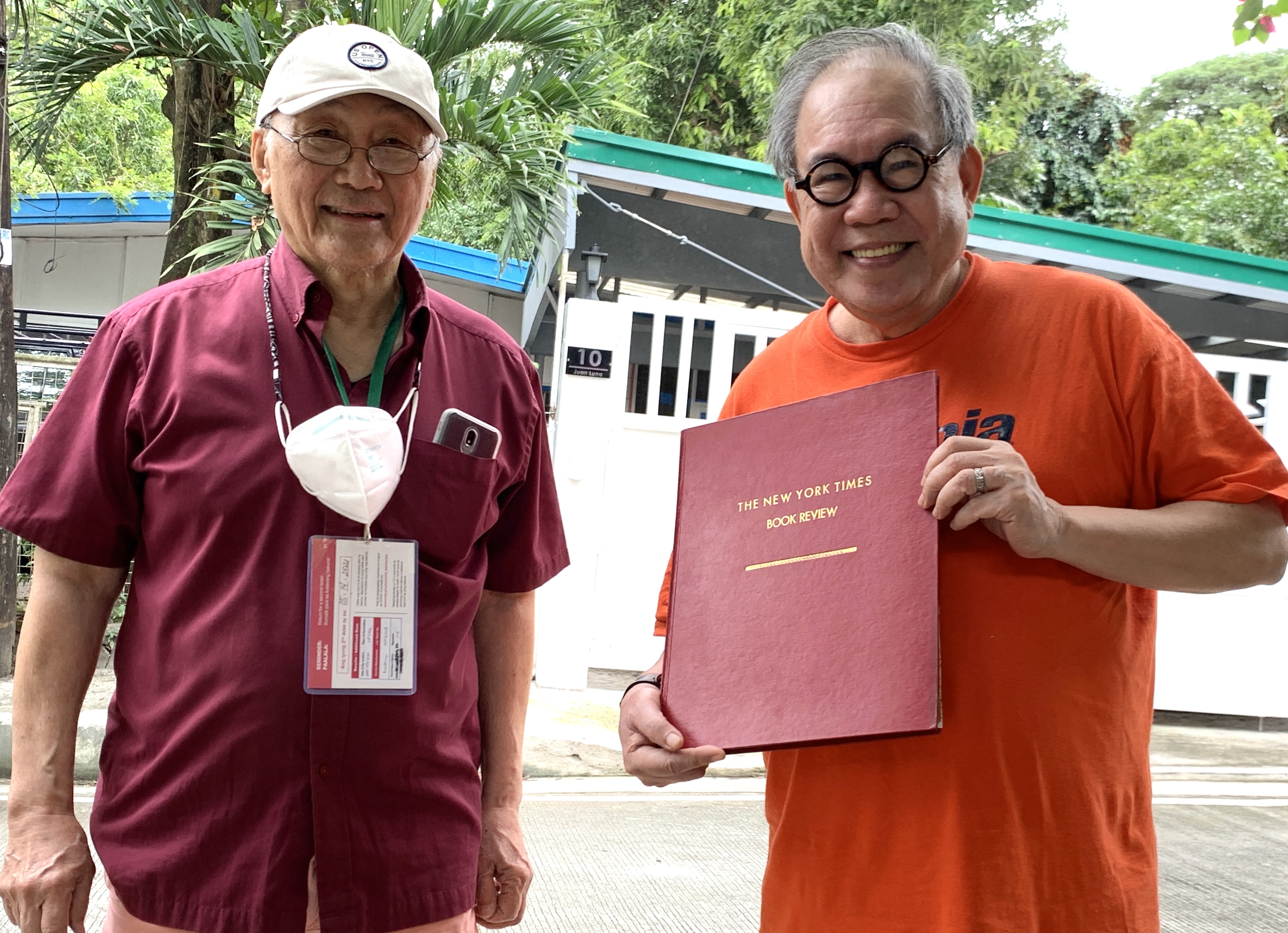
I HAD a surprise visit—and present—this morning from one of the people I have always acknowledged to be my life mentors, Dr. Gerry P. Sicat, my former boss (and Beng’s) at the National Economic and Development Authority. He brought me a bound special issue of the New York Times Book Review from 1996, featuring the first reviews of such literary luminaries aa Dostoyevsky, Conrad, Woolf, Hemingway, Gordimer, and Updike. He had saved the copy for me back when he was still working in Washington, when he heard from his daughter that I was “doing well” in UP; somehow he had misplaced the copy for 25 years, finding it only recently, and thus today’s visit.

The “doing well” remark goes back to the long story of my ten years at NEDA (1973-83) and how GPS (or “DG” as we all called him, for Director-General) shaped my life at a crucial stage.

I was just 19 in August 1973 when I stepped out of martial-law prison. I had dropped out of UP at 18 with 21 units to my name, but I had already worked for the Philippines Herald and Taliba as a reporter before my arrest for subversion. In Bicutan, I had studied drawing with the printmaker Orly Castillo, and upon my release I joined Orly at the Printmakers Association of the Philippines studio in Ermita to study and practice printmaking—something I would do for several years. It was at the PAP where I met Beng (I should say, met her again, as I had seen her in UP and admired her from a distance—she was a pretty senior on the Student Council, and I was a bumbling freshman), and within three months of our getting together, I told myself that I wanted to marry her. (Ours was a generation steeped in fire and blood—scores of comrades had died fighting the dictatorship, and we had come to be convinced that we were not going to see our 30th year, maybe not even our 25th. So if we had anything important to do—like marry and have children—the sooner we did it, the better.) 

I shared the bold announcement with my mom: I had met a nice girl and I was going to ask her to marry me. “Are you crazy?” she responded. “You don’t even have a job!” Well—I said—I suppose you’re right, I should find some gainful employment.

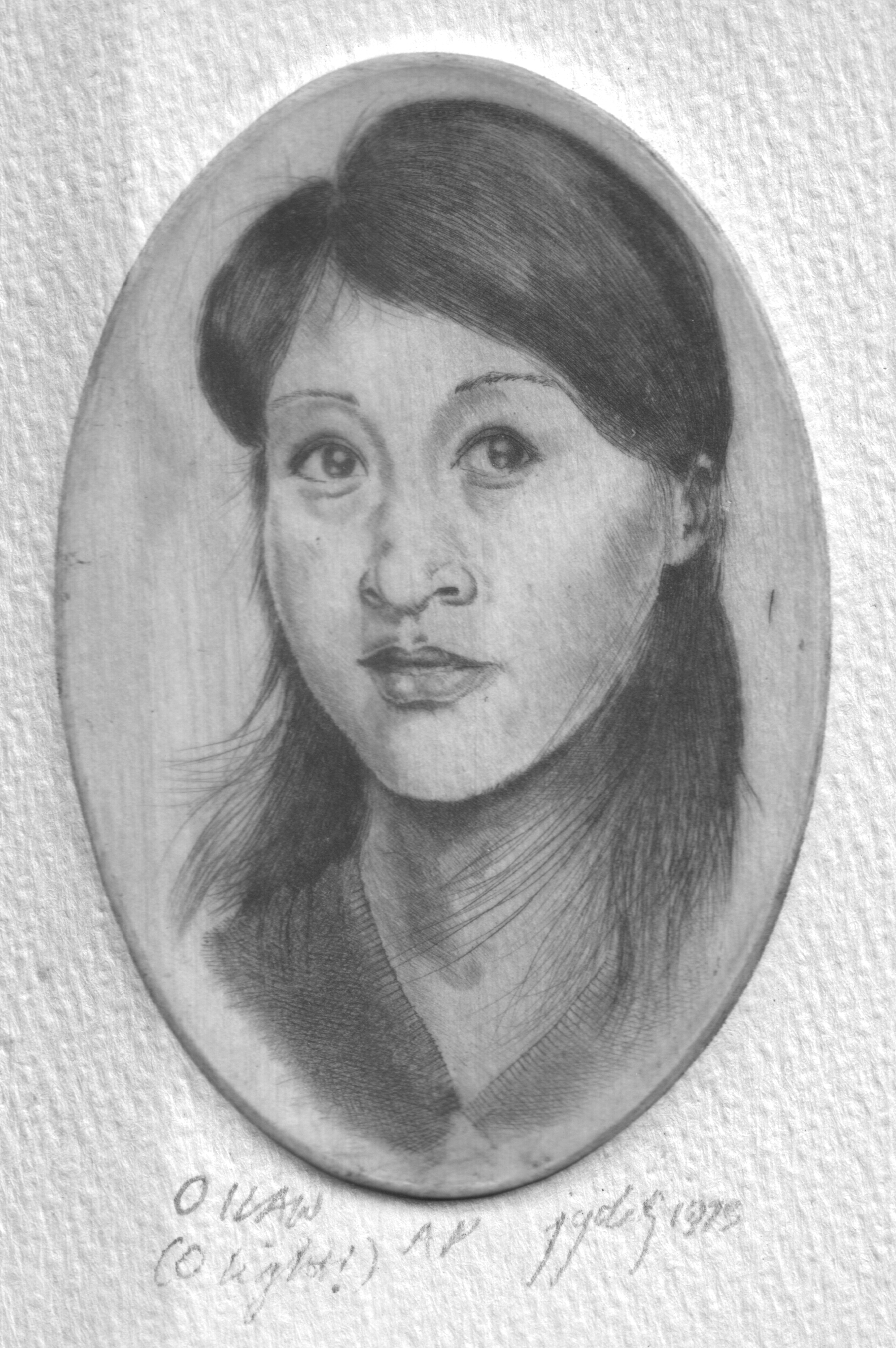
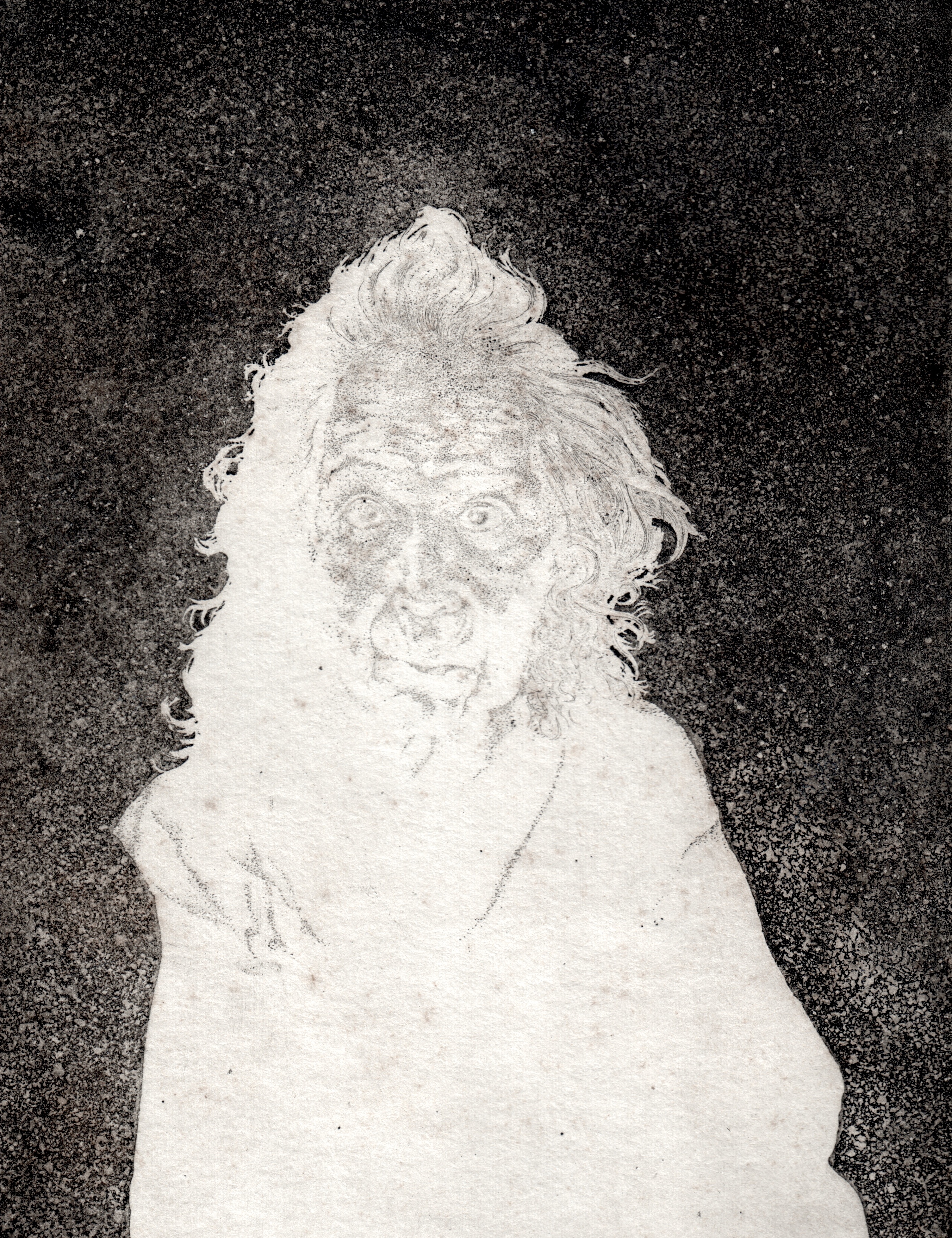
(Above, a drypoint print of Beng from 1973;
below, an aquatint and drypoint print of my grandmother Mamay from 1975. )

That same day I went to the PAP studio to work on some prints and to mull over my future. Printmaking was fun—and I got to hobnob with such brilliant (and real) artists as Bencab and Tiny Nuyda, among others—but it wasn’t something I could live off, let alone support a family with. A kind dealer came by every few weeks to buy prints from me and other PAP members for P15-25 each to serve as fillers for the frames she was selling to US servicemen in Clark and Subic. I needed a real 9-5 job.

That afternoon I walked around the Padre Faura neighborhood, and on the street I ran into an old friend and comrade, Jun Medina, who had been a newspaperman pre-ML and was now the PR chief at NEDA. He was so happy to see me—he had known I was in prison—that he literally emptied his wallet to give me whatever he had, a kindness I would never forget. He asked me if I was back working. “No,” I said. “In fact I’m looking for a job.” He lit up and said, “We’re looking for a feature writer! Why don’t you apply? Let’s go up and see the boss!” Sure, I thought, what’s there to lose?

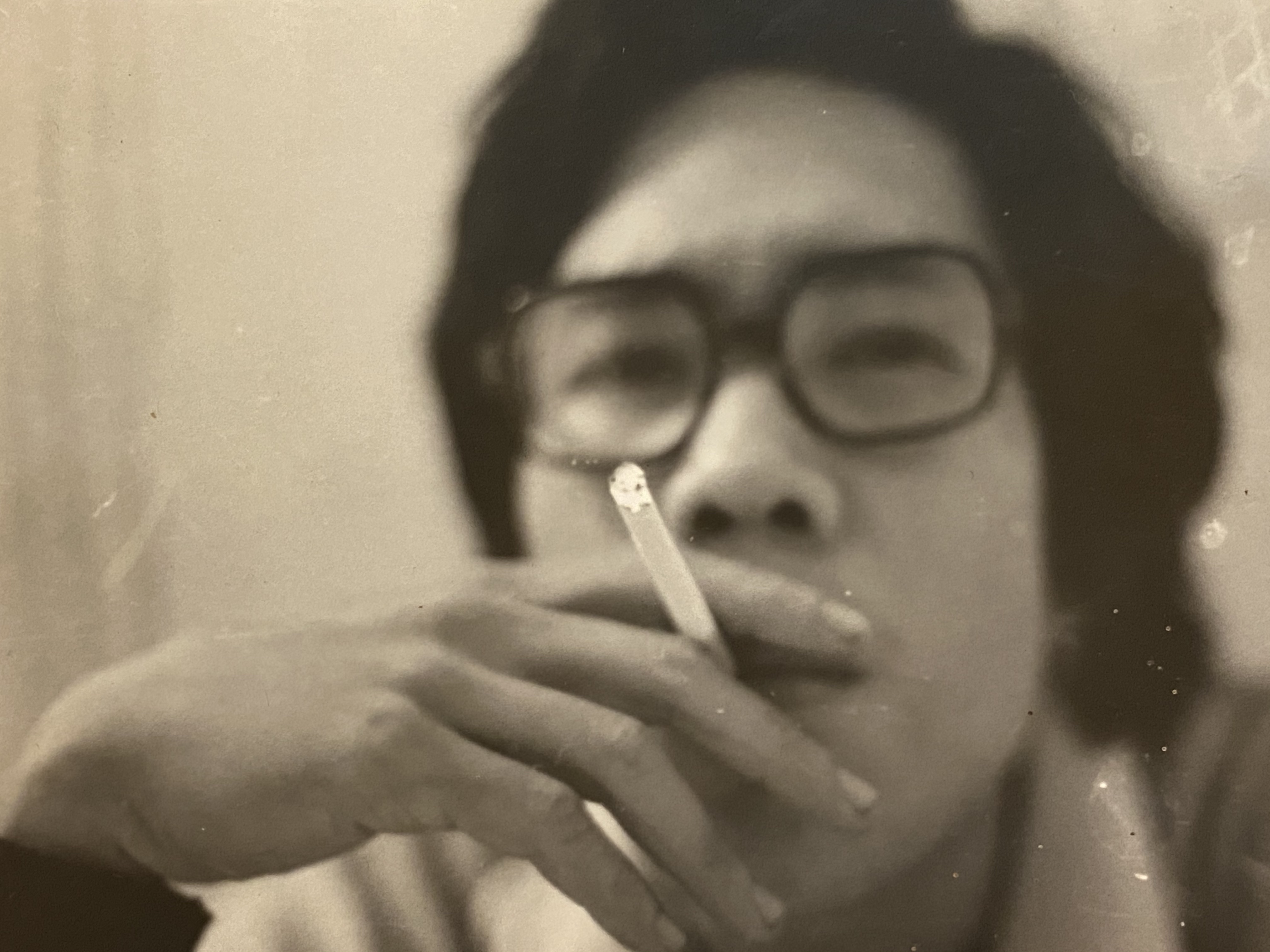
(Puffing and dreaming–at my worst, I smoked four packs a day;
quit smoking with Beng cold-turkey in 1994.)

And just like that, a few minutes later, I was talking to NEDA Director-General Dr. Gerardo P. Sicat, whom I had never met before; he was only 38 then, trim and fit (he was a tennis player and marathoner), but cool and laid back, asking just a few questions to see if I had anything in my noggin. Jun vouched for me and my writing, and that apparently was enough. “Let’s start you at P700,” said GPS, and lightbulbs popped in my head; in 1973, P700 a month was good  money.

That night I went home and had the pleasure of informing my mother that “I found a job, and I’m getting married!”

Of course I had to ask Beng first, so I sat her down at the old Skorpios in Cubao and probably over batchoy and puto I got a napkin and scribbled some figures on it, starting with “700.” How much would an apartment cost? Food? Transportation? “We can get married!” I concluded, although I guess I turned that into a question, because she agreed (and would later tell me, “I don’t know why, but I did!”).

We met at the PAP in September; on January 15, 1974, on my 20th birthday, we were married by the CFI judge my mother worked for—took less than five minutes—and had a merienda cena reception at The Bungalow for less than a hundred people at P8 per head; when the management realized that we hadn’t made arrangements for a wedding cake, they hastily and kindly provided one.

So Dr. Sicat made that possible, but his unbidden intercessions wouldn’t end there. Knowing that I was barely a freshman when I left UP, he sent me to the UP School of Economics as a special student to attend the one-year graduate diploma Program in Development Economics, so I could learn something more substantial about the things I was writing about. That course introduced me to outstanding teachers (some of them just instructors back then) like Agustin Kintanar, Gon Jurado, Rosalinda Tidalgo, Dante Canlas, and Ruping Alonzo, and made lifelong friends of batchmates like Meynard Guevarra (now DOJ Secretary) and Vicky Bataclan and Libran Cabactulan (later DFA ambassadors), among others. Against all odds, the salimpusa passed. (And I was ever aware that my “special student” enrollment was vaguely anomalous, but I suppose there were advantages to GPS being a UP regent at that time.)

On the strength of that diploma, Dr. Sicat later endorsed me to the United Nations Development Programme office in Manila when the security watchdogs at NISA complained about my access to sensitive documents at NEDA, as an ex-detainee who still had to report regularly to the military authorities. GPS was sending me to the UNDP to cool off—they even had to create the position of “National Professional Officer” for me, which was later adopted by other UNDP offices in the system—and for a year, I did project evaluations and liaised between the UNDP and NEDA. I was even given a chance to move over to the FAO and to work with NEDA’s External Assistance Staff, but after a year of role-playing as the economist I truly wasn’t, I asked to return to my PR job at NEDA and to my creative writing, which was what I most enjoyed. (For a time, my closest friend and officemate at NEDA was the late Bienvenido “Boy” Noriega, my Alpha Sigma fraternity brother and fellow playwright. Many other writers like Patty Rivera, Fidel Rillo, Lilia and Jess Santiago, and Eric Caruncho would join our Economic Information Staff.)

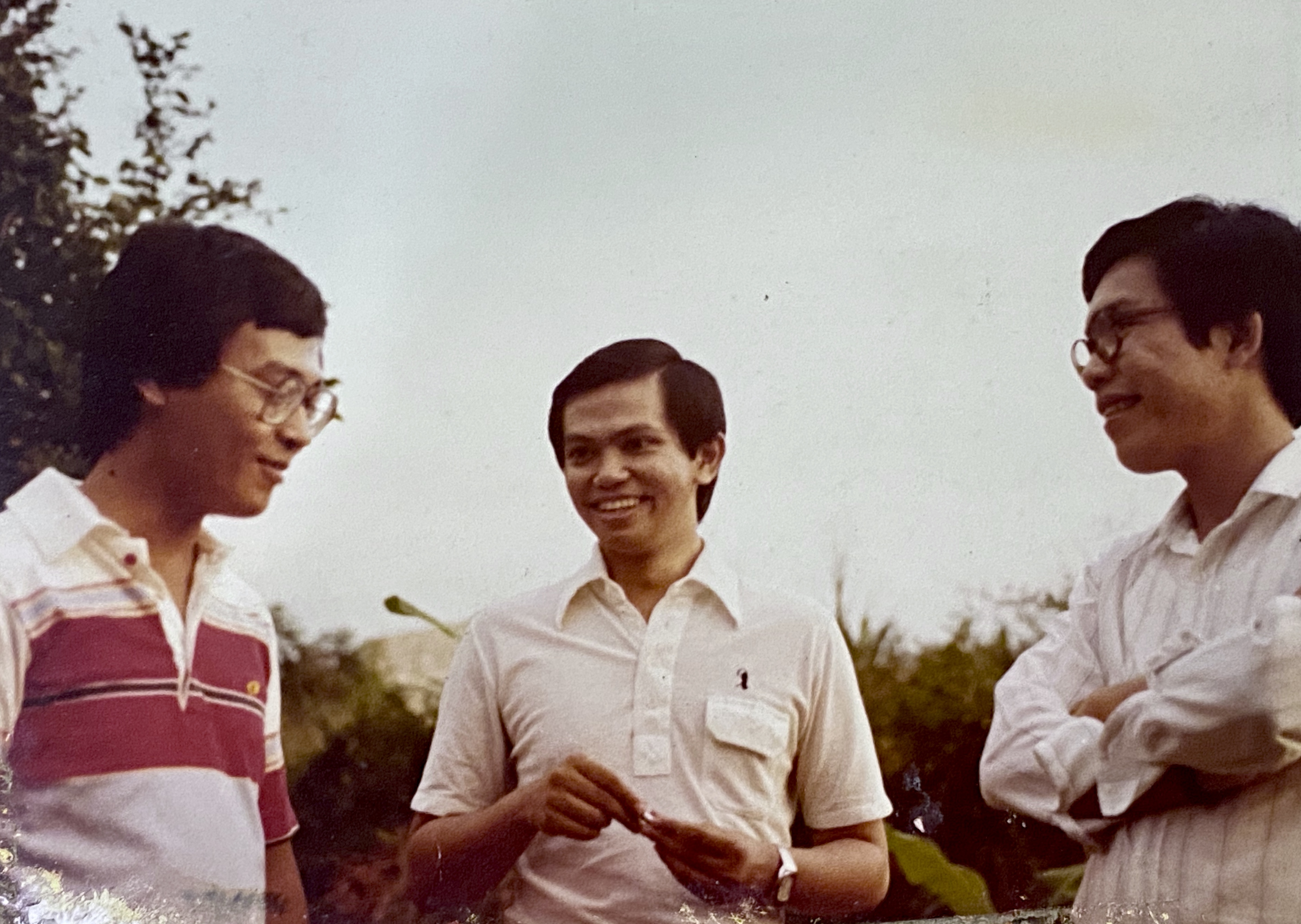
(With fellow playwrights Boy Noriega and Paul Dumol, ca. 1981.)

In 1980, GPS had another surprise for me: he was sending me to the US for three months on a USAID grant to study media operations—and I enjoyed and learned from that immensely, but I knew that GPS had really sent me out as a writer who needed to see a bit of the world outside, to broaden my horizons; it was something he routinely did for his young staff. I have since been to the US dozens of times—our daughter lives there—but that first visit remains incandescent in my memory: first snow, first tour of the Smithsonian, first glimpse of New York, Broadway, the raw material for my story “Oldtimer,” long walks in yellow forests. 

When I returned, I was filled with a fresh resolve to just go back to school, to study and write and perhaps to teach for the rest of my life, which I did. For two years, I shuttled between NEDA and UP, racing to get a proper AB English degree; I resigned from NEDA in 1983 as the political climate was heating up so I could focus on my studies full-time, graduating in 1984, with Beng working doubly hard to support us in the interim.

Also in 1984, Dr. Sicat left NEDA himself to take up a post with the World Bank in Washington, DC. Before leaving, he asked me and Boy Noriega to visit him at his home in La Vista, where he gave each of us 30 minutes to select ten books from his library. I was beside myself picking out those books—I recall choosing, among others, Kenneth Clark’s Civilization, William Pomeroy’s The Forest (which I had read in high school and was deeply impressed by), the two volumes on the Philippine short story compiled by Leopoldo Yabes, and Mao’s Little Red Book (because mine had been confiscated upon my arrest). They remain with me to this day.

And then I took my MFA and PhD in the US on a Fulbright grant (basically just a plane ticket and a book allowance, because Fulbright funds were running low then—so I had to work, among others, as a cook for a Chinese fast-food) from 1986 to 1991, and returned to UP to teach full-time, become a professor, and publish more books. I suppose this was what Dr. Sicat’s daughter meant when she told her dad that his former recruit was “doing well.” 

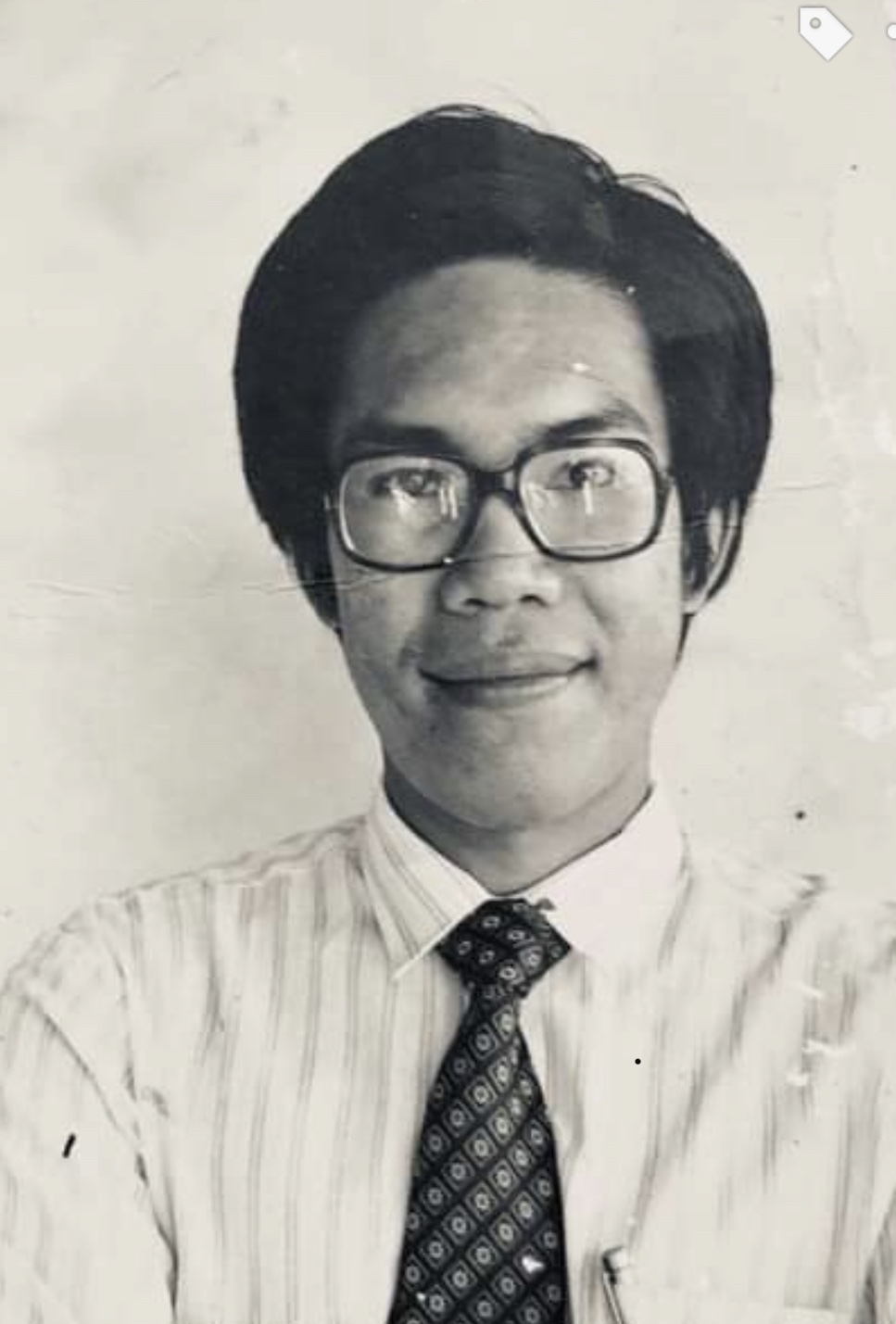
(From around 1992, going by the hair.)

When I retired in 2019, one of the guests I made sure would attend my retirement party was GPS, and shortly after I followed in his footsteps as Professor Emeritus. 

He must have been shaking his head—but smiling—when he left our place today. (Beng and I were—at 86, GPS looked a whole lot slimmer and fitter than my 67.) Many thanks, DG, for the job and the visit, and for everything in between.

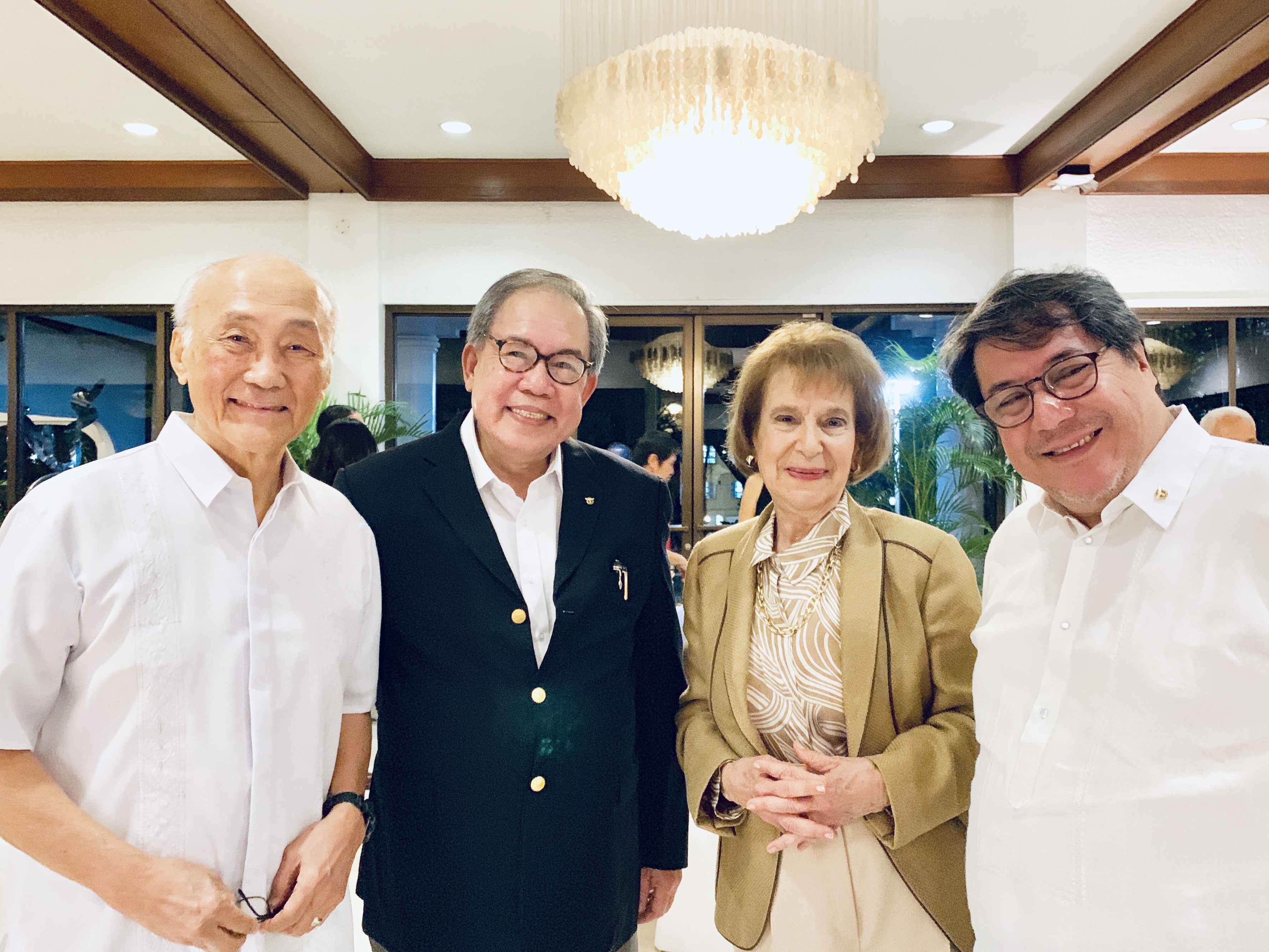
(At my retirement party, with GPS, my friend Julie Hill, and EVP Ted Herbosa.)