Penman No. 81: Hello, Seniorhood

ButchBeng1974

Penman for Monday, January 13, 2014

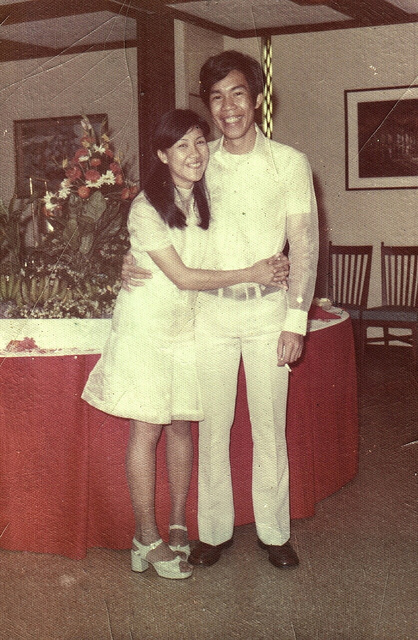
THIS WEDNESDAY the 15th, Providence permitting, I’ll be marking two milestones I frankly never thought I’d reach: I turn 60, and Beng and I will celebrate our 40th wedding anniversary. (That’s right, we got married in Manila’s City Hall on my 20th birthday. It seemed a cool idea at the time, but I’ve regretted it ever since—the timing, not the marriage—because it deprived us of an excuse to party twice.)

I’ll admit this only now, but I’ve been looking forward to seniorhood with growing anticipation over this past year. At 57 or 58 you might still be in denial, walking with a pronounced spring in your step to convince yourself and everyone else that all you need is a new pair of Merrells to unleash the inner tiger in you, but the fact is, within six months of 60, you can’t wait to get there and have the inevitable done with.

The last time I knew I had to be a senior soon was just last month, when I stood in a long line in the unseasonably sweltering heat at the DFA to submit my expiring passport for renewal. Taking pity on me, a guard came up to me and asked, “Sir, how old are you?”, obviously thinking to bump me up to the express lane where a few imperturbable seniors sat smiling. “I’ll be 60 in three weeks!” I said. Not good enough. I waited three hours.

I know something about seniors—I live with four of them in the house; I know their moods, their ailments and medications, their favorite TV dramas, their exquisite skill at swallowing fish heads and spitting out the eyeballs.

And there’s no diplomatic way of putting this, but for the past three years, I’ve been married to one (Beng’s folks didn’t know she was marrying a young innocent until we were in the car on the way to City Hall; I had to get parental dispensation). But to her enduring credit, elfin Beng often has to be “carded” in the restaurants, as they’d put it in the States, while all the salespeople and cashiers have simply albeit solicitously assumed that I have a senior card to show for a discount.

So I’ve been mooching off Beng’s seniority, tagging along with her when she goes to the head of the line come boarding time at the airport, or when we queue up for movie tickets. That’s when you realize that the next best thing to being a senior is marrying a card-carrying one. But Beng doesn’t find it funny when I tell her what a shock I get to wake up in the morning beside a lola. Well, I guess we’re even now.

Of course, in a sense, you can never get old enough, maybe not until you hit 80. At 60, there will always be writers in their 80s or 70s who can’t wait to remind you what a bumbling tyro you are compared to their accomplished selves. That’s all right, because having older people on your shoulders could be the only thing that will keep you young, or at least younger, not counting strange potions meant to stiffen, uhm, one’s resolve.

It’s a pleasant surprise to get this far, because ours was a generation that was supposed to die before we even hit 25. After stepping out of martial law prison at age 19, I’ve taken every breathing moment since as a kind of grace note.

As it turned out, the grace note was my marriage, running four decades long, another unexpected, shamelessly undeserved blessing. When Beng and I stood before a CFI judge—my mom’s boss—that nippy January in 1974, it was after just three months of being together. We were in love, surely—truly, madly, deeply—but we were also gasping for breath, seizing happiness when and while we could, thinking that the State’s long and murderous hand could break the spell at an instant. As it turned out, too, the predictable State was hardly the enemy, but the inconstant self. Some of those forty years proved hard and lonesome, thankfully not too many nor too long.

As we start the count toward our golden 50th, Beng and I have come to realize that there are a few things we need and want to do in the years ahead.

With some regret, we will seek and keep fewer friends—the real, not the Facebook, kind. We’d like to focus on family, work, good health, our private charities, and, of course, more time together. This will mean socializing less and staying home more, which will be all right, because we both have so much work to do and always less time to do it.

On the other hand, lest our world become too small, and with whatever we can spare from our perennially meager savings, we will travel up a storm—march up headless hilltops, wind through strange alleyways, and wander down foreign boulevards while our knees can. This May, I hope to realize a longstanding dream, which is to bring Beng to Venice, where I had a magical moment three years ago but where she’s never been (of course, she’ll have to stay with me at that dinky hostel in Mestre, across the water and next to the Asian food store that was my culinary lifeline in heathen Italy).

We might not even need to go that far. One of the most enjoyable dates Beng and I had over the recent holidays was in front of the TV, watching a late-night screening of “Funny Face” with Astaire and Hepburn in Paris and singing along to the Gershwin score. And then another day we took our quarterly stroll around the Quiapo area, imbibing the Oliver-Twistian energy of the hardware and music stalls on Raon and Evangelista, cherrypicking the dustiest of Avenida’s ukay-ukays, and consoling ourselves with cheap mami and siopao at the Pinsec place on Recto, because Ramon Lee’s chicken house was still closed for the New Year break. We’ve been to dreamier places like the Grand Canyon and Bellagio (the Italian and Vegas versions) but it’s these slumdog sorties that we’ll remember for the fun.

With our only child Demi well set in her own career in Southern California and well loved and cared for by her own man, we can and will help others achieve fullness in life by putting them through school and giving them the same kind of guidance we gave our daughter (“Don’t worry too much about grades, enjoy your education! Make your own mistakes! Learn to think on your feet! And never forget where you came from.”)

Where she came from, I think, was us. As I turn 60 and Beng and I turn 40 (which Demi, too, will be, come October), I’d like to think that beyond all the books and paintings we ever created, Beng and I did nothing better than produce Demi, whom I named—while Beng was still in a post-partum haze—Dalisay Emilia Poticar Dalisay, “Emilia” being my mother’s name. Demi loves her lola, but wasn’t too thrilled to grow up having to explain her redundant name to her classmates, with the anciently Shakespearean “Emilia” wedged in between. “Don’t worry,” I told her, “don’t you know that Demi Moore is really Dalisay Emilia Moore?” It didn’t fly. But hey, her name seemed like another cool idea at the time.

A couple of years ago, I wrote her this poem titled “To Our Unica Hija Demi, Born Dalisay Emilia Poticar Dalisay”:

It matters not if our names end with you

If no more Dalisays walk the earth

You were all we wanted in this world

Our most joyful blessing was your birth.

When at times we seem too far apart

Remember that we are your blood and breath

And that your name to us is like a distant bell

That you bore twice, and bore it well.

Here’s to the three of us, anak. We’re all growing older, but we’re doing it together. 

Butch Beng2013

Penman No. 77: Writers at Their Best

wn13_1Penman for Monday, December 16, 2013


WRITERS’ NIGHT 2013 went off last Dec. 6 in UP Diliman with nary a hitch, thanks to tremendous support from the Philippine writing community (and, of course, from my staff at the Institute of Creative Writing). It was a night of celebration that began early, with the Filipinas Copyright Licensing Society (FILCOLS) holding its general meeting and handing out historic (and substantial!) first checks to Filipino authors whose works had been used with permission in textbooks.

This was followed by the presentation of the 13th Madrigal-Gonzalez First Book Award, an annual recognition of the best first book by a Filipino author writing in English or Filipino (the award alternates between these two languages, so the award covers publications for the past two years in each language; it was English’s turn this year). This P50,000 prize—established and generously endowed by the Madrigal-Gonzalez family through Atty. Gizela Gonzalez-Montinola—has become another important rite of passage for Filipino writers, and over the years it has gone to such talents as Angelo Lacuesta, Luna Sicat Cleto, F.H. Batacan, Ellen Sicat, Vicente Groyon, Kristian Cordero, Rica Bolipata Santos, Zosimo Quibilan, Adam David, Lualhati Abreu, Lawrence Ypil, and Will P. Ortiz.

The actual awarding is preceded by a lively forum featuring the finalists, who remain unaware of the winner until the end of the ceremony. This year’s board of judges was chaired by prizewinning fictionist Charlson Ong, with poet Mookie Katigbak-Lacuesta and Prof. Shirley O. Lua of De La Salle University as members. It was a banner year for the University of Sto. Tomas Publishing House, whose books accounted for five of the six finalists.

The citations that the judges prepared for the finalists were little gems in themselves, so to give you an idea of what our best new writers have been producing, let me quote from those citations:

Daryll Delgado, After the Body Displaces Water (UST Publishing House, 2012): “In After the Body Displaces Water, Daryll Delgado draws upon both romantic and realistic traditions in fiction, the personal as well as the political, to deliver an outstanding debut collection. Here are tales of the post-EDSA uprising generation who navigate through the murky mire of lost certainties, failed expectations, of promise and compromise. Here, water, cleansing, life-giving yet dangerous, is prime element. Water is memory: malleable, mesmeric. It suggests the comfort of the womb and of early death, but must finally give way to the body, to present and authentic self. These stories offer up no easy answers only uneasy angles, uncanny ways of seeing as ‘through a glass darkly.’”

Marc Gaba, Have (Tupelo Press, 2011): “’Stories are about the dropped stitch,’ writes an American fictionist. The dropped stitch interrupts the pattern and disturbs an existing order. To stretch a metaphor: when this happens, a stitch falls off your needle and unravels for several rows beneath the row you are working on. At some point in your writing career, you are going to drop a stitch.
You will forsake what you know for what you don’t know.
Writers less fearless would try to reach that dropped stitch, slide a crochet hook into its loop, and mend a rent in the pattern.
But Gaba’s poems are about the dropped stitch—the one that makes the reader imagine a pattern because it has gone completely missing. His is the stitch that unravels the whole.”

Anna Maria L. Harper, Agueda:
A Ballad of Stone and Wind (UST Publishing House, 2012): “Rare is the Philippine historical novel, rarer still one with a woman main character. Agueda may be an attempt at national allegory, but its richness of detail make it a quite engaging read. Though treading familiar ground, the book visits nooks and crannies of our past usually ignored by historical texts. We catch glimpses of our forebears—rich and poor—heretofore unseen and gain further insight into who and why we are. Who knows, in time, its heroine may become as familiar to readers as the likes of Maria Clara and Salome?”

Neal Imperial, Silver Fish, Hook of Moon (UST Publishing House, 2012): This collection affirms the power of language in all its majestic simplicity and frugality, as if self-denial is a form of art. The seeming effortlessness of the poems’ cadence complements the stream of images and metaphoric turns which seek to stir the mind of the listener, such verses as ‘We hear the silence / of dead birds / combing the wind / for wings / stuffed / in the belly of a gun,’ ‘To love an older woman / is to bleed / on a bed of salt,’ or ‘You are too-much-food / too late…” This engaging work claws at our heart, like ‘the hook of moon.’”

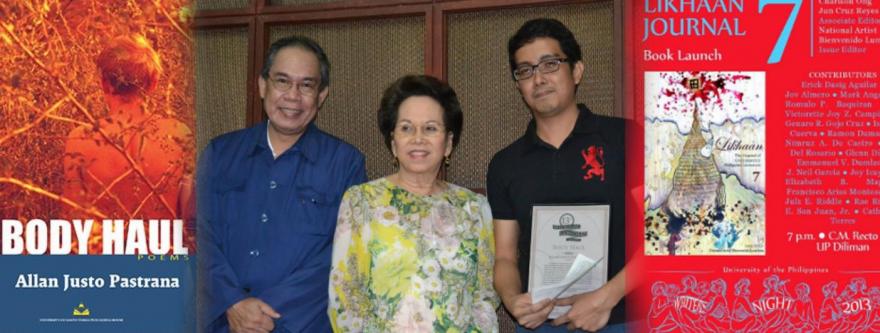
Allan Pastrana, Body Haul (UST Publishing House, 2011): “Called at turns difficult and lyrical, Pastrana’s poetry is deeply personal (and to the casual reader, hard to inhabit). His poems pose a difficult conundrum, for despite their apparent inaccessibility, an internal music moves them. Pastrana must be credited with such precise notation. Each of his themes seem set to an appropriate time signature—nostalgia, desire, childhood, domesticity—each one is given a clipped and particular music. It is music first that draws the reader into the writer’s milieu, uncertain of what he might find there, or if he will find anything at all…. First and last is his music. First and last is music of such virtuosity that Pastrana must be one of our finest poets.”

John Jack Wigley, Falling Into the Manhole: A Memoir (UST Publishing House, 2012): “This selection of essays shows the author’s deep-reflective investigation of his identity, whether as a boy growing up in the City of Angels, as a novice traversing through the muddled metropolis of our sad republic, or as a determined man embarking on a delicate quest in the land of his white forefather, a land deemed an earthly paradise by Spanish conquistadores. The personal narratives are unabashedly candid and sensitive, infused with humor and irony, and peppered with thrilling bits of pop culture. This book is both a delightful and heart-ripping read.”

The winner was Allan Pastrana, of whose work the judges had this further to say: “Like Orpheus’ lyre, Body Haul lures us with its refreshing variations of songs, stories, and tall tales. Like a prophet’s rod, it bestows spirit to birds, forces the word ‘trap’ to speak in three different languages, and illumines a path out of Eden to a re-worlding of stars and love. Pastrana’s kingdom is nonetheless that of a sophisticated intellectual, whose appreciation for music, literature, and the visual arts obtrusively yet gracefully seeps through the many fine verses in the collection.”

The evening’s highlight was an auction of writers’ memorabilia that we held for disaster relief, particularly for writers hard-hit by supertyphoon Yolanda. Beyond their craft, here were writers at their best, donating choice items and dipping liberally into their pockets to help out their fellows.

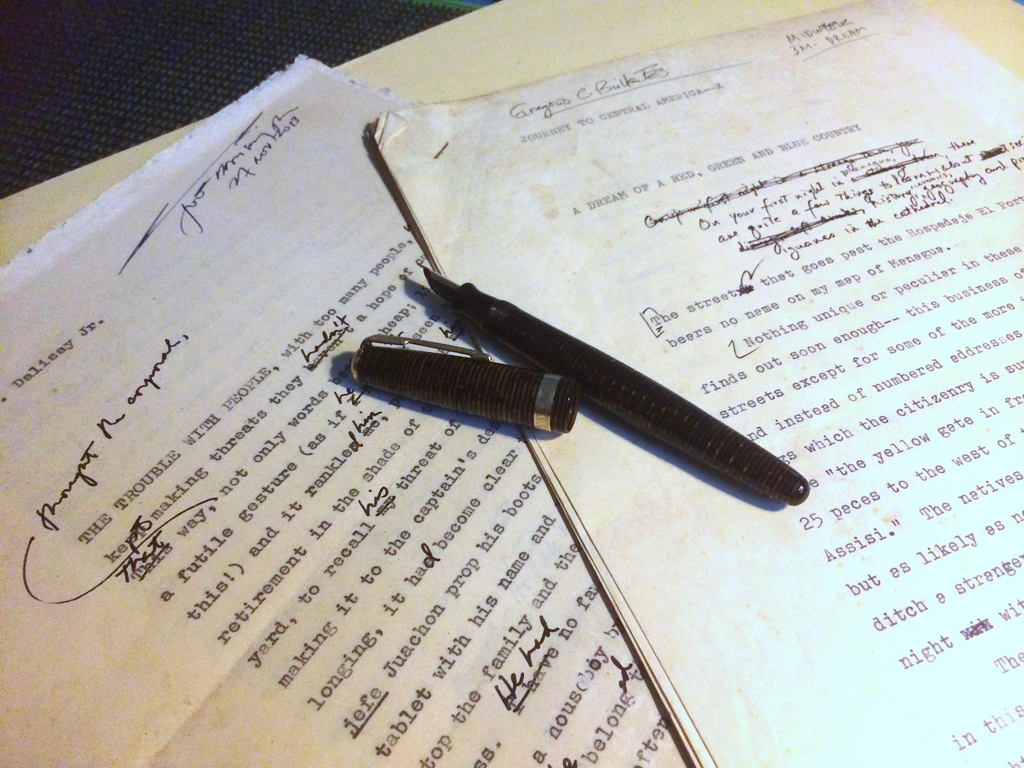
The money we raised came chiefly from a 1940s Parker Vacumatic fountain pen donated by yours truly (won by Jimmy Abad for P18,000 in spirited bidding over film director Auraeus Solito); a Smith Corona Portable Classic 12 donated by Paolo Manalo (won by a member of the Inkantada Band for P5,500); two manuscripts of works by Gregorio Brillantes and myself (won by Andrea Pasion-Flores for P4,200); and assorted manuscripts, author’s proofs (including that of Soledad’s Sister), and other memorabilia donated by Jimmy Abad and myself (won by rocker-news anchor-novelist-etc. Lourd de Veyra for P6,000). Poet Alan Popa went home with a drawing by fictionist Merlinda Bobis, donated by Chari Lucero, for P2,200. We’d also like to thank our other donors, buyers, and supporters—among them, National Artists Bien Lumbera and Rio Alma, poet Cirilo Bautista, and other writer-friends like Efren Abueg, Amelia Lapeña Bonifacio, Alma Miclat, Richard Gappi, Carlo Clemente, Dolores Mose, Francis Quina, Khavn de la Cruz, the NBDB, and the Chancellor’s Office of UP Diliman—for their generosity. We were all winners! See you all again in Writers Night 2014.


Flotsam & Jetsam No. 34: Pens Noir

I DIDN’T realize how much more interesting my favorite pens could look until one afternoon this week when—during a long and rather boring meeting at the office—I played around with the two pens in my pocket and with my iPhone, and then applied the “noir” filter in my Camera app. Then I went home and took a few more shots of my other pens. Voila—a whole new way of looking at fine pens.

Penman No. 75: A Writers’ Auction, and Shakespeare in Asia

DalisayBrillantesPenman for Monday, December 2, 2013

THIS IS going to be a very busy and exciting week on the literary front at the University of the Philippines in Diliman. First off, the UP Institute of Creative Writing will be hosting Writers’ Night on Friday, December 6, sustaining what’s become a longstanding annual tradition. Meanwhile, on Thursday and Friday, the Department of English and Comparative Literature will also be hosting its first international conference on “Shakespeare in Asia,” bringing together leading Shakespeare scholars from around the region and the US to affirm the Bard’s continuing relevance to global literature and society.

(It should also be mentioned that Philippine PEN will be holding its annual Congress December 3-4 at the Henry Sy Sr. Hall of De La Salle University, with the theme of “Literature of Concord and Solidarity: The Writer as Peacemaker,” and that FILCOLS—the Filipinas Copyright Licensing Society, Inc., which manages copyright payments for Filipino authors—will be holding its annual general meeting at the Claro M. Recto Hall in UP Diliman at 4 pm, December 6, just before Writers’ Night proper.)

Writers’ Night will consist of three segments, after the FILCOLS meeting: the awarding of the annual Madrigal-Gonzalez Best First Book Award, which this year will go to a Filipino author writing in English, and the launch of the 7th annual edition of Likhaan: the Journal of Contemporary Philippine Literature, which the UPICW publishes. Capping the evening will be a live auction of writers’ memorabilia, featuring donations by writers—including three National Artists—for the benefit of other writers left in dire need by recent disasters in the Visayas. We’ve received word that while no one we knew died in the wake of supertyphoon Yolanda, some writer-friends were badly savaged by the storm; while lives are of course the first priority, the loss to a writer of his or her home, and books and manuscripts among one’s few belongings, can also be deeply traumatic. We hope to be able to address some of these needs through the auction.

Writers’ Night actually debuted with an auction in 1996—I can’t believe it was 17 years ago!—and it was a blast. I came away with several handwritten manuscripts donated by Greg Brillantes and Cirilo Bautista, as well as a novel (Villa Magdalena) signed by Bienvenido Santos. Gina Apostol went home with NVM Gonzalez’s chair.

This year, to spice things up, we’ve solicited donations from National Artists Virgilio Almario (a signed copy of his very first book), Bien Lumbera (two CDs of his songs, also signed), and Frankie Sionil Jose (yet to be confirmed, but hopefully a book or manuscript). Poet Jimmy Abad has very graciously given an important group of his manuscripts, including the handwritten draft of the early poem “Fugitive Emphasis,” and more than a dozen copies of various issues the trailblazing and now rare Caracoa poetry journal from the 1980s. Alma Miclat is donating a copy of the hardbound edition of her late daughter Maningning’s book Voice from the Underworld, signed with her Chinese chop.

And to acknowledge how kind the Fates have been to me this year as they have been harsh to others, I will be donating a fully-functional, like-new Parker Vacumatic fountain pen from the early 1940s, in golden-pearl finish with a smooth, fine 14K nib, a pen I’ve actually written with and written about in my story “Penmanship”; although it’s about 70 years old, the pen is ready to write, and will carry a lifetime personal service warranty from me (if it ever breaks down, I’ll fix it for free). I will also be donating the signed original 11-page typescript of my 1986 short story “The Body,” with my edits on it, and re-donating one of the three Brillantes manuscripts I got in 1996, the signed, edited 6-page typescript of the essay “A Dream of a Red, Green, and Blue Country,” chronicling a visit to Nicaragua. (I’m sure Greg won’t mind; he’s one of the most generous people I’ve known, and I wish he could join us on Friday; come to think of it, if he hadn’t donated these papers to us in 1996, they might’ve joined the soggy mess that Ondoy made of his formidable library.)

Between now and Friday, we’ll expect more donations from writers (who can also donate books for the benefit book sale—it’s been a Writers Night custom to bring and toss a book into a box as a kind of admission fee). Bring your donations over to us at the UPICW in Diliman, or contact our admin officer Ronnie Amuyot at 0922-811-4449 if you need yours to be picked up. We’ll try to be as liberal with the live auction as we can—we’ll take cash, checks, and promissory notes, and you can even leave your bids with or text them to Ronnie before the auction if you’re away. We’ll display some of the choicest items at the Faculty Center before Writers Night itself.

Writers’ Night is free and open to all Filipino writers, writing and literature students, and their friends. Do come and join us at CM Recto Hall, UP Diliman, from 6 pm up this Friday; there’ll be food and drinks, and a lot of goodwill to go around.

JUDY CELINE Ick was an 18-year-old sophomore sporting a punk hairdo when we first met in Prof. Sylvia Ventura’s Shakespeare class in the early 1980s (a returning student, I was a decade older), and sharp as she was, you wouldn’t have known then that she would go on to become UP’s and one of Asia’s top experts on Shakespeare, completing a doctoral dissertation on him at the University of Massachusetts-Amherst on a Fulbright grant. I was finishing my own PhD in Wisconsin when she came over, and Judy and I would trade notes, sharing a passion for English Renaissance drama (the over-the-top theatrics of which would put your typical Viva/Regal movie to shame); but while I was just enjoying the verbiage and the swordplay, Judy’s focus on Shakespeare was deep and intense.

That focus has logically led to Dr. Ick convening the first international conference sponsored by the UP Department of English and Comparative Literature on  “Shakespeare in Asia” this Thursday and Friday, Dec. 5-6, also at the Faculty Center.

Like the old days, Judy wrote me a long note to root for her guy: “I’d really like to see our fellow academics and literary aficionados get a taste of what is a burgeoning field on the global Shakespeare scene. Asian Shakespeare is hot!—the subject of many critical collections, journal special editions, conference panels, and now even a tenure-track specialization in some of the more prestigious universities in the world.

“And why not? Around Asia Shakespeare has been produced and reproduced in the most exciting ways. Many regional theater companies continuously stage highly-imaginative versions of Shakespeare in local theater forms like Beijing Opera, Noh, Kathakali, Kabuki, wayang kulit, etc. The Japanese have elevated the Shakespearean anime and manga into an art form. (But then, of course, they also have Shakespearean manga porn (!)—itself a distinct métier.) Bollywood has produced critically acclaimed versions of Macbeth and Othello among other Shakespearean films. Even that award-winning Chinese martial arts film, The Banquet (starring your favorite Zhang Ziyi) is an adaptation of Hamlet. [Penman’s note—I’m more of a Michelle Yeoh fellow.]

“Sadly, many Filipinos are unaware of just how exciting Asian Shakespeare is. Our ability to read Shakespeare in the original, unlike many of our Asian neighbors, has proven both a blessing and a curse. While we are able to revel in the joys of the Bard’s very words, our imagination of his work has been very limited by that Englishness. Exposure to the vibrant work of our neighbors in Asia can change all that.

“A few months back, I had the surreal privilege of spending a day in Taipei with Stephen Greenblatt. We were the only two foreign guests at the inauguration of the Taiwan Shakespeare Association. He was there because, well, he was Stephen Greenblatt—eminent Shakespeare scholar, general editor of the Norton anthologies, longtime chairperson of Harvard’s English department, and author of some of the most influential literary criticism of the twentieth century. At some point, we got to talking about Asian Shakespeare and I was very inspired by what he had to say. ‘The Anglo-American hegemony,’ he asserted, ‘has just about played itself out and Asia is really where everything is now turning. Even Shakespeare.’

“I don’t think you’ll hear a clearer voice for the ‘Anglo-American hegemony’ in our profession than Stephen Greenblatt yet even he recognizes the coming primacy of Asian Shakespeare. I don’t think we Filipinos should get left behind because we have much to contribute. The conference is an important first step as it offers a far-reaching introduction to the field. We’ll have the top Shakespeareans from Taiwan, Japan, Korea, the US and India talking about how they play out ‘Asian Shakespeare.’ We’ll also feature films and filmed performances from India, Japan and China. Of course, Filipino artists who have boldly adapted Shakespeare will join in dialogue. The whole affair is capped off with an exciting new theater piece called ‘Have Thy Will,’ a staging of the sonnets devised and directed by Ron Capinding featuring some stellar performers—Ricky Abad, Frances Makil-Ignacio, Dolly De Leon, and Teroy Guzman. More info is available at the conference website: http://conference.up.edu.ph/shakespeareinasia2013/.”

Thanks, Judy—and this, Yolanda, is our response to you: a mightier torrent of words, a stronger companionship among writers. To quote one of my favorite Shakespeare sonnets (55), “Not marble, nor the gilded monuments / Of princes, shall outlive this powerful rhyme.”

Flotsam & Jetsam No. 33: My Trusty Merrells

SINCE MY daughter Demi bought them for me a year ago, these trusty Merrells have now taken me everywhere, from Michigan to Manila to Melbourne. They started out feeling tight and stiff but have softened nicely without being too cushy. They’ve also taken me on hundreds of kilometers of walks that have lost me a few dozen pounds (no kidding). Here they are in a brook in Palawan (I got them wet in the ocean not too long after).

Penman No. 70: Digital Detox and Ambrosia in Puerto Princesa

Penman for Monday, October 28, 2013
AFTER MORE than 20 years of being a digital junkie—usually traveling with nothing less than a Macbook Air, an iPhone, an iPad mini, a standby dual-SIM Nokia, sometimes a Nikon DSLR, two digital voice recorders, and a boatload of spare chargers and batteries—I never thought the day (much less the week) would come when I could pretty much do away with the cellular phone and the Internet.

But very recently, it happened—thanks to a writers’ retreat organized by a tirelessly dedicated Fil-Am writer and hosted by two of the most wonderful and interesting people I’ve ever met. (If this normally reserved writer runs out of superlatives this week, it will be for good reason.)

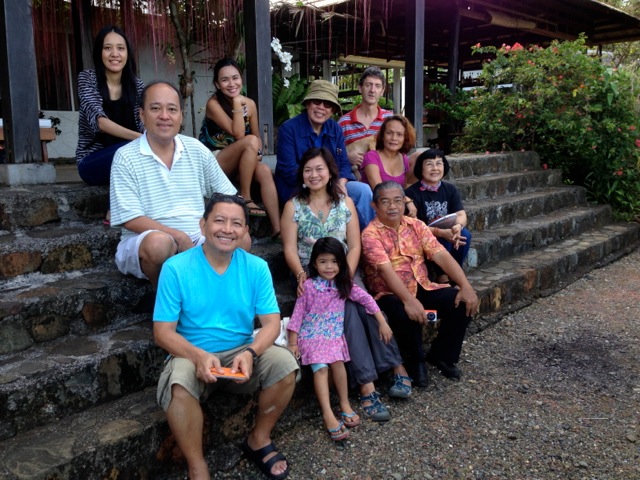
Almira Astudillo-Gilles has two master’s degrees and a PhD in Sociology, and could have been set for life working in business or academia, but she’s chosen the prickly path of creative writing to find another form of fulfillment. Having published a prizewinning book for children and a novel set in the Philippines, among other works, Almi—whom I met last year at the Philippine Studies conference in Michigan—put her mind to establishing a restful retreat for writers in need of a little solitude to recharge and to get some new work done. Marshaling her organizational resources and with the help of some private and institutional sponsors, Almi led our group to the first Adverbum Retreat for Writers at a hillside villa in Palawan.

IMG_4458

In the group, aside from Almi and myself, were writers Edgardo Maranan, Ricardo de Ungria, and Jhoanna Lynn Cruz, and guests Joel Tan-Torres and his daughter Marjette, who had writing projects of their own; my wife Beng, of course, was with us, bringing her drawing and painting kits along.

The hillside villa is about 1 ½ hours by van from downtown Puerto Princesa, way past Iwahig and a little beyond Napsan, on a road that alternates between patches of smooth concrete and gravel the size of pomelos. (Technically speaking, the villa is just out of Puerto, in Sitio Bubusawin, Barangay Apurawan, municipality of Aborlan. You’d have to remember that Puerto Princesa is the country’s largest city in terms of land area, at almost 254,000 hectares, a bit larger than Davao.) If you’re looking for city comforts, go no farther than the new Robinson’s mall downtown.

I’d have to say that, as a certified metrophile and mall rat, I was daunted and distressed by the villa’s promise of a complete “digital detox—guaranteed NO Internet and NO cellular connection”; I hadn’t gone offline for more than a day in years. I’m not on Facebook, but I check out eBay, PhilMUG, and the news a dozen times a day, and with four book projects in the works, I felt like I was about to vanish into the dark side of the moon. I was placated only by the promise that, should the isolation prove intolerable, we could get a cellphone signal by venturing out farther into the boonies or on the water. And probably worse than the digital detox, I’m a self-described culinary philistine who hates cheese and anything vaguely Frenchy and who thrives on canned sardines and instant noodles; the prospect of being fed fresh vegetables spiced up by offerings from the backyard herb garden sent me into a panic, so I stocked up on ramen and chocolates at the grocery before boarding the van to the villa.

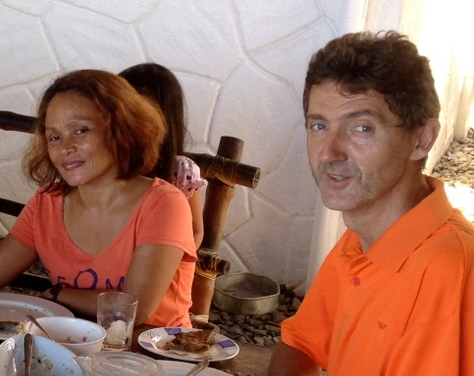
As it turned out, and to my own great surprise, my fears and anxieties proved largely groundless. The detox was made easier by the loveliness of the villa itself—a symphony in wood and stone, perched on a hillside overlooking a long trackless curve of beach and ocean (the silken beach alone would make you wonder why you’d need to go to crowded Boracay), under the shadow of cloud-enshrouded mountains. More than the place, we were relaxed by its owners—a Filipino-Belgian couple whose love for one another and for life itself is manifest in the way they keep their villa and feed and treat their guests.

Gielens

Theresa Juguan is a livewire, a brilliantly imaginative chef who may not have been born with a silver spoon in her mouth but who more than made up for the lack of privilege and opportunity with pluck, inspiration, and a single-minded determination to show the world just how good she could be. Theresa trained as a midwife, but discovered that she had a gift for baking, and was soon delivering fresh loaves and cupcakes instead of babies. The baking led to cooking, which she does with a liberal dash of the herbs she grows in her garden and, she says, “with emotion.”

Unlike most chefs we watch on TV, she doesn’t feel the need to taste what she’s cooking every five minutes or so; she knows in her bones, she says, how the dish will turn out. One guest remarked on the exquisiteness of her pork, which she had served him untasted; she doesn’t eat pork herself and can barely touch it. During our stay, we were served such seemingly simple but delectable creations made with crayfish, octopus, spring rolls, chapatti, and free-range chicken, most of it prepared with as little salt as possible, if any, to let the natural flavors of the ingredients pop.

Theresa also happens to be a talented and impeccably tasteful architect and interior designer, having designed and laid out the villa pretty much by herself. The very first thing that greets visitors to the villa is a striking trellis from which hair-like roots hang like a diaphanous pink curtain.

Her Belgian husband Herwig Gielen—you can call him “Gilles” (pronounced JIL)—was a businessman in the Philippines who one day found himself facing a very irate and demanding client—Theresa—and who was immediately captivated by her gutsiness, very much unlike the sweet, docile, marriageable types that expats like him tended to meet. If Theresa is an earth-goddess type, Gilles is a lanky, amiable god, indeed more shepherd than deity, in the attention he devotes not only to his wife and to the villa but to every small detail that will enhance the guest’s experience, from the virgin coconut oil and citronella concoction he prepares against insects and their bites to the ice for their cocktails and the generator that lights the place up after sundown.

As if the place needed yet another secret charm, you might get to meet Theresa’s five-year-old granddaughter Zanique (Theresa had been widowed before meeting Gilles), whom Beng and I instantly fell for like tipsy dominoes. She doesn’t talk much, preferring the company of her lola and her pet puppy Nitro, but she loves to draw and, not surprisingly, to cook, imbibing Theresa’s mastery of the kitchen.

Surprisingly, after being in operation for a couple of years, the Gielens had never really come around to finding a real name for their place—a visitor called it an “amazing villa” and the name (entirely true) stuck—but they took advantage of the presence of so many writers to cast about for another name, and my suggestion (ahem) was deemed acceptable: henceforth, this corner of Eden will be called Ambrosia, The Amazing Villa, after ambrosia, the food of the gods.

And let me thank Cebu Pacific for sponsoring the flights of the writers on this retreat (some members of the group, including Beng, paid their way through for the presumptive privilege of our company, and we think this can be a model for future workshop-retreats where aspiring or non-professional writers can spend some time and discuss their work with the pros). Since Beng and I are hopelessly footloose but can afford little more than budget fares, we’ve been traipsing all around Asia on one Cebu Pacific promo or other and I’ve been writing regularly about these trips and flights, but the Palawan trip was the first time I actually got a free ticket from CP. When our flight back to Manila was delayed for four hours by maintenance work on NAIA’s radar and runway congestion, Cebu Pac handed out packed lunches to the waiting passengers—nothing on the level of Theresa’s gourmet creations, but welcome nonetheless.

I’ll talk more about the retreat itself and about another place in Puerto well worth visiting—the new Hotel Centro downtown—in a forthcoming column. In the meanwhile, you can check out the Gielens’ place here and here (and you can write Gilles at herwiggielen@yahoo.com for more information—they have a home in downtown Puerto and attend to their email there; do give them some time to respond, as they may be away at the villa).

All I can add is, when my iPhone began chirping back to life on the road back in Iwahig, I felt a deep pang of regret; my message-less and therefore trouble-free week was over. Bon appetit!

Penman No. 69: The Girl with the Ukulele and Other Random Jottings

IMG_0021Penman for Monday, October 21, 2013

WHENEVER I travel, I jot random notes down. These notes are observations of the local scenery, things I’m likely to forget five minutes after I’ve seen them unless I find the compulsion and the patience to record them. Note-taking is a habit that anyone starting out as a writer should cultivate, whether mentally or physically. It keeps you attentive to detail, and even the most cursory image (“green umbrella”) can regenerate a whole scene and situation when you look at it again, once you have it down on paper or at least on some silicon wafer.

Ironically, I was never much of a note-taker in class, priding myself in storing whatever my professor had to say in what used to be a prodigious memory; I even found a perverse delight in walking into an open-book exam with nothing but pen and paper. Such was the foolish brashness of youth, since undone by crumbling synapses and flickering pinpricks in the brain.

When I signed up with The Philippines Herald and Taliba just before martial law, I learned how to use a notebook—the classic reporter’s notebook with the spiral top—and a Parker Jotter ballpoint. While not much of a ballpoint fan, I’m convinced that there’s still nothing more efficient than a button-operated Jotter for writing notes on the fly; the more popular because pricier Cross ballpoint—everyone’s idea of a Christmas present in the 1970s and 1980s—required two hands to put in business. The rollerball and the felt-tip pen (remember the Paper Mate Flair?) gave you a much smoother glide on the page, but they needed to be uncapped, and the ink offered the best proof of Murphy’s Law by drying out at the worst possible times.

At some point, I acquired and used a matte-black Sheaffer fountain pen—I still have it in the collection—but as dearly as I’ve come to love fountain pens, I’d be the first to admit that they’re not the best tools to carry on the road for random note-taking, as they combine all the clunky disadvantages of the other pens (two-handed operation, uncapping, sudden dryness) and usually cost more besides. Also, fountain pens need a steady supply of ink, and some of that ink will inevitably find its way to your shirt pocket in a blue-black bloom.

Another problem that often comes with fountain pens is the lack of suitable paper. Unlike ballpoints and rollerballs, fountain pens and the inks they use tend to feather and bleed through on porous paper—you’ll see the ink running into the fibers of the paper, making a thin line look fat and splotchy and the letters barely readable. Unfortunately, most of the paper used on notepads these days (including that in the iconic Moleskine) isn’t fountain-pen-friendly. I do persist in using fountain pens to write some notes with—for how else would I justify carrying two to three of them with me at any given time—but to avoid feathering and bleed-through, I use a Midori notebook, whose paper has a much tighter grain (you can find good, inexpensive paper at the bookstore, through trial and error).

Like many other human activities, note-taking changed, of course, with the advent of digital technology, and I eagerly embraced the Palm Pilot when it first came out in 1997, sticking with it through its many incarnations until the Treo in the mid-2000s. (My favorite of the lot was the sexy, blade-like Palm V.) The Palm had its own unique simplified shorthand, and I got pretty good at it, using a stylus. After the Palm came the BlackBerry, whose nifty keypad I also mastered well enough to write whole articles on.

And then came the iPhone and its total lack of a physical keypad or a built-in stylus. While I was one of the earliest adopters of the iPhone in 2007 (and yes, before you ask, I just picked up a 5s, which I’m calling my iPen), I had a hard time shifting to a virtual keypad. Indeed, if not for Apple’s FaceTime—which allows me to chat almost everyday with my daughter Demi in San Diego and my sister Elaine in Virginia for free—I might’ve stayed with the BlackBerry, which ironically has also morphed into something iPhone-like in the meanwhile.

But practice makes perfect, and I’ve trained myself to tap and peck away using the iPhone’s and iPad’s Notes app for everything from casual jottings to scenes for the novel-in-progress and paragraphs toward a column like this one. The beauty of the process is that you can simply email the note to yourself when you’re done, and thereby move it to your laptop or desktop for the final touches.

And what, pray tell, did I take note of during my recent trip to Jakarta? Herewith, my passing observations (in italics) and subsequent commentary:

Silaw. The Indonesians have the same word for “glare” or “blinding light”; also for “leech” (linta), which was brought up, not surprisingly, in a discussion about politics and politicians.

Stylish new buildings without the quirky bling of the Shanghai skyline. I was much impressed by Jakarta’s urban architecture, if only by its clean lines, with hints of native elements. Again, nothing as showy as Shanghai on the other side of the river. Like Manila, however, Jakarta could be 21st-century upscale one minute and Third-World, fish-sauce funky the next, just around the corner.

Bajaj. Pronounced bah-jay, the Indian motorcycle brand, now applied to Jakarta’s version of our tricycle and of Bangkok’s tuk-tuk.

Menteng. A district in Jakarta, where our Ibis Budget hotel was located. At the same time, said our host, “This is where Jakarta’s old rich live,” to which I replied, “Ah, we have our own Menteng, but we call it Forbes Park.” Huge, tree-shaded mansions.

Jalan Surabaya. A few blocks from our hotel, Jakarta’s antiques row, aimed at the tourist market; some real artifacts, to be sure (among them, curiously, an LP of Nora Aunor titled “Let Me Try Again”), but many items probably dodgy. Was looking for vintage pens as usual but didn’t find anything beyond a bruised Sheaffer Targa or two. Ho Chi Minh City’s Le Cong Kieu Street is vintage-pen heaven by comparison.

7-11. They were all over the place—one in front of our hotel, with knots of people forming just outside the door. Why? Ah, the free wi-fi, which you can access on your phone.

Girl with the ukulele. One of the first sights that greeted me, late at night on a street in Menteng, as my hotel-bound taxi whizzed by: a girl of about 15, carrying a baby, presumably her sister, and a ukulele. Behind her was an older man, also with a ukulele. What was going on? Likely the Jakarta version of our streetcorner seekers of alms.

Dilarang merokok. “No smoking”—but they do, anyway. Indonesian cigarettes are advertised all over, even on TV, although they never show anyone really puffing away.

No forks. The conference I attended offered packed lunches of rice, chicken, some kind of fish sauce, veggies, kropeck—all good—but only a plastic spoon and no fork. Everyone around me dug into their lunches, one-handed and fork-free.

Busway. They don’t have a subway, but they do have busways that segregate the buses on major roads from the rest of the traffic. It seemed very efficient, and I naturally wondered why we didn’t have the same thing in Metro Manila (we do, but they’re busways in the mind, eminently negotiable, not on the road; Jakarta’s busways were blocked off by a fixed concrete ridge).

Airport tax 20 USD. Or 150,000 Indonesian rupiahs, which is considerably less than $20, but which I didn’t have by the time I was leaving, because no one told me about the airport tax. I hate airports (like ours) which charge you a fee for using them, as if you had any other choice. Heck, anytime I’m in an airport, I’ve already paid someone a lot!

Penman No. 68: Towards a Regional Literary Community

Penman for Monday, Oct. 14, 2013

WE WERE back in Bangkok very recently, about the same time as last year, for another gathering of the newish Asia-Pacific Writers and Translators Association (APWriters). Around 200 participants from all around the region and from as far as Europe and the US got together from October 3 to 6 in Chulalongkorn University—also the site and host of last year’s conference—to meet on a wide range of literary concerns, most of them bearing on this year’s focus on “The Teaching of Creative Writing.”

Titled “Reaching the World 2013,” the conference was sponsored by the Bangkok Metropolitan Authority, Asia Books, and the Faculty of Arts of Chulalongkorn University. Bangkok had good reason to host us two years in a row; it had been named World Book Capital for 2013 by Unesco, and was celebrating the honor in the most appropriate way it could. It’s also at Bangkok’s historic Oriental Hotel that the annual SEAWrite Awards for the region’s best writers are given out, and we were welcomed there at dinner by the urbane and popular Governor of Bangkok, Sukhumbhand Paripatra. The son of a prince and educated at Oxford and Georgetown, the governor put everyone at ease by joking that he couldn’t greet us with rhymed couplets, as he was “only a politician” (he had, in fact, taught political science at Chula, Georgetown, and Columbia).

I was one of the organizers of the conference, and was proud to see that a total of 27 Filipino participants (not counting four who had to withdraw at the last minute for various reasons) attended “Reaching the World.” Among others, the delegation included stalwarts of the Philippine literary community such as STAR columnist and former DepEd Usec Isagani Cruz; UST and UP creative writing guru Cristina Pantoja-Hidalgo; MSU-IIT professor and poet Christine Godinez-Ortega; DLSU creative writing center head Shirley Lua; UP Press director and poet J. Neil Garcia; University of San Carlos professor Hope Sabanpan-Yu; the Bellagio-bound fictionist Menchu Sarmiento; and Davao Writers Guild president Jhoanna Lynn Cruz.

But more than seeing familiar names on the program, I was especially glad to see that many of our youngest writers on the UP faculty were able to attend as well, including Francis Quina (my deputy at the Institute of Creative Writing), Gabby Lee, Sandra Nicole Roldan, and Vyxz Vasquez. Conferences like APWriters expose writers like them to ideas and influences outside of their own local schools and networks, and sustain the continuity of our commitment to literature from one generation to the next.

APWriters grew out of the old Asia-Pacific Writing Partnership, which we expanded to include translators, in recognition of their crucial role not only in promoting the works and careers of individual authors but also of fostering international understanding through literature. On top of the transition has been the indefatigable Australian writer Jane Camens, who now serves as APWriters’ executive director (read: conference busybody) and who put the conference program together from dozens of proposals we received.

What distinguishes APWriters and its conference format is the informality of the discussions. Proposals for presentations were solicited and accepted, but no lengthy papers were actually read; instead, panelists spoke from notes or off the cuff, achieving our goal of witnessing “writers in conversation” as participants from places as diverse as Norwich and Ho Chi Minh City shed their academic robes, rolled up their sleeves, and spoke from the heart and from memory about the subjects that matter most to writers, translators, and teachers of creative writing.

We don’t mean to be unfriendly towards critics, scholars, and their important work, which after all endeavors to make sense of what we creative writers do. It’s just that there are already enough venues out there for the reading of formal papers (the annual and massively-attended conferences of the Modern Language Association and of the Associated Writing Programs come to mind) on the most obscure and abstruse of literary concerns. I took part in two panels at Chula, as a discussant in the first (which confronted the question of “cloning” in writing workshops and programs) and a moderator in the second (which dealt with how writers budget their time, and with what else they do besides writing).

Aside from Jane, I was glad to see old friends and acquaintances from around the region (or whose work and personal lives bring them regularly to Asia) such as the American writer and workshop specialist Tim Tomlinson, whose book The Portable MFA I’ve recommended to those in need of a crash course in creative writing; the Indonesian translator Eliza Vitri Handayani, who’d sponsored the translation workshop in Jakarta that I’d been a part of just the week before; Kate Griffin of the British Centre for Literary Translation; the Japanese-American fictionist Kyoko Mori, a fellow alumnus of the University of Wisconsin-Milwaukee’s PhD program; the Indonesian-Chinese-American Xu Xi, who directs the low-residency MFA program at the City University of Hong Kong; the Australian nonfiction and theater expert David Carlin; and, of course, the APWriters chairman himself, the Hong Kong-based Sri Lankan journalist and humorist Nury Vittachi, who’s been behind some of the region’s most significant literary projects, such as the Man Asian Literary Prize and the forthcoming World Readers’ Award.

There were many more, but you get the idea: this is a functioning network of writers and literary specialists from around the Asia-Pacific who’ve come to know each other as friends. And before anyone starts screaming “Another literary cabal!”, let me say, yes, why not, because right now, that’s what we need; there will be a time and an occasion for principled disagreement, but for now our emphasis is on finding and strengthening commonalities of thought, practice, and experience, thereby creating a working community of writers and translators in the region.

The commitment of these people to our emerging network was evidenced by the fact that many participants, including myself, were entirely self-funded. (It also helped, of course, that Bangkok is one of the most accessible, affordable, and tourist-friendly places on the planet.)

The large turnout from the Philippines also reflects the size and the maturity of our literary community and culture. Why shouldn’t we be able to send almost 30 writers to Bangkok? I respectfully disagree with those of us (including my friend Cirilo Bautista, whom I praised and quoted a few weeks ago) who see the Philippines as “a small country.” We’re certainly not—neither in size (at 300,000 sq. km., the same size as Italy), population (in 2005, we were 13th in the world), nor GDP (around 40th to 43rd  out of nearly 200 countries, depending on the year and who’s counting). Our grossly inequitable incomes and power relations are a real problem, but even these haven’t curbed, and may even have encouraged, our expressiveness in art and culture.

Indeed, as we look around the Asia-Pacific, we’ll find that the Philippines has one of the most robust of literary infrastructures, with formal creative writing programs in half a dozen major universities, a workshop tradition going back half a century, and the kind of democratic irrepressibility and irreverence that you can’t find anywhere else in Southeast Asia.

We’re banking on these strengths to put the Philippines more firmly on the global literary map, and we’ve taken a step in that direction by offering to host (after Singapore next year) the 2015 edition of the Asia-Pacific Writers and Translators conference. I hope to see many of our Bangkok fellows there, and more.

Flotsam & Jetsam No. 32: An Ode to My iPen 5s

I’M CALLING it my “iPen,” but yes, it’s the new iPhone 5s (the 32gb “slate gray” version) that this incorrigible Apple fanboy couldn’t resist during a recent sortie to Bangkok’s MBK shopping mall, which had loads of these gray-market goodies coming out a few days or even weeks ahead of its scheduled launch in most parts of the world. It came at a considerable premium, of course, but if you factor in US sales taxes and shipping (plus how much you would pay for that ineffable factor called instant gratification), it all evens out, or at least I convinced myself so. What does the 5s have over the 5 (mine’s not even a year old, picked up in the US last October)? Not much—they’re the exact same size, so I just slipped the new phone into the old, custom saddle-leather case—but it does have this cool fingerprint-ID technology that saves you a lot of passcode and password keystrokes, and the camera is blazingly fast and sharp. Worth all the extra bucks? I guess. Do I really need it? Very probably not. Do I really want it? Absolutely. Here’s a visual ode to what I’ll be signing with as my “iPen”:


Flotsam & Jetsam No. 27: My iOS7 Home Screen

IT WAS time to move to Apple’s iOS7 this week. I think the new, simplified icons actually work best against a black or plain background. I’ve retained my old wallpaper (a shot of one of my pocket watches) for the lock screen, but for my home screen, I use plain black (you just take a pic in the dark, or shoot a dark colored object and save the pic).

Come to think of it, it’s not much different from how my very first iPhone screen looked like (yes, I saved this image from Oct. 8, 2007, nearly six years ago!):